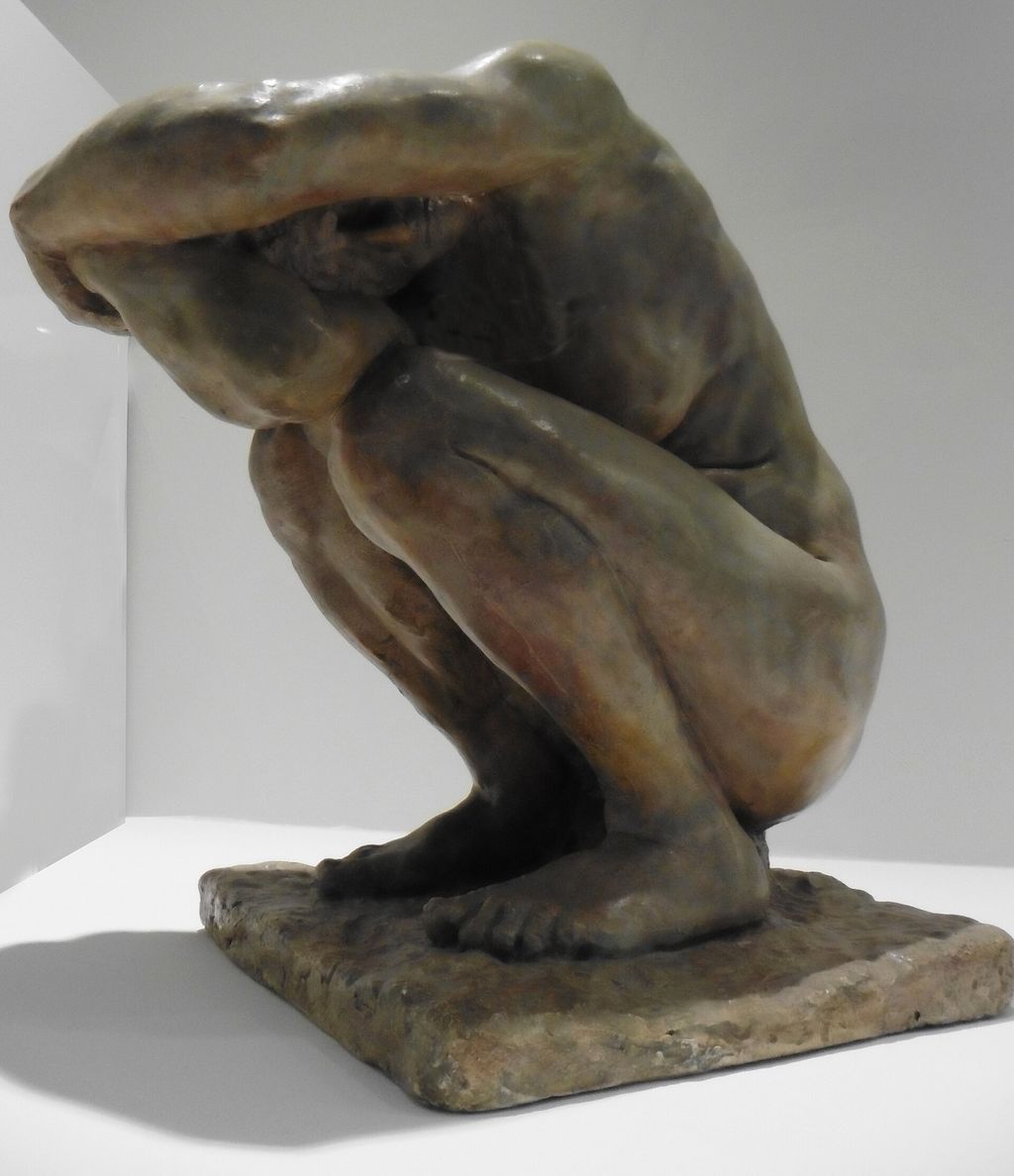
The complete Crouching Woman photographed at La Piscine, Roubaix, in 2015. Photograph by Pierre André Leclercq. Image source. CC BY-SA 4.0. Resized photograph, shared under CC BY-SA 4.0.
 by Tom Gurney
Tom Gurney BSc (Hons) is an art history expert with over 20 years experience
Email: tomgurney1@gmail.com / Phone: +44 7429 011000
Crouching Woman: Introduction
From one side of Camille Claudel’s Crouching Woman, the back runs in a long curve from the raised shoulder to the hip. Walk around towards the feet and that curve disappears behind the arms and knees. The woman’s hands meet above her lowered head, and the face comes into view only through a narrow opening. Claudel modelled the figure, known in French as Femme accroupie, around 1884–85. The example at the Musée Camille Claudel in Nogent-sur-Seine is patinated plaster, 37.5 centimetres high, 37.5 wide and 24.5 deep. The museum purchased it from Reine-Marie Paris in 2008 and catalogues it as 2010.1.2. Its mottled surface and carefully braided hair reward the same close attention as the way the body folds. [1]
At a Glance
- French titleFemme accroupie
- Nogent examplePatinated plaster, 2010.1.2
Camille Claudel in context
Old Hélène
c. 1881–82Sakuntala
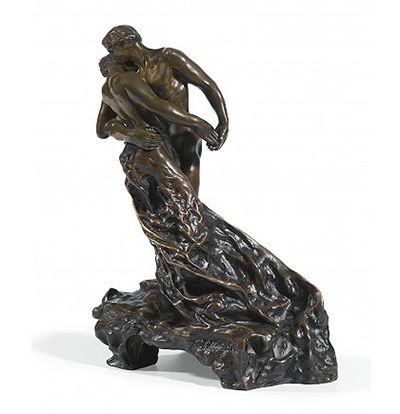
Plaster shown in 1888The Waltz
Developed c. 1889–93The Little Châtelaine
First model c. 1892–93The Gossips
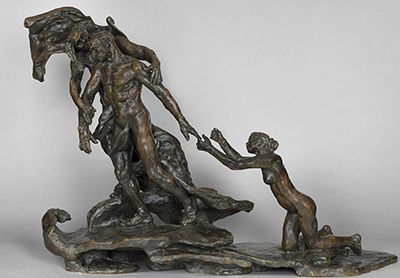
Described in 1893, shown in 1895The Mature Age
First and second versions, c. 1894–99The Wave
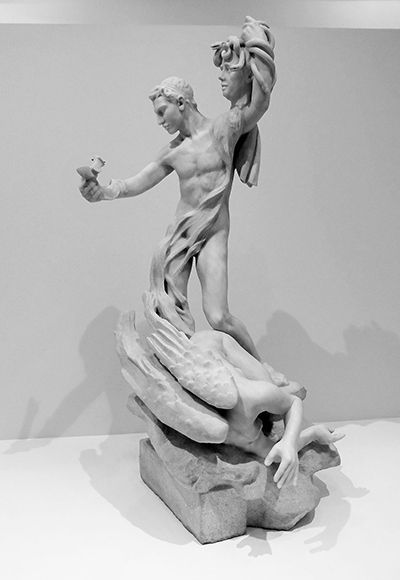
Plaster shown in 1897, mixed-material object dated 1897–1903 (?)Perseus and the Gorgon
Nogent design and marble, c. 1897–1902The Wounded Niobid
Modelled in 1906Contents
- How the figure holds its balance
- Colour across the plaster and the pattern of the braid
- Rodin, Degas and a crouching Aphrodite
- The Salon record and the bronze torso
How the figure holds its balance
Start with the museum’s front view, where the feet are set close together on a thin rectangular base. The knees rise on either side of a narrow shadow. Above them, a forearm stretches almost horizontally across the head, while one shoulder rises behind it. The front view makes the sculpture seem tall and narrow because so many of its parts line up over the feet. The arms do most of the work of concealing the face from here. They also give the eye a firm horizontal to measure against the rise of the knees and the uneven height of the shoulders. [1] [2]
From the side, the figure suddenly takes up more room. The back arches out behind the feet as the bent arms reach in the opposite direction. The thigh climbs sharply from the low hip towards the knee, and the shin returns on a diagonal to the foot. These two directions are easy to pick out because the leg is foreshortened in the front view. Look also at how little space survives between the thigh and the torso. A small opening under the upper body lets light through and gives the viewer a way to separate two masses that otherwise seem to run into one another. [1] [2]
The feet lie flat on the base, as the museum points out. That detail makes the stance more demanding than the figure’s compact shape might suggest. The heels stay down while the hips sink and the torso pitches forward and twists. From the rear three-quarter angle, the curve of the spine and the high point of the shoulder show how much the upper body has turned. The head follows the turn further and sits to one side of the back’s broadest curve. In the same view, the base still presents a straight edge below the feet. Its horizontal line makes the twist above it especially legible. [1] [2]
The museum observes that visitors often search for the face and read the pose as a sign of shame, fear or sadness. The position of the arms gives those readings something to work with. Even the angle that lets the viewer glimpse the face leaves the gaze directed into the fold of the body. The sculpture can also look absorbed or intensely still. The experience of moving from a view that hides the face to one that admits a glimpse is more definite than any single feeling the woman might be imagined to have. Mathias Morhardt, writing in 1898, dwelt on the living suppleness of the arms, back and belly. His response makes sense alongside the museum’s account of the strenuous pose. The figure appears soft where the forms meet even as the stance keeps the body under tension. [1]
Colour across the plaster and the pattern of the braid
The Musée Camille Claudel describes a flesh-coloured patina with blue-green reflections. In Marco Illuminati’s photographs, warm ochre and orange show up on parts of the knees and arms, while cooler areas spread over the back and across the flank. Compare the back in the rear three-quarter view with the thighs from the front. On the back, cooler colour crosses an extended curve and helps break it into areas of subtly different brightness. On the legs, warmer patches help draw attention to the bent knees and the narrower stretch down to the feet. The contrast changes with the angle and the light. It is worth following a single form across more than one view before deciding which variations come from the colouring and which come from shadow. [1] [2]
The braid gives that changing surface a finer scale. From behind, the interlaced strands are easy to distinguish where the hair gathers into a bun. In the side view, much of the head sits behind the arms, and the hair shows in smaller passages above and below the nearer forearm. Across the back, light can travel over an almost uninterrupted swell. In the hair it catches repeatedly on ridges separated by narrow grooves. Those marks have a practical effect on the way the figure reads. The eye can locate the head by the texture of the hair before it can trace a cheek or tell how far the head has turned. [1] [2]
Rodin, Degas and a crouching Aphrodite
Getty sees a likely precedent in the terracotta version of Auguste Rodin’s Crouching Woman, conceived around 1882 for The Gates of Hell. In the Musée Rodin’s small plaster, the left hand reaches through the gap between thigh and chest to grasp the breast. The opening between the limbs lets the viewer follow that gesture into the body. Claudel brings the two hands together and uses the forearms to enclose the head. Both figures make an extreme crouch, but the space between the limbs does different work. Rodin uses an opening to expose a gesture. Claudel keeps the most legible gesture, the meeting of the hands, outside the small space that conceals the face. The comparison belongs to the early years of Claudel’s work with Rodin, when she could develop a familiar studio motif in her own direction. [3] [4]
Valentine Pigeolet and Elise Gilles propose looking at Edgar Degas’s women at their toilette as another context for the sculpture. His Cabinet de toilette, a pastel over monotype dated 1876–77 by the Musée d’Orsay, offers a comparison from before Claudel modelled her figure. Degas gives the viewer a fixed view from behind, where the body leans into the action and the broad planes of the back carry much of the image. Claudel gives the viewer a similar chance to read a body from behind, with the option of moving around the figure and testing that view against others. Pigeolet and Gilles argue for an early affinity with Degas while acknowledging that the start of any influence is difficult to date. The comparison helps describe the intimacy of the pose. Degas places his figure in a room at her toilette, while the Nogent plaster gives the crouching body a shallow base and leaves its situation open. [5] [6]
The Galerie Malaquais study of Claudel’s related bronze torso brings the Louvre’s Vénus de Vienne into the comparison. The ancient marble belongs to the crouching Aphrodite type. Its surviving torso turns above the bent legs, and the Louvre identifies traces of a small Eros. The damaged marble and Claudel’s deliberately abbreviated bronze both direct attention to the changing planes of the torso, though one owes its present silhouette to losses and the other to a sculptor’s reworking of a figure. Seen alongside the complete Nogent plaster, the marble makes the addition of the folded arms especially consequential. Claudel’s hands meet around the bowed head and complete the figure’s enclosure. The comparison describes what each figure does with a crouch without settling which ancient sculpture Claudel may have studied. [7] [8]
The Salon record and the bronze torso
The illustrated catalogue for the 1885 Salon des Artistes Français lists a bronze called Étude under Claudel’s name, followed by a terracotta bust titled Vieille femme. The word Étude leaves the bronze’s subject open, and the Musée Camille Claudel’s Salon dossier associates that entry with the bust Giganti. Pigeolet and Gilles’s note on the crouching figure instead reports an exhibited bronze in 1885. Getty’s account of the composition describes a lost terracotta shown that year, while the Galerie Malaquais study identifies the exhibit as the plaster now at Nogent. The catalogue establishes that Claudel showed a bronze study. The abbreviated title and the conflicting accounts leave the exhibition history of the crouching figure uncertain. [9] [10] [5] [11] [7]
The complete composition also exists in bronze according to the Galerie Malaquais study, which records posthumous casts and gives a tentative date of about 1920–30 for a casting in Bucharest. Those reports concern the complete figure. Getty’s Torso of a Crouching Woman, 2018.32, belongs to a separate reworking of the design. The museum dates the torso model to about 1884–85 and its bronze to no later than 1913. Getty’s technical examination describes raised lines on the bronze that appear to preserve seams from a mould used to make a plaster model for indirect lost-wax casting. That evidence concerns the manufacture of this particular bronze. The head, arms and part of one knee are already absent in the composition Getty identifies as Claudel’s reworking. [7] [11] [12]
Put the Nogent plaster beside the Getty torso and the lasting features of the pose become easy to pick out. The thighs still rise towards the torso, the hip remains low, and the turn is visible in the uneven height of the shoulders. In the bronze, the back and the legs have to carry the sense of withdrawal on their own. Back at the plaster, the bend of the arms and the small pattern of the braid bring that withdrawal down to the scale of a particular gesture. From behind, the braid offers something to look at where a standing portrait would give you a face. From the side, the arc of the spine shows how far the entire figure has turned to put that face out of view. [1] [2] [3]
A closer look at Crouching Woman
Annotated Details from Crouching Woman
The complete Crouching Woman photographed at La Piscine, Roubaix, in 2015. Photograph by Pierre André Leclercq. Image source. CC BY-SA 4.0. Overview numbered and details cropped. Both are shared under CC BY-SA 4.0.
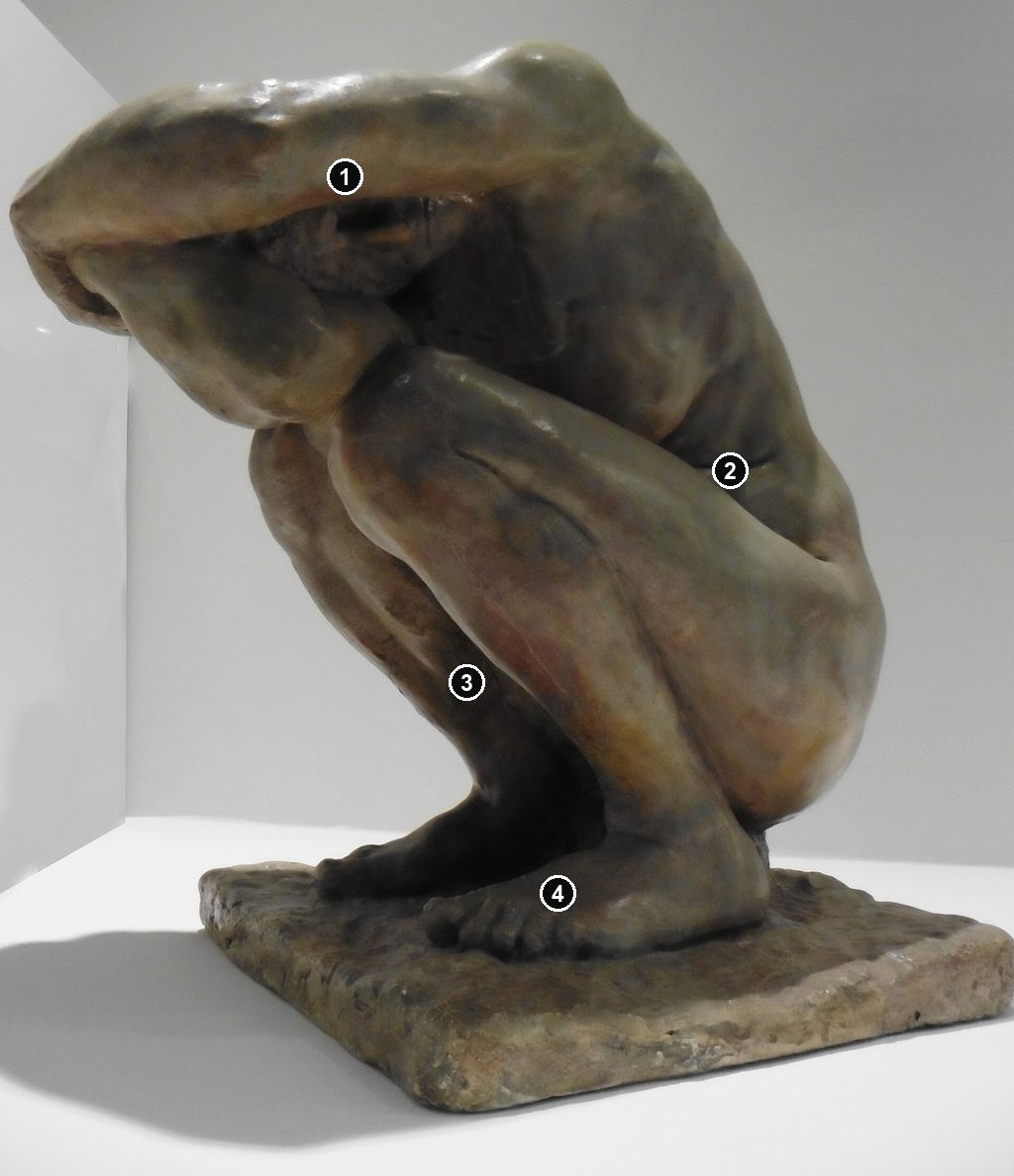
Details from CROUCHING WOMAN
Follow the numbered details, then return to the complete view.
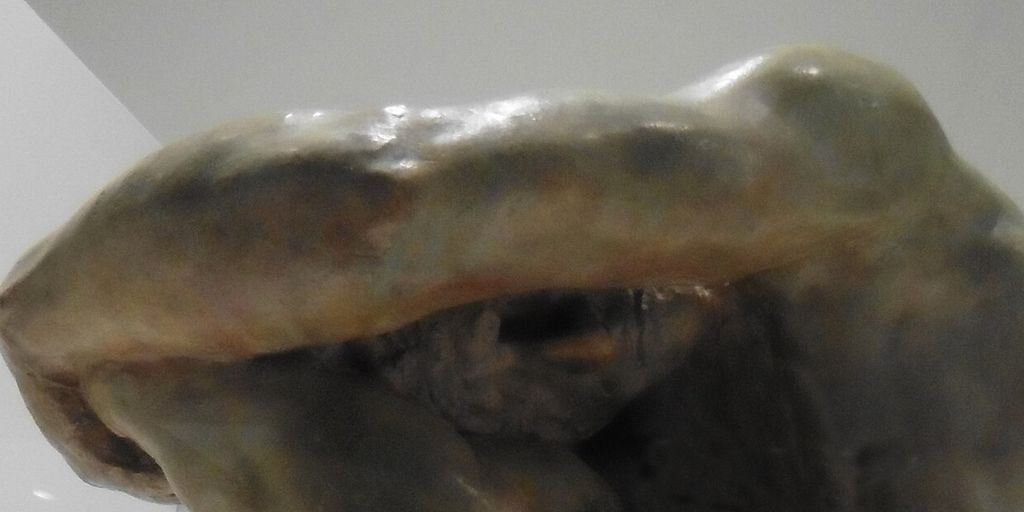
The arm over the head
The upper arm crosses the line of the head, leaving part of the face in shadow.
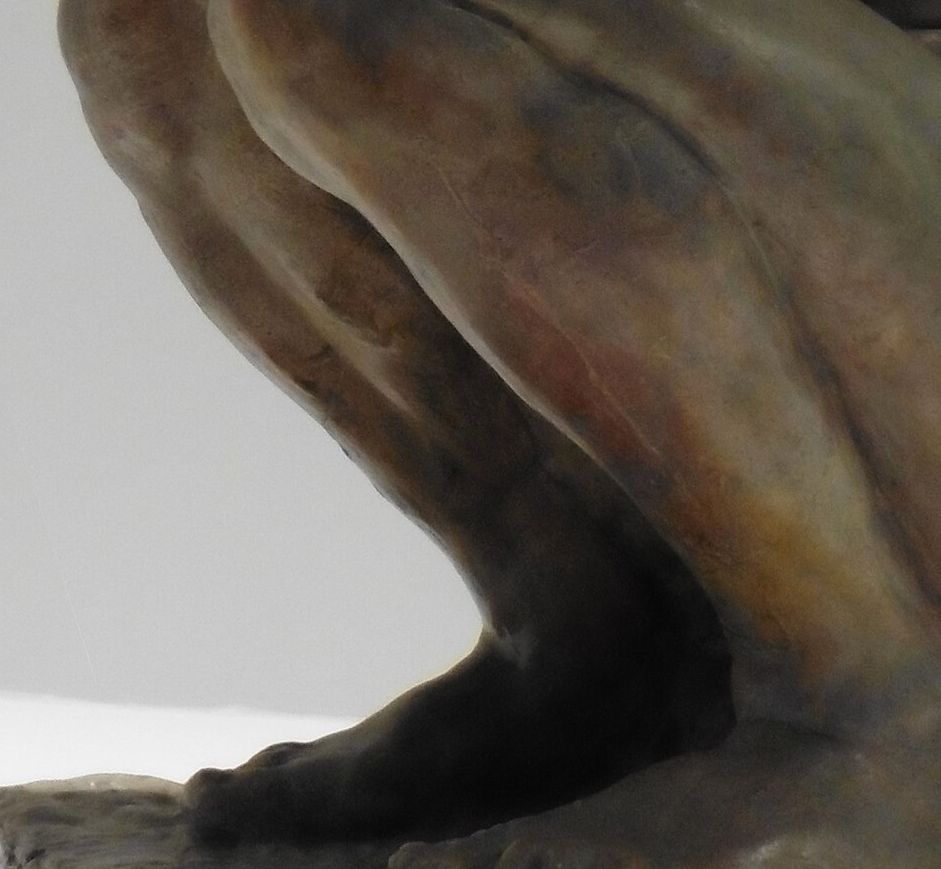
The curve of the back
The back bends forward above the compact mass of the thighs.
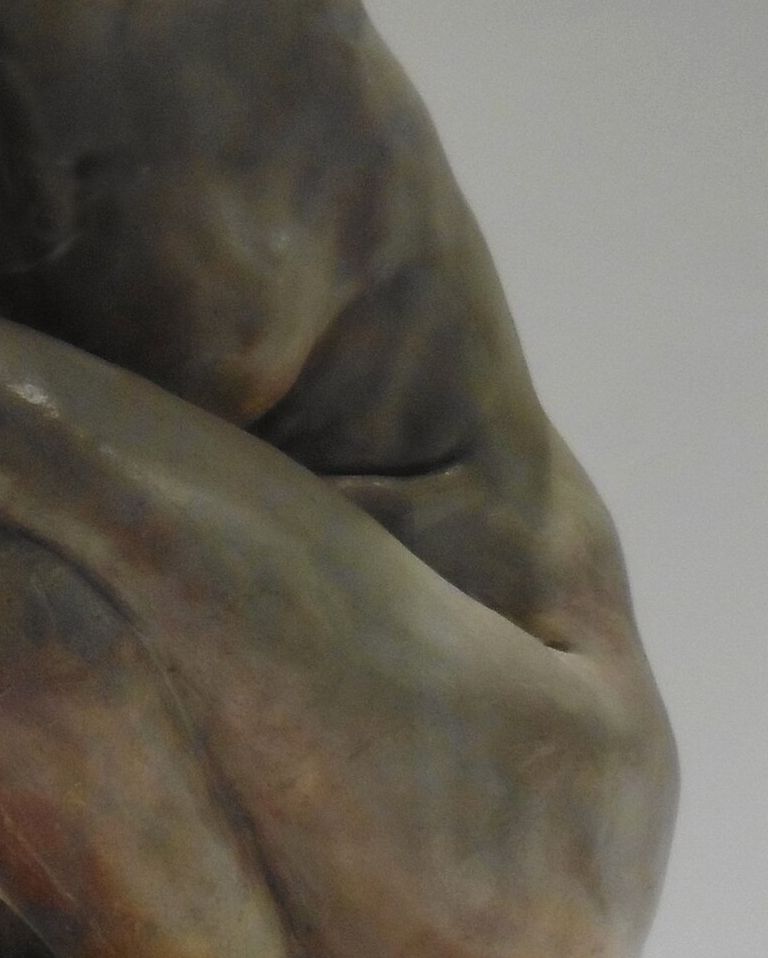
The knees drawn inward
The thigh rises steeply from the hip and brings the knee close to the upper body.
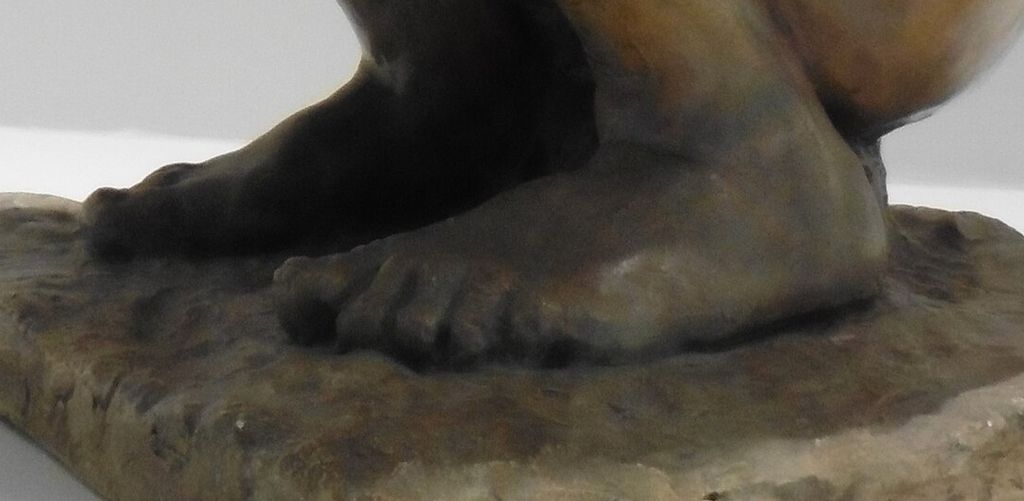
Feet on the base
The feet rest close together across the slab beneath the folded figure.
Artworks directory
| Name | Date | Medium |
|---|---|---|
| The Mature Age | 1894–99 | Sculpture |
| The Waltz | c. 1889–93 | Sculpture |
| Sakuntala | 1886–88 | Sculpture |
| The Little Châtelaine | 1892–93 | Sculpture |
| The Gossips | c. 1893 | Sculpture |
| The Wave | 1897–1903 | Sculpture |
| Perseus and the Gorgon | c. 1897–1902 | Sculpture |
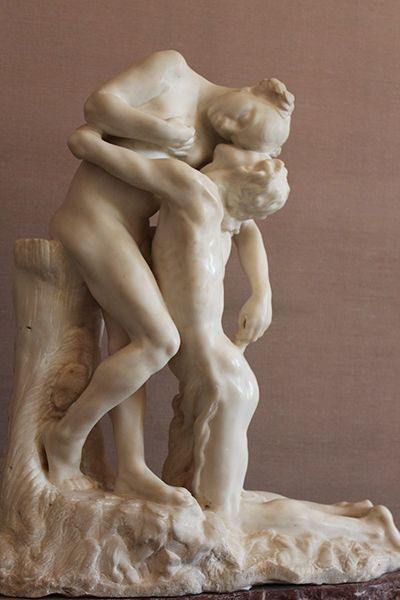
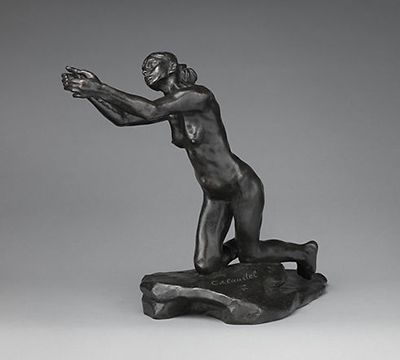
| The Implorer | c. 1894–99 | Sculpture |
| Clotho | 1893 | Sculpture |
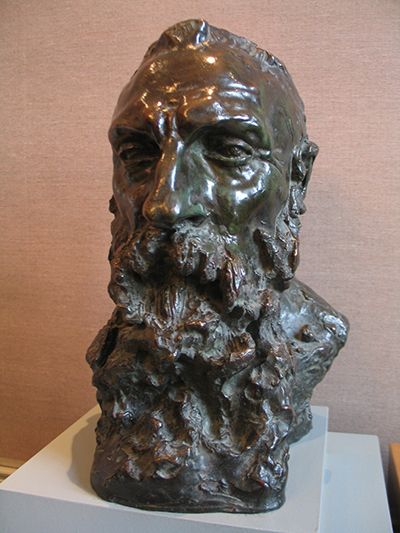
| Bust of Auguste Rodin | c. 1886–89 | Sculpture |
| Paul Claudel at Sixteen Years Old | c. 1882–87 | Sculpture |
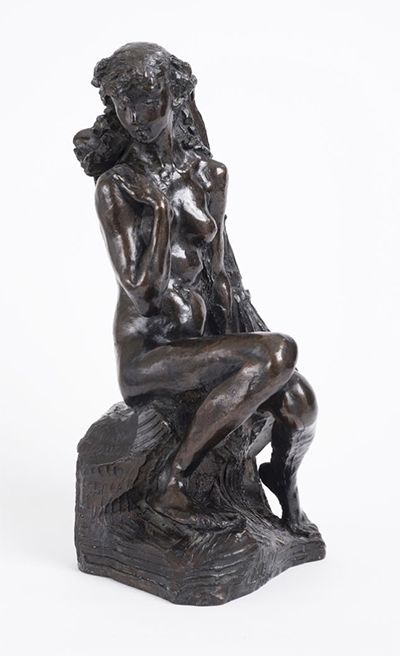
| Young Girl with a Sheaf | c. 1886–87 | Sculpture |
| Giganti | c. 1885 | Sculpture |
| Crouching Woman | c. 1884–85 | Sculpture |
| The Hungry Dog | c. 1893 | Sculpture |
| Old Hélène | c. 1881–82 | Sculpture |
| Fortune | c. 1902–05 | Sculpture |
| The Wounded Niobid | 1906 | Sculpture |
| The Siren, or The Flute Player | c. 1904–05 | Sculpture |
| Deep Thought | c. 1898 | Sculpture |
| Dream by the Fireside | c. 1899 | Sculpture |
| Paul Claudel at Thirty-Seven | 1905 | Sculpture |
| Portrait de Madame Claudel | c. 1883 | Sculpture Musée Camille Claudel. |
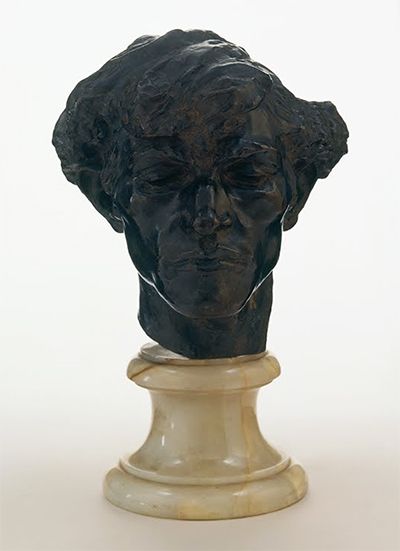
| Jeune Femme aux yeux clos | c. 1885 | Sculpture Musée Camille Claudel. |
| Ferdinande de Massary | 1888 | Sculpture Musée Camille Claudel. |
| Léon Lhermitte | 1889 | Sculpture Musée Camille Claudel. |
| Étude de main gauche | c. 1889 | Sculpture Musée Camille Claudel. |
| Vieil aveugle chantant | c. 1894 | Sculpture Musée Camille Claudel. |
| Tête de vieillard | c. 1890 | Sculpture Musée Camille Claudel. |
| Étude pour la tête d’Hamadryade | c. 1895 | Sculpture Musée Camille Claudel. |
| Aurore | c. 1900 | Sculpture Musée Camille Claudel. |
Discussion
Look again at the images and ideas explored in Crouching Woman. These editorial prompts invite your observations.
Reader Insights
How does the pose change when you look down from above?
What do the braided hair and patina contribute to the view?
Join the Conversation
Share a detail, comparison or question about Crouching Woman below.
References
- Musée Camille Claudel, Femme accroupie, patinated plaster, 2010.1.2, collection entry and three views,. View source.
- Éditions des Falaises, Camille Claudel, pp. 20–21, front, side and rear three-quarter photographs by Marco Illuminati,. View source.
- J. Paul Getty Museum, acquisition of Claudel’s Torso of a Crouching Woman, 2018.32, 2018,. View source.
- Musée Rodin, La Femme accroupie, plaster S.02857,. View source.
- Valentine Pigeolet and Elise Gilles, Edgar Degas et Camille Claudel, une influence dès les années 1880 ?, Koregos, including fig. 1 and note 1,. View source.
- Musée d’Orsay, Edgar Degas, Cabinet de toilette, RF 12254,. View source.
- Galerie Malaquais, Camille Claudel, study of Torse de femme accroupie, pp. 4–7 and 24–25,. View source.
- Musée du Louvre, Vénus de Vienne du type de l’Aphrodite accroupie, MNB 1292 and Ma 2240.1,. View source.
- Société des Artistes Français, Catalogue illustré du Salon, 1885, entries 3496 and 3497,. View source.
- Musée Camille Claudel and Société des Artistes Français, Camille Claudel au Salon des Artistes Français, pp. 10–11,. View source.
- J. Paul Getty Museum, Torso of a Crouching Woman, 2018.32, collection entry,. View source.
- J. Paul Getty Museum, Guidelines for the Technical Examination of Bronze Sculpture, visual atlas, fig. 75,. View source.