by Tom Gurney
Tom Gurney BSc (Hons) is an art history expert with over 20 years experience
Email: tomgurney1@gmail.com / Phone: +44 7429 011000
Fortune: Introduction
A woman balances on the rim of a wheel in Camille Claudel’s Fortune (La Fortune). The wheel stands low in the composition, half surrounded by rough bronze. The woman rises away from it, her head tipping back towards one lifted arm as her other hand hangs below the line of her shoulders. Look down from that raised hand and the bronze seems to open out as it descends. Cloth falls away from the body and spreads into the base, leaving a gap beneath the figure just beside the wheel. The Musée Camille Claudel in Nogent-sur-Seine preserves this bronze as inventory 2010.1.21. It is cast no. 12 of the edition produced by Eugène Blot, and the museum dates the cast to 1905. [1] [2]
At a Glance
- French titleLa Fortune
- Nogent exampleBlot bronze no. 12, 2010.1.21
Camille Claudel in context
Old Hélène
c. 1881–82Sakuntala
Plaster shown in 1888The Waltz
Developed c. 1889–93The Little Châtelaine
First model c. 1892–93The Gossips
Described in 1893, shown in 1895The Mature Age
First and second versions, c. 1894–99The Wave
Plaster shown in 1897, mixed-material object dated 1897–1903 (?)Perseus and the Gorgon
Nogent design and marble, c. 1897–1902The Wounded Niobid
Modelled in 1906Contents
- Balancing on the wheel
- A figure of chance
- What changes after The Waltz
- Blot’s edition and the 1905 exhibition
Balancing on the wheel
In Marco Illuminati’s full photograph of the Nogent bronze, the woman’s bare foot meets the crown of the rim. The spokes underneath give the eye a way to measure how far the body has moved from the wheel’s axis. The pelvis stays close to that line while the ribcage bends towards the raised arm. The head tilts still farther, against the inside of the arm, and the hand turns back a little above it. There is a noticeable change of direction from hip to shoulder and again at the wrist. The pose looks like a series of small corrections, the kind that a body makes when the surface beneath its foot could shift at any moment. [1]
The lowered arm makes a different line. It extends at an angle from the shoulder before bending at the elbow, and the wrist gives way so that the hand and its small object point down. In the museum’s detail photograph, the bare torso between the arms catches a broad patch of light across the ribs and abdomen. Around the waist the light breaks up. It catches on the raised edges of the cloth, leaving deep grooves beside the thighs. These changes in surface make it possible to follow the twisting body even where the folds interrupt the outline of a leg. The close view isolates the movement across the shoulders. The full view supplies the long diagonal below the waist that makes that movement feel precarious. [1]
At the bottom of the full photograph, the sheet of drapery reaches well to one side of the wheel. Follow its outer edge up and the wide, irregular mass at ground level narrows until the folds gather against the hip. Follow the inner edge and a small opening appears between the cloth and the wheel. The opening matters because it lets the rim and the foot remain distinct. Claudel gives the bronze a wide base through the sweep of the cloth, while making the figure appear to rely on a single point of contact. The weight one sees in the metal below and the lightness one imagines in the body above belong to the same shape. [1]
A figure of chance
The Nogent collection page dates Fortune 1902–1905 and records its exhibition at the Salon d’Automne in 1904. The museum’s collection guide gives an approximate date of around 1900 for the work, while the Alte Nationalgalerie’s exhibition checklist separates a design dated 1902–1904 from the 1905 cast lent by Nogent. The Salon appearance anchors the public history of the composition in 1904. The 1905 date identifies the example in Nogent, which measures 47.4 centimetres high, 35.5 wide and 24.7 deep. The museum acquired it from Reine-Marie Paris de La Chapelle in 2008. [1] [2] [3]
Claudel’s title gives the wheel an allegorical meaning. In its catalogue for a separate cast, Christie’s describes Fortune as blindfolded and identifies the object in her raised left hand as a purse. The Nogent photographs show how much the tipped head and the angle of the raised arm limit our view of the face. The hand is easier to read than the eyes. Its position makes it look as though she might bestow something, but the sculpture leaves the intended recipient outside the scene. The low hand, with a second small form, gives the viewer somewhere else to look and makes the difference in height between the two gestures more pronounced. As an image of chance, the wheel has a second job. It puts the very figure who might dispense good fortune in a position where her own footing looks insecure. [1] [4]
What changes after The Waltz
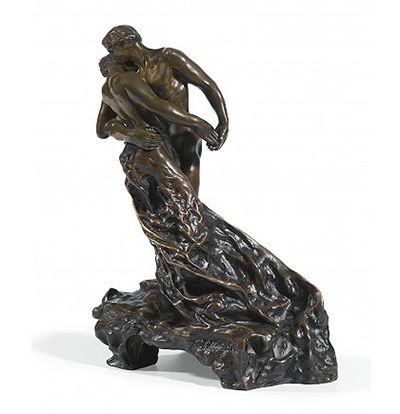
The woman’s pose recalls the dancer in The Waltz. In the Musée Rodin bronze (S.01013), the two dancers lean on a diagonal in a close embrace. The man lifts one foot, and the cloth that starts at the woman’s hips sweeps out to the same side. Follow the skirt from her waist and it makes the pair’s rotation visible even where the lower legs come close together. In Fortune the waist is again the point where the cloth begins its outward movement, but the woman has the space to herself. One arm rises into an area that a second body might have occupied. Her lifted hand and the little length of exposed wheel have to suggest what brought her into that position, just as the embrace and the angled feet suggest the dance in the earlier sculpture. [1] [4] [5]
The resemblance is clearest if you compare specific versions. The Getty’s exhibition guide traces changes to The Waltz across tinted plaster, bronze and stoneware, including a reduction in drapery around the female dancer and changes to the mound beneath the pair. In the Musée Rodin example the cloth runs down and out from the hips, amplifying the direction of a turn already set by the two bodies. In the Nogent Fortune, it extends towards the ground on the opposite side from the lifted hand. The resulting span gives the standing figure a larger footprint than the wheel could provide by itself. Both sculptures make fabric part of the balance, but in Fortune the folds also connect an image of uncertain footing to a base broad enough to carry it. [1] [5] [6]
Blot’s edition and the 1905 exhibition
The Nogent museum identifies Fortune as one of the first Claudel works Blot issued in bronze, alongside The Implorer and Dream by the Fireside, and records sixteen casts. His mark could be placed directly on the wheel. Artcurial’s catalogue for a 48-centimetre example records the number 1 and Blot’s Paris stamp on the wheel, another Blot stamp on the back and Claudel’s signature low on the side. The wheel is therefore part of the figure’s meaning and a surface that can help identify an individual object. A separate museum example entered the Musée Sainte-Croix collection in Poitiers with works from the collector André Brisson. An illustrated catalogue identifies the Poitiers bronze as Blot cast no. 9 and gives a height of 48 centimetres. The Poitiers and Nogent bronzes share a design and an editor, and their individual numbers and collection histories allow each to be followed separately. [1] [2] [7] [8] [9]
After the 1904 Salon d’Automne, Blot showed Fortune in his joint exhibition of Claudel and Bernhard Hoetger in Paris in December 1905. The Musée Camille Claudel’s account identifies the dates as 4–16 December and the address as 5 boulevard de la Madeleine. It describes works on wooden stands among plants. On the gallery booklet’s page for Claudel, Fortune is item 5, a few lines above La Valse at item 10. Blot’s roles as dealer and editor came together in that room. Visitors could see different Claudel compositions assembled under her name, and an edition allowed the same design to go on circulating beyond a single exhibition. The gallery belongs to the history of Claudel’s patrons and exhibitions, and Fortune makes the connection unusually tangible. A viewer leaning in to see where the foot touches the wheel could also be looking at the very part of the bronze that bore the editor’s name. [1] [7] [10] [11]
The entry for Fortune advertises an edition limited to fifty casts. The museum records sixteen produced. Those figures describe different stages of the work’s passage from gallery to collector. Fifty was the limit a visitor could read in the booklet in 1905. Sixteen is the number the museum gives for the production of the edition. The booklet’s item number, five, belongs to the arrangement of the exhibition, while the number twelve in the Nogent museum’s checklist belongs to the cast itself. Together the records show how the gallery presented the design and how one of the resulting bronzes can be identified today. [1] [2] [11]
Artworks directory
| Name | Date | Medium |
|---|---|---|
| The Mature Age | 1894–99 | Sculpture |
| The Waltz | c. 1889–93 | Sculpture |
| Sakuntala | 1886–88 | Sculpture |
| The Little Châtelaine | 1892–93 | Sculpture |
| The Gossips | c. 1893 | Sculpture |
| The Wave | 1897–1903 | Sculpture |
| Perseus and the Gorgon | c. 1897–1902 | Sculpture |
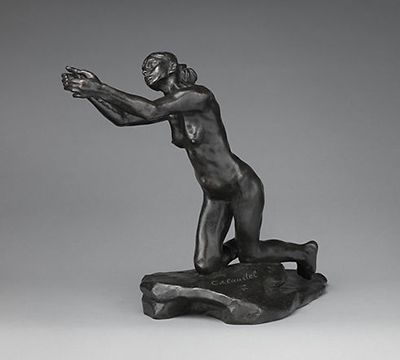
| The Implorer | c. 1894–99 | Sculpture |
| Clotho | 1893 | Sculpture |
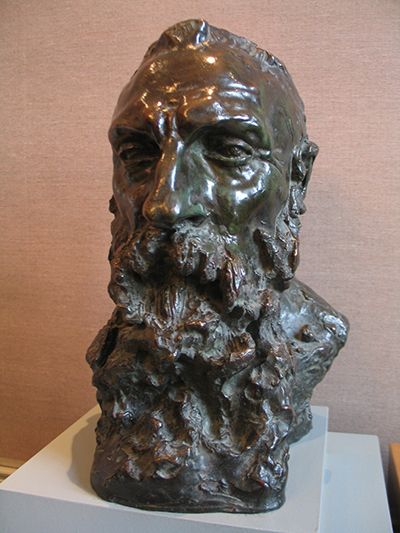
| Bust of Auguste Rodin | c. 1886–89 | Sculpture |
| Paul Claudel at Sixteen Years Old | c. 1882–87 | Sculpture |
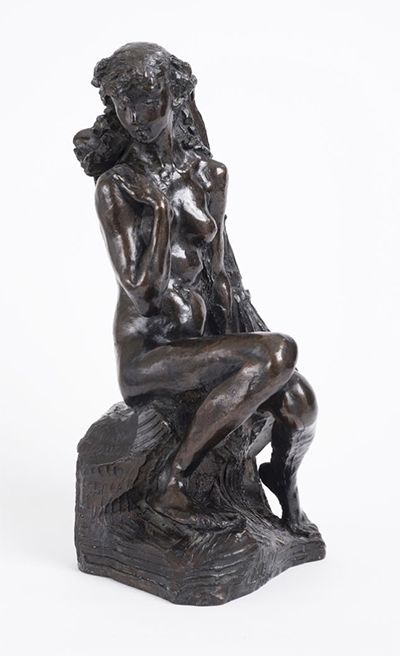
| Young Girl with a Sheaf | c. 1886–87 | Sculpture |
| Giganti | c. 1885 | Sculpture |
| Crouching Woman | c. 1884–85 | Sculpture |
| The Hungry Dog | c. 1893 | Sculpture |
| Old Hélène | c. 1881–82 | Sculpture |
| Fortune | c. 1902–05 | Sculpture |
| The Wounded Niobid | 1906 | Sculpture |
| The Siren, or The Flute Player | c. 1904–05 | Sculpture |
| Deep Thought | c. 1898 | Sculpture |
| Dream by the Fireside | c. 1899 | Sculpture |
| Paul Claudel at Thirty-Seven | 1905 | Sculpture |
| Portrait de Madame Claudel | c. 1883 | Sculpture Musée Camille Claudel. |
| Jeune Femme aux yeux clos | c. 1885 | Sculpture Musée Camille Claudel. |
| Ferdinande de Massary | 1888 | Sculpture Musée Camille Claudel. |
| Léon Lhermitte | 1889 | Sculpture Musée Camille Claudel. |
| Étude de main gauche | c. 1889 | Sculpture Musée Camille Claudel. |
| Vieil aveugle chantant | c. 1894 | Sculpture Musée Camille Claudel. |
| Tête de vieillard | c. 1890 | Sculpture Musée Camille Claudel. |
| Étude pour la tête d’Hamadryade | c. 1895 | Sculpture Musée Camille Claudel. |
| Aurore | c. 1900 | Sculpture Musée Camille Claudel. |
Discussion
Look again at the images and ideas explored in Fortune. These editorial prompts invite your observations.
Reader Insights
Where does the figure seem to carry its weight?
How does the direction of the drapery change when you move around the bronze?
Join the Conversation
Share a detail, comparison or question about Fortune below.
References
- Musée Camille Claudel, La Fortune, collection record for 2010.1.21 and two photographs by Marco Illuminati,. View source.
- Musée Camille Claudel, March 2024 press dossier, collection checklist for La Fortune and La Valse,. View source.
- Alte Nationalgalerie, Staatliche Museen zu Berlin, Camille Claudel and Bernhard Hoetger, exhibition checklist,. View source.
- Christie’s, La fortune, lot 6155266, bronze and iconographic account,. View source.
- Musée Rodin, The Waltz or The Waltzers, object record and collection photographs,. View source.
- J. Paul Getty Museum, Camille Claudel, exhibition guide, “The Waltz: A Sensuous Dance,”. View source.
- Artcurial, La Fortune, sale 2456, lot 6, cast and inscription record,. View source.
- Musée Sainte-Croix, Poitiers, La Niobide blessée educational notice, Johnatan Savarit, André Brisson collection,. View source.
- Rouillac, Artigny sale catalogue, 11 June 2017, study of La Valse, note 53 on the Musée Sainte-Croix bronze,. View source.
- Musée Camille Claudel, 1905 : l’exposition Claudel & Hoetger, venue, dates and installation evidence,. View source.
- Galerie Eugène Blot, Exposition d’œuvres de Camille Claudel et de Bernard Hoetger, December 1905, entries 5 and 10, facsimile at Musée Camille Claudel,. View source.