 by Tom Gurney
Tom Gurney BSc (Hons) is an art history expert with over 20 years experience
Email: tomgurney1@gmail.com / Phone: +44 7429 011000
Technique and materials: Introduction
At the Musée Rodin, three bronze bathers stand beneath a crest of pale, veined stone. The metal makes their bent legs and linked arms easy to pick out, while the pattern in the stone runs across the whole height of the wave. Look past the bathers and the stone continues into the hollow above their heads. Where the figures stand, the same material gives them a footing. The stone can suggest a solid floor and a mass of water about to break, depending on which part of it you follow. That change is characteristic of how Claudel used a material to shape the action of a group. [1] [2]
A sculpture might pass from clay to plaster and from plaster to metal or stone. Claudel could also rethink a pose, alter the scale or give a surface a different colour between versions. Her sculptures include terracotta studies, finished plasters, marble commissions and editions in bronze and glazed stoneware. Each material tells you something different about where the work stood when it left the studio. The figures can share a pose while the objects have separate histories of making, finishing and display. [3] [4]
At a Glance
- ArtistCamille Claudel
- Materials discussedPlaster, terracotta, marble, onyx, bronze and stoneware
Contents
- Modelling a pose in clay
- What plaster could do
- Reading a bronze cast
- Carving marble and working with a specialist
- Colour on plaster, bronze and stone
- Assembling different materials
- Comparing versions in the gallery
Modelling a pose in clay
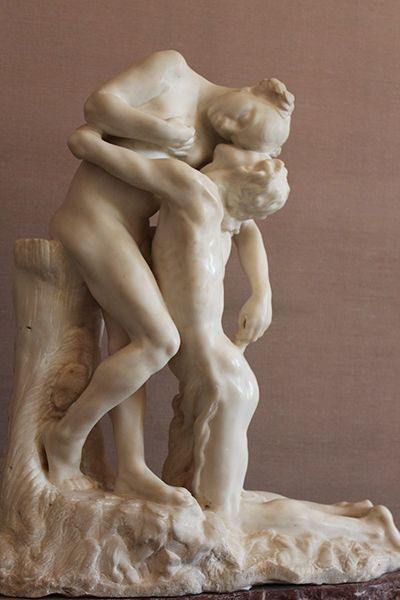
Soft clay allows a sculptor to build a form up, press into it and change its profile while the material is still workable. Firing fixes the shape as terracotta. A small study can preserve a decision about the balance of a group at a point when the faces and hands are still only broadly indicated. Claudel’s terracotta sketch for Sakuntala, Musée Rodin S.06772, is about 15.5 centimetres high. The woman kneels inside the curve of the man’s embrace. The Musée Rodin compares the arrangement with the plaster exhibited in 1888, where the woman stands and receives the embrace of the kneeling man. The changes shift the highest point of the group and reverse which body must reach upward. The sketch is evidence of a relationship between figures that Claudel tried out before arriving at the larger design. [3] [5] [6]
Terracotta could also carry the finish of a portrait. In Old Hélène, Nogent 2010.1.1, the mouth recedes beneath the nose and the chin pushes forward. The head turns slightly, so those features form a more uneven profile on one side than you might expect from the front. The cheeks and the fine detail of the hair call for different degrees of attention. Clay makes it possible to work from broad masses down to these small changes in depth. The contrast with the Sakuntala study is one of purpose. The study holds two bodies together in a few volumes that read at a glance. In the bust, small adjustments to the volumes are what make the expression particular to the sitter. [3] [5] [7]
What plaster could do
A mould holds a negative of a form. Plaster poured into it hardens as a positive, with the ridges and hollows of the model readable again. The mould maker, or mouleur, could supply a plaster for the studio, for exhibition or for the next specialist. The exhibition catalogue edited by Emerson Bowyer and Anne-Lise Desmas describes how plaster casts furnished models for carving and foundry work. It also distinguishes this sequence from working out the composition in soft material. An artist could go back to the design and revise it. The stages of manufacture alone cannot tell you whether two objects follow the same state of the model. [3]
The patinated plaster Sakuntala, now Musée Bertrand inv. 518, was itself the work shown at the 1888 Salon. That finish matters. A plaster surface can be coloured to change the relative weight of the shadows and the prominence of the modelling. Here, the version that introduced the composition publicly already had a surface of its own. A different job for plaster is documented in a 1902 letter from Claudel to Captain Tissier. The Musée d’Orsay identifies it as the letter making the plaster of The Mature Age available to the founder Fumière. There the plaster was a form from which a particular commission could proceed. The Salon object in Châteauroux and the model mentioned in the letter illustrate two uses of plaster that a medium label alone leaves open. [6] [8]
Reading a bronze cast
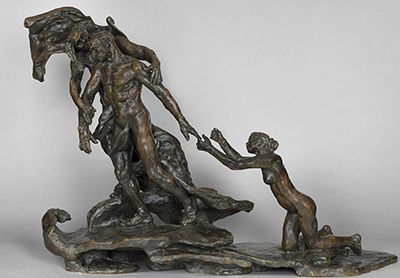
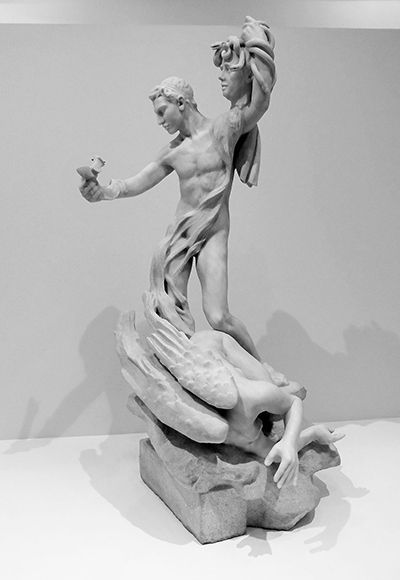
In sand casting, mould sections made of packed sand take the shape of a model. The mould receives the molten metal. Once the bronze has cooled and been taken out, it needs finishing, including work on casting traces and any seams between parts. A founder’s work therefore affects what the viewer sees, even when the cast follows the same model closely. The National Museum of Western Art in Tokyo explicitly identifies its Perseus and the Gorgon, S.2021-0001, as a sand cast made by Eugène Blot in 1905–06, from a model it dates 1898–1905. At 51 centimetres high it takes up much less space than the monumental marble at Nogent. The two examples ask for different viewing distances before the hero, raised head and body below become legible as a group. [9] [10] [11]
Turn to the back of the Tokyo bronze and the base carries Blot’s name and the address of his premises on the boulevard de la Madeleine. Claudel’s signature is on the side below the shield. The museum describes the bronze as unnumbered. The address in the founder’s mark identifies the business that issued it, and the separate signature names the artist whose sculpture it is. On the Orsay Mature Age, RF 3606, the first-proof and foundry inscriptions are on the reverse of the raised form behind the figures. The museum identifies Thiébaut Frères, Fumière et Gavignot as the founders of this cast, the bronze made for Tissier around 1902. Its inscriptions and Claudel’s letter give two kinds of evidence for a single commission. The Tokyo record specifies a casting process. The Orsay inscriptions and letter establish the workshop and the use of the plaster in that commission. [8] [10] [12]
The Musée Rodin has another bronze of the later composition of The Mature Age, S.01380, which its collections portal records as a 1913 lost-wax cast. The founder’s mark is on the front, where the museum transcribes it as “CARVELHANI Fondeur”. In lost-wax casting, the wax likeness of the model is enclosed in a mould and removed by heat. The bronze fills the space left by the wax. That intermediate likeness is the difference to keep in mind alongside the packed-sand process documented for Blot’s Perseus. The two Mature Age bronzes show how a composition could pass through different workshops at different dates, even at monumental scale. [12] [13] [14]
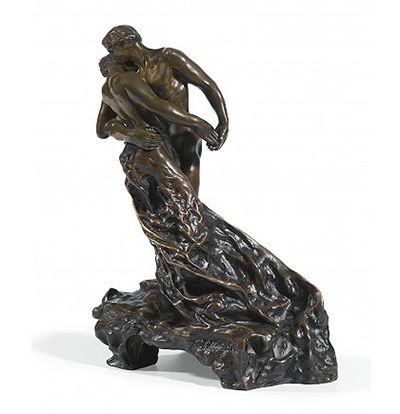
An edition could carry a number and still leave much to learn about the object. At Nogent, Émile Muller’s glazed stoneware Waltz is no. 14. Blot’s large-model bronze in the same museum is no. 5, cast in 1905. The numbers belong to two issues in different materials. Clay hardened and covered by a fired glaze can give a fold a broad area of reflected light and colour. In bronze, the turn of a fold can register through the relation between a brighter edge and a darker recess. Getty’s exhibition guide also identifies deliberate changes to the amount of drapery and the shape of the mound across versions. Where a silhouette changes, begin with those differences in the design. Then look at what each surface does to the passages that the versions share. [4] [15]
Carving marble and working with a specialist
A carver can use a plaster model to take measurements for a block of marble. In the transfer method known as pointing, selected points provide depths and positions to work towards as the stone is cut away. The Musée Rodin’s account of period practice describes pointed tools for taking away stone, toothed chisels that leave parallel marks and flatter chisels for smoothing a surface. That sequence explains how different textures can coexist in one sculpture. A rough passage breaks light into small patches, while a smooth curve allows a highlight to travel more continuously. A carved surface can preserve some of those contrasts even after the sculptor or practitioner has completed the work. [3] [16]
Nogent identifies the division of work on the Maigret marble of Perseus and the Gorgon, 2009.1.1. Claudel supplied the design. François Pompon was entrusted with carving the marble from the plaster shown at the Champ-de-Mars Salon in 1899, and the marble was completed in 1902. It stands 196 centimetres high. The upright figure has to register against the twisted body gathered close to the base. The change in scale from the Tokyo example affects where the viewer stands to follow that contrast, while the choice of stone gives both figures a shared pale surface that binds them into one group. The commission credits a named specialist with translating Claudel’s plaster into that monumental form. [10] [11]
The Getty credits Claudel’s own carving skills in the four marble versions of The Little Châtelaine. Much of the variation lies behind the ear and at the back of the neck. A straight plait gathers the hair into a single legible strand. In another marble, fine, partly freed strands and a partly hollowed interior let light penetrate farther into the stone. The resulting translucency softens the face, while shadows give the strands individual edges. The turn of the head survives across versions, but the work in the hair changes what happens when you move round the bust and the face passes out of view. The Getty’s account of that carving and Nogent’s credit to Pompon for Perseus locate the work of cutting and finishing at the level of the particular commission. [4] [11] [17]
Colour on plaster, bronze and stone
The word patina can describe several kinds of surface. The Art Institute of Chicago’s Young Roman, 2022.1438, is painted plaster. Colour belongs to the surface of the portrait even though the underlying material is pale. On bronze, colour can result from a chemical change at the surface of the metal, or from a coating. It can also change over the course of an object’s life. As the Getty conservation guidelines explain, what a surface looks like today may reflect the work of founders, artists and later interventions as well as changes acquired with age. The colour visible in a collection photograph is useful evidence for how a surface reads. Establishing who applied it, and when, takes a different kind of record. [18] [19]
Nogent’s Aurore gives that distinction a particular object. The museum dates the conception of the bust to about 1900. Blot acquired the plaster and issued six bronzes beginning in 1908. The museum holds a bronze master used for reproduction and a green-patinated cast, Blot no. 1 of 1908, 2010.1.13. The catalogue explains why a workshop might use a master in metal. It can withstand repeated moulding better than plaster. That helps explain the presence of two bronzes with different roles in the museum’s holdings. The green surface is a documented feature of the numbered example. It gives the smooth face and the curving loose hair a common colour, so their different shapes and the shadows between the strands do more to separate them. The Tokyo Perseus record, by contrast, describes both brown and green in the patina of its bronze. The labels describe the appearance of these individual bronzes. A record of the preparation or application would be needed to assign either finish to a particular hand. [3] [10] [20] [21]
Assembling different materials
In The Gossips, Musée Rodin S.01006, bronze and marble onyx divide the women’s immediate surroundings from their bodies. The stone screen carries its own pattern, while the bronzes give a darker sequence of heads and bent backs. Seen from the open side, the screen sets the figures apart like a folding wall. From a more oblique angle the coloured stone itself takes up much more of the view, as if you were passing the edge of a room and could see only part of what was happening. A separate bronze with a stone screen in Nogent, Blot no. 1, 2010.1.17, shows that the visual relation between group and screen could recur in a different issue. Nogent’s 2018 exhibition dossier calls the screen material tinted marble. In that account, the stone’s colour is a surface treatment, whereas the bands in the Musée Rodin’s marble onyx belong to the stone itself. [22] [23] [24]
In The Wave, the Rodin collections portal records bronze, onyx and a marble base, and names Pompon as praticien, or specialist practitioner. The exhibition catalogue identifies the curved stone as marble onyx, the name for the veined calcareous stone used here. Follow the contact between the bathers’ feet and the stone. What looks continuous in the bronze anatomy ends at the change of material, just where the figures appear to brace themselves. The crest and trough remain connected by the stone’s pattern, so a stone prized for its veining also supplies the moving water and the surface beneath the figures. The visible contact makes the assembly readable from the outside. The museum’s credit establishes a practitioner’s involvement, while the concealed fastening and division of the finishing work are separate questions. [1] [2] [3]
Comparing versions in the gallery
Start with the profile. If a kneeling figure becomes upright or a veil shrinks, you are looking at a decision about the model. Then find a detail common to both versions, such as the turn of the child’s cheek in The Little Châtelaine. Watch where the light settles on it in plaster or marble. Finally, check the accession, founder’s name, edition number and dates. A date beside a title may refer to a model even when the object in front of you was cast years later. Claudel’s work rewards looking in that order because each layer of evidence answers a different question. The pose tells you how she arranged the bodies. The surface shows how the material brings that arrangement into view. The records show whose work brought that particular object into being. [3] [4] [10] [17]
Artworks directory
| Name | Date | Medium |
|---|---|---|
| The Mature Age | 1894–99 | Sculpture |
| The Waltz | c. 1889–93 | Sculpture |
| Sakuntala | 1886–88 | Sculpture |
| The Little Châtelaine | 1892–93 | Sculpture |
| The Gossips | c. 1893 | Sculpture |
| The Wave | 1897–1903 | Sculpture |
| Perseus and the Gorgon | c. 1897–1902 | Sculpture |
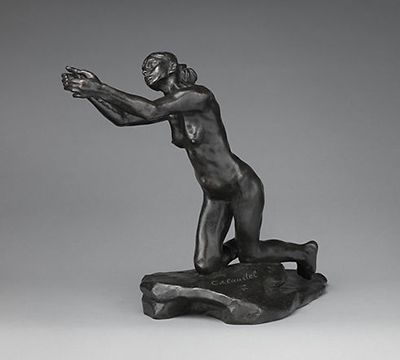
| The Implorer | c. 1894–99 | Sculpture |
| Clotho | 1893 | Sculpture |
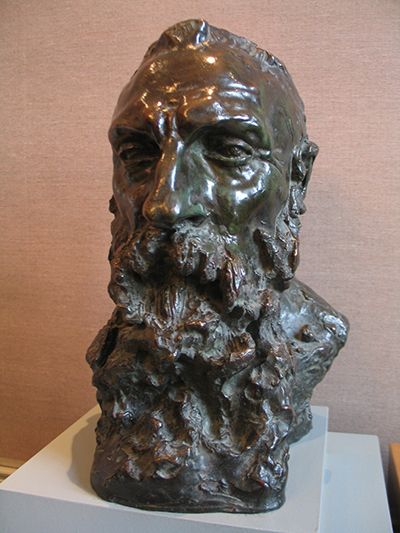
| Bust of Auguste Rodin | c. 1886–89 | Sculpture |
| Paul Claudel at Sixteen Years Old | c. 1882–87 | Sculpture |
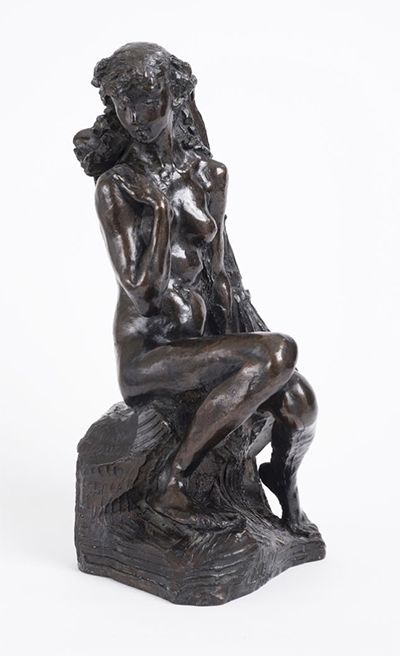
| Young Girl with a Sheaf | c. 1886–87 | Sculpture |
| Giganti | c. 1885 | Sculpture |
| Crouching Woman | c. 1884–85 | Sculpture |
| The Hungry Dog | c. 1893 | Sculpture |
| Old Hélène | c. 1881–82 | Sculpture |
| Fortune | c. 1902–05 | Sculpture |
| The Wounded Niobid | 1906 | Sculpture |
| The Siren, or The Flute Player | c. 1904–05 | Sculpture |
| Deep Thought | c. 1898 | Sculpture |
| Dream by the Fireside | c. 1899 | Sculpture |
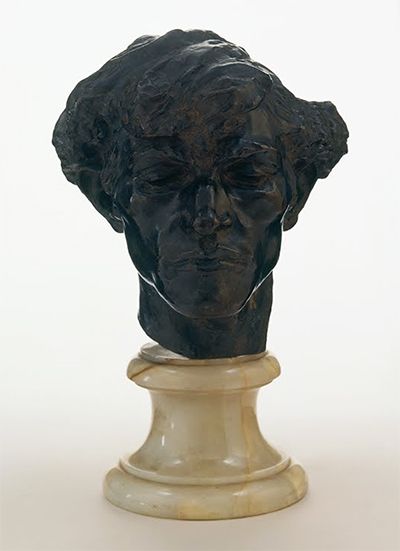
| Paul Claudel at Thirty-Seven | 1905 | Sculpture |
| Portrait de Madame Claudel | c. 1883 | Sculpture Musée Camille Claudel. |
| Jeune Femme aux yeux clos | c. 1885 | Sculpture Musée Camille Claudel. |
| Ferdinande de Massary | 1888 | Sculpture Musée Camille Claudel. |
| Léon Lhermitte | 1889 | Sculpture Musée Camille Claudel. |
| Étude de main gauche | c. 1889 | Sculpture Musée Camille Claudel. |
| Vieil aveugle chantant | c. 1894 | Sculpture Musée Camille Claudel. |
| Tête de vieillard | c. 1890 | Sculpture Musée Camille Claudel. |
| Étude pour la tête d’Hamadryade | c. 1895 | Sculpture Musée Camille Claudel. |
| Aurore | c. 1900 | Sculpture Musée Camille Claudel. |
Discussion
Look again at the images and ideas explored in Technique and materials. These editorial prompts invite your observations.
Reader Insights
Which details tell you whether a surface was modelled or carved?
How does natural colour change the relation between figures and setting?
Join the Conversation
Share a detail, comparison or question about Technique and materials below.
References
- Musée Rodin, The Wave or The Bathers, overview and photographs of S.06659,. View source.
- Musée Rodin, La Vague, collections portal, S.06659, material and authorship fields,. View source.
- Emerson Bowyer and Anne-Lise Desmas, eds., Camille Claudel, Getty Publications and Art Institute of Chicago, 2023, “The Practice of the Art of Sculpture”, pp. 7–8,. View source.
- J. Paul Getty Museum, Camille Claudel, exhibition guide, “The Waltz” and “The Little Lady”,. View source.
- Musée Rodin, Esquisse pour Sakountala, terracotta S.06772,. View source.
- Musée Bertrand / Ministère de la Culture, Sakountala, patinated plaster, inv. 518,. View source.
- Musée Camille Claudel, Old Hélène or Old Woman, terracotta 2010.1.1,. View source.
- Musée d’Orsay, Camille Claudel, letter to Captain Tissier making the plaster of The Mature Age available to Fumière, 1902,. View source.
- Musée Rodin, Fonte au sable, technical guide,. View source.
- National Museum of Western Art, Tokyo, Perseus and the Gorgon, bronze S.2021-0001, dates, medium and inscriptions,. View source.
- Musée Camille Claudel, Persée et la Gorgone, Maigret marble 2009.1.1,. View source.
- Musée d’Orsay, L’Age mur, Tissier bronze RF 3606,. View source.
- Musée Rodin, L’Âge mûr, lost-wax bronze S.01380, 1913 casting and inscription,. View source.
- Musée Rodin, Fonte à la cire perdue, technical guide,. View source.
- Musée Camille Claudel, Autour de La Valse, gallery 13, Muller and Blot editions,. View source.
- Musée Rodin, Taille du marbre, technical guide,. View source.
- Musée Rodin, La petite Châtelaine, object essay and the four marbles,. View source.
- J. Paul Getty Museum, Camille Claudel, exhibition checklist, Art Institute of Chicago’s Young Roman, 2022.1438,. View source.
- Ann Boulton, Susanne Gänsicke and Shelley Sturman, “Patina”, Guidelines for the Technical Examination of Bronze Sculpture, Getty Conservation Institute, section I.8,. View source.
- Musée Camille Claudel, Aurore, Blot no. 1, 2010.1.13, bronze master and edition history,. View source.
- Musée Camille Claudel, March 2024 press dossier, room 12 object list, green patina of Blot no. 1,. View source.
- Musée Camille Claudel, Camille Claudel et Paul Claudel, le rêve et la vie, 2018 exhibition dossier, checklist no. 42, tinted marble in 2010.1.17,. View source.
- Musée Rodin, The Gossips or Women Chatting, marble onyx and bronze S.01006,. View source.
- Musée Camille Claudel, Les Causeuses, Blot no. 1, 2010.1.17, bronze with stone screen,. View source.