 by Tom Gurney
Tom Gurney BSc (Hons) is an art history expert with over 20 years experience
Published on June 19, 2020 / Updated on October 14, 2023
Email: tomgurney1@gmail.com / Phone: +44 7429 011000
The Hungry Dog: Introduction
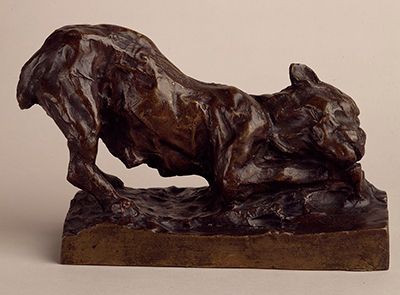
The highest point in Camille Claudel’s The Hungry Dog is the animal’s rump. From there the back slopes towards the shoulders, the head turns, and the muzzle comes down to a bone held close to the ground. The front of the body is so low that parts of the jaw and forelegs disappear into the rough modelling of the base. The Musée Camille Claudel in Nogent-sur-Seine dates the composition to around 1893 and calls it Chienne rongeant un os ou Chienne affamée, literally a female dog gnawing a bone or a hungry female dog. The two titles draw attention to different things. One names the action you can see, while the other gives that action a possible urgency. [1]
Perra Hambrienta Camille Claudel
At a Glance
- French titlesChienne rongeant un os and Chienne affamée
- Nogent exampleA. Rudier bronze, 2010.2.3
Camille Claudel in context
Old Hélène
c. 1881–82Sakuntala
Plaster shown in 1888The Waltz
Developed c. 1889–93The Little Châtelaine
First model c. 1892–93The Gossips
Described in 1893, shown in 1895The Mature Age
First and second versions, c. 1894–99The Wave
Plaster shown in 1897, mixed-material object dated 1897–1903 (?)Perseus and the Gorgon
Nogent design and marble, c. 1897–1902The Wounded Niobid
Modelled in 1906Contents
How the dog braces itself
In one of Marco Illuminati’s photographs of the Nogent bronze, the dog faces left and the line of the ribs is especially clear. Several ridges travel down and back from the spine, where they catch light against the darker flank. Below the belly is a narrow opening that widens towards the hind legs. It allows the viewer to see the difference between the two ends of the stance. The hind paws take weight well behind the shoulders, while the bent forequarters bring the dog almost flush with the ground. The deep space beneath the body gives way to crowded forms around the muzzle. That change tells you where the animal is putting its effort before you have even made out the bone. [1]
In the view from the other side, the head faces right and the tilt of the muzzle is easier to follow. One ear stands out from the top of the head, and the cheek folds down towards the bone. The bent foreleg nearest the viewer makes a short, substantial form. The farther paw emerges at the front of the base beside the muzzle. Rather than spacing the paws so that each is easy to see, Claudel lets the forelegs, jaw and bone overlap. A dog chewing in this position has to keep its purchase on something that could slip or roll away. The low head and the placement of the paws give that practical problem a shape. [1]
The base does some of the work. Its straight lower edge supplies a level against which the slope of the back is unmistakable. Above that edge, the surface is broken and ridged. At the rear, a hind foot makes contact with the uneven ground at a distinct point. At the front, the forms crowd together so closely that it takes both photographs to sort out the limbs and the object between them. The bone becomes legible at the point where the muzzle comes down between the paws. Claudel preserves the brief difficulty of seeing what a real dog is doing when it lowers its face over something between its paws. [1]
The bronzes in Nogent and Mexico City
The Nogent example, inventory 2010.2.3, is a bronze credited to A. Rudier. The collection record gives a height of 21 centimetres, a width of 30 and a depth of 17.6, and records the museum’s purchase from Philippe Cressent in 2008. On one side of the base, towards the dog’s hindquarters, the photograph shows a foundry inscription. The approximate date of 1893 belongs to the composition, and the object entry gives the caster and acquisition separately. It leaves the year in which this particular bronze was poured open. [1]
Museo Soumaya in Mexico City uses the Spanish title Perra hambrienta and also publishes the descriptive variant Perro que roe un hueso. Its brown-patinated bronze measures 15 × 25.5 × 10.8 centimetres in the museum’s 2014 publication, which records a private collection and a 1992 Christie’s sale in New York in the provenance. A later museum publication identifies the foundry as Siot-Decauville and specifies 1893 as the year of conception. Javier Hinojosa’s photograph shows the same arrangement of raised hindquarters, compressed shoulders and muzzle close to the base. The brown surfaces catch pale highlights on the hip and cheek, where greenish passages show in the Nogent photographs. Those are differences visible in the published views. The shape of the body and the positions of the feet are more reliable points of comparison across the photographs, which use different lighting. [2] [3] [4]
La Piscine in Roubaix preserves a patinated plaster, also dated to around 1893, acquired from Paul Claudel’s heirs in 2005. Another bronze appeared as lot 25 at the Hôtel des Ventes de Monte-Carlo in December 2018. The auction catalogue describes a signed cast with the Alexis Rudier mark at the back of the base, measuring 15.5 × 26.9 × 11.5 centimetres. It gives the total number of casts as unknown. The Roubaix plaster and the foundry records for the bronzes therefore answer different questions. The plaster documents the form in another material, and the foundry attributions identify the production of individual metal examples. The shared title alone cannot place them in a casting sequence. [5] [6]
Watching an animal at work
When the Musée Rodin held its Claudel retrospective in 1951, Paul Claudel singled out a dog gnawing a bone as evidence of his sister’s fascination with animal gesture. In the text reproduced by the Monte-Carlo catalogue, he says that the heirs of Madame Moreno gave him the sculpture shown at the exhibition. His account describes the work as he remembered and presented it decades later. What he chose to praise, the gesture, is still easy to see in the Nogent bronze. The shoulder drops, the head moves across the forelegs and the hind feet steady the body. Hunger gives those movements one reading, while the posture also has the familiar concentration of a dog intent on chewing. [6] [7]
Writing in 1898, the critic Mathias Morhardt described how Claudel made another small sculpture, Le Peintre. He says that she took notes and drew profiles while a painter worked, then used them to reconstruct his stance, palette in one hand and brush in the other. A figure in the act of painting could thus come from several observations, gathered at different moments and brought into a single pose. Morhardt gives this account for the painter. In the dog, you can see a comparable interest in the small adjustments that let a body carry out a familiar task. [8]
Nogent presents the bronze alongside Claudel’s small scenes from everyday life, including The Gossips. In that composition the women’s leaning bodies and turned heads let a viewer recognise a confidential conversation without hearing what is said. Here the bent limbs and turned muzzle give away the action even when the bone is difficult to pick out. The difference is where the gesture travels. The women turn towards one another and the space between them becomes part of the conversation. The dog gathers its weight over one small point on the base. In both sculptures, you understand what is happening by following where bodies lean and how close they come to each other or to the thing that holds their attention. [1] [9]
Artworks directory
| Name | Date | Medium |
|---|---|---|
| The Mature Age | 1894–99 | Sculpture |
| The Waltz | c. 1889–93 | Sculpture |
| Sakuntala | 1886–88 | Sculpture |
| The Little Châtelaine | 1892–93 | Sculpture |
| The Gossips | c. 1893 | Sculpture |
| The Wave | 1897–1903 | Sculpture |
| Perseus and the Gorgon | c. 1897–1902 | Sculpture |
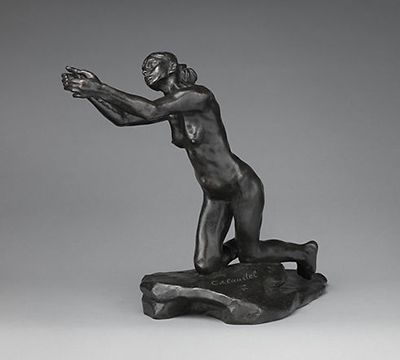
| The Implorer | c. 1894–99 | Sculpture |
| Clotho | 1893 | Sculpture |
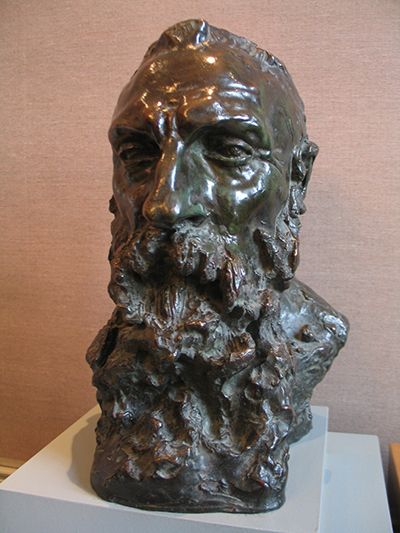
| Bust of Auguste Rodin | c. 1886–89 | Sculpture |
| Paul Claudel at Sixteen Years Old | c. 1882–87 | Sculpture |
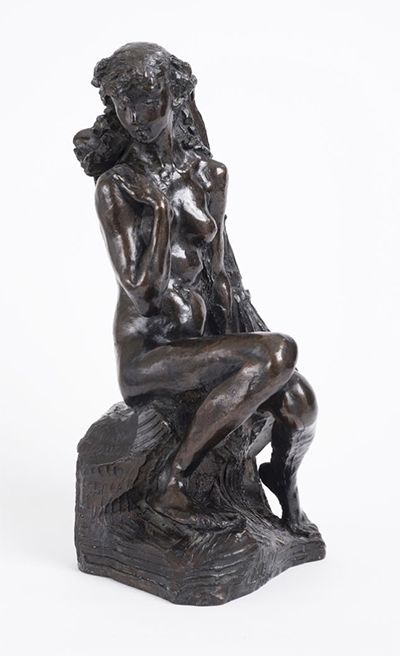
| Young Girl with a Sheaf | c. 1886–87 | Sculpture |
| Giganti | c. 1885 | Sculpture |
| Crouching Woman | c. 1884–85 | Sculpture |
| The Hungry Dog | c. 1893 | Sculpture |
| Old Hélène | c. 1881–82 | Sculpture |
| Fortune | c. 1902–05 | Sculpture |
| The Wounded Niobid | 1906 | Sculpture |
| The Siren, or The Flute Player | c. 1904–05 | Sculpture |
| Deep Thought | c. 1898 | Sculpture |
| Dream by the Fireside | c. 1899 | Sculpture |
| Paul Claudel at Thirty-Seven | 1905 | Sculpture |
| Portrait de Madame Claudel | c. 1883 | Sculpture Musée Camille Claudel. |
| Jeune Femme aux yeux clos | c. 1885 | Sculpture Musée Camille Claudel. |
| Ferdinande de Massary | 1888 | Sculpture Musée Camille Claudel. |
| Léon Lhermitte | 1889 | Sculpture Musée Camille Claudel. |
| Étude de main gauche | c. 1889 | Sculpture Musée Camille Claudel. |
| Vieil aveugle chantant | c. 1894 | Sculpture Musée Camille Claudel. |
| Tête de vieillard | c. 1890 | Sculpture Musée Camille Claudel. |
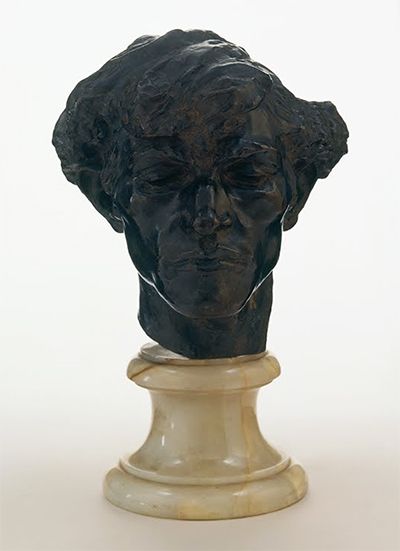
| Étude pour la tête d’Hamadryade | c. 1895 | Sculpture Musée Camille Claudel. |
| Aurore | c. 1900 | Sculpture Musée Camille Claudel. |
Discussion
Look again at the images and ideas explored in The Hungry Dog. These editorial prompts invite your observations.
Reader Insights
Where does the dog put its weight as it works at the bone?
What becomes visible when you move from the head to the paws?
Join the Conversation
Share a detail, comparison or question about The Hungry Dog below.
References
- Musée Camille Claudel, Chienne rongeant un os ou Chienne affamée, bronze 2010.2.3 and photographs by Marco Illuminati,. View source.
- Museo Soumaya, Hombre inclinado: el nuevo bronce de Camille Claudel en México, October 2023, alternate titles,. View source.
- Museo Soumaya, December 2014 magazine, p. 23, dimensions and provenance of Perra hambrienta,. View source.
- Museo Soumaya, December 2024 magazine, p. 52, Perra hambrienta, casting credit and photograph by Javier Hinojosa,. View source.
- Ville de Roubaix, L’Homme penché, le nouveau Camille Claudel de Roubaix, list of works in the La Piscine collection,. View source.
- Hôtel des Ventes de Monte-Carlo, December 2018 auction catalogue, lot 25, bronze and excerpt from Paul Claudel’s Ma sœur Camille,. View source.
- J. Paul Getty Museum, Camille Claudel exhibition guide, “Sketches from Life” and “Claudel’s Legacy,”. View source.
- Mathias Morhardt, Mademoiselle Camille Claudel, Mercure de France, March 1898, p. 743,. View source.
- Musée Camille Claudel, La plus grande collection d’œuvres de Camille Claudel, room 15 and sketches from life,. View source.