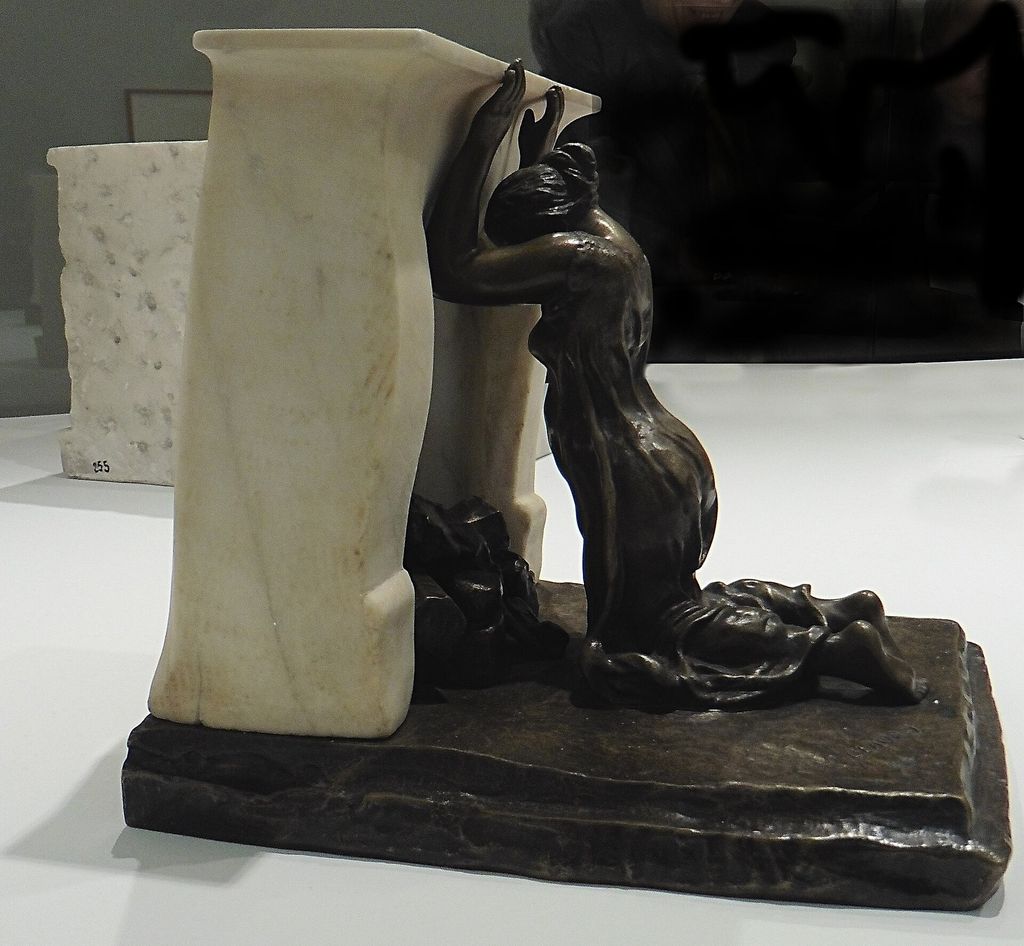
Deep Thought, photographed at La Piscine, Roubaix, in 2015. Photograph by Pierre André Leclercq. Image source. CC BY-SA 4.0. Resized photograph, shared under CC BY-SA 4.0.
 by Tom Gurney
Tom Gurney BSc (Hons) is an art history expert with over 20 years experience
Email: tomgurney1@gmail.com / Phone: +44 7429 011000
Deep Thought: Introduction
In Camille Claudel’s Deep Thought (Profonde pensée), a woman kneels directly in front of a fireplace and raises both hands to the mantel. Her bare feet point back towards the viewer, her dress gathers around her knees and her face tilts down towards the hearth. From behind, the shoulders and forearms make the gesture legible even though the face is hidden. Claudel conceived the composition around 1898. The Musée Camille Claudel in Nogent-sur-Seine holds two examples that bring out different aspects of the pose. One is entirely bronze. The other sets a bronze figure against a marble fireplace and belongs to the edition issued by Eugène Blot around 1905. [1] [2]
At a Glance
- French titleProfonde pensée
Camille Claudel in context
Old Hélène
c. 1881–82Sakuntala
Plaster shown in 1888The Waltz
Developed c. 1889–93The Little Châtelaine
First model c. 1892–93The Gossips
Described in 1893, shown in 1895The Mature Age
First and second versions, c. 1894–99The Wave
Plaster shown in 1897, mixed-material object dated 1897–1903 (?)Perseus and the Gorgon
Nogent design and marble, c. 1897–1902The Wounded Niobid
Modelled in 1906Contents
- A figure seen from behind
- Two fireplaces in two materials
- What the Salon visitor saw
- Marble, an edition and a change of title
A figure seen from behind
Start at the mantel. Its long horizontal edge brings the two hands into relation with one another. The fingers reach the same ledge, but the forearms come up at slightly different angles and the bowed head sits between them, well below the shelf. The posture has some of the symmetry of the fireplace without quite matching it. Below the arms, the neckline and folds across the back give way to a narrower waist. The lower dress spreads again where it meets the floor. The long movement from fingers to knees is compressed into a sculpture about twenty-five centimetres high. [1] [2]
The feet make sense of how she got there. In the photograph of the bronze version, the soles project from the crumpled hem and turn slightly away from one another. The knees take the weight on the base, while the upper body reaches forward far enough to make contact with the architecture. From this angle the viewer is close to the woman and can follow the dress down her back, yet has to infer what her face might show. The title directs attention to her state of mind. The sculpture gives it physical expression through the length of the reach and the way the head hangs inside it. [2]
The fireplace also gives the figure a position within a room that Claudel only partly describes. A broad base extends from the jambs to the edge behind the woman’s feet. It can be read as a short stretch of floor, long enough to show how close she has moved to the hearth. In the all-bronze version the opening remains conspicuous through the gaps beside the torso and beneath the arms. The woman occupies its centre. The surrounding uprights make it possible to see at once how much of the opening she fills and how little of the room the sculpture needs. [2]
Two fireplaces in two materials
The Nogent bronze is inventory 2010.1.19. It measures 24.4 centimetres high, 22.5 wide and 29 deep, and the museum acquired it from Reine-Marie Paris de La Chapelle in 2008. Its object record gives about 1898. A museum dossier tentatively assigns 1898 to the casting and leaves the founder unidentified. The bronze-and-marble example, inventory 2010.5.3, measures 24.5 by 22.5 by 28 centimetres. Nogent acquired it from Philippe Cressent in 2008. Its record likewise dates the composition to about 1898 and identifies the object as Blot cast no. 6, produced around 1905. [1] [2] [3]
The two objects are close in size and their fireplaces give a very different impression. In the all-bronze example, the jambs have irregular surfaces. Highlights break across them in much the same way as they do across the dress. The metal lets the floor, figure and surround share a dark tone even where their shapes diverge. On no. 6, the pale marble surround has smoother faces, a more even shelf and a clearly rounded arch. The dark fingers stand out against the light edge of the mantel, while the modelled logs at the base help give the opening depth. The body reads more distinctly as a silhouette against the fireplace. Look along the side of the waist and the boundary between bronze and marble runs close to the outline of the woman herself. [1] [2]
Marble and bronze alone can’t identify the composition. Claudel used the combination for Dream by the Fireside (Rêve au coin du feu) as well. In Nogent’s example of that work, 2010.1.20, the woman sits on a chair to one side and leans in, bringing her head close to the fireplace. Her face is visible in profile and the chair back marks the outer edge of the figure. In Deep Thought, the knees are on the floor at the centre and the raised hands lead the eye out to either side of the head. The sitter in Dream by the Fireside shares the base with the hearth. The kneeling figure in Deep Thought fits within the outline of its opening. [1] [2] [4]
What the Salon visitor saw
The 1898 Salon of the Société Nationale des Beaux-Arts listed La profonde pensée as no. 36, a bronze statuette described as a croquis d’après nature, or sketch from life. The Getty and Art Institute of Chicago exhibition catalogue identifies the exhibited bronze as belonging to M. Peytel. In his account of the Salon, the critic Gustave Geffroy places the statuette in the painting room where Puvis de Chavannes’s Geneviève was shown. He describes the woman kneeling with her face inclined towards the hearth and finds the figure both quickly sketched and affecting. Earlier in the same review he singles out Claudel’s Hamadryad for the vitality of its face. In the smaller hearth scene, his description turns to a whole attitude, from the knees to the direction of the face. [5] [6] [7]
Claudel’s letter to Geffroy, dated approximately to May or June 1898 by the researcher Marie Gevart-Dekaeke, gives a view from the artist’s side. Claudel tells him he picked out the Hamadryad and her little thinker and remarks that many visitors passed them by, their attention absorbed by Rodin’s Balzac. Her account concerns the competition for notice in a particular exhibition. Geffroy’s review records what he found worth looking at amid it. The Salon description as a sketch from life places the sculpture among Claudel’s small studies of everyday subjects. In this one, the domestic setting allows a passing gesture to have the concentration and weight of a sustained pose. [5] [6] [7]
Marble, an edition and a change of title
A marble Deep Thought appeared as no. 139 in the fine arts exhibition at the 1900 Paris Exposition Universelle. Writing about that exhibition, Geffroy mentions the translation of Deep Thought into marble before praising the liveliness of Dream by the Fireside as a separate statuette. The loan list for the Musée national des beaux-arts du Québec’s 2005 exhibition Camille Claudel et Rodin. La rencontre de deux destins records a marble dated 1900 from the Musée Sainte-Croix in Poitiers, accession 2000-00-1, measuring 23.5 by 23.3 by 31 centimetres. The same list records a separate Poitiers bronze, 2000-00-2, as the foundry model prepared for Blot’s edition, with its date tentatively given as around 1905. The bronze foundry model belongs to the preparation of an edition. The Poitiers marble shows that a version carved in stone could stand as a finished work in its own right. [5] [7] [8] [9]
The title Intimité appears in the booklet for Blot’s joint exhibition of Claudel and Bernhard Hoetger in December 1905. It is item 6 and carries an announced limit of fifty casts. Another title, La Bûche de Noël or The Yule Log, draws attention to the hearth itself. Au Coin du Feu, the other fireplace composition, has its own line at item 4. The sixth entry in the booklet and the number six on the Nogent edition record refer to different things. One locates a work in a gallery catalogue and the other identifies an individual cast. The booklet gives the planned limit, while an object record can document how a particular example was made. Christie’s catalogue for a separate numbered cast, no. 9, records Blot’s mark on the base and identifies its materials as bronze and onyx. On the examples documented in these records, stone was one of the ways an edition could vary the appearance of a composition without changing the central gesture. [1] [10] [11] [12]
The Musée Rodin links the fireplace sculptures to The Wave, in which bronze bathers bend beneath a mass of green onyx marble. There the bodies repeat a gesture beneath the sweep of the stone. The fireplace in Deep Thought has the straight edges and fixed position of a household fitting. In the mixed-material version its light surface frames the dark figure, but it is also where her hands come to rest. The change in colour makes that physical contact easier to see. [1] [13]
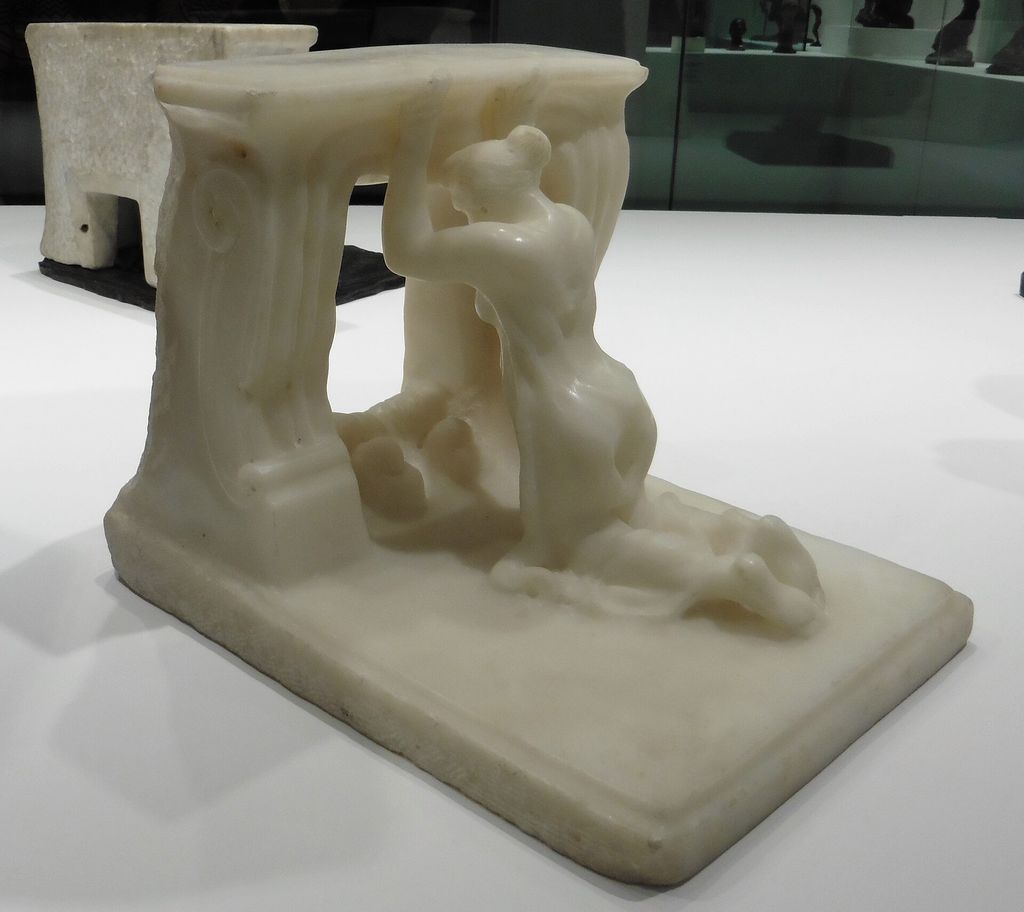
A white stone version of Deep Thought photographed at La Piscine, with the kneeling figure seen beside the mantel. Photograph by Pierre André Leclercq. Image source. CC BY-SA 4.0. Resized photograph, shared under CC BY-SA 4.0.
A closer look at Deep Thought
Annotated Details from Deep Thought
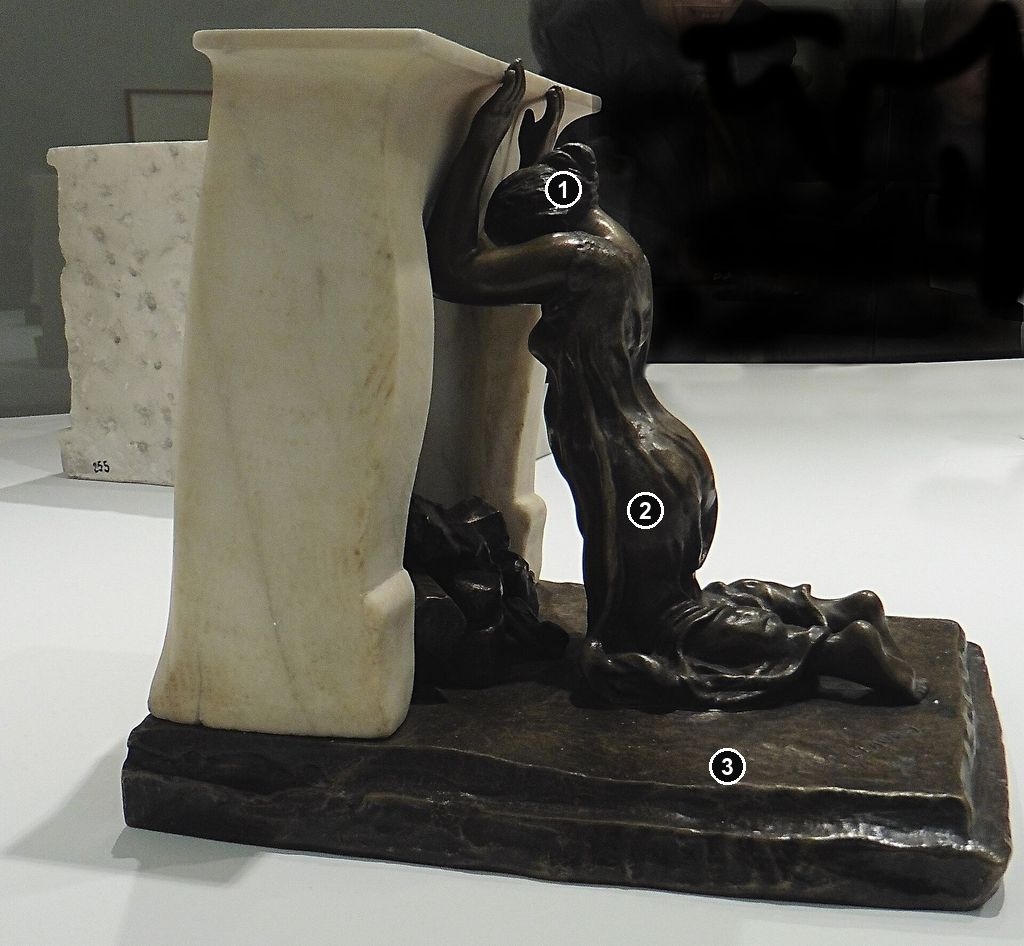
Deep Thought, photographed at La Piscine, Roubaix, in 2015. Photograph by Pierre André Leclercq. Image source. CC BY-SA 4.0. Overview numbered and details cropped. Both are shared under CC BY-SA 4.0.
Details from DEEP THOUGHT
Follow the numbered details, then return to the complete view.
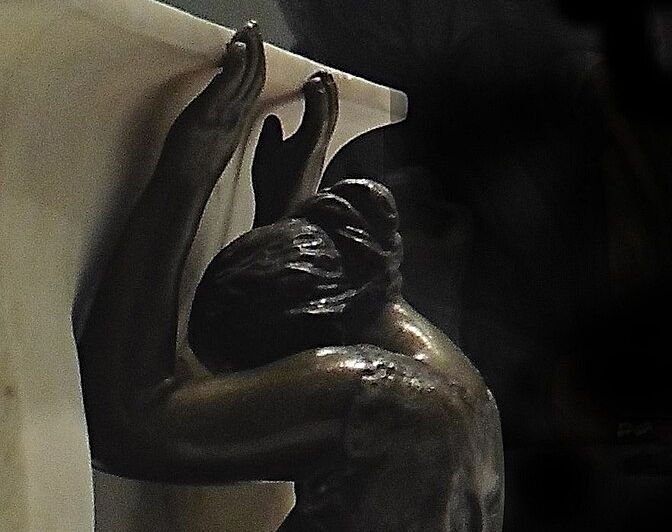
The arms beside the mantel
The bent arms rise into the narrow space between the head and the upper edge of the surround.
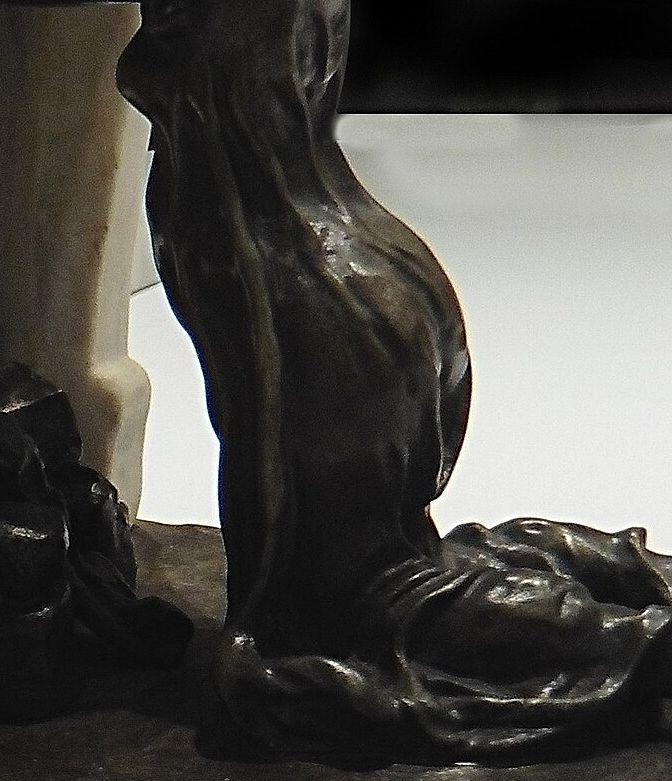
The back and drapery
The dark outline bends at the waist before the fabric falls toward the base.
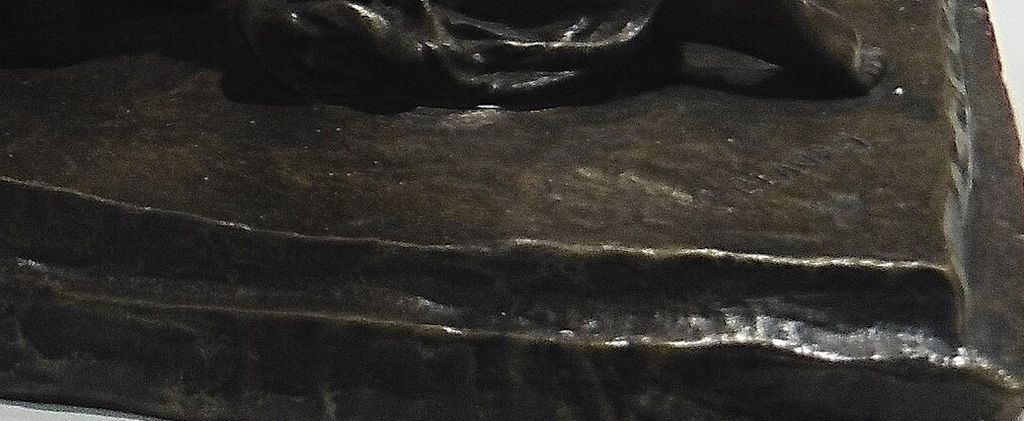
The base of the group
Irregular folds extend behind the knees along the flatter platform.
Artworks directory
| Name | Date | Medium |
|---|---|---|
| The Mature Age | 1894–99 | Sculpture |
| The Waltz | c. 1889–93 | Sculpture |
| Sakuntala | 1886–88 | Sculpture |
| The Little Châtelaine | 1892–93 | Sculpture |
| The Gossips | c. 1893 | Sculpture |
| The Wave | 1897–1903 | Sculpture |
| Perseus and the Gorgon | c. 1897–1902 | Sculpture |
| The Implorer | c. 1894–99 | Sculpture |
| Clotho | 1893 | Sculpture |
| Bust of Auguste Rodin | c. 1886–89 | Sculpture |
| Paul Claudel at Sixteen Years Old | c. 1882–87 | Sculpture |
| Young Girl with a Sheaf | c. 1886–87 | Sculpture |
| Giganti | c. 1885 | Sculpture |
| Crouching Woman | c. 1884–85 | Sculpture |
| The Hungry Dog | c. 1893 | Sculpture |
| Old Hélène | c. 1881–82 | Sculpture |
| Fortune | c. 1902–05 | Sculpture |
| The Wounded Niobid | 1906 | Sculpture |
| The Siren, or The Flute Player | c. 1904–05 | Sculpture |
| Deep Thought | c. 1898 | Sculpture |
| Dream by the Fireside | c. 1899 | Sculpture |
| Paul Claudel at Thirty-Seven | 1905 | Sculpture |
| Portrait de Madame Claudel | c. 1883 | Sculpture Musée Camille Claudel. |
| Jeune Femme aux yeux clos | c. 1885 | Sculpture Musée Camille Claudel. |
| Ferdinande de Massary | 1888 | Sculpture Musée Camille Claudel. |
| Léon Lhermitte | 1889 | Sculpture Musée Camille Claudel. |
| Étude de main gauche | c. 1889 | Sculpture Musée Camille Claudel. |
| Vieil aveugle chantant | c. 1894 | Sculpture Musée Camille Claudel. |
| Tête de vieillard | c. 1890 | Sculpture Musée Camille Claudel. |
| Étude pour la tête d’Hamadryade | c. 1895 | Sculpture Musée Camille Claudel. |
| Aurore | c. 1900 | Sculpture Musée Camille Claudel. |
Discussion
Look again at the images and ideas explored in Deep Thought. These editorial prompts invite your observations.
Reader Insights
How does the fireplace shape the space around the kneeling figure?
What does a side view reveal about the arms and drapery?
Join the Conversation
Share a detail, comparison or question about Deep Thought below.
References
- Musée Camille Claudel, Profonde pensée, bronze and marble, inventory 2010.5.3, object record and Marco Illuminati photograph,. View source.
- Musée Camille Claudel, Profonde pensée, bronze, inventory 2010.1.19, object record and Christian Moutarde photograph,. View source.
- Musée Camille Claudel, 2018 press dossier, Salle 15 collection list,. View source.
- Musée Camille Claudel, Rêve au coin du feu, bronze and marble, inventory 2010.1.20, object record and Marco Illuminati photograph,. View source.
- J. Paul Getty Museum and Art Institute of Chicago, Camille Claudel, edited by Emerson Bowyer and Anne-Lise Desmas, 2023, chronology for 1898 and 1900, View chronology. Official 1900 catalogue, p. 183, no. 139. View source 1. View source 2.
- Gustave Geffroy, “Salon de 1898,” section VII, La Vie artistique, sixth series, 1900, pp. 349–350, Getty Research Institute copy,. View source.
- Marie Gevart-Dekaeke, La sculpture et l’intime en France (1865–1909), Université Paris Nanterre, 2018, pp. 275–277, including the citation and transcription of Musée Rodin Ms 413 (Ma 165),. View source.
- Gustave Geffroy, “L’exposition décennale de la sculpture,” La Vie artistique, seventh series, 1901, p. 291, Getty Research Institute copy,. View source.
- Gazette officielle du Québec, 6 April 2005, Part 2, no. 14, exhibition loan list, pp. 1158 and 1160,. View source.
- Galerie Eugène Blot, December 1905 exhibition booklet, entries 4 and 6, Musée Camille Claudel facsimile,. View source.
- Musée Camille Claudel, 1905 : l’exposition Claudel & Hoetger, exhibition history,. View source.
- Christie’s, La profonde pensée or Intimité, lot 6009056, cast no. 9, materials and foundry inscription,. View source.
- Musée Rodin, The Wave or The Bathers, S.06659, collection record and discussion of the fireplace compositions,. View source.