by Tom Gurney
Tom Gurney BSc (Hons) is an art history expert with over 20 years experience
Email: tomgurney1@gmail.com / Phone: +44 7429 011000
Patrons, exhibitions and editions: Introduction
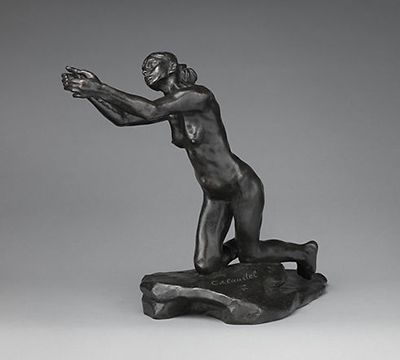
In December 1905, a visitor to Eugène Blot’s gallery at 5 boulevard de la Madeleine in Paris could find two versions of Camille Claudel’s kneeling figure in the catalogue. The first was advertised at the original size, with a limit of twenty bronze casts. The second was a reduction, with a limit of one hundred. Farther down the same page, beside a bronze called Les Bavardes, Blot listed a marble of the same subject belonging to the banker Joanny Peytel. Within one page the gallery set out two things a visitor could encounter in the room. One was a collector’s particular sculpture. The other was a work that a buyer might acquire in a choice of sizes, as one of a planned series. [1] [2]
Both possibilities had taken years to develop. In the 1890s Claudel had sought government commissions, arranged to show plaster models at Salons and worked for collectors who could pay for an individual marble or bronze. Blot gave her a way to bring several sculptures to the market at once and keep them available after an exhibition closed. The records of those earlier transactions help explain what his gallery could offer and why the same Claudel composition can turn up in museums under different titles, materials and dates. [2] [3]
At a Glance
- Dealer exhibitionCamille Claudel and Bernhard Hoetger, Paris, 1905
- Bronze publisherEugène Blot
Contents
- What a state inspection could secure
- Captain Tissier and the work of getting a bronze cast
- The Countess de Maigret and other private collectors
- The gallery on the boulevard de la Madeleine
- How many bronzes did Blot make?
What a state inspection could secure
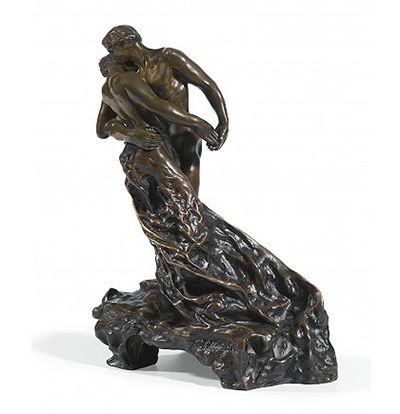
Claudel applied to the ministry responsible for fine arts in 1892 for a marble commission for The Waltz. The inspector Armand Dayot visited her studio to see the group, whose dancers were then both nude. His first report admired the sculpture and asked her to clothe the figures. Claudel spent part of the year studying drapery, and Dayot saw a revised group. He recommended its execution in marble in his report of 5 January 1893. The Getty exhibition chronology records a proposed order dated 9 March that remained unsigned. Dayot could examine a work, suggest changes and recommend it for public funding. The ministry still had to authorise the expenditure. Claudel had already committed time to remodelling the group by the time that distinction became decisive. [4] [5]
The draped plaster reached the Salon of the Société Nationale des Beaux-Arts in 1893. The following year a bronze owned by the foundry Siot-Decauville appeared in the inaugural exhibition of La Libre Esthétique in Brussels. It was listed there as a unique example. That entry records the object available to the Brussels organisers in 1894. Over a decade later, when Blot put La Valse on his list of limited editions, buyers were being offered the design under different terms. The intervening years had also given Claudel time to change its scale and drapery. The sculpture’s route from Paris to Brussels was already well under way even though the proposed state marble remained on paper. [1] [4] [5]
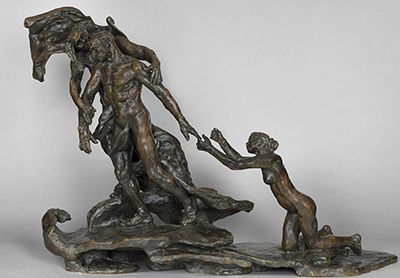
The state did pay for work on the plaster of The Mature Age, commissioned in 1895. The Musée Camille Claudel points to Dayot’s inspection reports as evidence for the group’s development. The Musée Rodin records that Claudel completed the work and received payment, although the plaster was never delivered to the state’s Dépôt des marbres. The later plaster was shown at the Société Nationale in 1899. Published accounts differ about the administrative status of the bronze proposal. The Musée d’Orsay describes a bronze that was never commissioned. The Getty chronology records an order in June 1899 cancelled that month. Both accounts leave the same material outcome. Visitors had seen the plaster, and the bronze that eventually reached the Salon was commissioned privately. [3] [5] [6] [7]
The 1899 Salon catalogue makes the distinction visible on the page. Three consecutive entries name a marble Clotho and plasters of The Mature Age and Perseus. A committee honouring the painter Puvis de Chavannes had commissioned the Clotho marble through a subscription organised at the instigation of the critic Mathias Morhardt. The committee intended it for the Musée du Luxembourg. A group of subscribers could therefore bring a sculpture into marble alongside work supported by a state model commission. The Salon supplied a common place to exhibit objects with different owners, sources of funding and intended destinations. [5] [8] [9]
Captain Tissier and the work of getting a bronze cast
Captain Louis Tissier’s correspondence with Claudel brings the practical decisions into view. In December 1899 Claudel wrote about payment for a kneeling figure in bronze and invited him to see her finished marbles. Two later letters concern the much larger group. In January 1902 she passed on François Rudier’s quotation of six thousand francs for casting The Mature Age. A separate letter, dated 25 February by the Orsay finding aid, made the plaster available to the founder Fumière. The two records describe successive steps in negotiating and arranging a casting. The figure Rudier quoted belongs to his proposed job. The finished bronze identifies another workshop. [7] [10] [11]
The Orsay bronze bears Claudel’s signature at the front and the foundry inscription of Thiébaut Frères, Fumière et Gavignot, on the back of the wave. The inscription calls it the first proof. Tissier’s support had turned a plaster seen in 1899 into a bronze shown at a different Paris Salon, the Société des Artistes Français, in 1903. Visitors there saw a privately commissioned object, even though some of the labour that had produced its model had been paid for by the state. In 1982 the Orsay acquired the bronze from the captain’s son André, who separately donated eight letters from Claudel to his father. The bronze and the correspondence came together in the museum because one family had kept both. [7] [10]
The Orsay inventory also records requests for advances and updates on works in progress. An advance put money into the workshop before a sculpture had to be finished and delivered. An invitation to see completed marbles brought the same patron to the studio when there was something ready to show. Together the letters give a sense of how much contact with a buyer could precede the moment when the finished object was ready for public view. [7] [10]
The Countess de Maigret and other private collectors
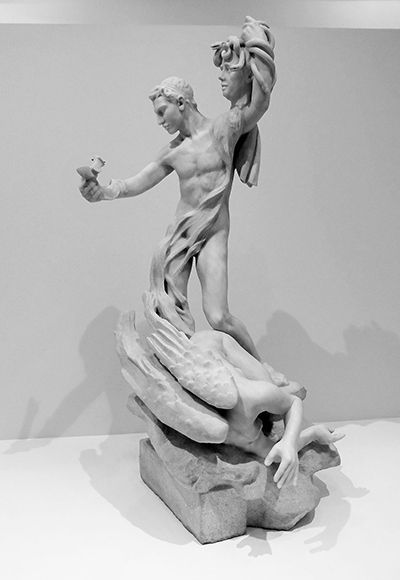
The Countess Arthur de Maigret became Claudel’s principal patron in the later 1890s. She commissioned portraits, including a bust of herself, and ordered the marble Perseus and the Gorgon for her residence on the rue de Téhéran. François Pompon carved it from Claudel’s model. At nearly two metres high, the marble required a block of substantial size, the work of a specialist carver and an intended space that could accommodate it. Before going to its private setting it appeared at the Société Nationale’s Salon in 1902, where the countess’s bust was listed beside it. The portrait and mythological group made two aspects of the same relationship visible to a public audience. [3] [12] [13]
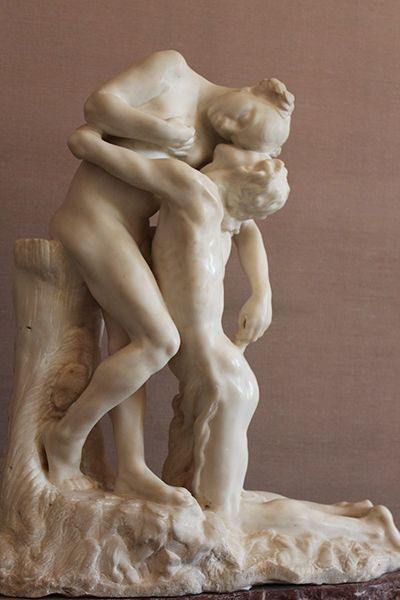
Maigret also made possible a marble version of a group that Claudel had been trying for years to realise in stone. The plaster Sakuntala had received an honourable mention in 1888. Repeated attempts to obtain a state commission for a marble followed. The 1905 marble for Maigret, Vertumnus and Pomona, was smaller and recast the subject in Roman terms. Claudel took pride in having carved it herself, according to the Musée Camille Claudel’s exhibition dossier. In the same year a bronze based on the group appeared at the Salon d’Automne as L’Abandon. The two objects took shape through different arrangements. The countess paid for a particular marble, while Blot could take the bronze design to a succession of buyers. [3] [14] [15]
Other patrons could help a work reach a museum before it ever came through a dealer’s exhibition. Alphonse de Rothschild gave bronzes of Giganti to public collections in Lille, Reims and Cherbourg. The Institut national d’histoire de l’art traces those gifts through Léon Gauchez, a critic and art dealer who acted for Rothschild. The Reims example, given in 1901, has a different pedestal and signature from the examples the museum compares it with. From a collector’s point of view it was possible to promote a design by placing several bronzes in different cities. From a museum’s point of view each gift still had to be identified by its own marks and arrival in the collection. [16]
Peytel’s marble in the 1905 catalogue shows another kind of contribution. Its owner was named alongside a bronze of the composition now generally called The Gossips. Visitors could encounter the subject in two materials at the same exhibition. The juxtaposition helped make the dealer’s offer intelligible. A finished marble that already had an owner could give the subject a public presence while Blot offered it in a material suited to an edition. The catalogue’s separate entry preserves the collector’s association with that marble as precisely as it preserves Blot’s advertised limit for the bronze. [1] [2]
A collector’s name was one kind of information a catalogue could preserve. The money already spent getting a sculpture into the room was harder to see. The collector Maurice Fenaille supported The Wave from 1898, and Claudel’s correspondence records a further payment of a thousand francs in 1900. In the 1905 booklet the work appears as Les Baigneuses, with its onyx and bronze specified and its uniqueness emphasised. A visitor could distinguish it from the editions offered beside it. The earlier payments give a glimpse of what it took to bring a work in two materials to that point. [1] [17] [18]
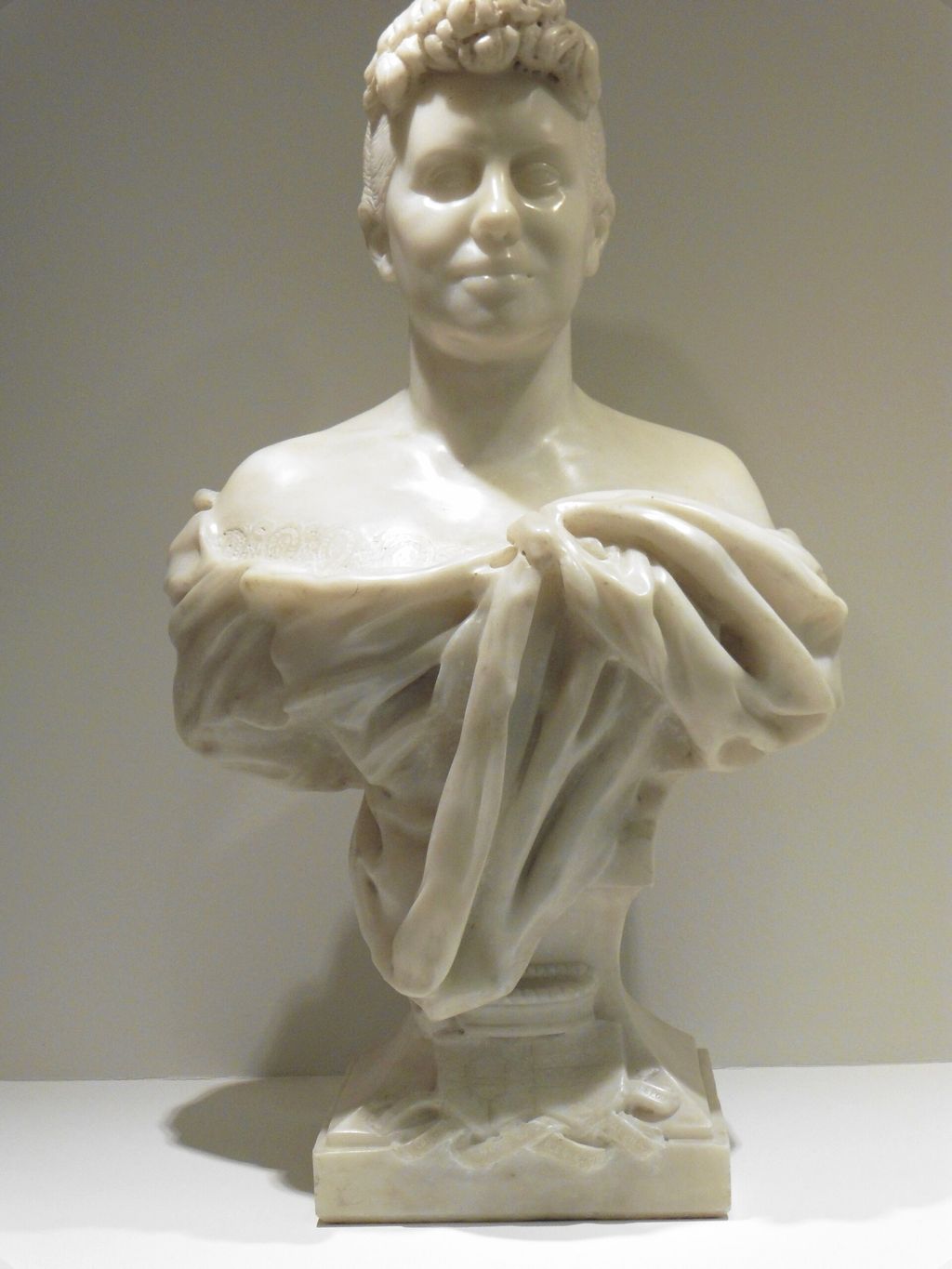
Claudel’s portrait of the Countess de Maigret, photographed at the Roubaix exhibition in 2015. Photograph by Pierre André Leclercq. Image source. CC BY-SA 4.0. Resized photograph, shared under CC BY-SA 4.0.
The gallery on the boulevard de la Madeleine
Blot came to art dealing through a family business that made decorative zinc objects. He moved towards limited editions of contemporary sculpture in bronze and opened his boulevard de la Madeleine gallery in 1902. At the joint exhibition, held from 4 to 16 December 1905, Claudel’s figures stood on wooden pedestals among plants. A surviving photograph records part of the installation. The booklet lists Bernhard Hoetger’s sculpture entries from 13 through 50, including plasters and a pair of entries specifying tin. It puts twenty drawings heightened with watercolour together under no. 51. Claudel’s side of the booklet is shorter. Its heading says bronzes, but the entries include Peytel’s marble and Les Baigneuses, specified as a unique work in onyx and bronze. The small print is more informative about materials than either heading on its own. [1] [2] [19]
The pairing gave visitors grounds for comparison across a single room. Claudel’s L’Abandon and Hoetger’s Les Adieux, listed as no. 35, both bring two bodies into an embrace. The titles send those gestures in different directions. An embrace can express the moment of yielding in one work and the moment before parting in the other. Hoetger’s range also ran to the street and workplace. His foundry worker and miner appear in the list just a few entries apart, while Claudel’s conversations and scene by a fire belonged to a quieter set of ordinary encounters. A dealer working with both sculptors could present small sculpture as a medium for quite different parts of contemporary life. [1] [2] [19]
Louis Vauxcelles’s catalogue essay gives an idea of the argument a visitor was invited to consider. He opened with Berthe Morisot and Claudel, acknowledging what Claudel had learned from Rodin while crediting her with an artistic personality as distinct as his. A profile of the kneeling Implorer sits beside the opening lines, with its hands and face turned towards the text. In the essay’s concluding pages Vauxcelles discusses Hoetger’s workers and the example of the Belgian sculptor Constantin Meunier, then publicly thanks Blot for supporting both artists. The praise belongs to the exhibition’s own publication. It shows a critic using the occasion to describe two careers and to give the dealer a visible part in each. [20] [21]
How many bronzes did Blot make?
The catalogue lists a limit of thirty for Persée and fifty for La Valse and L’Abandon. Those figures tell us what the gallery advertised in December 1905. The casts supply a different record. The National Museum of Western Art in Tokyo holds an unnumbered Perseus and the Gorgon which it dates to 1905–06 and attributes to Blot’s sand casting. The object attests to production, and its museum traces its ownership from a French private collection around 1960 to its purchase in 2021. That chain gives the history of the Tokyo proof as far back as the museum can establish it. The catalogue gives the projected extent of the edition. To place the Tokyo bronze in the room in December would require evidence tying that specific proof to the exhibition. [1] [22]
The reduced Implorer shows why the two kinds of evidence belong together. The published study of the Barbedienne foundry papers records fifty-nine casts against the hundred projected in the catalogue. In a 1936 letter to Barbedienne, Blot gave a limit of ten for the original-size figure, although he had advertised twenty in 1905. The Musée Camille Claudel holds proof no. 5 of that larger figure. Its number identifies one bronze, just as the entry number identifies one listing and the advertised limit describes the series the dealer proposed at the time. Blot also described an intermediate size in the letter. Even the two options that a visitor could read about in December were only part of the sculpture’s production history. [1] [23] [24]
Blot’s involvement also changed the way public institutions could buy Claudel’s work. In 1907 the French state purchased a bronze of L’Abandon through him, now deposited at the museum in Cambrai. The Nogent museum holds a smaller Blot cast of the same subject, numbered two, which entered its collection through a later purchase. With the Maigret marble at the Musée Rodin, the two bronzes show how several transactions could bring related works into public collections. A state purchase from an edition called for a different decision from authorising an artist to make a new marble. The object was already available to acquire. Blot also continued to exhibit Claudel. In 1907 at his new gallery on rue Richepanse, he showed her sculptures alongside paintings by Henri Manguin, Albert Marquet and Jean Puy. The small bronze Mature Age that appeared there belonged to a phase of the group’s public life distinct from the full-size cast commissioned by Tissier. [2] [3] [14] [23] [25] [26]
The exhibition returned as a museum project in Bremen and Berlin in 2025 and at Nogent-sur-Seine in 2026. The curators used the Paris pairing to consider how Claudel and Hoetger each established a practice in a profession where Rodin’s example carried enormous weight. The surviving photograph gives a view of the old gallery and the catalogue supplies the names and materials to look for. Tracking down modern loans also calls for records of the kind that distinguish the Tokyo proof from other bronzes. In 1905 Blot brought together works that had reached him by different routes. More than a century later, bringing their designs together again meant tracing how particular casts and carvings had passed from one collection to another. [2] [22] [27] [28] [29]
Artworks directory
| Name | Date | Medium |
|---|---|---|
| The Mature Age | 1894–99 | Sculpture |
| The Waltz | c. 1889–93 | Sculpture |
| Sakuntala | 1886–88 | Sculpture |
| The Little Châtelaine | 1892–93 | Sculpture |
| The Gossips | c. 1893 | Sculpture |
| The Wave | 1897–1903 | Sculpture |
| Perseus and the Gorgon | c. 1897–1902 | Sculpture |
| The Implorer | c. 1894–99 | Sculpture |
| Clotho | 1893 | Sculpture |
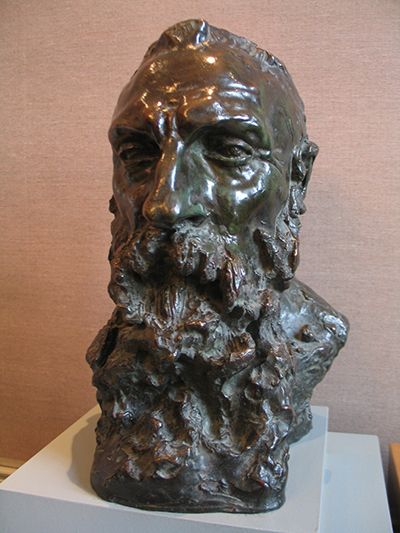
| Bust of Auguste Rodin | c. 1886–89 | Sculpture |
| Paul Claudel at Sixteen Years Old | c. 1882–87 | Sculpture |
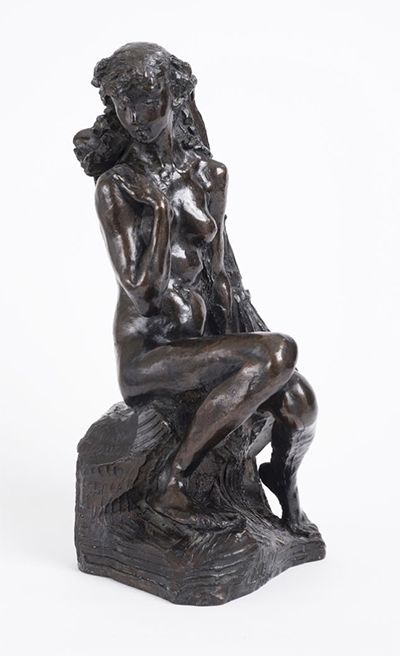
| Young Girl with a Sheaf | c. 1886–87 | Sculpture |
| Giganti | c. 1885 | Sculpture |
| Crouching Woman | c. 1884–85 | Sculpture |
| The Hungry Dog | c. 1893 | Sculpture |
| Old Hélène | c. 1881–82 | Sculpture |
| Fortune | c. 1902–05 | Sculpture |
| The Wounded Niobid | 1906 | Sculpture |
| The Siren, or The Flute Player | c. 1904–05 | Sculpture |
| Deep Thought | c. 1898 | Sculpture |
| Dream by the Fireside | c. 1899 | Sculpture |
| Paul Claudel at Thirty-Seven | 1905 | Sculpture |
| Portrait de Madame Claudel | c. 1883 | Sculpture Musée Camille Claudel. |
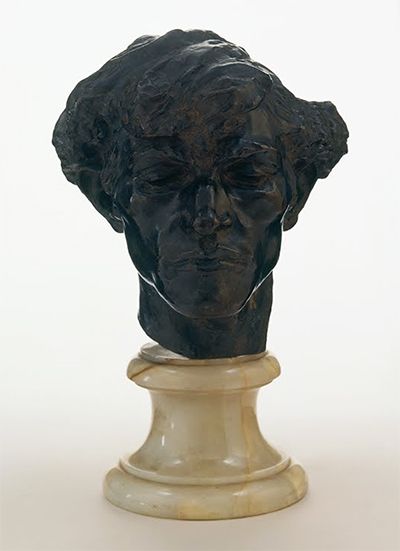
| Jeune Femme aux yeux clos | c. 1885 | Sculpture Musée Camille Claudel. |
| Ferdinande de Massary | 1888 | Sculpture Musée Camille Claudel. |
| Léon Lhermitte | 1889 | Sculpture Musée Camille Claudel. |
| Étude de main gauche | c. 1889 | Sculpture Musée Camille Claudel. |
| Vieil aveugle chantant | c. 1894 | Sculpture Musée Camille Claudel. |
| Tête de vieillard | c. 1890 | Sculpture Musée Camille Claudel. |
| Étude pour la tête d’Hamadryade | c. 1895 | Sculpture Musée Camille Claudel. |
| Aurore | c. 1900 | Sculpture Musée Camille Claudel. |
Discussion
Look again at the images and ideas explored in Patrons, exhibitions and editions. These editorial prompts invite your observations.
Reader Insights
What changed when a collector commissioned a cast directly?
How did Blot’s catalogue change the way people could buy and see the work?
Join the Conversation
Share a detail, comparison or question about Patrons, exhibitions and editions below.
References
- Galerie Eugène Blot, Exposition d’œuvres de Camille Claudel et de Bernard Hoetger, December 1905, Claudel listings 1–12 and 11 bis, and Hoetger listings 13–34. Catalogue facsimile. View source.
- Musée Camille Claudel, 1905 : l’exposition Claudel & Hoetger, exhibition history, installation photograph and catalogue facsimiles. View source.
- Musée Camille Claudel, 1893–1908 : Les années de création solitaire, chronology of commissions, Salons and purchases. View source.
- Armand Dayot, reports on La Valse of 20 March 1892 and 5 January 1893, Archives nationales, F 21 4299, excerpts in the Rouillac and Sculpture et Collection dossier. View source.
- Emerson Bowyer and Anne-Lise Desmas, editors, Camille Claudel, Getty Publications, 2023, chronology for 1892–1905. View source.
- Musée Rodin, L’Âge mûr, account of the two versions and state commission. View source.
- Musée d’Orsay, L’Âge mûr, bronze RF 3606, inscription, provenance and exhibitions. View source.
- Société Nationale des Beaux-Arts, illustrated Salon catalogue, 1899, sculpture entries 27–29. Digitised catalogue. View source.
- Musée Rodin, Clotho, record of the subscription, commission and intended destination. View source.
- Nadège Horner, Musée d’Orsay, Fonds Camille Claudel, inventory of Tissier correspondence, Ms 360.1–11, pp. 2–3. View source.
- Camille Claudel, letter to Captain Tissier making the plaster group available to Fumière, Musée d’Orsay, Ms 360 10, 11 et 10bis. Object record and manuscript image. View source.
- Musée Camille Claudel, Persée et la Gorgone, Maigret marble 2009.1.1. View source.
- Musée Camille Claudel, 1893–1908: Period of Solitary Creation, detailed Salon checklist for 1902. View source.
- Musée Rodin, Vertumne et Pomone, marble S.01293, state applications, Maigret commission and 1905 bronze exhibition. View source.
- Musée Camille Claudel, Sakountala, exhibition dossier, section on the making and exhibition of Vertumne et Pomone. View source.
- Marie-Hélène Montout-Richard, Institut national d’histoire de l’art, Tête de brigand, par Camille Claudel, on Alphonse de Rothschild’s gifts and Léon Gauchez. View source.
- Société Paul Claudel, Bulletin no. 172, study of Claudel’s correspondence with records of Fenaille’s payments. View source.
- Marie Gevart-Dekaeke, La sculpture et l’intime en France (1865–1909), Université Paris Nanterre and École du Louvre, 2018, pp. 273–275, on the production and exhibition of The Wave. View source.
- Galerie Eugène Blot, December 1905 catalogue, Hoetger listings 35–51. Catalogue facsimile. View source.
- Louis Vauxcelles, December 1905 catalogue essay, opening on Claudel, illustrated with The Implorer. Catalogue facsimile. View source.
- Louis Vauxcelles, December 1905 catalogue essay, conclusion on Hoetger and Blot. Catalogue facsimile. View source.
- National Museum of Western Art, Tokyo, Perseus and the Gorgon, bronze S.2021-0001, casting and provenance record. View source.
- Eugène Blot, letter to Barbedienne, 17 December 1936, Archives nationales, 368 AP 3, excerpts and Barbedienne edition records in Galerie Malaquais’s The Implorer dossier, pp. 4 and 7, notes 10–16. View source.
- Musée Camille Claudel, L’Implorante (grand modèle), Blot no. 5, 2010.1.15. View source.
- Gazette officielle du Québec, 6 April 2005, p. 1160, loan record for the Cambrai Blot bronze, 2104. View source.
- Musée Camille Claudel, L’Abandon, small Blot cast 2010.1.23, and exhibition history with proof number. View source.
- Paula Modersohn-Becker Museum, Camille Claudel & Bernhard Hoetger, Bremen exhibition, 2025. View source.
- Alte Nationalgalerie, Camille Claudel und Bernhard Hoetger. Emanzipation von Rodin, Berlin exhibition, 2025. View source.
- Musée Camille Claudel, Camille Claudel & Bernhard Hoetger : l’exposition de 1905, Nogent exhibition, 2026–27. View source.