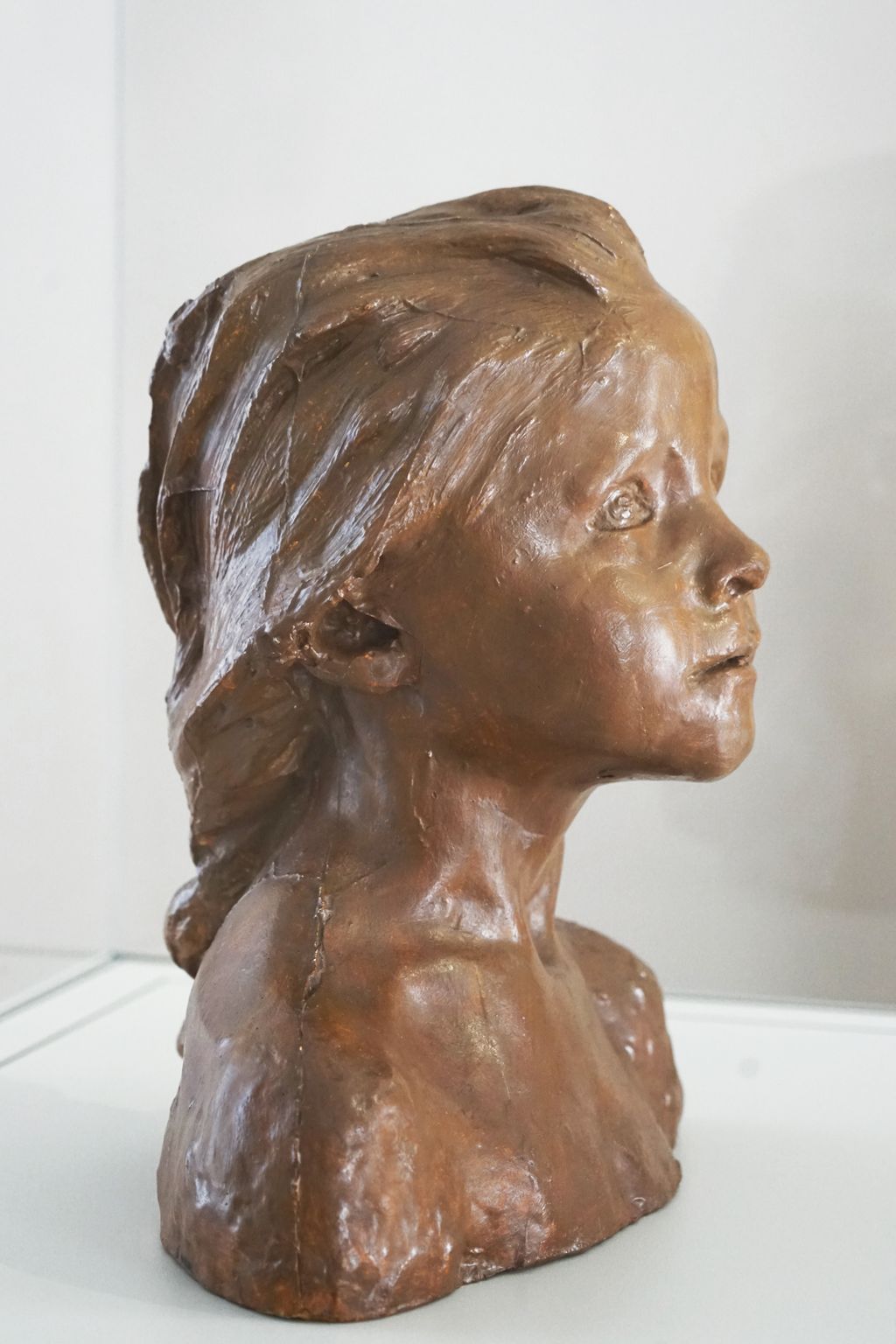
Profile of the patinated plaster of The Little Châtelaine at Nogent-sur-Seine. Photograph by Jean-Pierre Dalbéra. Image source. CC BY 2.0. Resized from the original photograph.
 by Tom Gurney
Tom Gurney BSc (Hons) is an art history expert with over 20 years experience
Email: tomgurney1@gmail.com / Phone: +44 7429 011000
The Little Châtelaine: Introduction
In the patinated plaster of The Little Châtelaine at Nogent-sur-Seine, the head is almost square to the shoulders. The eyes are already looking up. Dark hollows under the upper lids throw the rounded centres of the eyes into relief. The mouth stays slightly open, and the cheeks hold their fullness even as the chin rises clear of the neck. The uneven lower edge of the plaster cuts the chest off close below the collarbones. From that broad, low edge to the narrow space beneath the chin, the bust gathers itself into a movement so slight that it could be the beginning of a question. [1]
Turn to the side and the pose becomes easier to read. The chest remains nearly upright while the forehead, nose and mouth make a profile tipped back just enough to lift the face. The hair follows a different course. It sweeps away from the brow, crosses above the ear and drops in a heavy plait against the neck and upper back. Its end comes down close to the cut of the bust. From the front, the head seems drawn up by the gaze. From the side, the descending plait gives the head a line of weight. Claudel could alter that balance by changing the hair, the finish and the way she ended the bust. [1] [2]
Claudel began the portrait of six-year-old Marguerite Boyer at the Château de l’Islette in 1892. The composition went on to take different forms in plaster, bronze and marble, and it appeared in Brussels and Paris under different titles in 1894. The Nogent plaster and the marbles in Paris and Roubaix preserve the raised face, the small opening of the lips and the upward look. The things that surround those features, including the shadows at the eyes and the amount of stone left below the shoulders, can make the same expression seem more searching or more composed. [1] [2] [3] [4]
At a Glance
- French titleLa Petite Châtelaine
- SitterMarguerite Boyer
Camille Claudel in context
Old Hélène
c. 1881–82Sakuntala
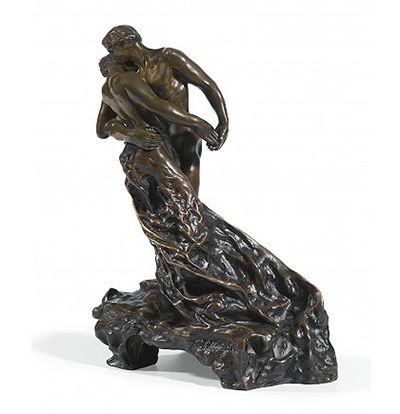
Plaster shown in 1888The Waltz
Developed c. 1889–93The Little Châtelaine
First model c. 1892–93The Gossips
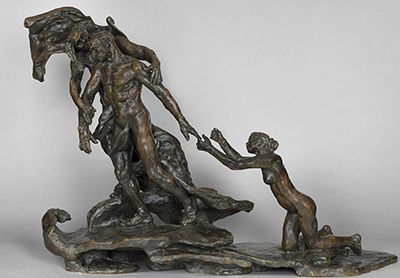
Described in 1893, shown in 1895The Mature Age
First and second versions, c. 1894–99The Wave
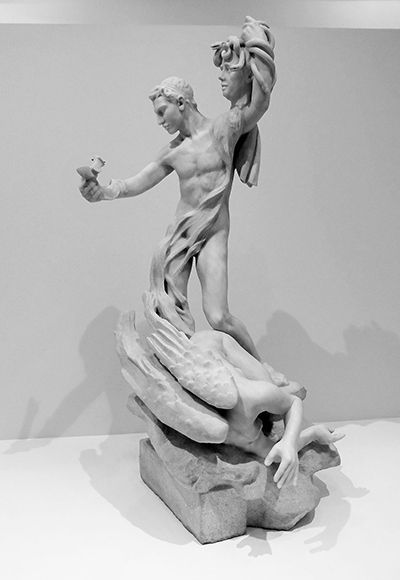
Plaster shown in 1897, mixed-material object dated 1897–1903 (?)Perseus and the Gorgon
Nogent design and marble, c. 1897–1902The Wounded Niobid
Modelled in 1906Contents
- Marguerite Boyer at l’Islette
- Contemplation in Brussels and a portrait in Paris
- Braids in the plaster and the 1895 marbles
- The Fontaine marble at Roubaix
- The Roubaix marble beside Degas and Renoir
Marguerite Boyer at l’Islette
The Château de l’Islette stands near Azay-le-Rideau in Touraine. Auguste Rodin and Camille Claudel both stayed there. Rodin travelled in the region while researching his monument to Honoré de Balzac, looking for records and a living model for the writer. In September 1892 Claudel stayed at the château on her own, according to the chronology prepared for the Getty and Art Institute of Chicago exhibition. The owners’ granddaughter, Marguerite Boyer, became the sitter for a work of Claudel’s own. Claudel began with a model in clay. The Musée Camille Claudel dates its plaster to 1892–93 and places the completion of the first plaster in 1893. [1] [5] [6]
A châtelaine is the lady of a château, and the title gives the child a place in that household without naming her. Little in the bust itself refers to rank or setting. The shoulders carry no dress, the hair is pulled back from the face, and there is no object in the child’s hands to suggest an occupation or a game. Claudel gives the adult viewer one clue to the encounter. The angle from which a small child might look at a standing sculptor survives in the figure’s raised face. The Musée Rodin reads the pose as the girl looking up at the artist at work. The sculpture leaves the space she looks into open, so that the same posture can be seen as waiting, listening or trying to understand. [1] [7]
Claudel had exhibited portraits since the early 1880s and had often drawn on people she knew for sitters. Her painted plaster Paul Claudel at Sixteen Years Old, for example, is an earlier study of a young face whose attention seems fixed somewhere beyond the viewer. In the Châtelaine, the short span between the shoulders and chin and the visibly lifted eyes make that distance feel more immediate. The child appears near enough for an exchange, even as her line of sight leads above ours. [1] [2]
Contemplation in Brussels and a portrait in Paris
The first exhibition of La Libre Esthétique in Brussels lists Claudel’s bust as no. 95, Contemplation. The entry follows The Waltz and precedes Le Psaume and Le Premier Pas. The catalogue gives the material and owner of The Waltz in the preceding entry, while Contemplation occupies one short line with no material specified. The Musée Camille Claudel associates the Brussels showing with the first plaster version. Its surviving Nogent example is patinated plaster, inventory 2010.1.12, measuring 32.3 × 28.9 × 21.2 centimetres. [1] [5] [8]
At the Société Nationale des Beaux-Arts Salon in Paris later that year, the illustrated catalogue lists Portrait d’une petite châtelaine as no. 36 and describes it as a bronze bust. The 2023 Getty exhibition chronology also records bronze for Paris. The Nogent museum’s account carries the story of the first plaster from Brussels through to Paris. The printed Paris entry provides firmer evidence for what the Salon advertised, while the identity of the individual bronze remains open. It appeared alongside Le Dieu envolé, a plaster statuette of a kneeling woman with her face raised. One sculpture gave the upward movement a whole body. In the other, the tilt of a head and the shape of the eyes had to carry it. [1] [5] [9] [10]
The titles offered viewers two points of entry. Portrait d’une petite châtelaine promises a likeness and suggests where the sitter belongs. Contemplation asks what kind of attention the face expresses. Two contemporary reviewers of the Paris Salon dwelt on the second question. Gustave Geffroy described eyes with an almost feverish intensity and read the expression as that of a child anxious to know. Roger Marx emphasised both the vitality of the face and the extraordinary fixity of the gaze. Their descriptions bring out a tension that persists across the busts. A girl can hold still for her portrait while appearing to strain towards something she has just become aware of. [1] [8] [9] [10]
The Musée Camille Claudel sees in that searching expression a departure from conventional Salon images of children and connects it to Symbolism. The title Contemplation helps explain the reading. An ordinary upward glance can suggest a state of mind once Claudel removes the details that would tell us exactly what prompted it. Getty’s exhibition guide finds confidence and curiosity where the Nogent account stresses unease. The open lids and lifted head can support either reading. Geffroy’s description sounds especially apt beside the dark, sharply marked eyes of the Nogent plaster, where the patina and the small shadows help each eye register even at the scale of a bust. [1] [2] [10]
Braids in the plaster and the 1895 marbles
The Musée Rodin dates four marbles to 1895–96 and singles out the hair as the most variable feature. Getty’s exhibition guide identifies a privately held Little Lady with Straight Plait of 1895. The braid follows the back of the neck closely. In the Getty’s front view, the hairline is softly modelled and the shoulders form a low, unbroken sweep, making the face seem to rise cleanly out of the bust. Shallow transitions around the cheeks and between the nose and lips keep the expression concentrated in the eyes. The marks around their centres show as small interruptions in pale stone. In the Nogent plaster, deeper-looking recesses and the brown patina give the eyes and parted lips a stronger contrast in the museum photographs. [1] [2] [7] [6]
The Musée Rodin marble, S.01007, is another 1895 execution. Its collections portal lists it as La Petite Châtelaine ou Jeanne enfant, gives dimensions of 34.3 × 28.4 × 22 centimetres and records Claudel’s signature beneath the base. From the front, the stone picks up a shine on the forehead, at the top of the cheeks and across the chest. Below the brows the lids cup the upward-facing eyes, with the pupils set high. From the side, this marble’s thicker braid bends outward at the back and gathers in a rounded end near the bottom of the shoulder. The ridges that pull the hair away from the face gather into a more emphatic shape behind the ear. The changing profile lets a viewer follow the passage from the smooth face to those deeper furrows. [3] [7]
The Paris and Nogent photographs also make the truncation easy to compare. In the Rodin marble, a clean edge closes the wide sweep of the shoulders. In the plaster, the corresponding surface is irregular, with small ridges and depressions catching the light along the chest and at the lower corners. Both busts place a slender neck on a wide piece of support, but the turn from smooth cheek to rougher torso is sharper in the patinated plaster. In the marble the sheen carries across the neck and chest, and the strongest breaks come at the lower edge, the hair and the features. These variations in finish change where the eye slows down as it moves over the surface. [1] [3]
Bronze also remained part of the composition’s history after the 1894 Salon. The Musée Joseph-Denais at Beaufort-en-Vallée holds a separate bronze dated 1895, BF 3294, given by Alphonse de Rothschild in 1896. At 32 centimetres high it is close in scale to the Nogent plaster. In 1895 the Paris Salon listed a marble belonging to Joanny Peytel as no. 20. A catalogue title shared between a bronze and a marble can record the public life of a composition, while a date, material, owner or inventory number distinguishes the object a viewer actually encountered. [1] [5] [11]
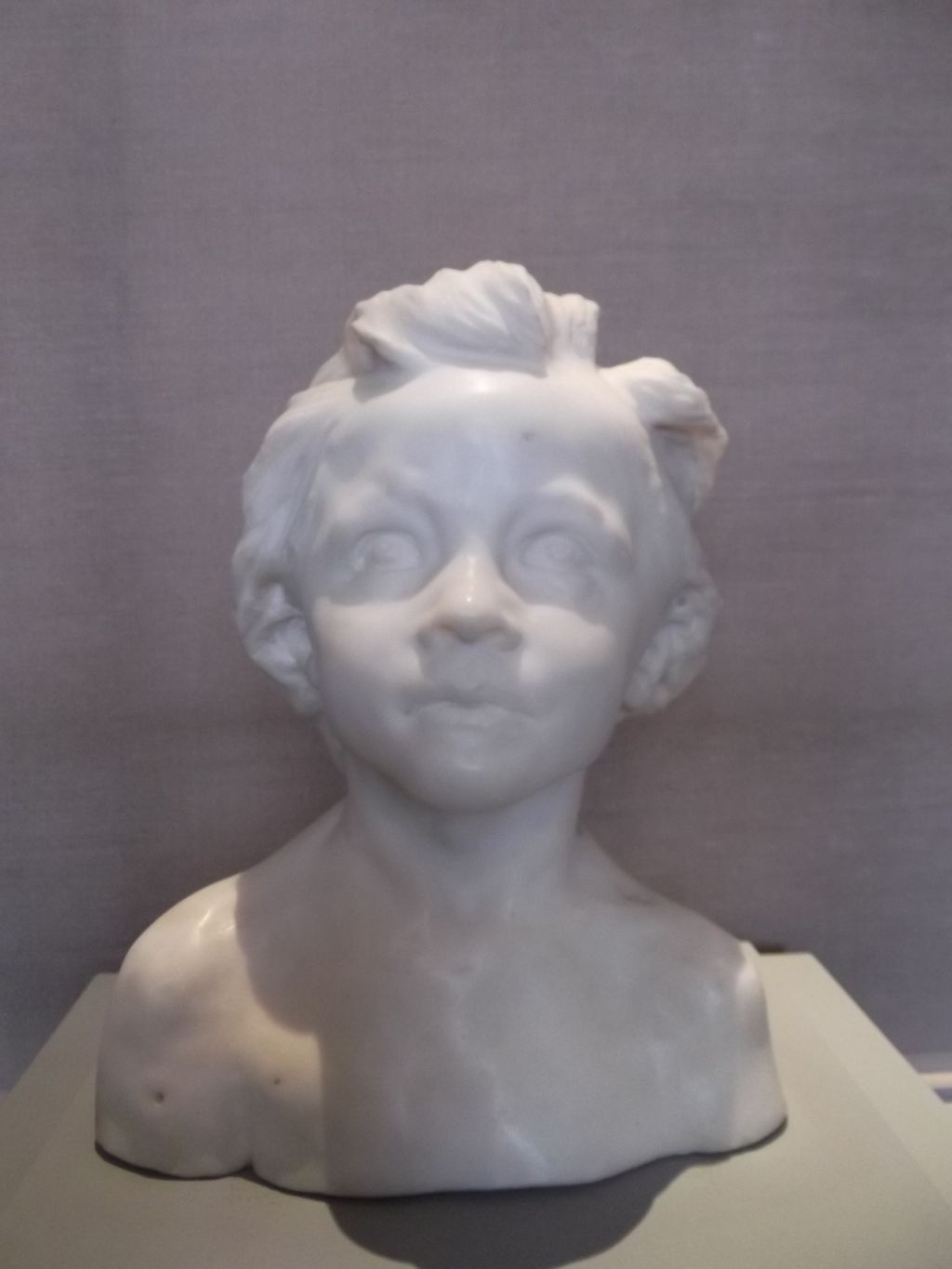
Marble version of The Little Châtelaine photographed at the Musée Rodin. Photograph by couscouschocolat. Image source. CC BY 2.0. Resized from the original photograph.
The Fontaine marble at Roubaix
The version commissioned by Henri Fontaine and now at La Piscine in Roubaix takes more room around the same face. The exhibition loan record identifies it as inventory 996-5-1 and gives dimensions of 44 × 36 × 29 centimetres. La Piscine traces the commission to an introduction by the sculptor Antoine Bourdelle. The Getty chronology identifies Fontaine’s marble in the 1896 Paris Salon as no. 24bis and records its appearance at Siegfried Bing’s Salon de l’Art Nouveau that year as no. 788. A century later, in 1996, La Piscine acquired it with the help of a public subscription. [4] [5] [12] [13]
Here the plait has loosened into strands deeply separated from one another. Gaps open through the hair, so that a moving viewer sees slivers of background where the straight plait offered a single line of marble. The chest and shoulders still end low, but they rise out of a spreading, roughly cut bed of stone. A ridge in front continues past the shoulder and lifts to one side. It keeps the smooth chest and throat in sight while providing a second, much broader outline below them. The finished face is framed by two passages where the material takes very different forms. Above it the worked hair lets light through the gaps. Below it the broad stone retains an uneven surface and catches light on its raised edges. [4] [6] [14]
The face is polished, and the marble was partly hollowed to let more light into the stone. The finish diffuses the shift from cheek to jaw, while shadows between the strands keep the hair distinct. Against that pale, continuous surface, the eyes can look less sharply bounded than in the Nogent plaster. The lift is still clear from the raised chin and the direction of the gaze. In the plaster the brow and the cavities under it do much of that work. In the Fontaine marble the entire turn of the head seems to carry the eyes upward, and the rough stone at the base gives the viewer a broad, steady line from which to see it. [1] [2] [4] [14]
In Clotho, the cords of hair descend around an older figure and can appear to hold her in place. Claudel used the hair of the child in the Fontaine marble to open the silhouette up to light, while the heavier braid of the Nogent plaster stays close against the back. Walk from the front towards the side of either Châtelaine and the face gradually yields to the profile, the lifted chin and the pattern behind the ear. The direction of the look is constant. How far it seems to reach changes with the stone or plaster that surrounds it. [1] [14] [15]
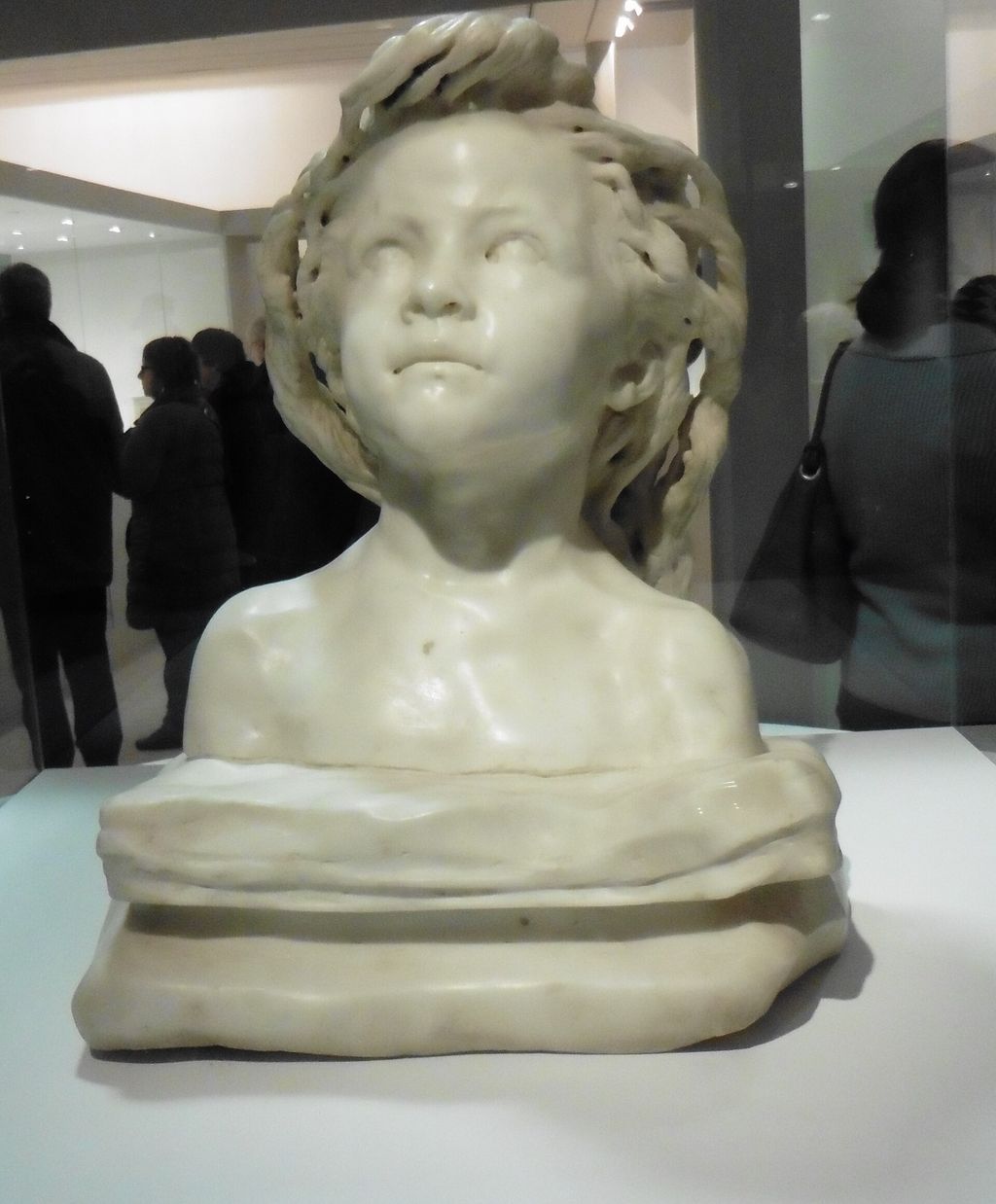
A marble Little Châtelaine on display at La Piscine, Roubaix, in 2015. Photograph by Pierre André Leclercq. Image source. CC BY-SA 4.0. Resized photograph, shared under CC BY-SA 4.0.
The Roubaix marble beside Degas and Renoir
In 2024 La Piscine used its marble to organise an exhibition about childhood. The museum placed The Little Châtelaine in conversation with works from the national collections, including Renoir’s Boy with a Cat and Degas’s Little Dancer Aged Fourteen. The museum presented the pairing as a meeting of distinct modern images of children. That invitation gives the bust a different role from the one it plays in a survey of Claudel’s career. Instead of following the sculptor from one portrait to the next, a visitor could look at the different ways three artists made a young person hold a pose. [16]
Claudel brings an entire gesture into the tilt of a head. The eyes lead the viewer above the edge of the bust, leaving the object of the girl’s attention in the room. Degas, by contrast, can distribute the stance through a standing figure, down to her feet and back to the arms gathered behind her. His original wax, exhibited in 1881, used real hair and clothing. The Orsay example is a bronze produced after his death and retains a textile tutu and a ribbon. The two sculptures therefore offer sharply different treatments of the details a viewer recognises as hair or fabric. In the Fontaine marble the braid, skin and any clothing at the shoulder all depend on changes in a continuous carved surface. [12] [16] [17]
Renoir’s painted child introduces a third point of comparison. The cat gives the boy something to hold and the artist another form against which to place the child’s arms. Claudel’s sitter has fewer things around her to explain her look. Even the neckline gives way rapidly to the small rise of a shoulder. That economy helps account for the different readings the bust sustains. A portrait label leads back to a particular child and sitting. An exhibition on childhood can make the same inclination of the head feel like a much less specific moment of watchfulness. [5] [6] [16]
The exhibition also makes clear how much a room can change an encounter with a sculpture. A visitor looking across at a standing figure is likely to judge the marble’s scale before noticing its polish. A visitor approaching a case for a closer look may notice the braid first. The 2024 display is one documented context for the Roubaix marble, alongside its earlier history of ownership, public acquisition and loans. Each context supplies a different starting point for seeing the same stone. [4] [12] [13] [16]
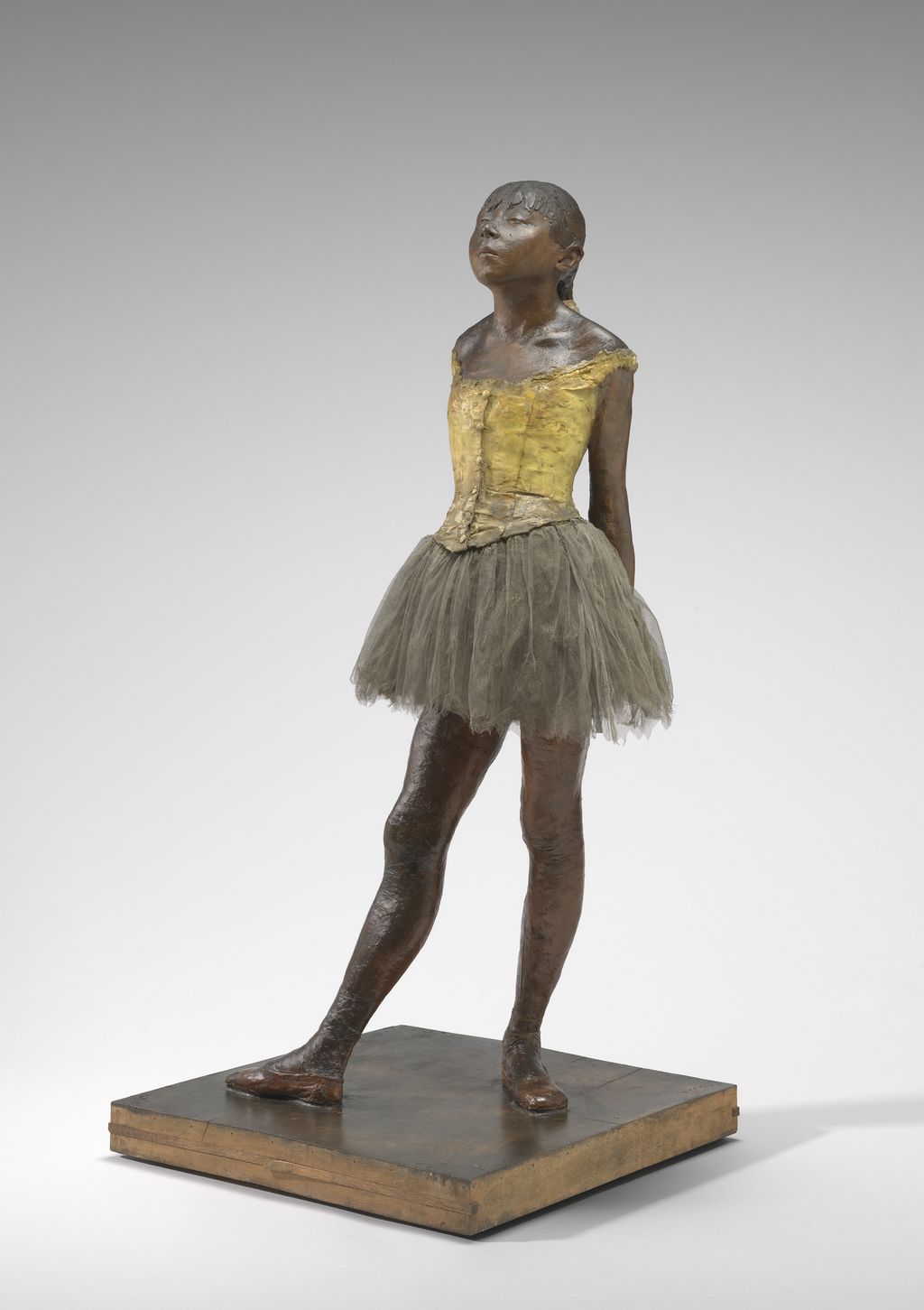
Edgar Degas, Little Dancer Aged Fourteen, 1878–81, original wax and mixed materials, National Gallery of Art, Washington. The 2024 Roubaix exhibition showed the Orsay bronze. National Gallery of Art, Washington, Collection of Mr. and Mrs. Paul Mellon. Image source. CC0 / Public domain. Resized from the museum image.
Artworks directory
| Name | Date | Medium |
|---|---|---|
| The Mature Age | 1894–99 | Sculpture |
| The Waltz | c. 1889–93 | Sculpture |
| Sakuntala | 1886–88 | Sculpture |
| The Little Châtelaine | 1892–93 | Sculpture |
| The Gossips | c. 1893 | Sculpture |
| The Wave | 1897–1903 | Sculpture |
| Perseus and the Gorgon | c. 1897–1902 | Sculpture |
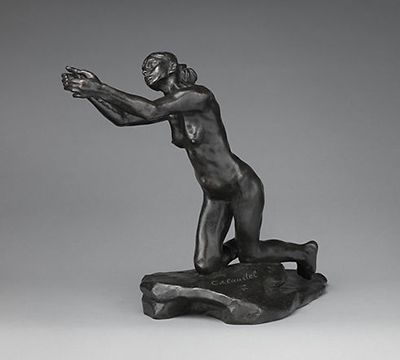
| The Implorer | c. 1894–99 | Sculpture |
| Clotho | 1893 | Sculpture |
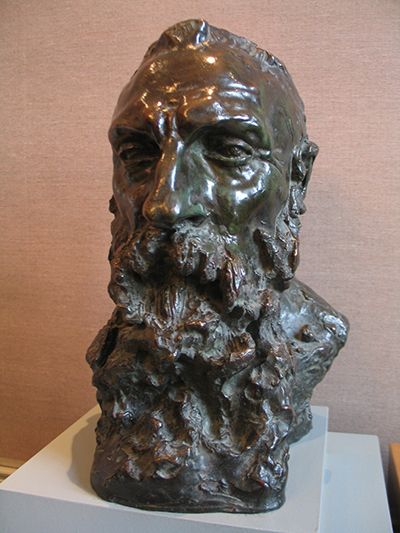
| Bust of Auguste Rodin | c. 1886–89 | Sculpture |
| Paul Claudel at Sixteen Years Old | c. 1882–87 | Sculpture |
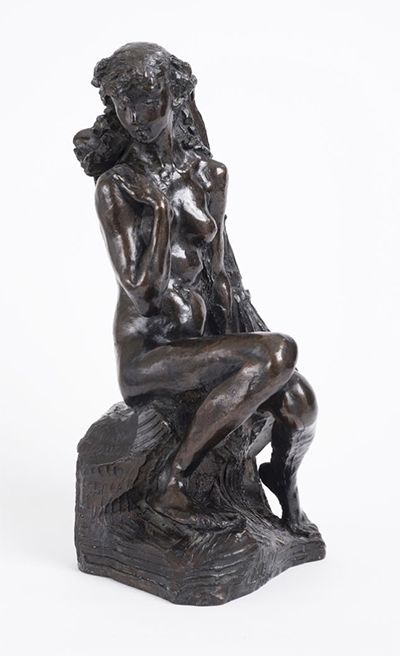
| Young Girl with a Sheaf | c. 1886–87 | Sculpture |
| Giganti | c. 1885 | Sculpture |
| Crouching Woman | c. 1884–85 | Sculpture |
| The Hungry Dog | c. 1893 | Sculpture |
| Old Hélène | c. 1881–82 | Sculpture |
| Fortune | c. 1902–05 | Sculpture |
| The Wounded Niobid | 1906 | Sculpture |
| The Siren, or The Flute Player | c. 1904–05 | Sculpture |
| Deep Thought | c. 1898 | Sculpture |
| Dream by the Fireside | c. 1899 | Sculpture |
| Paul Claudel at Thirty-Seven | 1905 | Sculpture |
| Portrait de Madame Claudel | c. 1883 | Sculpture Musée Camille Claudel. |
| Jeune Femme aux yeux clos | c. 1885 | Sculpture Musée Camille Claudel. |
| Ferdinande de Massary | 1888 | Sculpture Musée Camille Claudel. |
| Léon Lhermitte | 1889 | Sculpture Musée Camille Claudel. |
| Étude de main gauche | c. 1889 | Sculpture Musée Camille Claudel. |
| Vieil aveugle chantant | c. 1894 | Sculpture Musée Camille Claudel. |
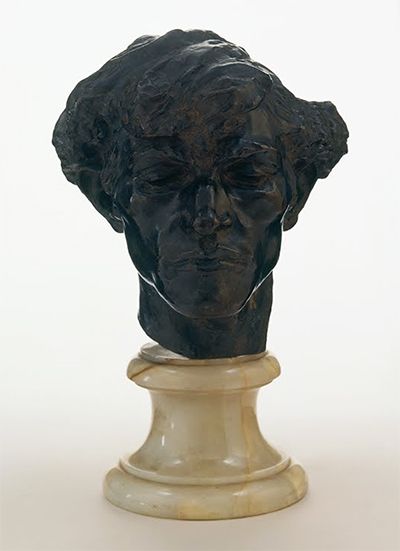
| Tête de vieillard | c. 1890 | Sculpture Musée Camille Claudel. |
| Étude pour la tête d’Hamadryade | c. 1895 | Sculpture Musée Camille Claudel. |
| Aurore | c. 1900 | Sculpture Musée Camille Claudel. |
Discussion
Look again at the images and ideas explored in The Little Châtelaine. These editorial prompts invite your observations.
Reader Insights
How does the turn of the head change the expression from different viewpoints?
Where does the handling of hair change the light in different versions?
Join the Conversation
Share a detail, comparison or question about The Little Châtelaine below.
References
- Musée Camille Claudel, La Petite Châtelaine, patinated plaster 2010.1.12. View source.
- J. Paul Getty Museum, Camille Claudel, exhibition guide and caption for The Little Lady with Straight Plait. View source.
- Musée Rodin, La Petite Châtelaine ou Jeanne enfant, collections portal and photographs of S.01007. View source.
- Gouvernement du Québec, loan record for Camille Claudel et Rodin, 2005, La Piscine marble 996-5-1. View source.
- Emerson Bowyer and Anne-Lise Desmas, eds., Camille Claudel, 2023, chronology, pp. 14–16. View source.
- Chloé M. Pelletier, “From Portrait to Allegory: Claudel’s The Little Lady,” in Camille Claudel, 2023, pp. 211–225. View source.
- Musée Rodin, La petite Châtelaine, interpretive entry and marble versions. View source.
- La Libre Esthétique, catalogue of the first exhibition, Brussels, 1894, scan p. 17, entries 94–97. View source.
- Société Nationale des Beaux-Arts, illustrated Salon catalogue, Paris, 1894, sculpture entries 35–36. View source.
- Gustave Geffroy and Roger Marx, 1894 Paris Salon reviews, transcribed in Alain Gauthier, Les Images de Camille Claudel. View source.
- Musée Joseph-Denais, La petite châtelaine, bronze BF 3294. View source.
- La Piscine, 2025 exhibition dossier, catalogue excerpts on Claudel, Bourdelle and Henri Fontaine. View source.
- La Piscine, museum history and acquisition of the Fontaine marble. View source.
- Valentine Pigeolet and Elise Gilles, “Edgar Degas et Camille Claudel, une influence dès les années 1880 ?”, fig. 14 and discussion of the Roubaix marble. View source.
- Musée Rodin, Camille Claudel artist essay, section on the ages of life and the comparison with Clotho. View source.
- French Ministry of Culture and Musée d’Orsay, 150 years of Impressionism, exhibition dossier for Roubaix. View source.
- Musée d’Orsay, Petite danseuse de quatorze ans, collection record RF 2137. View source.