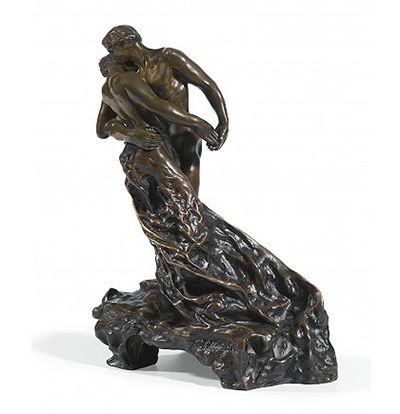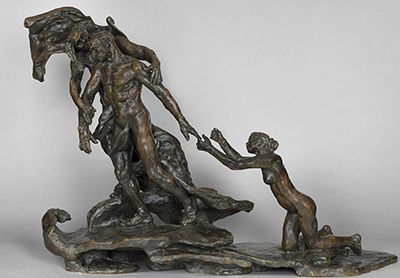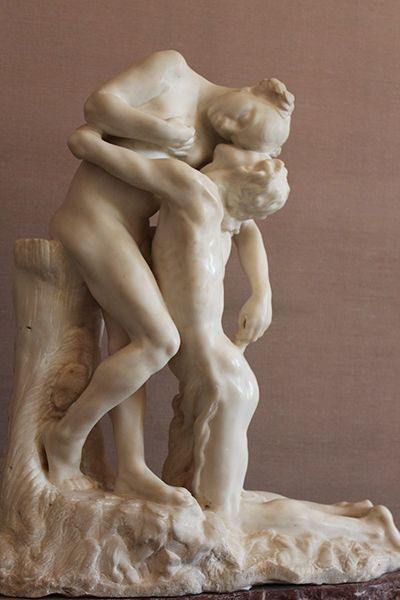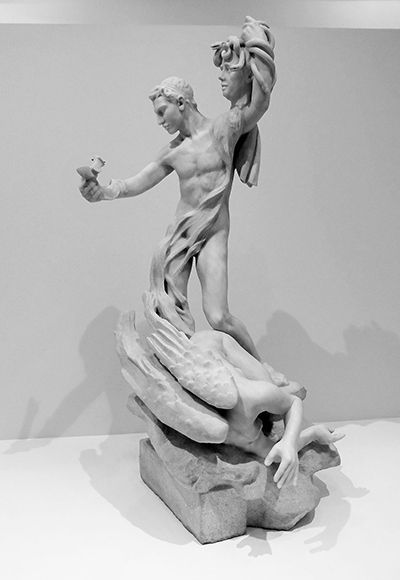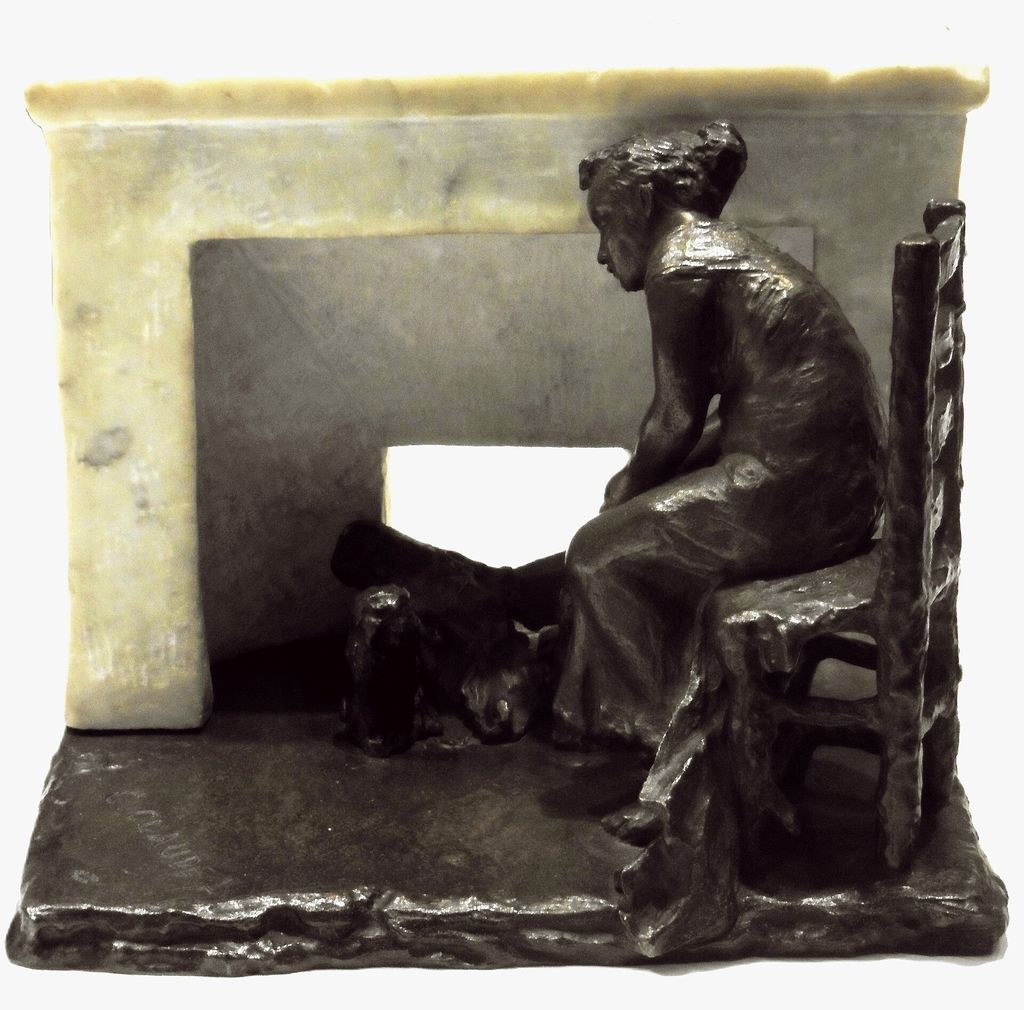
A bronze and marble example of Dream by the Fireside photographed at La Piscine, Roubaix, in 2015. Photograph by Pierre André Leclercq. Image source. CC BY-SA 4.0. Resized photograph, shared under CC BY-SA 4.0.
 by Tom Gurney
Tom Gurney BSc (Hons) is an art history expert with over 20 years experience
Email: tomgurney1@gmail.com / Phone: +44 7429 011000
Dream by the Fireside: Introduction
A woman has drawn a chair close to a fireplace and bent her head towards the logs. In Camille Claudel’s Dream by the Fireside (Rêve au coin du feu), the woman, chair and fireplace take up about thirty centimetres from side to side. Claudel conceived the sculpture around 1899 and returned to the subject in different materials. In the bronze-and-marble example at the Musée Camille Claudel in Nogent-sur-Seine, the light stone of the surround picks out the woman’s lowered profile. The chair stands just to one side, leaving the hearth open to view. [1]
At a Glance
- French titleRêve au coin du feu
Camille Claudel in context
Old Hélène
c. 1881–82Sakuntala
Plaster shown in 1888The Waltz
Developed c. 1889–93The Little Châtelaine
First model c. 1892–93The Gossips
Described in 1893, shown in 1895The Mature Age
First and second versions, c. 1894–99The Wave
Plaster shown in 1897, mixed-material object dated 1897–1903 (?)Perseus and the Gorgon
Nogent design and marble, c. 1897–1902The Wounded Niobid
Modelled in 1906Contents
- The woman, the chair and the hearth
- What the 1900 catalogue records
- The marbles for Maigret and Rothschild
- Eugène Blot’s edition and the nightlight
The woman, the chair and the hearth
The chair back rises almost to the woman’s head. Its upright posts give a measure of how far forward she leans. Her back rounds away from them, her feet remain on the floor and one arm follows the line of her thigh towards her knee. Her forehead meets the stone below the mantel’s upper edge. Seen from the front of the hearth, the diagonal from shoulder to temple stands out against the curve of the back and the near vertical of the skirt below the knee. Small ridges on the dress catch the light where the cloth pulls over the hip or bunches near the seat. A loose fold drops over the edge of the chair and nearly reaches the floor. [1]
Claudel made the lintel broad and the outer face of the surround relatively plain. Low down, the smaller opening behind the logs gives the fireplace depth. The bronze floor extends far enough to carry the chair legs and the woman’s feet, with a rough front edge that cuts across the scene like the edge of a section through a room. The eye can travel from the logs to the lowered face and from the face back to the logs. In a group so small, that short interval gives the woman’s attention a visible direction. Her dress, the chair and the hearth supply enough of the room for a viewer to recognise the habit of sitting close to a fire. [1]
The furniture also separates this work from Deep Thought, another hearth scene that Claudel had already conceived by about 1898. In that sculpture a woman kneels squarely in front of the opening, bows her head and raises both hands to the mantel. Dream by the Fireside shifts the weight onto a seat and moves the woman to the edge of the opening. Both figures are absorbed in the hearth, but the kneeling woman’s reach closes off much of the space between body and fireplace. The seated woman leaves a space beside her from which the viewer can follow her gaze. [1] [2]
What the 1900 catalogue records
At the Paris Exposition Universelle of 1900, the two hearth subjects occupied consecutive entries in the official fine arts catalogue. La profonde Pensée was no. 139 and Le Rêve au coin du feu was no. 140. The catalogue describes each as a marble statuette. Gustave Geffroy discussed the two hearth statuettes in his review of the Décennale, published in 1901. He singled out the robust grace and vitality of Dream by the Fireside and extended that praise to the life Claudel could give to a fragment as well as to a finished sculpture. The comparison makes sense of the way a cropped interior can feel complete when the pose and its setting are so closely related. [3] [4]
A plaster version also enters the documentary record. In her 2018 doctoral study, Marie Gevart-Dekaeke identifies a plaster version and describes the 1900 exhibit as plaster. The fair’s catalogue explicitly says marble. It gives neither dimensions nor an owner for no. 140, so the catalogue establishes how the statuette was listed and leaves its identity among the surviving versions open. The plaster belongs to the history of the composition, and its whereabouts and exhibition history remain unclear. [3] [5]
The marbles for Maigret and Rothschild
The Musée Camille Claudel records marble versions made for the Countess de Maigret and for Alphonse de Rothschild. Rothschild gave his to the museum at Draguignan in 1903. Recorded in an inventory of his gifts as Au coin de l’âtre, it is signed and measures 26 centimetres high, 31 wide and 24 deep. The Draguignan work is carved entirely in marble, so the figure and her surroundings share the colour of the stone. Fine lines in the floor suggest tiles, and the carved supports for the logs take the form of lions. The Maigret marble, identified by Galerie Malaquais as San Francisco’s Legion of Honor accession 2018.88, varies the shape of the chair and mantel and gives the lions less definition. These changes affect where the scene comes into focus. In the Draguignan marble, the small marks on the floor and the details of the hearth reward a look below the figure’s face. [1] [6] [7]
From 1 February to 1 April 2025, the Musée des Beaux-Arts in Draguignan showed the Rothschild marble alongside two loans from Nogent representing variations on the hearth subject. The temporary grouping put the differences in material in view. The stone of the Rothschild marble lets the light carry across the dress and fireplace, with incised lines and shadows marking the divisions. On Nogent’s mixed example, the pale surround divides from the bronze at the shoulder and forehead and again where the jambs meet the floor. The choice of material changes which edges are visible at first glance. At the base, where the skirt and feet meet the floor, the bronze still allows the folds to blend into the room around them. [1] [6] [8]
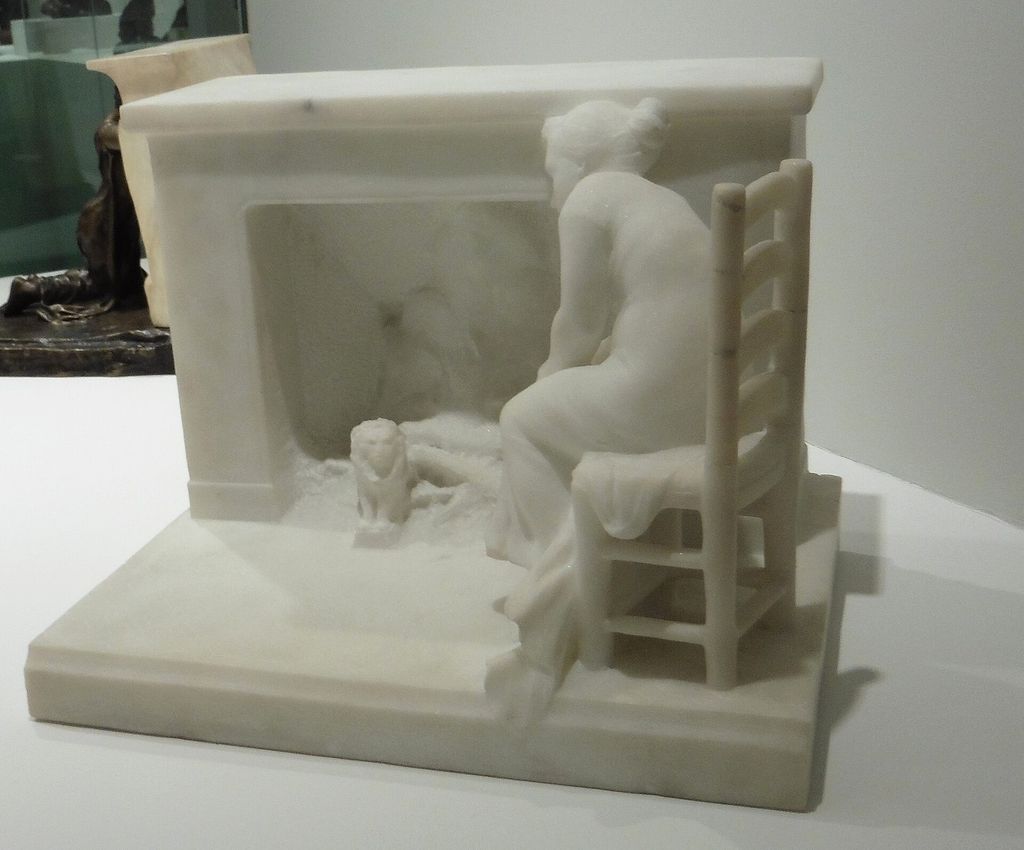
A white stone version of Dream by the Fireside photographed at La Piscine. The chair and hearth are carved in the same pale material. Photograph by Pierre André Leclercq. Image source. CC BY-SA 4.0. Resized photograph, shared under CC BY-SA 4.0.
Eugène Blot’s edition and the nightlight
The catalogue of Eugène Blot’s joint exhibition of Claudel and Bernhard Hoetger, held at his Paris gallery from 4 to 16 December 1905, calls the work Au Coin du Feu. It is item 4 under the heading Bronzes. That line carries no edition limit. Nearby, item 6, Intimité, the title Blot used for Deep Thought, carries a limit of fifty. The Musée Camille Claudel reports a total of sixty-five examples of Dream by the Fireside and describes an edition in bronze as well as in marble and bronze. The catalogue’s item number identifies the entry in the show. Surviving foundry marks identify individual objects, and the museum’s total describes the edition as a whole. [1] [2] [9] [10]
At Nogent, the mixed example measures 22 centimetres high, 30 wide and 24.5 deep and is dated to around 1905 as a Blot cast. The museum bought it from Reine-Marie Paris de La Chapelle in 2008 and records it as 2010.1.20. Stockholm’s Nationalmuseum owns another, NMSk 2418, a sand cast with a white, grey-veined marble fireplace and a Paris foundry stamp that includes the number 16. The Getty’s exhibition guide describes a Galerie Malaquais loan as alabaster and bronze. Even among mixed examples, the colour and veining of the surround can alter the balance of light around the figure. The Getty groups the hearth scene with Claudel’s sketches from life, small sculptures that make everyday activities their subject. [1] [11] [12]
Some examples were fitted with a small lamp in the hearth so that they could serve as nightlights. Blot later recalled putting a red bulb behind the logs. The Denver Art Museum holds a version in coloured marble and bronze with a functioning electric light. Its base carries both Claudel’s signature and Blot’s Paris stamp. With the lamp lit, the glow comes from the very place towards which the woman lowers her head. The small group can light a room while depicting one of its quietest moments. [1] [7] [13]
A closer look at Dream by the Fireside
Annotated Details from Dream by the Fireside
A bronze and marble example of Dream by the Fireside photographed at La Piscine, Roubaix, in 2015. Photograph by Pierre André Leclercq. Image source. CC BY-SA 4.0. Overview numbered and details cropped. Both are shared under CC BY-SA 4.0.
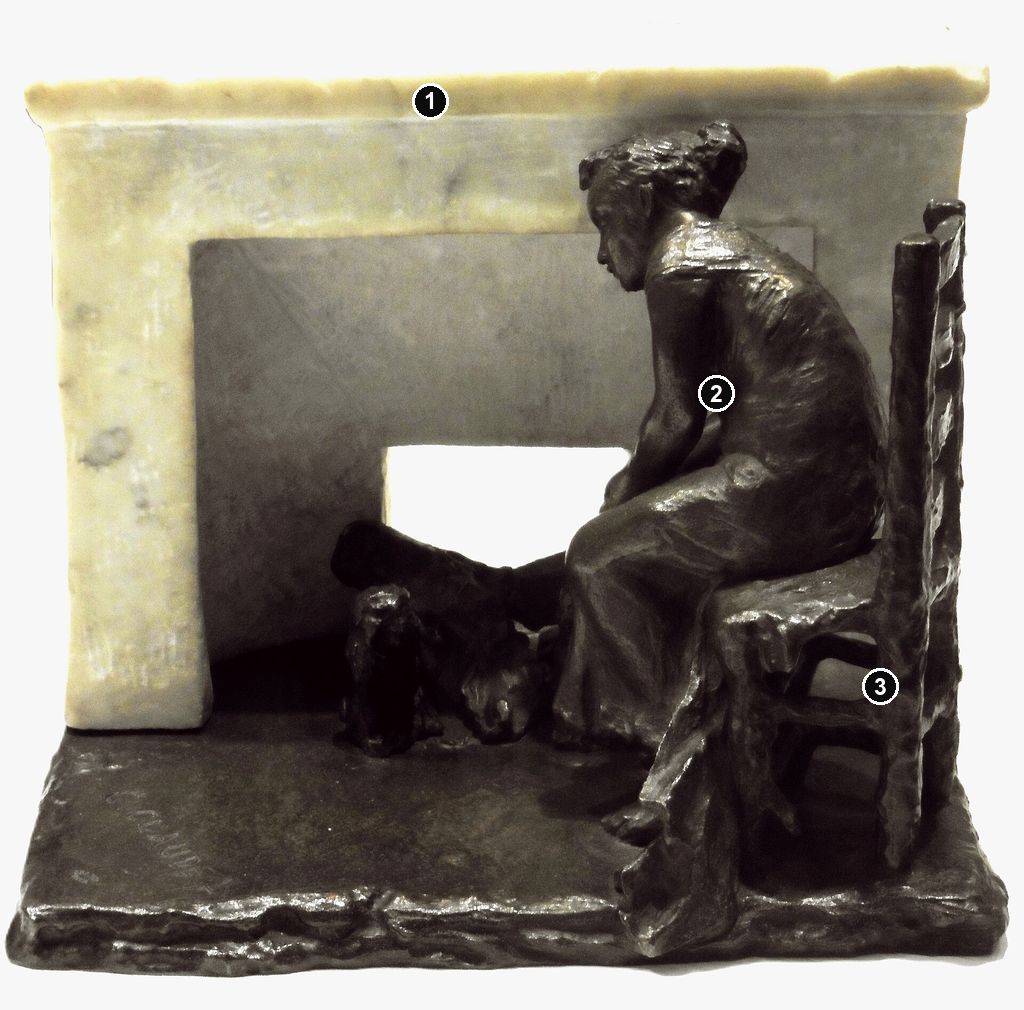
Details from DREAM BY THE FIRESIDE
Follow the numbered details, then return to the complete view.
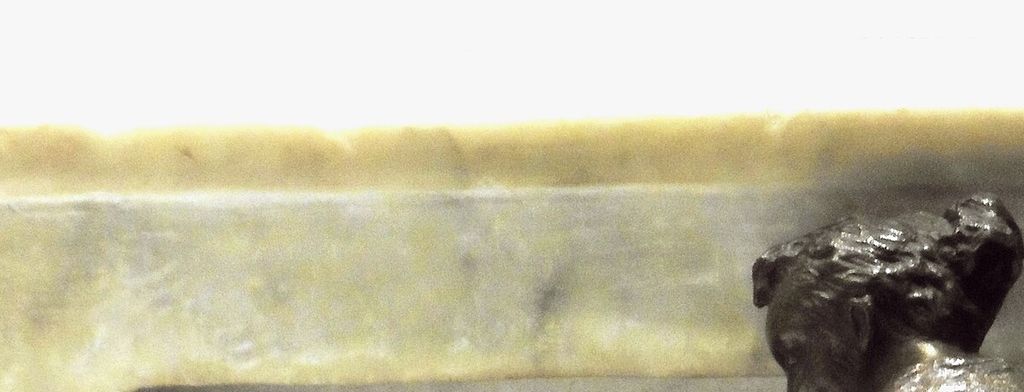
The pale mantel
The long pale beam marks the top of the fireplace and frames the darker space beneath it.
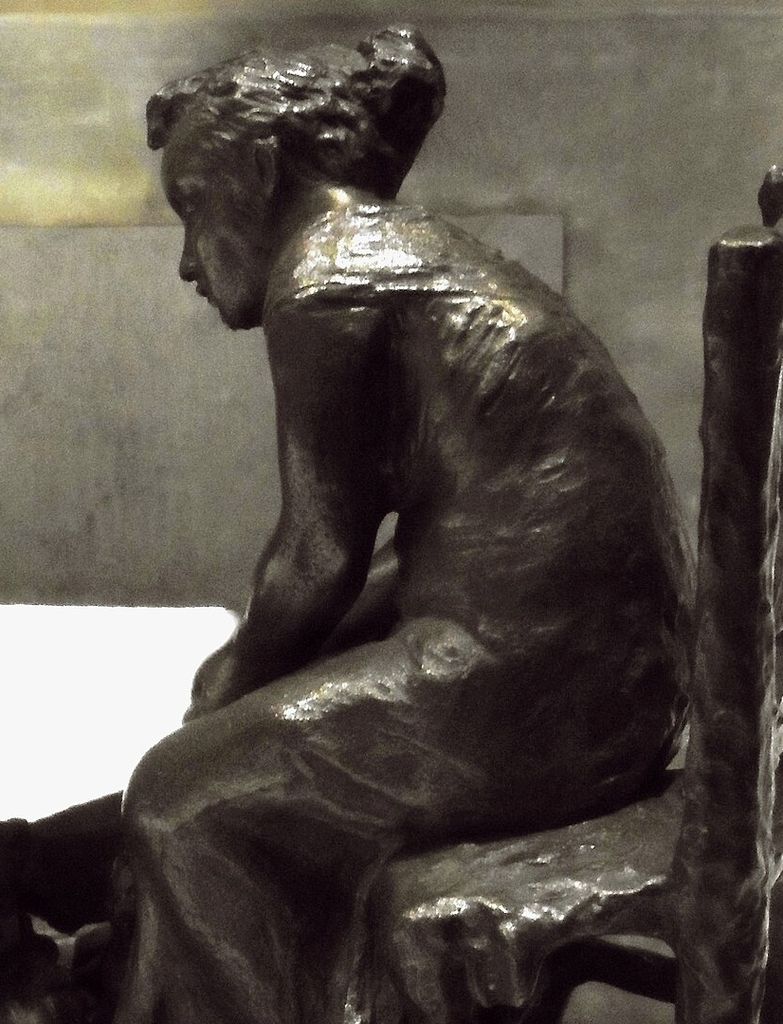
The seated figure
The seated figure leans forward into the space beside the hearth.
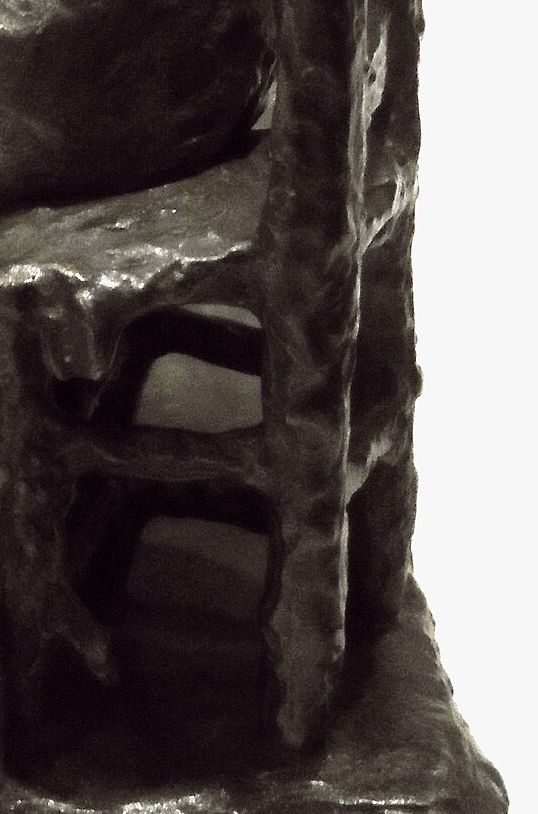
The chair
The uprights and crossbars of the chair remain legible behind the seated figure.
Artworks directory
| Name | Date | Medium |
|---|---|---|
| The Mature Age | 1894–99 | Sculpture |
| The Waltz | c. 1889–93 | Sculpture |
| Sakuntala | 1886–88 | Sculpture |
| The Little Châtelaine | 1892–93 | Sculpture |
| The Gossips | c. 1893 | Sculpture |
| The Wave | 1897–1903 | Sculpture |
| Perseus and the Gorgon | c. 1897–1902 | Sculpture |
| The Implorer | c. 1894–99 | Sculpture |
| Clotho | 1893 | Sculpture |
| Bust of Auguste Rodin | c. 1886–89 | Sculpture |
| Paul Claudel at Sixteen Years Old | c. 1882–87 | Sculpture |
| Young Girl with a Sheaf | c. 1886–87 | Sculpture |
| Giganti | c. 1885 | Sculpture |
| Crouching Woman | c. 1884–85 | Sculpture |
| The Hungry Dog | c. 1893 | Sculpture |
| Old Hélène | c. 1881–82 | Sculpture |
| Fortune | c. 1902–05 | Sculpture |
| The Wounded Niobid | 1906 | Sculpture |
| The Siren, or The Flute Player | c. 1904–05 | Sculpture |
| Deep Thought | c. 1898 | Sculpture |
| Dream by the Fireside | c. 1899 | Sculpture |
| Paul Claudel at Thirty-Seven | 1905 | Sculpture |
| Portrait de Madame Claudel | c. 1883 | Sculpture Musée Camille Claudel. |
| Jeune Femme aux yeux clos | c. 1885 | Sculpture Musée Camille Claudel. |
| Ferdinande de Massary | 1888 | Sculpture Musée Camille Claudel. |
| Léon Lhermitte | 1889 | Sculpture Musée Camille Claudel. |
| Étude de main gauche | c. 1889 | Sculpture Musée Camille Claudel. |
| Vieil aveugle chantant | c. 1894 | Sculpture Musée Camille Claudel. |
| Tête de vieillard | c. 1890 | Sculpture Musée Camille Claudel. |
| Étude pour la tête d’Hamadryade | c. 1895 | Sculpture Musée Camille Claudel. |
| Aurore | c. 1900 | Sculpture Musée Camille Claudel. |
Discussion
Look again at the images and ideas explored in Dream by the Fireside. These editorial prompts invite your observations.
Reader Insights
How does the scale of the chair affect the scene?
Where does the boundary between the hearth and the figure draw your eye?
Join the Conversation
Share a detail, comparison or question about Dream by the Fireside below.
References
- Musée Camille Claudel, Rêve au coin du feu, collection record and photograph, inventory 2010.1.20,. View source.
- Musée Camille Claudel, Profonde pensée, collection record for the Blot bronze and marble,. View source.
- Exposition internationale universelle de 1900, Catalogue général officiel, Group II, Class 9, p. 183, nos. 139–141, Cnum, View scan or read transcription. View source 1. View source 2.
- Gustave Geffroy, “L’Exposition décennale de la sculpture,” La Vie artistique, seventh series, 1901, p. 291, digitised facsimile,. View source.
- Marie Gevart-Dekaeke, La sculpture et l’intime en France (1865–1909), Université Paris Nanterre doctoral thesis, 2018, vol. I, p. 276,. View source.
- Institut national d’histoire de l’art, Rothschild donations inventory for Draguignan, p. 3, Au coin de l’âtre, inventory 255,. View source.
- Galerie Malaquais, Rêve au coin du feu, object dossier with comparative descriptions of the Draguignan and Maigret marbles and Blot’s recollection of the lamp,. View source.
- Musée des Beaux-Arts de Draguignan, (Re) voir Camille Claudel, notice of the 2025 display and Nogent loans,. View source.
- Musée Camille Claudel, 1905 : l’exposition Claudel & Hoetger, dates and venue,. View source.
- Galerie Eugène Blot, Exposition d’œuvres de Camille Claudel et de Bernard Hoetger, December 1905, entries 4 and 6, facsimile at the Musée Camille Claudel,. View source.
- Nationalmuseum, Dream by the Fireside, collection record for Blot cast no. 16, NMSk 2418,. View source.
- J. Paul Getty Museum, Camille Claudel, “Sketches from Life,” caption for the Galerie Malaquais example,. View source.
- Denver Art Museum, Fireside Dream (Rêve au coin du feu), collection record for accession 2025.2 and its electric light,. View source.