 by Tom Gurney
Tom Gurney BSc (Hons) is an art history expert with over 20 years experience
Published on June 19, 2020 / Updated on October 14, 2023
Email: tomgurney1@gmail.com / Phone: +44 7429 011000
The Waltz: Introduction
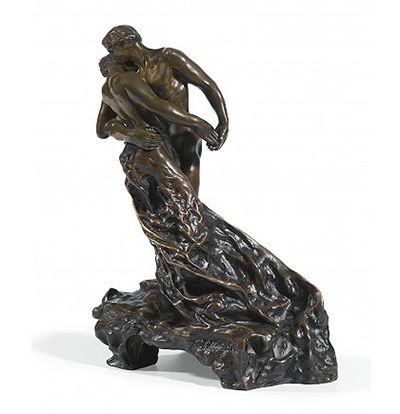
Start with the foot that has left the ground. On the Musée Rodin bronze of Camille Claudel’s The Waltz (La Valse, also Les Valseurs), the man’s left foot rises in the direction of the woman’s trailing skirt. From the side where her back faces us, the two upper bodies seem to rest on a single slant. Her head falls back as his bends towards her. The arm around her waist cuts across the slant, while the joined hands reach into open space on the other side. Look from behind the man and the mass of his back comes forward, his standing leg comes into view, and the space between the lifted foot and the base makes the transfer of weight easier to see. The partners look closest to falling precisely where their grip is clearest. [1] [2]
The figures share a turn, but their bodies take different paths through it. The man inclines towards his partner’s neck while she opens her chest and turns her face away from the viewer. Her bare shoulders catch the light at a different angle from his. Their clasped hands carry the turn out beyond the two torsos, leaving a gap between the arms and bodies that narrows and opens as you go around them. Close to the ground, a second opening appears where the cloth lifts clear of the base. That small interval of light makes the hem seem capable of rising farther. At its far end, the same cloth comes down and meets the surface supporting the group. Claudel makes the skirt seem to fly by giving it somewhere definite to land. [2]
The rough ground matters as much as the legs. Seen from the woman’s side, the block underneath presents an almost upright face, with the ledge carrying the feet jutting out above it. The cloth descends at an angle towards a narrower point of contact. The upright edge gives the eye a fixed line against which to measure the dancers’ tilt. From behind the man, the shoulder blades and spine pick up the diagonal that the skirt makes on the other side. The base also looks more uneven from this angle. Part of the impression of movement comes from this shift between a clearly legible support and a shape that seems to change under the figures. [2]
The 43.2-centimetre bronze in Paris is one of several objects made from this idea. The shape above the dancers’ heads, the angle of a foot and the direction in which the skirt spreads can change from one Waltz to another. The history begins with an entirely nude group. Claudel revised it for a proposed marble, sent the draped plaster to a Salon and went on developing versions that could circulate at a smaller scale. The changes make it possible to see how she used the parts around the bodies, as much as the figures themselves, to create the dance. [2] [3]
The Waltz Camille Claudel
At a Glance
- French titleLa Valse
- First Paris Salon showing1893, in plaster
Camille Claudel in context
Old Hélène
c. 1881–82Sakuntala
Plaster shown in 1888The Waltz
Developed c. 1889–93The Little Châtelaine
First model c. 1892–93The Gossips
Described in 1893, shown in 1895The Mature Age
First and second versions, c. 1894–99The Wave
Plaster shown in 1897, mixed-material object dated 1897–1903 (?)Perseus and the Gorgon
Nogent design and marble, c. 1897–1902The Wounded Niobid
Modelled in 1906Contents
- What Dayot asked Claudel to change
- Paris plaster and Brussels bronze
- The Allioli bronze and the Musée Rodin cast
- The papers that travelled with the sculptures
- What changes in plaster, stoneware and bronze
- What the stoneware shares with other Muller editions
- A sculpture that travelled in several forms
What Dayot asked Claudel to change
Claudel was already working on the dancers in February 1889, when she mentioned the unfinished group in a letter to her friend Florence Jeans. In February 1892 she wrote to the minister responsible for fine arts to ask for a commission to execute it in marble. She called the group Les Valseurs, described it as roughly half life-size and cited Rodin’s approval. The application brought Armand Dayot, an inspector for the ministry, to her studio. His March 1892 report admired the modelling and asked her to cover the dancers. The Musée Camille Claudel describes his objections as aesthetic as well as moral. [3] [4]
The altered composition carried drapery from the dancers’ feet to above their heads. A fold that rises that high has consequences beyond what it covers. In the tall bronze that preserves the design, cloth surrounds the joined bodies and extends the turn above them. Its rising outline makes the whole group read as a sweep before the positions of the individual limbs come into focus. Within it, the woman’s upper body remains bare. The fabric clings to the hip and spreads as it leaves the body, making visible how much faster the hem seems to be moving than the waist that carries it. Drapery gave Claudel another way to show the turn that Dayot had first seen in the nude figures. [3] [4] [5]
Dayot’s second report, dated 5 January 1893, read the new version as more explicitly symbolic. The change from a title naming the dancers to one naming the dance itself mattered to him. He praised the way the fabric wrapped around the figures and thought the group would gain from being executed in marble. His approval and the ministry’s decision were separate. The Getty exhibition chronology records a state commission dated 9 March 1893 whose order remained unsigned. The proposed marble never materialised. The veils are therefore evidence of a revision Claudel completed, while the marble belongs to the documentary history of the work. [3] [4] [6]
Paris plaster and Brussels bronze
At the 1893 Salon of the Société Nationale des Beaux-Arts in Paris, the public saw the veiled composition in plaster. It was catalogue no. 37, credited to Siot-Decauville. The next entry was Clotho, also in plaster. The juxtaposition was striking. One group catches two bodies in a turn, while the other gives an ageing woman’s hair enough weight and extent to seem to bind her in place. Critic Gustave Geffroy took in both sculptures and singled out the intimate contact of the dancers and the languor that persisted amid the flying cloth. Franck Joubin’s study of The Waltz notes that the work was reproduced on the front page of the illustrated supplement to Le Journal. The revised work reached readers as well as visitors to the Salon. [6] [7] [8]
The first La Libre Esthétique exhibition in Brussels in 1894 lists La Valse as no. 94. The printed entry specifies bronze, describes it as a unique example and says that it belonged to Siot-Decauville. Under Claudel’s name it also lists Contemplation, the work associated with The Little Châtelaine, as well as Le Psaume and Le Premier Pas. Reviewing the exhibition in L’Art moderne on 1 April, Émile Verhaeren credited Siot-Decauville with casting the bronze and drew attention to its warm, metallic patina. He also noticed how the dancers pressed together through the forward sway and how their clothes seemed to float. The catalogue’s designation of a unique bronze applies to the example on view at that moment. Claudel’s later versions had their own production and exhibition histories. [6] [8] [9]
The Getty catalogue identifies no. 94 with the Siot-Decauville cast of The Waltz (with Veils). The bronze catalogued by Sotheby’s in 2013 as the Brussels exhibit stands 96 centimetres high and carries the Siot-Decauville foundry mark. A Québec government loan listing for the 2005 exhibition Camille Claudel and Rodin likewise identifies a 96-centimetre Siot-Decauville bronze with drapery rising back over the head. Some records call this the first version, using the term for the first documented bronze design. The Musée Camille Claudel’s sequence begins one step earlier with the entirely nude conception and calls the veiled composition the second version. Where numbering differs, the drapery, material and foundry identify the object more precisely. [3] [5] [6] [10]
The Allioli bronze and the Musée Rodin cast
The Getty separately exhibited The Waltz (Allioli), a privately held bronze it dates to about 1900. In the photograph published by the Getty, the dancers’ heads sit against open air and the woman’s long skirt still streams behind the pair. The Rouillac sale dossier records a height of 46.7 centimetres, a brown-black patina and a signature on the base. It names Joseph Honoré Allioli as the first owner and reproduces a letter addressed to him by Claudel. It also describes a photograph of the work on a column beside the fireplace in his home. These traces establish a domestic setting for this particular Waltz. The dossier leaves the exact date and terms of acquisition open and gives no foundry attribution. The scale, outline and object history distinguish it from the 96-centimetre bronze shown in Brussels. [4] [5] [11]
The Musée Rodin bronze has a separate inventory number, S.01013. Its collections portal names the Alexis Rudier foundry and dates execution only to after 1893, while the public object page gives about 1893 as the date of conception. The portal records the artist’s name and title on the left of the mound, an interior annotation and the museum’s purchase in 1963. The Rouillac dossier compares its lively modelling to the Allioli cast but queries the Rudier attribution for the Rodin bronze, which it describes as bearing no foundry mark. These are different kinds of evidence. The museum’s attribution identifies how its bronze is catalogued, while the published inscription records what can be read on that object. The annotated interior number alone supplies no edition total or casting year. [1] [2] [4]
The papers that travelled with the sculptures
The government loan list for the 2005 exhibition Camille Claudel and Rodin places the two Dayot reports in a wider group of documents. It lists the March 1892 and January 1893 reports under the same Archives nationales file, F21 4299. It also lists a letter from Rodin to Dayot with a postmark of 21 March 1892, one day after the date of the first report. The letter belongs to the Musée Rodin under a different reference, L.944. That proximity helps establish the sequence of the paperwork. The postmark alone cannot establish what influence the letter had on the inspector’s decision. [10]
Another item in the same loan schedule is a letter from Paul Siot-Decauville to Rodin dated 11 August 1893, Musée Rodin Ms.250. It is later than Dayot’s second report and belongs to a different kind of record. The reports went to the ministry and concerned a potential public commission. The letter came from the name associated with the bronze identified in the Brussels catalogue the following year. Their survival in one exhibition loan list does not make them part of a single commission. Instead, the documents give us dates to compare against the record of a sculpture circulating first in plaster and then in bronze. [4] [9] [10]
The markings on the Musée Rodin bronze add a further kind of evidence. The national collections inventory records the artist’s name and the title on the left side of the base. It also notes an interior label carrying the number 25 and Claudel’s name. That inventory describes the bronze as cast after 1893 in its notes, even though its summary date fields also show 1892 and 1893. The museum portal likewise dates execution only to after 1893. The interior label helps describe the object. Its presence alone does not establish that 25 was the bronze’s place in a commercial edition. The inventory number, the inscription and the dates are worth checking separately, especially because several makers and publishers worked with versions of the same design. [2] [12]
What changes in plaster, stoneware and bronze
The Musée Camille Claudel in Nogent-sur-Seine groups four smaller examples around this phase of the design. The upper veil has gone, and the compact arrangement leaves the heads exposed. The shoulder, bent neck and turned face do more of the work of joining the figures visually. Down at the base, changes in the mound and skirt alter how far the sculpture seems to project beyond the dancers’ standing feet. Nogent notes small differences in the assembly of the figures as well as in the materials. A viewer comparing photographs can begin with three landmarks that survive a change of angle. Compare the place where the woman’s skirt meets the mound, the distance between the faces and the amount of open space beneath the joined arms. [3] [11]
Two Nogent examples are plasters with a patina, both retouched by Claudel before 1896. The museum describes one as signed and titled as well. Plaster was the medium of the public Salon group, and it could also be a finished object at a different scale. These smaller examples preserve interventions made to individual surfaces after the plaster took its form. A wrinkle can take a sharper edge, or the surface tone can shift across the skirt, without a change in the overall pose. The critic Mathias Morhardt described Claudel retouching and patinating the plasters individually in his 1898 account. In comparing Claudel’s sculptures, this is one reason to consider how a material was handled alongside what a label calls it. [3] [4]
Another Nogent example is Émile Muller’s grès flammé, a glazed stoneware identified by the museum as no. 14 of the 1895 issue. The Musée d’Orsay’s polychrome sculpture register gives it the Nogent inventory number 2010.1.11 and dimensions of 41.5 by 37 by 20.5 centimetres. Those measurements belong to the ceramic object, which is almost as wide as it is high. Compare the ceramic surface with the museum photographs of S.01013. The highlights on the bronze pick out the shoulder blades, knuckles and ridges of the skirt as the lighting changes around the group. On the stoneware the colour and sheen of the fired surface supply their own accents across the same kinds of forms. The sweep at the bottom can be read through those changes in finish as well as through the changing height of the folds. [2] [3] [13]
The fourth Nogent example is Eugène Blot’s bronze no. 5 of 1905. The museum calls it a grand modèle, the larger of the sizes in Blot’s commercial edition. Its exposed heads and reduced drapery put it with the later treatment. The designation describes its size within that edition, whereas the original veiled bronze approaches a metre in height. All four Nogent objects were acquired from Reine-Marie Paris de La Chapelle in 2008. Seen together, they allow a comparison across materials within a closely related design, with individual retouching in the plasters, a fired glaze on the Muller and an edition number identifying the Blot bronze. The distinction between a revised model and an individual cast also runs through Claudel’s wider use of materials and techniques. [3] [4] [5]
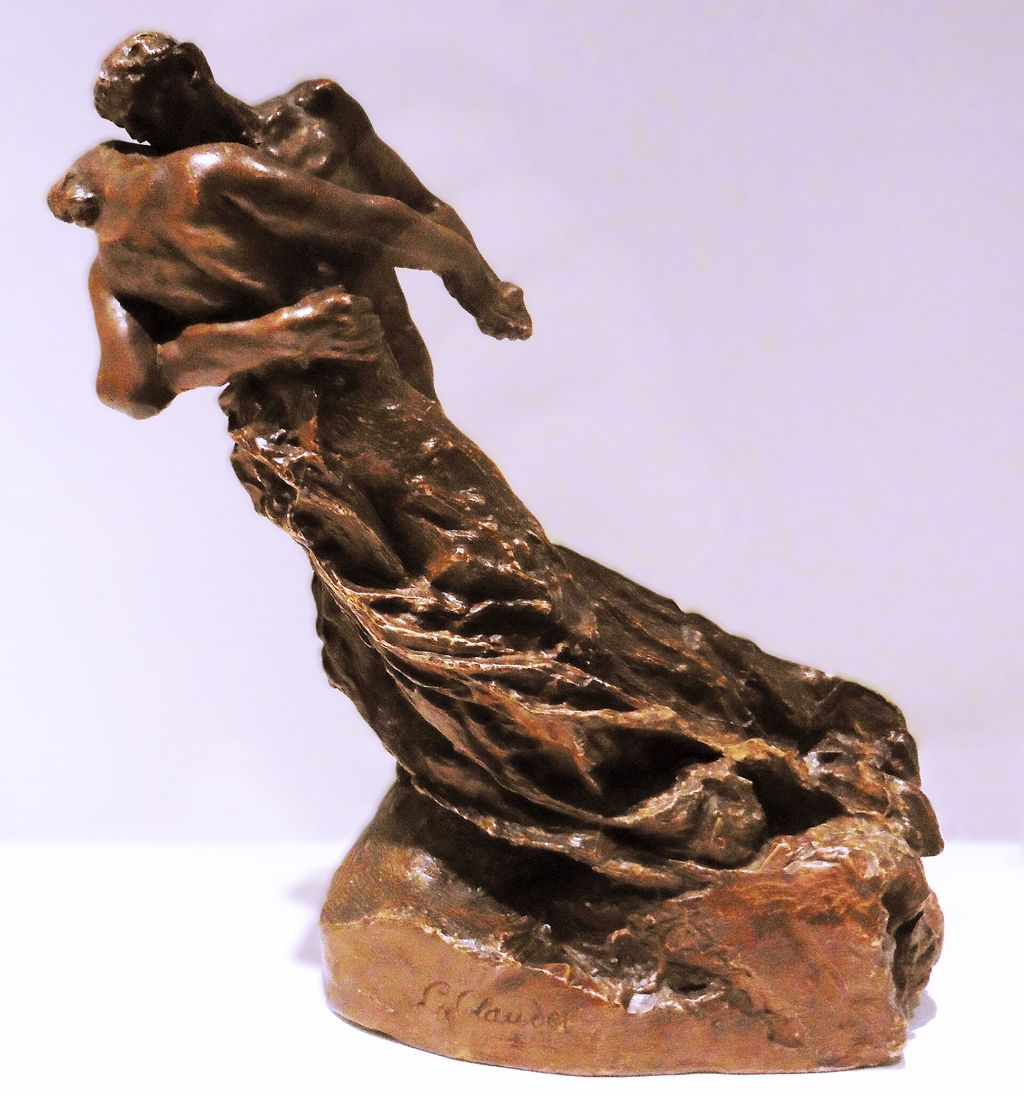
The Waltz in bronze at La Piscine, Roubaix. From this angle, the dancers’ clasp and the sweep of the drapery read together. Photograph by Pierre André Leclercq. Image source. CC BY-SA 4.0. Resized photograph, shared under CC BY-SA 4.0.
What the stoneware shares with other Muller editions
The Comité Camille Claudel’s study of the Muller issue compares it with stoneware editions the same business made from sculptures by Alfred Boucher, Jean Dampt and others. It gathers evidence from period publications about the distribution of those objects. That comparison puts Claudel’s dancers in a wider trade in sculptural ceramics. A cast or a plaster can tell us what features the model presents, but a ceramic workshop connects the object with different skills and different routes to a buyer. The documented Muller number identifies the Nogent example within that activity. It does not supply a total for the issue or date the unnumbered examples on its own. [3] [13] [14]
The effect is visible if you compare the Nogent stoneware to the Musée Rodin bronze at the bottom of the dancers’ skirts. Where the bronze gives the fold a sharply lit edge against a shadow, the ceramic lets colour travel over the rounded surface. At small scale the glaze can make two adjacent planes read as one patch of colour until the viewer changes angle. The workshop’s treatment thus affects how readily the folds can be counted or followed. It gives the eye a second kind of movement to attend to while the two bodies continue to describe the turn. [2] [3] [13]
A sculpture that travelled in several forms
After Brussels, the title appears as no. 81 at the Twelfth Annual Exhibition in St. Louis, Missouri, in 1895, as recorded in the Getty chronology. The same chronology lists a Muller stoneware Waltz at Siegfried Bing’s Salon de l’Art Nouveau in Paris that year. These records show the sculpture circulating in more than one exhibition setting. The Paris listing specifies maker and material for its ceramic, while Nogent’s no. 14 is a separately identified surviving example. [3] [6] [7]
In December 1905 Blot showed Claudel’s work at his Paris gallery alongside sculpture by Bernhard Hoetger. He also published several of her sculptures in bronze, including The Waltz, The Implorer and Fortune. His stock offered a route for the work beyond a single Salon. The official French section catalogue of the 1911 Turin exhibition names two bronzes under Claudel’s entry no. 29, Abandon and La Valse, and gives Blot’s name. Brussels had described Siot-Decauville’s unique example in 1894. Turin specifies bronze and supplies a different ownership credit, with no measurements or cast number in the entry. It gives a clear record of where the title went, while leaving the precise edition and example open. This change in how the work reached audiences is part of the larger story of Claudel’s patrons, exhibitions and editions. [9] [15] [16] [17]
These settings changed what could be seen at a glance. On the column in Allioli’s home, a small bronze with uncovered heads would have presented a concentrated silhouette in the room, while a near-metre veil gives the Salon design an outer edge that reads at a greater distance. The surviving photograph and exhibition records leave the original sightlines uncertain. They do let us compare what each form offers a viewer before any detail of the clasp or the foot becomes visible. [4] [5]
Blot’s Fortune, represented at Nogent by the 1905 bronze 2010.1.21, offers a comparison close to hand. A single nude figure has to maintain her poise as the cloth takes its own outward course. In Fortune, the eye returns from that sweep to one body and its small area of support. In The Waltz, the corresponding return is to the point where the partners hold each other. The large veiled bronze carries the sweep past the top of the pair. In the Musée Rodin bronze, with open air over their heads, it runs low towards the lifted foot and the trailing fabric. Changing the cloth changed where the eye starts and finishes the turn. [2] [5] [18]
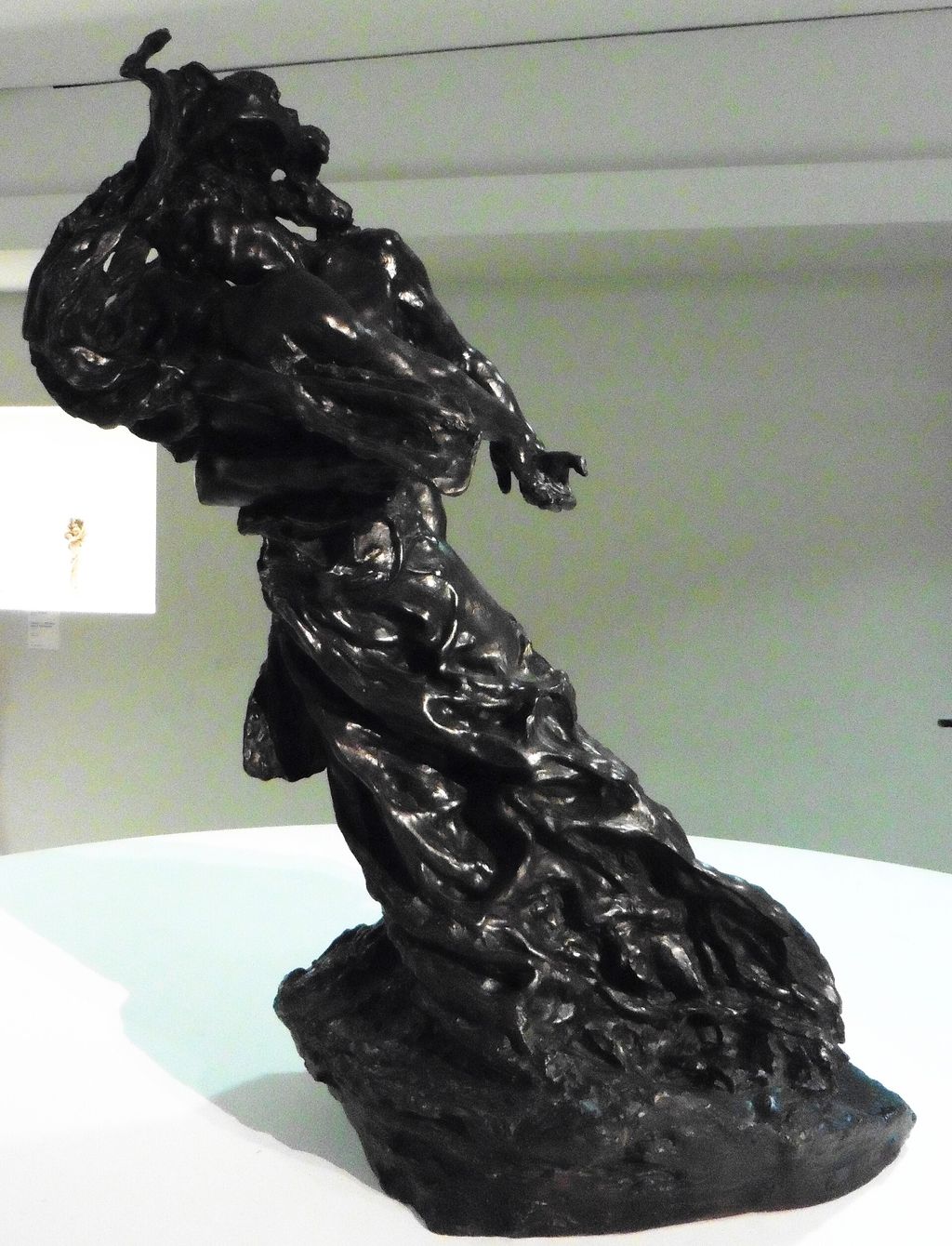
A bronze of The Waltz shown at La Piscine, Roubaix. This view emphasises the folds of the drapery and the incline of the group. Photograph by Pierre André Leclercq. Image source. CC BY-SA 4.0. Resized photograph, shared under CC BY-SA 4.0.
A closer look at The Waltz
Annotated Details from The Waltz
Follow four features in this view of the bronze at the Musée Rodin. Photograph by Philippe Alès. Source. CC BY-SA 4.0. Numbered overview and cropped details released under CC BY-SA 4.0.
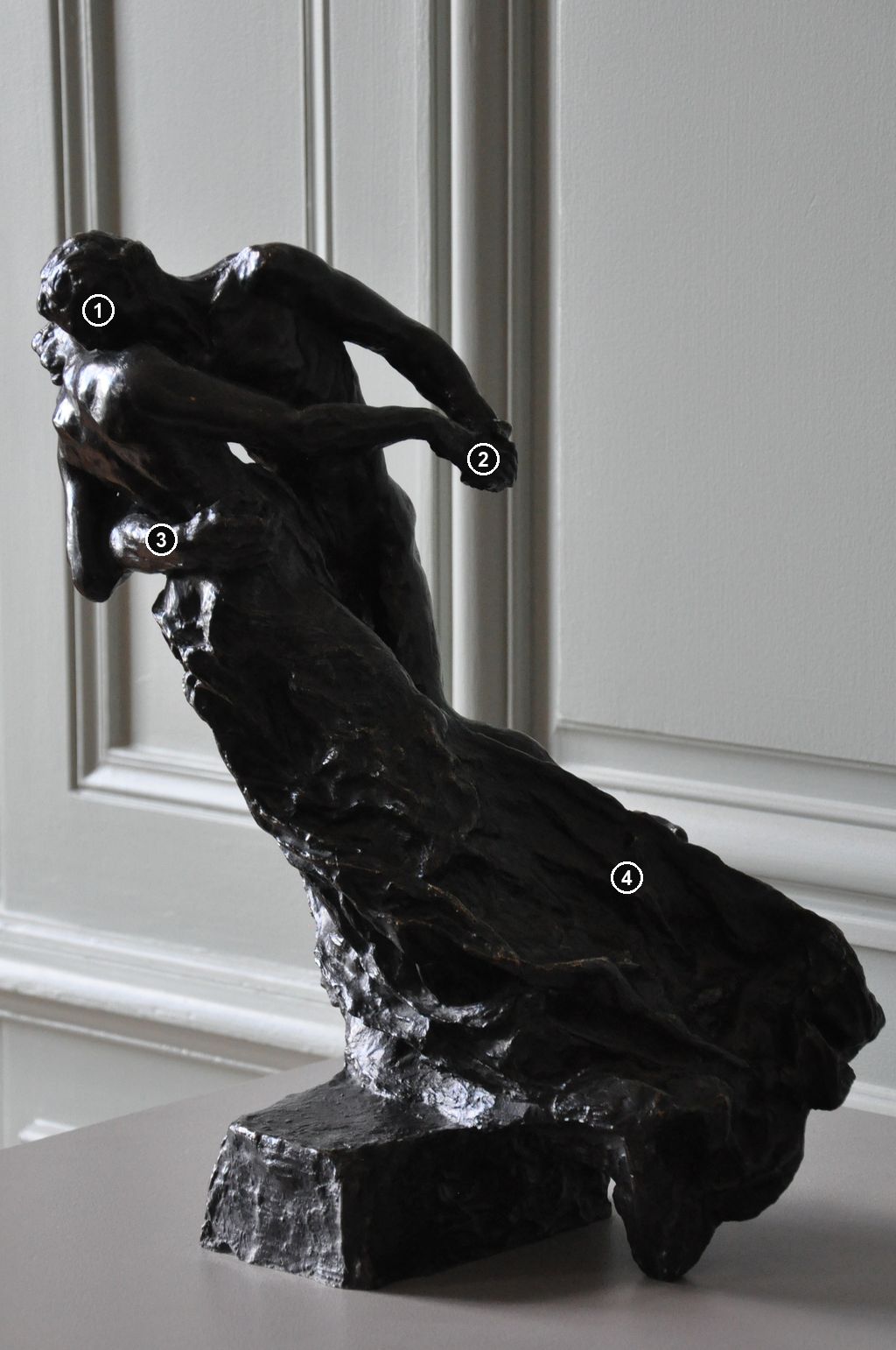
Details from THE WALTZ
Compare the two kinds of grip with the extended line of the drapery.
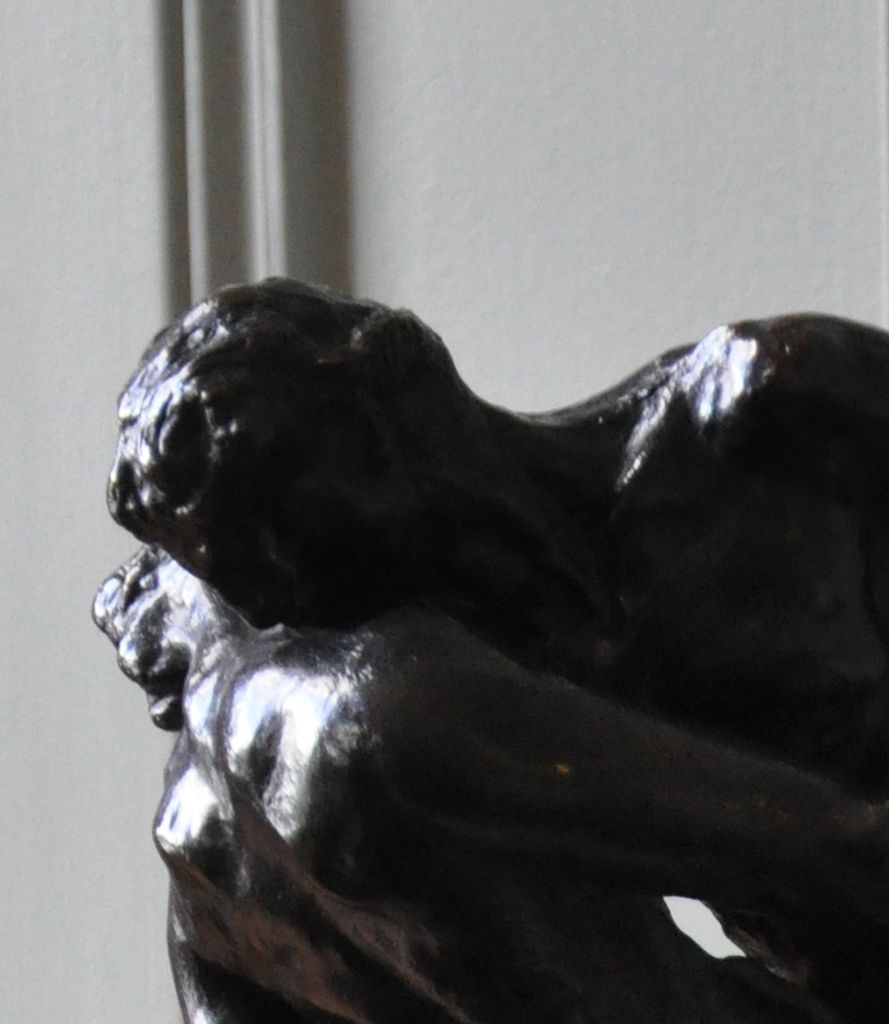
Heads leaning together
The heads nearly meet as the pair incline to the left. Their closeness makes the upper part of the group look momentarily still.
Joined hands
The hands at the end of the two extended arms bring the eye back toward the centre of the turn.
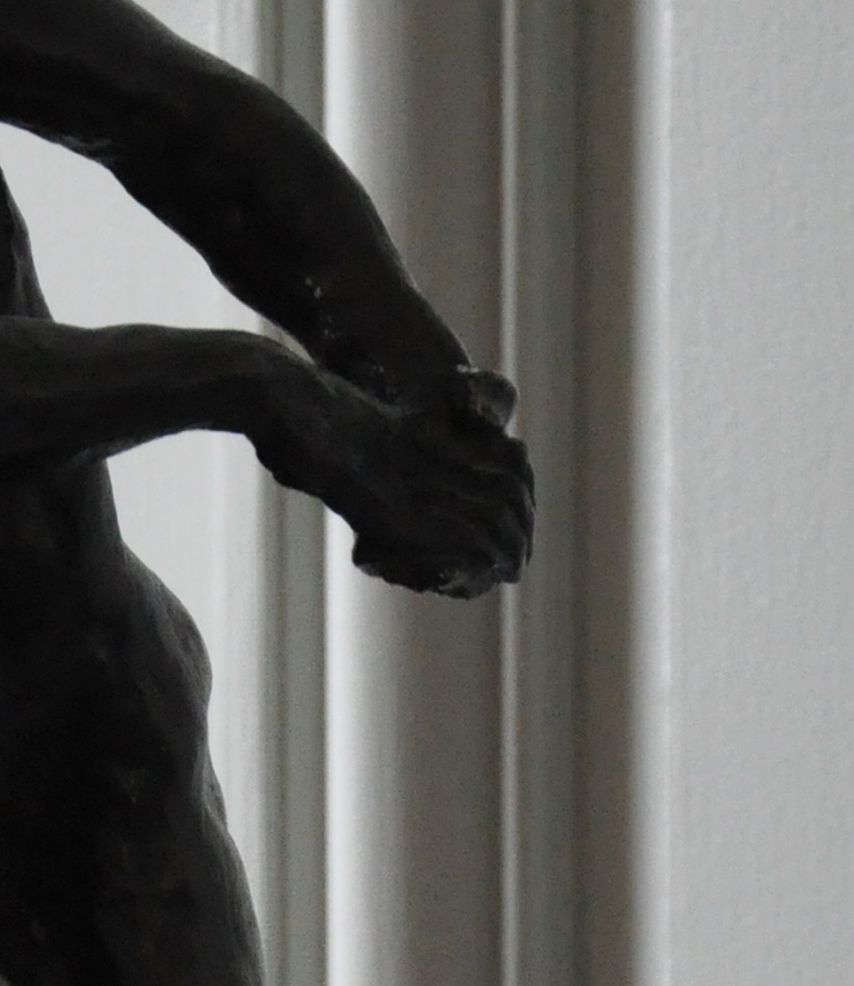
A hand around the waist
The second hold draws the dancers together at the waist. The fingers catch the light against the darker bronze.
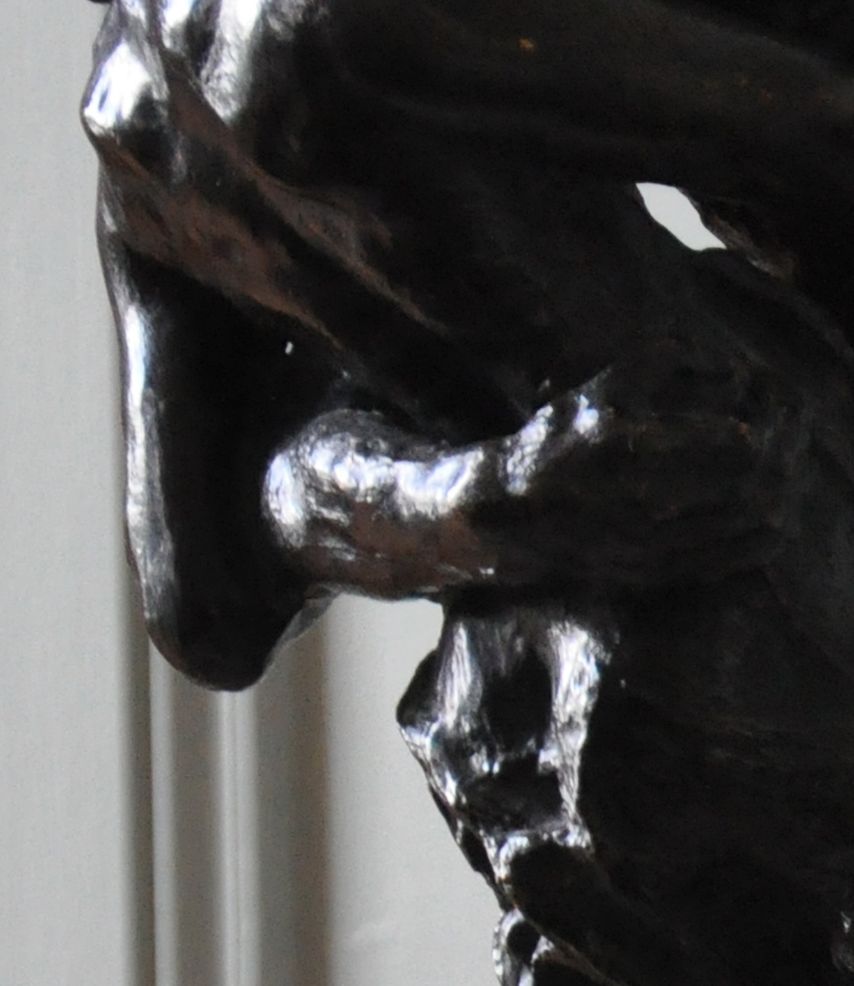
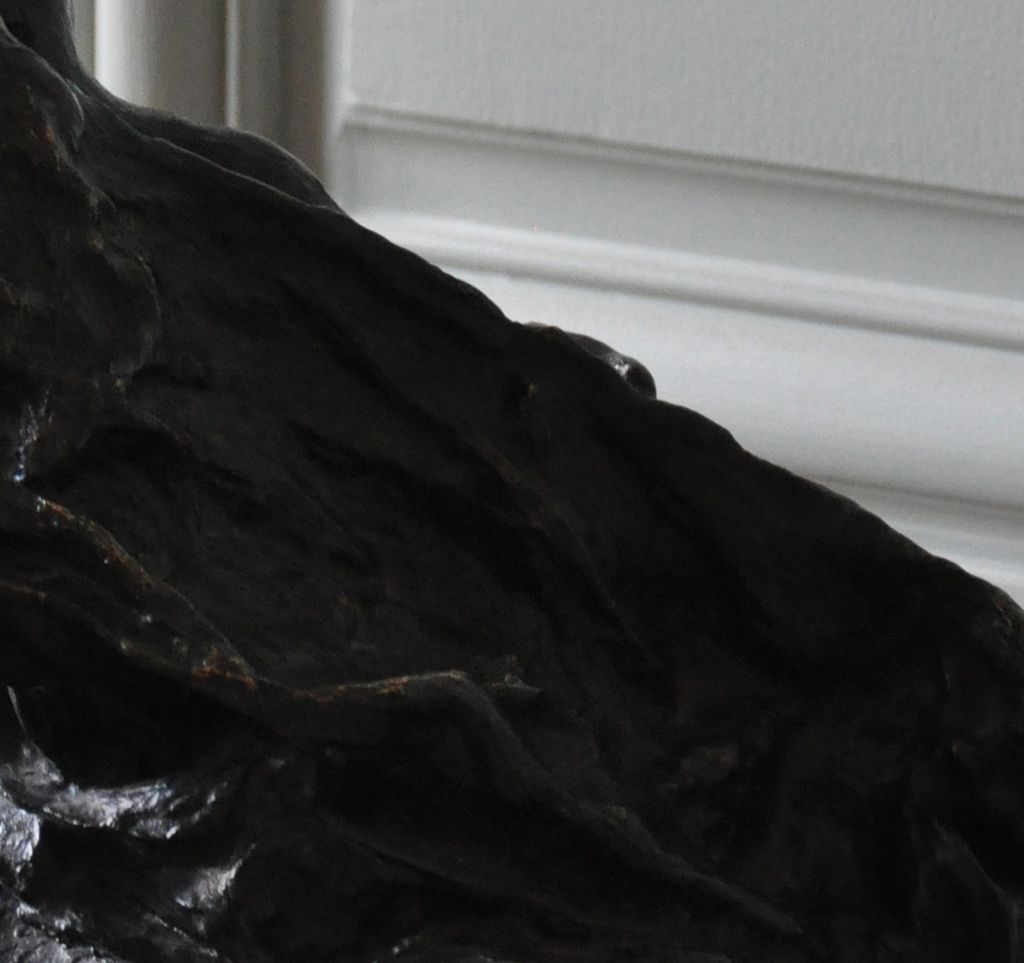
The trailing drapery
The bronze cloth runs diagonally back toward the base, prolonging the motion in the opposite direction to the upper bodies.
Artworks directory
| Name | Date | Medium |
|---|---|---|
| The Mature Age | 1894–99 | Sculpture |
| The Waltz | c. 1889–93 | Sculpture |
| Sakuntala | 1886–88 | Sculpture |
| The Little Châtelaine | 1892–93 | Sculpture |
| The Gossips | c. 1893 | Sculpture |
| The Wave | 1897–1903 | Sculpture |
| Perseus and the Gorgon | c. 1897–1902 | Sculpture |
| The Implorer | c. 1894–99 | Sculpture |
| Clotho | 1893 | Sculpture |
| Bust of Auguste Rodin | c. 1886–89 | Sculpture |
| Paul Claudel at Sixteen Years Old | c. 1882–87 | Sculpture |
| Young Girl with a Sheaf | c. 1886–87 | Sculpture |
| Giganti | c. 1885 | Sculpture |
| Crouching Woman | c. 1884–85 | Sculpture |
| The Hungry Dog | c. 1893 | Sculpture |
| Old Hélène | c. 1881–82 | Sculpture |
| Fortune | c. 1902–05 | Sculpture |
| The Wounded Niobid | 1906 | Sculpture |
| The Siren, or The Flute Player | c. 1904–05 | Sculpture |
| Deep Thought | c. 1898 | Sculpture |
| Dream by the Fireside | c. 1899 | Sculpture |
| Paul Claudel at Thirty-Seven | 1905 | Sculpture |
| Portrait de Madame Claudel | c. 1883 | Sculpture Musée Camille Claudel. |
| Jeune Femme aux yeux clos | c. 1885 | Sculpture Musée Camille Claudel. |
| Ferdinande de Massary | 1888 | Sculpture Musée Camille Claudel. |
| Léon Lhermitte | 1889 | Sculpture Musée Camille Claudel. |
| Étude de main gauche | c. 1889 | Sculpture Musée Camille Claudel. |
| Vieil aveugle chantant | c. 1894 | Sculpture Musée Camille Claudel. |
| Tête de vieillard | c. 1890 | Sculpture Musée Camille Claudel. |
| Étude pour la tête d’Hamadryade | c. 1895 | Sculpture Musée Camille Claudel. |
| Aurore | c. 1900 | Sculpture Musée Camille Claudel. |
Discussion
Look again at the images and ideas explored in The Waltz. These editorial prompts invite your observations.
Reader Insights
Where does the couple’s weight appear to fall as you move around the sculpture?
How does the changing drapery affect the space around the dancers?
Join the Conversation
Share a detail, comparison or question about The Waltz below.
References
- Musée Rodin, The Waltz or The Waltzers, S.01013,. View source.
- Musée Rodin, La Valse ou Les Valseurs, collections portal and multiple views of S.01013,. View source.
- Musée Camille Claudel, Autour de La Valse, gallery 13 and object list,. View source.
- Rouillac and Sculpture et Collection, Camille Claudel, La Valse, Allioli bronze sale dossier, with extracts from Claudel’s correspondence and the Dayot reports in Archives nationales F 21 4299,. View source.
- Sotheby’s, La Valse, première version, London, 19 June 2013, lot 43,. View source.
- Emerson Bowyer and Anne-Lise Desmas, eds., Camille Claudel, exhibition catalogue, 2023, chronology, pp. 14–15,. View source.
- Franck Joubin, “The Waltz”, in Camille Claudel, 2023, pp. 171–189,. View source.
- Gustave Geffroy and Émile Verhaeren, Salon of 1893 and La Libre Esthétique exhibition of 1894 reviews, transcribed in Alain Gauthier, Les Images de Camille Claudel,. View source.
- La Libre Esthétique, Catalogue de la première exposition, Brussels, 1894, scan p. 17, entries 94–97,. View source.
- Gouvernement du Québec, loan list for Camille Claudel et Rodin, 2005, entry for the 96 cm Siot-Decauville bronze,. View source.
- J. Paul Getty Museum, Camille Claudel exhibition guide and The Waltz (Allioli) caption,. View source.
- French Ministry of Culture, Joconde record 000SC004758, Musée Rodin bronze S 1013, inscriptions and dates,. View source.
- Musée d’Orsay, La Valse, dit aussi Les Valseurs, polychrome sculpture register, Nogent 2010.1.11,. View source.
- Comité Camille Claudel, research notice on the Émile Muller stoneware edition and its comparative evidence,. View source.
- Musée Camille Claudel, 1893–1908 : Les années de création solitaire, Blot’s editions and December 1905 exhibition,. View source.
- Musée Camille Claudel, Claudel & Hoetger, exhibition history,. View source.
- Exposition universelle et internationale de Turin, Catalogue spécial officiel de la section française, 1911, p. 290, no. 29,. View source.
- Musée Camille Claudel, Fortune, 2010.1.21,. View source.