 by Tom Gurney
Tom Gurney BSc (Hons) is an art history expert with over 20 years experience
Published on June 19, 2020 / Updated on October 14, 2023
Email: tomgurney1@gmail.com / Phone: +44 7429 011000
Bust of Auguste Rodin: Introduction
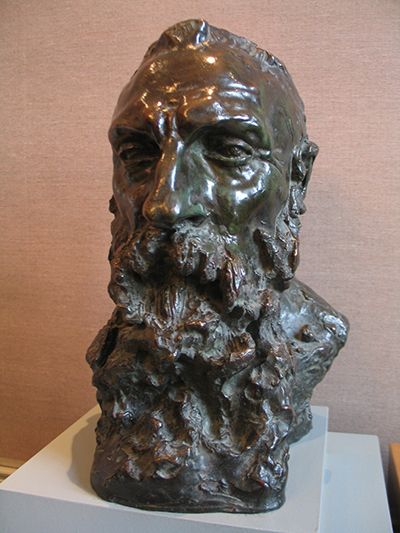
In Camille Claudel’s Bust of Auguste Rodin, the forehead catches the light while the eyes sit far back under the brow. A narrow highlight follows the bridge of the nose down to the moustache. Below it the beard spreads and gathers into thick, irregular folds that carry the face all the way to the base. The sculptor and her sitter had worked together, and this was a face she knew at close range. The bronze makes it recognisable at a distance through a few large forms, then rewards a closer look with the creases under the eyes and the small changes of plane around the nose. Claudel showed the portrait at the Société Nationale des Beaux-Arts in Paris in 1892. A bronze made by the Gruet foundry that year survives at the Musée Rodin. [1] [2] [3]
Bust of Auguste Rodin Camille Claudel
At a Glance
- SitterAuguste Rodin
- Musée Rodin bronzeGruet cast, 1892, S.1021
Camille Claudel in context
Old Hélène
c. 1881–82Sakuntala
Plaster shown in 1888The Waltz
Developed c. 1889–93The Little Châtelaine
First model c. 1892–93The Gossips
Described in 1893, shown in 1895The Mature Age
First and second versions, c. 1894–99The Wave
Plaster shown in 1897, mixed-material object dated 1897–1903 (?)Perseus and the Gorgon
Nogent design and marble, c. 1897–1902The Wounded Niobid
Modelled in 1906Contents
- The face from the front and side
- Claudel as a portraitist
- At the Champ-de-Mars Salon
- The Gruet and Rudier bronzes
- A likeness Rodin put on view
The face from the front and side
In the Musée Rodin’s frontal detail of the Gruet bronze, the brow forms two ledges with an upright crease between them. The light crosses the cheek below the eye, leaving a small shadow just under the lower lid. The eye is still visible in its recess. Claudel has put enough shape into the lids to give the gaze a direction of its own. The face seems to be attending to something while the forehead and nose retain their firmness. Lower down, the mouth is difficult to follow between the ridges of the moustache. The distribution of detail lets a viewer read the eyes first, even though most of the lower half is busier. [2]
In profile, the same face reads in a different order. The nose pushes out in a clean, continuous curve. The small recess immediately below it is followed by the knotted edge of the moustache, then by the beard, which juts out again farther down. These changes of depth are easy to miss head-on, where one part of the beard overlaps another. From the side, the cheek provides a relatively broad plane between the eye and the textured hair. A slight change of angle brings a bright edge back to the cheek or loses it in shadow. The beard has a wider range of surfaces, with blunt ridges that hold highlights and narrow hollows that stay dark. Its broken outline keeps changing as a viewer moves, while the nose keeps its shape. [2]
A photograph catalogued by the Musée Rodin under Adolphe Braun’s name and dated about 1890 gives a useful comparison. Rodin sits at an angle in a dark jacket, with a chair behind him and his eyes looking off to one side. His hair is brushed up, his ear shows, and the beard fans across his chest. The photograph gives a clear sense of how much of the man’s appearance depended on that beard. Claudel made it do more work in the bust. In the photograph it has the jacket as a backdrop. In the bronze it thickens into the irregular support below the face, and the sitter’s body has been pared back around it. The photograph and sculpture both show the heavy brow and long beard. The bronze gives those features a weight of their own by making them project into the viewer’s space. [2] [4]
Claudel as a portraitist
Claudel varied the way she set a head on its support from one portrait to another. In the painted plaster Young Roman at the Art Institute of Chicago, her teenage brother Paul appears with his head turned above the measured edge of a garment. The surface around the mouth and cheek is relatively even, and the turn gives the face its alertness. In The Little Châtelaine, the child’s raised chin opens the front of the neck and makes the gaze rise beyond the edge of the bust. The strong lower mass in the Rodin portrait produces a third effect. The head seems planted above it, and the finer modelling around the eyes works inside that broad, stable outline. All three faces depend on what Claudel did with the forms below them. [2] [5]
The Musée Camille Claudel describes the likeness as close to Rodin’s own manner and notes the suggestion that it is a kind of self-portrait by proxy. The analogy refers to the style. A sitter known for expressive modelling appears in a work that makes his furrowed skin and coarse hair part of the expression. The authorship is clear on the objects themselves. Claudel signed the surviving plaster and the Gruet bronze, and the illustrated Salon catalogue lists the bust under her name. She also drew Rodin and painted a portrait that the Musée Rodin describes as lost. This sculpted likeness gave her a way to make an expressive face legible in the round. Their wider exchange of portraits belongs to the story of Rodin and Camille Claudel. [1] [2] [3] [6] [7]
At the Champ-de-Mars Salon
The 1892 illustrated Salon catalogue lists Claudel’s work as no. 1482, Buste du sculpteur Rodin. Naming Rodin as a sculptor made his profession part of the introduction to the work. The actual bronze offers few such cues. The face rises directly from the beard, with no tool or piece of sculpture alongside it. The catalogue supplied the profession, and viewers could decide how far the look of concentration belonged to the man or to Claudel’s reading of him. Gustave Geffroy recalled finding the bust in the central walk of the sculpture garden. In his Salon review, collected in La Vie artistique in 1893, he described the head as pensive and energetic and credited Claudel with combining force and delicacy in her treatment of it. The broad outline would have been legible along the walk he described. The recesses of the eyes reward the approach the setting allowed. [2] [3] [8]
Paul Leroi, writing in L’Art, saw the resemblance to Rodin’s sculpture as a liability. He acknowledged Claudel’s talent and argued that in this case she had fallen into imitating her teacher. The two critics agreed that her handling drew attention, but they judged it by different standards. Geffroy looked for an understanding of the sitter that could account for the work’s strength and fine detail. Leroi looked for a visible distance between the methods of the two sculptors. That disagreement was possible because the work put Rodin’s face and a manner associated with him before the same audience. The textures that gave the head such presence could also give a critic a reason to talk about the sitter’s art. [8] [9]
Claudel herself saw the portrait as work she could sell and send abroad. Before the middle of September 1892 she wrote to Bertha Honoré Palmer, offering it in bronze or plaster. That autumn she wrote to Rodin asking for the bust to be sent to the forthcoming fair in Chicago. The official fine arts catalogue for the 1893 World’s Columbian Exposition lists Bust of M. Rodin under Claudel’s name as no. 35 in the French sculpture section. Her offer to Palmer gives an early example of how she presented the likeness to a prospective buyer. The Chicago listing records its appearance abroad without specifying the foundry or an inventory number. [10] [11]
The Gruet and Rudier bronzes
The Musée Rodin’s Gruet bronze, S.1021, is 40 centimetres high, 24.6 wide and 28 deep. The museum’s exhibition page dates the modelling to 1886–88 and identifies this example as sand cast in 1892. Its detailed catalogue, where the bronze is indexed as S.01021, gives 1888–89 for creation and 1892 for execution. The mark on the back names Gruet Aîné, alongside Claudel’s signature. The museum also holds a signed plaster, S.01695, catalogued as 1888–89. The plaster has a seam visible along the profile, which the museum takes as evidence of a mould broken away after the impression was made. The plaster and the bronze are separate objects. The two published estimates for the model date coexist with a firm date and foundry for the early metal cast. [1] [2] [6]
The bronze at the Musée Camille Claudel in Nogent-sur-Seine was cast by François Rudier in 1897–98 from a model dated there to 1888–89. It measures 40.3 by 24.2 by 28.8 centimetres. Its distinctive mark is a caduceus, the emblem of the Mercure de France, engraved under Claudel’s signature. The journal arranged a series through Mathias Morhardt. In a letter probably written in November 1897, Claudel set out the financial problem in practical terms. Each cast needed the foundry’s work, and the proposed finish called for work on the seams and an engraved emblem. She estimated a day for engraving and five or six to remove the seams properly. The cast at Nogent preserves the emblem she discussed. Her letter brings an element of the work back into view that a finished bust can hide. Getting a bronze ready to sell involved decisions about time, the quality of the finish and who would pay for it. [7] [10] [12] [13]
The Petit Palais bronze PPS1268 is catalogued as after 1897. It is signed, measures 41 by 26 by 32 centimetres and entered the collection in 1922 as a gift from Arnold Seligmann. An exhibition catalogue associates it with François Rudier and notes visible seams and the absence of a caduceus or a foundry stamp. It proposes that this may be one of the examples completed without the finishing work discussed in the correspondence. That suggestion remains an attribution, while the cast’s date range and acquisition are part of the Petit Palais object record. A privately held Rudier bronze exhibited by the Getty has a separate cast date of after 1898. The different marks and histories give each object its own record even where the broad outline of the portrait is shared. [9] [14] [15]
A likeness Rodin put on view
Rodin often showed Claudel’s portrait of him in exhibitions of his own work. The Musée Rodin describes it as taking on the role of an official portrait. A bust originally submitted under Claudel’s name to a public exhibition could now help introduce an exhibition devoted to its sitter. Reproduction carried it further. In December 1897 Rodin wrote to Claudel that the printmaker Charles Courtry had made an etching from her bust. The sculpted face could circulate on a page, with the forehead and beard retaining their distinctive outline in a different medium. The label and the signature matter especially in that later life. They return the viewer to the arrangement Claudel made, from the eyes set back in the head to the irregular mass that holds it upright. [1] [2] [9] [12]
Artworks directory
| Name | Date | Medium |
|---|---|---|
| The Mature Age | 1894–99 | Sculpture |
| The Waltz | c. 1889–93 | Sculpture |
| Sakuntala | 1886–88 | Sculpture |
| The Little Châtelaine | 1892–93 | Sculpture |
| The Gossips | c. 1893 | Sculpture |
| The Wave | 1897–1903 | Sculpture |
| Perseus and the Gorgon | c. 1897–1902 | Sculpture |
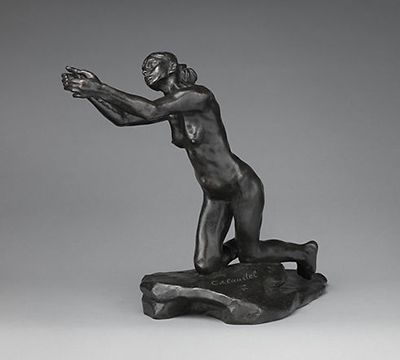
| The Implorer | c. 1894–99 | Sculpture |
| Clotho | 1893 | Sculpture |
| Bust of Auguste Rodin | c. 1886–89 | Sculpture |
| Paul Claudel at Sixteen Years Old | c. 1882–87 | Sculpture |
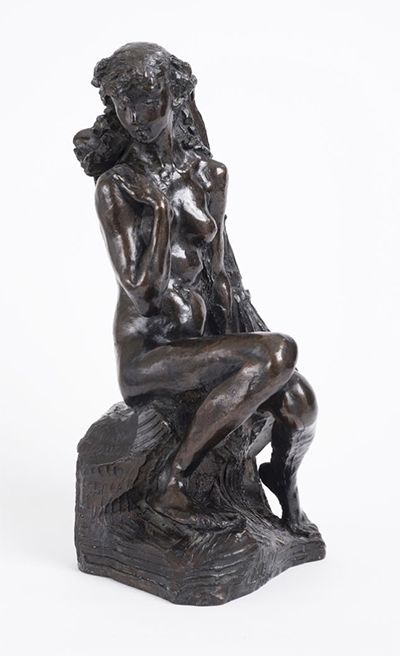
| Young Girl with a Sheaf | c. 1886–87 | Sculpture |
| Giganti | c. 1885 | Sculpture |
| Crouching Woman | c. 1884–85 | Sculpture |
| The Hungry Dog | c. 1893 | Sculpture |
| Old Hélène | c. 1881–82 | Sculpture |
| Fortune | c. 1902–05 | Sculpture |
| The Wounded Niobid | 1906 | Sculpture |
| The Siren, or The Flute Player | c. 1904–05 | Sculpture |
| Deep Thought | c. 1898 | Sculpture |
| Dream by the Fireside | c. 1899 | Sculpture |
| Paul Claudel at Thirty-Seven | 1905 | Sculpture |
| Portrait de Madame Claudel | c. 1883 | Sculpture Musée Camille Claudel. |
| Jeune Femme aux yeux clos | c. 1885 | Sculpture Musée Camille Claudel. |
| Ferdinande de Massary | 1888 | Sculpture Musée Camille Claudel. |
| Léon Lhermitte | 1889 | Sculpture Musée Camille Claudel. |
| Étude de main gauche | c. 1889 | Sculpture Musée Camille Claudel. |
| Vieil aveugle chantant | c. 1894 | Sculpture Musée Camille Claudel. |
| Tête de vieillard | c. 1890 | Sculpture Musée Camille Claudel. |
| Étude pour la tête d’Hamadryade | c. 1895 | Sculpture Musée Camille Claudel. |
| Aurore | c. 1900 | Sculpture Musée Camille Claudel. |
Discussion
Look again at the images and ideas explored in Bust of Auguste Rodin. These editorial prompts invite your observations.
Reader Insights
Where does the beard break up the outline of the face?
Which effects change with the light or the angle from which you look?
Join the Conversation
Share a detail, comparison or question about Bust of Auguste Rodin below.
References
- Musée Rodin, Portrait of Rodin, S.1021, exhibition page and casting method,. View source.
- Musée Rodin, Portrait d’Auguste Rodin, Gruet bronze S.01021, detailed catalogue and photographs,. View source.
- Société Nationale des Beaux-Arts, Catalogue illustré des ouvrages de peinture, sculpture et gravure exposés au Champ-de-Mars, 1892, p. XLII, no. 1482,. View source.
- Musée Rodin, Portrait de Rodin les cheveux en brosse, photograph catalogued under Adolphe Braun, about 1890, Ph.01080,. View source.
- J. Paul Getty Museum, Camille Claudel, Portraits section and object views,. View source.
- Musée Rodin, Portrait de Rodin, signed plaster S.01695,. View source.
- Musée Camille Claudel, Auguste Rodin, Rudier bronze, caduceus and interpretation,. View source.
- Gustave Geffroy, “Salon de 1892,” La Vie artistique, second series, 1893, p. 337,. View source.
- Amélie Simier, Buste d’Auguste Rodin, cat. 26 in Figuras de la Francia moderna, Fundación Juan March, French text and notes, citing Paul Leroi, “Salon de 1892,” L’Art, vol. 53, p. 18,. View source.
- Art Institute of Chicago and J. Paul Getty Museum, Camille Claudel, exhibition catalogue chronology, entries for 1892, 1893 and 1897,. View source.
- World’s Columbian Exposition, Official Catalogue, Part X, Department K, Fine Arts, 1893, France, Group 139, p. 93, no. 35,. View source.
- Camille Claudel and Auguste Rodin, letters of November (?) and 2 December 1897, Musée Rodin archives MS.365 and L.1394, English translations at the Château de l’Islette,. View source.
- Musée Camille Claudel, museum press dossier, gallery checklist and object caption, pp. 27 and 29,. View source.
- Petit Palais, Paris Musées, Buste de Rodin, bronze PPS1268,. View source.
- J. Paul Getty Museum, Camille Claudel, Selected Works caption for the privately held Rudier bronze,. View source.