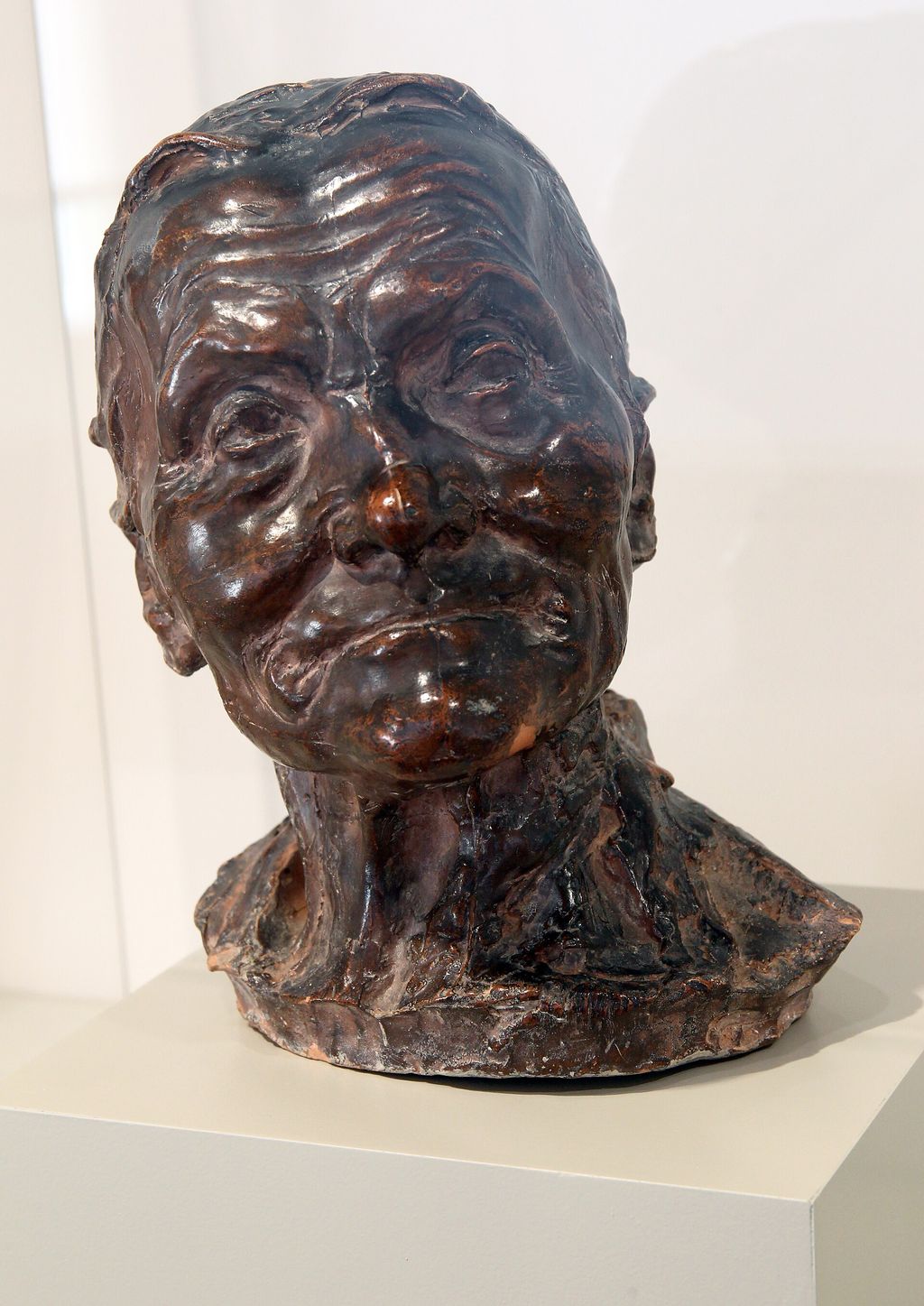
The terracotta of Old Hélène in the Musée Camille Claudel, Nogent-sur-Seine. Photograph by Vassil. Image source. CC0 / Public domain. Resized from the original photograph.
 by Tom Gurney
Tom Gurney BSc (Hons) is an art history expert with over 20 years experience
Email: tomgurney1@gmail.com / Phone: +44 7429 011000
Old Hélène: Introduction
In Camille Claudel’s Old Hélène (La Vieille Hélène, also called Old Woman), the head turns and tips a little, as though the sitter has shifted her attention to someone beside her. The movement is slight enough that the front still shows both eyes. Step to one side, though, and the deep notch between the nose and the projecting chin comes into view. The Musée Camille Claudel in Nogent-sur-Seine dates its terracotta to about 1881–82. It stands 28 centimetres high and is one of the early portraits in which Claudel learned how much of a person’s bearing a bust could convey. [1]
At a Glance
- French titleLa Vieille Hélène
- Nogent exampleTerracotta, 2010.1.1
Camille Claudel in context
Old Hélène
c. 1881–82Sakuntala
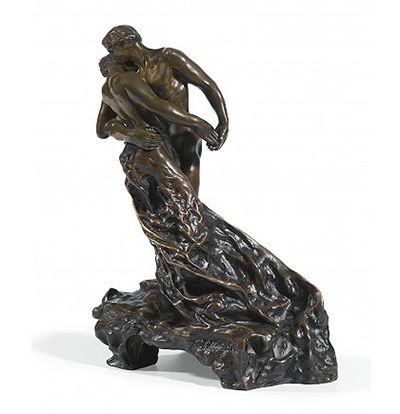
Plaster shown in 1888The Waltz
Developed c. 1889–93The Little Châtelaine
First model c. 1892–93The Gossips
Described in 1893, shown in 1895The Mature Age
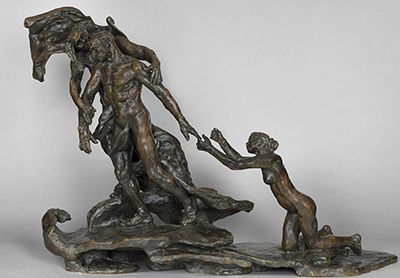
First and second versions, c. 1894–99The Wave
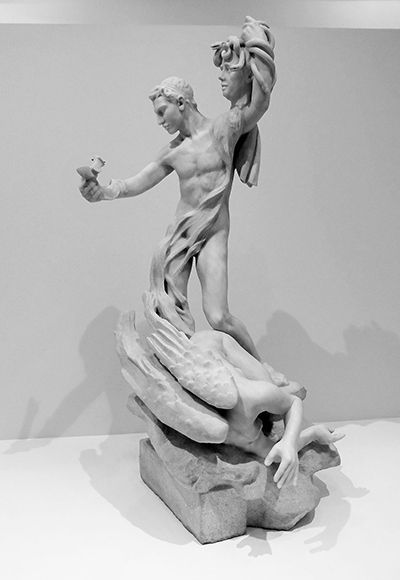
Plaster shown in 1897, mixed-material object dated 1897–1903 (?)Perseus and the Gorgon
Nogent design and marble, c. 1897–1902The Wounded Niobid
Modelled in 1906Contents
- How the face changes as you move
- A sitter from the household
- Fired clay at the Salon
- The later bronze at Poitiers
- From Hélène to Clotho
How the face changes as you move
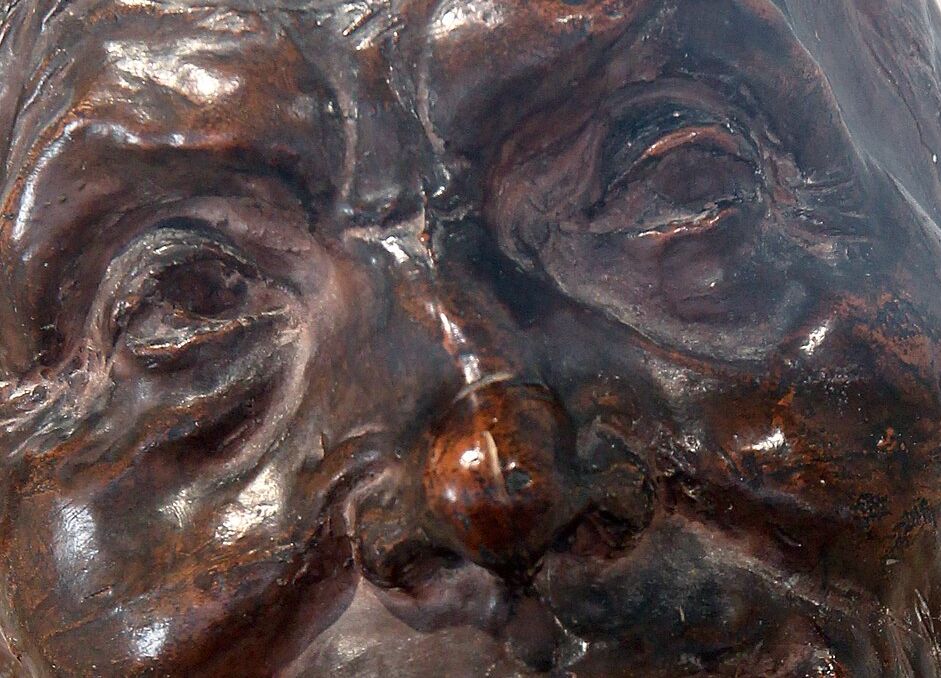
The near-frontal view brings the forehead into play first. The furrows travel in uneven bands above the brows, and the ridge over each eye has a slightly different curve. The head’s angle puts one socket higher in the near-frontal view. On the lower side, the crease beneath the eye extends across the cheek towards the ear. A short ridge along one cheek picks up the light where the flesh below it falls away. Claudel makes the furrows read as changes in the planes of the face. Some taper at the temple or disappear into the surrounding surface, while others hold their shadow almost to the brow. [1]
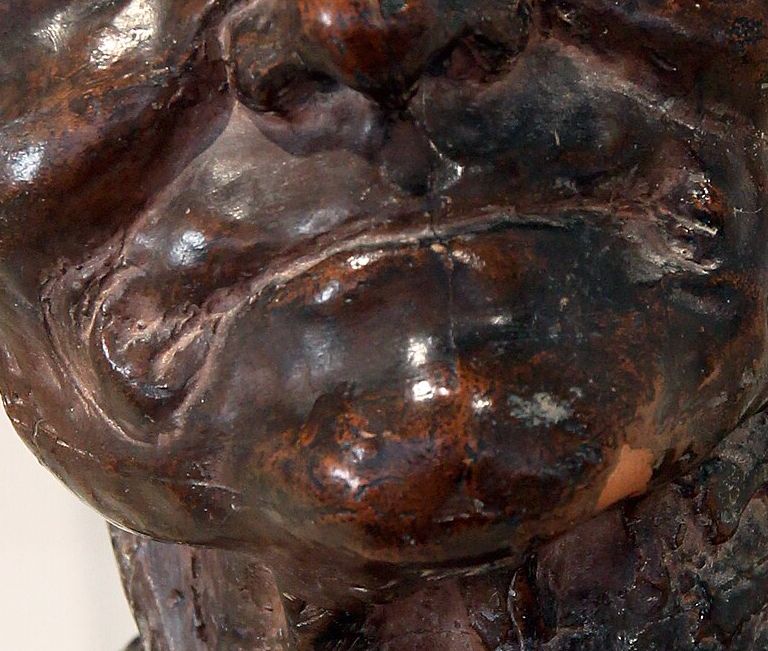
From the side, the lips almost disappear into the silhouette. The nose and chin push out on either side of them, and the line of the lower jaw carries the eye back to the exposed ear. In the front view, one corner of the closed mouth sits higher than the other. The museum sees an amused look in the sitter’s face. That reading makes sense from an angle where the eyes and the lifted corner are visible together. In profile the gaze is harder to read and the face has a firmer set. A viewer’s movement around this small object can change the apparent expression without taking anything away from the specificity of the likeness. [1]
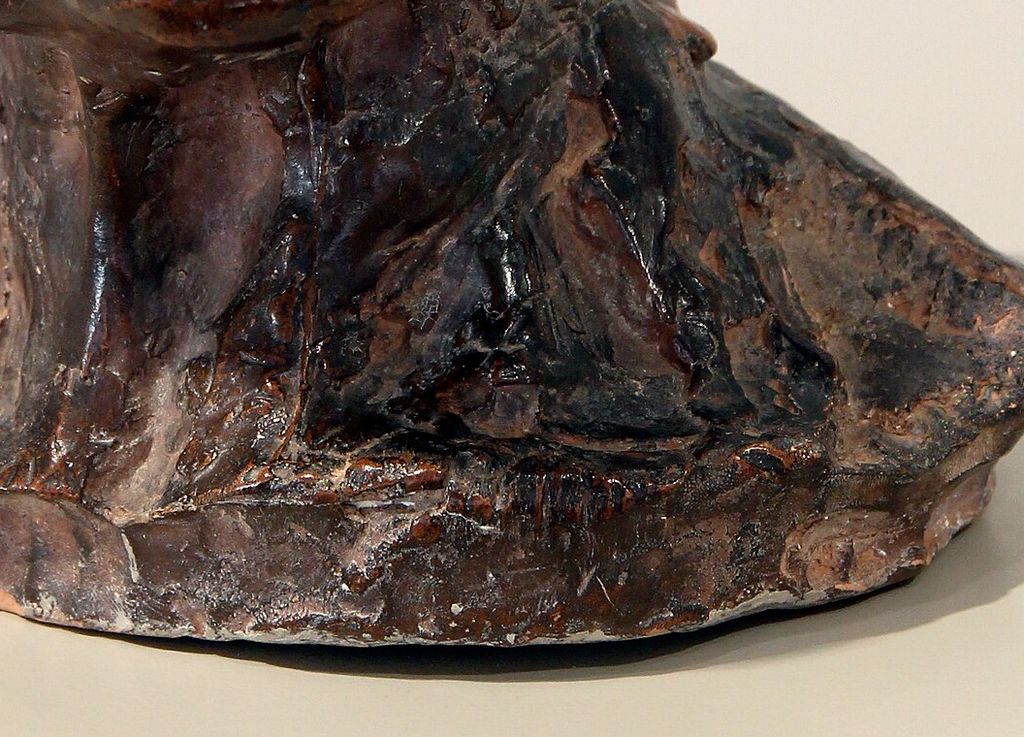
The two side views also make clear how much of the portrait lies behind the face. Grooves in the hair run past the ear and gather at a low bun, a compact knot that extends the outline of the skull. Below, the modelled folds of the neck descend into a rough, shallow band at the base. The shoulder line spreads more to one side in the near-frontal view. Its uneven edge gives the head room to lean without making the bust look about to topple. Where the cheek reads as a continuous surface, the cut below the neck is full of ridges and hollows. The sharp change in handling makes it easy to see where Claudel has concentrated the description of the sitter. [1]
A sitter from the household
The Nogent museum identifies Hélène as a servant in the Claudel household. The familiar name in the title preserves something of the relationship between artist and sitter. The name by itself supplies little about Hélène’s life. Even the tidy knot of hair, which the museum reads as a sign of her social position, can be approached as a practical arrangement and a sculptural choice. It holds the hair away from the ear and neck and lets the turn of the head remain visible all the way round. The portrait gives Hélène that particular bearing while the surviving title chiefly identifies her by age and first name. [1]
The family moved to Paris in 1881 so that Claudel could study art, with encouragement from Alfred Boucher. The bust’s approximate date places it close to that move. Mathias Morhardt, who met Claudel in 1896, later pictured the family home as an extension of her studio, with people around her enlisted for sittings and other work. Nogent also credits him with the claim that Old Hélène was Claudel’s first signed sculpture. These recollections were published in 1898, well after the period they describe. The surviving bust gives a more direct sense of what a familiar sitter offered the young sculptor. She could work from the whole head, matching the inclination of the neck and the outline of the skull to the smaller changes around the eyes and mouth. [1] [2]
Fired clay at the Salon
In the illustrated catalogue of the 1885 Salon des Artistes Français, entry 3497 gives the title Vieille femme and identifies the work as a terracotta bust. Immediately above it is Claudel’s bronze Étude, no. 3496, identified by the Getty and Art Institute of Chicago exhibition catalogue as Giganti. The two entries record a sculptor showing work in different materials at the same exhibition. For Old Hélène, clay was the material in which the public was invited to see the work. The catalogue calls it a bust, with the same matter-of-fact terminology it uses for the other portraits nearby. [3] [4] [5]
An account of a plaster shown in 1882 comes from Morhardt. The 2023 Getty and Art Institute chronology records his assertion and notes the lack of a corresponding entry in that year’s catalogue. It also lists a plaster of the composition at the Exposition des Arts Libéraux in 1892. These notices describe the work circulating in more than one material. The terracotta shown in 1885 has a different documentary basis from the reported 1882 plaster, and the later exhibition of a plaster cannot settle what was on view a decade earlier. [3] [4]
The Nogent terracotta, inventory 2010.1.1, measures 28 by 20 by 18.5 centimetres and was acquired from Reine-Marie Paris de la Chapelle in 2008. Its warm brown surface has lighter patches along the ear and the lower edge. Under the light used for the museum’s photographs, broad cheek planes catch a softer reflection than some of the narrow ridges near the neckline. The shallow grooves around the temple and the deeper recesses under the chin remain legible at the same scale. What would have been a small movement of flesh in life is now a change in the depth of the clay that the light can pick up. [1]
The later bronze at Poitiers
A signed bronze Old Hélène entered the Musée Sainte-Croix in Poitiers after the 2017 sale of works from the heirs of Claudel’s sister Louise. The French Ministry of Culture’s announcement identifies the bronze by Claudel’s signature and a foundry mark. Artcurial’s record for the sale describes a brown-patinated sand cast with a foundry stamp naming Thiébaut Frères and the successor firm Fumière et Cie, and estimates that this particular bronze was cast between 1906 and 1926. Its 28-centimetre height matches the terracotta’s. The casting range concerns the bronze itself, while the earlier dates describe the making of the portrait that it reproduces. Artcurial identified the Poitiers example as the only cast it knew to have been made in Claudel’s lifetime and also recorded a posthumous edition. A bronze can therefore carry a date in the 1880s as part of its title even when the metal was poured decades later. [6] [7] [8]
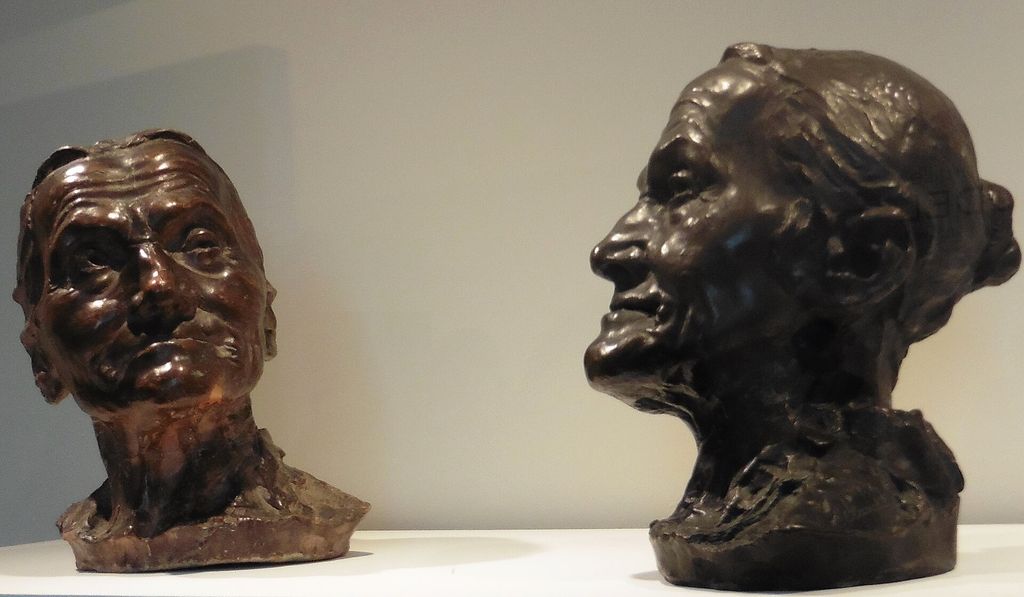
Front and profile of two examples of Old Hélène at the Roubaix exhibition. Photograph by Pierre André Leclercq. Image source. CC BY-SA 4.0. Resized photograph, shared under CC BY-SA 4.0.
From Hélène to Clotho
A comparison with Clotho shows how differently Claudel could use the signs of ageing. The Musée Rodin’s 1893 plaster is about 90 centimetres high and presents a figure from head to foot. In the myth, Clotho is the youngest of the three Fates. Claudel makes her an old woman whose hair hangs heavily over her head. Hélène’s bun opens the face to scrutiny and keeps the back of the head compact. Clotho’s hair covers part of her face and changes how we read the whole figure. Its weight seems to impede her, even where it falls clear of her features. [1] [9]
Hélène’s ageing belongs to the face of a woman who posed for a portrait. The tilted head and the open line of the neck make her appear alert to something beyond the bust. In Clotho, the stoop, the exposed body and the mass of hair turn old age into part of a story about human destiny. Seeing the two together brings out what the early portrait can do in such a narrow compass. Claudel gives Hélène just enough shoulder to carry the movement of the neck and just enough turn for the expression to change as the viewer comes around her. [1] [9]
A closer look at Old Hélène
Annotated Details from Old Hélène
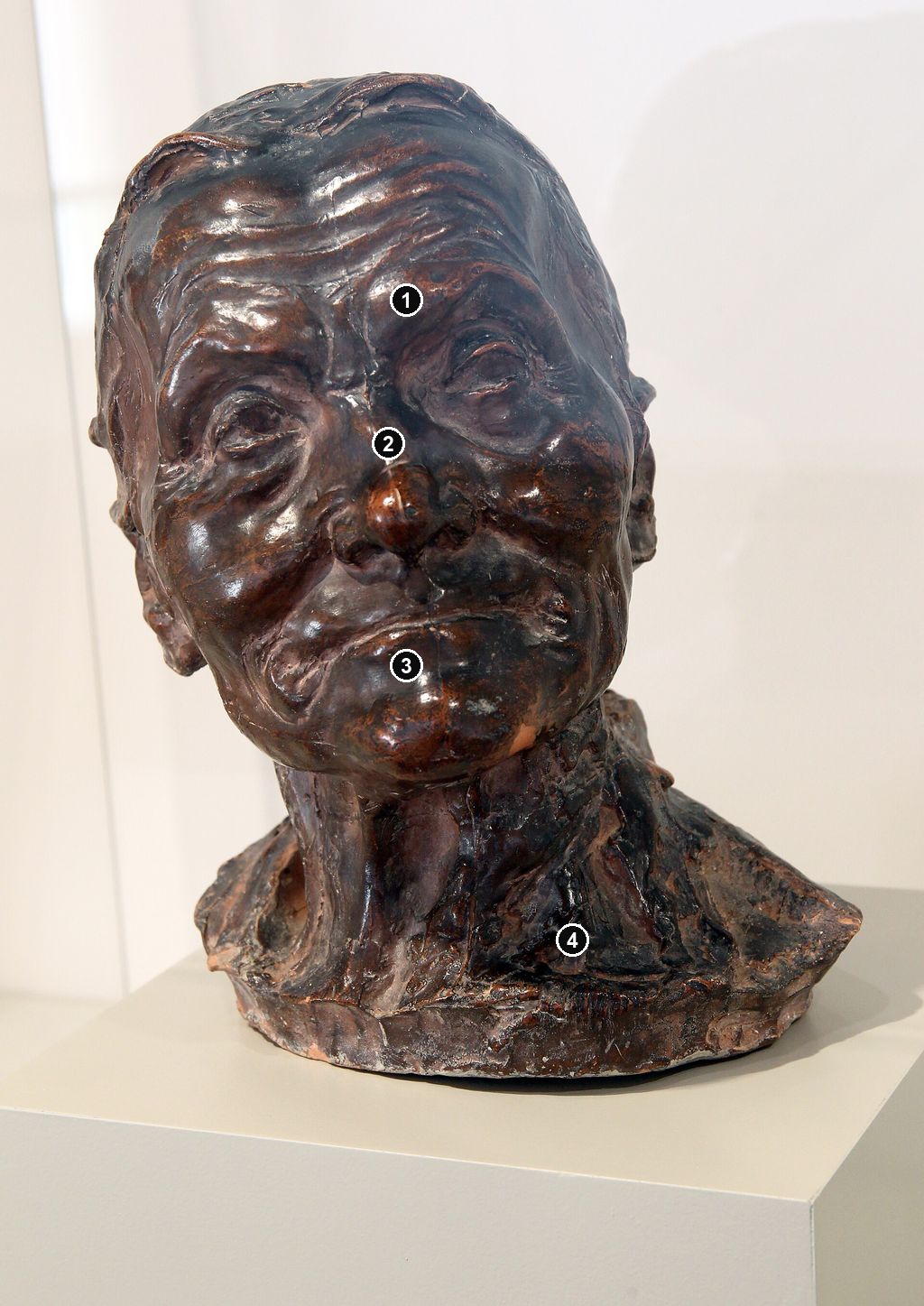
The terracotta of Old Hélène in the Musée Camille Claudel, Nogent-sur-Seine. Photograph by Vassil. Image source. CC0. Overview numbered and details cropped.
Details from OLD HÉLÈNE
Follow the numbered details, then return to the complete view.
The creases across the brow
Closely spaced creases cross the forehead and change direction as they approach the temple.
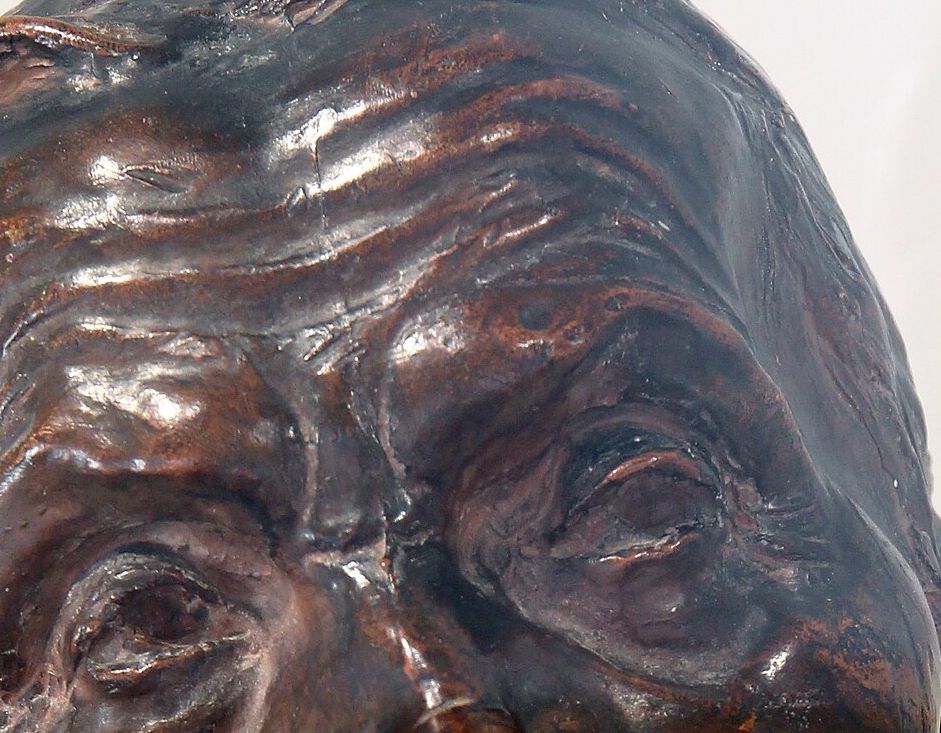
Eyes under heavy lids
The sharply defined lid on the left catches the light. Deeper shadows on the right make the gaze harder to read.
The tight line of the mouth
The narrow line of the lips sits between deeper modelling at the nose and a heavy fold below.
From face to shoulder
Marks around the neck and shoulders interrupt the smoother surfaces of the central face.
Artworks directory
| Name | Date | Medium |
|---|---|---|
| The Mature Age | 1894–99 | Sculpture |
| The Waltz | c. 1889–93 | Sculpture |
| Sakuntala | 1886–88 | Sculpture |
| The Little Châtelaine | 1892–93 | Sculpture |
| The Gossips | c. 1893 | Sculpture |
| The Wave | 1897–1903 | Sculpture |
| Perseus and the Gorgon | c. 1897–1902 | Sculpture |
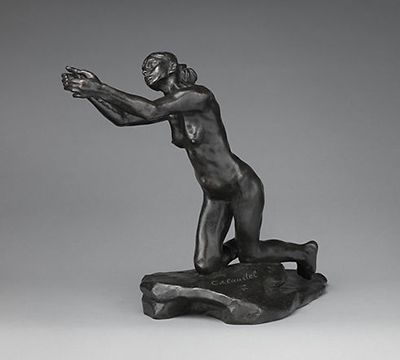
| The Implorer | c. 1894–99 | Sculpture |
| Clotho | 1893 | Sculpture |
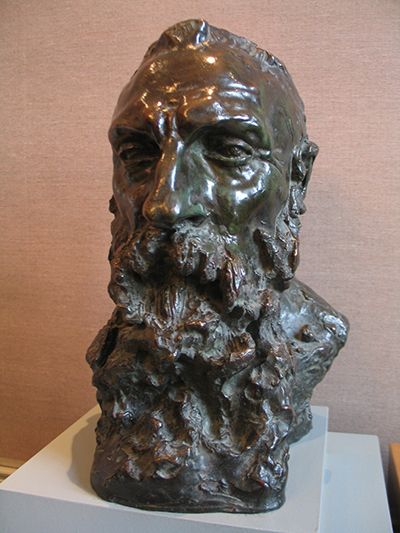
| Bust of Auguste Rodin | c. 1886–89 | Sculpture |
| Paul Claudel at Sixteen Years Old | c. 1882–87 | Sculpture |
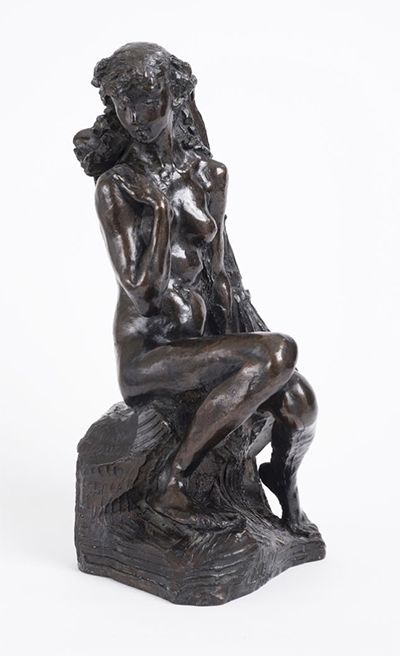
| Young Girl with a Sheaf | c. 1886–87 | Sculpture |
| Giganti | c. 1885 | Sculpture |
| Crouching Woman | c. 1884–85 | Sculpture |
| The Hungry Dog | c. 1893 | Sculpture |
| Old Hélène | c. 1881–82 | Sculpture |
| Fortune | c. 1902–05 | Sculpture |
| The Wounded Niobid | 1906 | Sculpture |
| The Siren, or The Flute Player | c. 1904–05 | Sculpture |
| Deep Thought | c. 1898 | Sculpture |
| Dream by the Fireside | c. 1899 | Sculpture |
| Paul Claudel at Thirty-Seven | 1905 | Sculpture |
| Portrait de Madame Claudel | c. 1883 | Sculpture Musée Camille Claudel. |
| Jeune Femme aux yeux clos | c. 1885 | Sculpture Musée Camille Claudel. |
| Ferdinande de Massary | 1888 | Sculpture Musée Camille Claudel. |
| Léon Lhermitte | 1889 | Sculpture Musée Camille Claudel. |
| Étude de main gauche | c. 1889 | Sculpture Musée Camille Claudel. |
| Vieil aveugle chantant | c. 1894 | Sculpture Musée Camille Claudel. |
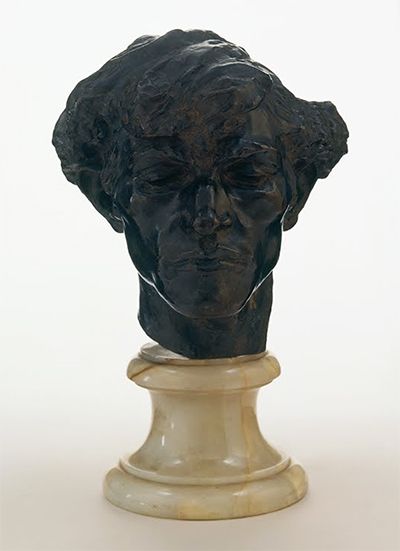
| Tête de vieillard | c. 1890 | Sculpture Musée Camille Claudel. |
| Étude pour la tête d’Hamadryade | c. 1895 | Sculpture Musée Camille Claudel. |
| Aurore | c. 1900 | Sculpture Musée Camille Claudel. |
Discussion
Look again at the images and ideas explored in Old Hélène. These editorial prompts invite your observations.
Reader Insights
What changes between the profile and the front view?
How does the clay surface carry the expression around the eyes and mouth?
Join the Conversation
Share a detail, comparison or question about Old Hélène below.
References
- Musée Camille Claudel, Old Hélène or Old Woman, terracotta 2010.1.1, collection entry and three object views,. View source.
- J. Paul Getty Museum, Camille Claudel, exhibition guide, early training and Paris,. View source.
- Société des Artistes Français, Catalogue illustré du Salon, 1885, p. LVII, entries 3496–3497,. View source.
- Emerson Bowyer and Anne-Lise Desmas, eds., Camille Claudel, J. Paul Getty Museum and Art Institute of Chicago, 2023, chronology under 1882, 1885 and 1892,. View source.
- Musée Camille Claudel and Société des Artistes Français, Camille Claudel au Salon des Artistes Français, 1885 section, pp. 10–11,. View source.
- Ministère de la Culture, announcement of public acquisitions of works by Camille Claudel, 2017,. View source.
- Artcurial, Camille Claudel, un trésor en héritage, 27 November 2017, lot 10, La Vieille Hélène,. View source.
- Grand Poitiers, Nouveautés dans la collection Claudel, Grand Poitiers magazine no. 3, p. 21,. View source.
- Musée Rodin, Clotho, 1893 plaster S.01379,. View source.