 by Tom Gurney
Tom Gurney BSc (Hons) is an art history expert with over 20 years experience
Published on June 19, 2020 / Updated on October 14, 2023
Email: tomgurney1@gmail.com / Phone: +44 7429 011000
Paul Claudel at Sixteen Years Old: Introduction
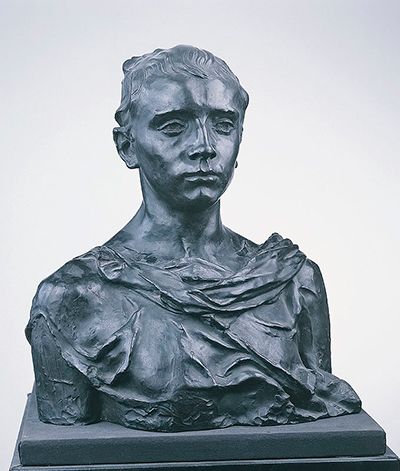
The young man in Camille Claudel’s bust holds his head almost square to the viewer. His lips meet in a narrow line, his eyes look out from beneath a low brow, and his short hair breaks into small locks along his forehead. Below that steady face, a fold of cloth drops diagonally across the chest. Claudel gave her brother Paul the bearing of a figure from the past while preserving the features of a boy she knew well. The portrait is also known as Jeune Romain (Young Roman) and Mon frère (My Brother). It survives in several versions, including painted plaster at the Art Institute of Chicago, patinated plaster at the Musée Camille Claudel in Nogent-sur-Seine and bronzes in French public collections. [1] [2] [3]
Paul Claudel at Sixteen Years Old Camille Claudel
At a Glance
- SitterPaul Claudel
- Chicago examplePainted plaster, 2022.1438
Camille Claudel in context
Old Hélène
c. 1881–82Sakuntala
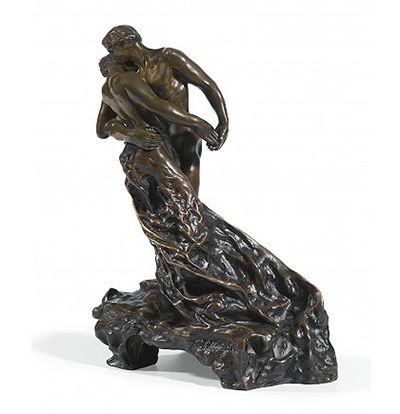
Plaster shown in 1888The Waltz
Developed c. 1889–93The Little Châtelaine
First model c. 1892–93The Gossips
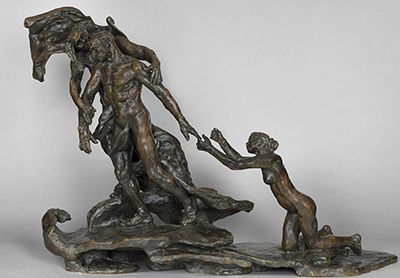
Described in 1893, shown in 1895The Mature Age
First and second versions, c. 1894–99The Wave
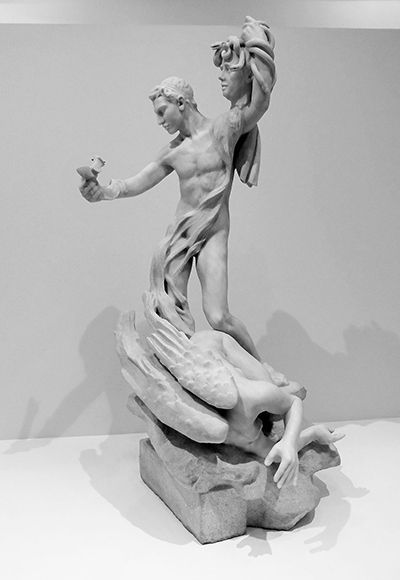
Plaster shown in 1897, mixed-material object dated 1897–1903 (?)Perseus and the Gorgon
Nogent design and marble, c. 1897–1902The Wounded Niobid
Modelled in 1906Contents
- The face above the drapery
- Two plasters and the question of age
- At the Salon and in bronze
- The same sitter in 1905
The face above the drapery
In the Chicago plaster, start at the brow and follow the bridge of the nose to the mouth. The light runs down a relatively narrow strip, with wider and more gradual transitions across the cheeks. The closed mouth gives the face a firm centre. Look towards either ear and the head seems to narrow again before it settles on the neck. The neckline sits low enough that the neck has room to widen towards the shoulders. That widening gives the upright pose some of its ease. The head can look self-possessed without seeming braced. [1]
The shoulders establish a broad outline, but the drapery takes a less predictable course. Its upper edge dips towards the middle, where the fabric folds back on itself, then rises towards one shoulder. Below it, a longer fold crosses the chest on a slant and breaks into smaller changes of direction near the bottom. Seen from the front, the face and neck make an upright shape while the cloth pulls the eye sideways. In a three-quarter view of the Nogent plaster, the nearer shoulder comes forward and the far edge of the cloth recedes. The folds that looked like lines across the chest begin to read as layers wrapped around a body. [1] [2] [4]
The titles offer different ways into the same arrangement. Mon frère identifies the sitter through his relationship with the sculptor. Jeune Romain asks what she has made of his likeness by wrapping him in drapery and setting him upright within a compact bust. The Musée Camille Claudel relates the portrait to early Italian Renaissance sculpture Claudel studied at the Louvre. It points to the shoulders and upper chest, cut off in the manner of a reliquary bust, and to the contrast of colours across the surface. An allusion to Rome could therefore come through a format Claudel knew from fifteenth-century Italy. The abbreviated shoulders are part of that borrowing. They give the drapery enough width to frame Paul’s face while keeping the likeness concentrated in the head and neck. [2] [5]
Portraits of family members gave Claudel room to work between observation and invention. The Getty exhibition situates her early busts within a wider practice among women artists in nineteenth-century Paris, who often drew their sitters from a circle of friends and relatives. Access to a sitter was one condition of the work. The choice of how to present that sitter was another. Here the uneven line of the fringe and the subtle changes across the cheeks carry the likeness, while the drapery gives the bust a scale and dignity that an everyday jacket would have conveyed differently. [1] [5]
Two plasters and the question of age
The Getty exhibition caption dates the Chicago plaster, Art Institute of Chicago 2022.1438, to 1882/83–87. Its surface has patches of reddish brown, ochre and green that extend across the face and chest. The Art Institute’s account, reproduced by the French Sculpture Census, describes transparent colour applied in layers to imitate the altered surfaces of ancient bronzes. In the Getty photograph, colour gathers around the curls and the folds, but also runs across smoother areas of the forehead and chest. The effect depends as much on patches that interrupt the modelling as on colour that follows its contours. As the light finds the nose or the upper edge of the cloth, the painted surface can look convincingly metallic. [1] [6]
The Nogent plaster is a separate object, on deposit from the Département de l’Aube and listed as D2017.14.1 in the museum’s French collection record. Its surface makes a different impression. The hair and gathered cloth at the neck read as darker, cooler passages against the warmer face and chest. The dark band along the shoulders makes the shape of the neckline particularly easy to follow. The Chicago and Nogent plasters are both about 52 centimetres high. The difference in appearance comes through most clearly in how colour crosses or reinforces the edges of the forms, even allowing for the different lighting in the photographs. [1] [2] [6]
The museum at Nogent has used more than one date for its plaster. Its gallery checklist gives about 1884 and includes Paul Claudel à seize ans among the titles. The French collection entry dates it to about 1882 and proposes that Claudel began the portrait when her brother was thirteen. That earlier estimate places the modelling near the family’s move to Paris in 1881. Paul was born in 1868, so the dates point to different moments in his teens. The familiar title preserves one identification of his age. The French Sculpture Census gives a separate estimate of about 1881–86 for the modelling of the Chicago example, while Getty labels that object with its own range. The records leave room for uncertainty about when Claudel first worked on the likeness. A date for the portrait’s conception, a label for a surviving plaster and the date on a bronze can each describe a different event. [1] [2] [6] [7]
At the Salon and in bronze
By 1887 a bronze Jeune Romain was on view at the Salon des Artistes Français in Paris. Reviewing entry no. 3779 for L’Art, Paul Leroi praised the casting and the tone of the metal. He remarked that he did not know who had cast it and heard in the work an echo of fifteenth-century Florence. The journal published an illustration after the bust by Henri Dumont and identified the bronze as belonging to the baronne Nathaniel de Rothschild. The review shows what a contemporary viewer could recognise in the portrait even without knowing the foundry. To Leroi, the finish and the historical character of the work were part of the same experience. Claudel had already exhibited Old Hélène in 1885. With Young Roman, she brought a different kind of likeness to the Salon, using dress and finish to give a face from her own circle a public bearing. [8] [9]
The Musée des Augustins bronze in Toulouse, RA 941, has the kind of evidence Leroi lacked. The French national collections record gives 1884 and 1895 and transcribes a stamp on the lower back naming the Paris founder A. Gruet Aîné and the year 1895. It records Claudel’s signature on the left shoulder. A viewer can thus use the front of the work to recognise the composition and turn to the back to date that particular cast. The bronze was acquired in 1895, and the record names Baron Alphonse de Rothschild as a former owner. Alphonse also gave the bronze in Avignon, T511, to the Institut Calvet in 1897. Calvet labels its bust 1884–87. The gift dates document the passage of separate objects into public collections, while the Toulouse stamp gives a manufacture date for one of them. [3] [10]
Comparing the Toulouse record with the Chicago photograph makes a useful distinction between likeness and material. The broad planes across the cheeks, the closed mouth and the folds around the neck belong to the design a viewer can recognise across versions. The stamped name and year belong to the bronze in Toulouse. The transparent colour and mottling described by the Art Institute belong to the Chicago plaster. Those details let the two examples tell different parts of the work’s history even where the pose and proportions are closely related. Claudel’s other uses of colour and casting offer further examples of how much the material can change the reading of a familiar shape. [1] [3] [6]
The Avignon photographs show the bronze from three angles. In the view from the sitter’s right, the chin projects clearly beyond the throat and the neckline forms a shallow shelf below it. From the opposite side, a bright line travels across the near cheek and ends before the shadow under the chin. The way the chest ends also becomes easier to see. The near shoulder drops to a short vertical edge, while the irregular hem of the drapery carries the lower outline farther across the base. The frontal view brings the two edges together and makes the portrait look more compact. [10]
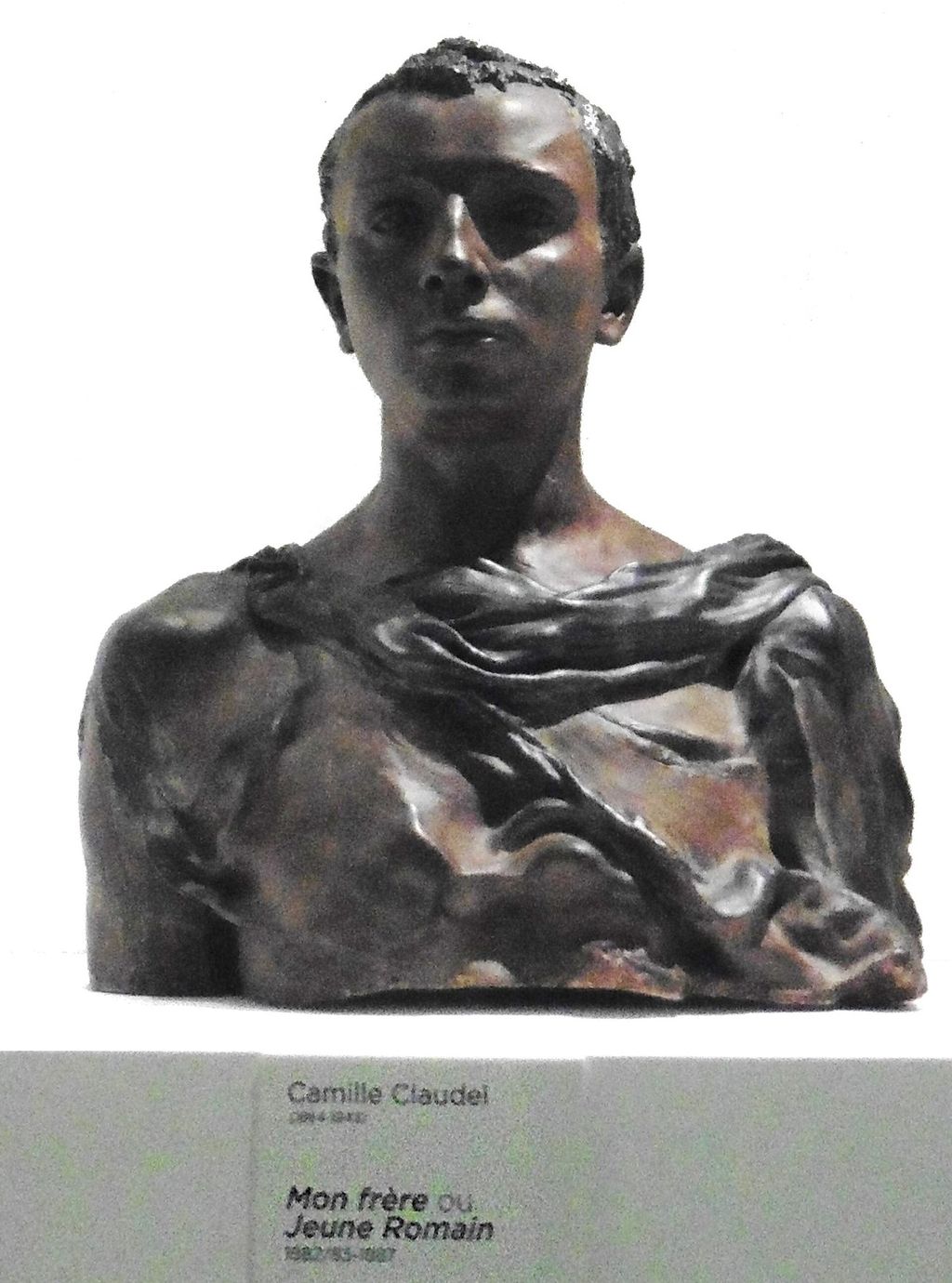
Bronze of the young Paul Claudel, photographed at La Piscine, Roubaix. Photograph by Pierre André Leclercq. Image source. CC BY-SA 4.0. Resized photograph, shared under CC BY-SA 4.0.
The same sitter in 1905
In Paul Claudel at Thirty-Seven, Claudel returned to the upright head and a broad cut across the shoulders. Claudel modelled the portrait in 1905. P. Converset cast the Nogent bronze, 2016.1.1, in 1912–13. Set the museum’s photographs of the two busts side by side and the base of the neck is a good place to begin. In Young Roman, the folds curve up and across the shoulders, framing the exposed skin. In the later bust, bare shoulders and collarbones carry the eye out from the neck. The adult face looks heavier around the lower cheeks, and the moustache makes the mouth harder to read at a glance. The cloth that gave the younger figure so much movement has yielded to a few wide planes across the chest. Look back at the earlier portrait and the particular qualities of the boy come forward again, especially the fine line of the lips and the way the collar frames a neck that seems long in proportion to the face. [2] [11]
Artworks directory
| Name | Date | Medium |
|---|---|---|
| The Mature Age | 1894–99 | Sculpture |
| The Waltz | c. 1889–93 | Sculpture |
| Sakuntala | 1886–88 | Sculpture |
| The Little Châtelaine | 1892–93 | Sculpture |
| The Gossips | c. 1893 | Sculpture |
| The Wave | 1897–1903 | Sculpture |
| Perseus and the Gorgon | c. 1897–1902 | Sculpture |
| The Implorer | c. 1894–99 | Sculpture |
| Clotho | 1893 | Sculpture |
| Bust of Auguste Rodin | c. 1886–89 | Sculpture |
| Paul Claudel at Sixteen Years Old | c. 1882–87 | Sculpture |
| Young Girl with a Sheaf | c. 1886–87 | Sculpture |
| Giganti | c. 1885 | Sculpture |
| Crouching Woman | c. 1884–85 | Sculpture |
| The Hungry Dog | c. 1893 | Sculpture |
| Old Hélène | c. 1881–82 | Sculpture |
| Fortune | c. 1902–05 | Sculpture |
| The Wounded Niobid | 1906 | Sculpture |
| The Siren, or The Flute Player | c. 1904–05 | Sculpture |
| Deep Thought | c. 1898 | Sculpture |
| Dream by the Fireside | c. 1899 | Sculpture |
| Paul Claudel at Thirty-Seven | 1905 | Sculpture |
| Portrait de Madame Claudel | c. 1883 | Sculpture Musée Camille Claudel. |
| Jeune Femme aux yeux clos | c. 1885 | Sculpture Musée Camille Claudel. |
| Ferdinande de Massary | 1888 | Sculpture Musée Camille Claudel. |
| Léon Lhermitte | 1889 | Sculpture Musée Camille Claudel. |
| Étude de main gauche | c. 1889 | Sculpture Musée Camille Claudel. |
| Vieil aveugle chantant | c. 1894 | Sculpture Musée Camille Claudel. |
| Tête de vieillard | c. 1890 | Sculpture Musée Camille Claudel. |
| Étude pour la tête d’Hamadryade | c. 1895 | Sculpture Musée Camille Claudel. |
| Aurore | c. 1900 | Sculpture Musée Camille Claudel. |
Discussion
Look again at the images and ideas explored in Paul Claudel at Sixteen Years Old. These editorial prompts invite your observations.
Reader Insights
How does the turn of the head change the portrait in profile?
Which features make the title Young Roman seem apt?
Join the Conversation
Share a detail, comparison or question about Paul Claudel at Sixteen Years Old below.
References
- J. Paul Getty Museum, Camille Claudel, Portraits section, photograph and exhibition caption for Art Institute of Chicago 2022.1438,. View source.
- Musée Camille Claudel, Jeune Romain, French collection record and photograph for D2017.14.1,. View source.
- Ministère de la Culture, Joconde record 05620001916, Musée des Augustins, Toulouse, RA 941,. View source.
- Musée Camille Claudel, Camille Claudel, Paul Claudel. Le rêve et la vie, 2018 press dossier, p. 10, photograph of the Nogent plaster,. View source.
- Musée Camille Claudel, Camille Claudel portraitiste, family sitters and the Louvre studies,. View source.
- French Sculpture Census, Young Roman, Chicago 2022.1438, dimensions and technical description from the Art Institute of Chicago,. View source.
- Musée Camille Claudel, museum press dossier, Salle 12 checklist, p. 27,. View source.
- Paul Leroi, “Salon de 1887 (fin),” L’Art, vol. 43, 1887, text and illustration caption transcribed in Véronique Gauthier’s documentary compilation, p. 177,. View source.
- Musée Camille Claudel and Réunion des musées nationaux – Grand Palais, Camille Claudel au Salon des Artistes Français, exhibition dossier, pp. 9–14,. View source.
- Institut Calvet, Buste de Paul Claudel en jeune Romain, T511,. View source.
- Musée Camille Claudel, Paul Claudel à trente-sept ans, collection record and photograph for 2016.1.1,. View source.