by Tom Gurney
Tom Gurney BSc (Hons) is an art history expert with over 20 years experience
Email: tomgurney1@gmail.com / Phone: +44 7429 011000
The Rediscovery of Camille Claudel: Introduction
The cover of the catalogue for Camille Claudel’s first posthumous retrospective, at the Musée Rodin in 1951, showed a sculpture by Auguste Rodin. In The Thought, Claudel’s face rises from a block left rough. The exhibition gave the public a chance to see what she had made, while the book that accompanied it presented her first as someone another sculptor had portrayed. More than seventy years later, the Art Institute of Chicago and the Getty used a painted plaster of her brother Paul to introduce her portraiture in the guide to their joint retrospective. The difference is visible in the objects each exhibition used to introduce her. One begins with her face, the other with what she made of someone else’s. [1] [2] [3]
At a Glance
- Early retrospectiveMusée Rodin, 1951
- Musée Camille Claudel opened2017, Nogent-sur-Seine
Contents
- A retrospective becomes a collection
- The audiences of the 1980s
- What travelled and what changed hands
- How Nogent built a museum around Claudel
- What the Chicago and Getty retrospective made visible
- Recovering the exhibition history
A retrospective becomes a collection
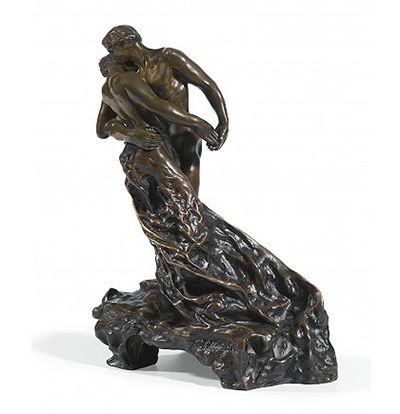
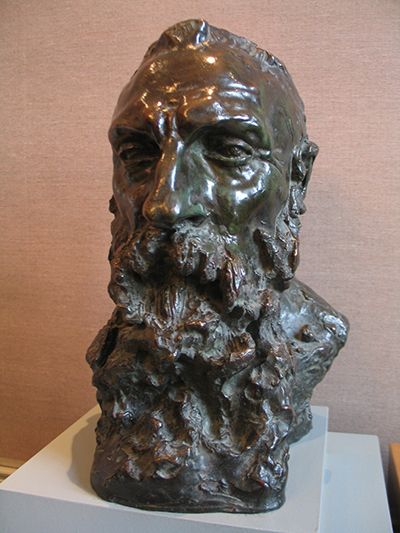
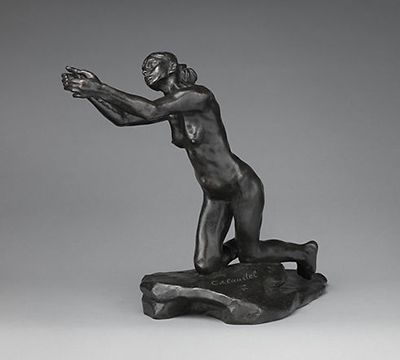
Works by Claudel still appeared in exhibitions during her lifetime, even after she had stopped working. The Salon des femmes artistes modernes showed pieces including The Waltz, The Imploring Woman and her bust of Rodin between 1934 and 1938. In 1949, six years after her death, Paul Claudel approached the Musée Rodin about a retrospective. He worked with Cécile Goldscheider and wrote the catalogue preface, Ma sœur Camille. The exhibition opened on 16 November 1951. The museum’s archive preserves an unbound copy of the catalogue in Goldscheider’s papers, and the manuscript of Paul’s preface is held by the Bibliothèque nationale de France. These are records of how the exhibition was put before the public and of the part each collaborator played in it. [1] [4] [5]
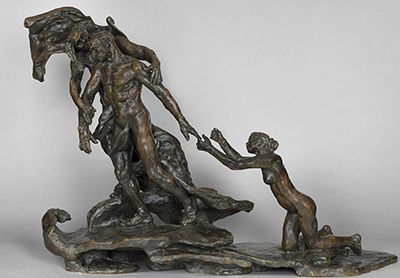
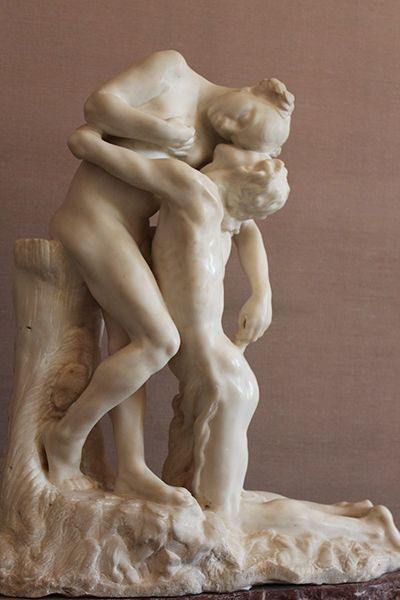
Paul gave the Musée Rodin four sculptures the following year, enabling it to open a room devoted to his sister’s work. His gift included two versions of The Mature Age, as well as Vertumnus and Pomona and Clotho. The two versions of The Mature Age made the gift particularly consequential. A single group could establish the scale of Claudel’s ambition. With two, viewers could follow a decision she had made. In the earlier composition the young woman still holds the man’s arm. In the later one she reaches across an interval that leaves the two figures apart. Paul’s preface offered visitors a reading of the group through his sister’s life. The sculptures in his gift also let them see the work change in her hands. [1] [6] [7]
The audiences of the 1980s
The Musée Rodin describes the early 1980s as a second period of rediscovery. It singles out theatre in 1981, followed by the wide exposure Bruno Nuytten’s 1988 film gave Claudel’s story. Isabelle Adjani’s performance furnished many viewers with a face for a person whose surviving photographs were much less familiar. There was also a separate effort to gather and document the sculpture. The Musée Rodin exhibited Claudel’s work in Paris in 1984, and the show travelled to the Musée Sainte-Croix in Poitiers. Bruno Gaudichon’s illustrated catalogue, with a bibliography, gave readers something they could consult after the exhibition closed. The film and the catalogue circulated very different kinds of evidence about a woman whose name had become newly familiar. [6] [8] [9]
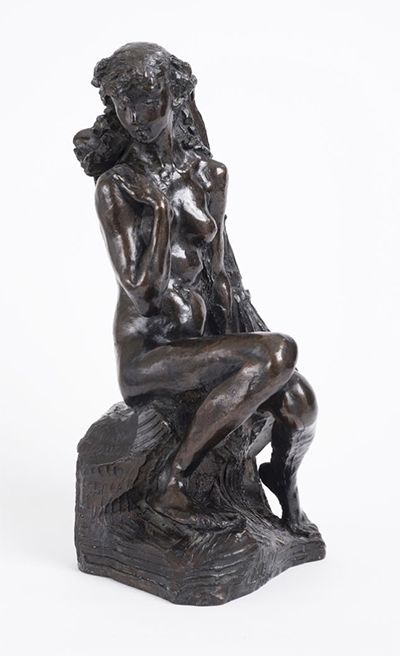
In 1988 the National Museum of Women in the Arts in Washington, DC, mounted what it describes as the first US exhibition devoted to Claudel’s work. Her great-niece Reine-Marie Paris curated it. The museum announced eighty sculptures, including examples of The Little Châtelaine and The Waltz, alongside loans of Rodin’s work. Public and private collections in the United States supplemented works brought from France. The museum’s archive illustrates the show with its own bronze of Young Girl with a Sheaf, a gift from Wallace and Wilhelmina Holladay. The caption dates that cast to 1984, almost a century after Claudel modelled the girl. An American viewer could see the shape and gesture of the early composition through an object made during the revival of interest in her work. [10]
The Musée d’Orsay used a smaller selection to tell a different story. It acquired the early bronze of The Mature Age in 1982 and a plaster Torso of Clotho in 1988, the year it opened an exhibition centred on The Mature Age. The museum understood the purchases as filling gaps in the collection it had inherited from the Musée du Luxembourg. The marble Clotho that had been at the Luxembourg disappeared after 1913. The torso the museum bought in 1988 preserved part of Claudel’s treatment of the figure. The exhibition catalogue set a small number of sculptures against written recollections and criticism. Where the Washington exhibition could establish range through many loans, Orsay could make the absence of a particular marble part of the history a visitor encountered. [11]
What travelled and what changed hands
International exhibitions also changed the company in which Claudel’s work appeared. In 2004 the State Tretyakov Gallery in Moscow marked the 140th anniversary of the Russian sculptor Anna Golubkina’s birth by bringing her work into comparison with Rodin’s. A contemporary account in the gallery’s magazine credits Léonard Gianadda with offering loans of Rodin’s work from the Fondation Pierre Gianadda in Switzerland and proposing three Claudel sculptures. The Musée d’Orsay’s exhibition history for its bronze of The Mature Age records the work’s inclusion in the Moscow show. Golubkina was the reason for the exhibition. Claudel’s presence made it possible to compare how two sculptors who had worked with Rodin developed their own ways of modelling figures. [12] [13]
The retrospective that opened at Fundación MAPFRE in Madrid in 2007 and moved to the Musée Rodin in 2008 brought together more than eighty Claudel sculptures, alongside drawings, prints, photographs and correspondence. The Paris museum used it to present terracotta studies it had recently reattributed to Claudel. It also included the plaster of The Wounded Niobid placed by the French state at the museum in Béjaïa, Algeria, in 1935. Such works changed the exhibition’s account of her practice. Terracotta studies gave visitors evidence of how she worked at a small scale. The loan of the Béjaïa plaster gave them access to an object with a different history from a bronze of the same composition. The correspondence and photographs could place the sculptures in a working life, while the objects gave scholars something to test against what the documents said. [14]
How Nogent built a museum around Claudel
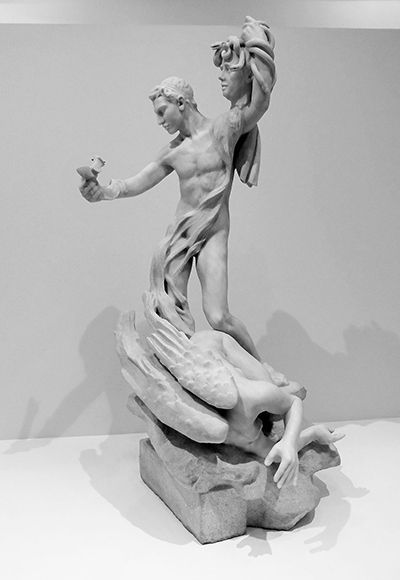
In 2003 Nogent-sur-Seine held an exhibition drawn from the collections assembled by Reine-Marie Paris and Philippe Cressent. The town’s museum estimates that it drew some 40,000 visitors in three months. It traces the decision to build a substantial Claudel collection to that exhibition. The first acquisitions included a study for the Head of a Hamadryad in 2006 and a small model of The Imploring Woman in 2007. In 2008 the collectors agreed to sell the town the works they had assembled over years of research. The town also acquired the Claudel family’s former home that year. With state heritage funding and corporate sponsorship, the town also acquired the monumental marble Perseus and the Gorgon, which the museum catalogues as a 2009 purchase. [15] [16]
Nogent had a sculpture collection long before it had a museum named for Claudel. Alfred Boucher helped found the town’s museum in 1902, and by 1905 a new gallery could take large pieces such as Paul Dubois’s Joan of Arc. Decades later, curator Jacques Piette began an inventory and restoration of the collection, and the renovated sculpture gallery reopened in 1995. Those holdings gave the Claudel project something the collectors’ works alone could never supply. The museum that opened in March 2017 could place Claudel’s sculptures in the context of the public monuments, workshop practices and range of styles that characterised French sculpture in her lifetime. Boucher’s work was part of that history, as were works by sculptors such as Jules Desbois and François Pompon, who shared the working world of Rodin’s studio. [15] [1]
The former family home establishes a link with Claudel’s childhood in Nogent. Adelfo Scaranello’s adjoining building gave the collection a different kind of space. From the street, its brick volumes and large windows make the museum visible in the town centre. Inside, the sequence of galleries first puts visitors among other nineteenth-century sculptors and then gives sustained attention to Claudel’s own work. A viewer can arrive at Perseus and the Gorgon having already seen what other sculptors of her period asked of a large figure group. The building and collection make that comparison possible as part of an ordinary visit, without waiting for a retrospective to assemble the context again. [1] [15] [17]
What the Chicago and Getty retrospective made visible
The Getty announced its acquisition of Torso of a Crouching Woman, its first Claudel, in 2018 alongside the acquisition of a Rodin bronze. The Claudel had once belonged to Paul. The Getty dates the model to about 1884–85 and the bronze cast to no later than 1913. Its technical study proposes that raised lines on the metal preserve seams from a mould used to make the plaster model for casting. The object thus bears evidence of an earlier stage of production, although the plaster is lost. In Chicago the Art Institute acquired Young Roman, a painted plaster, with funds from a prior bequest and individual donors. The two museums’ purchases made different kinds of object available for study, from the early portrait with a coloured surface to the bronze in which the crouching body retains its balance even without a head or arms. [18] [19] [3]
The joint retrospective ran at the Art Institute of Chicago from October 2023 to February 2024 and at the Getty Center from April to July 2024. The Getty presented nearly sixty sculptures, and the Art Institute records more than thirty institutional and private lenders for the Chicago presentation. Those loans let the curators examine differences among works that a single museum rarely holds in several versions. Several bronzes of The Waltz brought different surfaces and arrangements of drapery into view. Two versions of The Gossips put green onyx beside white marble. The Getty also presented three examples of Dream by the Fireside, including one conceived as a nightlight. The comparison gives that hearth a practical purpose alongside its place in the composition. It also lets the viewer see how much a change of material or finish can alter the appearance of a scene that remains recognisable from one example to the next. [20] [21] [22] [3]
Recovering the exhibition history
One later project made an exhibition from Claudel’s own lifetime the subject of research. In 2025 the Paula Modersohn-Becker Museum in Bremen and the Alte Nationalgalerie in Berlin presented her work with that of Bernhard Hoetger. The collaboration reached Nogent in September 2026. The point of departure was the double exhibition Eugène Blot held in Paris in 1905, where he showed twelve Claudel bronzes alongside Hoetger’s sculptures and drawings. In 2024 the Nationalgalerie had acquired an early bronze of The Imploring Woman with support from the Ernst von Siemens Kunststiftung. The acquisition and the exhibition gave the same figure two contexts. The bronze entered a collection where it could be seen in relation to the museum’s Rodins. The exhibition put it back in the company of work by a sculptor with whom Claudel had shared a public in 1905. [23] [24]
Nogent identifies three kinds of evidence that survive from Blot’s show, including a short catalogue, press coverage and one installation photograph. The photograph records wooden stands and plants around the sculptures. The catalogue and press can be read against that view to recover what the exhibition offered visitors and how some of them responded. This approach gives Claudel a place in the working exhibition culture of Paris, among the dealers, reviewers and other sculptors through whom her work first became public. [25]
An exhibition can give a work new neighbours for a few months. An acquisition can keep a work available for comparison long after the loans go home. The 1952 gift put two stages of The Mature Age within reach of the same institution. The acquisitions at Nogent gave small studies and a monumental marble a common setting. The Chicago and Getty show temporarily brought together examples that had passed into different hands. Each changed what people could see of Claudel’s decisions as a sculptor. The many locations that made those comparisons possible also explain why the collections that hold her work still tell different parts of the story. [1] [15] [21]
Artworks directory
| Name | Date | Medium |
|---|---|---|
| The Mature Age | 1894–99 | Sculpture |
| The Waltz | c. 1889–93 | Sculpture |
| Sakuntala | 1886–88 | Sculpture |
| The Little Châtelaine | 1892–93 | Sculpture |
| The Gossips | c. 1893 | Sculpture |
| The Wave | 1897–1903 | Sculpture |
| Perseus and the Gorgon | c. 1897–1902 | Sculpture |
| The Implorer | c. 1894–99 | Sculpture |
| Clotho | 1893 | Sculpture |
| Bust of Auguste Rodin | c. 1886–89 | Sculpture |
| Paul Claudel at Sixteen Years Old | c. 1882–87 | Sculpture |
| Young Girl with a Sheaf | c. 1886–87 | Sculpture |
| Giganti | c. 1885 | Sculpture |
| Crouching Woman | c. 1884–85 | Sculpture |
| The Hungry Dog | c. 1893 | Sculpture |
| Old Hélène | c. 1881–82 | Sculpture |
| Fortune | c. 1902–05 | Sculpture |
| The Wounded Niobid | 1906 | Sculpture |
| The Siren, or The Flute Player | c. 1904–05 | Sculpture |
| Deep Thought | c. 1898 | Sculpture |
| Dream by the Fireside | c. 1899 | Sculpture |
| Paul Claudel at Thirty-Seven | 1905 | Sculpture |
| Portrait de Madame Claudel | c. 1883 | Sculpture Musée Camille Claudel. |
| Jeune Femme aux yeux clos | c. 1885 | Sculpture Musée Camille Claudel. |
| Ferdinande de Massary | 1888 | Sculpture Musée Camille Claudel. |
| Léon Lhermitte | 1889 | Sculpture Musée Camille Claudel. |
| Étude de main gauche | c. 1889 | Sculpture Musée Camille Claudel. |
| Vieil aveugle chantant | c. 1894 | Sculpture Musée Camille Claudel. |
| Tête de vieillard | c. 1890 | Sculpture Musée Camille Claudel. |
| Étude pour la tête d’Hamadryade | c. 1895 | Sculpture Musée Camille Claudel. |
| Aurore | c. 1900 | Sculpture Musée Camille Claudel. |
Discussion
Look again at the images and ideas explored in The Rediscovery of Camille Claudel. These editorial prompts invite your observations.
Reader Insights
What becomes visible when related objects are shown together?
How has a museum or exhibition changed the way you encounter Claudel’s work?
Join the Conversation
Share a detail, comparison or question about The Rediscovery of Camille Claudel below.
References
- Musée Camille Claudel, English museum press dossier, “Birth of the Camille Claudel Museum,” “Exhibition tour” and “Slow recognition”,. View source.
- Musée d’Orsay, La Pensée, Auguste Rodin, collection record,. View source.
- J. Paul Getty Museum, Camille Claudel, exhibition guide, sections on portraiture, The Waltz and everyday life,. View source.
- Musée Rodin, Cécile Goldscheider papers, archival finding aid,. View source.
- Musée Camille Claudel, Camille Claudel, Paul Claudel : le rêve et la vie, exhibition dossier, checklist entries 66 and 67,. View source.
- Musée Rodin, Camille Claudel. Nouveaux regards, nouvelles questions, study day introduction,. View source.
- Musée Rodin, The Age of Maturity, S.01380, collection record and comparison of the two compositions,. View source.
- Musée Rodin, Portrait of Camille Claudel, Ph.00527, collection record,. View source.
- Bibliothèque nationale de France, Bibliographic record for Bruno Gaudichon’s Camille Claudel : 1864-1943, Musée Rodin, 1984,. View source.
- National Museum of Women in the Arts, Camille Claudel: 1864-1943, exhibition archive, 1988,. View source.
- Musée d’Orsay, L’Âge mûr de Camille Claudel, exhibition archive, 1988–89,. View source.
- Irina Krasnikova, Tretyakov Gallery Magazine, Rodin, Golubkina, Claudel, contemporary exhibition account, 2004,. View source.
- Musée d’Orsay, L’Âge mûr, RF 3606, collection and exhibition record,. View source.
- Musée Rodin, Camille Claudel, Madrid and Paris retrospective, exhibition archive,. View source.
- Musée Camille Claudel, Histoire du musée, municipal collection and acquisitions,. View source.
- Musée Camille Claudel, Perseus and the Gorgon, marble 2009.1.1, collection record,. View source.
- Musée Camille Claudel, 2023 press dossier, “L’architecture du musée”,. View source.
- J. Paul Getty Museum, Acquisition announcement for Torso of a Crouching Woman and Rodin’s Bust of John the Baptist, 2018,. View source.
- J. Paul Getty Museum, Guidelines for the Technical Examination of Bronze Sculpture, fig. 75, 2018.32,. View source.
- Art Institute of Chicago, Camille Claudel, exhibition record, 2023–24,. View source.
- J. Paul Getty Museum, Camille Claudel, retrospective archive, 2024,. View source.
- J. Paul Getty Museum, 2024 retrospective announcement, object loans and installation,. View source.
- Staatliche Museen zu Berlin, Alte Nationalgalerie, Camille Claudel und Bernhard Hoetger. Emanzipation von Rodin, exhibition archive and 2024 purchase,. View source.
- Musée Camille Claudel, Camille Claudel & Bernhard Hoetger: the 1905 Exhibition, Nogent exhibition record,. View source.
- Musée Camille Claudel, 1905 : l’exposition Claudel & Hoetger, surviving exhibition documentation,. View source.