 by Tom Gurney
Tom Gurney BSc (Hons) is an art history expert with over 20 years experience
Email: tomgurney1@gmail.com / Phone: +44 7429 011000
Camille and Paul Claudel: Introduction
In December 1893, Camille Claudel sent her younger brother Paul a letter filled with ideas for sculptures. She sketched the groups she had in mind, asked his opinion and told him to keep the drawings to himself. Twelve years later, Paul was making a public case for her originality in the literary journal L’Occident. By 1951, when he wrote the preface to her retrospective at the Musée Rodin, he was asking visitors to see her life in the figures she had made. The letter, the essay and the preface belong to different moments in the siblings’ relationship. The first shows what Camille chose to tell her brother about her work. The two published texts show how Paul came to speak about it in his own terms. [1] [2]
At a Glance
- SiblingsCamille Claudel and Paul Claudel
- RetrospectiveMusée Rodin, 1951
Contents
- A sitter and a first reader
- What Paul argued in 1905
- What Camille asked of Paul at Montdevergues
- The brother who wrote the preface
A sitter and a first reader
Paul had known his sister’s sculpture from the other side of the modelling stand. As a teenager he sat for the likeness now called Paul Claudel at Sixteen Years Old, also exhibited as Jeune Romain (Young Roman). The title Young Roman gave an audience at the Salon a way to read the bearing and drapery of a boy known to the artist as her brother. When Camille began Paul Claudel at Thirty-Seven in 1905, she returned to a familiar sitter with a very different face and gave the older man bare shoulders. The younger likeness had already had a public life for years by the time Paul became her published critic. [1] [3]
Paul entered the diplomatic service in 1893, the year Camille sent him the sketches. The letter let her continue a conversation about sculpture across the distance opened by his work abroad, at a point when she wanted to develop a practice distinct from Rodin’s. One of the groups she drew for Paul, Le Bénédicité (Grace Before the Meal), placed tiny figures around a large table as they listened to a prayer. Another, Le Dimanche (Sunday), showed three figures perched on a high cart, on their way to Mass. Both proposals depend on a relationship of scale. A table can make the people gathered around it look small, while the height of a cart can give an ordinary outing the shape of a procession. The captions and drawings allowed a reader away from her studio to picture arrangements that would be worked out in three dimensions. [1] [2] [4]
Camille asks for an opinion and sets the terms on which she wants it. She decides which ideas to describe and who may see them while they are still hers to develop. The request for secrecy is especially revealing alongside the confidence with which she presents so many possibilities in one letter. Paul is a reader she trusts with work in progress. When they met in the Pyrenees in the summer of 1905, Paul sat for the adult portrait. In October, with the work still under way, he told his friend Gabriel Frizeau that he expected it to turn out superbly. That remark preserves a sitter’s view of a work still taking shape. The essay published that year asked a much wider audience to judge the sculptor’s art. [2] [5]
What Paul argued in 1905
Camille Claudel, statuaire appeared under the initials P. C. in the August 1905 issue of L’Occident. A few months later, Eugène Blot exhibited twelve of Camille’s bronzes alongside work by the German sculptor Bernhard Hoetger at his Paris gallery. The essay gave journal readers a way to approach Camille’s sculpture at a time when a dealer was putting a range of her work before viewers and buyers. Its title names her by profession. The argument makes room for her within a history of sculpture, where Paul saw the display and grandeur of official nineteenth-century art giving way to a different kind of attention. [2] [6] [7]
Paul calls the art he finds in Camille’s work sculpture intérieure. He begins his explanation with the way daylight enters a room and changes as it meets walls, furniture and mirrors. The objects acquire some of their meaning through the traces of people who have used them. A hat on a piano can register the absence of the person who left it there. Read beside The Gossips, the comparison draws attention to how an enclosure changes a scene. Four figures huddle together, and the screen in the Musée Rodin’s version sets their gathering apart from the space around it. The screen helps the viewer see that the conversation has a boundary. It also brings the figures into a more concentrated relation to one another. [2] [8]
The essay has a second way of describing invention. Paul calls the motif a figure made from several movements coming together at a particular moment. One of his examples is a runaway horse being brought under control. The idea depends on the action of the horse and the effort to restrain it becoming legible together. In The Wave, three figures bend beneath a rising mass. Their repeated poses and the sweep above them make the event legible before it has run its course. The horse is Paul’s example. The bathers show how his idea can help a viewer describe the timing of one of Camille’s groups. [2] [8]
Paul sharpened his argument by describing an unnamed rival whose figures seemed to him to struggle out of a compact lump of material. The Société Paul Claudel identifies the target as Rodin. The polemic favours openness and movement in Camille’s work and makes the sculpture of the other artist sound wilfully heavy. The contrast tells us where Paul put his allegiance. His account of the motif has a wider application because it asks a reader to look for the particular combination of forces that makes a figure or a group intelligible. In July 1913, the essay appeared again in an illustrated issue of L’Art décoratif. By then, the circumstances in which people read it had changed sharply. [1] [2]
What Camille asked of Paul at Montdevergues
The siblings’ father died on 3 March 1913. Dr Michaux drew up a certificate on 7 March, and Camille was admitted to Ville-Évrard on 10 March. The Musée Camille Claudel identifies her mother as the person who requested admission under the procedure called placement volontaire. Its account of the arrangements also records Paul’s involvement alongside his mother. The wartime move south followed in September 1914, and Camille remained at Montdevergues, near Avignon, until her death in 1943. Paul came to see her on several occasions. Their mother and sister Louise did not visit, and the family had requested restrictions on Camille’s visits and correspondence. [1] [9] [10]
In a letter dated by the editors of her correspondence to after May 1915, Camille reminded Paul that he had come to see her at the end of May and that she had asked him to promise to take care of her. She said she had heard nothing from him since, and asked how he thought it felt to go months or years without news or hope. Her preferred outcome was to return to ordinary life. The letter establishes what she told him she wanted and what she remembered asking of him in person. It also shows the difficulty of reading a silence in this correspondence. Some of Camille’s surviving letters were intercepted or withheld, so the existence of a letter and its arrival with the intended reader are separate questions. [11]
In February 1927 Camille wrote to her mother about the cold and reported that Paul had arranged for her to be put in first class. What she stressed was that her family made decisions for her without asking what she needed. The following month she wrote to Paul himself about how happy she would be to return to Villeneuve-sur-Fère. The village was a place they had known since childhood. Paul associated it with his vocation and used its rocky landscape in his early play La Jeune Fille Violaine. For Camille writing from Montdevergues, Villeneuve was somewhere she could imagine going back to. Naming it gave her wish to leave a destination her brother knew. [1] [11] [12]
Paul’s journal records his last visit in September 1943. He recalled Camille recognising him and repeatedly calling him her little Paul. He set the woman he saw against his memory of her as a girl and young artist, and wrote of his bitter regret at having left her alone for so long. A few days later he described her sculpture as a confession. He worked through a sequence of groups, from L’Abandon to The Mature Age, treating them as stages in a private drama. Those entries put his account of a particular encounter beside a reading of sculptures made decades earlier. The closeness of the entries helps explain the emotional force of the reading Paul would later give the public. [13]
The brother who wrote the preface
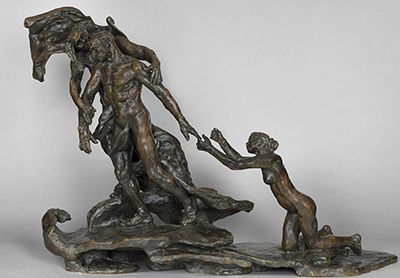
In 1949, six years after Camille’s death, Paul approached the Musée Rodin about a retrospective. It opened in 1951. His catalogue preface, Ma sœur Camille (My Sister Camille), presents an artist whose work tells the story of her life. In the passage reproduced by the Musée d’Orsay, he addresses the viewer in front of The Mature Age and identifies his sister with the kneeling woman. The separation taking place before the viewer becomes, in his account, a tearing away of her soul. The move from the 1905 essay to the 1951 preface is visible in the way Paul uses gesture. Where the earlier text asks how different movements gather into a recognisable motif, the later one gives a movement the meaning of an event in his sister’s life. [1] [2] [9] [14]
Camille had written to Paul about the three-figure group while it was still a project. The Musée Rodin’s account describes her considering a slanting tree to reinforce the idea of destiny. In the early version the young woman can still hold on to the man. In the later one her reach falls short as the older figure draws him away. That revision makes separation visible in the space between hands. In Paul’s reading the kneeling woman has a name. Camille’s revisions give the passage from youth to age a form that can be understood through the figures’ changing contact. [14] [15]
In 1952 Paul gave the Musée Rodin four works by Camille, including both versions of The Mature Age, Clotho and Vertumnus and Pomona. The gift helped the museum establish the room for her work that the critic Mathias Morhardt had proposed to Rodin in 1914. Putting two versions of a composition into a public collection made a different kind of encounter possible from the one Paul staged in his preface. Viewers could see what the sculptor had changed between versions. The brother who had received a private account of a work still being imagined helped give later audiences the means to follow its development for themselves. [8] [15]
Artworks directory
| Name | Date | Medium |
|---|---|---|
| The Mature Age | 1894–99 | Sculpture |
| The Waltz | c. 1889–93 | Sculpture |
| Sakuntala | 1886–88 | Sculpture |
| The Little Châtelaine | 1892–93 | Sculpture |
| The Gossips | c. 1893 | Sculpture |
| The Wave | 1897–1903 | Sculpture |
| Perseus and the Gorgon | c. 1897–1902 | Sculpture |
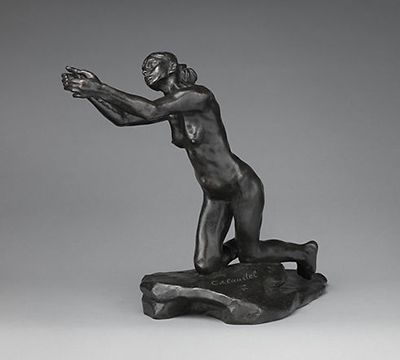
| The Implorer | c. 1894–99 | Sculpture |
| Clotho | 1893 | Sculpture |
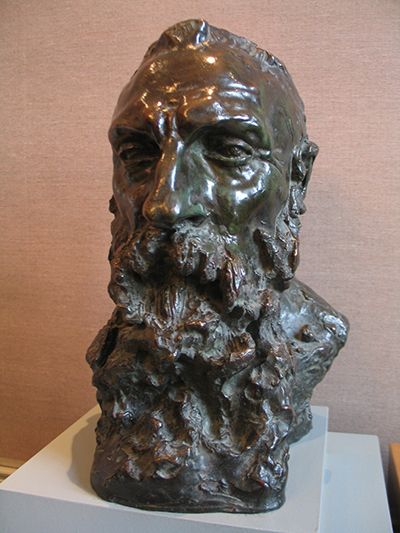
| Bust of Auguste Rodin | c. 1886–89 | Sculpture |
| Paul Claudel at Sixteen Years Old | c. 1882–87 | Sculpture |
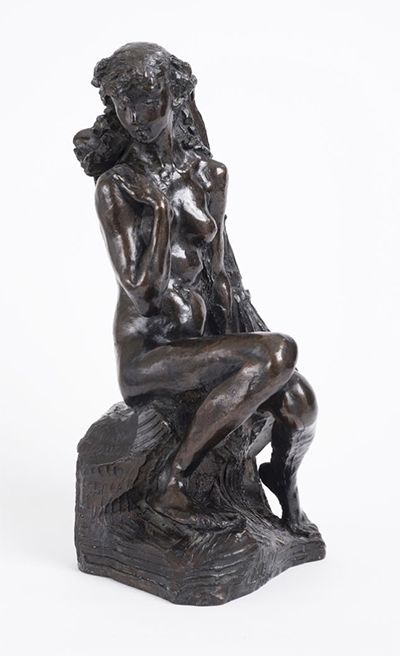
| Young Girl with a Sheaf | c. 1886–87 | Sculpture |
| Giganti | c. 1885 | Sculpture |
| Crouching Woman | c. 1884–85 | Sculpture |
| The Hungry Dog | c. 1893 | Sculpture |
| Old Hélène | c. 1881–82 | Sculpture |
| Fortune | c. 1902–05 | Sculpture |
| The Wounded Niobid | 1906 | Sculpture |
| The Siren, or The Flute Player | c. 1904–05 | Sculpture |
| Deep Thought | c. 1898 | Sculpture |
| Dream by the Fireside | c. 1899 | Sculpture |
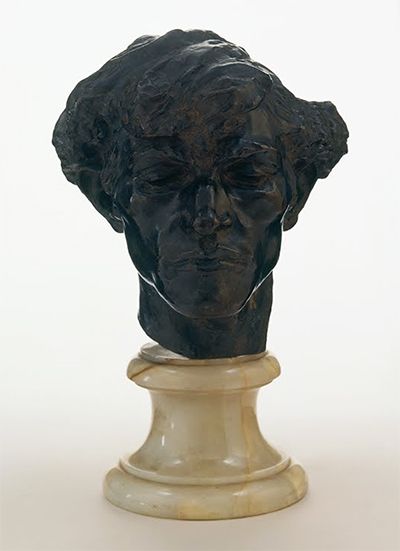
| Paul Claudel at Thirty-Seven | 1905 | Sculpture |
| Portrait de Madame Claudel | c. 1883 | Sculpture Musée Camille Claudel. |
| Jeune Femme aux yeux clos | c. 1885 | Sculpture Musée Camille Claudel. |
| Ferdinande de Massary | 1888 | Sculpture Musée Camille Claudel. |
| Léon Lhermitte | 1889 | Sculpture Musée Camille Claudel. |
| Étude de main gauche | c. 1889 | Sculpture Musée Camille Claudel. |
| Vieil aveugle chantant | c. 1894 | Sculpture Musée Camille Claudel. |
| Tête de vieillard | c. 1890 | Sculpture Musée Camille Claudel. |
| Étude pour la tête d’Hamadryade | c. 1895 | Sculpture Musée Camille Claudel. |
| Aurore | c. 1900 | Sculpture Musée Camille Claudel. |
Discussion
Look again at the images and ideas explored in Camille and Paul Claudel. These editorial prompts invite your observations.
Reader Insights
How do the portraits and the written record tell different parts of the siblings’ story?
Which surviving document helps you place their relationship in time?
Join the Conversation
Share a detail, comparison or question about Camille and Paul Claudel below.
References
- Musée Camille Claudel, Camille Claudel, Paul Claudel. Le rêve et la vie, 2018 exhibition dossier, pp. 4–9 and checklist nos. 35–41, 49 and 60–67,. View source.
- Société Paul Claudel, “Claudel et la sculpture,” including Paul Claudel’s “Camille Claudel statuaire,” excerpt from Œuvre en prose, Bibliothèque de la Pléiade, p. 274,. View source.
- J. Paul Getty Museum, Camille Claudel exhibition guide, early portraiture and Young Roman,. View source.
- Marie Gevart-Dekaeke, La sculpture et l’intime en France (1865–1909), doctoral dissertation, Université Paris Nanterre, 2018, pp. 269–70, descriptions and transcribed excerpts of the December 1893 letter, BnF NAF 28255,. View source.
- Anne Rivière, discussion of Camille’s adult bust in the Bulletin de la Société Paul Claudel, no. 191, including Paul’s letter to Gabriel Frizeau, 23 October 1905,. View source.
- Institut national d’histoire de l’art, repertoire of French-language art journals, entry for L’Occident, no. 45, August 1905, pp. 81–85,. View source.
- Alte Nationalgalerie, Camille Claudel and Bernhard Hoetger, historical account of the 1905 Blot exhibition,. View source.
- Musée Rodin, 2025 documentary dossier, p. 18, Room 16, small groups and history of the Claudel collection,. View source.
- Musée Camille Claudel, “Les années d’enfermement,” dated chronology,. View source.
- Centre Hospitalier de Montfavet, “La vie de Camille Claudel,” confinement and visits,. View source.
- Camille Claudel, letters 311 and 324 in Anne Rivière and Bruno Gaudichon, eds., Correspondance, pp. 303–04 and 314–15, excerpted by Emma Wilson in Modern Languages Open, 2021, pp. 7–8,. View source.
- Maison de Camille et Paul Claudel, educational dossier, p. 3, excerpt of Camille’s 1927 letter to Paul about Villeneuve-sur-Fère,. View source.
- Paul Claudel, Journal, September 1943 entries, excerpted in “Camille et Paul, leur dernière rencontre,” Lettre de l’Académie des beaux-arts,. View source.
- Paul Claudel, “Ma sœur Camille,” 1951 exhibition preface, passage on L’Âge mûr reproduced by the Musée d’Orsay,. View source.
- Musée Rodin, The Age of Maturity or Destiny or The Path of Life or Fatality, S.01380,. View source.