by Tom Gurney
Tom Gurney BSc (Hons) is an art history expert with over 20 years experience
Email: tomgurney1@gmail.com / Phone: +44 7429 011000
Training and women sculptors in Paris: Introduction
An 1887 photograph by William Elborne in the Musée Rodin shows Camille Claudel and Jessie Lipscomb in their workshop at 117 rue Notre-Dame-des-Champs. The museum identifies the large group beside Claudel as Sakuntala, still in progress. Lipscomb sits farther back. Their working clothes and the size of the sculpture tell you something about the sort of place this was. Here there was room for a group of two figures at a scale that demanded considerable space, as well as room for another sculptor. The two women had studied at the same private academy and made portraits of one another. The print was mounted as a small carte de visite. In a format often used to circulate a person’s likeness, the women appear in the space they had made for their work. [1] [2] [3]
In the 1880s a woman arriving in Paris to study sculpture had to find instruction, space and people to work with, each of which could come through a different channel. Claudel took classes at the Académie Colarossi. Alfred Boucher visited her and her colleagues in a studio they rented themselves. She later worked in Auguste Rodin’s much larger establishment, which had premises assigned by the state. Following the passage between those places helps explain what training meant for women who hoped to earn a living in sculpture, and how differently the same opportunities could work out for individual artists. [1] [2] [4]
At a Glance
- CityParis
- Training contextPrivate academies and shared studios
Contents
- Learning sculpture when the state school was closed to women
- Alfred Boucher and the workshop at number 117
- Jessie Lipscomb as colleague, sitter and sculptor
- The Marble Depot and careers beyond it
- Hélène Bertaux and the campaign for access
Learning sculpture when the state school was closed to women
When Claudel moved to Paris in 1881, the École des Beaux-Arts offered free training to those it admitted, and women were ineligible. Private schools and artists’ studios supplied other routes. The Académie Colarossi, at 10 rue de la Grande-Chaumière, accepted women and offered practical instruction, including modelling from life. The Académie Julian also ran women’s classes. It provides a point of comparison for private provision in the city. The Russian painter Marie Bashkirtseff’s In the Studio, exhibited at the Salon in 1881, depicts students at work in Julian’s women’s section. Claudel’s own enrolment was at Colarossi, where the Musée de Pont-Aven reports that women paid higher tuition than men. [2] [4] [5]
Life study mattered to a sculptor because a pose had to be understood from more than one angle. The student could observe how weight shifts across the feet, how that shift changes the line of the hips, and how the torso turns above them. A living sitter made it possible to test those observations against a body in three dimensions. Access to such instruction, particularly when the model was nude, had long been restricted for women. Training at a private academy helped with that part of an education, while the student still needed a place to work on a sculpture between sessions and keep it as it developed. The academy fee and the cost of making a finished piece were separate expenses. [2] [5]
A sculptor had to pay for some combination of space, materials, sitters and specialist labour. Even with a model worked out in clay, turning it into bronze could entail paying a mould maker and a founder. A marble called for a block of stone and, in many cases, a practitioner who could transfer the model to the block and carve it. These costs mattered differently depending on the scale of a project and whether an artist had a commission. Sharing a workshop divided a recurring expense. Taking turns to sit for one another could also supply a subject when paying a professional model was difficult. Neither arrangement made a monumental work inexpensive, but it helped make the long period before a sculpture could be exhibited or sold possible. [2] [6]
The expense of working from a model comes through in a letter Claudel sent to Florence Jeans on 25 December 1887. Giganti had gone back to Italy before she had finished Sakuntala, and Claudel told Jeans that the changes would take time and cost money. The plaster earned an honourable mention at the 1888 Salon, but a state order for a monumental marble did not follow. The costs she describes belong to the making of a work that had yet to meet a jury. Even a favourable decision at that stage left the question of who would pay for a marble version open. [7]
Alfred Boucher and the workshop at number 117
Claudel met Alfred Boucher as a young modeller in Nogent-sur-Seine, where he gave her early instruction. Boucher knew from his own experience what one sculptor’s introduction could do. Marius Ramus had encouraged him in Nogent and introduced him to Paul Dubois, who helped him obtain a scholarship for the École des Beaux-Arts. Boucher later introduced Claudel to Dubois, by then the school’s director. Personal introductions could bring an aspiring sculptor’s work to someone in authority even while the rules of admission kept her out of his school. [4] [8]
Boucher’s small patinated plaster Young Girl Reading, dated about 1880 by the Musée Camille Claudel, bears a dedication to Claudel. The girl bends over an open book. The museum leaves the identity of the sitter unresolved, so the inscription gives firmer evidence about the relationship than the face does. It names the young sculptor as the recipient of a work made by the man who taught her. The object belongs to the story of their acquaintance even without a secure identification of whom Boucher modelled. [9]
By 1882 the family lived at 111 rue Notre-Dame-des-Champs. With her father’s support, Claudel rented a separate workshop at number 117 and shared the expense. The circle changed over time. It included the sculptors Madeleine Jouvray and Sigrid af Forselles and, later, English artists including Amy Singer, Emily Fawcett and Lipscomb. The exhibition at Pont-Aven also documents painters Ghita Theuriet and Laetitia von Witzleben among the studio associates. A photograph by Victor Pannelier places Theuriet and Claudel together around 1882. The distinction between the two street numbers matters because family support and a workplace of their own operated side by side. It also mattered that the women worked in different media. A painter could sit for a sculptor, or make a portrait of a colleague, and their work could circulate beyond the room they shared. [2] [4] [6]
Boucher came to review their work. That made the studio an extension of the women’s training without turning it into a branch of the academy. They could develop their own pieces between visits and get criticism from a professional who knew how works were prepared for exhibition. When Boucher left for Florence in autumn 1882, he asked Rodin to take over the visits. The first arrangement was for Rodin to come to their workshop. The later move of some of the women into his working establishment gave them a different relation to him and to one another. [1] [2] [9]
Jessie Lipscomb as colleague, sitter and sculptor
Lipscomb trained in London before studying at Colarossi. She shared the rue Notre-Dame-des-Champs workshop and for a time lodged with the Claudel family. The Musée Camille Claudel dates the two artists’ portraits of one another to about 1883–86. Claudel’s likeness of Lipscomb survives in terracotta, while the example of Lipscomb’s portrait of Claudel shown in the museum’s exhibition is bronze. Displayed together, the works reverse the direction of attention. Each sculptor had to sit for the other and could observe how a colleague dealt with the same problem of turning a familiar face into a bust. The surviving materials identify the examples displayed and leave open the sequence in which they were modelled or reproduced. [3] [6]
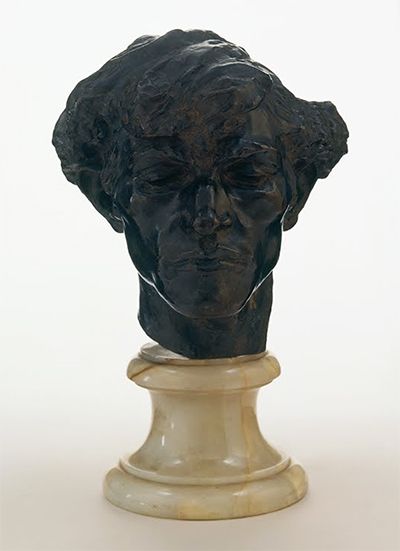
The Italian model Giganti gives a second way to see their work side by side. The Pont-Aven exhibition brought together treatments of him by Lipscomb, Claudel and Rodin. In the illustrated bronze of Lipscomb’s portrait, the curls frame the forehead above a face presented squarely to the viewer. In the bronze by Claudel at Nogent, the head turns, so the neck and the angle of the face change the silhouette as you move around the bust. Pont-Aven describes Rodin’s treatment as more stylised. Holding the sitter constant makes choices about pose, modelling and the lower edge of a bust easier to see. It also helps explain why sharing access to a model could be valuable to artists pursuing quite different results. [2] [6] [10]
Lipscomb’s public career extended across the Channel. Algernon Graves’s register of Royal Academy exhibitors lists three appearances under the spelling Lipscombe, from 1885 through 1887. The entries describe two terracottas, including Day-dreams, and a bronze Study of a Head. The University of Glasgow’s sculpture research database also records a terracotta called Sans Souci exhibited in 1887. For a sculptor working among students from several countries, an exhibition in Britain was one way to be seen beyond the Paris studio. Lipscomb returned to England and in 1929 visited Claudel at Montdevergues. The photographs and the paired portraits preserve evidence of their early association, while the exhibition records establish a public body of work under Lipscomb’s own name. [3] [11] [12]
The Marble Depot and careers beyond it
Rodin’s commission for The Gates of Hell gave him a workshop at the state’s Dépôt des marbres. A large commission generated work for assistants and practitioners, and Rodin’s instruction was closely tied to that work. Claudel was working in his orbit by the mid-1880s. Lipscomb and Jouvray also entered his studio, and af Forselles worked there as an assistant. Studio practice offered proximity to models, finished work and colleagues experienced in different materials. An assistant could spend part of her working life on a commission that would be exhibited under another artist’s name and develop pieces of her own in parallel. The distinction between a visit to number 117 and work at the Depot is important to Claudel’s artistic relationship with Rodin. [2] [4] [6] [13]
Jouvray later shared a studio with af Forselles on rue Blomet, earning a living through lessons in modelling and drawing. She also carved marble for Rodin. Pont-Aven exhibited a marble Danaïde under Jouvray’s own name, with a subject that Rodin also treated. The two roles place different demands on a sculptor. As a practitioner she helped realise an existing design in stone. A marble exhibited as her own work shows how that skill could be applied to a subject also being worked out by artists around her. In af Forselles’s later Development of the Human Soul, another use of the skills learnt in Paris appears at a very different scale. The five large plaster reliefs form a series, now divided between the Finnish National Gallery and Kallio Church in Helsinki. A shared training environment could lead to work for different audiences and settings. [2] [6] [13] [14]
The next generation could approach Claudel herself for instruction. The Scottish sculptor Ottilie Maclaren arrived in Paris in 1897 and studied at Colarossi. She and the American Sarah Whitney sought lessons from Claudel, an arrangement that ended quickly. Maclaren worked with Rodin between 1899 and 1901, showed busts at the Salon de la Nationale in 1903 and 1904, and later opened a sculpture class for women in London. Her brief contact with Claudel belongs to the later history of this network, after the early shared workshop. The sequence shows a student drawing on several teachers and eventually becoming a source of training herself. [6]
Hélène Bertaux and the campaign for access
Hélène Bertaux belonged to an older generation and offers a comparison with Claudel’s workshop circle. She exhibited at the Salon from 1849 and secured commissions for the Louvre and the Hôtel de Ville. In 1881, the year Claudel came to Paris, Bertaux founded the Union des femmes peintres et sculpteurs. It pursued access to academic training and gave women artists opportunities to exhibit. Bertaux’s plaster Psyché sous l’empire du mystère was shown at the Union’s Salon in 1888. The state acquired the marble at the following year’s Paris Salon. The two records show how a sculpture could reach the public through a venue run by women artists as well as through official exhibition and purchase. [15] [16]
Access to the École changed by stages. In 1897 women were permitted to sit its entrance examinations and attend theoretical courses. Access to separate workshops for women, one for sculpture and one for painting, followed in 1900, and eligibility for the Prix de Rome in 1903. A photograph dated about 1903 in the school’s own collection records a women’s studio. The sequence matters for Claudel’s generation because she was already exhibiting finished works by the time the entrance examinations opened. The arrangements she and her colleagues made at Colarossi and rue Notre-Dame-des-Champs belong to the years when they had to put together elsewhere the opportunities that formal admission would begin to provide. By the time a camera recorded a women’s workshop inside the École, another camera had already recorded Claudel and Lipscomb doing that work in a room they rented themselves. [1] [2] [17] [18]
Artworks directory
| Name | Date | Medium |
|---|---|---|
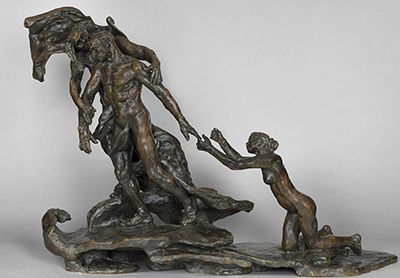
| The Mature Age | 1894–99 | Sculpture |
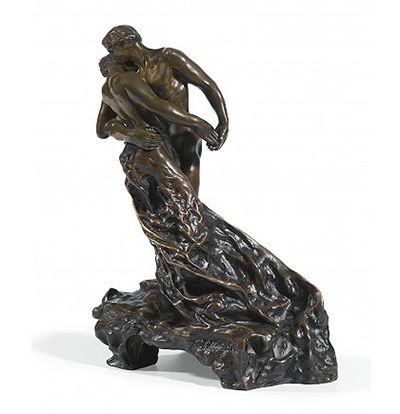
| The Waltz | c. 1889–93 | Sculpture |
| Sakuntala | 1886–88 | Sculpture |
| The Little Châtelaine | 1892–93 | Sculpture |
| The Gossips | c. 1893 | Sculpture |
| The Wave | 1897–1903 | Sculpture |
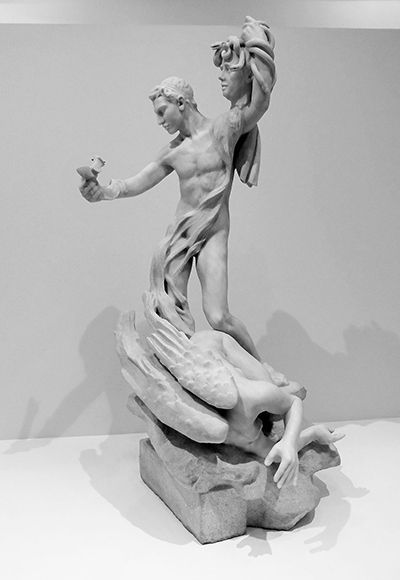
| Perseus and the Gorgon | c. 1897–1902 | Sculpture |
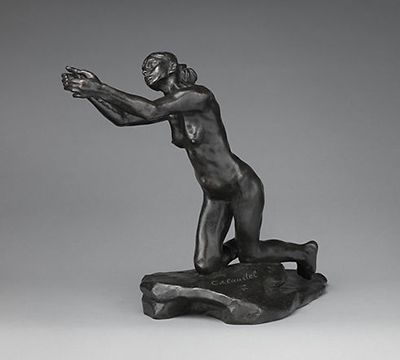
| The Implorer | c. 1894–99 | Sculpture |
| Clotho | 1893 | Sculpture |
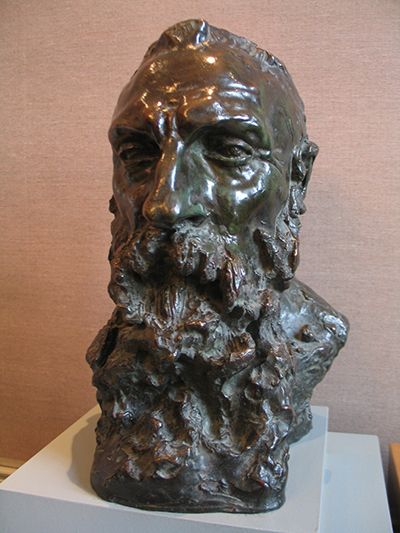
| Bust of Auguste Rodin | c. 1886–89 | Sculpture |
| Paul Claudel at Sixteen Years Old | c. 1882–87 | Sculpture |
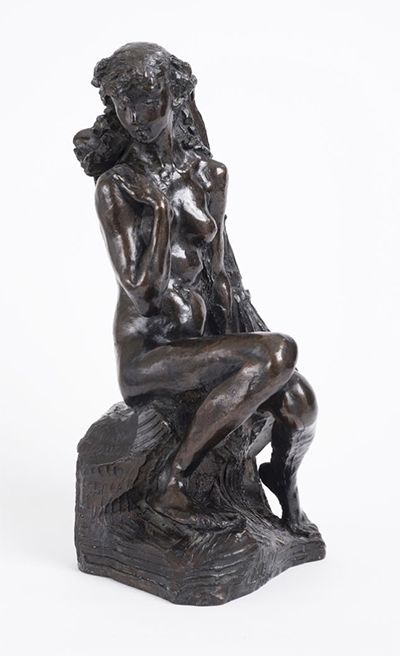
| Young Girl with a Sheaf | c. 1886–87 | Sculpture |
| Giganti | c. 1885 | Sculpture |
| Crouching Woman | c. 1884–85 | Sculpture |
| The Hungry Dog | c. 1893 | Sculpture |
| Old Hélène | c. 1881–82 | Sculpture |
| Fortune | c. 1902–05 | Sculpture |
| The Wounded Niobid | 1906 | Sculpture |
| The Siren, or The Flute Player | c. 1904–05 | Sculpture |
| Deep Thought | c. 1898 | Sculpture |
| Dream by the Fireside | c. 1899 | Sculpture |
| Paul Claudel at Thirty-Seven | 1905 | Sculpture |
| Portrait de Madame Claudel | c. 1883 | Sculpture Musée Camille Claudel. |
| Jeune Femme aux yeux clos | c. 1885 | Sculpture Musée Camille Claudel. |
| Ferdinande de Massary | 1888 | Sculpture Musée Camille Claudel. |
| Léon Lhermitte | 1889 | Sculpture Musée Camille Claudel. |
| Étude de main gauche | c. 1889 | Sculpture Musée Camille Claudel. |
| Vieil aveugle chantant | c. 1894 | Sculpture Musée Camille Claudel. |
| Tête de vieillard | c. 1890 | Sculpture Musée Camille Claudel. |
| Étude pour la tête d’Hamadryade | c. 1895 | Sculpture Musée Camille Claudel. |
| Aurore | c. 1900 | Sculpture Musée Camille Claudel. |
Discussion
Look again at the images and ideas explored in Training and women sculptors in Paris. These editorial prompts invite your observations.
Reader Insights
Which kinds of training were available in private studios and academies?
How did the cost of materials affect an artist’s choice of work?
Join the Conversation
Share a detail, comparison or question about Training and women sculptors in Paris below.
References
- Musée Rodin, William Elborne’s photograph of Claudel working on Sakuntala with Lipscomb in the studio, 1887, Ph.01773,. View source.
- Musée de Pont-Aven, In Camille Claudel’s Time, Being a Sculptress in Paris, exhibition texts,. View source.
- Musée Camille Claudel, Jessie Lipscomb and the reciprocal portraits,. View source.
- Musée Camille Claudel, Paris training and workshop chronology, 1881–85,. View source.
- Metropolitan Museum of Art, Women Artists in Nineteenth-Century France, academic access and life study,. View source.
- Musée Camille Claudel, In the Time of Camille Claudel, Being a Woman Sculptor in Paris, English exhibition dossier and artist biographies,. View source.
- Musée Camille Claudel, Camille Claudel à l’œuvre : Sakountala, p. 6, citing Claudel’s letter to Florence Jeans of 25 December 1887,. View source.
- Musée Camille Claudel, Alfred Boucher’s training and scholarship,. View source.
- Musée Camille Claudel, Alfred Boucher, Jeune Fille lisant, patinated plaster 2010.1.28,. View source.
- Musée Camille Claudel, Camille Claudel, Giganti, bronze 2010.5.1,. View source.
- Algernon Graves, The Royal Academy of Arts: A Complete Dictionary of Contributors and Their Work, vol. 5, 1906, p. 71, under “Lipscombe,”. View source.
- University of Glasgow, Jessie Lipscomb, Sans Souci, citing the 1887 catalogue, p. 76, no. 706,. View source.
- Ateneum Art Museum, Modern Woman, Sigrid af Forselles exhibition text,. View source.
- Marja Lahelma, “Sigrid af Forselles and ‘The Development of the Human Soul’,” Approaching Religion, 2021,. View source.
- Petit Palais, Hélène Bertaux, Psyché sous l’empire du mystère, bronze PPS933 and career note,. View source.
- Musée d’Orsay, Hélène Bertaux, Psyché sous l’empire du mystère, marble RF 3892 and related plasters,. View source.
- French Ministry of Culture, milestones in women artists’ institutional access,. View source.
- Beaux-Arts de Paris, Atelier de femmes à l’École des Beaux-Arts, photograph PH 8705, about 1903,. View source.