by Tom Gurney
Tom Gurney BSc (Hons) is an art history expert with over 20 years experience
Email: tomgurney1@gmail.com / Phone: +44 7429 011000
Myth and Allegory in Claudel’s Sculpture: Introduction
In Camille Claudel’s Sakuntala, a woman bends towards a man who has dropped to his knees. In The Wounded Niobid, a figure derived from that woman inclines again, this time against a rough support, with one hand drawn up to her chest. The two works ask us to account for the tilt of a body in different ways. In the first, another person draws her forward. In the second, the hand at her chest tells us where to look for the cause. The names put the gestures into stories about reunion and injury, and the sculptures give each story a different distribution of weight. [1] [2]
Claudel’s mythological subjects vary in how much of a story they bring into view. In Perseus and the Gorgon, the hero holds up the result of an act that has already taken place. Clotho gives the Fate who spins a human life the body of an elderly woman, so that the length of a life seems present in her posture and skin. In Fortune, a figure on a wheel suggests a change that could happen at any moment. Looking across these works means attending to what has already happened, what may happen next, and where the sculptor places us in relation to the event. [3] [4] [5]
At a Glance
- Works discussedSakuntala, Clotho, Perseus and the Gorgon, The Wounded Niobid and Fortune
Contents
- What changes when the lovers change names
- Who is there to see the injury?
- Fate that weighs and fortune that turns
What changes when the lovers change names
In Kālidāsa’s Sanskrit play, King Dushyanta fails to recognise Shakuntala under the effect of a curse. His memory returns after the recovery of a lost ring, and when the two meet again in Act VII, he falls at her feet and asks her to put aside the memory of his cruelty. Claudel’s Sakuntala gives that appeal a direction and a height. The man reaches upwards towards the woman. She inclines towards him from above, bringing their faces close. The kneeling makes the difference in their positions conspicuous, even as their joined bodies make it seem as though that distance might be closed. [1] [2] [6]
The play separates the recovery of memory from the meeting. Claudel concentrates our attention on what the characters do once they are together. The story gives the viewer reasons to dwell on the woman’s response. From where the man kneels, contact depends on her bending towards him. Her position also changes as the viewer moves around the group. From one angle her upper body seems to yield into the embrace. A shift to the side brings the steep difference in their heights into view and makes the man’s need to reach her more evident. Both readings belong to the pose, and the title brings the history of his earlier rejection to bear on them. [1] [6] [7]
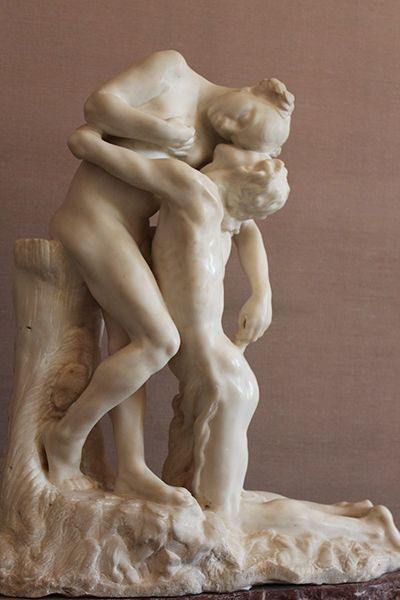
The Musée Rodin’s marble Vertumnus and Pomona brings the lovers into a different story. In Book XIV of Ovid’s Metamorphoses, Vertumnus enters Pomona’s garden disguised as an old woman, then reveals himself in youthful form. For the viewer who knows Ovid, the couple’s closeness comes after a revelation, whereas in the Sanskrit play it follows recovered memory. Claudel retains the arrangement of the kneeling man and inclined woman. The apple crown and vine motifs documented in the marble point towards the garden and give the new title support within the sculpture itself. The act of kneeling stays legible while its reason changes. [1] [7] [8]
Eugène Blot’s bronze edition appeared as L’Abandon, often translated as The Abandonment. That title leaves the two figures unnamed and makes their attitude the subject. A viewer can give more attention to the point where the woman inclines into the man’s reach, or to the apparent surrender in the way the two bodies come together. The comparison with the marble helps to explain the effect of the title. The kneeling figure can ask forgiveness, approach a lover after revealing himself, or simply take part in an embrace. The disposition of the bodies makes all three readings possible. [1] [2] [7]
Who is there to see the injury?
The Wounded Niobid takes the woman out of the group and places her in a story with many victims. In Book VI of the Metamorphoses, Apollo and Diana kill Niobe’s children after Niobe boasts of her own family at their mother Latona’s expense. Ovid gives the daughters separate reactions. One grasps at an arrow in her side, another bends in pain, and others try to hide or flee. Claudel’s bronze isolates a daughter and puts a small indication of the arrow by the hand drawn to her chest. That detail makes the hand a response to something that has just happened. [1] [2] [9] [10]
Where the woman in Sakuntala leans towards someone who can receive her, the Niobid has a rough upright at her back and hip. Its surface breaks up the light around the smoother bronze body. The eye can still follow the figure’s long incline through the shoulders, but the hand at her chest brings attention back to a point inside her outline. Move to the side where the chest is less exposed and the support becomes more prominent. From there, the tilt and the difference in height between the shoulders carry much of the sense of injury. The sculpture can show both a local wound and a change in how the body holds itself. [1] [2] [10]
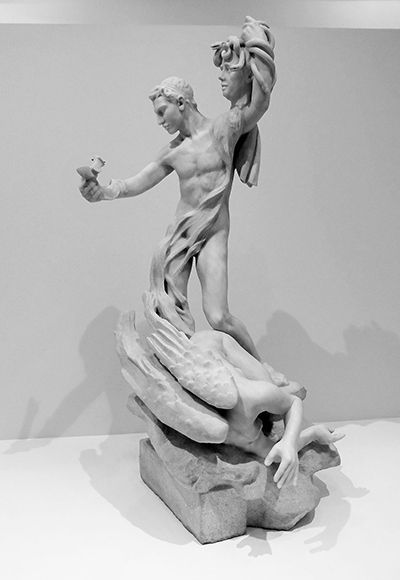
In Perseus and the Gorgon, the result of the injury is made visible across the height of the group. Medusa’s body folds at Perseus’s feet while he raises her head. His arm carries it high enough for the viewer to attend to a face at one end of the composition and then to the body at the other. The Niobid’s hand makes us search closely for a small mark. In the monumental marble of Perseus, the distance between head and body gives the wound its scale. One work makes the viewer seek the evidence of injury. The other makes the eye cross the space the injury has opened. [2] [3] [10]
Ovid’s Perseus describes seeing Medusa in the reflection of his shield before striking. Claudel keeps his attention directed away from the head even after the blow. The shield is missing from the Nogent marble, but its position can still be seen in the much smaller Blot bronze in Tokyo. The bronze makes the hero’s two actions easy to read together. One arm displays the head, while the other provides the means of looking at it. The different directions of the arms also separate the viewer’s act of looking from his. We can examine the face he must approach by way of a reflection. Where Sakuntala gives recognition the form of an approach, Perseus gives a successful act of seeing the form of a turn away. [3] [11] [12]
Fate that weighs and fortune that turns
Hesiod names Clotho, Lachesis and Atropos as the Fates who apportion good and ill to mortals. The standing plaster of Clotho isolates the sister associated with spinning the thread of life. Claudel gives her an aged body and masses of hair that come down over it in long loops. The title encourages us to see those lengths as threads, while their thickness and the way they cross the body give them weight. The outstretched hand seems able to catch a strand within its reach, yet the fall of the hair makes even a small step look difficult. The figure who shapes a mortal lifespan appears to bear its effects herself. [4] [13] [14]
The plaster Torso of Clotho at the Musée d’Orsay offers another way of seeing the figure. Its bald head and cropped body bring the muscles of the neck and the surfaces of the chest and shoulders into the open. The title still calls up the Fate, even though the long strands that give the standing work its play between hair and thread are absent. Time becomes legible in what has happened to the body itself. The difference between the two plasters also makes it easier to see how much the standing work depends on the space around the legs and arm. That is where the hair can turn an attribute of the figure into something that seems to act upon her. [4] [15]
Fortune gives chance a body poised on a wheel. The Nogent bronze has a broad base of cloth and rough ground, yet the visible contact between the woman’s foot and the rim is narrow. Her upper body leans away from that point and the lifted arm extends the motion. The name lets the viewer read the wheel as an emblem of changing circumstances. The pose goes a step further by making Fortune herself seem subject to a possible turn. The bronze holds the figure at the point where a small shift would be enough to upset her balance. [5]
The wheel had long expressed the way success can turn into loss. In Book II of Boethius’s Consolation of Philosophy, Fortune herself explains that turning it brings down those who were high and raises those who were low. Claudel’s bronze offers a different relation between the figure and the emblem. The wheel is small in proportion to the woman and there are no riders to rise or fall as it turns. Her own foot rests where a turn would be felt. The eye can trace the arc of the rim on either side of that foot and imagine how quickly its point of support could move. The figure gives an abstract reversal a consequence we can imagine through our own sense of balance. [5] [16]
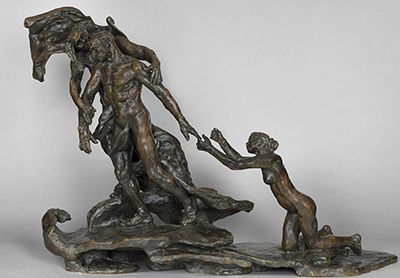
Put the two upright figures beside one another and look at where each pose seems to go. Clotho’s strands repeatedly lead back to her, even when they fall towards the ground. Fortune’s arm opens into the space above her and the cloth spreads away beneath her. In the first, the accumulation of material makes time feel like something that has gathered and become difficult to shed. In the second, an outward reach and a foothold on a curve make time feel like the interval before a change. Both works let the distribution of material carry an idea that the name alone can only suggest. [4] [5]
The telling detail changes with each sculpture. The gap between the faces in Sakuntala is almost closed by two people who move towards each other. The gap between Medusa’s head and her body is the consequence of a severing and remains open. In the Niobid, the distance between hand and wound is barely perceptible, yet it can make us see the whole incline of the body differently. Claudel’s titles give us reasons to attend to those intervals. Moving around the sculptures, or comparing views of different versions, lets us discover how much of the story she entrusted to them. [1] [2] [3] [10]
Artworks directory
| Name | Date | Medium |
|---|---|---|
| The Mature Age | 1894–99 | Sculpture |
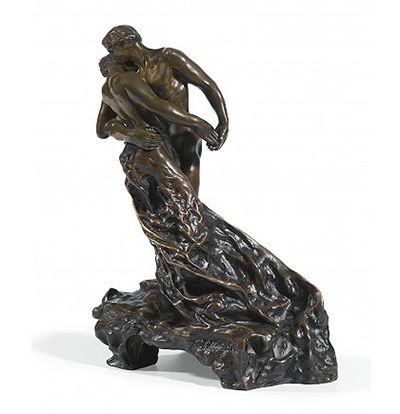
| The Waltz | c. 1889–93 | Sculpture |
| Sakuntala | 1886–88 | Sculpture |
| The Little Châtelaine | 1892–93 | Sculpture |
| The Gossips | c. 1893 | Sculpture |
| The Wave | 1897–1903 | Sculpture |
| Perseus and the Gorgon | c. 1897–1902 | Sculpture |
| The Implorer | c. 1894–99 | Sculpture |
| Clotho | 1893 | Sculpture |
| Bust of Auguste Rodin | c. 1886–89 | Sculpture |
| Paul Claudel at Sixteen Years Old | c. 1882–87 | Sculpture |
| Young Girl with a Sheaf | c. 1886–87 | Sculpture |
| Giganti | c. 1885 | Sculpture |
| Crouching Woman | c. 1884–85 | Sculpture |
| The Hungry Dog | c. 1893 | Sculpture |
| Old Hélène | c. 1881–82 | Sculpture |
| Fortune | c. 1902–05 | Sculpture |
| The Wounded Niobid | 1906 | Sculpture |
| The Siren, or The Flute Player | c. 1904–05 | Sculpture |
| Deep Thought | c. 1898 | Sculpture |
| Dream by the Fireside | c. 1899 | Sculpture |
| Paul Claudel at Thirty-Seven | 1905 | Sculpture |
| Portrait de Madame Claudel | c. 1883 | Sculpture Musée Camille Claudel. |
| Jeune Femme aux yeux clos | c. 1885 | Sculpture Musée Camille Claudel. |
| Ferdinande de Massary | 1888 | Sculpture Musée Camille Claudel. |
| Léon Lhermitte | 1889 | Sculpture Musée Camille Claudel. |
| Étude de main gauche | c. 1889 | Sculpture Musée Camille Claudel. |
| Vieil aveugle chantant | c. 1894 | Sculpture Musée Camille Claudel. |
| Tête de vieillard | c. 1890 | Sculpture Musée Camille Claudel. |
| Étude pour la tête d’Hamadryade | c. 1895 | Sculpture Musée Camille Claudel. |
| Aurore | c. 1900 | Sculpture Musée Camille Claudel. |
Discussion
Look again at the images and ideas explored in Myth and Allegory in Claudel’s Sculpture. These editorial prompts invite your observations.
Reader Insights
Which gesture is most legible before you learn the title?
How does a change of title alter your reading of a familiar composition?
Join the Conversation
Share a detail, comparison or question about Myth and Allegory in Claudel’s Sculpture below.
References
- Musée Camille Claudel, Camille Claudel à l’œuvre. Sakountala, exhibition dossier, pp. 10–13, on the plaster, marble, bronze edition and Niobid,. View source.
- J. Paul Getty Museum, Camille Claudel, exhibition guide, “Tales of Passion” and “The Last Decade,”. View source.
- Musée Camille Claudel, Persée et la Gorgone, collection entry for the marble 2009.1.1,. View source.
- Musée Rodin, Clotho, collection entry and views for the standing plaster S.01379,. View source.
- Musée Camille Claudel, La Fortune, collection entry and views for the bronze 2010.1.21,. View source.
- Kālidāsa, Śakoontalá, or The Lost Ring, translated by Monier Monier-Williams, Acts IV–VII,. View source.
- Musée Rodin, Vertumnus and Pomona, collection entry and views for the marble S.01293,. View source.
- Ovid, Metamorphoses, Book XIV, lines 623–771, translated by A. S. Kline,. View source.
- Ovid, Metamorphoses, Book VI, lines 146–312, translated by A. S. Kline,. View source.
- Johnatan Savarit, Notice MBA Poitiers / Musée Sainte-Croix. La Niobide blessée, educational sheet and details of the Poitiers bronze,. View source.
- Ovid, Metamorphoses, Book IV, lines 753–803, translated by A. S. Kline,. View source.
- National Museum of Western Art, Perseus and the Gorgon, collection entry and views for Blot’s bronze S.2021-0001,. View source.
- Hesiod, Theogony, lines 901–906, translated by Hugh G. Evelyn-White, University of Oslo Bibliotheca Polyglotta,. View source.
- Musée Camille Claudel, La mythologie au musée. Torse de Clotho chauve, teaching sheet on the three Fates and Clotho’s role as spinner,. View source.
- Musée d’Orsay, Torse de Clotho, collection entry and views for the plaster RF 4216,. View source.
- Boethius, The Consolation of Philosophy, Book II, Prose II, translated by H. R. James,. View source.