


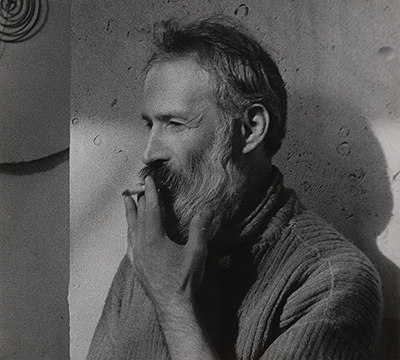
 by Tom Gurney
Tom Gurney BSc (Hons) is an art history expert with over 20 years experience
Published on June 19, 2020 / Updated on November 5, 2026
Email: tomgurney1@gmail.com / Phone: +44 7429 011000
Constantin Brancusi Drawings
A faint pencil plan, a blue figure on a battered sheet and a small ink self-portrait reveal different kinds of thought in Constantin Brâncuși’s drawings. Some sheets concern the body; others organise the spaces around sculpture. Their marks can be searching, playful or practical. Seen together, they bring the artist’s hand close again after the extraordinary smoothness of his polished metal and stone. [1] [2] [3]
Drawing offered Brâncuși several ways of working. A recognisable sculpture could become a coloured shape within a studio view. A bird could be tested through an angular outline. A human head could emerge from a few emphatic curves. These purposes deserve to be distinguished: a drawing of an existing sculpture has a different relationship to making from a study for a proposed work. The surviving sheets allow us to explore those relationships through particular objects. [4] [5]
At a Glance
Contents
The body in a few lines
In Buste de femme nue, de profil, tête inclinée, or Bust of a Nude Woman in Profile, Head Inclined, the graphite is so light that the figure seems to hover at the edge of visibility. An oval occupies the upper part of the sheet. Below it, a breast and the long sweep of the torso establish a body through widely separated lines. Little internal modelling is needed: the weight and tilt of the pose depend on the relationship between these contours. [1]
The Centre Pompidou dates the drawing to about 1910 and records its dimensions as 50.3 × 32.5 centimetres. The generous paper makes the sparseness of the marks especially striking. Look at the interval between the head and the outer curve of the back: the blank area is essential to the figure’s quiet, bowed presence. The drawing gives us an image that remains open and lightly stated. Its museum title identifies the pose without attaching a sitter’s name or a particular sculptural destination. [1]
A more vigorous encounter with the figure appears in Étude de nu, tête inclinée, an undated study in blue pencil. The head is repeated through overlapping ovals, while broader curves carry the shoulder, breast, body and bent leg. These lines coexist, allowing several positions to remain visible at once. Following them is a different experience from tracing the gently sustained contour of the graphite bust. [2]
Here the support has its own conspicuous presence. Pompidou describes torn and creased paper, 57.5 × 40 centimetres, and identifies this image as the recto of inventory AM 2001-184. The irregular edges and warm paper remain visible around the blue marks. They are part of the sheet’s current appearance, although they do not tell us when or why each tear occurred. The drawing’s energy comes from its loose accumulation of gestures: a head turns, an arm seems to shift, and the body is held together through curves that repeatedly cross. [2]
These two studies make it difficult to reduce Brâncuși’s draughtsmanship to a single formula. Economy can mean leaving a few pale indications on a large sheet. It can also mean working rapidly through a limited vocabulary of circles and arcs. In both cases, a body becomes legible without being filled with descriptive detail. The viewer supplies connections between marks, an active process that rewards looking at the empty spaces as carefully as the lines themselves. [1] [2]
Explore drawings in museum collections
Bust of a nude woman in profile
About 1910; graphite on paper. Pompidou AM 2001-171.
Nude study, head inclined
Undated; blue pencil on torn and creased paper, recto. Pompidou AM 2001-184 (R).
Plans of the studio
About 1930–38; graphite on paper, verso. Pompidou AM 3733 D (V).
Portrait, profile and self-portrait
The undated Portrait de femme de profil in the Centre Pompidou has a firmer graphic presence. Made in greasy pencil, or crayon gras, on a notebook page measuring 21.5 × 17.5 centimetres, it concentrates attention on the face. A dark descending line establishes the forehead and nose; the closed or lowered eye stretches into a long almond. The jaw turns sharply before meeting the neck, while a large surrounding sweep gives the head its outer shape. [6]
Several passages are doubled or reinforced. Around the nose, mouth and neck, the hand has returned to the same area instead of concealing the earlier marks. This produces a useful tension between a strongly readable profile and a visibly exploratory line. The face feels specific, yet the museum’s record leaves the woman unnamed. That anonymity invites attention to the drawing itself: the compressed features, the breadth of the head and the long downward movement into the neck. [6]
Brâncuși’s ink Autoportrait is smaller still, at 17.5 × 11.3 centimetres. The Pompidou record identifies black ink on paper and a signature at the lower right. Hair, ears and beard enclose a frontal face. The eyes are dark spots beneath short strokes; the nose is a quick angle; curved divisions within the beard suggest its texture without laborious description. [3]
The outline changes in strength as it moves around the head. Thin passages broaden into darker accents beside the face and under the chin. These variations give the portrait a lively, slightly uneven rhythm. Its direct gaze and simplified features make it immediately approachable. Yet simplicity has not made all the features equivalent: the small black eyes hold attention within the much larger, pale field of hair and beard. The record does not assign a creation date, so the sheet should not be used to illustrate an exact year in the artist’s life. [3]
Animals and sculptural studies
In the undated Tête d’animal, a circular eye and a projecting muzzle establish an animal’s head near the upper left. Long diagonals then open across the paper into an unexpectedly broad enclosure. The greasy pencil outline is angular in places and rounder in others, with repeated strokes reinforcing parts of the outer form. At 21 × 27 centimetres, the sheet gives this small head a generous surrounding field. [7]
Pompidou’s title means simply Animal Head. It supplies no species and identifies no corresponding sculpture. That restraint is useful. We can enjoy the quick recognition created by eye, muzzle and ear-like curve without deciding that the animal must represent a particular pet or sculptural project. Much of the pleasure lies in the disproportion between a few identifying features and the expansive lines extending from them. [7]
A clearer connection to sculpture exists in Étude pour “le coq”, dated about 1923. Pompidou identifies it specifically as a study for the first clay version of the Grand Coq of 1923, which no longer survives. The medium is graphite on paper, and the sheet measures 34.7 × 26 centimetres. This documented relationship gives the drawing particular value: it preserves a stage associated with a lost three-dimensional work. [5]
The image rises towards a narrow point. One long edge carries the form upward, while the opposite side breaks into angles. Fainter alternative lines accompany the stronger contour, making the outline feel tested rather than mechanically fixed. The bird’s upward thrust matters more than feathers or surface texture. It is tempting to connect every such sheet directly to a familiar finished bronze, but this record makes a more precise connection to an earlier clay version. That distinction preserves the drawing’s place within the development of the subject. [5]
Animal imagery also appears beyond these individual records. Pompidou’s checklist for the 2002 exhibition Les animaux sortent de leur réserve includes a Croquis d’animal of 1929, in pencil on paper, measuring 20 × 35 centimetres. The listing documents another animal sheet, although its brief description does not justify identifying it with the undated Tête d’animal. Titles that sound similar can belong to separate objects, and keeping their dimensions and records together helps preserve those differences. [8]
Drawing the studio
The studio offered another subject entirely. In View of the Artist’s Studio of 1918, now at the Museum of Modern Art, Brâncuși used gouache and pencil on board. Its coloured forms show sculpture within a shared environment. MoMA identifies the columnar Kiss in the background and Mlle Pogany in the foreground, where yellow indicates the polished bronze. Colour translates a material effect into the flat language of the image. [4]
The museum emphasises the stacking and layering of works, a concern shared with Brâncuși’s photographs. Individual sculptures retain their identities while also becoming parts of an arrangement. This gives the studio drawing a double interest. It records objects, but it also asks us to follow their relationships: what stands in front, what rises behind, and how one shape changes the visibility of another. The room becomes an organised field of forms. [4]
Sculptor Scott Burton returned to this image in his 1989 MoMA essay. Comparing Brâncuși’s studio gouache with Matisse’s The Red Studio, he treated both interiors as imaginative worlds populated by the artists’ own objects. Burton also drew attention to the edge of the drawing board that bars entry into Brâncuși’s scene. His reading brings the maker’s position into focus: we see an interior that has already been selected and framed from a particular place. [9]
That is a helpful way to approach a studio view. The image may contain familiar sculptures, but their presence does not make it an impersonal inventory. A viewpoint gathers them into a particular visual experience. We can look for the distinction between a work’s identity and its role in the composition, noticing how a head becomes an oval accent or a tall sculpture creates a vertical interval. The act of drawing makes relationships visible through selection and emphasis. [4] [9]
Planning the space around sculpture
The Centre Pompidou’s Plans de l’atelier has a quieter, practical character. Graphite lines spread across a sheet measuring 49 × 63.7 centimetres. The museum dates it approximately 1930–38 and identifies the drawing as the verso, inventory AM 3733 D (V). Rectangular outlines and internal divisions appear at different positions across the paper. Some lines are extremely faint, asking the viewer to slow down and separate the marks from the discolouration and folds of the support. [10]
The plan invites a different kind of attention from the studio gouache. We follow boundaries and intervals instead of sculptural surfaces. A line may establish the edge of a space without suggesting its texture or illumination. This is drawing used to make spatial relationships manageable on a flat sheet. The record’s approximate date range also matters: it does not identify a single day or one conclusively documented building operation. [10]
Ariane Coulondre’s 2024 catalogue excerpt explains why the workshop’s layout deserves attention. After moving within the impasse Ronsin in 1928, Brâncuși removed partitions to create a larger room; further spaces were added as his needs grew. He shaped the furnishings as well as the setting, making objects that could serve as furniture or sculpture bases. The arrangement of the sculptures remained subject to change. [11]
Within that context, the plan belongs to a sustained concern with the environment of the work. Sculpture required room to stand, to be approached and to enter relationships with neighbouring forms. The studio was also a place of daily life and reception. A practical drawing of its spaces therefore touches the conditions under which the art was made and encountered. The broad date assigned to this sheet encourages us to see it within that continuing activity, without forcing it into a specific undocumented episode. [10] [11]
Where drawing meets photography
Paper alone does not identify a drawing. Brâncuși’s Socle, dated 1922 in Pompidou’s record, is a gelatin silver photograph. It also carries pencil inscriptions recording dimensions and material. The annotations make it a working document, but the central image was produced photographically. It belongs to the museum’s photography collection, with inventory PH 680 B. [12]
The distinction helps us understand how different means of recording could meet around the same object. A photograph can preserve the appearance of a base while written measurements supply information the image cannot reliably convey. A drawing can choose, reduce or rearrange a contour. A plan can describe the boundaries of a room. These activities overlap in their usefulness to a sculptor, while each gives a different kind of evidence. [12] [10] [5]
Following those differences brings us closer to Brâncuși’s varied habits of looking. The figure studies preserve light contours and repeated gestures; the portraits use selected features to make a face legible; the studio image places finished works in a shared visual world. None requires every surviving sheet to have the same function. The intimacy of the drawings comes from these changing demands on the hand, from a wavering blue oval to the measured division of a room. [1] [2] [3] [4] [10]
Artworks directory
Individually documented sculptures, drawings and a photograph with pencil measurements. Casts, versions and the recto or verso of a sheet are identified separately. A dash marks an undated object. Additional Tate entries preserve the museum’s unmaintained October 2014 catalogue snapshot. This is a selection, not an inventory of all surviving work. [13]
| Name | Date | Medium |
|---|---|---|
| The Kiss (Philadelphia, fourth version) | 1916 | Sculpture |
| Sleeping Muse (Pompidou bronze) | 1910 | Sculpture |
| Mlle Pogany, version I (MoMA bronze) | 1913, after a marble of 1912 | Sculpture |
| Maiastra (Venice brass) | about 1912 | Sculpture |
| Bird in Space (MoMA bronze) | about 1941 | Sculpture |
| Bird in Space (Venice brass) | 1932–40 | Sculpture |
| Endless Column, version I (oak) | 1918 | Sculpture |
| Brâncuși Monumental Ensemble of Târgu Jiu | 1937–38 | Sculpture |
| Bust of a nude woman in profile, head inclined | about 1910 | Drawing |
| Nude study, head inclined (recto) | — | Drawing |
| Self-portrait (ink) | — | Drawing |
| View of the Artist’s Studio | 1918 | Drawing |
| Study for the cock (lost clay Grand Coq) | about 1923 | Drawing |
| Portrait of a woman in profile | — | Drawing |
| Animal head | — | Drawing |
| Animal sketch (2002 checklist) | 1929 | Drawing |
| Plans of the studio (verso) | about 1930–38 | Drawing |
| Base (photograph with pencil measurements) | 1922 | Photograph |
| Danaïde (Tate T00296) | c.1918 | Sculpture |
| Maiastra (Tate T01751) | 1911 | Sculpture |
| Head (Tate T03066) | c.1919–23 | Sculpture |
| Fish (Tate T07107) | 1926 | Sculpture |
Frequently Asked Questions
Socle is a gelatin silver photograph with pencil measurements, rather than a drawn image. [12]
Discussion
Compare the purposes of a figure study, a studio view and a plan, keeping each sheet’s material and date distinct.
Reader Insights
What can an empty part of the paper contribute?
How does a plan ask for a different kind of looking from a portrait?
When is a drawing a record of a sculpture, and when is it a study towards one?
Join the Conversation
Share a detail, comparison or question about Constantin Brancusi Drawings below.
References
- Centre Pompidou, Buste de femme nue, de profil, tête inclinée, about 1910, AM 2001-171: graphite figure study. Collection record and reproduction; object information in French on an English interface. View source.Splash image: Constantin Brancusi. Artist biography
- Centre Pompidou, Étude de nu, tête inclinée, undated, AM 2001-184 (R): blue pencil on torn and creased paper. Collection record and reproduction; object information in French on an English interface. View source.
- Centre Pompidou, Autoportrait, undated, AM 2001-189 (44): black ink self-portrait. Collection record and reproduction; object information in French on an English interface. View source.
- Museum of Modern Art, View of the Artist’s Studio, 1918, 19.1978: gouache, pencil and the arrangement of sculpture. Collection record and 2018–19 exhibition label. English. View source.
- Centre Pompidou, Étude pour “le coq”, about 1923, AM 2783 D: study for the lost clay Grand Coq. Collection record and reproduction; object information in French on an English interface. View source.
- Centre Pompidou, Portrait de femme de profil, undated, AM 2001-169: greasy pencil notebook drawing. Collection record and reproduction; object information in French on an English interface. View source.
- Centre Pompidou, Tête d’animal, undated, AM 2001-162: animal head in greasy pencil. Collection record and reproduction. In French. View source.
- Centre Pompidou, Les animaux sortent de leur réserve: exhibition press dossier and checklist, 26 June–2 September 2002, PDF p. 8, listing Croquis d’animal. In French. View source.
- Scott Burton, Burton on Brancusi: “The Studio and the Self”, Museum of Modern Art, 1989. English. View source.
- Centre Pompidou, Plans de l’atelier, about 1930–38, AM 3733 D (V): graphite studio plans on the verso. Collection record and reproduction; object information in French on an English interface. View source.
- Ariane Coulondre, Centre Pompidou, “L’atelier de Brancusi, matrice de tout son œuvre”, 26 March 2024. Accessible excerpt from the 2024 exhibition catalogue. In French; paraphrased in English. View source.
- Centre Pompidou, Socle, 1922, PH 680 B: gelatin silver photograph with pencil measurements. Collection record; object information in French on an English interface. View source.
- Tate, Tate Collection metadata, artwork_data.csv, October 2014 snapshot, released under CC0. Repository readme states that this dataset is no longer maintained. Downloaded and artist rows inspected 28 October 2026. View source.


