


 by Tom Gurney
Tom Gurney BSc (Hons) is an art history expert with over 20 years experience
Published on June 19, 2020 / Updated on November 5, 2026
Email: tomgurney1@gmail.com / Phone: +44 7429 011000
Apollo in the Forge of Vulcan
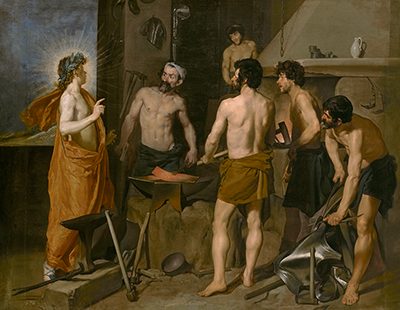
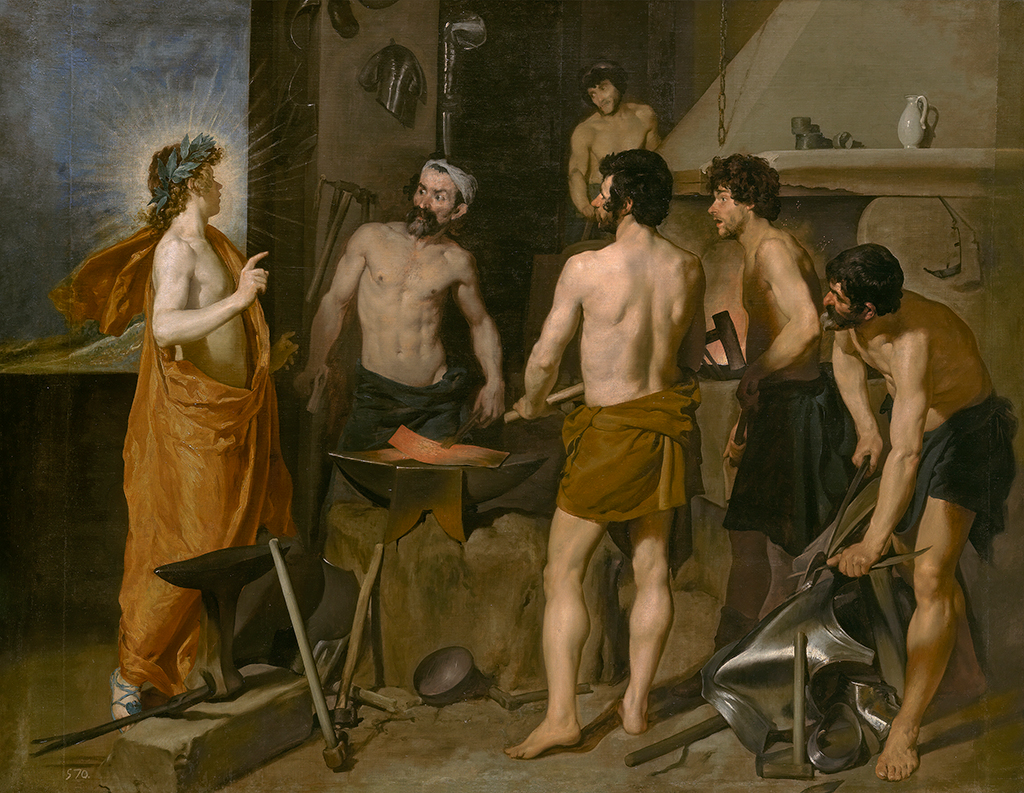
A hammer has paused, a head turns, and a busy workshop becomes an audience. At the left, Apollo raises a finger as he speaks to Vulcan, the god of fire and metalworking. His message concerns Venus, Vulcan's wife, and her affair with Mars. Diego Velázquez makes the arrival of this news the centre of Apollo in the Forge of Vulcan, also known as Vulcan's Forge. Painted in Rome in 1630, the large oil painting on canvas belongs to the Museo Nacional del Prado in Madrid. It measures 223 × 290 centimetres and bears the collection number P001171. [1]
The extraordinary visitor has entered a very tangible place. Men stand around an anvil, their bodies uncovered for work; tools lean against a block, armour catches the light, and a small jug rests high on the chimney. Apollo's radiant head announces the presence of a god, yet the room seems to belong to people whose hands and shoulders know the weight of metal. The encounter brings a classical story within reach of ordinary experience.
At a Glance
Where the painting sits in Velázquez’s career
Contents
The news behind the scene
The episode appears in Book IV of Ovid's Metamorphoses. The Sun sees the adultery of Venus and Mars and reports it to Vulcan. Stunned, the craftsman drops the work he is holding. He then turns his skill towards revenge, making an almost invisible bronze net in which he catches the lovers together. When he summons the other gods to witness their humiliation, their response is laughter. [2]
Velázquez concentrates on the disclosure, before the trap and its public consequences. Venus and Mars remain outside the picture. We learn about them through Apollo's speech and the faces of the listeners. Their absence gives the painting a distinctive structure: its central event cannot be seen directly, but its effect moves across the room. We find ourselves watching people receive an account of something happening elsewhere.
There is a small distinction between the ancient text and the familiar title. Ovid names the informer as the Sun, or Sol. In the painting he appears as Apollo, crowned with laurel and surrounded by rays. The Prado catalogue explains this combination through the later identification of Apollo with the sun god. The wreath evokes his association with poetry, while the radiance makes his solar character unmistakable. [1] [2] Those attributes establish who he is without requiring a chariot or a distant heavenly setting.
A different response in every body
The first exchange takes place between Apollo and Vulcan. Apollo is upright and comparatively composed. His raised hand gives direction to his words, and the folds of his orange-gold mantle fall around a pale torso. Across the anvil, Vulcan turns his head sharply towards him. His brow contracts and his mouth opens. The twist between his planted body and his attentive face makes the interruption visible before we try to give his expression a name.
That expression can hold more than one feeling. Surprise, disbelief and the beginning of anger are all possible responses to the news. Velázquez does not need a theatrical gesture of despair. Vulcan still inhabits the stance of a working man, with his equipment close to his hands. The story has reached him faster than his body has been able to leave its task.
The assistants extend this encounter through a series of different positions. The man nearest us presents his back, so that his turning head must carry much of his response. Beyond him, a tousled worker leans forward with parted lips. At the far right, a man bends above a piece of armour while looking towards the visitor. Higher and farther away, another figure peers out from the shadowed rear of the workshop. The news reaches people who stand at different distances and at different stages of physical movement.
Follow their heads from left to right and then return to their hands. Faces have turned towards Apollo, while hands remain beside the materials of labour. That slight mismatch gives the group its vitality. These are bodies caught in a transition, and the painting allows the transition to last. We can feel the sudden loss of the forge's usual rhythm without hearing a single tool fall.
Walking into the workshop
The central figure's broad back is especially useful to the composition. He stands between us and the anvil, partially obstructing our view. We have to look around him, towards Vulcan on one side and the listening worker on the other. This obstruction gives the scene a convincing depth: the figures occupy places in a room, and the most important encounter is not arranged entirely for our convenience.
His exposed shoulders also offer a different kind of information from Apollo's face or Vulcan's expression. Light spreads across the shoulder blades and descends along the spine, describing the structure of a body seen from behind. At the right, the bent worker provides another angle on the torso. The varied poses let Velázquez explore how muscles, joints and skin change with movement, while keeping each body involved in the same unfolding story.
Near the floor, long-handled implements lean at angles against the anvil block. Pieces of armour and smaller objects occupy the foreground. Their diagonal lines interrupt the mostly upright figures, giving the lower part of the canvas an uneven, practical arrangement. A viewer who looks only at the faces misses how thoroughly the scene is grounded in equipment. The tools make the suspension of work legible: this room was active before Apollo arrived.
Flesh, fire and a white jug
Apollo is conspicuous through colour as well as radiance. His drapery makes a large warm shape at the left, set against the restrained browns and greys of the forge. A glimpse of blue beyond him opens the room towards the outdoors. Within the interior, the pale bodies are separated by dark intervals rather than joined into a single bright mass. Those intervals give each figure breathing room.
Several small accents reward a slower look. The heated metal on the anvil is a concentrated patch of orange. The armour at the right answers it with a cooler metallic sheen. Above, the little pale jug stands clear against the wall. These objects offer three different surfaces: glowing metal, reflecting metal and glazed pottery. Their scale is modest, but they help us imagine the workshop through temperature and touch.
The jug also draws the eye away from the immediate drama. Placed above the listeners, it belongs to the ordinary life of the room. It has no necessary role in explaining the adultery. Its presence allows the mythological encounter to share space with something commonplace, and the pause it creates in our looking makes the surrounding bodies seem still more substantial.
What changed in Rome
The date places the painting within Velázquez's first Italian journey. The Prado catalogue relates its figure arrangement and handling of the nude to his encounter with Italian painting and ancient sculpture. Julián Gállego, the author of the catalogue entry, particularly associates its frieze-like organisation with Guido Reni. [1] That is a critical comparison, rather than proof that Velázquez borrowed one identifiable figure. The painting's procession of bodies is inseparable from their individual reactions.
Material evidence adds another dimension to this development. Larry Keith and Dawson W. Carr identify a pale grey ground beneath Apollo at the Forge of Vulcan. A ground is the preparation laid on the canvas before the image is painted. Its colour affects what can be achieved with the paint above it, particularly when that paint is thin. The authors explain that the lighter, cooler preparation offered Velázquez a wider tonal range and could be warmed selectively with transparent brown applications. [3]
This marked a change from the earth-coloured preparations associated with his early Seville work and the red grounds of his first Madrid period. The technical study describes an evolving practice, including an intervening brown ground in Joseph's Bloody Coat. [3] Rome therefore represents more than a change of scenery or an opportunity to study impressive bodies. In the forge, Velázquez was also developing the material foundation that allowed flesh, shadow and surrounding air to work together with greater flexibility.
An argument about making
A workshop visited by Apollo has invited interpretations beyond the immediate myth. The art historian Escardiel González Estévez reads the painting in relation to the struggle to establish painting as an intellectual and liberal art. The study connects its craftsmen and classical learning with contemporary arguments about artistic skill, imitation and the social standing of painters. [4]
This remains an interpretation, and the visible scene does not depend on accepting it. It does, however, direct attention towards a productive question. Apollo possesses the authority of speech and revelation; Vulcan and his assistants possess the knowledge required to make things. Velázquez gives their work a remarkable physical presence. The painter, meanwhile, makes metal appear hot, bodies appear solid and a room appear to fall silent. The picture demonstrates a range of skills even as it shows skilled workers momentarily brought to a halt.
From Rome to the Prado
The work's later royal ownership should not be confused with an original royal commission. The Prado's 1990 catalogue states that Velázquez painted it without such a commission. Jerónimo de Villanueva bought it from him in 1634, after his return from Italy. It is recorded in the Buen Retiro Palace inventory of 1701 and later in the Royal Palace inventories of 1772 and 1794. It entered the Prado on 5 August 1819. [1]
Joseph's Bloody Coat, another ambitious narrative painted during the Italian visit, was purchased in the same year. The two works have often been discussed together, although the catalogue records disagreement over whether they should be understood as a pair. [1] Their shared interest in the effect of news is suggestive: each gives faces and bodies the task of making an unseen event immediate. In the forge, that task remains wonderfully open to looking. Apollo is still speaking, the metal is still hot, and each listener is only beginning to discover what the interruption will mean.
Artworks directory
A selection from the collection records and catalogues linked here. The São Paulo and New York Olivares portraits are different paintings. The sculptor’s portrait retains its traditional identification and the dating associated with it. This is not a complete catalogue of Velázquez’s work.
| Name | Date | Medium |
|---|---|---|
| Saint John on Patmos | 1618–19 | Painting |
| The Immaculate Conception | 1618–19 | Painting |
| The Waterseller of Seville | about 1620 | Painting |
| Count-Duke of Olivares (São Paulo) | 1624 | Painting |
| Count-Duke of Olivares (New York) | about 1625–26 | Painting |
| Apollo in the Forge of Vulcan | 1630 | Painting |
| Prince Baltasar Carlos on Horseback | 1634–35 | Painting |
| Portrait of Juan Martínez Montañés (traditional identification) | about 1635–36, on the Montañés identification | Painting |
Frequently Asked Questions
He tells Vulcan of the affair between Venus and Mars, an episode in Ovid’s Metamorphoses. [2]
Velázquez painted it in Rome in 1630. [1]
Discussion
Follow the interrupted gestures around the forge and compare the different responses to Apollo’s news.
Reader Insights
Which response makes the pause most vivid?
How do tools and worked metal give the room its character?
What changes when a classical story enters a workshop?
Join the Conversation
Share a detail, comparison or question about Apollo in the Forge of Vulcan below.
References
- Julián Gállego, “La fragua de Vulcano,” catalogue entry 23, in Antonio Domínguez Ortiz, Alfonso E. Pérez Sánchez and Julián Gállego, Velázquez, exhibition catalogue, Museo del Prado / Ministerio de Cultura, Madrid, 1990, pp. 158–162, including the colour plate on p. 159. Complete catalogue digitised by the Real Jardín Botánico library. Spanish-language source. Entry and publication credits consulted; interpretations are paraphrased in English. View source.
- Ovid, Metamorphoses, Book IV, lines 167–189, translated by A. S. Kline, 2000. “Leuconoë's story: Mars and Venus,” University of Virginia, The Ovid Collection. English translation of the Latin primary narrative; consulted for the story, not the painting's production history. View source.
- Larry Keith and Dawson W. Carr, “Velázquez's ‘Christ after the Flagellation’: Technique in Context,” National Gallery Technical Bulletin, vol. 30, 2009, pp. 52–71, especially pp. 67–69, plate 23 and note 19. National Gallery technical study. English-language source; exact discussion of the forge painting's ground and the relevant chronological comparisons consulted. View source.
- Escardiel González Estévez, “En torno a la Fragua de Vulcano de Velázquez. Nuevas aportaciones a la interpretación de su significado,” Laboratorio de Arte, vol. 21, 2008–2009, pp. 411–426, especially pp. 413–414 and 419–423. Article in the Universidad de Sevilla repository. Spanish-language source; proposed interpretation paraphrased and explicitly attributed. View source.
- National Gallery, London, Diego Velázquez, Saint John the Evangelist on the Island of Patmos, NG6264. Collection record, artist dates and painting date; accessed 28 October 2026. View source.


