 by Tom Gurney
Tom Gurney BSc (Hons) is an art history expert with over 20 years experience
Published on June 19, 2020 / Updated on November 5, 2026
Email: tomgurney1@gmail.com / Phone: +44 7429 011000
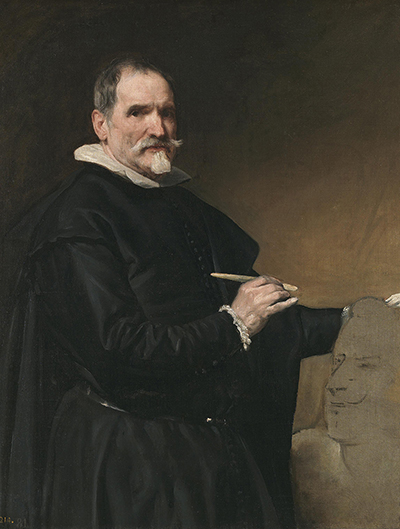
Portrait of Juan Martínez Montañés
The sculptor has turned away from his work, but his hand remains raised. Between his fingers is a slender modelling tool; beside him, a second face is only beginning to emerge. His own face meets us with much greater assurance. The white moustache, pointed beard and bright collar come forward from a broad field of black clothing, while the eyes hold our attention. Velázquez makes the encounter feel immediate without telling us what has interrupted it.
Known as the Portrait of Juan Martínez Montañés, this oil painting belongs to the Museo Nacional del Prado in Madrid, inventory P001194. The identification with the celebrated Sevillian sculptor is the prevailing one, although Alonso Cano has also been proposed. On the Montañés identification, the portrait is associated with his stay at court in 1635–36. The uncertainty matters because the sitter's name and the picture's date are connected. [1]
At a Glance
Where the painting sits in Velázquez’s career
Contents
The face before the work
Begin with the relationship between head and shoulders. The body occupies much of the canvas, its dark silhouette spreading across the left side and narrowing towards the extended arm. The head turns towards us above that heavy arrangement of fabric. It is a small movement, yet it changes the whole encounter: someone who might have remained absorbed in an object now acknowledges another person in the room.
The face is neither smooth nor evenly illuminated. A bright forehead gives way to the darker hollows around the eyes. Warm colour gathers around the nose and cheeks, while the greying hair is set back against the background. The moustache projects sideways in fine, pale strokes; the beard forms a more compact light below the mouth. These different textures keep the features from becoming a uniform patch of brightness. The eyes are especially effective because their darkness remains distinct within the surrounding shadow.
His expression allows several responses. The brow can seem searching, the mouth reserved, the direct glance almost challenging. None requires a story about a particular mood. We can see the concentration without knowing whether the man was pleased, impatient or simply attentive. The portrait gives him enough presence to resist being reduced to a single adjective.
The white collar does more than separate flesh from clothing. Its uneven edge and changing angles turn around the neck, giving the head a firm place above the body. Below it, the black garment contains a surprising range of light. Look along the upper arm: folds catch broad grey reflections, then disappear into deeper darkness. Follow the sleeve towards the wrist and those larger forms tighten into smaller creases. Black becomes a sequence of surfaces rather than an empty silhouette.
A hand suspended
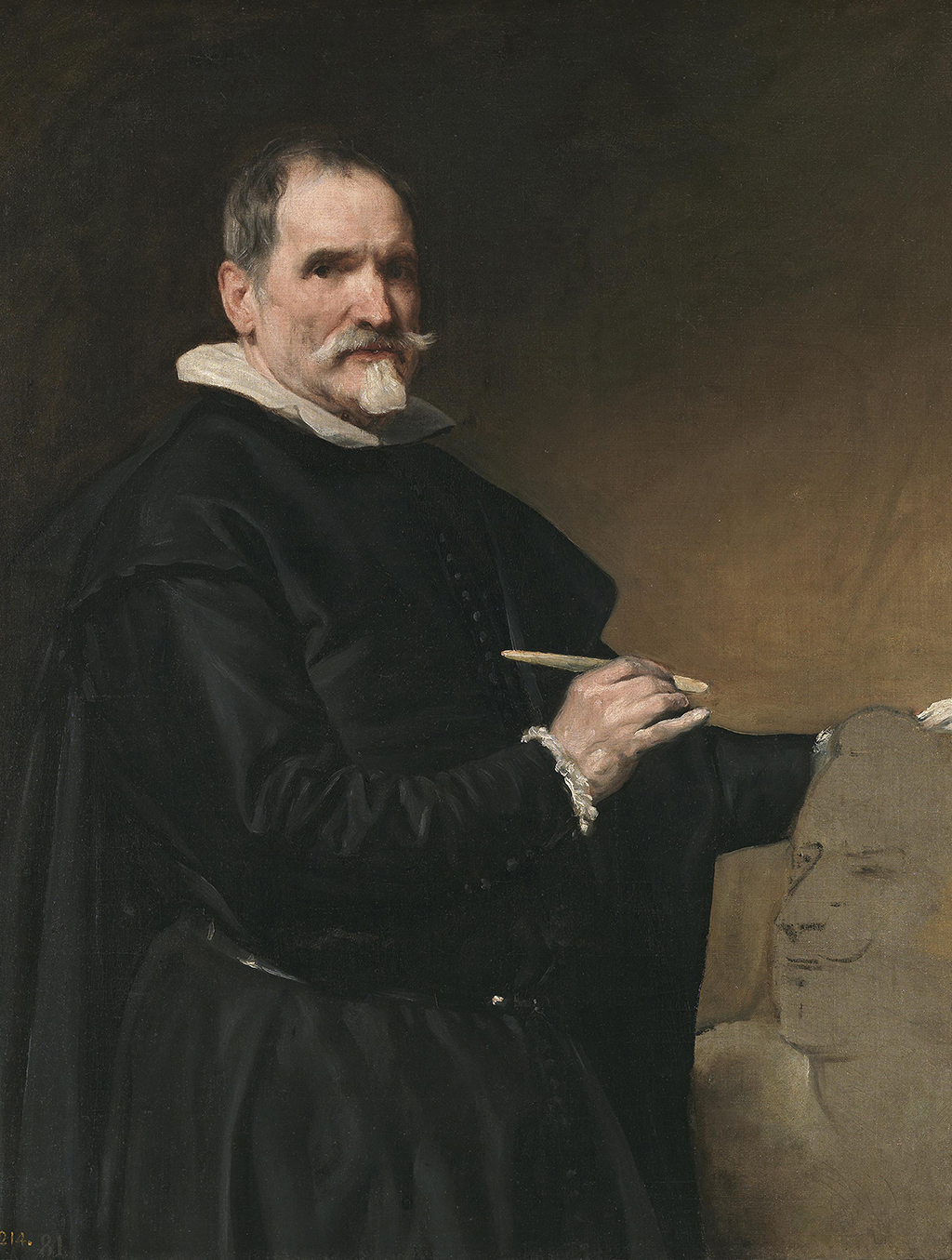
The raised hand is the picture's second centre of attention. Its warm light answers the face across the chest, with the fine white edging at the wrist providing another brief flash. The fingers bend around the tool instead of displaying it ceremonially. The grip looks usable. At the same time, the hand is held clear enough for us to understand its shape and its relation to the work beside it.
Try tracing the tool from left to right. Its pale shaft passes above the fingers, nearly horizontal, while the arm beneath it reaches towards the model. This small straight line interrupts the sweeping folds of the clothing. It also helps bridge two very different kinds of representation: the fully present sculptor and the lightly indicated head at the right. Without that hand and tool, the second head might seem a disconnected fragment. With them, it becomes something being considered and made.
The sculpted head is easier to overlook because so little separates it from its surroundings. Its profile faces left, towards the painter's central figure. We can pick out the brow, long nose, mouth and chin, but the transitions are sparse. Around the shoulder and lower edge, broad patches remain much less resolved than the sculptor's illuminated face. Looking back and forth between them makes the contrast especially clear. One likeness looks out of the painting; the other remains enclosed in the process of taking shape.
That contrast should not be turned into a confident explanation of why Velázquez stopped. Nor does it establish the model's material from colour alone. What the picture offers directly is a difference in finish, and that difference becomes part of its visual interest. We watch a painter represent a sculptor making a portrait, with the stages of representation still visibly unequal.
Why Montañés, and why Cano?
A portrait can be vivid while its historical identification remains uncertain. The Prado's 1990 exhibition catalogue reviews both names. Comparisons with portraits associated with Montañés support the prevailing identification, while the clothing has helped sustain arguments for Cano. The alternative also changes the proposed date, placing the work much later in Velázquez's career. [1]
The comparisons are useful when approached carefully. In the catalogue, Francisco Varela's portrait of Montañés shows a younger man with a more elaborate collar, holding a small sculptural figure. A drawing by Francisco Pacheco offers another face for comparison, although the catalogue discusses difficulties surrounding its identification. These images give the argument a basis beyond a general impression of age or dignity. They do not turn resemblance into the equivalent of a signed name on this canvas. [1]
There is also a documented professional occasion behind the Montañés reading. The Archivo Histórico Provincial de Sevilla records his journey to Madrid in 1635 to model the king's bust, and identifies a later testament made under a power he granted in connection with that journey. The archive's account therefore supplies context independent of the painted expression or costume. [2] It makes sense to retain the familiar title while keeping the identification's qualified status visible.
The royal portrait beyond the canvas
Montañés's journey connected a Sevillian sculptor with an ambitious royal monument. Marta Poza Yagüe explains that his model of Philip IV was intended to assist Pietro Tacca in Florence with the king's bronze equestrian statue. The modelling took place between June 1635 and January 1636; Tacca's statue dates from 1640. The project helps explain why this particular sculptor could have been at court when Velázquez painted the portrait. [3]
It also gives the lightly indicated head a plausible historical setting. The model in the painting has traditionally been understood as Philip IV, but its few painted features should not be treated as a finished, independently identifiable royal bust. The sitter's identification and the model's identity support one another within an interpretation; they are not two wholly separate proofs. The Prado catalogue itself preserves the uncertainty. [1]
Poza Yagüe reproduces a sonnet by Gabriel de Bocángel celebrating Montañés's royal portrait in clay. Its subject is the power of art to give life and endurance to mortal matter. [3] This contemporary literary response adds something the painting alone cannot supply: evidence that the sculptor's work could attract attention as an intellectual and poetic achievement. We do not have to assume that Velázquez illustrated the poem to recognise a shared interest in the maker's powers.
Painting another artist
The setting contains remarkably little equipment. There is no crowded bench to explore, no array of implements competing for attention, and no carefully described workshop interior. The background lightens beside the model and darkens around the sitter's head. This gives both forms room to register while leaving the room itself indefinite. Our route through the painting is carried by face, collar, hand and emerging profile.
That economy affects how we understand the man. His work identifies his profession, but it does not consume his personality. He can turn towards us and remain the commanding presence in the picture. His clothes occupy more space than the sculpture, and his gaze is more insistent than the movement of the tool. The manual act is visible, while the person directing it receives the greater emphasis.
Julián Gállego reads this arrangement as an image of artistic thought: the raised implement awaits the idea governing its use. [1] The interpretation is persuasive because it grows out of something observable. The hand pauses, the head turns, and the work remains incomplete. Yet the picture leaves room for a less theoretical experience too. Anyone who has stopped in the middle of a task to look at someone can recognise the balance between continued occupation and momentary attention.
Montañés's professional life gives substance to the hand's expertise. The Seville archive records his examination in 1588 in sculpture, carving and architecture, and describes the contracts, valuations and other transactions preserved among the notarial records. [2] Behind this apparently effortless gesture lay a working career with practical obligations. The painting's quiet dignity does not require us to forget the trained hand.
From an uncertain beginning to the Prado
The portrait's early ownership is less secure than its present home. The Prado catalogue does not identify its original recipient or patron. It records the painting in the royal collections in 1794 at the Quinta del duque del Arco, and in the museum from its foundation in 1819. [1] There is no need to fill the earlier gap with an imagined royal commission or a private gift between friends.
That incomplete history leaves the encounter unusually open. We know where the painting has come to rest, but not exactly whose room it first occupied or what that first owner expected from it. Standing before it, the most compelling relationship is still the one established across its surface: a living face, a poised hand and a second likeness waiting beside them. Velázquez lets us move between the person and the work, noticing how much presence can be created by a few illuminated forms surrounded by darkness.
Artworks directory
A selection from the collection records and catalogues linked here. The São Paulo and New York Olivares portraits are different paintings. The sculptor’s portrait retains its traditional identification and the dating associated with it. This is not a complete catalogue of Velázquez’s work.
| Name | Date | Medium |
|---|---|---|
| Saint John on Patmos | 1618–19 | Painting |
| The Immaculate Conception | 1618–19 | Painting |
| The Waterseller of Seville | about 1620 | Painting |
| Count-Duke of Olivares (São Paulo) | 1624 | Painting |
| Count-Duke of Olivares (New York) | about 1625–26 | Painting |
| Apollo in the Forge of Vulcan | 1630 | Painting |
| Prince Baltasar Carlos on Horseback | 1634–35 | Painting |
| Portrait of Juan Martínez Montañés (traditional identification) | about 1635–36, on the Montañés identification | Painting |
Frequently Asked Questions
Montañés is the prevailing identification, but Alonso Cano has also been proposed. The identification affects the picture’s dating. [1]
Discussion
Compare the sitter’s finished face with the partly formed head beside him, keeping the identification question open.
Reader Insights
What does the raised hand make you imagine happening next?
How does the unfinished head change the encounter?
Which details give the sculptor’s face its presence?
Join the Conversation
Share a detail, comparison or question about Portrait of Juan Martínez Montañés below.
References
- Julián Gállego, “Juan Martínez Montañés,” catalogue entry 48, in Antonio Domínguez Ortiz, Alfonso E. Pérez Sánchez and Julián Gállego, Velázquez, Museo del Prado / Ministerio de Cultura, Madrid, 1990, pp. 292–297, including the full painting and detail plates (in Spanish). Read the exhibition catalogue. View source.
- Archivo Histórico Provincial de Sevilla, “Martínez Montañés: vida,” document of the month, January 2020, Junta de Andalucía; institutional commentary and descriptions of the notarial records, including the examination of 1 December 1588 and testament of 19 April 1655, 8628P, fols. 276r–284v (in Spanish). Read the archive's account. View source.
- Marta Poza Yagüe, “Modelando al rey…,” Rinconete, Centro Virtual Cervantes, Instituto Cervantes, 20 October 2009; discussion of the royal model and reproduction of Gabriel de Bocángel's sonnet (in Spanish). Read the illustrated essay. View source.
- National Gallery, London, Diego Velázquez, Saint John the Evangelist on the Island of Patmos, NG6264. Collection record, artist dates and painting date; accessed 28 October 2026. View source.