Diego Velazquez.jpg)
 by Tom Gurney
Tom Gurney BSc (Hons) is an art history expert with over 20 years experience
Published on June 19, 2020 / Updated on November 5, 2026
Email: tomgurney1@gmail.com / Phone: +44 7429 011000
Portrait of the Count-Duke of Olivares in São Paulo
A large key, a heavy gold chain and a pair of spurs announce this man's importance before we know his name. Gaspar de Guzmán, Count-Duke of Olivares, stands almost squarely before us, dressed in black, with one hand resting on a red-covered table. MASP, the Museu de Arte de São Paulo Assis Chateaubriand, catalogues the painting as a work by Diego Velázquez dated 1624. It is an oil painting on canvas, inventory number MASP.00171. The location matters: this is the frontal, full-length São Paulo portrait, a distinct painting from the Olivares likeness in New York's Hispanic Society. [1] [4]
The effect is imposing, but its means are surprisingly economical. There is no elaborate architecture behind the sitter and no distant landscape to explore. A muted background gives the black silhouette room to expand. The brightest things belong to the body: pale skin, the broad collar, gold fittings and the red cross on the chest. The portrait asks us to look closely at a man whose position can be read through the things he wears.
At a Glance
Where the painting sits in Velázquez’s career
Contents
A courtier in black
Olivares's clothes are dark without becoming a single flat surface. Along the sleeve beside the table, sharp folds catch blue-grey highlights. Across the chest, narrower ridges suggest fabric gathered and drawn diagonally. On the opposite side, the cloak forms a broader, quieter mass. Following those changes slowly makes the outfit easier to understand: its richness emerges through texture and light rather than a crowded pattern of colours.
The collar is particularly arresting. Its pale wings extend beyond the neck and make a clear ledge beneath the head. Against that cool shape, the pinks of the face seem warmer. Above it, cropped dark hair and the curled moustache give the features a tidy outline; below it, the black costume spreads out across the shoulders. The head consequently looks small in relation to the expanse of clothing. That difference contributes to the figure's monumental presence, even though the sitter occupies an ordinary interior.
The table helps organise this breadth. Its red cloth supplies a strong vertical shape down the left edge, while the outstretched arm connects it to the torso. On the other side, the cloak creates a dark counterweight. Between them, the gold chain draws a diagonal through the centre. Our eye can travel around this arrangement without losing the face, which remains isolated against the unbroken background.
Gold, a key and the signs of office
The key is too conspicuous to pass as an everyday convenience. It lies diagonally across the waist, its open bow clearly distinguished from the small teeth at the other end. Nearby, the spurs hang against the black costume. In the museum's interpretation, these objects identify the sitter's service close to the king: the key belongs to his chamber office, the spurs to his responsibility for the royal horses. The chain binds the display together visually. Office is made tangible through objects that can catch the light. [1]
The red cross needs a little care. MASP's longer catalogue essay identifies it as the cross of Calatrava, and Adriana Gonçalves de Carvalho's study of the painting follows that identification. MASP's shorter curatorial text instead names Alcântara. The longer account connects the red emblem with Olivares's change of military order in 1624, before the green Alcântara insignia appears in subsequent portraits. Calatrava is therefore the better-supported reading of the emblem here; the museum's two explanations should not be treated as interchangeable. [1] [3]
Looking back at the image after learning what these objects signify changes its apparent simplicity. The black suit carries a carefully distributed set of bright assertions. Yet the objects retain their individual shapes: the chain is made of separate links, the key has an unusually open curve, and the spurs dangle rather than forming a rigid badge. This makes the statement of rank feel materially present. The sitter's authority is attached to a body, with weight, clothing and accessories, rather than conveyed by an abstract label.
A commission from the first years at court
A signed payment receipt gives the portrait a documentary setting. As Michael Gallagher explains in his study of the Metropolitan Museum's early Philip IV, Velázquez acknowledged 800 reales on 4 December 1624 for three portraits: the king, Olivares and Don García Pérez de Araciel. The last portrait is lost. Gallagher suggests that Araciel's widow, Doña Antonia de Ipeñarrieta, may have commissioned the group. That possibility places this image within a network of court and family connections rather than proving that Olivares personally ordered it. [2]
The receipt also brings the São Paulo portrait into conversation with the Metropolitan's standing king. It does not establish how the pictures originally hung. Similarity of format alone cannot demonstrate that they were a deliberately facing pair. The useful connection is the documented commission and the shared problem of giving political rank a persuasive human form. [1] [2]
Gallagher's technical research into Philip IV shows why the wider history of court portraiture requires precision. Closely related royal images can involve repetition, tracing and different degrees of participation by the painter and his workshop. Those findings concern the king's portraits; they are not technical findings about the São Paulo canvas. A named commission and a surviving object must still be considered separately when judging authorship. Here, the attribution follows MASP's cataloguing, without treating the payment document as proof of every brushstroke or of the status of other Olivares portraits. [2]
Hands, stance and the public face
The two hands have different roles in the composition. The hand on the table is open enough for us to see the fingers descending over the edge. It fixes the figure to a solid support. The opposite hand remains closer to the body, beside the sword. One arm extends; the other helps close the silhouette. Neither hand offers a welcoming gesture towards the viewer. Together they make the stance feel occupied and self-contained.
Carvalho approaches the painting as a portrait of public standing, placing it alongside Vicente Carducci's discussion of painting, published in 1633. Her comparison draws attention to the gravity of the pose and to hands engaged with significant objects. This is a useful historical framework for looking, rather than evidence that Velázquez followed that later text as a set of instructions. The picture's formality belongs to a visual culture in which a noble sitter's bodily bearing could express social position. [3]
Look lower down and the effect becomes less straightforwardly rigid. The shoes turn at different angles; one projects towards the right edge. The legs leave a narrow opening beneath the broad body. There is room for movement, even though no movement actually takes place. The tablecloth, hanging in a long red fold almost to the floor, makes the stillness of the figure more noticeable. Its soft edge contrasts with the straight dark line of the leg beside it.
The face offers another kind of restraint. The eyes meet the space in front of the sitter, while the small mouth sits beneath an emphatic moustache. These features can suggest reserve, but they cannot tell us what Olivares felt during a sitting. The painting gives much firmer evidence of how he is presented: composed, prominent and equipped with the visible signs of office. Its force depends on that presentation rather than on an imagined private mood.
Distinguishing the other Olivares portraits
The Hispanic Society's Gaspar de Guzmán, Count-Duke of Olivares is a separate work, dated about 1625–26 in the institution's history. That account records its purchase by Arabella Huntington and her gift of it to the Society. Its collection history must not be attached to the São Paulo canvas simply because the sitter and artist are the same. Naming the holding museum is one practical way to keep these closely related portraits distinct. [4]
An equally revealing comparison is with the young king discussed by Gallagher. In that portrait, the slender figure and the measured intervals around it establish a different bodily rhythm. Olivares's width, spread arms and conspicuous fittings make his own image feel more densely occupied. The comparison does not require us to decide which sitter appears more admirable. It shows how much expressive work can be done within the narrow vocabulary of a standing figure, dark clothes, a table and an otherwise quiet room. [2]
The portrait at MASP
MASP records the painting's acquisition as a collective gift in 1948. Today its full-length format allows viewers to follow the relationship between the face, the signs of office and the stance all the way down to the shoes. [1] It rewards that complete view. Cropping to the head would preserve a likeness but remove much of the argument made by the body.
Return finally to the open space around the shoulders. Its emptiness makes every projection legible: the collar, the elbow, the cloak, the hand against the red cloth. The portrait's authority comes partly from this careful allocation of space. Gold and red may attract us first, but the dark figure holds our attention through its outline, its weight and its unhurried presence.
Artworks directory
A selection from the collection records and catalogues linked here. The São Paulo and New York Olivares portraits are different paintings. The sculptor’s portrait retains its traditional identification and the dating associated with it. This is not a complete catalogue of Velázquez’s work.
| Name | Date | Medium |
|---|---|---|
| Saint John on Patmos | 1618–19 | Painting |
| The Immaculate Conception | 1618–19 | Painting |
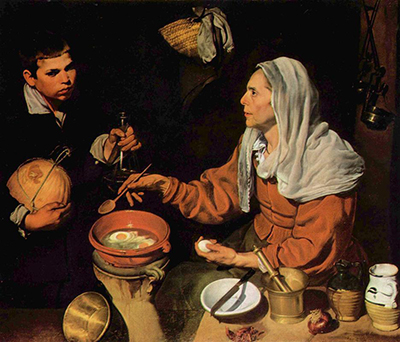
| The Waterseller of Seville | about 1620 | Painting |
| Count-Duke of Olivares (São Paulo) | 1624 | Painting |
| Count-Duke of Olivares (New York) | about 1625–26 | Painting |
| Apollo in the Forge of Vulcan | 1630 | Painting |
| Prince Baltasar Carlos on Horseback | 1634–35 | Painting |
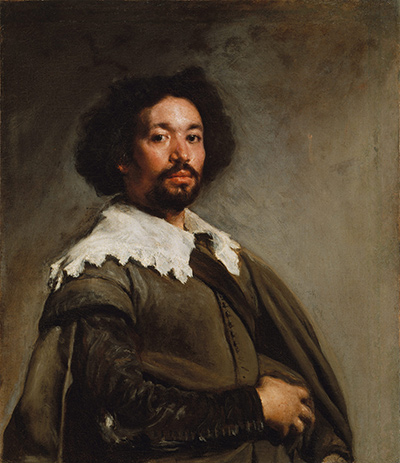
| Portrait of Juan Martínez Montañés (traditional identification) | about 1635–36, on the Montañés identification | Painting |
Frequently Asked Questions
MASP connects them with Olivares's royal chamber and horse-related offices. They turn responsibilities at court into visible attributes. [1]
Discussion
Look at how black clothing, gold fittings, the key and the stance construct a public image of power.
Which establishes the sitter's authority most strongly for you: his stance, the objects he wears, or the way he occupies the surrounding space?
Reader Insights
Which object first tells you about the sitter’s position?
Where does black clothing become a pattern of light?
How do the hands differ in their effect?
Join the Conversation
Share a detail, comparison or question about Portrait of the Count-Duke of Olivares in São Paulo below.
References
- MASP, Retrato do conde-duque de Olivares, inventory MASP.00171, object record; curatorial text, 2017; longer essay reproduced from Luiz Marques, organiser, Catálogo do Museu de Arte de São Paulo Assis Chateaubriand (1998; reissued 2008). In Portuguese. Object fields and both interpretations consulted. View source.
- Michael Gallagher, “Velázquez's Philip IV in the Metropolitan Museum,” Metropolitan Museum Journal 45 (2010), pp. 187–198, especially p. 187 on the three-picture commission and pp. 193–197 on repetition and attribution. Full journal hosted by RKD; article begins on PDF page 188. View source.
- Adriana Gonçalves de Carvalho, “O retrato do Conde-Duque de Olivares,” IV Encontro de História da Arte, IFCH/UNICAMP (2008), pp. 296–302, especially pp. 297–298 and 301–302. In Portuguese. View source.
- Hispanic Society Museum & Library, “History of HSML”, passage on Arabella Huntington's acquisition and gift of Velázquez's Gaspar de Guzmán, Count-Duke of Olivares, dated about 1625–26. View source.
- National Gallery, London, Diego Velázquez, Saint John the Evangelist on the Island of Patmos, NG6264. Collection record, artist dates and painting date; accessed 28 October 2026. View source.