 by Tom Gurney
Tom Gurney BSc (Hons) is an art history expert with over 20 years experience
Published on June 19, 2020 / Updated on November 5, 2026
Email: tomgurney1@gmail.com / Phone: +44 7429 011000
Queen Isabella of Spain — the Vienna Portrait
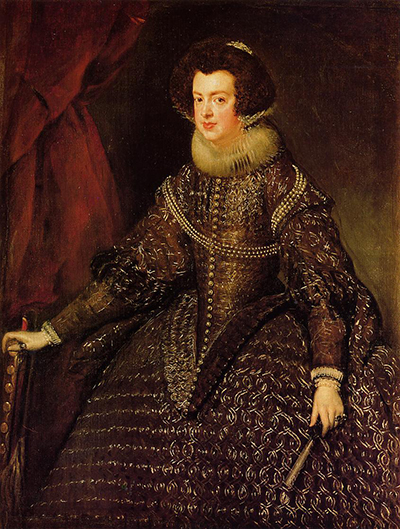
An elaborate pattern spreads across the queen's dark dress, but her face remains quietly distinct. Pale necklaces cross the shoulders, a long row of buttons descends towards the waist, and the broad skirt fills the lower part of the picture. One hand touches a chair; the other holds a closed fan. The Kunsthistorisches Museum in Vienna catalogues this portrait of Queen Isabella of Spain, whom it calls Elisabeth, as a work of 1632 by Diego Velázquez and his workshop. Its inventory number is GG 2129. [1]
That joint attribution matters. The painting belongs to the production of royal images around Velázquez, rather than offering an uncomplicated example of work carried out entirely by him. It also has an altered format: the museum believes that it was probably once full length. Looking at its decoration, gestures and present edges reveals a portrait with several histories, as an image of a queen, a collaborative painting and an object adapted to a later setting. [1]
At a Glance
Where the painting sits in Velázquez’s career
Contents
A figure built from ornament
The dress seems almost architectural in its breadth. At the shoulders, large folds project sideways; below the narrow waist, the skirt expands towards both lower corners. The queen's body provides the central support for this arrangement, yet its natural outline is largely concealed. We encounter an imposing shape made out of clothing before we begin to imagine the figure beneath it.
Within that shape, the ornament behaves differently from one area to another. Small bright marks crowd the chest, where the close-set buttons establish a firm downward direction. On the skirt, larger curling forms repeat across a darker field. The pattern passes over folds that change its angle and visibility. It consequently describes both a decorated surface and something capable of bending, gathering and carrying weight.
The broadest dark passage curves away from the waist towards the lower left. Elsewhere, pale threads of ornament interrupt the darkness almost continuously. Comparing those areas makes the costume easier to read. Its richness does not depend on an even distribution of detail: densely worked patches acquire their brilliance beside quieter, darker intervals. The contrast also prevents the skirt from appearing to be a flat screen placed in front of the sitter.
The face and its pale collar
Above the crowded costume, the face occupies a relatively small area of calm. Dark hair spreads around it in a rounded shape, while a narrow ornament catches light at the top. The forehead and cheeks receive warmer, more continuous illumination than the tiny scattered highlights below. Our eye finds the face partly because it offers a different kind of surface.
The pale ruff strengthens this separation. Its small, repeated divisions form a fan around the neck, making a light boundary between skin and dress. It is broad enough to frame the head without extending across the whole width of the shoulders. Where the necklaces spread outwards, the collar gathers attention inwards again.
The queen looks towards the viewer, with her head slightly turned in relation to her torso. Her mouth is closed and her expression controlled. It would be tempting to turn that restraint into an account of what she felt, but the picture gives us no access to a particular private mood. What it does make visible is the balance between a recognisable face and an exceptionally formal presentation. The individual remains legible within the surrounding display.
The chair and the closed fan
The hands interrupt the patterned dress with two smaller areas of light. At the left edge of the image, the outstretched hand rests on the chair. The fingers meet its rounded top while the arm forms a long connection back towards the shoulder. This is a useful line to follow: it opens the figure sideways and gives the pose a point of support outside the body.
The opposite hand stays much closer to the skirt. From it, the closed fan runs diagonally downwards, crossing the repeated decoration rather than competing with it. The two gestures are complementary. One extends towards a piece of furniture; the other brings an accessory into contact with the costume. Neither interrupts the stillness with an expansive movement.
The chair is only partly visible. A narrow upright, small bright fittings and the curved top are enough to establish its presence. It helps place the queen in an interior without requiring a detailed description of the room. The red curtain above it performs a different task: its large folds and relatively broad areas of colour set off the more intricate fabric worn by the sitter.
Dress and public standing
Beatriz Romero Chaves discusses this particular portrait in her study of clothing in the images of Isabella and Mariana of Austria. She draws attention to the pointed bodice, the double sleeves and the skirt as a separate part of the outfit. These distinctions help us see how the costume is assembled, rather than treating every fold as part of one undifferentiated gown. [2]
Her account places such clothing within the formal presentation of royal women. The width, ornament and controlled silhouette establish a public appearance whose demands differ from ordinary freedom of movement. This does not mean that every decorative mark can be decoded as a specific emblem, or that the painting records the queen's personal choices in each detail. The stronger claim is visible in the portrait itself: clothing enlarges the figure's presence and organises how she can be seen. [2]
The effect depends on relationships. The dark background allows pale ornament to remain distinct; the red curtain answers the warm tones within the dress; the hand on the chair stretches across the space between them. If attention remains fixed only on the richness of individual accessories, the larger arrangement becomes harder to appreciate. The painting joins costly-looking detail to a remarkably economical setting.
An altered format
The present boundaries require care. According to the Kunsthistorisches Museum, the portrait was probably originally full length and was subsequently cropped to make it a counterpiece to a portrait of the king. The museum also records additions at the corners. These statements describe changes to the object, rather than a completely preserved original format. [1]
That history affects how we read the composition. The skirt now seems to push against the lower edge, and the chair is cut short at the side. Those effects are real features of the painting as it survives, but they cannot all be treated as choices made for this exact rectangle in 1632. A changed edge can produce an emphatic closeness that was less pronounced in a larger image.
Nor does the proposed adaptation allow us to reconstruct everything that has disappeared. We should not supply imaginary floor space, furniture or accessories below the surviving skirt. The useful distinction is between what can be seen and what the museum concludes about the object's development. Keeping both in view makes the portrait more interesting: its commanding presence has survived a change in the conditions under which it was displayed.
A portrait made with workshop participation
Velázquez and workshop is therefore the relevant attribution for this canvas. The museum does not identify a particular assistant, or divide the face, hands and costume into securely documented contributions. Without that evidence, assigning individual passages to named painters would suggest a precision the record does not provide. [1]
Workshop participation also belongs within the practical history of royal portraiture. Dulwich Picture Gallery, for example, describes its later portrait of Philip IV as a studio copy of Velázquez's image painted at Fraga. That is a different object and a different occasion, but it provides a concrete reminder that court images were repeated by painters working around the master. [5]
For the Vienna queen, the question is therefore more useful than a simple choice between admiration and dismissal. How does the whole image hold together? The face and collar form one clear centre, the hands another pair of accents, and the dress supplies a wider field of light and dark. Appreciating that organisation does not require us to remove the museum's qualification. Looking and attribution can inform one another without becoming the same exercise.
Keeping other portraits separate
Isabella appears in several related royal images, which makes the collection and inventory important. The Royal Collection's full-length portrait, RCIN 402915, is dated about 1635–38 and attributed to Velázquez and his workshop. Its small black-and-white spaniel is one of the details mentioned in that institution's description. It is a separate painting from Vienna's GG 2129. [3]
A full-length likeness elsewhere cannot simply fill the gaps left by the cropping of this one. Similar poses, dress and accessories may make comparison rewarding, but similarity does not prove that all versions once contained identical details. Neither the Royal Collection's date nor the history of its particular canvas should be transferred to the Vienna portrait.
A Spanish portrait in Vienna
Isabella was Philip IV's first wife, the daughter of Henry IV of France and Marie de Medici. She married Philip in 1615. Those connections place her image within a network of royal households rather than solely within the painter's immediate surroundings. The Metropolitan Museum's account of Velázquez's royal portraiture notes how official likenesses circulated across Europe and the Americas. That broader practice helps explain why the destination of a court portrait is an important part of its history. [1] [4]
For this painting, however, the route to Vienna is only partly documented. The Kunsthistorisches Museum gives a possible dispatch in May 1639 and records the portrait in the Belvedere in 1858. The first is a possibility; the second is a documented point in the painting's later history. They should not be joined into an invented continuous account of ownership. [1]
Returning to the picture, its lasting force lies in the different scales at which it asks to be seen. From a distance, the broad costume and red curtain establish an imposing royal figure. Closer looking discovers the changes of direction within the ornament, the small intervals around the hands and the warmer simplicity of the face. Neither its collaborative attribution nor its altered edges prevents those relationships from working. They give the encounter a more precise historical setting.
Artworks directory
A selection of source-bound collection records. The Vienna queen is catalogued as Velázquez and workshop; the private riding-school painting is distinct from Wallace P6. This is not a complete catalogue of Velázquez’s work.
| Name | Date | Medium |
|---|---|---|
| Saint John on Patmos | 1618–19 | Painting |
| The Immaculate Conception | 1618–19 | Painting |
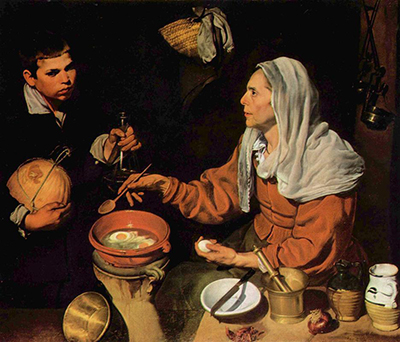
| The Waterseller of Seville | about 1620 | Painting |
| Count-Duke of Olivares (São Paulo) | 1624 | Painting |
| Count-Duke of Olivares (New York) | about 1625–26 | Painting |
| Apollo in the Forge of Vulcan | 1630 | Painting |
| Prince Baltasar Carlos on Horseback | 1634–35 | Painting |
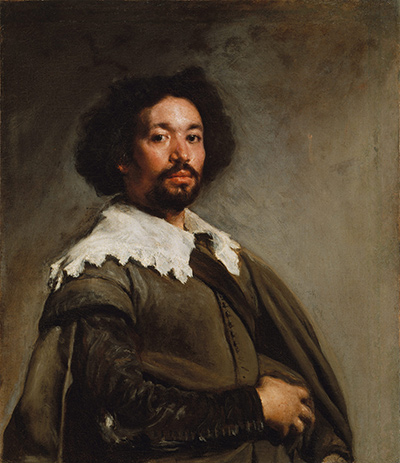
| Portrait of Juan Martínez Montañés (traditional identification) | about 1635–36, on the Montañés identification | Painting |
| Queen Isabella of Spain — the Vienna Portrait — Velázquez and workshop | 1632 | Painting |
| Prince Baltasar Carlos in the Riding School — the Private Version | about 1636 | Painting |
| The Temptation of Saint Thomas Aquinas | 1632 | Painting |
Frequently Asked Questions
The Kunsthistorisches Museum catalogues GG 2129 under Diego Velázquez and his workshop. It should not be described as securely painted entirely by Velázquez. [1]
The museum dates it to 1632. Isabella, Isabel and Elisabeth are forms of the queen's name used in different languages and catalogues. [1]
The museum considers that probable and says it was cropped to serve as a counterpiece to a portrait of Philip IV. The original lower part cannot be reconstructed from the surviving image alone. [1]
Discussion
Follow the picture’s gestures, differences in scale and arrangements of light before deciding which passage holds the scene together.
Which first draws your attention: the face, the ornament or the outstretched hand? Follow the darkest areas of the dress and then the lightest details. How does that change your sense of the queen's pose?
Reader Insights
Where does ornament become a broad field of light?
How do the two hands organise the pose?
How do the surviving edges affect your view of the dress?
Join the Conversation
Share a detail, comparison or question about Queen Isabella of Spain — the Vienna Portrait below.
References
- Kunsthistorisches Museum, Vienna, Queen Elisabeth of Spain, 1632, Gemäldegalerie GG 2129. Current object record, artist/workshop fields, format history and provenance; accessed 28 October 2026. View source.Splash image: Queen Isabella of Spain — the Vienna Portrait. Velázquez and workshop, 1632. Kunsthistorisches Museum, Vienna, GG 2129.
- Beatriz Romero Chaves, “Gustos femeninos en la corte barroca. Los retratos de Isabel de Borbón y Mariana de Austria,” Accadere. Revista de Historia del Arte 9 (June 2025), pp.37–53, especially pp.43–44 and fig.3. In Spanish. DOI:10.25145/j.histarte.2025.09.02. View source.
- Royal Collection Trust, Isabella of Bourbon (1602–1644), consort of Philip IV of Spain (1605–1665), about 1635–38, RCIN 402915. “Spanish paintings in the Royal Collection,” institutional summary and attribution; accessed 28 October 2026. View source.
- The Metropolitan Museum of Art, Philip IV (1605–1665), King of Spain, probably 1624, object14.40.639. Current collection label, on the circulation of royal portraits; accessed 28 October 2026. View source.
- Dulwich Picture Gallery, Philip IV, King of Spain, workshop of Diego Velázquez, 1644–60, DPG249. Current collection label, on studio copies; accessed 28 October 2026. View source.
- National Gallery, London, Diego Velázquez, Saint John the Evangelist on the Island of Patmos, NG6264. Collection record, artist dates and painting date; accessed 28 October 2026. View source.