


 by Tom Gurney
Tom Gurney BSc (Hons) is an art history expert with over 20 years experience
Published on June 19, 2020 / Updated on November 5, 2026
Email: tomgurney1@gmail.com / Phone: +44 7429 011000
Prince Baltasar Carlos in the Riding School — the Private Version
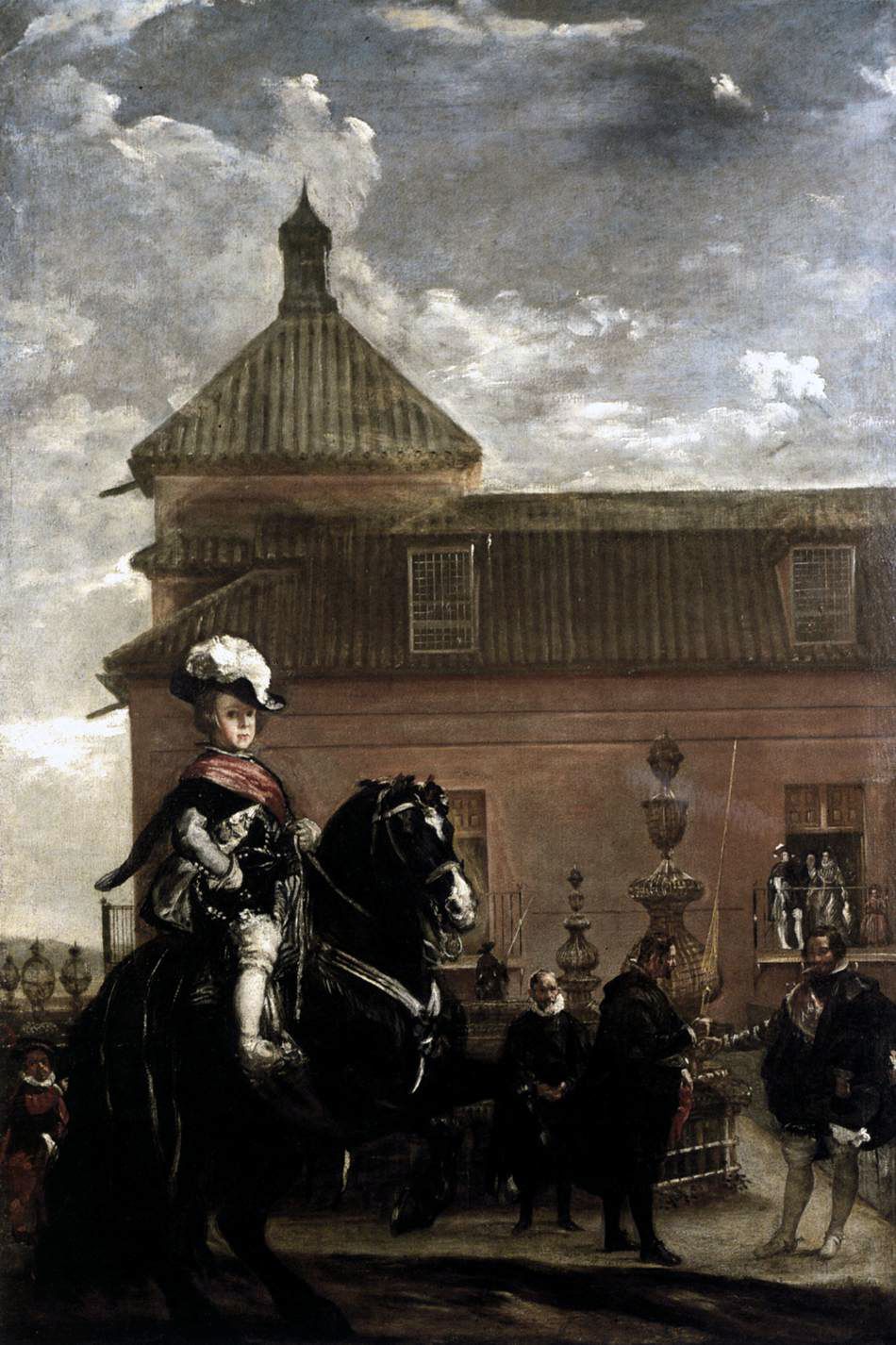
A boy on a dark horse commands the left side of the picture, but he has plenty of company. Men gather across the courtyard, spectators appear at a window, and a large palace building rises behind them. The horse lifts its forelegs while the young rider keeps his upright seat. His face turns towards us, giving the impression that the lesson has briefly become a portrait.
This is Prince Baltasar Carlos, son of Philip IV of Spain, in the private version of Prince Baltasar Carlos in the Riding School. The Centro de Estudios Europa Hispánica identifies it as a painting by Velázquez of around 1636. Its conspicuous figure of the Count-Duke of Olivares distinguishes it from the related picture in the Wallace Collection. The two compositions have different histories of attribution and must be considered separately. [2]
At a Glance
Where the painting sits in Velázquez’s career
Contents
A young rider on a powerful horse
The horse supplies the picture's strongest dark shape. Its raised head, rounded neck and broad chest make an imposing platform for a child. Bright touches along the bridle, muzzle and neck divide this mass into smaller passages, while the pale ground beneath it makes the lifted legs easy to follow. The animal seems to gather its weight before moving, rather than simply crossing the courtyard.
The prince's clothes answer that controlled energy. A pale plume spreads from his hat, a warm sash crosses his upper body, and the light catches the elaborate sleeves and breeches. His small boot reaches down beside the saddle. These details give the rider a ceremonial brightness without disguising his youth. The face above the costume remains that of a child.
Look at the difference between the two heads. The horse faces into the space on the right; the prince looks out towards the spectator. Their bodies belong to the same exercise, but their attention seems divided. The result gives the image two kinds of presence: a lesson unfolding within the courtyard and a royal sitter acknowledging an audience beyond it.
A palace filled with spectators
The building occupies much more of the canvas than the child does. Its long horizontal bands, repeated windows and steep tower roof form an architectural counterweight to the horse. The sky opens above the roof, bringing cool, shifting light into a scene otherwise dominated by brown walls and dark clothes. The court appears extensive, yet the figures gather in a relatively narrow strip near the bottom.
A window on the right breaks this architectural regularity. People stand in its opening, looking towards the activity below. The Prado's 1990 catalogue identifies Philip IV and his first wife, Isabel, among these spectators. Their distance from the foreground makes the family relationship part of the setting rather than the centre of a conventional group portrait. [1]
Try looking at that window before returning to the prince. The small watching figures change the meaning of the empty wall between them and the horse. It becomes a distance across which the boy's performance is being observed. The lesson has an audience inside the painting as well as outside it.
Olivares and the adults around the child
The Count-Duke of Olivares stands to the right of the horse among the foreground adults. His prominence is central to the way the CEEH distinguishes this private composition from the Wallace version. He places the prince's activity within the sphere of the powerful minister as well as the royal household. [2]
Visually, the adults do more than supply a setting for the boy. Their differently angled bodies introduce small movements across the courtyard. One figure turns, another stands more squarely towards the action, and the long upright lance cuts through the space above them. Dark cloaks connect the group, while pale legs and collars prevent it from becoming one continuous silhouette.
The contrast in scale is striking. The prince sits high on his horse, while the standing men occupy a lower band. His position gives him pictorial importance without making him the largest person in the scene. Authority is conveyed through placement and attention: the adults are there because of what the child is doing.
There is no need to imagine a spoken exchange to feel the social complexity. The painting already provides a network of relationships through glances, gestures, distances and shared space. It shows a court organised around an heir whose body is still small enough to need instruction.
Riding as an education in public life
The related Wallace painting is interpreted by its museum as a display of accomplished riding that anticipates the prince's ability to govern. Its courtyard is described as a tiltyard, a place for practising the skills associated with jousting. That account helps explain why a riding lesson could carry such weight in a royal image, although the Wallace canvas remains a different object. [3]
A French comparison makes the connection between instruction and kingship especially clear. The Louvre holds a 1625 print by Crispijn de Passe the Younger showing Antoine de Pluvinel teaching the sixteen-year-old Louis XIII. The museum identifies it as an illustration for Pluvinel's L'instruction du Roy en l'exercice de monter à cheval. A royal pupil, a teacher and an equestrian exercise could become the subject of an elaborate printed image as well as a practical lesson. [5]
The French Ministry of Culture places Pluvinel's teaching within a wider education for young nobles, alongside subjects including arms, dance and the arts. This does not establish an identical curriculum for Baltasar Carlos. It does show a culture in which command of a horse belonged to the formation and public identity of a ruler. [6]
Seen in that context, the prince's upright bearing carries more than the excitement of a child riding well. The exercise lets an audience imagine qualities he is expected to possess in adulthood. The adults and spectators make that expectation visible around him.
Two pictures with different claims
The Wallace Collection catalogues its own Prince Baltasar Carlos in the Riding School, inventory P6, as a work from Velázquez's studio, dated about 1640–45. Its description distinguishes it from the private painting of 1636. The absence of the prominent Olivares group gives the Wallace composition a different distribution of figures and space. [3]
These are meaningful differences, rather than small variations in reproductions of one canvas. In the private picture, the minister and nearby men occupy an area that might otherwise draw attention towards the palace and the distant spectators. Their presence pulls political office into the immediate company of the heir.
The close relationship between the images makes careful comparison rewarding. A figure present in one and absent from the other changes the balance of the scene, even when the horse, child and palace still seem familiar. Their differences belong to the encounter with each painting, rather than to a competition to find the most crowded version.
How the attribution has been discussed
The private painting's attribution has not passed unchanged through scholarship. In the Prado's 1990 catalogue, Julián Gállego surveys differing positions: Aureliano de Beruete had favoured Juan Bautista Martínez del Mazo, whereas Jonathan Brown accepted the picture as Velázquez. The entry makes authorship a historical question with arguments on both sides. [1]
More recent institutional language gives the private composition a stronger standing. The Wallace Collection's programme for its March 2021 conference describes it as an accepted autograph version, while distinguishing the painting in its own collection. The CEEH project likewise identifies the private picture as the composition painted by Velázquez around 1636. These statements explain its treatment here without erasing the earlier debate. [4] [2]
That distinction matters when looking at the small figures. A convincing impression of activity does not, by itself, prove who painted every passage. Nor does an old disagreement make the work impossible to discuss. Its visible relationships remain available to scrutiny, while the attribution is understood through the particular authorities and dates attached to it.
Looking across different kinds of detail
The reproduction moves between strongly stated forms and much smaller indications. The prince's costume catches the light in scattered marks, while the horse depends on larger areas of darkness. Farther back, the window spectators have to register within a compact opening. They can appear recognisable as a group before every individual feature becomes distinct.
The long lance makes an effective guide through these changes of scale. Follow it upwards from the men and it leads towards the elevated audience. Follow the line of the building back across the picture and it returns the eye towards the tower above the prince. Straight architectural elements and small angled human gestures keep interrupting one another.
This gives the painting a different rhythm from an isolated equestrian portrait. The rider is its point of concentration, but the surrounding court keeps making fresh demands on our attention. The eye travels outwards and back, finding the boy again after encountering the people who watch, attend and instruct him.
Returning to the prince
Baltasar Carlos lived from 1629 to 1646. His early death gives an added poignancy to images that present him as a future ruler. That later knowledge should not obscure the confidence built into the scene: an heir mounted above his attendants, performing before the court. [3]
The picture's appeal also survives outside that dynastic story. A small face emerges from rich clothes, a horse holds its weight, and distant spectators gather at a window. Those observations bring a public image of royal preparation close to an ordinary human experience: being watched while learning something difficult. The scale and setting are exceptional; the pressure of the lesson is readily imaginable.
Artworks directory
A selection of source-bound collection records. The Vienna queen is catalogued as Velázquez and workshop; the private riding-school painting is distinct from Wallace P6. This is not a complete catalogue of Velázquez’s work.
| Name | Date | Medium |
|---|---|---|
| Saint John on Patmos | 1618–19 | Painting |
| The Immaculate Conception | 1618–19 | Painting |
| The Waterseller of Seville | about 1620 | Painting |
| Count-Duke of Olivares (São Paulo) | 1624 | Painting |
| Count-Duke of Olivares (New York) | about 1625–26 | Painting |
| Apollo in the Forge of Vulcan | 1630 | Painting |
| Prince Baltasar Carlos on Horseback | 1634–35 | Painting |
| Portrait of Juan Martínez Montañés (traditional identification) | about 1635–36, on the Montañés identification | Painting |
| Queen Isabella of Spain — the Vienna Portrait — Velázquez and workshop | 1632 | Painting |
| Prince Baltasar Carlos in the Riding School — the Private Version | about 1636 | Painting |
| The Temptation of Saint Thomas Aquinas | 1632 | Painting |
Frequently Asked Questions
Discussion
Follow the picture’s gestures, differences in scale and arrangements of light before deciding which passage holds the scene together.
Which part of the courtyard draws your attention away from the prince? Follow the relationship between the foreground adults and the window spectators, then consider how the scene would change without Olivares.
Reader Insights
What takes your attention away from the prince?
How does Olivares change the foreground?
What relationship joins the distant spectators and the rider?
Join the Conversation
Share a detail, comparison or question about Prince Baltasar Carlos in the Riding School — the Private Version below.
References
- Julián Gállego, “El príncipe Baltasar Carlos en el picadero,” entry 41, in Velázquez (Madrid: Museo del Prado / Ministerio de Cultura, 1990), pp. 246–253. Full painting, details and catalogue discussion consulted in the original Spanish. View source.Splash image: Prince Baltasar Carlos in the Riding School, private version, about 1636. Bidragsyter, via Wikimedia Commons; public-domain reproduction, re-exported at native size. · Public domain
- Centro de Estudios Europa Hispánica, “Balthasar Carlos at The Wallace Collection,” restoration project account, undated. English text consulted 28 October 2026; distinguishes the private composition from the Wallace painting. View source.
- Wallace Collection, “Prince Baltasar Carlos in the Riding School,” inventory P6, collection record. Artist, date and descriptive fields consulted 28 October 2026. View source.
- Wallace Collection, Velázquez and the Spanish Prince: Baltasar Carlos in the Riding School, online conference programme, 4–5 March 2021, pp. 1–2. View source.
- Musée du Louvre, Antoine de Pluvinel donnant une leçon d'équitation au jeune Louis XIII âgé de 16 ans, Crispijn de Passe the Younger, 1625, inventory 25062 LR/Recto, collection record; French text consulted 28 October 2026. View source.
- Ministère de la Culture, Le cheval et ses patrimoines, “Antoine de Pluvinel,” French educational essay, undated; consulted 28 October 2026. View source.
- National Gallery, London, Diego Velázquez, Saint John the Evangelist on the Island of Patmos, NG6264. Collection record, artist dates and painting date; accessed 28 October 2026. View source.
- Wikimedia Commons, source reproduction for Baltasar Carlos, private riding-school version, public-domain faithful reproduction credited to Bidragsyter. View source.


