


 Buy Art Prints Now
from Amazon
* As an Amazon Associate, and partner with Google Adsense and Ezoic, I earn from qualifying purchases.
 by Tom Gurney
Tom Gurney BSc (Hons) is an art history expert with over 20 years experience
Published on June 19, 2020 / Updated on September 28, 2026
Email: tomgurney1@gmail.com / Phone: +44 7429 011000
Degas Paintings: Introduction
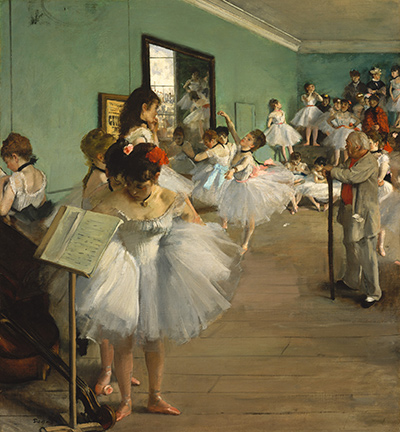
The dancers in Edgar Degas's The Dance Class seem to occupy a room that continues beyond the edges of the canvas. One young dancer is being examined by the ballet master Jules Perrot, while others wait, stretch or look elsewhere. The floor opens diagonally, and the arrangement asks the eye to move among separate acts of attention. The picture appears to show a passing moment, yet its balance of figures, empty space and sightlines is carefully made. It is one way into Degas's paintings: the instant we see is often the result of extended decisions in paint and drawing. This is the Metropolitan Museum of Art's 1874 oil painting, accession 1987.47.1, distinct from a similarly titled canvas in the Musée d'Orsay. [1][5][6] [17]
Browse Degas paintings
Explore these paintings through their individual artwork pages.
 Edgar Degas.jpg)
At a Glance
- Early portraitA Woman Seated beside a Vase of Flowers, 1865 [3]
- Modern subjectThe Dance Class, 1874 [4]
- Later oilDancers, Pink and Green, c. 1890 [14]
Contents
- Introduction
- From Academic Training to Modern Subjects
- A Portrait That Gives the Flowers the Centre
- Painting a Room Full of Separate Actions
- Racing, Work and the Problem of Finish
- Different Viewpoints, Different People
- Oil Painting Alongside Pastel
- How to Look at a Degas Painting
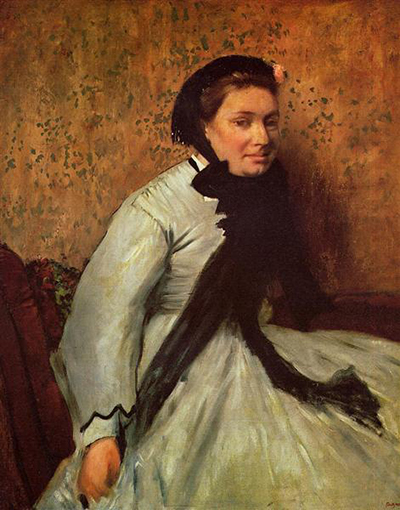
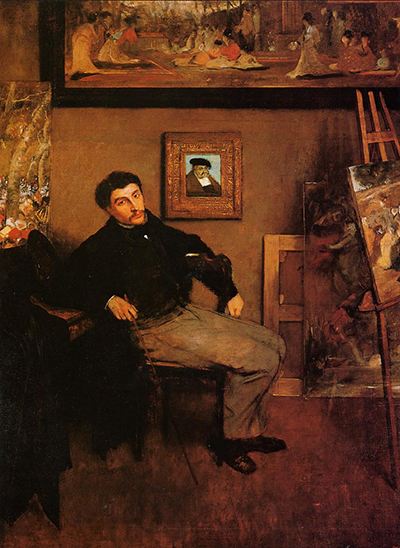
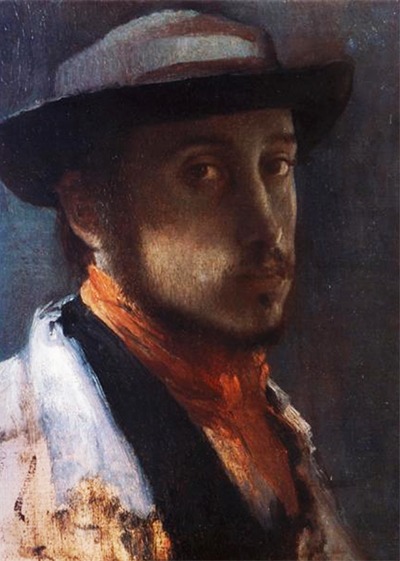
Degas painted portraits, imagined histories, theatres, racecourses, workplaces and people at leisure. He worked in oil across decades, even as pastel, drawing, printmaking and sculpture offered other ways to investigate the same subjects. His oil paintings did not move in a straight line from smooth academic finish to loose modern handling. They include small works and large canvases, carefully resolved passages beside exposed revisions, and late pictures whose colour and texture can resemble pastel. To understand his painting, it helps to ask what a particular canvas lets us see about its making. [1][2][3][14][15]
From Academic Training to Modern Subjects
Degas learned to draw through study of earlier masters. He copied at the Louvre, trained with Louis Lamothe and spent substantial time in Italy in the 1850s. He initially pursued portraits and historical subjects suited to the ambitions of academic painting. This training gave him a command of figure placement and line that he could use in very different settings. A painting of contemporary life did not require him to abandon planning or to treat the brush as a substitute for drawing. [1][2][3]
The Bellelli Family, listed by Orsay as Portrait de famille, shows the scale of the early ambition. The museum dates the canvas broadly between 1858 and 1869. Degas arranged his aunt, uncle and cousins within an interior whose doors, furniture and picture on the wall become part of the composition. The painting took shape over a period longer than a single sitting in Italy. Its domestic subject belongs to the artist's family, but it is also a testing ground for how a large oil painting can organise several figures without forcing them into one unified gesture. The biography follows the family and the portraiture page looks more closely at portraits as relations between sitters and settings. [1][8]
By the 1860s Degas was increasingly painting his own time. The Met's account describes a turn toward the racecourse and then theatre and café-concert subjects, while his sustained study of older art continued. A modern subject could be approached with the same searching attention he had given an historical composition. What changed was the scene and the kind of attention the scene invited. A painting could make a viewer notice the pause before a race, the routine behind a performance or the effort of ordinary work. [1][2]
His place among the independent artists later called Impressionists clarifies both common ground and difference. Degas helped organise their exhibitions and shared an interest in contemporary life, but he did not make outdoor light and quick landscape painting the model for all his work. He returned to interiors, artificial light and carefully placed figures. Musée d'Orsay identifies his participation in seven of the eight independent exhibitions; the number locates a public career rather than defining a painting method. The medium did not decide whether a work was “Impressionist” by itself. [1][2][4]
A Portrait That Gives the Flowers the Centre
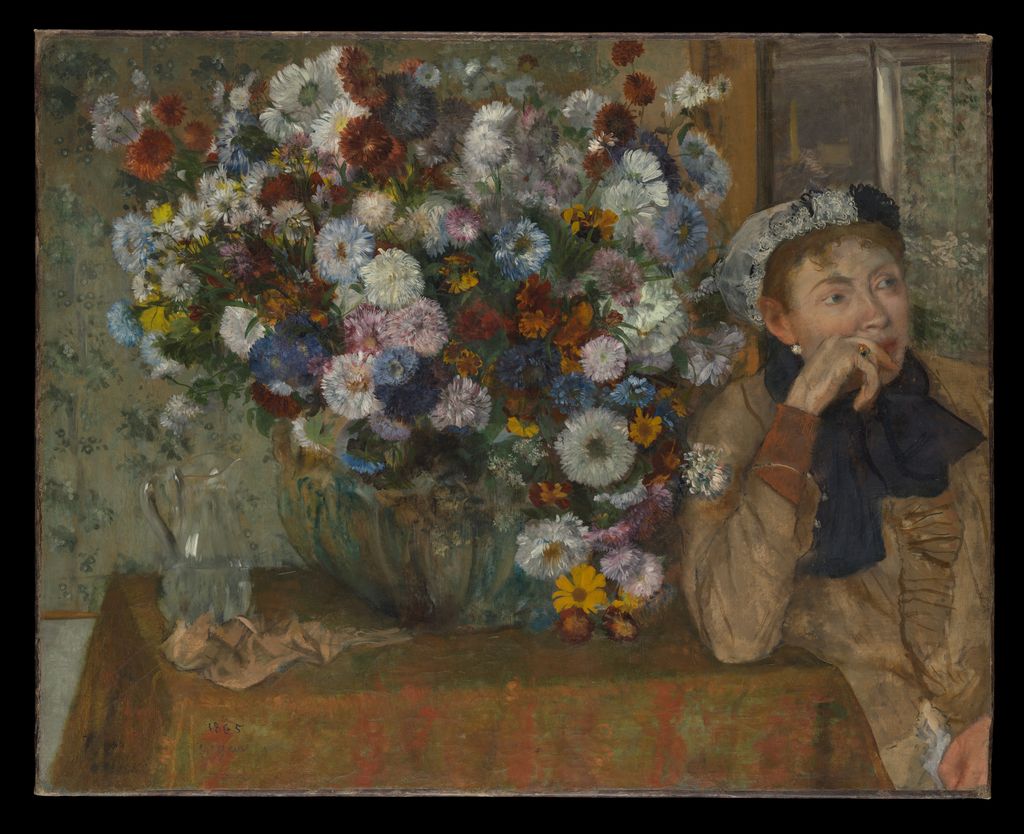
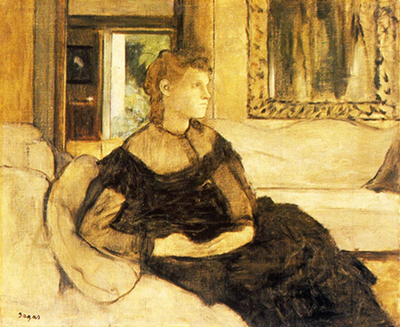
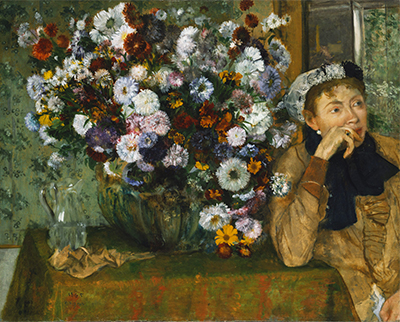
In the Met's A Woman Seated beside a Vase of Flowers of 1865, an abundant bouquet takes up much of the canvas while the seated woman is pushed to the right. Her gaze moves away from the flowers and beyond the picture. The large vessel and the sitter occupy different kinds of attention: one is a dense arrangement of colour and repeated forms, the other a person seemingly caught in thought. The painting does not simply place a portrait subject in the centre and surround her with accessories. It asks the viewer to find the sitter through the flowers. [7]
The Met identifies the woman only tentatively as Madame Paul Valpinçon. That question mark matters. A useful account can describe exactly what the painting does without pretending that the sitter's name is settled. The museum also records a pencil drawing of the woman made before the canvas. The drawing is evidence that this apparently casual arrangement had a period of preparation; it does not let us reconstruct every step of its making. [7]
The off-centre figure is often used to discuss Degas's interest in unexpected framing. The Met's broader essay connects such choices to several visual traditions, including Japanese prints and earlier Italian painting. No single influence is needed to describe the visible effect here. The flowers have physical weight in the painting, and the right edge makes the sitter feel near and partly withheld. The choice is specific to this canvas. A similarly cropped Degas dancer or racecourse scene may produce a different relationship between figure and space. [1][7]
Painting a Room Full of Separate Actions
The Met's The Dance Class of 1874 offers a different problem. It is a room of many people, not a sitter and a bouquet. One dancer works before Perrot; others and their mothers occupy the edges of the activity. The picture gives attention to waiting and preparation around the central exercise. The wide floor and the angled view hold the group together while allowing each figure a separate posture. A quick first glance may register a ballet scene. A longer look finds a constructed route through bodies, furniture and space. [5]
The Met painting is frequently confused with Orsay's La Classe de danse, dated 1873–76 and accession RF 1976. Both are oils on canvas, but their figures, room arrangements and dimensions belong to different objects. A claim about the Met picture should be checked against accession 1987.47.1, not transferred from Orsay's catalogue or photograph. The exact painting matters as much as the familiar title. The two dedicated pages, Met The Dance Class and Orsay La Classe de danse, follow their respective compositions. [5][6]
Degas repeatedly painted dancers because rehearsals and performances offered changes of stance, balance and attention. The room was also a place of training and work. On this paintings page, its principal question is how an oil canvas can hold multiple movements in a single arrangement. The ballet and dancers page carries the wider history of the Opéra, labour and spectatorship across media. The painting's figures should not be treated as interchangeable examples of a general “ballet style.” [1][5]
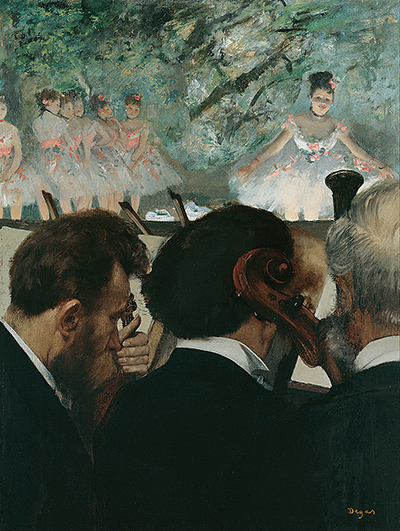
Other interiors change the viewer's position. In the Städel's Orchestra Musicians, begun in 1872 and altered in 1874–76, the perspective places us among the musicians looking toward dancers beyond them. The close foreground figures and distant stage share one picture, yet they demand different kinds of looking. Städel records that Degas cropped and added canvas, turning an initially horizontal composition into a vertical one. The unusual viewpoint was not merely chosen once and left untouched. He physically changed the support to change the relation of orchestra and dance. [9]
This Städel example makes the word “composition” concrete. Degas could revise a figure's pose, but he could also change the field in which the figures appear. Cropping and extension alter what sits near an edge, how much room a group has and where the viewer feels placed. The finished image may look like a view glimpsed through a theatre, but the museum's dating and account show a sequence of material decisions. Its English title is often given as Orchestra Musicians; Städel's record identifies the object as SG 237. [9]
Racing, Work and the Problem of Finish
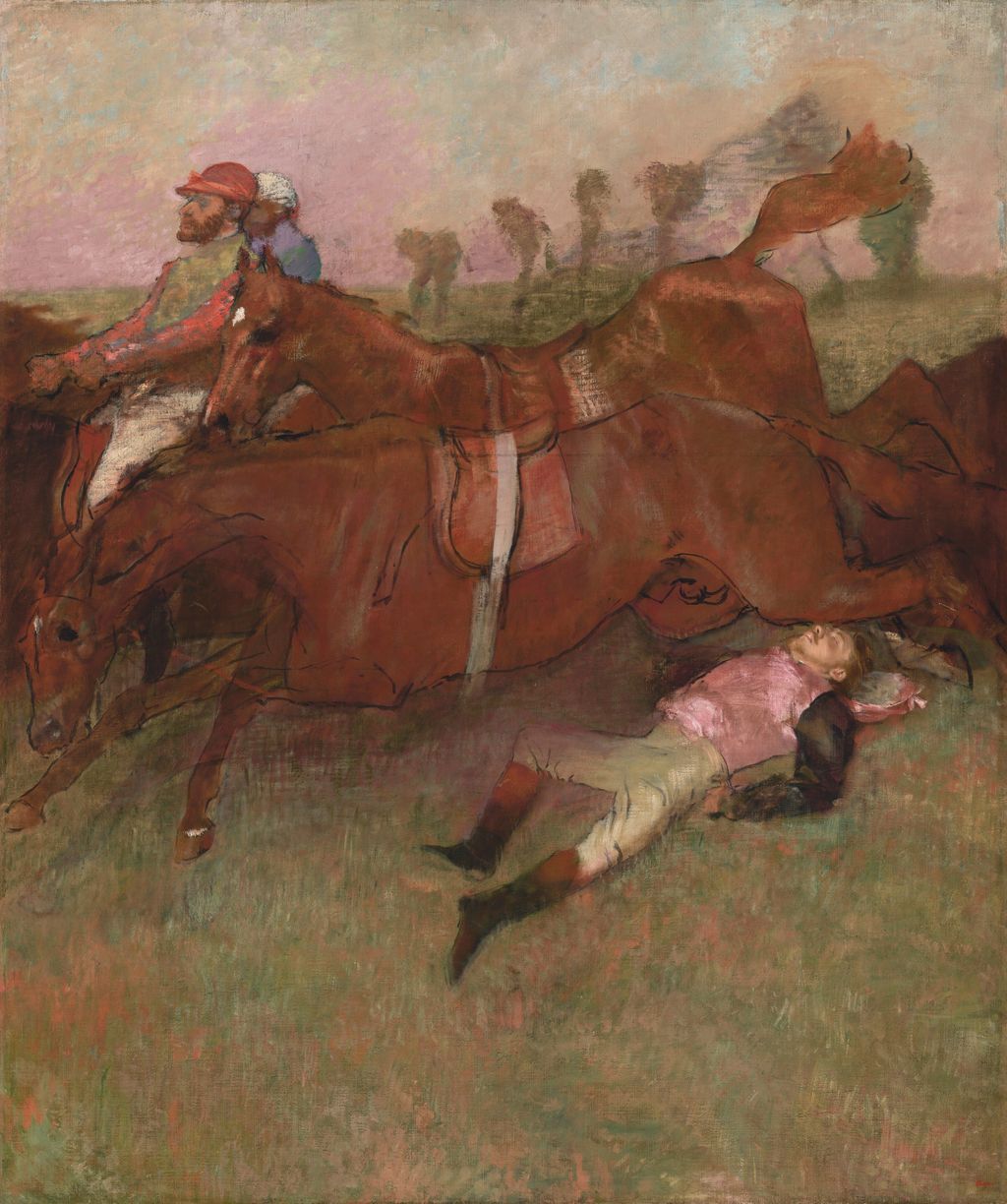
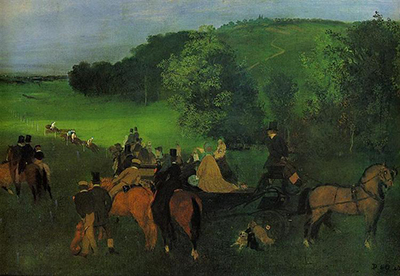
Degas's racecourse pictures offered other arrangements of people, animals and space. Some show the interval before movement rather than the race at full speed. The horse racing page considers that subject across media. One oil canvas, the National Gallery of Art's Scene from the Steeplechase: The Fallen Jockey, is especially useful for understanding how long a painting might remain open to change. Degas made it in 1866 and reworked it in 1880–81 and again around 1897. Its current surface carries decisions from widely separated parts of his career. [2][10]
The NGA points to traces of a horse removed from the composition and parts of an earlier blue sky still visible. Look at the overlapping animals and the fallen rider: lines and painted forms do not all settle into one uniform finish. The canvas was shown at the Salon in 1866, yet the version before us includes major later changes. A visitor at that exhibition did not see exactly the same image a museum visitor sees today. “Finished” cannot simply mean “once exhibited,” nor can an open-looking brushstroke prove that Degas left a painting accidentally incomplete. The record gives a history of this one object, not a verdict on every Degas canvas. [10]
The NGA's Woman Ironing provides another long span: begun around 1876 and completed around 1887. One woman presses a shirt across a table, the pressure of her body and arm making the action legible. A line of garments and the room around her locate the work without turning it into a posed costume study. The dates remind us that a familiar scene of labour could occupy Degas for years. The oil paint can carry concentrated observation and extended revision at once. This is the NGA's single ironer, accession 1972.74.1, not the two women in Orsay's Women Ironing. The museum's record treats that two-figure work and its history separately. [11]
Theodore Reff's study of Degas's technique describes varied approaches to oil: thin, smooth early passages, work on paper, oil diluted to different effects and later surfaces with more forceful marks. Reff's examples are historical scholarship rather than a modern laboratory account of every canvas. They support a broad point: Degas did not use one oil-paint recipe or one degree of polish. For a specific painting, the owning museum's technical description and the visible surface remain the better starting points. [3]
This variety makes a simple “unfinished Degas” category unreliable. A surface may have exposed canvas, a thinly indicated figure, heavy worked paint or an alteration visible beneath a later passage. Those effects can arise from different decisions and different histories. Fallen Jockey offers a documented long revision; Städel's musicians offer a documented change to the canvas format; Woman Ironing offers a dated span of work. None alone establishes what Degas thought the ideal stopping point for all his paintings should be. [3][9][10][11]
Watch: Edgar Degas
Explore his paintings, drawings and sculpture in three short videos.
Degas, The Dance Class
Look closely at Degas’s off-duty dancers and his unusual view into the rehearsal room.
Watch on YouTubeDifferent Viewpoints, Different People
Degas's painting of performers is sometimes described as though he always looked from above or caught people unaware. Miss La La at the Cirque Fernando, owned by the National Gallery in London, immediately breaks the first habit: its viewpoint looks steeply upward. The acrobat hangs high within the circus roof, while the structure occupies most of the oil canvas. The museum documents preparatory studies and identifies the technical difficulty of the ceiling's perspective. The painting was shown in the 1879 independent exhibition. Its performer, Anna Albertine Olga Brown, was a named and skilled professional, not an anonymous device for an unusual angle. Her dedicated page can give the performance and her life the attention they require. [12]
The same caution applies to modern work. Degas painted women ironing and worked on several versions of laundress subjects. The composition of a single figure pressing cloth is an artistic construction; it should not be described as a photograph of typical conditions for all Parisian women. Likewise, A Cotton Office in New Orleans brings family members and the business of cotton into a painted room without depicting the whole economic system behind that trade. The Cotton Office page and the biography address the New Orleans setting and its limits. The paintings page can ask how Degas arranged people and space while leaving each subject's history visible rather than flattening it into a formal example. [5][11][13]
Oil Painting Alongside Pastel
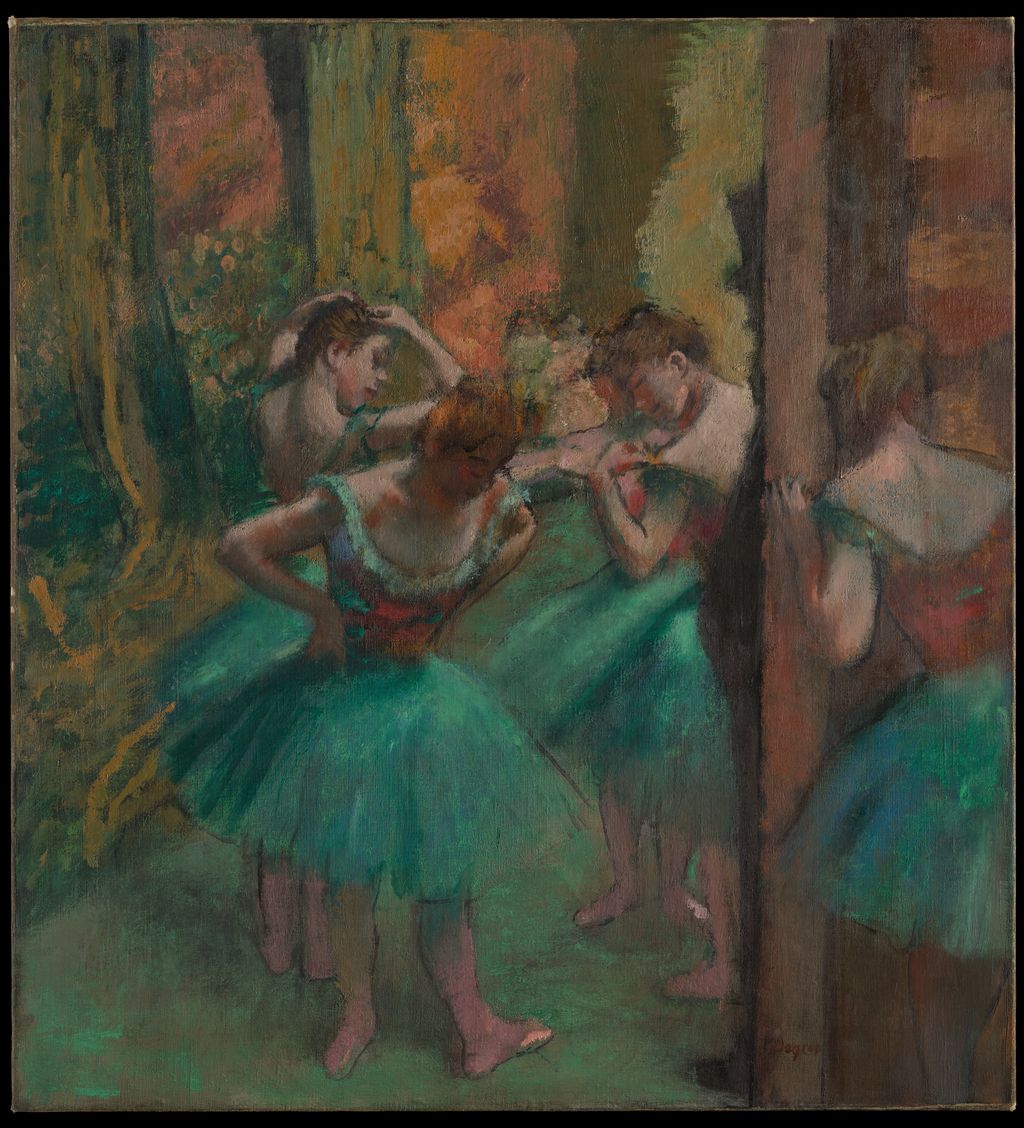
Pastel became an increasingly important medium for Degas after the mid-1870s and prominent in his later work. The Met and Musée d'Orsay describe that shift in broad terms. It does not supply a date at which Degas stopped painting in oil. The NGA's Four Dancers is an oil on canvas dated around 1899; the Met's Dancers, Pink and Green is an oil of about 1890. Those object records are enough to reject a tidy replacement story. The pastels page explains what dry colour let him do differently. [1][14][15][16]
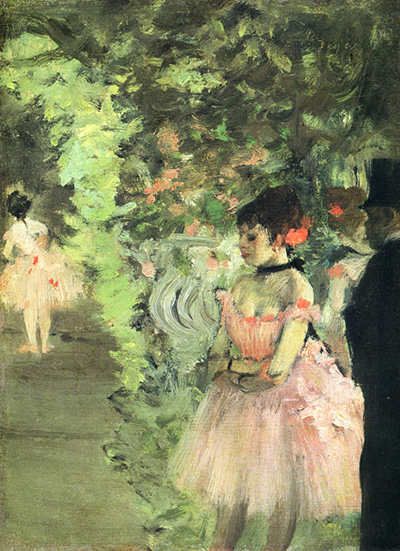
In Dancers, Pink and Green, the women adjust their clothing in a crowded backstage space. Green skirts gather into large areas of colour while figures and a darker vertical passage break the field into overlapping parts. The Met describes a heavily worked oil surface, with paint built in layers and handled with brushes and fingers. The effect approaches aspects of his pastel practice, but the museum identifies the object unambiguously as oil on canvas, accession 29.100.42. The medium matters: its thick passages and revisions are paint, not pastel dust on paper. [14]
The comparison is more useful than a simple early-versus-late contrast. A Woman Seated beside a Vase of Flowers concentrates a bouquet and a displaced sitter in an 1865 oil; Dancers, Pink and Green uses a compressed group and saturated, worked paint around 1890. Between them lie the theatre interiors, racecourse revisions and scenes of labour. Each painting presents a different problem of placement, surface and attention. The chronology shows change without requiring every later oil to look alike. [7][9][10][11][14]
How to Look at a Degas Painting
First, identify the exact object. Similar titles can name different dance-class rooms, and a single ironing woman is not Orsay's two-figure scene. The museum, accession, medium and date set a secure starting point. The central example here is the Met’s The Dance Class, 1874, oil on canvas, accession 1987.47.1. The Met vase portrait, the NGA Fallen Jockey and the Met’s late dancers show other aspects of the medium, each tied to its museum record. [5][6][7][10][11][14]
Next, follow where the painting places you. Are you looking across a rehearsal floor, toward a sitter pushed to the edge, past musicians to a stage, or up into a circus roof? Look at the empty areas as well as the people. A large floor, a crowded bouquet or a roof truss can direct attention just as strongly as a face. These arrangements are visible choices, not automatic proof of one influence or of an unobserved moment caught by chance. [5][7][9][12]
Finally, look for the history in the surface. A painting may have been studied on paper, worked in oil over years or reconfigured after being shown. The NGA's Fallen Jockey gives a rare owner-documented case of decades of revision; Städel's Orchestra Musicians shows a changed canvas format. A late oil can use heavy, layered colour that recalls pastel without ceasing to be paint. No one procedure describes the whole career. The drawings, prints and sculptures pages show how Degas pursued related questions through different materials. [3][9][10][14]
Selected paintings
Artworks directory
A selected index of documented works, combining owner records with entries sampled across Michel Schulman’s digital catalogue raisonné. It is not a complete catalogue. View the full catalogue
Discussion
Share what you notice in a Degas painting and how its materials shape the result.
Reader Insights
What changes when Degas places a figure at the edge rather than the centre?
How does the material label affect your reading of a scene?
Which visible revision changes the way you understand a Degas painting?
Join the Conversation
Share your reading of these works below.
References
- Ruth Schenkel, “Edgar Degas (1834–1917): Painting and Drawing,” Heilbrunn Timeline of Art History, Metropolitan Museum of Art, 2004. View source
- National Gallery of Art, “Edgar Degas,” artist profile. View source
- Theodore Reff, “The Artist as Technician,” in Degas: The Artist's Mind, Metropolitan Museum of Art, 1976, especially pp. 270–78 and 295–303. View source
- Marina Ferretti and Xavier Rey, “Degas, an impressionist painter?” Musée d'Orsay, 2015. View source
- Metropolitan Museum of Art, The Dance Class, 1874, oil on canvas, accession 1987.47.1. View source
- Musée d'Orsay, La Classe de danse, 1873–76, oil on canvas, RF 1976. View source
- Metropolitan Museum of Art, A Woman Seated beside a Vase of Flowers (Madame Paul Valpinçon?), 1865, oil on canvas, accession 29.100.128. View source
- Musée d'Orsay, Portrait de famille / La famille Bellelli, 1858–69, oil on canvas, RF 2210. View source
- Städel Museum, Die Orchestermusiker / Orchestra Musicians, 1872, altered 1874–76, oil on canvas, SG 237. View source
- National Gallery of Art, Scene from the Steeplechase: The Fallen Jockey, 1866, reworked 1880–81 and c. 1897, oil on canvas, accession 1999.79.10. View source
- National Gallery of Art, Woman Ironing, begun c. 1876, completed c. 1887, oil on canvas, accession 1972.74.1. View source
- National Gallery, London, Miss La La at the Cirque Fernando, 1879, oil on canvas, NG4121. View source
- Musée des Beaux-Arts de Pau, Un bureau de coton à la Nouvelle-Orléans, 1873, accession 878.1.2; institutional account. View source · View source
- Metropolitan Museum of Art, Dancers, Pink and Green, c. 1890, oil on canvas, accession 29.100.42. View source
- National Gallery of Art, Four Dancers, c. 1899, oil on canvas, accession 1963.10.122. View source
- Musée d'Orsay, “Degas The Pastel Artist,” 2023 exhibition article. View source
- Splash image: Edgar Degas, The Dance Class, 1874, oil on canvas. The Metropolitan Museum of Art, 1987.47.1. Collection record. View source