 by Tom Gurney
Tom Gurney BSc (Hons) is an art history expert with over 20 years experience
/
Email: tomgurney1@gmail.com / Phone: +44 7429 011000
Flora: Introduction
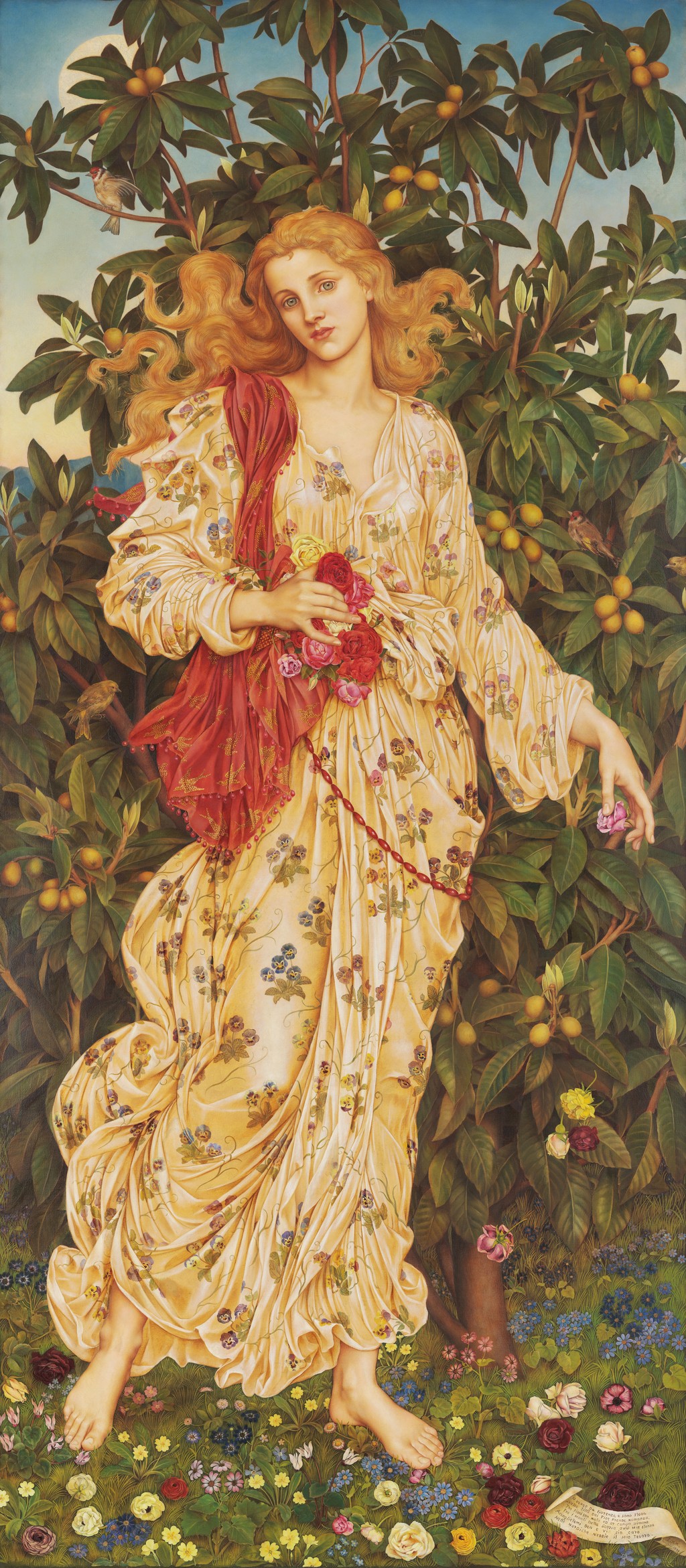
Evelyn De Morgan’s Flora (1894) presents the Roman goddess of flowers as a towering figure embedded in a world of growth. A fruiting loquat tree closes the space behind her, blossoms cover her robe and loose flowers carpet the ground. At the lower right, a small scroll turns this abundant garden into a message travelling from Florence to Scotland. The painting is therefore more than an image of spring: it joins ancient myth, Renaissance memory, close natural observation and a modern relationship between artist and patron.
At a Glance
- ArtistEvelyn De Morgan
- Date1894
- MediumOil on canvas
- Dimensions1990 × 880 mm
- Identifier and collectionP_EDM_0017, De Morgan Collection
- SubjectFlora, Roman goddess of flowers and spring
Evelyn De Morgan in context
Cadmus and Harmonia
1877Night and Sleep
1878Flora
1894The Gilded Cage
probably 1901–02The Love Potion
1903The Cadence of Autumn
1905Daughters of the Mist
c. 1905–10S.O.S.
1914–16Contents
- A Goddess at Nearly Life Size
- Flowers, Fruit and Birds
- The Scroll: Florence Bound for Scotland
- Florence, Botticelli and Primavera
- Jane Hales as Flora
- Colour, Gold and Pattern
- William Imrie and the Work of Patronage
- Flora within De Morgan’s Career
A Goddess at Nearly Life Size
The canvas is almost two metres high but only 88 centimetres wide. Its elongated format gives Flora room to stand at near-human scale. She fills the vertical field from flowing hair to bare feet. Foliage presses around her shoulders, sleeves and skirt, so the garden never recedes into a distant setting.
Flora does not stride or perform a dramatic action. One hand gathers roses at her waist, while the other releases a pink flower. Her head inclines slightly and her gaze meets the viewer without revealing a fixed emotion. The pose is calm but carefully asymmetrical. One arm crosses the body; the other opens towards the surrounding plants. Drapery sweeps down in long folds before breaking around her feet, introducing movement without disturbing her poise.
As the Roman goddess associated with flowers and spring, Flora belongs to De Morgan’s wider engagement with mythology and transformation. Yet the painting does not illustrate a particular episode from an ancient text. It constructs an identity through attributes — blossoms, fruit, youthful growth and the goddess’s name — then connects that identity to a nineteenth-century exchange between Florence and Scotland.[1]
Flowers, Fruit and Birds
Flowers appear as a bouquet, motifs across the pale robe and a dense field at ground level. Repetition ties the figure to the garden, but varied scale and colour keep the surface legible. Red and pink roses cluster near Flora’s hands; smaller blue, yellow, white and violet blooms spread across cloth and grass.
Behind the goddess stands a loquat, called a nescola in the Foundation’s record. Its glossy dark leaves and golden spring fruit form a weighty screen against Flora’s light dress. The tree has a seasonal purpose as well as a compositional one: its spring fruit reinforces the goddess’s identity. It also supplies a branching structure that frames the head and interrupts the pale blue sky.[1]
The Foundation identifies a chaffinch and a siskin among the small birds in the branches.[1] Their scale encourages close looking. They are not emblems announced with the clarity of Flora’s roses or the written scroll; they make the grove feel inhabited and observed. It would be possible to attach elaborate symbolic meanings to each species, but the object record does not require that. Their secure role is to animate the tree and deepen the work’s celebration of seasonal life.
The Scroll: Florence Bound for Scotland
The scroll at Flora’s feet supplies the painting’s geographical argument. In the Foundation’s 2023 translation, Flora begins, “I come from Florence and I am Flora.” The remaining lines play on the city’s association with flowers, say that she was born among them and announce a new home in the Scottish mountains. She asks to be welcomed and treasured amid northern mists.[1]
This text makes Florence more than a picturesque backdrop. Flora’s name, the city’s name and the surrounding flowers are drawn into a deliberate verbal and visual pattern. The goddess carries Florentine culture northwards in the form of a painting. De Morgan signed the work EDeM Maggio 1894, using the Italian word for May, so even the inscription participates in its place and season.[1]
The reference to Scotland addresses the destination and patron. William Imrie, the Scottish shipowner who became De Morgan’s most prolific regular buyer, acquired the work. The Foundation suggests he may have been attracted by the address to “Scotia”.[1] The scroll reads as an act of presentation, but does not prove that Imrie dictated the design.
Florence, Botticelli and Primavera
The painting was made entirely in Florence and deliberately celebrates the city and its Renaissance artists. The Foundation names Sandro Botticelli’s Primavera as its clearest inspiration.[1] The association is readily visible in the standing female figure, the flower-strewn ground, rhythmic drapery and fusion of classical subject with an intensely patterned garden.
De Morgan did not simply extract a figure from Botticelli. She isolated Flora, brought her close to the picture surface and transformed the surrounding grove. In Primavera, several mythological figures share a broad woodland stage. In De Morgan’s narrow canvas, one goddess commands almost every level of the composition. The loquat’s broad leaves replace the distant orange grove as a close green wall, while the detailed dress expands the floral field across Flora’s body.
Visits to Italy and study of Old Master painting formed a long strand in De Morgan’s biography. From 1890, she and William spent winters in Florence, although they maintained their London life and exhibiting connections.[2][3] Flora is unusually explicit about that movement between countries: the painting declares where it was made and imagines itself speaking on arrival elsewhere.
Jane Hales as Flora
The Foundation identifies Jane Hales as the model for Flora, as well as for Cassandra and Helen of Troy, two other works associated with Imrie.[1] That evidence gives a name to the person whose pose and features De Morgan studied. It does not make the painting a portrait of Hales in the usual sense. The title, attributes and scroll identify the represented figure as a goddess.
This distinction matters. Hales provided the bodily presence from which De Morgan constructed Flora, but costume, setting and mythological role belong to the finished invention. The goddess’s expression should likewise be described cautiously. Her direct gaze may feel intimate or self-possessed, yet the sources do not document a single intended emotion. What can be observed is the contrast between her steady face and the profusion of curving hair, cloth and leaves around it.
De Morgan’s Slade training emphasised figure drawing, and the Foundation records her continued practice of detailed studies of bodies, faces, hands, feet and drapery.[2] In Flora, clear anatomy beneath the folds prevents pattern from dissolving the figure into its setting.
Colour, Gold and Pattern
The colour design moves between warm light and dense green. Flora’s pale cream robe catches and reflects gold, while the deep red scarf provides a strong vertical counterweight. Golden hair and loquat fruit repeat one another across the upper half. At ground level, darker reds and cool blues give the flower bed enough contrast to remain distinct from the dress.
The Foundation’s artist account describes De Morgan applying coloured oils over gold leaf in Flora, connecting the luminous effect with medieval altarpieces she knew in Florence.[2] This is a work-specific technical claim, not evidence that every gold-toned painting by De Morgan used the same construction. Her broader colour, gold and technique changed according to subject and support.
Pattern is equally structural. Flowers repeat across fabric and earth, yet their motifs bend around folds. Leaves overlap behind the figure, while gaps of blue keep the canopy from becoming uniform. Repetition creates a lavish surface without sacrificing depth or bodily weight.
William Imrie and the Work of Patronage
William Imrie was a Liverpool-based Scottish shipowner and one of De Morgan’s important patrons. The Foundation’s career account states that he bought eight of her paintings and may have influenced the character of works produced for his collection.[2] Its current object record says he bought Flora and notes that he also commissioned Cassandra and Helen of Troy.[1]
Those records establish a sustained relationship, though they leave room around the exact origin of Flora. Calling it a patron painting is justified: its scroll explicitly anticipates a Scottish home, and Imrie acquired it. Calling every feature his instruction would go further than the evidence. The imagery also reflects De Morgan’s own Florentine experience, Renaissance interests and disciplined treatment of the figure.
De Morgan reached a network of buyers through regular exhibitions in London and other British cities; the Foundation names Imrie among those who sustained her professional career.[3] Flora makes this relationship visible by writing the object’s journey into its imagined speech.
Flora within De Morgan’s Career
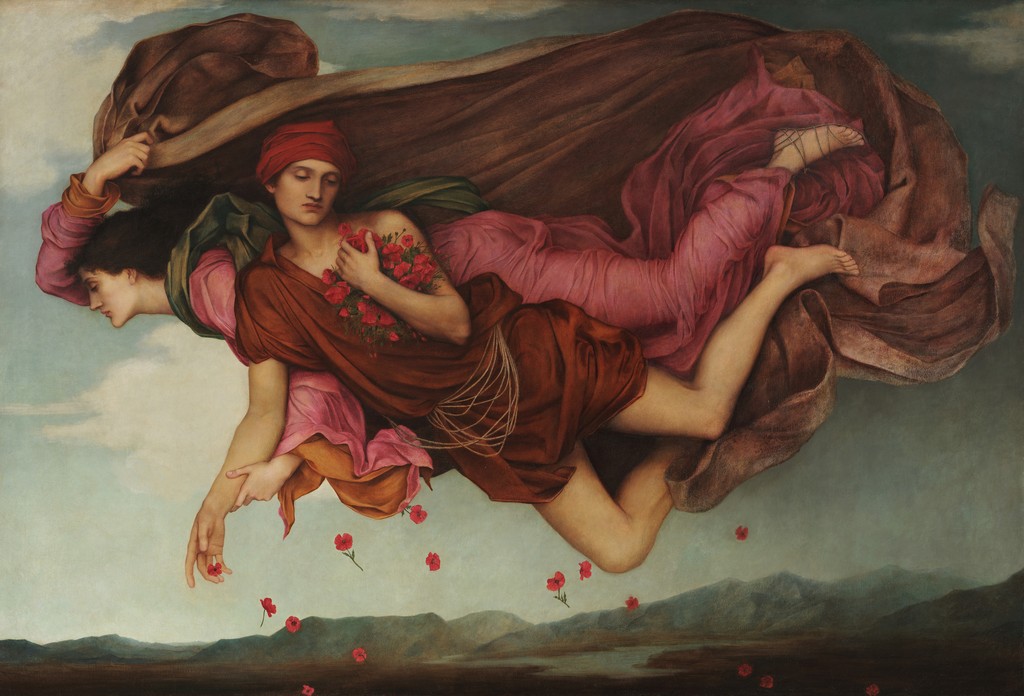
Placed among Evelyn De Morgan’s paintings, Flora stands at the meeting point of myth, portrait-based figure study, decoration and patronage. A comparison with the earlier Night and Sleep shows a shared debt to Botticelli, but also a change in scale and density. The 1878 pair flies through open sky; the 1894 goddess is rooted within a densely worked surface.
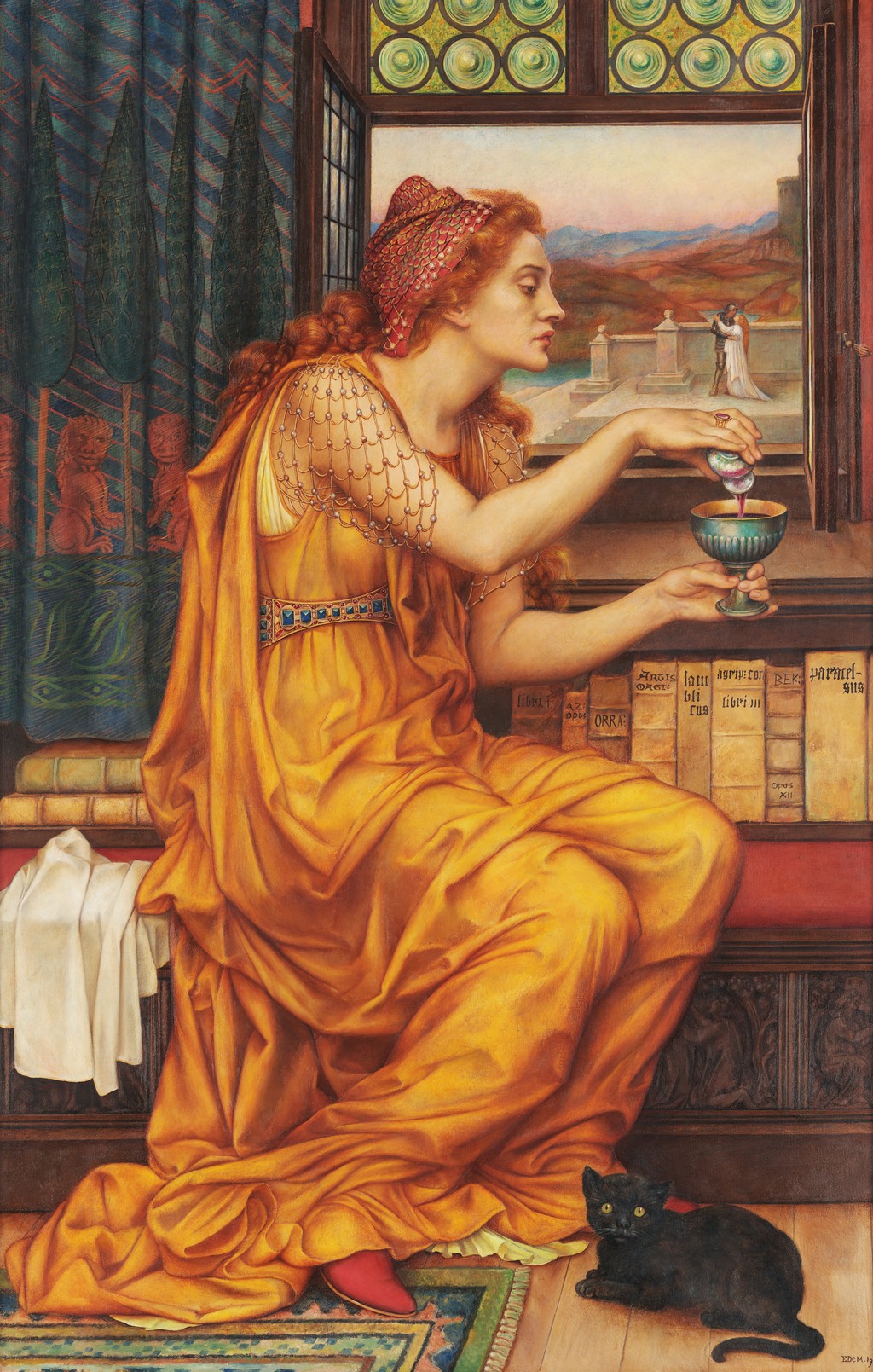
The later Love Potion offers another contrast. There De Morgan builds an enclosed scene around ambiguous spiritual and alchemical knowledge. Flora remains more outward-facing: its inscription names places, its plants announce spring and its figure serves as both classical presence and cultural envoy.
These comparisons should not reduce the painting to a step towards later achievements. Its elongated format, visual abundance and witty Florence–flower connection answer a particular artistic and social situation in 1894. De Morgan turns the delivery of a luxury object into its subject, allowing Flora to carry the art of one city into the landscape of another.
About this directory: These 72 entries form a reproducible researched online works census assembled from current public records. It is not a catalogue raisonné and does not claim absolute completeness.
Artworks directory
| Name | Date | Medium |
|---|---|---|
| A Soul in Hell | Date unknown | Painting |
| Ariadne in Naxos | 1877 | Painting |
| Aurora Triumphans | 1877 | Painting |
| Blindness and Cupidity Chasing Joy from the City | 1897 | Painting |
| Boreas and Oreithyia | 1896 | Painting |
| Boreas and the Fallen Leaves | 1910 | Painting |
| By the Waters of Babylon | 1882 | Painting |
| Cadmus and Harmonia | 1877 | Painting |
| Cassandra | 1898 | Painting |
| Clytie | 1886 | Painting |
| Daughters of the Mist | 1909 | Painting |
| Death of a Butterfly | 1910 | Painting |
| Death of the Dragon | 1916 | Painting |
| Deianira | 1878 | Painting |
| Demeter Mourning for Persephone | 1906 | Painting |
| Drapery study | 1890 | Drawing |
| Earthbound | 1897 | Painting |
| Eos | 1895 | Painting |
| Evening Star over the Sea | 1910 | Painting |
| Flora | 1894 | Painting |
| Helen of Troy | 1898 | Painting |
| In Memoriam | 1904 | Painting |
| Life and Thought Emerging from the Tomb | 1893 | Painting |
| Love's Passing | 1883 | Painting |
| Luna (Moon) | 1885 | Painting |
| Lux in Tenebris | 1895 | Painting |
| Medea | 1889 | Painting |
| Medusa | 1879 | Painting |
| Mercury | Date unknown | Painting |
| Moonbeams dipping into the Sea | 1918 | Painting |
| 'Music Sweet Music' (Saint Cecilia) | 1884 | Painting |
| Night and Dawn | 1910 | Painting |
| Night and Sleep | 1878 | Painting |
| Our Lady of Peace | 1907 | Painting |
| Phosphorus and Hesperus | 1881 | Painting |
| Port after Stormy Seas | 1905 | Painting |
| Portrait John Roddam Spencer Stanhope | 1880 | Painting |
| Queen Eleanor and the Fair Rosamund | Date unknown | Painting |
| S.O.S. | 1914–1916 | Painting |
| Sleep and Death: the Children of Night | 1883 | Painting |
| Study for 'Saint Christina' | 1904 | Painting |
| Study from the life | 1890 | Drawing |
| Study of Arms for "The Cadence of Autumn | 1905 | Drawing |
| Sunbeam and Summer Shower | 1910 | Painting |
| The Angel of Death I | 1880 | Painting |
| The Barred Gate | 1910 | Painting |
| The Cadence of Autumn | 1905 | Painting |
| The Captives | Date unknown | Painting |
| The Dryad | 1884 | Painting |
| The Garden of Opportunity | 1892 | Painting |
| The Gilded Cage | probably 1901–1902 | Painting |
| The Grey Sisters | 1880 | Painting |
| The Hourglass | 1904 | Painting |
| The Kingdom of Heaven Suffereth Violence and the Violent Take It by Force | 1878 | Painting |
| The Light Shineth in Darkness and the Darkness Comprehendeth It Not | 1906 | Painting |
| The Little Sea Maid | 1880 | Painting |
| The Love Potion | 1903 | Painting |
| The Martyr (Nazuraea) | 1880 | Painting |
| The Mourners | 1915 | Painting |
| The Passing of the Soul at Death | 1910 | Painting |
| The Poor Man Who Saved the City | 1901 | Painting |
| The Prisoner | 1907 | Painting |
| The Red Cross | 1915 | Painting |
| The Salutation | 1883 | Painting |
| The Sea Maidens | 1885 | Painting |
| The Soul's Prison House | 1880 | Painting |
| The Storm Spirits | 1900 | Painting |
| The Worship of Mammon | 1909 | Painting |
| Twilight | 1910 | Painting |
| Venus and Cupid | 1878 | Painting |
| William De Morgan | 1909 | Painting |
| William De Morgan (1839–1917) | 1893 | Painting |
Frequently Asked Questions
She represents Flora, the Roman goddess of flowers and spring. The person who modelled for the figure was Jane Hales, whom De Morgan also used for Cassandra and Helen of Troy.[1]
The Italian scroll identifies the speaker as Flora from Florence, plays on the connection between the city and flowers, and announces that she will live in Scotland. It links the painting’s Florentine making to its Scottish patron and destination.[1]
It belongs to the De Morgan Collection and is recorded as object P_EDM_0017. Display locations and loans can change, so current viewing information should be checked with the De Morgan Foundation.[1]
It has features often associated with later Pre-Raphaelite art, including saturated colour, botanical detail and an idealised figure. That label is incomplete, however. Botticelli and the Italian Renaissance, De Morgan’s Slade training, Aestheticism and her own professional development are all necessary contexts for the work.[1][2][3]
Discussion
What should readers notice when looking closely at Flora?
Reader Insights
Move from Flora’s face and hair to embroidered flowers, real flowers, loquat fruit, birds and the scroll.
Hold the Roman goddess, Florentine setting, Scottish patron and English model together without collapsing them.
Which detail makes the painting feel most like an encounter: gaze, gesture, surface or scale?
Join the Conversation
Share your reading below, keeping observations specific and evidence clear.
References
- De Morgan Foundation, Flora, View source
- De Morgan Foundation, Evelyn De Morgan (1855–1919), View source
- De Morgan Foundation, Evelyn De Morgan: The Modern Artist in Victorian London, View source