 by Tom Gurney
Tom Gurney BSc (Hons) is an art history expert with over 20 years experience
/
Email: tomgurney1@gmail.com / Phone: +44 7429 011000
S.O.S.: Introduction
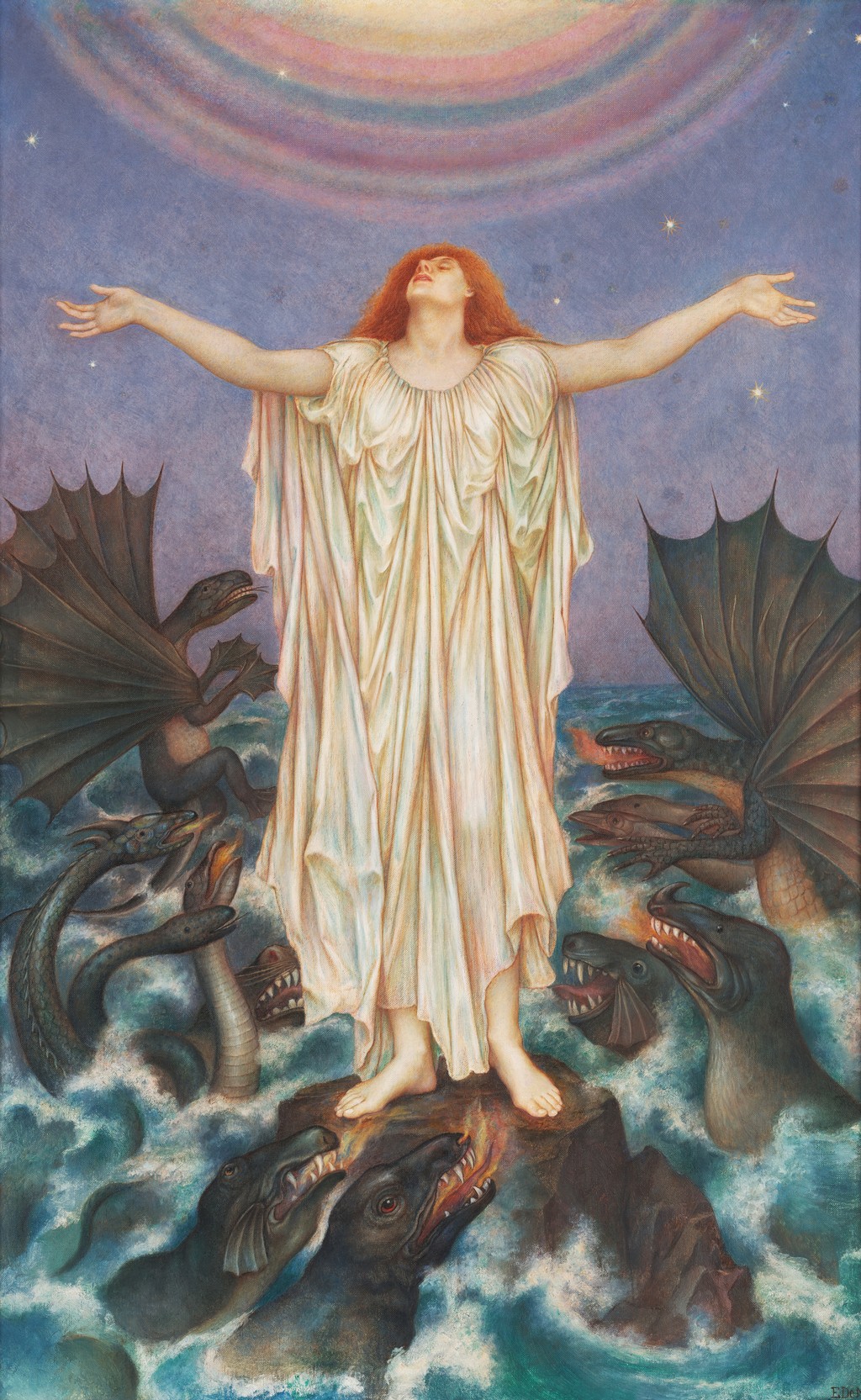
In S.O.S., one woman occupies the narrow ground between a violent sea and a radiant sky. Barefoot and dressed in white, she stands on a small rock as reptilian heads press in from every side. Her body rises through their ring, arms opened wide and face tilted towards an immense rainbow. Evelyn De Morgan makes the scene immediately legible as danger, appeal and possibility, yet she does not show that rescue has arrived.
Painted during the First World War, the work replaces military description with a Symbolist crisis. Its forces are elemental and moral rather than national: water against stone, monsters against a solitary body, darkness beneath spectral light. That compression gives De Morgan’s pacifism a form that can be understood without turning the battlefield into spectacle.
At a Glance
- ArtistEvelyn De Morgan
- Date1914–1916
- MediumOil on canvas
- Framed dimensions934 × 655 × 50 mm
- Identifier and collection
P_EDM_0056, De Morgan Collection - ContextA First World War allegory associated with De Morgan’s 1916 Red Cross benefit exhibition
Evelyn De Morgan in context
Cadmus and Harmonia
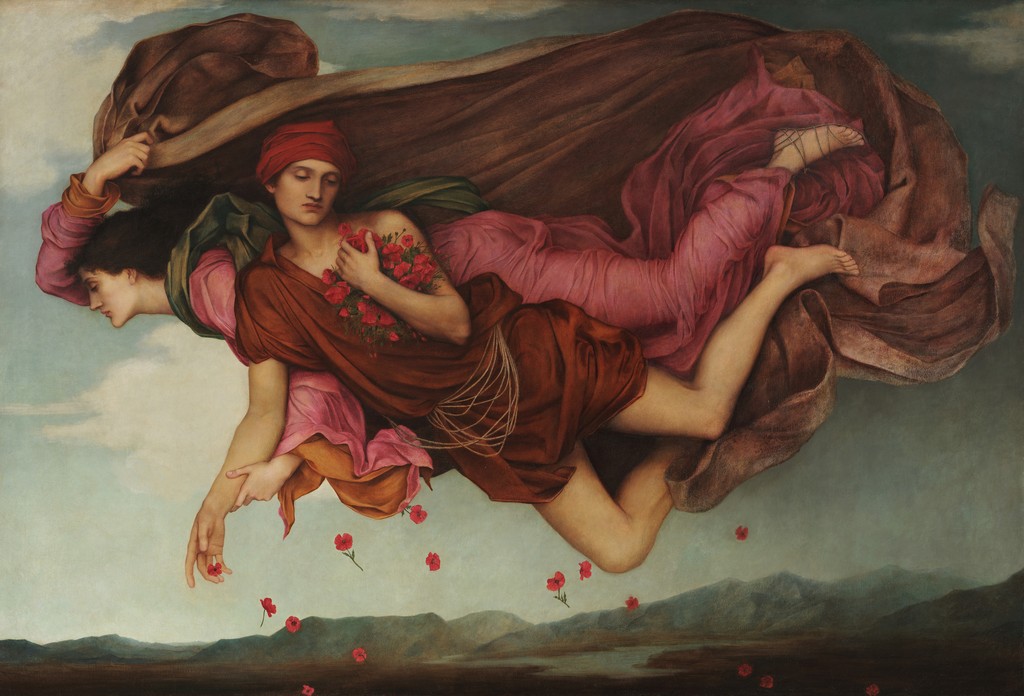
1877Night and Sleep
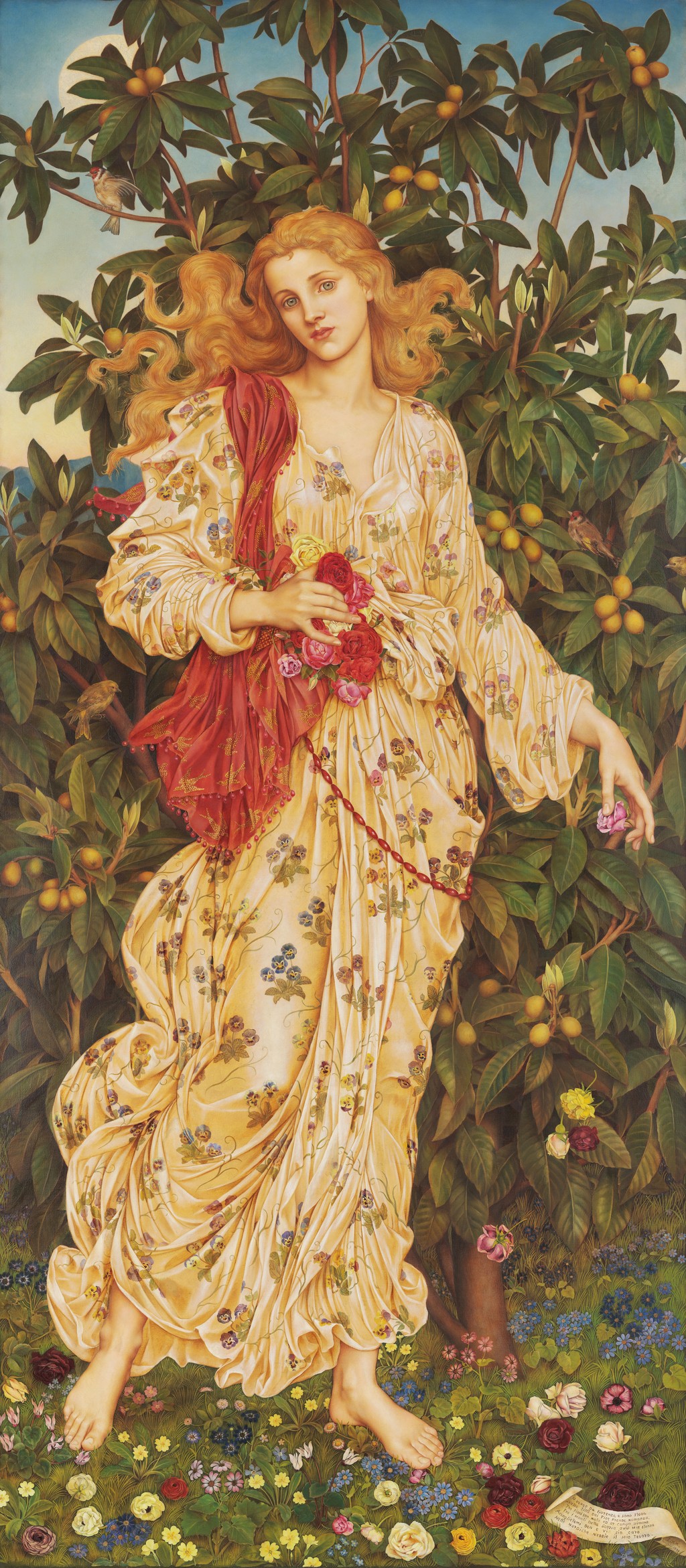
1878Flora
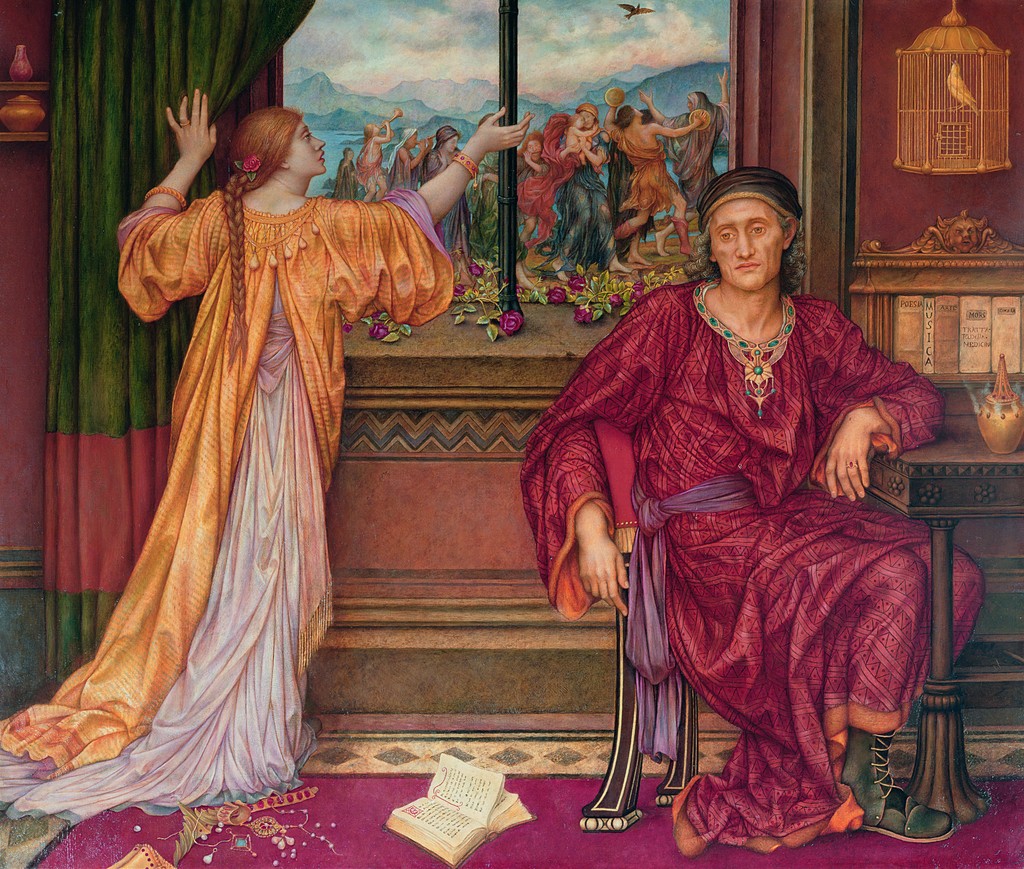
1894The Gilded Cage
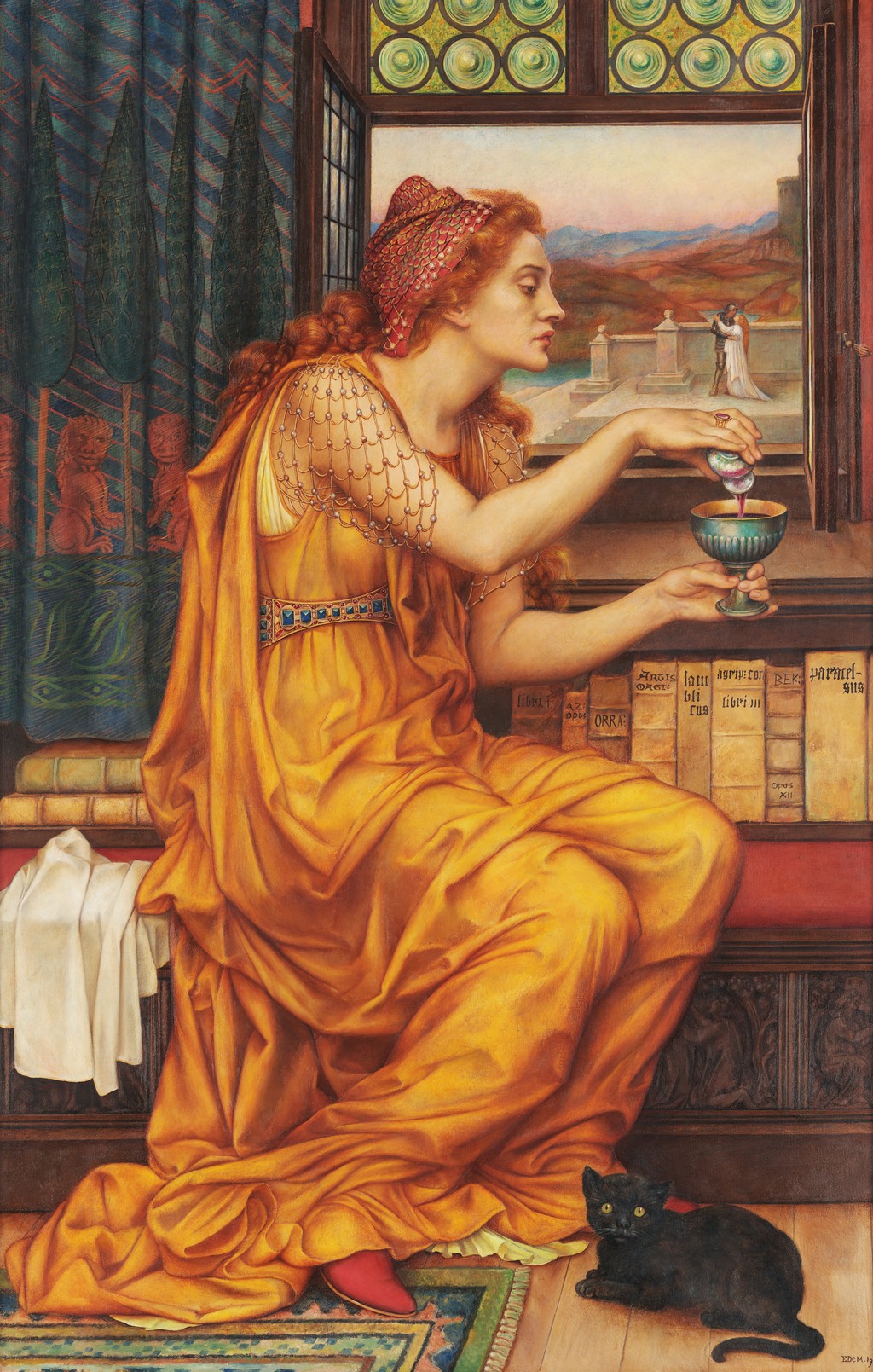
probably 1901–02The Love Potion
1903The Cadence of Autumn
1905Daughters of the Mist
c. 1905–10S.O.S.
1914–16Contents
- The Object on Record
- What the Title Does
- A Body with Almost No Ground
- The Sea and Its Creatures
- The Rainbow Is Not Yet Rescue
- First World War Context and Pacifist Purpose
- Career Comparisons
The Object on Record
The De Morgan Foundation records S.O.S. as an oil on canvas dating from 1914–1916. Its framed size is 934 mm high, 655 mm wide and 50 mm deep; the inscription is the signature EdeM, and its collection number is P_EDM_0056.[1] These details matter because abbreviated captions sometimes supply a single year. The current object record’s range should control.
The vertical format supports the painting’s movement. A dark rock anchors the bottom edge, the figure occupies the tall central axis, and bands of coloured light spread across the upper sky. Lateral pressure comes from the creatures and waves; the human body answers with extension and height. This is not proof of what the woman thinks. It is a visible organisation that directs attention from immediate threat towards a distant alternative.
Within De Morgan’s paintings, the canvas belongs to a late group concerned with conflict, death and spiritual release. Her biography places that group within a career already shaped by allegory rather than treating wartime Symbolism as an abrupt change.
What the Title Does
The title invokes the Morse code distress signal then newly established for emergencies. Three short signals, three long and three short again form a pattern designed to be recognised clearly. Unlike a narrative title, S.O.S. does not identify the woman, place or exact event. It inserts urgency before any interpretation begins.[1]
The Foundation draws out the phrase “save our souls”, and its spiritual relevance to the image is evident.[1] The phrase nevertheless needs qualification. Morse code encodes the letters S-O-S; it does not literally translate them into those three English words. “Save our souls” is best treated as a memorable expansion that sharpens the painting’s double appeal for bodily and spiritual deliverance, not as the documented origin of the signal or proof that De Morgan used the letters as an acronym.
That distinction improves the reading. A standard public alarm acquires spiritual resonance through what De Morgan paints around it. The work does not need a secret verbal key: the title calls for help, while the woman’s position asks what kind of rescue could answer.
A Body with Almost No Ground
The figure’s white garment gives her the brightest continuous shape in the picture. Its long folds drop towards the rock, while pale green, pink and gold reflections keep the fabric from becoming a blank cut-out. Red hair separates her head from the blue-violet sky. Her arms stretch far beyond the robe, palms open, and her face turns away from the surrounding mouths.
The rock beneath her bare feet is remarkably limited. It holds one body but offers no route out of the sea. De Morgan therefore gives stability and precarity at once: the woman has not been engulfed, but her foothold cannot be mistaken for safety. Her pose may suggest prayer, appeal, surrender or an embrace of the light above. No single label exhausts a gesture made deliberately open.
The Foundation interprets her white clothing as the innocence of war’s victims.[1] That institutional reading fits the contrast between her unarmed body and the attacking creatures. It should not be extended into an unsupported identity for the model or a claim that every woman in De Morgan’s art carries the same meaning. The wider study of women, spiritualism and freedom compares how female figures take on different roles across her work.
The Sea and Its Creatures
Below the woman, individual waves are difficult to separate from jaws, necks and fin-like wings. Some heads rise on long serpentine bodies; others push forward close to the rock with teeth exposed. Their crowding denies the open water any calm horizon. They are not zoological specimens, and trying to name each species would miss their collective work in the composition.
The Foundation describes them as sea serpents, dragons and monsters, interpreting this bestiary as De Morgan’s language for evil and death.[1] Sarah Hardy likewise connects the demons with the First World War and argues that De Morgan rejected realistic front-line imagery in favour of personal symbols.[2] This places the canvas within Symbolism, even though its clear outlines and luminous colour retain affinities with the later Pre-Raphaelite world. De Morgan used those stylistic resources independently, not as a member of the original Brotherhood.
The monsters also give violence no attractive human agent. There are no uniforms, flags or weapons to admire. War becomes predatory appetite and enclosure: many mouths converge on one exposed person. The war and pacifism account follows this refusal of heroic battle imagery across The Red Cross, The Mourners and related works.
The Rainbow Is Not Yet Rescue
The rainbow occupies much of the sky, appearing less like a thin meteorological arc than a broad field of rose, gold, green and violet light. Small stars punctuate the cooler space below it. The woman reaches and looks into this upper zone, while the creatures remain concentrated beneath her arms. Colour separates two orders without placing a wall between them.
The Foundation interprets the rainbow as salvation and the afterlife.[1] Art UK’s Sarah Hardy situates it within De Morgan’s recurring passage from darkness towards light, linking prismatic colour to spiritual ascent and the hope of peace.[5] These are grounded readings, but hope should not be confused with a completed happy ending. The rainbow emits no visible rope, hand or vessel. The figure remains stranded and the sea remains full of teeth.
That unresolved distance is the painting’s strength. The upper light offers orientation rather than escape. Hope is active because the woman directs her whole posture towards it; danger is active because nothing in the lower half has withdrawn. De Morgan allows both conditions to occupy the same instant.
First World War Context and Pacifist Purpose
The First World War deeply affected De Morgan. Institutional accounts describe her as unable or unwilling to reproduce the front line directly, so she joined academic figure painting, allegory and personal symbolism to express horror at conflict and a desire for peace.[2][3][4] S.O.S. is therefore not reportage, nor is its fantastic imagery a retreat from current events. Its monsters make modern war morally intelligible without illustrating a specific episode.
In 1916 De Morgan exhibited war paintings in her London studio for the benefit of the British Red Cross and the Italian Croce Rossa. S.O.S. and The Red Cross were among the associated canvases.[2] The event gave the painting a practical role: its appeal for rescue accompanied fundraising for organisations treating the consequences of war. The Foundation’s Artist of Hope account also describes De Morgan’s wish that her images advocate peace.[3]
The charitable purpose does not make the picture pro-war. Relief work addressed immediate suffering, while the imagery opposed the violence producing it. This conjunction—aid in the present, pacifist persuasion for the future—is central to De Morgan’s response.[2][3]
Career Comparisons
The upward reach in S.O.S. becomes more precise when compared with earlier paintings. In Night and Sleep, airborne figures move with closed, dreamlike calm across twilight; in the wartime canvas, the central body strains from a fixed rock. The Gilded Cage locates confinement inside a luxurious room, whereas S.O.S. strips captivity down to body, sea and sky.
The comparison also clarifies De Morgan’s mature symbolism and allegory. She did not assign one permanent meaning to light, women or thresholds. Instead she reconfigured familiar elements around a new pressure. Here the solitary woman is neither decorative ideal nor passive victim. Her vulnerability is undeniable, yet the open gesture makes her the painting’s principal force.
About this directory: These 72 entries form a reproducible researched online works census assembled from current public records. It is not a catalogue raisonné and does not claim absolute completeness.
Artworks directory
| Name | Date | Medium |
|---|---|---|
| A Soul in Hell | Date unknown | Painting |
| Ariadne in Naxos | 1877 | Painting |
| Aurora Triumphans | 1877 | Painting |
| Blindness and Cupidity Chasing Joy from the City | 1897 | Painting |
| Boreas and Oreithyia | 1896 | Painting |
| Boreas and the Fallen Leaves | 1910 | Painting |
| By the Waters of Babylon | 1882 | Painting |
| Cadmus and Harmonia | 1877 | Painting |
| Cassandra | 1898 | Painting |
| Clytie | 1886 | Painting |
| Daughters of the Mist | 1909 | Painting |
| Death of a Butterfly | 1910 | Painting |
| Death of the Dragon | 1916 | Painting |
| Deianira | 1878 | Painting |
| Demeter Mourning for Persephone | 1906 | Painting |
| Drapery study | 1890 | Drawing |
| Earthbound | 1897 | Painting |
| Eos | 1895 | Painting |
| Evening Star over the Sea | 1910 | Painting |
| Flora | 1894 | Painting |
| Helen of Troy | 1898 | Painting |
| In Memoriam | 1904 | Painting |
| Life and Thought Emerging from the Tomb | 1893 | Painting |
| Love's Passing | 1883 | Painting |
| Luna (Moon) | 1885 | Painting |
| Lux in Tenebris | 1895 | Painting |
| Medea | 1889 | Painting |
| Medusa | 1879 | Painting |
| Mercury | Date unknown | Painting |
| Moonbeams dipping into the Sea | 1918 | Painting |
| 'Music Sweet Music' (Saint Cecilia) | 1884 | Painting |
| Night and Dawn | 1910 | Painting |
| Night and Sleep | 1878 | Painting |
| Our Lady of Peace | 1907 | Painting |
| Phosphorus and Hesperus | 1881 | Painting |
| Port after Stormy Seas | 1905 | Painting |
| Portrait John Roddam Spencer Stanhope | 1880 | Painting |
| Queen Eleanor and the Fair Rosamund | Date unknown | Painting |
| S.O.S. | 1914–1916 | Painting |
| Sleep and Death: the Children of Night | 1883 | Painting |
| Study for 'Saint Christina' | 1904 | Painting |
| Study from the life | 1890 | Drawing |
| Study of Arms for "The Cadence of Autumn | 1905 | Drawing |
| Sunbeam and Summer Shower | 1910 | Painting |
| The Angel of Death I | 1880 | Painting |
| The Barred Gate | 1910 | Painting |
| The Cadence of Autumn | 1905 | Painting |
| The Captives | Date unknown | Painting |
| The Dryad | 1884 | Painting |
| The Garden of Opportunity | 1892 | Painting |
| The Gilded Cage | probably 1901–1902 | Painting |
| The Grey Sisters | 1880 | Painting |
| The Hourglass | 1904 | Painting |
| The Kingdom of Heaven Suffereth Violence and the Violent Take It by Force | 1878 | Painting |
| The Light Shineth in Darkness and the Darkness Comprehendeth It Not | 1906 | Painting |
| The Little Sea Maid | 1880 | Painting |
| The Love Potion | 1903 | Painting |
| The Martyr (Nazuraea) | 1880 | Painting |
| The Mourners | 1915 | Painting |
| The Passing of the Soul at Death | 1910 | Painting |
| The Poor Man Who Saved the City | 1901 | Painting |
| The Prisoner | 1907 | Painting |
| The Red Cross | 1915 | Painting |
| The Salutation | 1883 | Painting |
| The Sea Maidens | 1885 | Painting |
| The Soul's Prison House | 1880 | Painting |
| The Storm Spirits | 1900 | Painting |
| The Worship of Mammon | 1909 | Painting |
| Twilight | 1910 | Painting |
| Venus and Cupid | 1878 | Painting |
| William De Morgan | 1909 | Painting |
| William De Morgan (1839–1917) | 1893 | Painting |
Frequently Asked Questions
It refers first to the Morse emergency signal. “Save our souls” is a later mnemonic that suits the painting’s spiritual appeal, but it is not a literal translation of Morse or the established origin of the letters.[1]
The painting belongs to the De Morgan Collection under object number P_EDM_0056. Because works may travel or enter temporary displays, consult the Foundation’s current object and loan information before planning a visit.[1]
Discussion
What should readers notice when looking closely at S.O.S.?
Reader Insights
Follow the circle of sea monsters upward through the figure’s arms to the rainbow.
Keep wartime peril visible even while the Foundation’s interpretation emphasises spiritual salvation.
Is the upward gesture a plea, an act of faith, an assertion of survival, or several at once?
Join the Conversation
Share your reading below, keeping observations specific and evidence clear.
References
- De Morgan Foundation, S.O.S., View source
- De Morgan Foundation, Why Evelyn De Morgan Is Not a Pre-Raphaelite Painter, View source
- De Morgan Foundation, Artist of Hope, View source
- De Morgan Foundation, Evelyn De Morgan (1855–1919), View source
- Art UK, The Rainbow as a Symbol of Hope in Evelyn De Morgan’s Paintings, View source