


 by Tom Gurney
Tom Gurney BSc (Hons) is an art history expert with over 20 years experience
Published on July 14, 2026 / Updated on July 16, 2026
Email: tomgurney1@gmail.com / Phone: +447429011000
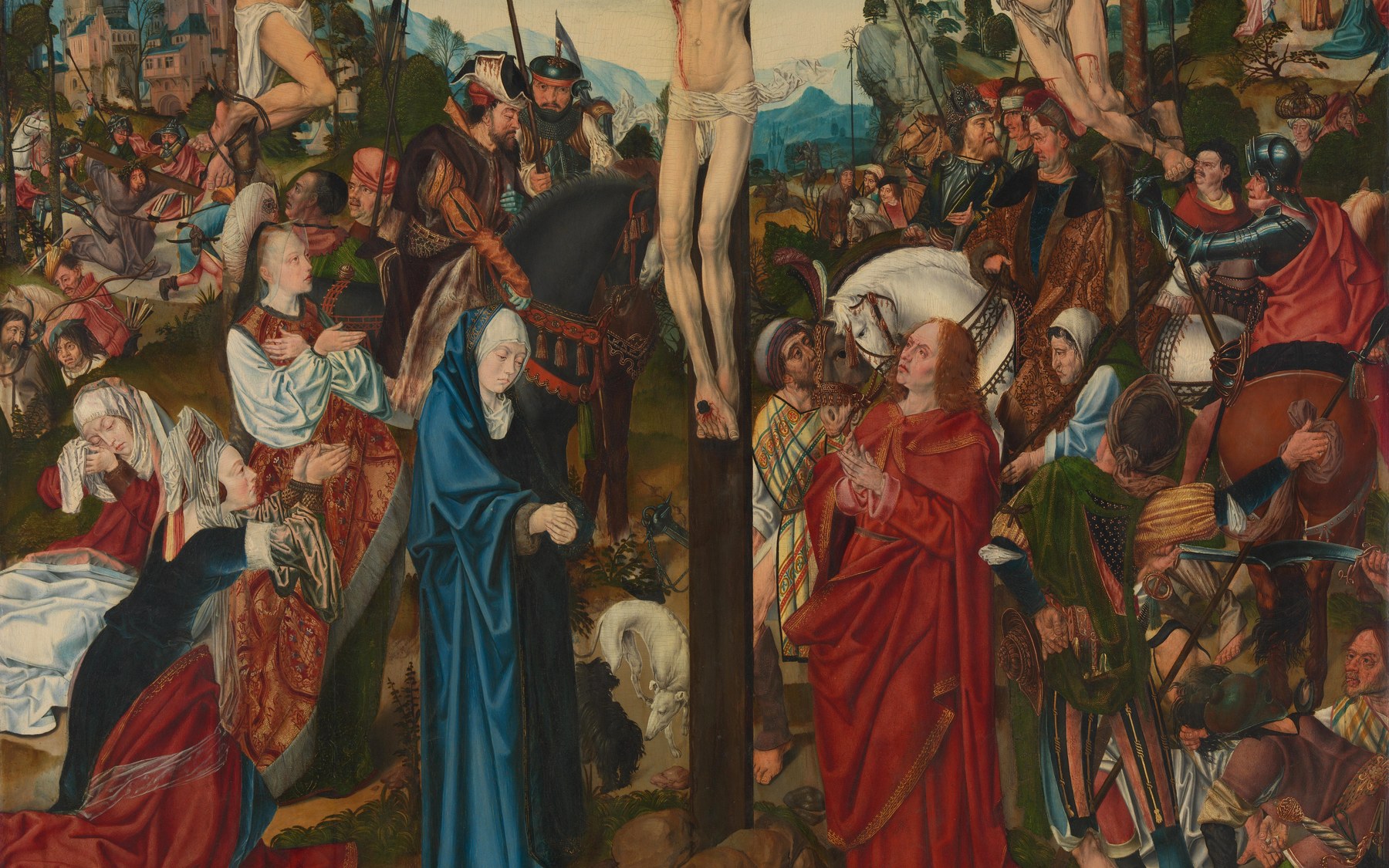
Meister des Aachener Altars - Kreuzigung (National Gallery, London).jpg by Master of the Aachen Altar; Public domain via Wikimedia Commons. Cropped for TheHistoryOfArt.org. · Image source
What to expect
Gallery Middle Ages and Renaissance is an ongoing Belvedere display in the Palace Stables at the Lower Belvedere in Vienna. The official Belvedere page describes it as a permanent exhibition of medieval and Renaissance works, shown beside the Orangery in the Prunkstall, the former stables for Prince Eugene of Savoy's personal horses. That setting matters. The display is not a temporary blockbuster, but a collection route that gives the Belvedere's earlier holdings a distinct physical home.
The official source identifies the Salzburg Altar by the late Gothic painter Rueland Frueauf the Elder as a particular highlight. Its eight panels once belonged to a monumental winged altarpiece in Salzburg, probably in the church of the Archabbey of St Peter. Around that anchor, the display includes panel paintings by Michael Pacher, Thomas of Villach and Urban Goertschacher, carved figures by Hans Klocker and sandstone sculptures by the Master of Grosslobming. The date range runs from the middle of the fourteenth century to the first half of the sixteenth century.
This is valuable for the guide because the Belvedere is often approached through Klimt, Vienna around 1900, Biedermeier painting or modern Austrian art. A Middle Ages and Renaissance page corrects that imbalance. It shows that the institution's collection story reaches much earlier, and that Austrian art can be read through late Gothic altarpieces, sculpture, devotional panels and the transition toward Renaissance ideas as well as through the better-known modern route.
Why go
The strongest reason to go is concentration. Medieval art can be difficult to use well in an encyclopedic museum if it appears as a few isolated objects before the famous rooms begin. The Palace Stables display gives the material a coherent environment and a clear subject: works from the late Middle Ages and Renaissance in Austria and the surrounding regions, with painting and sculpture seen together. That makes it a strong support page for readers interested in materials, workshop practice, religious imagery, altarpieces and regional art before the modern museum story.
The Salzburg Altar gives the display a particularly useful anchor. Eight panels from a former winged altarpiece allow a visitor to think about fragmentation, survival and reconstruction. These panels were not originally independent gallery pictures. They belonged to a larger liturgical object, designed for a church, with opening and closing states, narrative sequence, scale and devotional use. Seeing them in a museum requires a double act of looking: attend to the panel in front of you, but also imagine the larger structure and function it once served.
The display is also useful because it places painting beside sculpture. Carved figures by Hans Klocker and sandstone works by the Master of Grosslobming remind readers that late medieval visual culture was not divided neatly into the categories modern museum visitors often use. Altars, panels, sculpture, architecture, pigment, gilding, stone and wood could all belong to a shared devotional environment. The Belvedere's display is therefore a good place to think about how media worked together before the modern idea of the standalone artwork became dominant.
What to look for
Begin with function. Ask what each object was made to do before it became part of a museum display. Was it part of an altar? Did it mark a sacred presence, teach a story, support prayer, decorate a church, or demonstrate patronage? Medieval and early Renaissance works can seem remote if they are treated only as style examples. They become more legible when seen as objects with uses, settings and audiences.
Then look for surface. Panel painting rewards close attention to colour, line, gilding, damage, restoration and the relation between figure and ground. Sculpture asks different questions: how the body is carved, how drapery falls, where traces of paint or gilding may matter, and how a figure would have occupied space. The Palace Stables setting can make those material questions more vivid because the works are not simply stepping-stones on the way to Klimt or later Austrian art.
Rueland Frueauf the Elder is especially worth slowing down for because late Gothic panel painting often combines sharp narrative, devotional intensity and precise detail. Look for how scenes are staged, how gestures carry emotion, and how figures are organised across a panel. If the panels once belonged to a monumental winged altar, then sequence and relation matter as much as individual composition.
With Michael Pacher, Thomas of Villach and Urban Goertschacher, the useful question is transition. How do late Gothic habits meet emerging Renaissance interests? Do the figures remain hieratic and devotional, or do they begin to occupy more convincing space? Is the emphasis on gold, pattern and sacred clarity, or on bodily presence, architecture and observed detail? The display can help readers feel the transition rather than memorise a period label.
How it fits the Belvedere and Vienna
This page strengthens the Belvedere cluster by giving the museum a durable collection-display route alongside temporary exhibitions. The Waldmüller page adds nineteenth-century landscape; the Lampi IN-SIGHT page adds conservation and technical research; this Middle Ages and Renaissance page reaches back to the foundation of the collection's long chronology. Together they make the Belvedere page more than a modern Austrian art stop.
For Vienna planning, the Lower Belvedere location matters. A visitor may pair the Palace Stables with the Lower Belvedere's temporary exhibitions or with the gardens and palace complex, rather than trying to combine everything with the Upper Belvedere in a rush. The official Belvedere visit page should still be checked before travel, especially because the Palace Stables may have maintenance closures or access changes.
The page also creates useful future internal-link territory. It can connect later to glossary entries on altarpieces, panel painting, carving, restoration and late Gothic art; to artist pages for Michael Pacher or Rueland Frueauf if those are added; and to broader feature ideas around materials, apprenticeships, workshops and religious themes in art.
Image and rights note
The image prospects are comparatively good because the works are medieval and Renaissance, but the most relevant photographs on the Belvedere page are institutional images with specific credit lines. This page remains image-free until a clearly licensed source and credit path are selected. The future image review should prefer public-domain or explicitly approved object images, and should not treat Belvedere installation or collection photographs as reusable without source review.
How to use this page
Because Gallery Middle Ages and Renaissance is current, the page should help a reader decide whether it deserves time before the closing date, not merely record that it exists. The most reliable fixed details are the venue, dates, broad subject, media and official source link. The interpretive notes help place the exhibition in art-historical context: what kind of show it is, why it may matter, and which artists or topics are worth exploring next.
It is listed as a recommended exhibition rather than a headline major show, so the main value is a focused subject, strong venue context or a useful route into related artists.
Looking notes
For a visitor, the most useful approach is to look for patterns rather than isolated highlights. With Rueland Frueauf the Elder, Salzburg Altar, Michael Pacher, Thomas of Villach, Urban Goertschacher, Hans Klocker, Master of Grosslobming, ask how the exhibition frames the subject: as biography, period survey, focused theme, collection display or reassessment. With media such as panel painting, sculpture, altarpiece, carved figures, sandstone sculpture, medieval art, pay attention to changes of scale, surface, lighting, material and display sequence, because those details are often lost in online listings.
The guide avoids over-specific claims where the public source does not yet support them. If a museum has not published a full object list, it is better to stay clear about what is confirmed than to imply certainty.
Who it is best for
Gallery Middle Ages and Renaissance is most likely to help readers who are already interested in Rueland Frueauf the Elder, Salzburg Altar, Michael Pacher, Thomas of Villach, Urban Goertschacher, Hans Klocker, and Master of Grosslobming, but it may also be useful for visitors building a wider route around Belvedere Museum Vienna in Vienna. If time is limited, use this page to decide whether the subject fills a gap in your knowledge, whether it connects to artists you already follow, and whether the official venue information makes the visit practical.
.jpg)