 by Tom Gurney
Tom Gurney BSc (Hons) is an art history expert with over 20 years experience
Published on June 19, 2020 / Updated on November 2, 2026
Email: tomgurney1@gmail.com / Phone: +44 7429 011000
The Dog Rita Asleep by Frédéric Bazille: Introduction
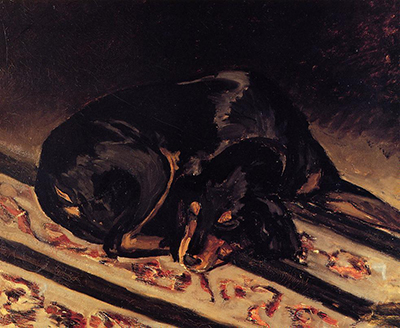
A dark dog lies curled on a patterned textile, her head lowered towards the front edge of the picture. The body almost closes into a circle, while small touches of light pick out the muzzle, legs and turning contours. Frédéric Bazille's The Dog Rita Asleep makes this ordinary resting pose the entire subject of a painting. His digital catalogue dates the oil on canvas to 1864; the National Gallery of Art's exhibition checklist gives the slightly broader dating of about 1864. It remains in a private collection. [1] [2]
The painting rewards a slower look than its modest subject might suggest. Its chief interest lies in the relationship between a nearly black living form and the warm, patterned surface beneath it. The name Rita makes the encounter particular, but the picture also sets Bazille a substantial problem: how to make an animal's weight, shape and relaxed posture legible within a closely related range of dark colours.
At a Glance
- Date1864 (catalogue); about 1864 (2017 checklist) [1] [2]
- MediumOil on canvas [1]
- CollectionPrivate collection [1] [2]
This work across Frédéric Bazille’s career
The Dog Rita Asleep by Frédéric Bazille (current article)
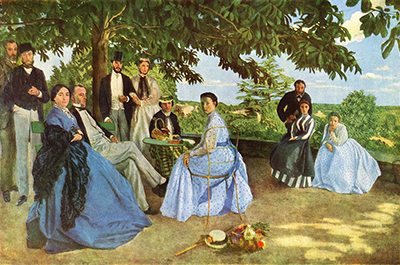
1864 (catalogue); c. 1864 (2017 checklist)Family Reunion
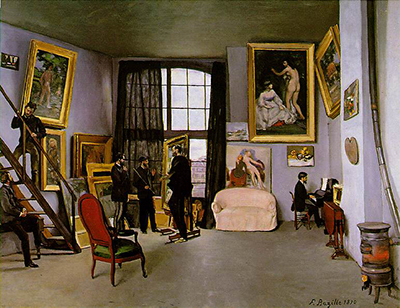
1867–1868 (museum)Bazille’s Studio, Rue La Condamine
1869–1870Summer Scene (Bathers)
1869–1870Contents
- A body folded into the picture
- Warm colour and a shallow domestic space
- An early experiment in looking
- Animal painting and Realist comparisons
- Rita and the dogs in the drawings
- From family possession to retrospective exhibitions
A body folded into the picture
The dog's rounded back rises across the left and centre of the canvas. Her head rests lower, towards the right, where the face becomes easier to distinguish against the lighter textile. Limbs overlap inside the curve of the body rather than spreading into a display of separate anatomical parts. At first the dog reads as one compact dark mass; continued looking gradually separates its components.
This gradual recognition is central to the effect. Bazille gives the viewer enough information to understand the pose without outlining every boundary equally. A highlighted edge may explain the turn of a leg, while a neighbouring passage stays almost indistinguishable from the surrounding darkness. The collar provides another small point of orientation. The dog is solidly present, yet her shape never becomes a diagram of an animal.
The low position of the head brings the face close to the viewer. There is no answering glance and no action to anticipate. The sleeping posture holds the composition together by turning the animal inward. Even the tail extending towards the right stays close to the surface on which she lies. The picture's energy is carried by the arrangement of curves and diagonals rather than a story of movement.
The textile supplies the counterweight. Its bands and scattered red details cross the lower part of the canvas at an angle, beneath the dog's rounded outline. These firmer, straighter divisions make the irregular living shape easier to see. They also establish a shallow platform: the dog rests on something with a visible pattern and direction, rather than floating against an undifferentiated dark field.
The composition consequently combines enclosure with proximity. The curve of the body contains the animal, while the textile carries that form towards the bottom edge. We can look closely, but the dog remains absorbed in sleep. The intimacy comes from the view and the pose; it does not require a reconstructed story about the painter's feelings.
Warm colour and a shallow domestic space
Black is the painting's strongest apparent colour, but the dark passages are varied. Brown and warmer reddish notes connect the dog with the background; lighter ochre accents describe particular edges and features. The animal does not stand against a sharply contrasting wall. Instead, the surrounding darkness changes just enough to allow the rounded back to emerge.
Across the lower edge, the pale ground of the textile gives the warm colours a brighter setting. Red marks interrupt it in small, uneven intervals. Their scale matters: a much larger patch of bright red would compete with the dog, whereas these scattered accents keep attention moving through the foreground. The patterned fabric contributes visual incident without becoming a second subject.
Schulman draws attention to the warm, restricted palette and compares it with the drapery in Bazille's early Reclining Nude. That comparison locates Rita within the painter's interest in bodies resting against textiles, even though the two subjects differ greatly in scale and purpose. [1] In Rita, the contrast between living form and patterned support is particularly concentrated. Almost everything the viewer needs is contained in that meeting.
The room itself is barely specified. There is no broad view of furniture or an architectural setting to establish the household. The collar, resting pose and textile make a domestic reading persuasive, but the painting does not identify the room or tell us who owned the dog. Its closely cropped space permits sustained attention to the animal without furnishing an elaborate interior around her.
The highlights describe the changing surface of the fur with a few interrupted marks. Their sparseness preserves the unity of the dark body, while the textile's broken pattern keeps the lighter foreground lively. The painting gains much of its coherence from this balance between the broad animal shape and the smaller incidents around it.
An early experiment in looking
Rita belongs to the period when Bazille committed himself to painting. After moving to Paris in 1862, he continued medical studies while training in Charles Gleyre's studio, where his friendships with Monet, Renoir and Sisley developed. He decided to abandon medicine in the early summer of 1864. The Musée Fabre's account places his ambitious Reclining Nude in that same decisive year. [3]
Against that background, the sleeping dog gives a different measure of early ambition. The subject requires neither a large staged composition nor an impressive setting. It allows the painter to concentrate on the appearance of something familiar and close at hand. The everyday subject gives these acts of observation unusual prominence.
The date also guards against judging every Bazille painting by the brighter outdoor scenes that became central to his reputation. The warm darkness of Rita is a positive pictorial choice, capable of describing a convincing body and a coherent space. It need not be treated as an incomplete step towards another style.
A comparison with the Self-Portrait with Detachable Collar, which Minneapolis dates to 1865–67, offers another way into this tonal language. [4] In each picture, selected lighter passages make a form emerge from a subdued surrounding field. The human face and the curled animal demand very different kinds of recognition, but both ask the viewer to notice how much can be carried by a few carefully placed changes of value.
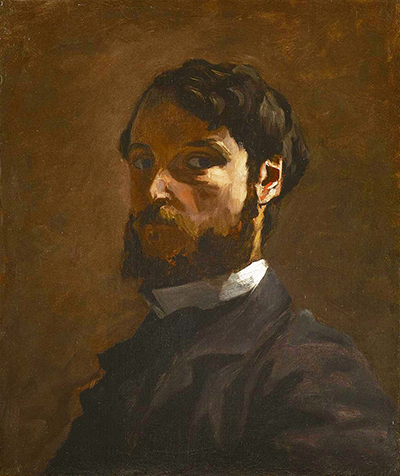
Self-Portrait with Detachable Collar — Minneapolis
Watch: Bazille and early Impressionism
Explore a Paris studio with Smarthistory, then discover the beginnings of Impressionism with the National Gallery of Art.
Jean-Frédéric Bazille, The Artist’s Studio, Rue Visconti, Paris
A close look at Bazille’s 1867 painting of the studio he shared in Paris.
Watch on YouTubeAnimal painting and Realist comparisons
Rita also occupies a distinctive position among Bazille's animal subjects. Still Life with Fish, dated 1866, and Still Life with Heron, dated 1867, bring animal bodies into the arrangements of still-life painting. [2] Rita presents a living animal at rest. The difference changes the viewer's relationship with the subject, even when darkness, reflected light and the material character of a body remain important in all three.
In the fish painting, the pale cloth and bright scales create conspicuous differences between surfaces. Rita's fur and background sit closer together in tone, while the textile supplies the principal light area. Looking between the paintings makes their separate solutions clearer. Bazille could build an image through pronounced contrasts of material, or make the viewer search within a quieter dark range.
The Musée Fabre's 2016 exhibition account situates his fish still lifes between Dutch precedents and contemporary Realists including Bonvin, Vollon and Manet. It also connects the game pictures with an older tradition of hunting trophies. [3] These comparisons help explain the broader artistic setting of his animal subjects, while Rita adds the separate experience of watching a living creature rest.
The painting has itself attracted several proposed artistic affinities. Schulman reports a Delacroix comparison by Jean Lapeyre and a Manet connection made by Kermit Champa, while favouring a relationship with Monet. These are different critical readings of its colour and handling, rather than a single demonstrated source for the composition. [1] The range of suggestions is useful because it opens the painting to comparison without reducing Bazille's decisions to one borrowed formula.
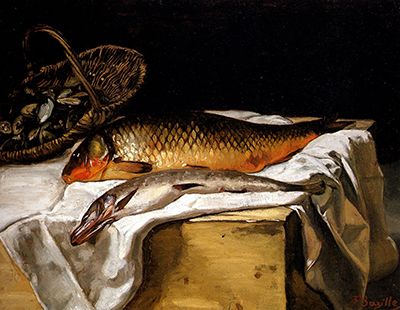
Still Life with Fish
Rita and the dogs in the drawings
Dogs recur in Bazille's work on paper, where a passing observation could become a study in its own right or enter a larger composition. Schulman relates Rita to a charcoal Study of a Dog, catalogued as MSb-151, and to the animal included in a study for Family Reunion. The individual identification is uncertain: the entries for those drawings discuss a family dog under another name. [1] [5] [6]
The relationship is more useful as evidence of Bazille's attention to animals than as a way of assembling Rita's biography. A dog can be the whole subject, as in this painting, or one participant within a group. In the developed study for Family Reunion, the animal appears among the figures and objects on the terrace; it is absent from the completed painting. [6] The difference shows how an observed domestic presence could enter a composition and then be omitted as that composition changed.
It also makes the independence of Rita's painting more apparent. Here the animal needs no family group to justify her place. The canvas gives a familiar creature the concentrated attention usually associated with a portrait, while leaving her asleep and unresponsive to the viewer. Recognition rests in the distinctive body and pose rather than an expressive exchange of gazes.
From family possession to retrospective exhibitions
The catalogue traces the painting through the artist's family and his nephew, also named Frédéric Bazille, before recording a private collection in Montpellier. This is a concise ownership history, rather than a detailed account of every transfer. It does not establish where Rita lived or the circumstances in which the portrait was made. [1]
The same record lists the canvas in the 1927 Bazille retrospective at the Musée Fabre, followed by later exhibitions including Chicago in 1978 and the Montpellier–New York exhibition of 1992–93. Its inclusion in the 2016–17 retrospective is independently confirmed by the National Gallery of Art's checklist. [1] [2] Although privately owned, the picture has therefore contributed repeatedly to public accounts of Bazille's development.
That history gives the small canvas a useful place beside his larger figure compositions and landscapes. Rita reveals the concentration he could bring to a limited subject: the weight of a sleeping body, the subdued distinctions inside dark fur, and the brighter pattern that supports it. The painting's appeal begins with a recognisable animal, but its lasting interest comes from the precision with which those few elements work together.
Bazille catalogue directory
The 284 records comprise 85 painting records,40 separate works-on-paper records and 159 album or study records. They describe the catalogue’s organisation rather than 284 independent objects or unanimously accepted attributions. Recto, verso, albums and multiple studies remain distinct. Dates are qualified where needed; the Drawing filter includes the etching, gouache and mixed works on paper. Manuscript mentions and unproved projects are listed separately below.
Works known through documents
These mentions remain separate from the 284 catalogue records. Some may concern surviving studies or underlying compositions; they cannot simply be added together as missing physical paintings.
- A copy after Rubens mentioned in March 1863 is unlocated.
- A portrait of an unidentified woman was reported completed before July 1866.
- A portrait of Monet and a composition of two life-size women arranging flowers were reported in progress in April 1867. Their mention does not establish two otherwise unknown surviving canvases.
- Gertrude et le père Lapin was at least begun in the summer of 1870.
Further reported works and uncertain attributions
- A Bouquet of Lilacs was reportedly stolen and returned in 1864; a portrait of the friend Theulier and Yellow Narcissi reported by Maître in 1868 are also documentary mentions.
- Unidentified pictures associated with Guillemet and Mme Rolina are reported through later correspondence cited by the catalogue.
- Children Dressed as Bride and Groom was associated with Vallotton’s collection and also attributed to Renoir. Its identification and authorship should remain open.
Projects whose completion is unproved
- A portrait of Pauline was planned in July 1865.
- A portrait of Marc was proposed in April 1866; a related drawing survives.
- A Jardinière project appears in album inscriptions and related figure material. Written plans are not evidence of a completed painting.
| Name | Date | Medium |
|---|---|---|
| Mystic Marriage of St. Catherine | 1863 | Oil on canvas |
| Trees, Study | 1863 | Oil on canvas |
| Farm of Saint-Sauveur | 1863 | Oil on canvas |
| In the Garden of the Parc Monceau, Paris | 1864 | Oil on canvas |
| Naked Woman from Behind | 1864 | Oil on canvas |
| Reclining Nude | 1864 | Oil on canvas |
| Courtyard of the Auberge du Cheval blanc at Chailly near Barbizon | 1864 | Oil on canvas |
| Covered Soup Bowls | 1864 | Oil on canvas |
| Two Herrings | 1864 | Oil on canvas |
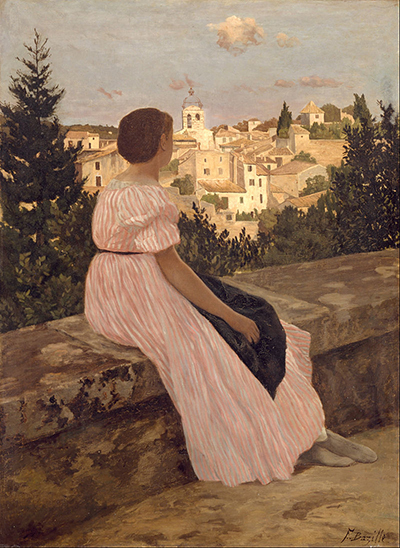
| The Pink Dress | 1864 | Oil on canvas |
| The Dog Rita Asleep | 1864 (catalogue); c. 1864 (2017 checklist) | Oil on canvas |
| The Scoter | 1864 | Oil on canvas |
| Naked Reclining Woman | 1864 | Oil on canvas |
| Landscape at Chailly | 1865 | Oil on canvas |
| Rocks at Chailly, Forest of Fontainebleau | 1865 | Oil on canvas |
| Undergrowth at Chailly, Forest of Fontainebleau | 1865 | Oil on canvas |
| Still Life with Grapes and Nuts | 1865 | Oil on canvas |
| Self-Portrait with a Palette — Chicago | 1865 | Oil on canvas |
| Landscape of Saint-Sauveur | 1865 | Oil on canvas |
| Beach at Sainte-Adresse | 1865 | Oil on canvas |
| The Improvised Field Hospital | 1865 | Oil on canvas |
| Village Street, Chailly | 1865 | Oil on canvas |
| Small Valley in the Forest of Fontainebleau | 1865 | Oil on canvas |
| Forest of Fontainebleau | 1865 | Oil on canvas |
| Woman Ironing | 1866 | Oil on canvas |
| The Artist's Studio on the rue de Furstenberg | 1865–66 (museum) | Oil on canvas |
| Still Life with Fish | 1866 | Oil on canvas |
| Little Italian Street Singer | 1866 | Oil on canvas |
| Potted Flowers | 1866 | Oil on canvas |
| The Little Gardener | 1866–1867 | Oil on canvas |
| Young Woman Playing the Piano | 1866–1867 | Oil on canvas |
| End of a Summer Day | 1866–1867 | Oil on canvas |
| A Studio on the rue Visconti | 1867 | Oil on canvas |
| Thérèse Reading in the Park at Méric | 1867 | Oil on canvas |
| Portrait of Verlaine | 1867 | Oil on canvas |
| The Terrace at Méric | 1867 | Oil on canvas |
| Still Life with Heron | 1867 | Oil on canvas |
| The Family Gathering | 1867–68 (museum) | Oil on canvas |
| Oleanders | 1867 | Oil on canvas |
| Woman on the Terrace at Méric | 1867 | Oil on canvas |
| The Ramparts at Aigues-Mortes from South | 1867 | Oil on canvas |
| The Western Ramparts at Aigues-Mortes | 1867 | Oil on canvas |
| Portrait of Edmond Maître — head study | 1867 | Oil on canvas |
| Porte de la Reine at Aigues-Mortes | 1867 | Oil on canvas |
| Portrait of Sisley | 1867 | Oil on wood |
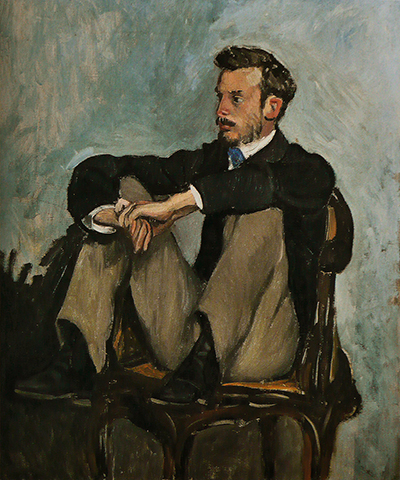
| Portrait of Renoir — Cleveland | 1867 | Oil on canvas |
| Portrait of Renoir — Musée d’Orsay | 1867 | Oil on canvas |
| Self-Portrait with a Detachable Collar — Minneapolis | 1865–67 (museum); 1867–68 (catalogue) | Oil on canvas |
| Vase of Flowers on a Console | 1868 (museum); 1867–68 (catalogue) | Oil on canvas |
| Portrait of a Woman | 1868 | Oil on canvas |
| Young Woman in the Vineyards | 1868 | Oil on card |
| Harvester with a Basket | 1868 | Oil on card |
| Harvester with a Yellow Hat | 1868 | Oil on card |
| Harvester with a Headdress | 1868 | Oil on panel |
| On the Banks of the Lez | 1868 | Oil on canvas |
| After the Bath (attribution questioned) | 1868? | Oil on canvas |
| Young Woman with Lowered Eyes | 1868 | Oil on canvas |
| Fisherman with a Net | 1868 | Oil on canvas |
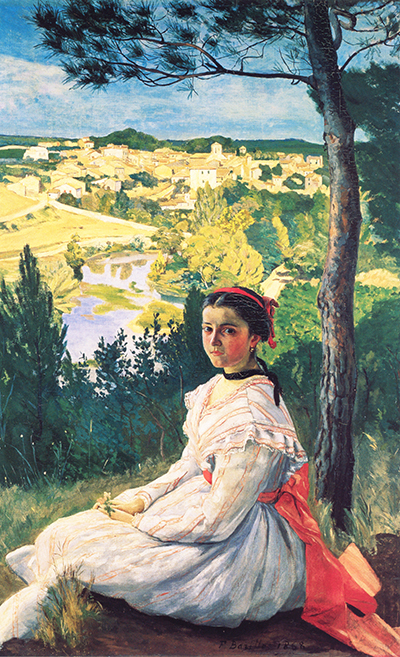
| View of the Village | 1868 | Oil on canvas |
| Portrait of Bazille (attributed to Monet by Musée Fabre; disputed catalogue attribution) | 1864 (museum); 1868 (catalogue) | Oil on panel |
| Studies for a Grape Harvest (two panels) | 1868 | Oil on canvas (two panels) |
| The Fortune Teller | 1868–69 (catalogue); c. 1869–70 (2017 checklist) | Oil on canvas |
| Harvester with a Cap | 1869 | Oil on card |
| Portrait of Edmond Maître — 1869 | 1869 | Oil on canvas |
| Woman in a Moorish Costume | 1869 | Oil on canvas |
| Young Woman in the Garden | 1869 | Oil on canvas |
| Portrait of Alphonse Tissié in a Cavalryman's Uniform | 1869 | Oil on canvas |
| Portrait of a dragoon | 1869 | Oil on canvas |
| Portrait of Zacharie Astruc | 1869 | Oil on canvas |
| Bunch of Grapes in a Bucket | 1869 | Oil on card |
| Portrait of Edouard Blau | Probably 1869; inscribed 1866 | Oil on canvas |
| Young Male Nude Lying on the Grass | 1870 | Oil on canvas |
| Summer Scene | 1869–1870 | Oil on canvas |
| The Studio on the rue La Condamine | 1869–1870 | Oil on canvas |
| La Toilette | 1870 | Oil on canvas |
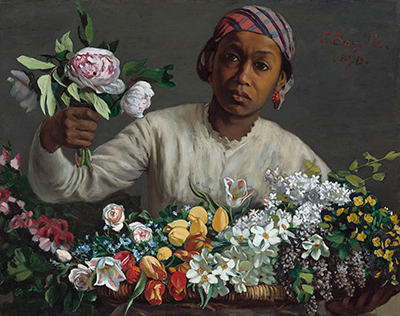
| Young Woman with Peonies — Montpellier | 1870 | Oil on canvas |
| Young Woman with Peonies — Washington | 1870 | Oil on canvas |
| Monotonous Chant | 1870 | Oil on canvas |
| Flowers — private collection | 1870 | Oil on canvas |
| Flowers — Musée Fabre | 1870 | Oil on canvas |
| Young Fisherman | 1870 | Oil on canvas |
| Study for Ruth and Boaz | 1870 | Oil on wood |
| Ruth and Boaz | 1870 | Oil on canvas |
| Self-Portrait in Shirt Sleeves | 1870 | Oil on canvas |
| Landscape on the Banks of the Lez | 1870 | Oil on canvas |
| Study after an Alpine Landscape | 1860 | Graphite on watercolour-tinted paper |
| Profile Head | 1862 | Charcoal on laid paper |
| Studies after Delacroix | 1863 | Ink and graphite, with gouache and watercolour, on paper |
| Academic Head | 1863 | Charcoal on paper |
| Study of a Woman's Head in Profile on a Chair | 1863 | Charcoal on paper |
| Academic Head of a Woman | 1863 | Charcoal on paper |
| Academy of Woman | 1863 | Black pencil and charcoal, stumped, on watermarked laid paper |
| Academy of Man | 1863 | Black pencil and charcoal, stumped, on watermarked laid paper |
| Naked Man | 1863 | Charcoal on paper |
| The Pont au Change in Paris | 1864 | Watercolour on paper |
| Study for the Pink Dress or Portrait of Thérèse des Hours | 1864 | Black pencil on paper |
| Naked Woman Standing | 1864 | Pencil on paper |
| Study of a Reclining Nude | 1864 | Charcoal on paper |
| Bathers | 1864 | Charcoal on paper |
| Portrait of a Man | 1864 | Charcoal on paper |
| Study for The Pink Dress | 1864 | Black pencil, squared, on paper |
| Study for Landscape of Saint-Sauveur | 1864 | Graphite on paper |
| Study for Landscape of Saint-Sauveur | 1865 | Pencil on paper |
| Man Taming a Bull | 1866 | Pen and black pencil on paper |
| Man Half Lying on a Sofa | 1866 | Charcoal on paper |
| Study for The Family Gathering | 1867 | Pencil on paper |
| Study for The Family Gathering | 1867 | Graphite, charcoal and black pencil on paper |
| The Embroiderer | 1867 | Pencil on pink paper |
| Study of Children | 1867 | Pencil on paper |
| Women in a Garden | 1867 | Pencil drawing |
| View of the Village | 1868 | Etching on paper |
| Portrait of a Bearded Man (catalogued as Self-Portrait) | Undated (museum); 1869 (catalogue) | Charcoal and brown ink |
| Man Smoking Pipe | 1869 | Watercolour on paper |
| Manet Drawing | 1868–70(?) (museum) | Charcoal and white chalk on paper |
| Study for the Summer Scene | 1869 | Charcoal, pen and ink on paper |
| Family Portrait | 1869 | Pastel and charcoal on paper |
| Study for Ruth | 1870 | Pencil and charcoal on paper |
| Woman Arranging a Hat | 1870 | Pencil drawing |
| Study for Boaz Asleep | 1870 | Pastel and red chalk |
| Boaz Asleep | 1870 | Charcoal and pencil on paper |
| Study for Boaz Asleep | 1870 | Black and beige pastel with red chalk on laid paper |
| Ruth Lying down | 1870 | Charcoal and pastel on paper |
| Head, Arm and Chest of Ruth | 1870 | Charcoal on paper |
| Chest of Ruth | 1870 | Black chalk and charcoal on paper |
| Black Woman with Peonies — gouache | c. 1870 | Gouache, watercolour, pencil and black chalk on card |
| Various Unidentified Subjects | Undated | Pencil drawing |
| Rocky Sea Side | Undated | Charcoal on paper |
| Studies of a Dancing Woman | Undated | Drawing with white chalk |
| Study of a Leg | Undated | Pencil drawing |
| Dancers in Camargue | Undated | Pencil drawing |
| Academy of Woman | Undated | Charcoal |
| Caricature of Venus of Milo and Various Other Caricatures | Undated | Charcoal |
| Caricature | Undated | Pencil drawing |
| Study of Landscape | Undated | Charcoal |
| Caricatures and Seated Monk | Undated | Charcoal |
| Caricatures and Various Subjects | Undated | Pencil drawing |
| Women Carrying a Pitcher | Undated | Pencil drawing |
| The Hanged Man | Undated | Charcoal |
| Castle in the Plain | Undated | Charcoal |
| Naked Woman from Behind | Undated | Charcoal |
| Caricatures | Undated | Charcoal and pencil |
| Unidentified Subjects | Undated | Pencil drawing |
| Landscape with a Castle | Undated | Charcoal |
| Study of Landscape | Undated | Charcoal |
| Horse Rider seen from Behind | Undated | Charcoal |
| Mazeppa | Undated | Pencil and charcoal |
| Study of Rider and Others Subjects | Undated | Pencil, pen and brown ink |
| Study of an Unidentified Man | Undated | Pencil drawing |
| Study for an Unknown Historic Scene | Undated | Pencil drawing |
| Study a Man Reading | Undated | Pencil drawing |
| Study of Men Reading | Undated | Pencil drawing |
| Study of Landscape ? | Undated | Charcoal |
| Study of a Head of a Man | Undated | Pencil drawing |
| Erotic Scene | Undated | Pencil drawing |
| Study of Dog | Undated | Charcoal |
| Studies of Unidentified Subjects and Erotic Scene | Undated | Pencil and charcoal drawing |
| Study for a Theater Scene | Undated | Charcoal |
| Study of a Reclining Naked Woman | Undated | Charcoal |
| Two Studies of Landscape | Undated | Pencil drawing |
| Caricature | Undated | Pencil and charcoal drawing |
| Portrait of an Unidentified Young Man | Undated | Charcoal |
| Study of an Unidentified Subject | Undated | Brown ink drawing |
| Unidentified Man with a Hat | Undated | Pencil and charcoal |
| Study of an Unidentified Women | Undated | Pencil drawing |
| Study for a Theater Character ? | Undated | Pencil drawing |
| Study for a Theater Character ? | Undated | Pen drawing |
| The Pavillon de la Reine in Paris | Undated | Pencil drawing |
| Study of a Horse Rider | Undated | Pencil and charcoal drawing |
| Entwined Couple. Caricature ? | Undated | Pencil drawing |
| Woman Sitting on a Sofa | Undated | Pencil drawing |
| Studies of Unidentified Subjects | Undated | Pencil and charcoal drawing |
| Studies of Animals | Undated | Pencil drawing |
| Study of a Horse Rider in Camargue | Undated | Charcoal |
| Study of Hunting Dogs | Undated | Pencil drawing |
| Study of Soldiers. Caricatures | Undated | Pencil drawing |
| Studies of Hunting Dogs ? | Undated | Pencil drawing |
| Hunting Scene. Hunter Playing the Horn | Undated | Pencil drawing |
| Caricature | Undated | Pencil drawing |
| Study of an Ibex | Undated | Pencil drawing |
| Theater Scene. Caricatures | Undated | Pencil drawing |
| Studies of Animals. Horses ? | Undated | Pencil drawing |
| Caricatures | Undated | Pencil drawing |
| Studies of Various Subjects and Animals | Undated | Pencil drawing |
| Unidentified Subject | Undated | Pencil drawing |
| Rider Taming a Horse [in Camargue ?] | Undated | Pencil drawing |
| Caricature of a Soldier | Undated | Pencil drawing |
| Study of a Woman and Mouse | Undated | Pencil drawing |
| Historic Scene | Undated | Charcoal |
| Architecture Studies | Undated | Pencil drawing |
| Mythologic Scene | Undated | Charcoal |
| Ophelia | Undated | Pencil drawing |
| Mythologic Scene | Undated | Charcoal |
| Studies of Various Subjects | Undated | Pencil and pen drawing |
| Studies of Peasants | Undated | Pencil drawing |
| Historic Scene | Undated | Pencil drawing |
| Historic or Literary Scene | Undated | Pencil drawing |
| Unidentified Historic Scene | Undated | Pencil drawing |
| Studies of Unidentified Subjects | Undated | Pencil drawing |
| Unidentified Study | Undated | Pencil drawing |
| Man in an Armchair | Undated | Pencil drawing |
| Studies of Various Subjects | Undated | Pencil drawing |
| Portraits of Unidentified Men | Undated | Pencil drawing |
| Studies of Various Subjects | Undated | Pencil drawing |
| Horse Rider and Artist | Undated | Charcoal and pencil |
| Study of Unidentified Characters | Undated | Charcoal |
| Dead Horse in a Plain | Undated | Charcoal |
| Study of Various Subjects and Furniture | Undated | Pencil drawing |
| Caricatures and Various Notes about Opéra | Undated | Pencil drawing |
| Galloping Horse | Undated | Charcoal |
| Study for La Toilette | Undated | Pencil drawing |
| Study of a Naked Woman | Undated | Pencil drawing |
| Domestic Scene | Undated | Pencil drawing |
| Physiognomies | Undated | Pencil drawing |
| Study for a Grape Harvest | Undated | Pencil drawing |
| Study for the Summer Scene | Undated | Pencil drawing |
| Female Profiles | Undated | Pencil drawing |
| Various Subjects | Undated | Pencil drawing |
| Study for The Terrace at Méric | Undated | Pencil drawing |
| Study for The Ramparts at Aigues-Mortes | Undated | Pencil drawing |
| Study for The Ramparts at Aigues-Mortes | Undated | Pencil drawing |
| Study for a Grape Harvest | Undated | Charcoal |
| Children Portraits | Undated | Pencil drawing |
| Study for Children's Heads | Undated | Pencil drawing |
| Study of Minerva | Undated | Pencil drawing |
| Study for a Grape Harvest | Undated | Pencil drawing |
| Study for The Family Gathering | Undated | Pencil drawing |
| Study for a Young Fisherman | Undated | Charcoal |
| Self-Portraits | Undated | Black pencil drawing |
| Study of Horses for the Porte de la Reine at Aigues-Mortes | Undated | Ink drawing |
| Study of Horses for the Porte de la Reine at Aigues-Mortes | Undated | Ink drawing |
| Study of Horses for the Porte de la Reine at Aigues-Mortes | Undated | Ink drawing |
| Study for an Outdoor Concert | Undated | Pencil drawing |
| Studies of Legs | Undated | Pencil drawing |
| Study for The Ramparts at Aigues Mortes | Undated | Pencil drawing |
| Studies of Hats | Undated | Pencil drawing |
| Studies of Men | Undated | Pencil drawing |
| Study for The Little Gardener | Undated | Pencil drawing |
| Study for The Ramparts at Aigues Mortes | Undated | Charcoal |
| Studies of Sail Boats | Undated | Pencil drawing |
| Portrait of Marc Bazille | Undated | Charcoal, black pencil and graphite |
| Studies of Children's Heads | Undated | Pencil drawing |
| Study for Aigues-Mortes | Undated | Pencil drawing |
| Studies of Women's Heads | Undated | Pencil drawing |
| Portrait of Camille des Hours and an Unidentified Man | Undated | Charcoal |
| Study of Flying Birds | Undated | Charcoal or graphite |
| Study for the Summer Scene | Undated | Pencil drawing |
| Study of Hands | Undated | Pen drawing |
| Self-Portrait | Undated | Black pencil drawing |
| Study for the Summer Scene | Undated | Pencil drawing |
| Study for the Summer Scene | Undated | Pencil drawing |
| Study for a Grape Harvest | Undated | Pencil drawing |
| Study of Branches | Undated | Pencil drawing |
| Study of a Seated Child | Undated | Pencil drawing |
| Study for a Couple and Unidentified Women | Undated | Pencil drawing |
| Studies of Unidentified Women | Undated | Pencil drawing |
| Study of Buildings | Undated | Pencil drawing |
| Study for a Grape Harvest | Undated | Pencil and charcoal |
| Studies of Boaters | Undated | Pencil drawing |
| Study of a Man Writing at his Table | Undated | Pencil drawing |
| Study of a Woman Cutting Flowers | Undated | Pencil drawing |
| Study of Hand | Undated | Pencil drawing |
| Women in a Garden | Undated | Pencil drawing |
| Studies of Women in Profile | Undated | Pencil drawing |
| Study for Ruth and Boaz | Undated | Charcoal |
| Study for The Family Gathering | Undated | Pencil drawing |
| Study for the View of the Village | Undated | Pencil drawing |
| Study of the View of the Village | Undated | Pencil drawing |
| Study for the Fisherman with a Net | Undated | Pencil drawing |
| Study for the View of the Village | Undated | Charcoal |
| Study for The Little Gardener | Undated | Charcoal |
| Portrait of a Man with a Top Hat | Undated | Pencil drawing |
| Portrait of a Man with a Top Hat | Undated | Pencil drawing |
| Inscriptions | Undated | Pencil inscriptions |
| Study of Tree | Undated | Pencil drawing |
| Caricature of Nina la Belle | Undated | Pencil drawing |
| Study for Saint Sebastian | Undated | Pencil drawing |
| Young Woman Sewing | Undated | Pencil drawing |
| Studies of Hands | Undated | Pencil drawing |
| Woman in a Garden | Undated | Pencil drawing |
| Elegant Woman | Undated | Pencil drawing |
| Various Inscriptions | Undated | Inscriptions (medium unspecified in index) |
| Study of a Man with a Hat | Undated | Pencil drawing |
| Study of a Child | Undated | Pencil drawing |
| Study of a Man with a Hat | Undated | Pencil drawing |
Frequently Asked Questions
The painting does not establish the dog’s owner or a detailed pet biography. Its catalogue title supplies the name. [1]
Discussion
The sleeping dog emerges slowly from a warm dark field. Which light accent first makes the curled body legible?
Reader Insights
How does the textile’s diagonal pattern support the dog’s rounded body?
Which small highlight first separates a limb or muzzle from the dark fur?
Compare Rita’s living, sleeping body with the fish still life. How do their surfaces invite different kinds of attention?
Join the Conversation
Share a detail, comparison or question about The Dog Rita Asleep by Frédéric Bazille below.
References
- Michel Schulman, The Dog Rita Asleep, MSb-11, digital catalogue raisonné: object entry, history, exhibitions and critical essay. Source (English translation of a French scholarly catalogue). View source.
- National Gallery of Art, Frédéric Bazille and the Birth of Impressionism, exhibition checklist, 2017, entries for The Dog Rita, Asleep, Still Life with Fish and Still Life with Heron. Source. View source.
- Musée Fabre, Frédéric Bazille: la jeunesse de l'impressionnisme, press dossier, 2016, pp. 11–13. Source (in French). View source.
- Minneapolis Institute of Art, Self-Portrait with Detachable Collar, accession 62.39, collection record. Source. View source.
- Michel Schulman, Study of Dog, MSb-151, digital catalogue raisonné. Source (English translation of a French scholarly catalogue). View source.
- Michel Schulman, Study for The Family Gathering, MSb-106, digital catalogue raisonné. Source (English translation of a French scholarly catalogue). View source.
- Joconde/POP, La Robe rose, RF2450. View source. (in French).
- Musée d’Orsay, L’Ambulance improvisée, RF 1967 5. View source. (in French).
- Musée d’Orsay, Réunion de famille,RF2749. View source. (in French).
- Musée d’Orsay, Pierre Auguste Renoir,DL1970 3. View source.
- Musée Fabre, Vue de village, 898.5.1. View source. (in French).
- National Gallery of Art, Young Woman with Peonies,1983.1.6. View source.
- Michel Schulman, painting index and documentary introduction (English titles; French metadata). View source.
- Michel Schulman, works-on-paper index (English titles; French metadata). View source.
- Michel Schulman, albums and studies index (English titles; French metadata). View source.
 Frederic Bazille.jpg)