 by Tom Gurney
Tom Gurney BSc (Hons) is an art history expert with over 20 years experience
Published on June 19, 2020 / Updated on November 2, 2026
Email: tomgurney1@gmail.com / Phone: +44 7429 011000
Frédéric Bazille: Letters and Quotes: Introduction
Frédéric Bazille's letters bring the practical life of a painter into unusually sharp focus. A promise to work harder sits beside a request for bedding; an exhibition scheme follows disappointment; a landscape depends on the arrival of fine weather. His voice can be affectionate, impatient, funny and fiercely judgemental. Read together, these passages reveal the changing relationship between artistic ambition and the people, places and money that made work possible.
The Musée Fabre preserves a group of letters that includes exchanges with his parents and his cousin Louis. Its exhibition account treats the correspondence as a way into both his everyday circumstances and the artistic world around him. The letters repeatedly explain what he is doing, defend how he spends his time and report how other people have received his paintings. Their addressees matter as much as their most memorable phrases. [1]
At a Glance
- SourcesLetters to his parents and cousin Louis [1]
- English quotationsOur translations from the original French [2]
- Key contextWork, friendship, money, travel and public exhibition [1]
Contents
- Reading Bazille in his own words
- January 1865: reassurance, Monet and winter work
- Choosing painting without simplifying the painter
- April 1867: “You will see that people will talk about us”
- Aigues-Mortes: books, weather and drawing materials
- Rooms, models and the price of working
- April 1869: the painters Bazille admired
- Looking at prints and admitting what he knows
- Friendship and voices beyond the letters
Reading Bazille in his own words
All English quotations from Bazille below are our translations from the French. Each belongs to a particular letter and occasion. Several dates were supplied by the editors of the museum transcriptions rather than written out in full by Bazille; a month or a season can therefore be more accurate than an apparently exact day. The surviving pages also move rapidly between subjects. A statement about painting may be part of an appeal to a worried parent, while an opinion about another artist may accompany a proposed purchase.
That intimacy is part of their value. Bazille does not write as though explaining a completed career to posterity. He names projects still in progress, predicts outcomes that have yet to occur and announces decisions he may later change. The letters should be read alongside the paintings, with room for the difference between intention and result. A proposed canvas is not necessarily a surviving picture; admiration for another painter does not establish a specific borrowing.
January 1865: reassurance, Monet and winter work
In the letter dated 6 January 1865, Bazille tells his father that he can now be reached at 6 place Furstenberg. He has received his sheets and describes an iron bed, mattress and blankets, with curtains still to come. These domestic particulars establish the circumstances of the better-known passage about Monet: a young painter is getting himself settled and trying to reassure his family that the arrangement will lead to serious work. [2]
His mother has allowed him to see that his parents fear he is neglecting both his painting and them. Bazille answers with a concrete daily routine. “Monet takes the trouble to come and wake me every morning,” he writes, followed by “I spend all my days in his studio painting from the living model.” Both quotations describe the situation that winter. They give Monet a role in the discipline of work as well as in artistic companionship. [2]
“I must paint a great many figures this winter” is the next essential statement. Its explanation follows immediately: he wants to be ready to make good use of spring and summer in the countryside. Figure practice indoors and painting outdoors belong to the same programme. The living model offers preparation for the more complicated task of making a body convincing within a landscape, where the light, setting and relation of figure to surroundings must all be considered. [2]
The letter then returns to his father's support. Bazille promises to “work with all my heart” in gratitude for the sacrifices made for him and to demonstrate greater progress in the coming year. Detached from that setting, the phrase sounds like a general motto. In the letter it is a personal undertaking, with an imagined future moment when his father will judge the results. At the end, Bazille asks for his paintings to be sent from home, together with his parasol and folding outdoor stool. Ambition takes the form of study, transport and equipment. [2]
Choosing painting without simplifying the painter
An earlier letter, assigned to mid-July 1864, shows how difficult it could be to make progress visible. Bazille fears another failure in his medical examination and describes a demanding painting that requires repeated alterations. He tells his father that he sometimes undoes the next day what he accomplished the day before. The canvas is not securely identified by this passage. What it records is a process of trial and dissatisfaction, rather than effortless production. [3]
By 17 July 1865 he has a more varied set of achievements to report. Alongside paintings, he describes a play written with his friend Blau and a rowing victory at Bougival. He anticipates the objection that these activities are distracting him and insists that painting remains his main occupation. His hopes for the play are still hopes: its completion and a favourable private reading do not establish that the proposed public performance followed. [4]
The same letter explains a planned life-size portrait as practice for a portrait of Pauline at Méric. It also records his intention to spend several days at Chailly posing for Monet's large composition. Practice, family portraits and service to a friend's project overlap. Bazille's developing career was made of such exchanges, in which he could be painter, model, collaborator and correspondent. [4]
April 1867: “You will see that people will talk about us”
One of Bazille's most forceful declarations occurs in a letter to his mother assigned to April 1867. He has received bad news about his Salon submissions. He answers rejection by questioning the authority of the jury and describing an alternative: about a dozen young artists intend to hire a large studio each year and exhibit as many works as they wish. They would also invite painters they admired to contribute. [5]
According to Bazille, Courbet, Corot, Diaz and Daubigny have promised works and support the idea. His confidence rises further when he mentions Monet, whose ability he rates above theirs. Then comes the prediction: “You will see that people will talk about us.” This is a statement of collective ambition, directed to a mother who may need convincing that a rejection does not mean failure. The pronoun matters: the imagined success belongs to a circle. [5]
The proposal also has conditions. A petition is seeking an exhibition for rejected works; if that succeeds, the independent venture might wait until the following year. Bazille says a postponement would give him time to make important paintings in Montpellier. The letter therefore contains planning as well as defiance: premises, collaborators, timing and pictures still to be produced. [5]
It is tempting to treat this as the first act of the Impressionist exhibitions. It does establish that Bazille and his associates were considering a recurring independent exhibition well before the first Impressionist exhibition of 1874, which took place after his death. It does not establish that the scheme described here happened in its proposed form, or make him a participant in that later event. [1]
His declaration that he will submit nothing more to the jury was also a decision made in the heat of this particular disappointment. Subsequent letters show him awaiting Salon decisions again. The tension between independence and the desire for public recognition continued; a private letter catches that tension more faithfully than a seamless story of rebellion would. [5] [6]
Aigues-Mortes: books, weather and drawing materials
From the Hôtel Saint-Louis at Aigues-Mortes, in a letter assigned to late May 1867, Bazille reports that the weather has allowed him to go out to work only four times. He has begun three or four landscapes and plans a large view of the town walls reflected in water at sunset. Although he expects a simple composition, he reckons that he needs at least eight fine days. The apparent ease of the projected picture depends on a demanding run of suitable conditions. [7]
The Western Ramparts at Aigues-Mortes gives a natural point of comparison, with its extended walls, open water and reflections. Yet the letter is a report of work under way, not a final inventory. Its count of projects does not prove that four completed paintings survive. Nor should the sunset plan automatically be treated as a description of every finished Aigues-Mortes view. [7]
“I have a great need for books,” he tells his mother. The request accompanies a specific wish for Victor Hugo's account of travels by the Rhine and for copies of Le Figaro. The painter away from Paris wants reading matter as well as landscape subjects. It is evidence of literary appetite, without requiring an invented connection between a particular passage of Hugo and a particular patch of paint. [7]
The rest of the letter widens the scene. Bazille gives a sarcastic account of a musical evening at the hotel, arranges a payment towards his Paris rent and asks for very black wood-cased Conté pencils. These are useful companions to the quotation about books. The stay involves aesthetic pleasure and irritation, practical obligations at a distance, and the need for usable materials. Painting in the south does not remove him from either his family network or his Paris expenses. [7]
Watch: Bazille and early Impressionism
Explore a Paris studio with Smarthistory, then discover the beginnings of Impressionism with the National Gallery of Art.
Jean-Frédéric Bazille, The Artist’s Studio, Rue Visconti, Paris
A close look at Bazille’s 1867 painting of the studio he shared in Paris.
Watch on YouTubeRooms, models and the price of working
Letters about money prevent a misleadingly easy picture of Bazille as an artist with unlimited resources. In a letter assigned to April 1868, he explains an old restaurant debt to his father, describes arrangements for a loan and worries about the coming rent payment. Elsewhere in that letter he considers his Salon prospects and the need to find a clothed female model for Montpellier. The financial and pictorial questions occupy the same sheet. [8]
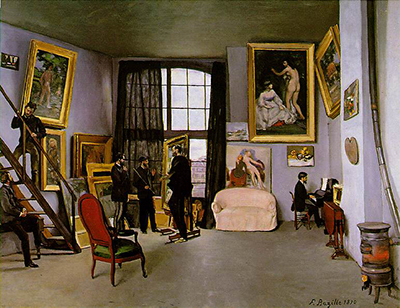
Space has its price too. In late November 1867 he defends the decision to leave the rue Visconti because he lacks room. He has rented a much larger studio at Batignolles at an additional cost of 200 francs, found a replacement tenant and plans to move in January. This letter places the proposed move at January 1868. It also reveals the calculation behind the expansive room later represented in Bazille's Studio, Rue La Condamine. [9]
In mid-February 1869, news of artistic encouragement leads to another account of costs. Bazille reports that visiting painters have praised his pictures, and that Alfred Stevens plans to introduce jury members to his work. At the same time he is short of money because he has paid overdue model fees and continues to employ models almost every day. Praise does not cancel the expense of producing the next picture. [10]
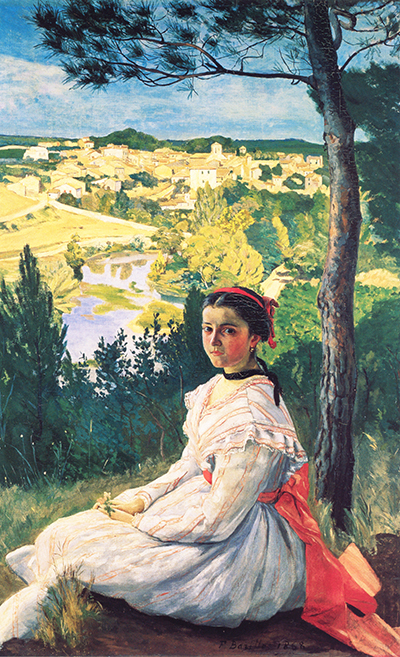
The painting he calls the little Italian in this letter is View of the Village, rather than the earlier painting of an Italian street singer. The distinction matters because he is describing the reception of a recent figure-and-landscape experiment. Some visitors prefer it, others the male nude. These are reports of studio discussion before the Salon's verdict, not evidence that the works had already secured public success. [10] [11]
Studio in Rue de La Condamine
April 1869: the painters Bazille admired
The letter of 27 April 1869 to his cousin Louis is particularly revealing because it has a practical purpose. Louis wants help buying paintings. Bazille reports unsuccessful attempts to obtain works offered as a Rubens grisaille and a Goya portrait, then sets out his opinions of modern painters. The names and attributions are those of the historical transactions he describes; the letter does not authenticate the auction pictures for a present-day reader. [12]
Bazille expresses exceptionally strong admiration for Delacroix. He then writes: “I greatly like Ingres, Corot, Rousseau, Millet, and often Courbet.” The word often matters: he is making a discriminating personal judgement. The passage puts painters with very different approaches beside one another, and his enthusiasm is too broad to fit a simple opposition between tradition and modernity. [12]
He admires Corot particularly as a landscape painter, while considering availability and price. He suspects that success has encouraged Troyon to repeat pleasing effects, although he still allows that a work might be worth owning. Cabanel receives a much harsher assessment. Bazille separates tidiness and good intentions from the qualities he seeks in painting. These are forcefully expressed preferences offered to one collector, rather than impartial rankings. [12]
Perhaps the most suggestive omission is deliberate. He says that there are two or three young painters, known mainly among other young people, whose talent he greatly likes, but leaves them unnamed. The reader cannot responsibly fill in those names. The passage preserves a distinction between the artistic convictions he holds within his own circle and the advice he is prepared to offer Louis at that moment. [12]
Looking at prints and admitting what he knows
Another letter to Louis, headed only Monday and placed by the Musée Fabre in February 1870, concerns old-master prints. Bazille discusses impressions associated with Marcantonio Raimondi and Rembrandt, examining the depth of the blacks, signs of an early impression, ink at the plate edges and the absence of retouching. He explains features he believes indicate the freshness of a copperplate. These are his observations and historical explanations, rather than a modern technical assessment of the individual sheets. [13]
He also acknowledges that the beauty of the drawing remains his principal guide, even while he learns about market value. That admission makes the letter especially engaging: he is acquiring specialist knowledge without pretending that it has displaced visual judgement. His list of desired masters includes Dürer, Lucas van Leyden and Mantegna. The correspondence thus records sustained interest in older art alongside his commitment to living painters. [13]
The subject here is collecting rather than making prints. The letter shows how closely he could look at works in another medium and how readily questions of artistic quality, physical condition and price entered the same conversation. [13]
Friendship and voices beyond the letters
In the letter of 5 April 1869, Bazille reports that Monet is staying with him in severe financial difficulty. Read beside Monet's morning visits in January 1865, this offers a more reciprocal understanding of their relationship: encouragement towards work and the provision of shelter belong to the same history. Elsewhere in the April letter, Bazille punctures the glamour of the Opéra backstage by describing cold rooms, busy stagehands and dancers discussing rents and pets. His account repeatedly notices the ordinary work beneath artistic spectacle. [6]
The correspondence also supplies a less public register of artistic friendship. At the end of 1869 Bazille writes from Maître's home, lists a studio interior, Blau's portrait and a female nude among his current projects, and recalls hearing Fidelio with Maître, Renoir and others. Work, music and meals form a connected social world. His list records the winter's tasks; it does not certify that each painting was finished before the year's end. [14]
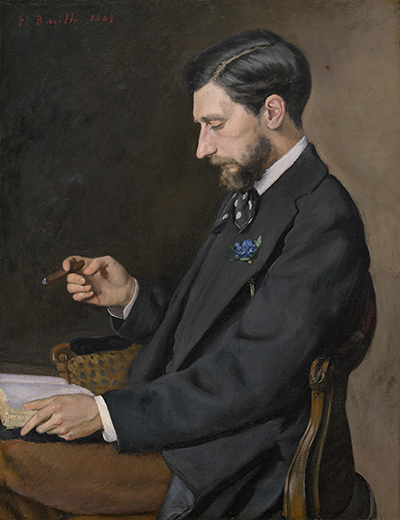
That world is visible in the Condamine studio painting: pictures surround a central exchange by the easel, while a pianist occupies the right side of the room. The correspondence helps us understand the coexistence of looking, discussion and music without requiring every figure in the picture to be identified beyond doubt. The portrait of Edmond Maître offers another route into the friendship, through a more concentrated encounter with a single sitter.
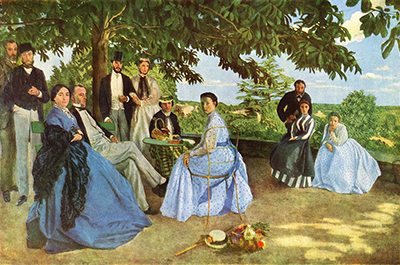
Other people's responses provide a different kind of evidence. Reviewing Family Reunion on 24 May 1868, Émile Zola praised the care given to individual faces and poses and welcomed the depiction of contemporary dress. His judgement explains one reason the painting mattered to an advocate of modern subjects. It remains a particular critic's assessment, rather than a record of unanimous approval. [15]
Berthe Morisot's response to View of the Village, in a letter to Edma dated 5 May 1869 and reproduced in the Musée Fabre's exhibition account, identifies a related achievement: placing a figure convincingly outdoors. Her observation helps connect Bazille's winter programme of figure practice with the problem another painter recognised in the finished work. It is Morisot's judgement of Bazille, distinct from his own statements about what he hoped to accomplish. [1]
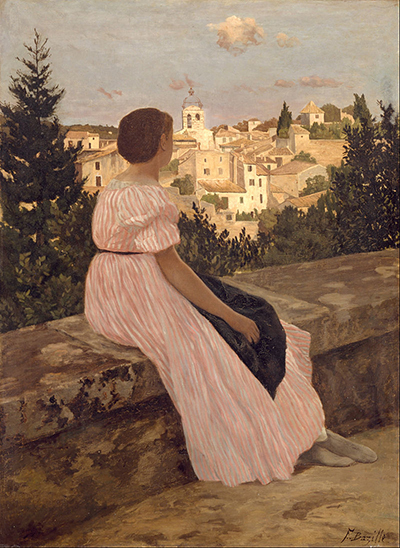
The paintings can also disclose work that no selected quotation adequately describes. Bruno Mottin's laboratory study documents extensive reworking of The Pink Dress and establishes that the Condamine interior initially lacked its figures. Such findings complement letters about perseverance and current projects, while belonging to a different body of evidence. Bazille's words make the effort personal; the surfaces and underlying compositions show how particular pictures changed. Together they allow a fuller encounter with the artist than either a fixed artistic creed or an isolated memorable sentence can provide. [16]
Portrait of Edmond Maitre
Bazille catalogue directory
The 284 records comprise 85 painting records,40 separate works-on-paper records and 159 album or study records. They describe the catalogue’s organisation rather than 284 independent objects or unanimously accepted attributions. Recto, verso, albums and multiple studies remain distinct. Dates are qualified where needed; the Drawing filter includes the etching, gouache and mixed works on paper. Manuscript mentions and unproved projects are listed separately below.
Works known through documents
These mentions remain separate from the 284 catalogue records. Some may concern surviving studies or underlying compositions; they cannot simply be added together as missing physical paintings.
- A copy after Rubens mentioned in March 1863 is unlocated.
- A portrait of an unidentified woman was reported completed before July 1866.
- A portrait of Monet and a composition of two life-size women arranging flowers were reported in progress in April 1867. Their mention does not establish two otherwise unknown surviving canvases.
- Gertrude et le père Lapin was at least begun in the summer of 1870.
Further reported works and uncertain attributions
- A Bouquet of Lilacs was reportedly stolen and returned in 1864; a portrait of the friend Theulier and Yellow Narcissi reported by Maître in 1868 are also documentary mentions.
- Unidentified pictures associated with Guillemet and Mme Rolina are reported through later correspondence cited by the catalogue.
- Children Dressed as Bride and Groom was associated with Vallotton’s collection and also attributed to Renoir. Its identification and authorship should remain open.
Projects whose completion is unproved
- A portrait of Pauline was planned in July 1865.
- A portrait of Marc was proposed in April 1866; a related drawing survives.
- A Jardinière project appears in album inscriptions and related figure material. Written plans are not evidence of a completed painting.
| Name | Date | Medium |
|---|---|---|
| Mystic Marriage of St. Catherine | 1863 | Oil on canvas |
| Trees, Study | 1863 | Oil on canvas |
| Farm of Saint-Sauveur | 1863 | Oil on canvas |
| In the Garden of the Parc Monceau, Paris | 1864 | Oil on canvas |
| Naked Woman from Behind | 1864 | Oil on canvas |
| Reclining Nude | 1864 | Oil on canvas |
| Courtyard of the Auberge du Cheval blanc at Chailly near Barbizon | 1864 | Oil on canvas |
| Covered Soup Bowls | 1864 | Oil on canvas |
| Two Herrings | 1864 | Oil on canvas |
| The Pink Dress | 1864 | Oil on canvas |
| The Dog Rita Asleep | 1864 (catalogue); c. 1864 (2017 checklist) | Oil on canvas |
| The Scoter | 1864 | Oil on canvas |
| Naked Reclining Woman | 1864 | Oil on canvas |
| Landscape at Chailly | 1865 | Oil on canvas |
| Rocks at Chailly, Forest of Fontainebleau | 1865 | Oil on canvas |
| Undergrowth at Chailly, Forest of Fontainebleau | 1865 | Oil on canvas |
| Still Life with Grapes and Nuts | 1865 | Oil on canvas |
| Self-Portrait with a Palette — Chicago | 1865 | Oil on canvas |
| Landscape of Saint-Sauveur | 1865 | Oil on canvas |
| Beach at Sainte-Adresse | 1865 | Oil on canvas |
| The Improvised Field Hospital | 1865 | Oil on canvas |
| Village Street, Chailly | 1865 | Oil on canvas |
| Small Valley in the Forest of Fontainebleau | 1865 | Oil on canvas |
| Forest of Fontainebleau | 1865 | Oil on canvas |
| Woman Ironing | 1866 | Oil on canvas |
| The Artist's Studio on the rue de Furstenberg | 1865–66 (museum) | Oil on canvas |
| Still Life with Fish | 1866 | Oil on canvas |
| Little Italian Street Singer | 1866 | Oil on canvas |
| Potted Flowers | 1866 | Oil on canvas |
| The Little Gardener | 1866–1867 | Oil on canvas |
| Young Woman Playing the Piano | 1866–1867 | Oil on canvas |
| End of a Summer Day | 1866–1867 | Oil on canvas |
| A Studio on the rue Visconti | 1867 | Oil on canvas |
| Thérèse Reading in the Park at Méric | 1867 | Oil on canvas |
| Portrait of Verlaine | 1867 | Oil on canvas |
| The Terrace at Méric | 1867 | Oil on canvas |
| Still Life with Heron | 1867 | Oil on canvas |
| The Family Gathering | 1867–68 (museum) | Oil on canvas |
| Oleanders | 1867 | Oil on canvas |
| Woman on the Terrace at Méric | 1867 | Oil on canvas |
| The Ramparts at Aigues-Mortes from South | 1867 | Oil on canvas |
| The Western Ramparts at Aigues-Mortes | 1867 | Oil on canvas |
| Portrait of Edmond Maître — head study | 1867 | Oil on canvas |
| Porte de la Reine at Aigues-Mortes | 1867 | Oil on canvas |
| Portrait of Sisley | 1867 | Oil on wood |
| Portrait of Renoir — Cleveland | 1867 | Oil on canvas |
| Portrait of Renoir — Musée d’Orsay | 1867 | Oil on canvas |
| Self-Portrait with a Detachable Collar — Minneapolis | 1865–67 (museum); 1867–68 (catalogue) | Oil on canvas |
| Vase of Flowers on a Console | 1868 (museum); 1867–68 (catalogue) | Oil on canvas |
| Portrait of a Woman | 1868 | Oil on canvas |
| Young Woman in the Vineyards | 1868 | Oil on card |
| Harvester with a Basket | 1868 | Oil on card |
| Harvester with a Yellow Hat | 1868 | Oil on card |
| Harvester with a Headdress | 1868 | Oil on panel |
| On the Banks of the Lez | 1868 | Oil on canvas |
| After the Bath (attribution questioned) | 1868? | Oil on canvas |
| Young Woman with Lowered Eyes | 1868 | Oil on canvas |
| Fisherman with a Net | 1868 | Oil on canvas |
| View of the Village | 1868 | Oil on canvas |
| Portrait of Bazille (attributed to Monet by Musée Fabre; disputed catalogue attribution) | 1864 (museum); 1868 (catalogue) | Oil on panel |
| Studies for a Grape Harvest (two panels) | 1868 | Oil on canvas (two panels) |
| The Fortune Teller | 1868–69 (catalogue); c. 1869–70 (2017 checklist) | Oil on canvas |
| Harvester with a Cap | 1869 | Oil on card |
| Portrait of Edmond Maître — 1869 | 1869 | Oil on canvas |
| Woman in a Moorish Costume | 1869 | Oil on canvas |
| Young Woman in the Garden | 1869 | Oil on canvas |
| Portrait of Alphonse Tissié in a Cavalryman's Uniform | 1869 | Oil on canvas |
| Portrait of a dragoon | 1869 | Oil on canvas |
| Portrait of Zacharie Astruc | 1869 | Oil on canvas |
| Bunch of Grapes in a Bucket | 1869 | Oil on card |
| Portrait of Edouard Blau | Probably 1869; inscribed 1866 | Oil on canvas |
| Young Male Nude Lying on the Grass | 1870 | Oil on canvas |
| Summer Scene | 1869–1870 | Oil on canvas |
| The Studio on the rue La Condamine | 1869–1870 | Oil on canvas |
| La Toilette | 1870 | Oil on canvas |
| Young Woman with Peonies — Montpellier | 1870 | Oil on canvas |
| Young Woman with Peonies — Washington | 1870 | Oil on canvas |
| Monotonous Chant | 1870 | Oil on canvas |
| Flowers — private collection | 1870 | Oil on canvas |
| Flowers — Musée Fabre | 1870 | Oil on canvas |
| Young Fisherman | 1870 | Oil on canvas |
| Study for Ruth and Boaz | 1870 | Oil on wood |
| Ruth and Boaz | 1870 | Oil on canvas |
| Self-Portrait in Shirt Sleeves | 1870 | Oil on canvas |
| Landscape on the Banks of the Lez | 1870 | Oil on canvas |
| Study after an Alpine Landscape | 1860 | Graphite on watercolour-tinted paper |
| Profile Head | 1862 | Charcoal on laid paper |
| Studies after Delacroix | 1863 | Ink and graphite, with gouache and watercolour, on paper |
| Academic Head | 1863 | Charcoal on paper |
| Study of a Woman's Head in Profile on a Chair | 1863 | Charcoal on paper |
| Academic Head of a Woman | 1863 | Charcoal on paper |
| Academy of Woman | 1863 | Black pencil and charcoal, stumped, on watermarked laid paper |
| Academy of Man | 1863 | Black pencil and charcoal, stumped, on watermarked laid paper |
| Naked Man | 1863 | Charcoal on paper |
| The Pont au Change in Paris | 1864 | Watercolour on paper |
| Study for the Pink Dress or Portrait of Thérèse des Hours | 1864 | Black pencil on paper |
| Naked Woman Standing | 1864 | Pencil on paper |
| Study of a Reclining Nude | 1864 | Charcoal on paper |
| Bathers | 1864 | Charcoal on paper |
| Portrait of a Man | 1864 | Charcoal on paper |
| Study for The Pink Dress | 1864 | Black pencil, squared, on paper |
| Study for Landscape of Saint-Sauveur | 1864 | Graphite on paper |
| Study for Landscape of Saint-Sauveur | 1865 | Pencil on paper |
| Man Taming a Bull | 1866 | Pen and black pencil on paper |
| Man Half Lying on a Sofa | 1866 | Charcoal on paper |
| Study for The Family Gathering | 1867 | Pencil on paper |
| Study for The Family Gathering | 1867 | Graphite, charcoal and black pencil on paper |
| The Embroiderer | 1867 | Pencil on pink paper |
| Study of Children | 1867 | Pencil on paper |
| Women in a Garden | 1867 | Pencil drawing |
| View of the Village | 1868 | Etching on paper |
| Portrait of a Bearded Man (catalogued as Self-Portrait) | Undated (museum); 1869 (catalogue) | Charcoal and brown ink |
| Man Smoking Pipe | 1869 | Watercolour on paper |
| Manet Drawing | 1868–70(?) (museum) | Charcoal and white chalk on paper |
| Study for the Summer Scene | 1869 | Charcoal, pen and ink on paper |
| Family Portrait | 1869 | Pastel and charcoal on paper |
| Study for Ruth | 1870 | Pencil and charcoal on paper |
| Woman Arranging a Hat | 1870 | Pencil drawing |
| Study for Boaz Asleep | 1870 | Pastel and red chalk |
| Boaz Asleep | 1870 | Charcoal and pencil on paper |
| Study for Boaz Asleep | 1870 | Black and beige pastel with red chalk on laid paper |
| Ruth Lying down | 1870 | Charcoal and pastel on paper |
| Head, Arm and Chest of Ruth | 1870 | Charcoal on paper |
| Chest of Ruth | 1870 | Black chalk and charcoal on paper |
| Black Woman with Peonies — gouache | c. 1870 | Gouache, watercolour, pencil and black chalk on card |
| Various Unidentified Subjects | Undated | Pencil drawing |
| Rocky Sea Side | Undated | Charcoal on paper |
| Studies of a Dancing Woman | Undated | Drawing with white chalk |
| Study of a Leg | Undated | Pencil drawing |
| Dancers in Camargue | Undated | Pencil drawing |
| Academy of Woman | Undated | Charcoal |
| Caricature of Venus of Milo and Various Other Caricatures | Undated | Charcoal |
| Caricature | Undated | Pencil drawing |
| Study of Landscape | Undated | Charcoal |
| Caricatures and Seated Monk | Undated | Charcoal |
| Caricatures and Various Subjects | Undated | Pencil drawing |
| Women Carrying a Pitcher | Undated | Pencil drawing |
| The Hanged Man | Undated | Charcoal |
| Castle in the Plain | Undated | Charcoal |
| Naked Woman from Behind | Undated | Charcoal |
| Caricatures | Undated | Charcoal and pencil |
| Unidentified Subjects | Undated | Pencil drawing |
| Landscape with a Castle | Undated | Charcoal |
| Study of Landscape | Undated | Charcoal |
| Horse Rider seen from Behind | Undated | Charcoal |
| Mazeppa | Undated | Pencil and charcoal |
| Study of Rider and Others Subjects | Undated | Pencil, pen and brown ink |
| Study of an Unidentified Man | Undated | Pencil drawing |
| Study for an Unknown Historic Scene | Undated | Pencil drawing |
| Study a Man Reading | Undated | Pencil drawing |
| Study of Men Reading | Undated | Pencil drawing |
| Study of Landscape ? | Undated | Charcoal |
| Study of a Head of a Man | Undated | Pencil drawing |
| Erotic Scene | Undated | Pencil drawing |
| Study of Dog | Undated | Charcoal |
| Studies of Unidentified Subjects and Erotic Scene | Undated | Pencil and charcoal drawing |
| Study for a Theater Scene | Undated | Charcoal |
| Study of a Reclining Naked Woman | Undated | Charcoal |
| Two Studies of Landscape | Undated | Pencil drawing |
| Caricature | Undated | Pencil and charcoal drawing |
| Portrait of an Unidentified Young Man | Undated | Charcoal |
| Study of an Unidentified Subject | Undated | Brown ink drawing |
| Unidentified Man with a Hat | Undated | Pencil and charcoal |
| Study of an Unidentified Women | Undated | Pencil drawing |
| Study for a Theater Character ? | Undated | Pencil drawing |
| Study for a Theater Character ? | Undated | Pen drawing |
| The Pavillon de la Reine in Paris | Undated | Pencil drawing |
| Study of a Horse Rider | Undated | Pencil and charcoal drawing |
| Entwined Couple. Caricature ? | Undated | Pencil drawing |
| Woman Sitting on a Sofa | Undated | Pencil drawing |
| Studies of Unidentified Subjects | Undated | Pencil and charcoal drawing |
| Studies of Animals | Undated | Pencil drawing |
| Study of a Horse Rider in Camargue | Undated | Charcoal |
| Study of Hunting Dogs | Undated | Pencil drawing |
| Study of Soldiers. Caricatures | Undated | Pencil drawing |
| Studies of Hunting Dogs ? | Undated | Pencil drawing |
| Hunting Scene. Hunter Playing the Horn | Undated | Pencil drawing |
| Caricature | Undated | Pencil drawing |
| Study of an Ibex | Undated | Pencil drawing |
| Theater Scene. Caricatures | Undated | Pencil drawing |
| Studies of Animals. Horses ? | Undated | Pencil drawing |
| Caricatures | Undated | Pencil drawing |
| Studies of Various Subjects and Animals | Undated | Pencil drawing |
| Unidentified Subject | Undated | Pencil drawing |
| Rider Taming a Horse [in Camargue ?] | Undated | Pencil drawing |
| Caricature of a Soldier | Undated | Pencil drawing |
| Study of a Woman and Mouse | Undated | Pencil drawing |
| Historic Scene | Undated | Charcoal |
| Architecture Studies | Undated | Pencil drawing |
| Mythologic Scene | Undated | Charcoal |
| Ophelia | Undated | Pencil drawing |
| Mythologic Scene | Undated | Charcoal |
| Studies of Various Subjects | Undated | Pencil and pen drawing |
| Studies of Peasants | Undated | Pencil drawing |
| Historic Scene | Undated | Pencil drawing |
| Historic or Literary Scene | Undated | Pencil drawing |
| Unidentified Historic Scene | Undated | Pencil drawing |
| Studies of Unidentified Subjects | Undated | Pencil drawing |
| Unidentified Study | Undated | Pencil drawing |
| Man in an Armchair | Undated | Pencil drawing |
| Studies of Various Subjects | Undated | Pencil drawing |
| Portraits of Unidentified Men | Undated | Pencil drawing |
| Studies of Various Subjects | Undated | Pencil drawing |
| Horse Rider and Artist | Undated | Charcoal and pencil |
| Study of Unidentified Characters | Undated | Charcoal |
| Dead Horse in a Plain | Undated | Charcoal |
| Study of Various Subjects and Furniture | Undated | Pencil drawing |
| Caricatures and Various Notes about Opéra | Undated | Pencil drawing |
| Galloping Horse | Undated | Charcoal |
| Study for La Toilette | Undated | Pencil drawing |
| Study of a Naked Woman | Undated | Pencil drawing |
| Domestic Scene | Undated | Pencil drawing |
| Physiognomies | Undated | Pencil drawing |
| Study for a Grape Harvest | Undated | Pencil drawing |
| Study for the Summer Scene | Undated | Pencil drawing |
| Female Profiles | Undated | Pencil drawing |
| Various Subjects | Undated | Pencil drawing |
| Study for The Terrace at Méric | Undated | Pencil drawing |
| Study for The Ramparts at Aigues-Mortes | Undated | Pencil drawing |
| Study for The Ramparts at Aigues-Mortes | Undated | Pencil drawing |
| Study for a Grape Harvest | Undated | Charcoal |
| Children Portraits | Undated | Pencil drawing |
| Study for Children's Heads | Undated | Pencil drawing |
| Study of Minerva | Undated | Pencil drawing |
| Study for a Grape Harvest | Undated | Pencil drawing |
| Study for The Family Gathering | Undated | Pencil drawing |
| Study for a Young Fisherman | Undated | Charcoal |
| Self-Portraits | Undated | Black pencil drawing |
| Study of Horses for the Porte de la Reine at Aigues-Mortes | Undated | Ink drawing |
| Study of Horses for the Porte de la Reine at Aigues-Mortes | Undated | Ink drawing |
| Study of Horses for the Porte de la Reine at Aigues-Mortes | Undated | Ink drawing |
| Study for an Outdoor Concert | Undated | Pencil drawing |
| Studies of Legs | Undated | Pencil drawing |
| Study for The Ramparts at Aigues Mortes | Undated | Pencil drawing |
| Studies of Hats | Undated | Pencil drawing |
| Studies of Men | Undated | Pencil drawing |
| Study for The Little Gardener | Undated | Pencil drawing |
| Study for The Ramparts at Aigues Mortes | Undated | Charcoal |
| Studies of Sail Boats | Undated | Pencil drawing |
| Portrait of Marc Bazille | Undated | Charcoal, black pencil and graphite |
| Studies of Children's Heads | Undated | Pencil drawing |
| Study for Aigues-Mortes | Undated | Pencil drawing |
| Studies of Women's Heads | Undated | Pencil drawing |
| Portrait of Camille des Hours and an Unidentified Man | Undated | Charcoal |
| Study of Flying Birds | Undated | Charcoal or graphite |
| Study for the Summer Scene | Undated | Pencil drawing |
| Study of Hands | Undated | Pen drawing |
| Self-Portrait | Undated | Black pencil drawing |
| Study for the Summer Scene | Undated | Pencil drawing |
| Study for the Summer Scene | Undated | Pencil drawing |
| Study for a Grape Harvest | Undated | Pencil drawing |
| Study of Branches | Undated | Pencil drawing |
| Study of a Seated Child | Undated | Pencil drawing |
| Study for a Couple and Unidentified Women | Undated | Pencil drawing |
| Studies of Unidentified Women | Undated | Pencil drawing |
| Study of Buildings | Undated | Pencil drawing |
| Study for a Grape Harvest | Undated | Pencil and charcoal |
| Studies of Boaters | Undated | Pencil drawing |
| Study of a Man Writing at his Table | Undated | Pencil drawing |
| Study of a Woman Cutting Flowers | Undated | Pencil drawing |
| Study of Hand | Undated | Pencil drawing |
| Women in a Garden | Undated | Pencil drawing |
| Studies of Women in Profile | Undated | Pencil drawing |
| Study for Ruth and Boaz | Undated | Charcoal |
| Study for The Family Gathering | Undated | Pencil drawing |
| Study for the View of the Village | Undated | Pencil drawing |
| Study of the View of the Village | Undated | Pencil drawing |
| Study for the Fisherman with a Net | Undated | Pencil drawing |
| Study for the View of the Village | Undated | Charcoal |
| Study for The Little Gardener | Undated | Charcoal |
| Portrait of a Man with a Top Hat | Undated | Pencil drawing |
| Portrait of a Man with a Top Hat | Undated | Pencil drawing |
| Inscriptions | Undated | Pencil inscriptions |
| Study of Tree | Undated | Pencil drawing |
| Caricature of Nina la Belle | Undated | Pencil drawing |
| Study for Saint Sebastian | Undated | Pencil drawing |
| Young Woman Sewing | Undated | Pencil drawing |
| Studies of Hands | Undated | Pencil drawing |
| Woman in a Garden | Undated | Pencil drawing |
| Elegant Woman | Undated | Pencil drawing |
| Various Inscriptions | Undated | Inscriptions (medium unspecified in index) |
| Study of a Man with a Hat | Undated | Pencil drawing |
| Study of a Child | Undated | Pencil drawing |
| Study of a Man with a Hat | Undated | Pencil drawing |
Frequently Asked Questions
Bazille wrote in French. The English artist quotations on this page are our translations, with their original letters identified in the references. [2]
He described plans for a recurring independent exhibition in a rented studio. The letter records a conditional proposal, rather than a completed exhibition. [5]
No. His winter 1865 letter connects daily living-model work in Monet’s studio with preparation for the countryside. [2]
Discussion
Read a letter beside the painting it helps explain. What becomes clearer when the words retain their original circumstances?
Reader Insights
Which practical detail in a letter changes the meaning of a memorable quotation?
How does Bazille’s voice change when he writes to a parent rather than advising his cousin about purchases?
What do the letters leave open that a painting or technical examination can help you understand?
Join the Conversation
Share a detail, comparison or question about Frédéric Bazille: Letters and Quotes below.
References
- Musée Fabre, Frédéric Bazille: la jeunesse de l'impressionnisme, exhibition press dossier, 2016, especially pp. 10, 17 and 21–22. Museum dossier (in French). View source.
- Frédéric Bazille, letter to his father, 6 January 1865, Musée Fabre, inventory 92.2.1; manuscript and transcription. Letter (in French; English quotations are our translations). View source.
- Frédéric Bazille, letter to his father, mid-July 1864, Musée Fabre, inventory 92.2.3; manuscript and transcription. Letter (in French; date editorially assigned). View source.
- Frédéric Bazille, letter to his father, 17 July 1865, Musée Fabre, inventory 92.2.2; manuscript and transcription. Letter (in French). View source.
- Frédéric Bazille, letter to his mother, April 1867, Musée Fabre, inventory 94.7.1; manuscript and transcription. Letter (in French; date editorially assigned; English quotation is our translation). View source.
- Frédéric Bazille, letter to his mother, 5 April 1869, Musée Fabre, inventory 94.7.4; manuscript and transcription. Letter (in French). View source.
- Frédéric Bazille, letter to his mother from Aigues-Mortes, late May 1867, Musée Fabre, inventory 94.7.2; manuscript and transcription. Letter (in French; date editorially assigned; English quotation is our translation). View source.
- Frédéric Bazille, letter to his father, April 1868, Musée Fabre, inventory 92.2.4; manuscript and transcription. Letter (in French; date follows the transcription). View source.
- Frédéric Bazille, letter to his father, late November 1867, Musée Fabre, inventory 92.2.5; manuscript and transcription. Letter (in French; date editorially assigned). View source.
- Frédéric Bazille, letter to his mother, mid-February 1869, Musée Fabre, inventory 94.7.3; manuscript and transcription. Letter (in French; date editorially assigned). View source.
- Michel Schulman, View of the Village, MSb-46, digital catalogue raisonné. Catalogue entry (English translation of French scholarly catalogue). View source.
- Frédéric Bazille, letter to his cousin Louis, 27 April 1869, Musée Fabre, inventory 94.2.1; manuscript and transcription. Letter (in French; English quotation is our translation). View source.
- Frédéric Bazille, letter to his cousin Louis, undated Monday, inventory 94.7.5; manuscript and transcription. Letter. The Musée Fabre assigns February 1870 in its letter index (both in French). View source 1. View source 2. (in French).
- Frédéric Bazille, letter to his father, late 1869, Musée Fabre, inventory 92.2.6; manuscript and transcription. Letter (in French; date editorially assigned). View source.
- Émile Zola, “Les Actualistes”, Mon Salon 1868, L'Événement illustré, 24 May 1868; scholarly transcription in Les Cahiers naturalistes. Review (in French). View source.
- Bruno Mottin, “L'œuvre de Frédéric Bazille (1841–1870) examiné au laboratoire”, Technè, 46, 2018, pp. 30–38, especially paragraphs 3–10 and 21–23. Article (in French). View source.
- Michel Schulman, painting index and documentary introduction (English titles; French metadata). View source.
- Michel Schulman, works-on-paper index (English titles; French metadata). View source.
- Michel Schulman, albums and studies index (English titles; French metadata). View source.
 Frederic Bazille.jpg)