



 by Tom Gurney
Tom Gurney BSc (Hons) is an art history expert with over 20 years experience
Published on June 19, 2020 / Updated on November 2, 2026
Email: tomgurney1@gmail.com / Phone: +44 7429 011000
Portrait of Edmond Maître by Frédéric Bazille: Introduction
Edmond Maître sits with an open book on his knees, a cigar between the fingers of his other hand and a blue flower against his dark lapel. His eyes remain lowered. Frédéric Bazille gives us a close view of a friend without making that friend acknowledge our presence. Painted in 1869, this oil on canvas measures 83 × 64.2 cm and belongs to the National Gallery of Art in Washington. [1]
The portrait brings together two kinds of attention: the reader’s absorption in his book and the painter’s concentration on the reader. Its restrained setting makes the smallest differences count. A white cuff separates hand from sleeve; pale dots brighten the neckwear; a fold of dark cloth catches enough light to describe the weight of an arm. Behind this quiet arrangement lies a friendship in which literature, concerts and playing the piano had an active place.
At a Glance
- Date1869 [1]
- MediumOil on canvas [1]
- Dimensions83 × 64.2 cm [1]
- CollectionNational Gallery of Art, Washington, 1985.64.2 [1]
This work across Frédéric Bazille’s career
Family Reunion
1867–1868 (museum)Bazille’s Studio, Rue La Condamine
1869–1870Summer Scene (Bathers)
1869–1870Contents
- Returning to a friend’s portrait
- The book, the cigar and the interval between them
- A dark painting with many differences
- Music and the friendship beyond the chair
- Reading the pose without diagnosing the sitter
- Maître among Bazille’s other friends
- From Maître’s possession to Washington
- Annotated details
Returning to a friend’s portrait
This is Bazille’s second surviving portrait of Maître. A smaller, frontal likeness dated 1867 remains in a private collection. Michel Schulman’s catalogue identifies that earlier canvas as a fragment cut from a larger portrait and recounts Bazille’s dissatisfaction with it. The Washington picture should therefore be understood as a fresh attempt to portray the same friend, rather than an enlargement of the surviving head. The catalogue connects the new painting with Bazille’s renewed work on Maître’s portrait at the beginning of 1869. [2]
That return is revealing without requiring us to reconstruct either sitting. Bazille had already tested the face as the centre of a portrait. Here the head belongs to a more extended arrangement of torso, arms, hands, chair and book. The occupation matters as much as the likeness. Reading gives the gaze a direction and supplies a reason for the inclination of the head, while the cigar introduces a second, suspended action.
The result is neither a head study nor a full-length standing portrait. Maître’s body fills the narrow vertical canvas, yet the surrounding space is scarcely described. The book runs into the left edge, the trousers continue beyond the bottom, and the chair presses close to the right border. These cuts bring the figure near. At the same time, his turned face prevents that nearness from becoming an exchange of looks.
Bazille signs and dates the painting in red at the upper left. Those small marks occupy the otherwise unfilled space towards which Maître faces. They identify the painter’s presence in a picture that keeps the act of painting out of view. [1]
The book, the cigar and the interval between them
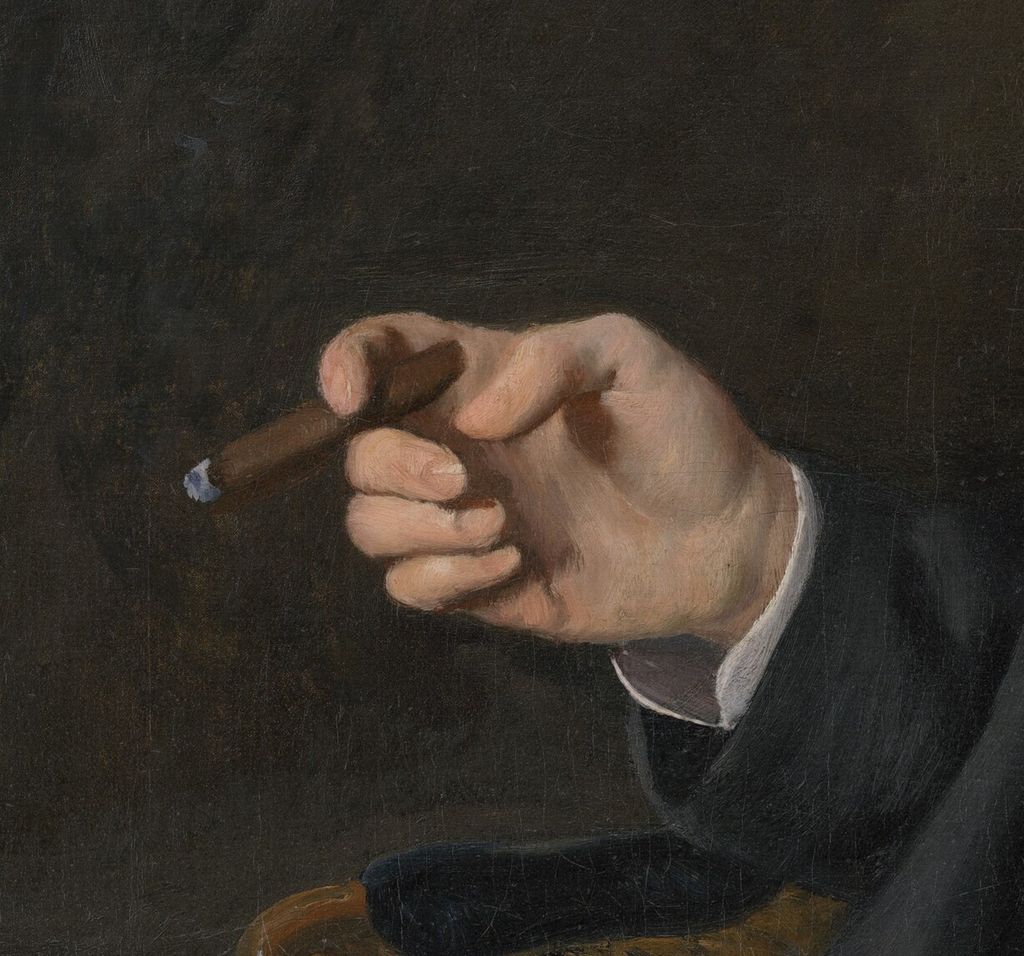
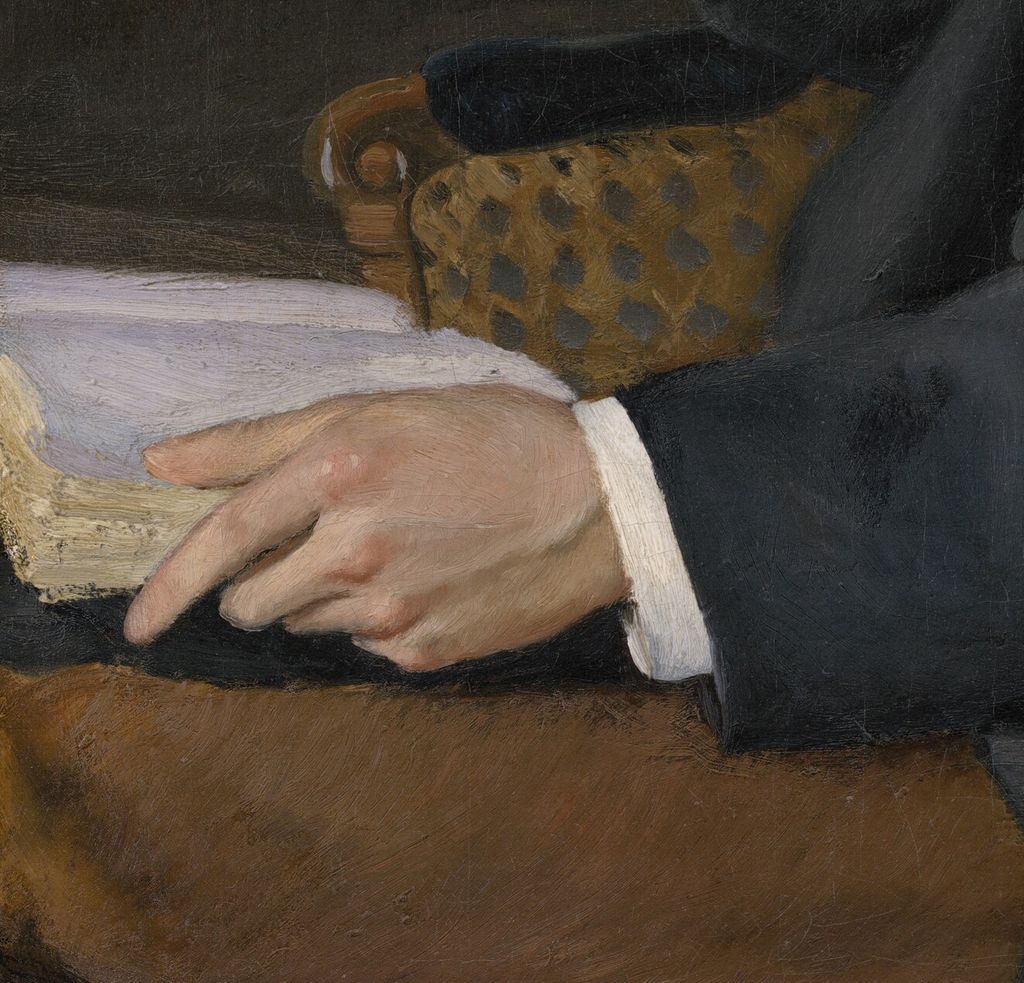
The two hands perform very different tasks. The left holds the book open, with the fingers spread across its lower edge. Its pale pages provide the broadest light area near the bottom of the composition. Above it, the right hand holds the cigar delicately, projecting into the dark field to the left. Nothing else competes with that isolated gesture. The gap between the hands slows the eye as it moves from the open pages towards the face.
The cigar does not establish that Maître has stopped reading. His eyes are still directed downwards, and his finger maintains his place. Nor can we know the particular passage before him: the book offers the visible shape of reading without yielding an identifiable text. That distinction is part of the portrait’s interest. We can see the activity clearly while remaining outside its content.
The same balance operates in the clothing. The white collar makes a crisp border under the beard, but the patterned neckwear immediately breaks up the severity of the dark suit. The blue lapel flower is small enough to be missed when looking first at the face. Once noticed, it becomes a concentrated point of colour between the face and the book. Its irregular petals differ from the pale, repeated spots at the throat. One detail is loosely clustered, the other patterned.
Below, the chair offers another change of texture. Warm wood and the perforated cane side contrast with the broad fabric of the sleeve. The curved arm and back support the seated body, but only portions of their construction remain visible. Bazille gives enough furniture to establish comfort and support without turning the room into a second subject.
These objects suggest cultivated leisure, a reading also developed in Schulman’s account of Maître’s literary and musical interests. Yet they remain particular things before becoming signs of character. The carefully held cigar, open book and flower do not tell us everything about the person who uses or wears them. [3]
Annotated Details from Portrait of Edmond Maître
The numbered points identify visible features discussed in this article. Return from each detail to the whole composition. Portrait of Edmond Maitre
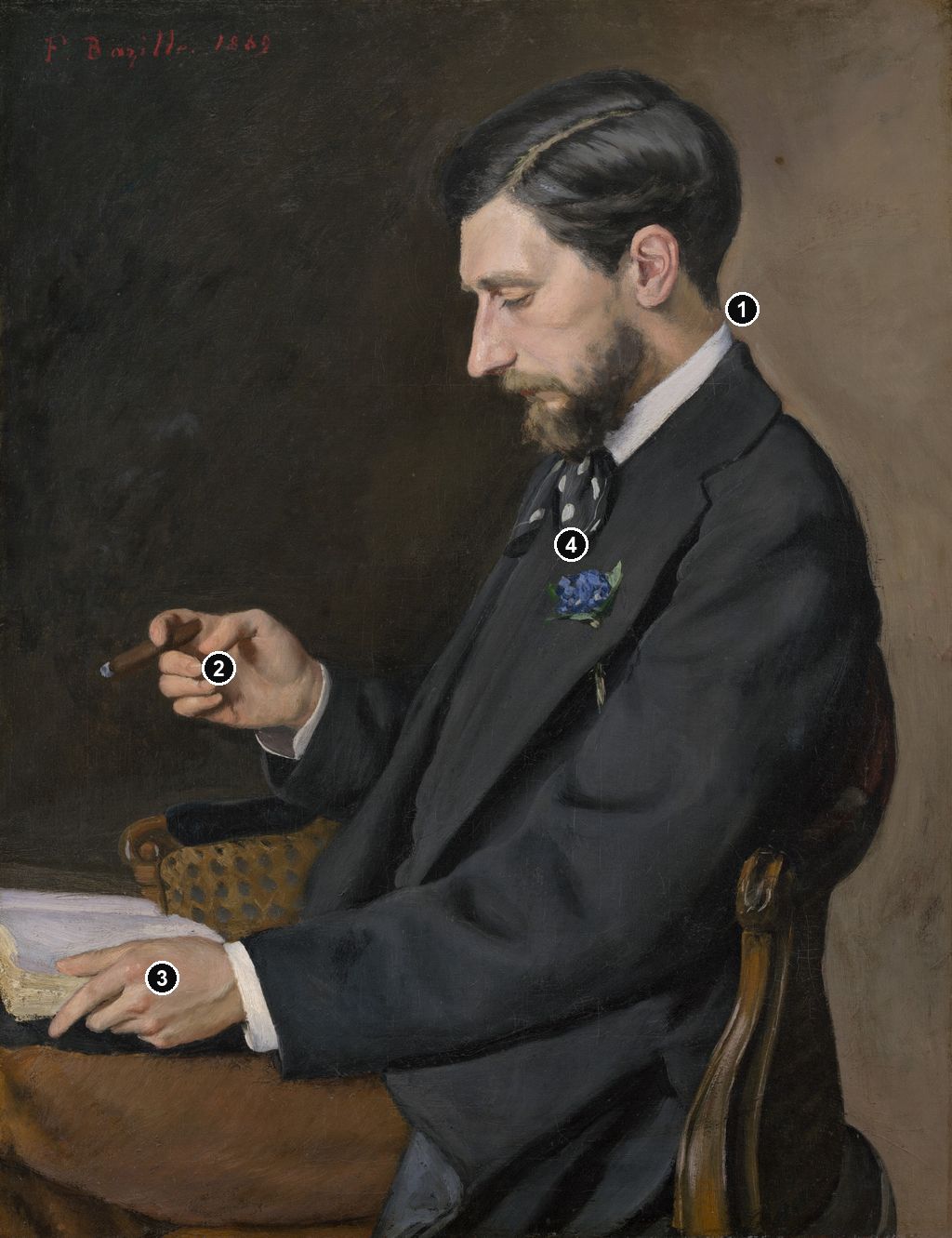
Details from PORTRAIT OF EDMOND MAÎTRE
Compare the cropped details with the complete images above. Notice how their colours, shapes and positions contribute to the larger compositions.
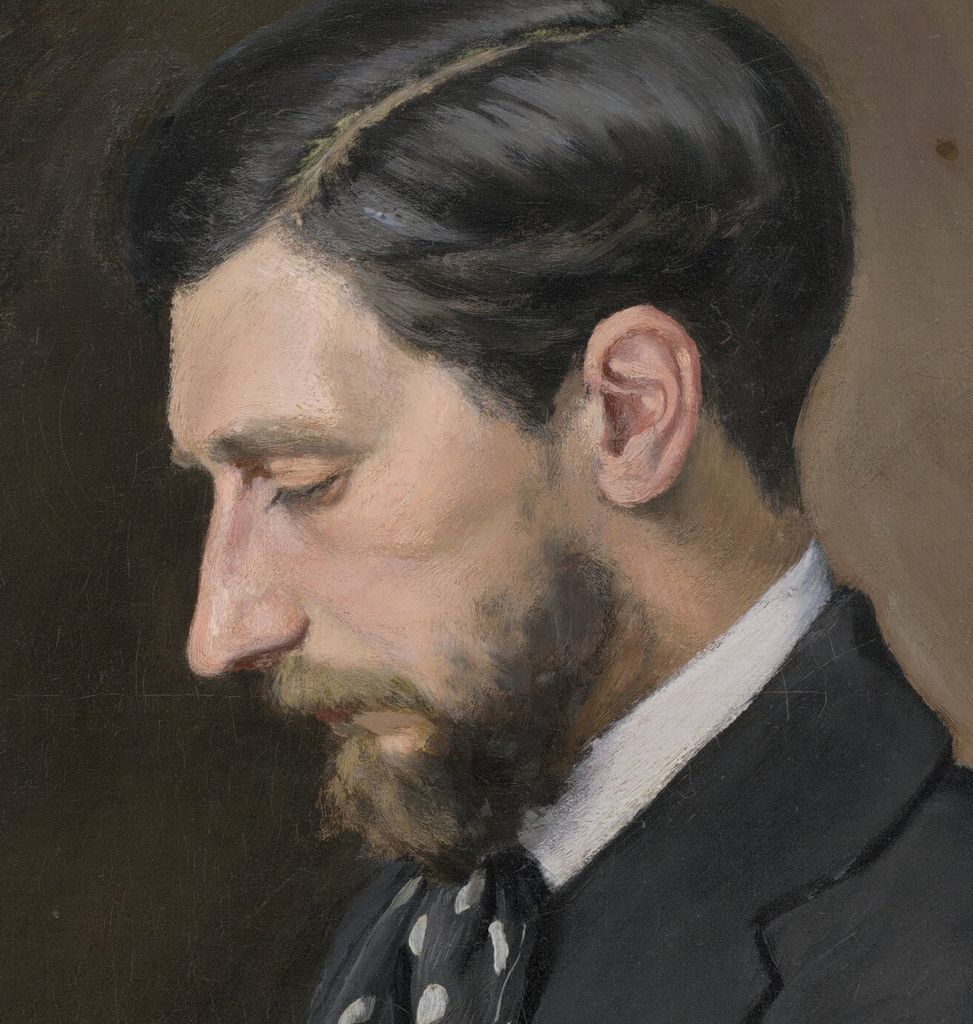
The lowered profile
The light face emerges against the dark field while the lowered eyes keep attention within the painting.
The hand holding the cigar
The isolated gesture projects into open darkness, separated from the other hand and the book.
Book and supporting hand
Pale pages and white cuff make a low light area, grounding the portrait’s activity in a particular held object.
Flower and patterned neckwear
Small blue petals and pale repeated spots bring different kinds of colour and pattern into the dark suit.
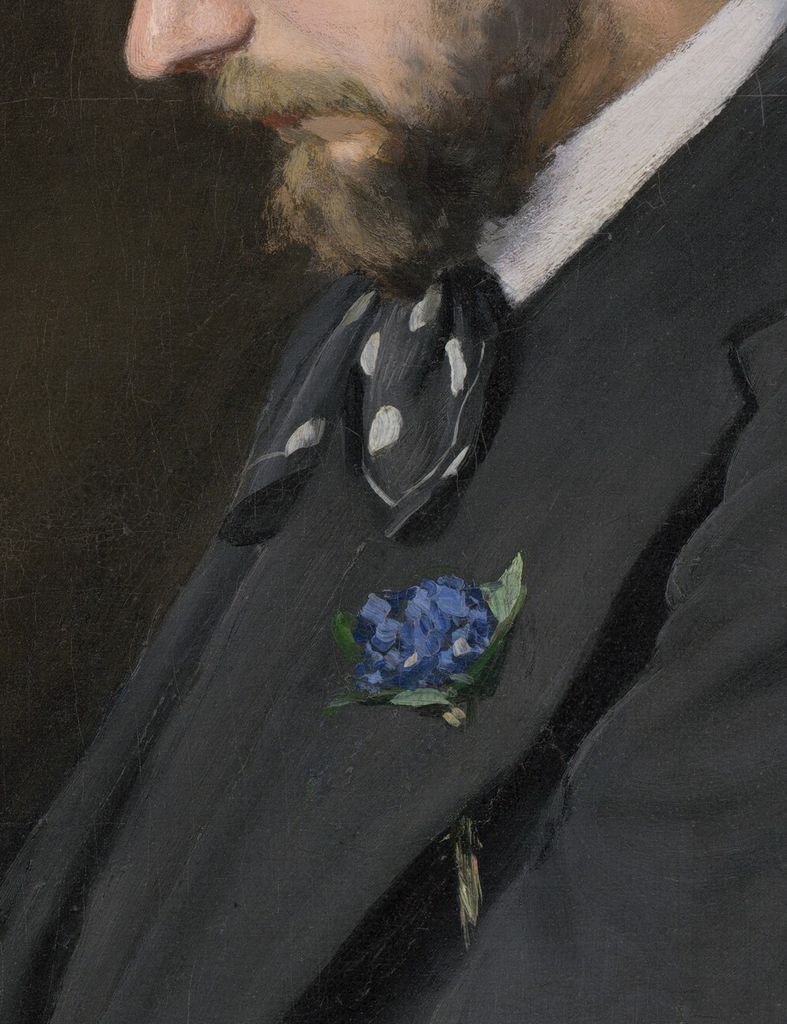
A dark painting with many differences
The apparent simplicity of the colour scheme is deceptive. The background is darkest on the left and becomes warmer and lighter behind the right shoulder. The figure has an opposing rhythm: the pale face projects into the dark field, while the dark shoulder stands against the lighter ground. This changing relationship keeps the outline clear without surrounding the whole body with an equally strong border.
The hair forms a rounded mass at the top, its sheen broken by a precise parting. Beneath it, the forehead, nose and beard create a much more angular profile. The line down the face is decisive, but the cheek is modelled through softer transitions. Looking from the bright bridge of the nose towards the ear reveals how much of the head is conveyed through modest shifts of warm and cool colour rather than a repeated dark contour.
The jacket also contains more variation than its first impression suggests. Long lapels lead down from the white collar towards the lower centre. Broad, subdued highlights across the sleeve distinguish its volume from the waistcoat beneath. The hands, shirt and flower interrupt these dark shapes at different heights. Brown trousers then give the lower portion a warmer weight. The painting’s tonal restraint makes these small changes carry much of its structure.
The handling changes with the thing depicted. The face is more closely resolved than the surrounding ground; the flower is built from small, conspicuous touches; the background remains more broadly worked. Bazille varies the degree of description within a single figure, giving the hair, pages and cloth different kinds of emphasis.
Watch: Bazille and early Impressionism
Explore a Paris studio with Smarthistory, then discover the beginnings of Impressionism with the National Gallery of Art.
Jean-Frédéric Bazille, The Artist’s Studio, Rue Visconti, Paris
A close look at Bazille’s 1867 painting of the studio he shared in Paris.
Watch on YouTubeMusic and the friendship beyond the chair
Maître’s connection with Bazille began in 1865. He worked at the prefecture of the Seine, in the department concerned with public instruction and religious affairs, while maintaining literary, artistic and musical interests. Schulman places these pursuits at the centre of the friendship. [3] Michel Hilaire likewise describes the two friends attending concerts, discussing literature and playing piano duets. [4]
Bazille’s own letters bring this shared life into focus. In a letter to his mother assigned to mid-February 1869, he writes from Maître’s home. Much of the letter concerns work: painters have admired his recent pictures, models require payment, rehearsals occupy his evenings, and he is making plans for further painting at Méric. He ends by explaining that Maître is waiting for him at the piano. The movement from professional concerns to music is immediate and ordinary. [5]
That setting gives the portrait a fuller context. The man shown alone with a book was also someone with whom the painter spent evenings making music. Reading, music and friendship belonged to overlapping parts of their lives. The letter does not establish which book appears in the painting or what music they played that particular evening; it does establish that the portrait’s cultivated setting has a counterpart in a documented relationship.
A further letter, assigned to late 1869, again finds Bazille writing from Maître’s home. He tells his father about attending Fidelio with Maître, Renoir and others, followed by a meal of sauerkraut. Another evening’s news concerns a woodcock cooked at Maître’s. Alongside these pleasures, Bazille lists his current work, including the studio interior, a portrait of Blau and a female nude intended for the Salon. [6]
The letters do not divide artistic ambition from sociability as cleanly as a solemn portrait might encourage us to do. Music evenings, food, friends and paintings recur within the same account of daily life. Maître’s absorption in the portrait need not therefore be treated as evidence that he was detached from other people. Bazille has selected a quiet activity from a friendship that also involved shared performances, visits and conversation.
The Musée Fabre’s account of the artist’s life supplies a later, more urgent expression of that bond. In August 1870, Maître protested against Bazille’s decision to enlist, and Renoir added to the communication. Bazille was killed at Beaune-la-Rolande on 28 November that year. [7] Those events make the portrait moving in retrospect, but they are later events. The composed reader of 1869 should not be made to foresee the painter’s death.
Reading the pose without diagnosing the sitter
Maître’s pale face, lowered eyes and narrow profile have invited psychological descriptions. Schulman’s discussion passes on older readings of a disillusioned intellectual and a man of fragile health, while emphasising the portrait’s psychological interest. These are interpretations of the person through his painted appearance. They should be distinguished from what the canvas itself can demonstrate. [3]
The visible evidence is more precise and more limited. Maître looks down; his mouth is closed; the hand supporting the book is at rest. His face receives strong light against a dark setting. These choices can produce an impression of seriousness or inwardness without proving melancholy, illness or disappointment. A light complexion also has a pictorial function here: it makes the head emerge from the surrounding darks.
The profile gives that restraint a particular form. A frontal sitter can appear to return our scrutiny, but this reader remains directed towards something within the picture. We are allowed to study him while he appears to continue an activity of his own. The portrait’s intimacy grows from that combination of access and distance. It makes attention visible while preserving the privacy of its object.
Nor does friendship mean that every detail must reveal a private message. The flower need not be assigned an undisclosed symbolic meaning, and the cigar does not require an anecdote about Maître’s habits. Bazille’s arrangement is already expressive through the relationships it establishes among face, hands and objects. Its specificity is stronger than an invented key to the sitter’s personality.
Maître among Bazille’s other friends
In Bazille’s Studio, Rue La Condamine, Maître appears at the piano on the right of the room. Schulman identifies the pianist as Maître while recognising disputes over several of the other figures. [8] The comparison changes the scale of his presence. In the portrait, his body dominates almost the whole canvas; in the studio scene, the musician occupies a corner beyond a large stretch of floor. Nevertheless, the piano gives him a distinct activity within the gathering.
Both pictures allow him to concentrate on something other than the viewer. In one, the book is close to the bottom edge; in the other, the keyboard and music stand organise a small working space within the larger studio. The comparison connects the solitary-looking reader with the social environment documented in the letters. It also shows how Bazille can make attention part of a group picture without bringing every person into the central conversation.
The Portrait of Renoir offers a different arrangement of a seated friend. Renoir’s knees rise high, his forearms stretch across them, and his hands gather near the centre. The pale wall makes his compressed pose particularly legible. [9] Maître’s body is more extended and supported by the chair. His two hands stay apart, each associated with a separate object. The difference is one of pictorial organisation before it becomes a judgement about either man’s temperament.
In the Portrait of Édouard Blau, the curved red frame and green upholstery of a chair remain prominent around the head. That sitter looks to the side with open eyes, while Maître’s lowered gaze remains anchored to his book. These neighbouring portraits make clear how much Bazille could change within a restricted subject: a dark-suited man, seated indoors, becomes a different encounter through the position of the head, the amount of body shown and the setting that surrounds it.

Portrait of Édouard Blau

Portrait of Renoir
From Maître’s possession to Washington
The Washington portrait belonged first to Maître and then to his brother Léon. The National Gallery records it with André Bazille by at least 1935, followed by Mme Rachou-Bazille. Through Wildenstein, it entered Paul Mellon’s collection in August 1960; the gift to the National Gallery followed in 1985. [1] Its ownership thus connects the sitter’s family, the artist’s family and a later public collection.
It also took part in the large retrospective shared by Montpellier, Paris and Washington in 2016–17, where the checklist dated it to early 1869. [10] Seen within Bazille’s wider work, it expands the idea of a painter often approached through outdoor figures and southern light. Here the central problem is the sustained presence of a single clothed person in a subdued interior.
The portrait rewards a correspondingly slow kind of looking. Its dark field initially draws us towards the face, then releases the eye to the patterned neckwear, blue flower, separated hands and open pages. Those details establish a recognisable activity without exhausting the person. Bazille’s friend is close enough to observe carefully, occupied enough to remain his own.
Bazille catalogue directory
The 284 records comprise 85 painting records,40 separate works-on-paper records and 159 album or study records. They describe the catalogue’s organisation rather than 284 independent objects or unanimously accepted attributions. Recto, verso, albums and multiple studies remain distinct. Dates are qualified where needed; the Drawing filter includes the etching, gouache and mixed works on paper. Manuscript mentions and unproved projects are listed separately below.
Works known through documents
These mentions remain separate from the 284 catalogue records. Some may concern surviving studies or underlying compositions; they cannot simply be added together as missing physical paintings.
- A copy after Rubens mentioned in March 1863 is unlocated.
- A portrait of an unidentified woman was reported completed before July 1866.
- A portrait of Monet and a composition of two life-size women arranging flowers were reported in progress in April 1867. Their mention does not establish two otherwise unknown surviving canvases.
- Gertrude et le père Lapin was at least begun in the summer of 1870.
Further reported works and uncertain attributions
- A Bouquet of Lilacs was reportedly stolen and returned in 1864; a portrait of the friend Theulier and Yellow Narcissi reported by Maître in 1868 are also documentary mentions.
- Unidentified pictures associated with Guillemet and Mme Rolina are reported through later correspondence cited by the catalogue.
- Children Dressed as Bride and Groom was associated with Vallotton’s collection and also attributed to Renoir. Its identification and authorship should remain open.
Projects whose completion is unproved
- A portrait of Pauline was planned in July 1865.
- A portrait of Marc was proposed in April 1866; a related drawing survives.
- A Jardinière project appears in album inscriptions and related figure material. Written plans are not evidence of a completed painting.
| Name | Date | Medium |
|---|---|---|
| Mystic Marriage of St. Catherine | 1863 | Oil on canvas |
| Trees, Study | 1863 | Oil on canvas |
| Farm of Saint-Sauveur | 1863 | Oil on canvas |
| In the Garden of the Parc Monceau, Paris | 1864 | Oil on canvas |
| Naked Woman from Behind | 1864 | Oil on canvas |
| Reclining Nude | 1864 | Oil on canvas |
| Courtyard of the Auberge du Cheval blanc at Chailly near Barbizon | 1864 | Oil on canvas |
| Covered Soup Bowls | 1864 | Oil on canvas |
| Two Herrings | 1864 | Oil on canvas |
| The Pink Dress | 1864 | Oil on canvas |
| The Dog Rita Asleep | 1864 (catalogue); c. 1864 (2017 checklist) | Oil on canvas |
| The Scoter | 1864 | Oil on canvas |
| Naked Reclining Woman | 1864 | Oil on canvas |
| Landscape at Chailly | 1865 | Oil on canvas |
| Rocks at Chailly, Forest of Fontainebleau | 1865 | Oil on canvas |
| Undergrowth at Chailly, Forest of Fontainebleau | 1865 | Oil on canvas |
| Still Life with Grapes and Nuts | 1865 | Oil on canvas |
| Self-Portrait with a Palette — Chicago | 1865 | Oil on canvas |
| Landscape of Saint-Sauveur | 1865 | Oil on canvas |
| Beach at Sainte-Adresse | 1865 | Oil on canvas |
| The Improvised Field Hospital | 1865 | Oil on canvas |
| Village Street, Chailly | 1865 | Oil on canvas |
| Small Valley in the Forest of Fontainebleau | 1865 | Oil on canvas |
| Forest of Fontainebleau | 1865 | Oil on canvas |
| Woman Ironing | 1866 | Oil on canvas |
| The Artist's Studio on the rue de Furstenberg | 1865–66 (museum) | Oil on canvas |
| Still Life with Fish | 1866 | Oil on canvas |
| Little Italian Street Singer | 1866 | Oil on canvas |
| Potted Flowers | 1866 | Oil on canvas |
| The Little Gardener | 1866–1867 | Oil on canvas |
| Young Woman Playing the Piano | 1866–1867 | Oil on canvas |
| End of a Summer Day | 1866–1867 | Oil on canvas |
| A Studio on the rue Visconti | 1867 | Oil on canvas |
| Thérèse Reading in the Park at Méric | 1867 | Oil on canvas |
| Portrait of Verlaine | 1867 | Oil on canvas |
| The Terrace at Méric | 1867 | Oil on canvas |
| Still Life with Heron | 1867 | Oil on canvas |
| The Family Gathering | 1867–68 (museum) | Oil on canvas |
| Oleanders | 1867 | Oil on canvas |
| Woman on the Terrace at Méric | 1867 | Oil on canvas |
| The Ramparts at Aigues-Mortes from South | 1867 | Oil on canvas |
| The Western Ramparts at Aigues-Mortes | 1867 | Oil on canvas |
| Portrait of Edmond Maître — head study | 1867 | Oil on canvas |
| Porte de la Reine at Aigues-Mortes | 1867 | Oil on canvas |
| Portrait of Sisley | 1867 | Oil on wood |
| Portrait of Renoir — Cleveland | 1867 | Oil on canvas |
| Portrait of Renoir — Musée d’Orsay | 1867 | Oil on canvas |
| Self-Portrait with a Detachable Collar — Minneapolis | 1865–67 (museum); 1867–68 (catalogue) | Oil on canvas |
| Vase of Flowers on a Console | 1868 (museum); 1867–68 (catalogue) | Oil on canvas |
| Portrait of a Woman | 1868 | Oil on canvas |
| Young Woman in the Vineyards | 1868 | Oil on card |
| Harvester with a Basket | 1868 | Oil on card |
| Harvester with a Yellow Hat | 1868 | Oil on card |
| Harvester with a Headdress | 1868 | Oil on panel |
| On the Banks of the Lez | 1868 | Oil on canvas |
| After the Bath (attribution questioned) | 1868? | Oil on canvas |
| Young Woman with Lowered Eyes | 1868 | Oil on canvas |
| Fisherman with a Net | 1868 | Oil on canvas |
| View of the Village | 1868 | Oil on canvas |
| Portrait of Bazille (attributed to Monet by Musée Fabre; disputed catalogue attribution) | 1864 (museum); 1868 (catalogue) | Oil on panel |
| Studies for a Grape Harvest (two panels) | 1868 | Oil on canvas (two panels) |
| The Fortune Teller | 1868–69 (catalogue); c. 1869–70 (2017 checklist) | Oil on canvas |
| Harvester with a Cap | 1869 | Oil on card |
| Portrait of Edmond Maître — 1869 | 1869 | Oil on canvas |
| Woman in a Moorish Costume | 1869 | Oil on canvas |
| Young Woman in the Garden | 1869 | Oil on canvas |
| Portrait of Alphonse Tissié in a Cavalryman's Uniform | 1869 | Oil on canvas |
| Portrait of a dragoon | 1869 | Oil on canvas |
| Portrait of Zacharie Astruc | 1869 | Oil on canvas |
| Bunch of Grapes in a Bucket | 1869 | Oil on card |
| Portrait of Edouard Blau | Probably 1869; inscribed 1866 | Oil on canvas |
| Young Male Nude Lying on the Grass | 1870 | Oil on canvas |
| Summer Scene | 1869–1870 | Oil on canvas |
| The Studio on the rue La Condamine | 1869–1870 | Oil on canvas |
| La Toilette | 1870 | Oil on canvas |
| Young Woman with Peonies — Montpellier | 1870 | Oil on canvas |
| Young Woman with Peonies — Washington | 1870 | Oil on canvas |
| Monotonous Chant | 1870 | Oil on canvas |
| Flowers — private collection | 1870 | Oil on canvas |
| Flowers — Musée Fabre | 1870 | Oil on canvas |
| Young Fisherman | 1870 | Oil on canvas |
| Study for Ruth and Boaz | 1870 | Oil on wood |
| Ruth and Boaz | 1870 | Oil on canvas |
| Self-Portrait in Shirt Sleeves | 1870 | Oil on canvas |
| Landscape on the Banks of the Lez | 1870 | Oil on canvas |
| Study after an Alpine Landscape | 1860 | Graphite on watercolour-tinted paper |
| Profile Head | 1862 | Charcoal on laid paper |
| Studies after Delacroix | 1863 | Ink and graphite, with gouache and watercolour, on paper |
| Academic Head | 1863 | Charcoal on paper |
| Study of a Woman's Head in Profile on a Chair | 1863 | Charcoal on paper |
| Academic Head of a Woman | 1863 | Charcoal on paper |
| Academy of Woman | 1863 | Black pencil and charcoal, stumped, on watermarked laid paper |
| Academy of Man | 1863 | Black pencil and charcoal, stumped, on watermarked laid paper |
| Naked Man | 1863 | Charcoal on paper |
| The Pont au Change in Paris | 1864 | Watercolour on paper |
| Study for the Pink Dress or Portrait of Thérèse des Hours | 1864 | Black pencil on paper |
| Naked Woman Standing | 1864 | Pencil on paper |
| Study of a Reclining Nude | 1864 | Charcoal on paper |
| Bathers | 1864 | Charcoal on paper |
| Portrait of a Man | 1864 | Charcoal on paper |
| Study for The Pink Dress | 1864 | Black pencil, squared, on paper |
| Study for Landscape of Saint-Sauveur | 1864 | Graphite on paper |
| Study for Landscape of Saint-Sauveur | 1865 | Pencil on paper |
| Man Taming a Bull | 1866 | Pen and black pencil on paper |
| Man Half Lying on a Sofa | 1866 | Charcoal on paper |
| Study for The Family Gathering | 1867 | Pencil on paper |
| Study for The Family Gathering | 1867 | Graphite, charcoal and black pencil on paper |
| The Embroiderer | 1867 | Pencil on pink paper |
| Study of Children | 1867 | Pencil on paper |
| Women in a Garden | 1867 | Pencil drawing |
| View of the Village | 1868 | Etching on paper |
| Portrait of a Bearded Man (catalogued as Self-Portrait) | Undated (museum); 1869 (catalogue) | Charcoal and brown ink |
| Man Smoking Pipe | 1869 | Watercolour on paper |
| Manet Drawing | 1868–70(?) (museum) | Charcoal and white chalk on paper |
| Study for the Summer Scene | 1869 | Charcoal, pen and ink on paper |
| Family Portrait | 1869 | Pastel and charcoal on paper |
| Study for Ruth | 1870 | Pencil and charcoal on paper |
| Woman Arranging a Hat | 1870 | Pencil drawing |
| Study for Boaz Asleep | 1870 | Pastel and red chalk |
| Boaz Asleep | 1870 | Charcoal and pencil on paper |
| Study for Boaz Asleep | 1870 | Black and beige pastel with red chalk on laid paper |
| Ruth Lying down | 1870 | Charcoal and pastel on paper |
| Head, Arm and Chest of Ruth | 1870 | Charcoal on paper |
| Chest of Ruth | 1870 | Black chalk and charcoal on paper |
| Black Woman with Peonies — gouache | c. 1870 | Gouache, watercolour, pencil and black chalk on card |
| Various Unidentified Subjects | Undated | Pencil drawing |
| Rocky Sea Side | Undated | Charcoal on paper |
| Studies of a Dancing Woman | Undated | Drawing with white chalk |
| Study of a Leg | Undated | Pencil drawing |
| Dancers in Camargue | Undated | Pencil drawing |
| Academy of Woman | Undated | Charcoal |
| Caricature of Venus of Milo and Various Other Caricatures | Undated | Charcoal |
| Caricature | Undated | Pencil drawing |
| Study of Landscape | Undated | Charcoal |
| Caricatures and Seated Monk | Undated | Charcoal |
| Caricatures and Various Subjects | Undated | Pencil drawing |
| Women Carrying a Pitcher | Undated | Pencil drawing |
| The Hanged Man | Undated | Charcoal |
| Castle in the Plain | Undated | Charcoal |
| Naked Woman from Behind | Undated | Charcoal |
| Caricatures | Undated | Charcoal and pencil |
| Unidentified Subjects | Undated | Pencil drawing |
| Landscape with a Castle | Undated | Charcoal |
| Study of Landscape | Undated | Charcoal |
| Horse Rider seen from Behind | Undated | Charcoal |
| Mazeppa | Undated | Pencil and charcoal |
| Study of Rider and Others Subjects | Undated | Pencil, pen and brown ink |
| Study of an Unidentified Man | Undated | Pencil drawing |
| Study for an Unknown Historic Scene | Undated | Pencil drawing |
| Study a Man Reading | Undated | Pencil drawing |
| Study of Men Reading | Undated | Pencil drawing |
| Study of Landscape ? | Undated | Charcoal |
| Study of a Head of a Man | Undated | Pencil drawing |
| Erotic Scene | Undated | Pencil drawing |
| Study of Dog | Undated | Charcoal |
| Studies of Unidentified Subjects and Erotic Scene | Undated | Pencil and charcoal drawing |
| Study for a Theater Scene | Undated | Charcoal |
| Study of a Reclining Naked Woman | Undated | Charcoal |
| Two Studies of Landscape | Undated | Pencil drawing |
| Caricature | Undated | Pencil and charcoal drawing |
| Portrait of an Unidentified Young Man | Undated | Charcoal |
| Study of an Unidentified Subject | Undated | Brown ink drawing |
| Unidentified Man with a Hat | Undated | Pencil and charcoal |
| Study of an Unidentified Women | Undated | Pencil drawing |
| Study for a Theater Character ? | Undated | Pencil drawing |
| Study for a Theater Character ? | Undated | Pen drawing |
| The Pavillon de la Reine in Paris | Undated | Pencil drawing |
| Study of a Horse Rider | Undated | Pencil and charcoal drawing |
| Entwined Couple. Caricature ? | Undated | Pencil drawing |
| Woman Sitting on a Sofa | Undated | Pencil drawing |
| Studies of Unidentified Subjects | Undated | Pencil and charcoal drawing |
| Studies of Animals | Undated | Pencil drawing |
| Study of a Horse Rider in Camargue | Undated | Charcoal |
| Study of Hunting Dogs | Undated | Pencil drawing |
| Study of Soldiers. Caricatures | Undated | Pencil drawing |
| Studies of Hunting Dogs ? | Undated | Pencil drawing |
| Hunting Scene. Hunter Playing the Horn | Undated | Pencil drawing |
| Caricature | Undated | Pencil drawing |
| Study of an Ibex | Undated | Pencil drawing |
| Theater Scene. Caricatures | Undated | Pencil drawing |
| Studies of Animals. Horses ? | Undated | Pencil drawing |
| Caricatures | Undated | Pencil drawing |
| Studies of Various Subjects and Animals | Undated | Pencil drawing |
| Unidentified Subject | Undated | Pencil drawing |
| Rider Taming a Horse [in Camargue ?] | Undated | Pencil drawing |
| Caricature of a Soldier | Undated | Pencil drawing |
| Study of a Woman and Mouse | Undated | Pencil drawing |
| Historic Scene | Undated | Charcoal |
| Architecture Studies | Undated | Pencil drawing |
| Mythologic Scene | Undated | Charcoal |
| Ophelia | Undated | Pencil drawing |
| Mythologic Scene | Undated | Charcoal |
| Studies of Various Subjects | Undated | Pencil and pen drawing |
| Studies of Peasants | Undated | Pencil drawing |
| Historic Scene | Undated | Pencil drawing |
| Historic or Literary Scene | Undated | Pencil drawing |
| Unidentified Historic Scene | Undated | Pencil drawing |
| Studies of Unidentified Subjects | Undated | Pencil drawing |
| Unidentified Study | Undated | Pencil drawing |
| Man in an Armchair | Undated | Pencil drawing |
| Studies of Various Subjects | Undated | Pencil drawing |
| Portraits of Unidentified Men | Undated | Pencil drawing |
| Studies of Various Subjects | Undated | Pencil drawing |
| Horse Rider and Artist | Undated | Charcoal and pencil |
| Study of Unidentified Characters | Undated | Charcoal |
| Dead Horse in a Plain | Undated | Charcoal |
| Study of Various Subjects and Furniture | Undated | Pencil drawing |
| Caricatures and Various Notes about Opéra | Undated | Pencil drawing |
| Galloping Horse | Undated | Charcoal |
| Study for La Toilette | Undated | Pencil drawing |
| Study of a Naked Woman | Undated | Pencil drawing |
| Domestic Scene | Undated | Pencil drawing |
| Physiognomies | Undated | Pencil drawing |
| Study for a Grape Harvest | Undated | Pencil drawing |
| Study for the Summer Scene | Undated | Pencil drawing |
| Female Profiles | Undated | Pencil drawing |
| Various Subjects | Undated | Pencil drawing |
| Study for The Terrace at Méric | Undated | Pencil drawing |
| Study for The Ramparts at Aigues-Mortes | Undated | Pencil drawing |
| Study for The Ramparts at Aigues-Mortes | Undated | Pencil drawing |
| Study for a Grape Harvest | Undated | Charcoal |
| Children Portraits | Undated | Pencil drawing |
| Study for Children's Heads | Undated | Pencil drawing |
| Study of Minerva | Undated | Pencil drawing |
| Study for a Grape Harvest | Undated | Pencil drawing |
| Study for The Family Gathering | Undated | Pencil drawing |
| Study for a Young Fisherman | Undated | Charcoal |
| Self-Portraits | Undated | Black pencil drawing |
| Study of Horses for the Porte de la Reine at Aigues-Mortes | Undated | Ink drawing |
| Study of Horses for the Porte de la Reine at Aigues-Mortes | Undated | Ink drawing |
| Study of Horses for the Porte de la Reine at Aigues-Mortes | Undated | Ink drawing |
| Study for an Outdoor Concert | Undated | Pencil drawing |
| Studies of Legs | Undated | Pencil drawing |
| Study for The Ramparts at Aigues Mortes | Undated | Pencil drawing |
| Studies of Hats | Undated | Pencil drawing |
| Studies of Men | Undated | Pencil drawing |
| Study for The Little Gardener | Undated | Pencil drawing |
| Study for The Ramparts at Aigues Mortes | Undated | Charcoal |
| Studies of Sail Boats | Undated | Pencil drawing |
| Portrait of Marc Bazille | Undated | Charcoal, black pencil and graphite |
| Studies of Children's Heads | Undated | Pencil drawing |
| Study for Aigues-Mortes | Undated | Pencil drawing |
| Studies of Women's Heads | Undated | Pencil drawing |
| Portrait of Camille des Hours and an Unidentified Man | Undated | Charcoal |
| Study of Flying Birds | Undated | Charcoal or graphite |
| Study for the Summer Scene | Undated | Pencil drawing |
| Study of Hands | Undated | Pen drawing |
| Self-Portrait | Undated | Black pencil drawing |
| Study for the Summer Scene | Undated | Pencil drawing |
| Study for the Summer Scene | Undated | Pencil drawing |
| Study for a Grape Harvest | Undated | Pencil drawing |
| Study of Branches | Undated | Pencil drawing |
| Study of a Seated Child | Undated | Pencil drawing |
| Study for a Couple and Unidentified Women | Undated | Pencil drawing |
| Studies of Unidentified Women | Undated | Pencil drawing |
| Study of Buildings | Undated | Pencil drawing |
| Study for a Grape Harvest | Undated | Pencil and charcoal |
| Studies of Boaters | Undated | Pencil drawing |
| Study of a Man Writing at his Table | Undated | Pencil drawing |
| Study of a Woman Cutting Flowers | Undated | Pencil drawing |
| Study of Hand | Undated | Pencil drawing |
| Women in a Garden | Undated | Pencil drawing |
| Studies of Women in Profile | Undated | Pencil drawing |
| Study for Ruth and Boaz | Undated | Charcoal |
| Study for The Family Gathering | Undated | Pencil drawing |
| Study for the View of the Village | Undated | Pencil drawing |
| Study of the View of the Village | Undated | Pencil drawing |
| Study for the Fisherman with a Net | Undated | Pencil drawing |
| Study for the View of the Village | Undated | Charcoal |
| Study for The Little Gardener | Undated | Charcoal |
| Portrait of a Man with a Top Hat | Undated | Pencil drawing |
| Portrait of a Man with a Top Hat | Undated | Pencil drawing |
| Inscriptions | Undated | Pencil inscriptions |
| Study of Tree | Undated | Pencil drawing |
| Caricature of Nina la Belle | Undated | Pencil drawing |
| Study for Saint Sebastian | Undated | Pencil drawing |
| Young Woman Sewing | Undated | Pencil drawing |
| Studies of Hands | Undated | Pencil drawing |
| Woman in a Garden | Undated | Pencil drawing |
| Elegant Woman | Undated | Pencil drawing |
| Various Inscriptions | Undated | Inscriptions (medium unspecified in index) |
| Study of a Man with a Hat | Undated | Pencil drawing |
| Study of a Child | Undated | Pencil drawing |
| Study of a Man with a Hat | Undated | Pencil drawing |
Frequently Asked Questions
The Washington canvas dates from 1869. The National Gallery records 83 × 64.2 cm. [1]
The text has not been securely identified. Its visible role is to give the hands and lowered gaze a shared activity.
Discussion
The reader’s attention is held inside the portrait. How do the book, cigar and lowered face sustain it?
Reader Insights
How does the gap between the cigar hand and the book slow your movement through the portrait?
Which small accent most changes the dark suit: the white cuff, patterned neckwear or blue flower?
Compare the reader with the pianist in Condamine. How does Bazille show concentration within different social settings?
Join the Conversation
Share a detail, comparison or question about Portrait of Edmond Maître by Frédéric Bazille below.
References
- National Gallery of Art, Edmond Maître, 1869, accession 1985.64.2, collection record, inscription, provenance and exhibition history. Source. View source.
- Michel Schulman, Portrait of Edmond Maître, 1867, MSb-28, digital catalogue raisonné, complete entry. Source (English translation of French catalogue). View source.
- Michel Schulman, Portrait of Edmond Maître, 1869, MSb-48, digital catalogue raisonné, complete critical essay. Source (English translation of French catalogue). View source.
- Michel Hilaire, “Bazille ou la vie brève,” Académie des Sciences et Lettres de Montpellier, 2016, pp. 166–172, especially p. 168. Source (in French). View source.
- Frédéric Bazille, letter to his mother, Thursday [mid-February 1869], Musée Fabre, inventory 94.7.3, transcription p. 5; date assigned by the museum. Source (in French). View source.
- Frédéric Bazille, letter to his father, Friday evening [late 1869], Musée Fabre, inventory 92.2.6, transcription p. 4; date assigned by the museum. Source (in French). View source.
- Musée Fabre, Frédéric Bazille: la jeunesse de l’impressionnisme, 2016 exhibition press dossier, especially p. 23, reproducing Maître’s August 1870 communication and recounting Bazille’s death. Source (in French). View source.
- Michel Schulman, The Studio on the rue La Condamine, MSb-58, digital catalogue raisonné, critical essay; used for Maître’s identification at the piano. Source (English translation of French catalogue). View source.
- Michel Schulman, Portrait of Renoir, MSb-30, digital catalogue raisonné; identification and composition, with comparison based on the painting. Source (English translation of French catalogue). View source.
- National Gallery of Art, Frédéric Bazille and the Birth of Impressionism, 2017 exhibition checklist, p. 7, catalogue no. 51. Source. View source.
- Joconde/POP, La Robe rose, RF2450. View source. (in French).
- Musée d’Orsay, L’Ambulance improvisée, RF 1967 5. View source. (in French).
- Musée d’Orsay, Réunion de famille,RF2749. View source. (in French).
- Musée d’Orsay, Pierre Auguste Renoir,DL1970 3. View source.
- Musée Fabre, Vue de village, 898.5.1. View source. (in French).
- National Gallery of Art, Young Woman with Peonies,1983.1.6. View source.
- Michel Schulman, painting index and documentary introduction (English titles; French metadata). View source.
- Michel Schulman, works-on-paper index (English titles; French metadata). View source.
- Michel Schulman, albums and studies index (English titles; French metadata). View source.


 Frederic Bazille.jpg)


