 by Tom Gurney
Tom Gurney BSc (Hons) is an art history expert with over 20 years experience
Published on June 19, 2020 / Updated on November 2, 2026
Email: tomgurney1@gmail.com / Phone: +44 7429 011000
Young Woman with Peonies (Washington Version): Introduction
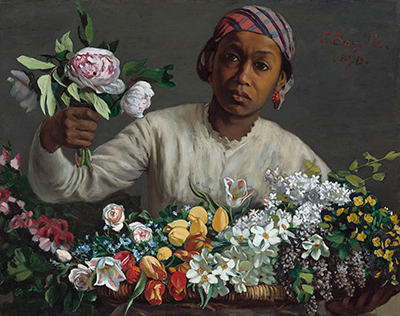
A woman lifts a small bouquet towards us, her hand closed firmly around the stems. Below her, flowers crowd a wide wicker basket; above them, her face holds our attention as insistently as the brilliant petals. Frédéric Bazille’s Young Woman with Peonies, painted in 1870 and now in the National Gallery of Art, Washington, brings a flower seller’s gesture into the close space of a portrait. [1] Its interest lies in the exchange it sets up: we look at flowers offered for inspection, but we also meet the person who holds them.
This is one of two closely related oil paintings, both depicting a Black woman among flowers. In the Montpellier version, she turns towards an arrangement in a vase. Here she faces outwards, extending the bouquet beyond the larger display. Neither the order of the canvases nor the model’s name has been securely established. Their differences are more revealing than an assumed progression from a first attempt to a finished solution. [2]
At a Glance
- Date1870 [1]
- MediumOil on canvas [1]
- Dimensions60 × 75 cm [1]
- CollectionNational Gallery of Art, Washington, 1983.1.6 [1]
This work across Frédéric Bazille’s career
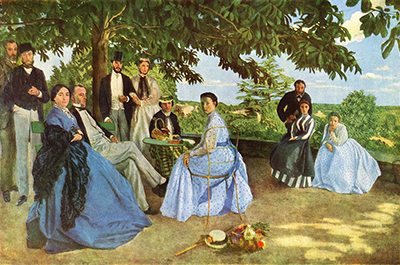
Family Reunion
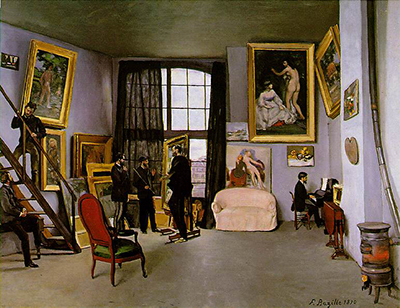
1867–1868 (museum)Bazille’s Studio, Rue La Condamine
1869–1870Summer Scene (Bathers)
1869–1870Contents
- Identifying the Washington painting
- A bouquet held out, a gaze returned
- Flowers as a structure of paint
- Two paintings, two kinds of attention
- Manet, Olympia and the woman at the centre
- A longer interest in women and flowers
- From a friend’s collection to new questions
- Annotated details
Identifying the Washington painting
The Washington canvas measures 60 × 75 centimetres and is painted in oil. Bazille’s red signature and the date 1870 appear against the grey ground at upper right. Its accession number is 1983.1.6. [1] Those details distinguish it from the almost equally sized painting in Montpellier, which has a different arrangement and a separate collection history. The National Gallery’s 2017 retrospective checklist dated both oil paintings to spring 1870; the year itself is recorded on the Washington picture. [3]
The horizontal shape allows the flowers to spread sideways while leaving room for a substantial half-length figure. The figure has enough scale and substance to hold her own against the abundant flowers. Her extended arm occupies almost the whole left half of the upper composition. At the lower right, her other hand appears beneath the basket, supporting its weight. Holding, selecting and presenting are all part of her presence.
The setting offers very little information about where this encounter takes place. There is no street, stall sign, customer or neighbouring shop. The grey background gives the head, sleeve and bouquet clear contours without specifying a room. The flower seller is a role established through the basket and gesture, rather than a documented account of this particular woman’s occupation. The National Gallery likewise describes her as posed as a vendor, without assigning a detailed story to the scene. [1]
That distinction matters. A painting can represent an everyday activity while being carefully arranged in a studio. It can also convey a particular person’s presence without preserving her biography. The absence of a known name should leave space for attention to her, rather than invite an invented identity.
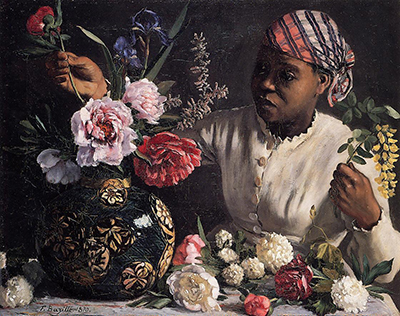
Young Woman with Peonies — Montpellier
A bouquet held out, a gaze returned
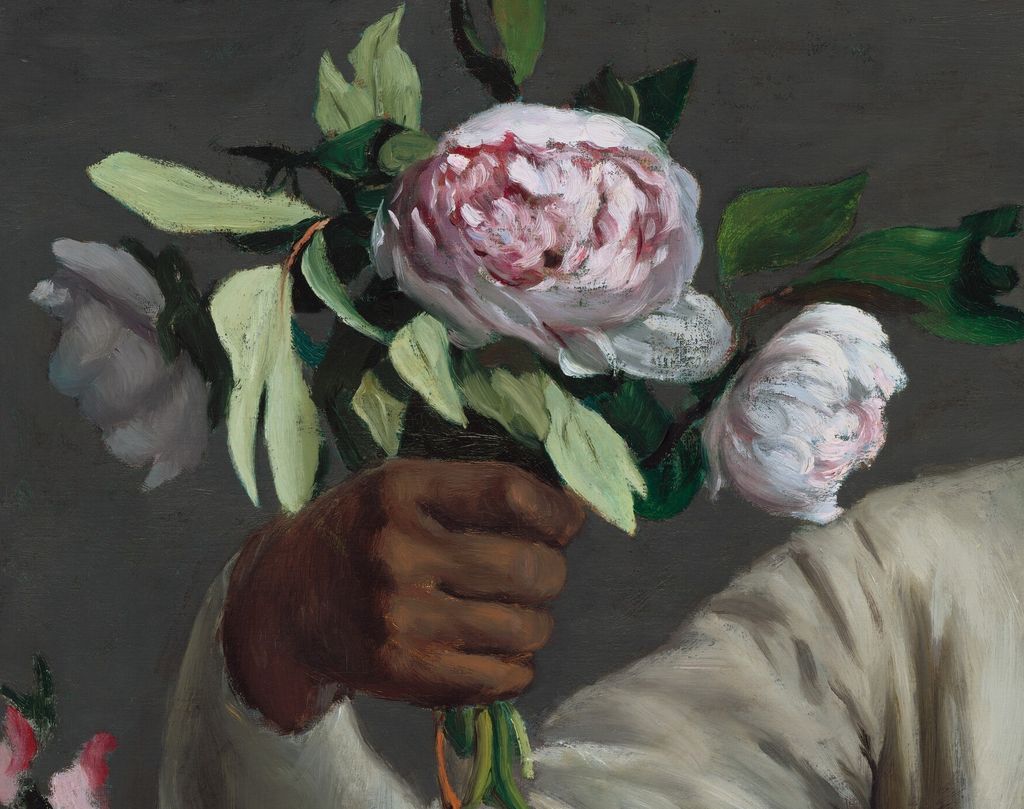
The woman’s right hand, on our left, grips the stems at the point where they become a manageable bunch. Her fingers are painted as a solid, rounded group, with small warm highlights separating their joints. Above the hand, leaves open in several directions. The peonies do not form a neat symmetrical crown: a large pink-and-white flower faces us, another angles downwards, and a paler bloom turns partly away at the outer edge. This variation makes the bouquet feel like something that can be turned and examined.
Her sleeve provides the route between the bouquet and her body. Its folds bend around the raised forearm, then broaden into the white blouse across her chest. The wrist is surrounded by a deep fold of fabric, setting off the exposed hand. Follow this movement back towards her shoulder and it leads towards the head; follow it outwards and it leads towards the flowers. The arm makes an active connection between the two principal subjects.
The offer remains unresolved. She has not released the bouquet, and no receiving hand enters the picture. We occupy the place towards which it is extended, but the painting withholds the next action. That is why the gesture can suggest a sale, a demonstration or simply an invitation to look. None of these possibilities requires us to supply a conversation or decide what the woman is thinking.
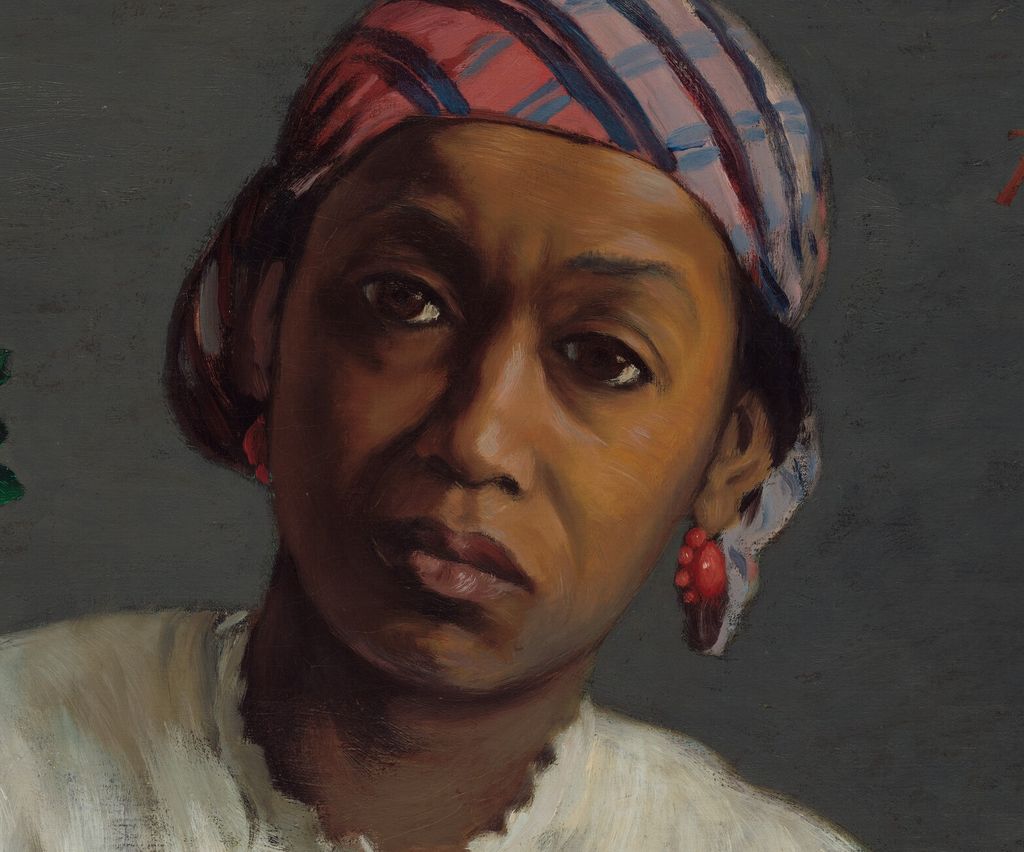
Her face complicates an easy reading of cheerful commerce. The lips are closed, the brows unevenly drawn together, and the eyes look towards us beneath differently lit lids. Her head inclines slightly, giving the gaze an individual direction rather than a rigid frontal symmetry. These visible features make her expression attentive and difficult to settle. They do not establish sadness, suspicion or a personal hardship. The expression sustains our attention even as its precise meaning remains open.
The patterned headcloth introduces an additional rhythm. Red, pale pink and blue-grey bands cross and bend around the head, changing direction with the folds. The red earrings form smaller accents near the cheeks. Both details help connect the face to the flower colours below, but they also remain articles of dress worn by a person. Reading every colour only as a formal device would miss the careful attention given to how she is clothed and presented.
Annotated Details from Young Woman with Peonies (Washington Version)
The numbered points identify visible features discussed in this article. Return from each detail to the whole composition. Young Woman with Peonies
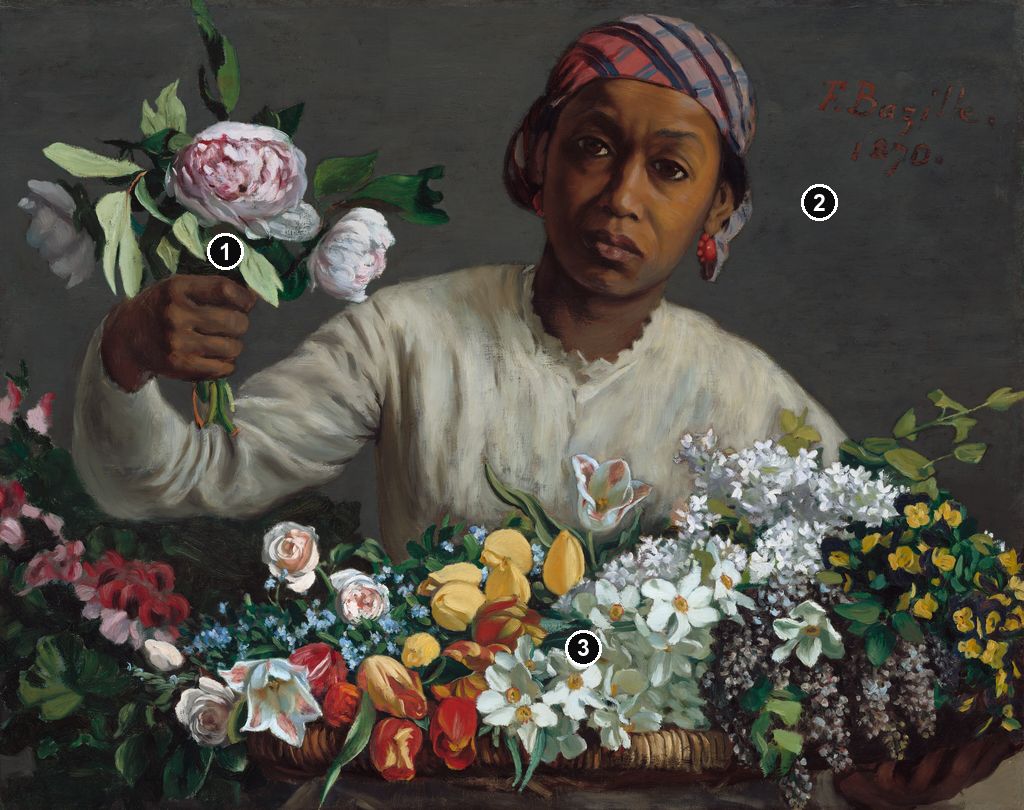
Details from YOUNG WOMAN WITH PEONIES (WASHINGTON VERSION)
Compare the cropped details with the complete images above. Notice how their colours, shapes and positions contribute to the larger compositions.
The raised hand and flowers
The clenched stems and open blooms bring the bouquet forward while the white sleeve returns the movement towards the body.
The face and headscarf
The turned head and direct eyes establish an encounter with the viewer; the striped headscarf adds a second pattern around the face.
The flowers across the foreground
Different sizes, colours and directions of blooms make the lower band active beneath the much quieter blouse.
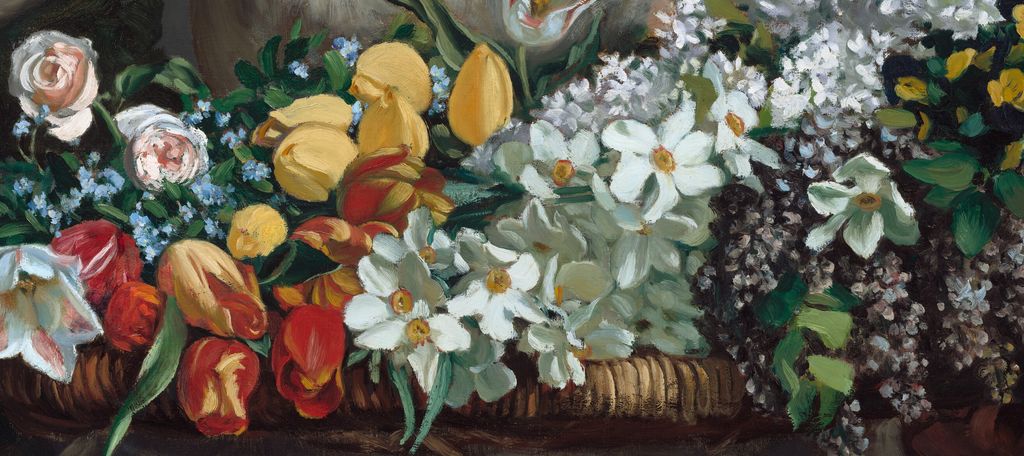
Flowers as a structure of paint
The basket occupies the full width of the foreground. Its rim is easiest to see towards the centre, where short curved strokes describe the woven material below pale blossoms. Elsewhere foliage and petals conceal it. That alternation matters: the visible wicker gives the arrangement a physical support, while the overflowing flowers repeatedly interrupt its boundary.
The flower heads are packed closely enough to create a broad band, yet Bazille keeps changing the scale and direction of his marks. Small blue touches gather between larger pale and red forms. Open white flowers with yellow centres face outwards near the middle and right. Tall, branching clusters rise towards the blouse, while broader folded petals roll forward near the lower edge. These differences make the surface move, even before we try to identify particular flowers.
The flowers held in the hand are especially distinct from the crowded lower display. Open grey space surrounds their outer edges. A few large, curved strokes build the thick petals; pale paint is crossed by pink and darker red, with shadows gathering inside the folded centres. The stems remain narrow and linear. The contrast between these fine supports and the heavy heads gives the bunch a convincing physical imbalance, which the hand must control.
The blouse is equally important to the colour. It is not a flat expanse of pure white. Grey, cream and warmer passages describe its volume, and darker strokes run down between folds. Some edges are crisply separated from the background; others look loosely brushed. Its broad, comparatively quiet area gives the eye a pause between the patterned headcloth and the floral abundance. Because it shares pale tones with the petals, it also prevents the woman from becoming a dark silhouette behind a bright still life.
There is a useful difference between the face and the flowers. The cheeks, nose and mouth depend on transitions between neighbouring tones; a misplaced edge would alter the expression. Across the basket, short strokes can remain more openly independent, letting a patch of colour suggest a petal or leaf. The painting holds these two kinds of attention together. Its subject is a human encounter, but much of its energy comes from the pleasure and difficulty of making many unlike materials readable in paint.
The grey ground is essential to that balance. It absorbs neither the darkest leaves nor the darkest areas of the face completely. It also gives the raised flowers enough space to appear separate from the background. With so much happening along the lower edge, the relatively unoccupied upper corners keep the composition from feeling uniformly crowded.
Watch: Bazille and early Impressionism
Explore a Paris studio with Smarthistory, then discover the beginnings of Impressionism with the National Gallery of Art.
Jean-Frédéric Bazille, The Artist’s Studio, Rue Visconti, Paris
A close look at Bazille’s 1867 painting of the studio he shared in Paris.
Watch on YouTubeTwo paintings, two kinds of attention
The companion in the Musée Fabre measures 60.5 × 75.4 centimetres and was given to the museum by Bazille’s brother Marc in 1918. [4] Its similar dimensions make the differences especially clear. Bazille did not merely move a few flowers within the same setting. He reorganised the relationship between the woman, her hands, the container and the spectator.
In Montpellier, an ornamented vase stands at the left. The model turns towards the flowers, raising one hand to place or adjust a stem while holding further greenery in the other. Her gaze follows the activity across the picture. The vase gathers the flowers into a rising structure, while loose blossoms and stems occupy the surface below. In Washington, the broad basket spreads the floral display across the front, and the lifted bouquet separates out from that abundance. One painting asks us to follow an act of arranging; the other makes us the destination of a gesture.
The two versions also distribute light differently. The Montpellier arrangement emerges against a much darker background, with strong contrasts around the blouse and flower heads. Washington gives the face a wider range of visible warm tones against a lighter grey setting. These differences change how quickly we find the woman’s eyes and how we move between her and the flowers. They need not be explained as an improvement or correction. Each organisation makes a different encounter possible.
Schulman’s catalogue emphasises the uncertainty of their relationship and reports disagreement about which came first. [2] Similar clothing and a closely related sitter connect them, but do not establish the sequence of sittings, the time separating the canvases or an intention to hang them as a pair. Their shared subject gives a strong basis for comparison; a more elaborate story of their production remains uncertain.
A related work on card in the Fitzwilliam Museum adds a third object to this group. Dated around 1870, Black Woman with Peonies measures 33.5 × 52.5 centimetres and combines watercolour, gouache, black chalk and graphite. [5] Its different support and materials distinguish it from both oils. It broadens the evidence for Bazille’s sustained interest in the motif, without by itself resolving the order of the finished canvases.
Manet, Olympia and the woman at the centre
The peonies connect the painting to Édouard Manet as well as to Bazille’s own flower studies. The Musée Fabre’s 2016 retrospective presentation linked both peony paintings with Manet’s flower subjects and with the Black woman carrying flowers in Olympia. It treated the combination of figure and still life as a significant feature of Bazille’s late work. [6]
The comparison involves a profound change in the distribution of attention. In Olympia, painted in 1863 and exhibited at the Salon in 1865, the flower-bearing woman stands beside a reclining nude. [7] Bazille’s Washington canvas gives the woman with flowers the entire human action. There is no second figure to whom her gesture is subordinate. Her face, sleeve and raised hand organise the upper half of the painting, and her gaze brings the viewer directly into the exchange.
The changed relationship is more substantial than a shared flower or a similar headcloth, although it does not settle the painting’s political meaning. Bazille takes a figure-and-bouquet relationship associated with Manet and gives it a different pictorial purpose. The flowers come towards the spectator from someone who is herself looking back. We cannot inspect the display without repeatedly meeting its holder’s eyes.
The Musée d’Orsay’s 2019 exhibition Le modèle noir de Géricault à Matisse placed such paintings within a wider history of Black people’s participation in artistic life. Its curators gave particular attention to the relationship between artists and models, recovering the work of people who had often been reduced to a descriptive title or an unnamed role. [7] That perspective is especially helpful here. The model contributed her body, pose and sustained presence to the making of the image. The painting records that collaboration unevenly: Bazille’s name is conspicuous on the surface, while hers has not been securely recovered.
The resemblance to Manet’s subject must not be used to fill that gap. Laure is associated with Manet’s Olympia, but the identification of Bazille’s model as Laure is unproved. Nor does a staged role as a vendor reveal where this woman was born, how she lived or whether she sold flowers outside the studio. The link to Olympia concerns representation; it cannot supply a missing biography. [2] [7]
Bazille’s La Toilette provides another important comparison. A Black model there occupies the lower-left part of an elaborate scene around a reclining nude. Scholars have associated that model with the woman in the peony paintings, but the identification should remain qualified. [2] Looking between the works, the more secure observation is the change of role and visual emphasis: a bent working figure within a multi-figure interior becomes the dominant presence in an independent composition. The shift is visible whether or not the sitter was the same woman.
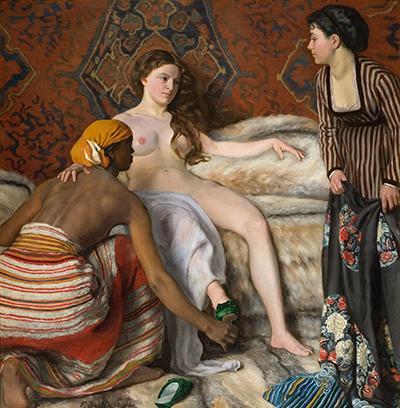
La Toilette
A longer interest in women and flowers
The peony paintings belong to a line of inquiry that predates their immediate relationship with La Toilette. Technical examination of Still Life with Heron revealed an earlier composition beneath it, inverted in relation to the bird painting: a woman behind flowers. In his laboratory study, Bruno Mottin connects this finding with Paul Perrin’s comparisons to a young-woman study and to Bazille’s Potted Flowers. The evidence places an earlier version of the figure-and-flowers problem in the years 1866–67. [8]
That discovery changes the scale of the story. The Washington picture can be understood within Bazille’s recurring efforts to bring a substantial human figure together with a densely worked still life. The earlier hidden composition is not evidence that the same woman posed across these years, and it does not establish how the Washington canvas was prepared. It shows that the combination itself had occupied him before.
The vase of flowers on a console offers a further visual comparison. There, a decorated vessel and surrounding furnishings give the flowers an elaborate domestic setting. Here, the container is a basket held by a person. The change directs attention towards handling and exchange. Flowers can furnish a room, form a still life, be arranged by someone or be offered to someone; Bazille’s pictures explore these different relationships through changes of scale, support and viewpoint.
Schulman also records John Rewald’s interpretation of the Washington display as an affinity with Delacroix, contrasting it with a possible Courbet association in the Montpellier painting. These are historical critical readings rather than a documented programme supplied by Bazille. [2] The distinction is useful chiefly because it reminds us that the painting’s broad colour relationships and abundance have invited several lines of comparison. Its response to Manet does not exhaust its character.
From a friend’s collection to new questions
Bazille gave the Washington painting to his friend Edmond Maître. It passed through Gaston Maître to Marc Bazille in 1913, and later to the artist’s nephew. Paul Mellon bought it through Wildenstein in October 1963; it entered the National Gallery in 1983. [1] That route joins the intimate world of the artist’s friends to the family’s later preservation of his work and its eventual place in a public collection.
Its exhibition history has opened several ways of seeing it. It appeared in the 2015–16 exhibition Delacroix and the Rise of Modern Art and the 2016–17 Bazille retrospective. [1] The 2019 Orsay exhibition brought it into the discussion around Olympia and Black models. [7] These contexts draw attention, respectively, towards colour and artistic inheritance, Bazille’s own development, and the people whose labour helped create modern painting.
The painting can sustain all three perspectives because its formal and human questions are inseparable. The basket is a remarkable concentration of coloured marks, but the hands give it weight and purpose. The blouse is a broad arrangement of pale tones, but it clothes an active body. The face anchors the composition while resisting a single easy description of its expression. Looking from the offered peonies back to the woman, we encounter both a carefully constructed painting and a person whose presence exceeds what the surviving title and history can tell us.
Bazille catalogue directory
The 284 records comprise 85 painting records,40 separate works-on-paper records and 159 album or study records. They describe the catalogue’s organisation rather than 284 independent objects or unanimously accepted attributions. Recto, verso, albums and multiple studies remain distinct. Dates are qualified where needed; the Drawing filter includes the etching, gouache and mixed works on paper. Manuscript mentions and unproved projects are listed separately below.
Works known through documents
These mentions remain separate from the 284 catalogue records. Some may concern surviving studies or underlying compositions; they cannot simply be added together as missing physical paintings.
- A copy after Rubens mentioned in March 1863 is unlocated.
- A portrait of an unidentified woman was reported completed before July 1866.
- A portrait of Monet and a composition of two life-size women arranging flowers were reported in progress in April 1867. Their mention does not establish two otherwise unknown surviving canvases.
- Gertrude et le père Lapin was at least begun in the summer of 1870.
Further reported works and uncertain attributions
- A Bouquet of Lilacs was reportedly stolen and returned in 1864; a portrait of the friend Theulier and Yellow Narcissi reported by Maître in 1868 are also documentary mentions.
- Unidentified pictures associated with Guillemet and Mme Rolina are reported through later correspondence cited by the catalogue.
- Children Dressed as Bride and Groom was associated with Vallotton’s collection and also attributed to Renoir. Its identification and authorship should remain open.
Projects whose completion is unproved
- A portrait of Pauline was planned in July 1865.
- A portrait of Marc was proposed in April 1866; a related drawing survives.
- A Jardinière project appears in album inscriptions and related figure material. Written plans are not evidence of a completed painting.
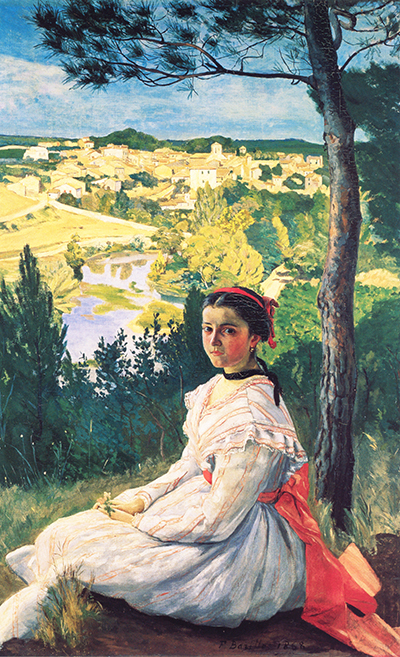
| Name | Date | Medium |
|---|---|---|
| Mystic Marriage of St. Catherine | 1863 | Oil on canvas |
| Trees, Study | 1863 | Oil on canvas |
| Farm of Saint-Sauveur | 1863 | Oil on canvas |
| In the Garden of the Parc Monceau, Paris | 1864 | Oil on canvas |
| Naked Woman from Behind | 1864 | Oil on canvas |
| Reclining Nude | 1864 | Oil on canvas |
| Courtyard of the Auberge du Cheval blanc at Chailly near Barbizon | 1864 | Oil on canvas |
| Covered Soup Bowls | 1864 | Oil on canvas |
| Two Herrings | 1864 | Oil on canvas |
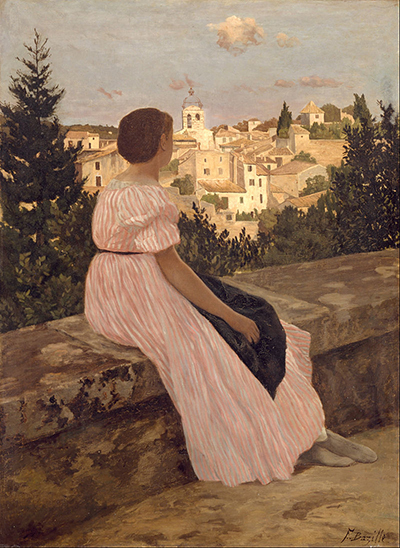
| The Pink Dress | 1864 | Oil on canvas |
| The Dog Rita Asleep | 1864 (catalogue); c. 1864 (2017 checklist) | Oil on canvas |
| The Scoter | 1864 | Oil on canvas |
| Naked Reclining Woman | 1864 | Oil on canvas |
| Landscape at Chailly | 1865 | Oil on canvas |
| Rocks at Chailly, Forest of Fontainebleau | 1865 | Oil on canvas |
| Undergrowth at Chailly, Forest of Fontainebleau | 1865 | Oil on canvas |
| Still Life with Grapes and Nuts | 1865 | Oil on canvas |
| Self-Portrait with a Palette — Chicago | 1865 | Oil on canvas |
| Landscape of Saint-Sauveur | 1865 | Oil on canvas |
| Beach at Sainte-Adresse | 1865 | Oil on canvas |
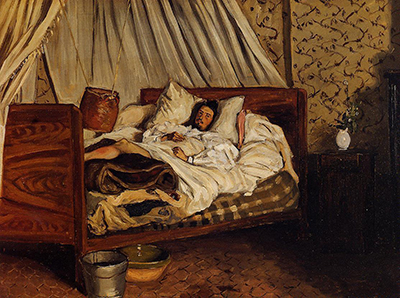
| The Improvised Field Hospital | 1865 | Oil on canvas |
| Village Street, Chailly | 1865 | Oil on canvas |
| Small Valley in the Forest of Fontainebleau | 1865 | Oil on canvas |
| Forest of Fontainebleau | 1865 | Oil on canvas |
| Woman Ironing | 1866 | Oil on canvas |
| The Artist's Studio on the rue de Furstenberg | 1865–66 (museum) | Oil on canvas |
| Still Life with Fish | 1866 | Oil on canvas |
| Little Italian Street Singer | 1866 | Oil on canvas |
| Potted Flowers | 1866 | Oil on canvas |
| The Little Gardener | 1866–1867 | Oil on canvas |
| Young Woman Playing the Piano | 1866–1867 | Oil on canvas |
| End of a Summer Day | 1866–1867 | Oil on canvas |
| A Studio on the rue Visconti | 1867 | Oil on canvas |
| Thérèse Reading in the Park at Méric | 1867 | Oil on canvas |
| Portrait of Verlaine | 1867 | Oil on canvas |
| The Terrace at Méric | 1867 | Oil on canvas |
| Still Life with Heron | 1867 | Oil on canvas |
| The Family Gathering | 1867–68 (museum) | Oil on canvas |
| Oleanders | 1867 | Oil on canvas |
| Woman on the Terrace at Méric | 1867 | Oil on canvas |
| The Ramparts at Aigues-Mortes from South | 1867 | Oil on canvas |
| The Western Ramparts at Aigues-Mortes | 1867 | Oil on canvas |
| Portrait of Edmond Maître — head study | 1867 | Oil on canvas |
| Porte de la Reine at Aigues-Mortes | 1867 | Oil on canvas |
| Portrait of Sisley | 1867 | Oil on wood |
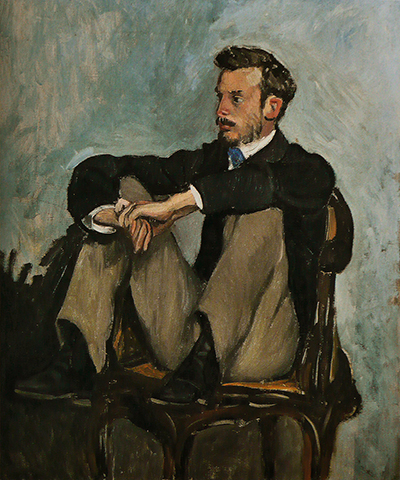
| Portrait of Renoir — Cleveland | 1867 | Oil on canvas |
| Portrait of Renoir — Musée d’Orsay | 1867 | Oil on canvas |
| Self-Portrait with a Detachable Collar — Minneapolis | 1865–67 (museum); 1867–68 (catalogue) | Oil on canvas |
| Vase of Flowers on a Console | 1868 (museum); 1867–68 (catalogue) | Oil on canvas |
| Portrait of a Woman | 1868 | Oil on canvas |
| Young Woman in the Vineyards | 1868 | Oil on card |
| Harvester with a Basket | 1868 | Oil on card |
| Harvester with a Yellow Hat | 1868 | Oil on card |
| Harvester with a Headdress | 1868 | Oil on panel |
| On the Banks of the Lez | 1868 | Oil on canvas |
| After the Bath (attribution questioned) | 1868? | Oil on canvas |
| Young Woman with Lowered Eyes | 1868 | Oil on canvas |
| Fisherman with a Net | 1868 | Oil on canvas |
| View of the Village | 1868 | Oil on canvas |
| Portrait of Bazille (attributed to Monet by Musée Fabre; disputed catalogue attribution) | 1864 (museum); 1868 (catalogue) | Oil on panel |
| Studies for a Grape Harvest (two panels) | 1868 | Oil on canvas (two panels) |
| The Fortune Teller | 1868–69 (catalogue); c. 1869–70 (2017 checklist) | Oil on canvas |
| Harvester with a Cap | 1869 | Oil on card |
| Portrait of Edmond Maître — 1869 | 1869 | Oil on canvas |
| Woman in a Moorish Costume | 1869 | Oil on canvas |
| Young Woman in the Garden | 1869 | Oil on canvas |
| Portrait of Alphonse Tissié in a Cavalryman's Uniform | 1869 | Oil on canvas |
| Portrait of a dragoon | 1869 | Oil on canvas |
| Portrait of Zacharie Astruc | 1869 | Oil on canvas |
| Bunch of Grapes in a Bucket | 1869 | Oil on card |
| Portrait of Edouard Blau | Probably 1869; inscribed 1866 | Oil on canvas |
| Young Male Nude Lying on the Grass | 1870 | Oil on canvas |
| Summer Scene | 1869–1870 | Oil on canvas |
| The Studio on the rue La Condamine | 1869–1870 | Oil on canvas |
| La Toilette | 1870 | Oil on canvas |
| Young Woman with Peonies — Montpellier | 1870 | Oil on canvas |
| Young Woman with Peonies — Washington | 1870 | Oil on canvas |
| Monotonous Chant | 1870 | Oil on canvas |
| Flowers — private collection | 1870 | Oil on canvas |
| Flowers — Musée Fabre | 1870 | Oil on canvas |
| Young Fisherman | 1870 | Oil on canvas |
| Study for Ruth and Boaz | 1870 | Oil on wood |
| Ruth and Boaz | 1870 | Oil on canvas |
| Self-Portrait in Shirt Sleeves | 1870 | Oil on canvas |
| Landscape on the Banks of the Lez | 1870 | Oil on canvas |
| Study after an Alpine Landscape | 1860 | Graphite on watercolour-tinted paper |
| Profile Head | 1862 | Charcoal on laid paper |
| Studies after Delacroix | 1863 | Ink and graphite, with gouache and watercolour, on paper |
| Academic Head | 1863 | Charcoal on paper |
| Study of a Woman's Head in Profile on a Chair | 1863 | Charcoal on paper |
| Academic Head of a Woman | 1863 | Charcoal on paper |
| Academy of Woman | 1863 | Black pencil and charcoal, stumped, on watermarked laid paper |
| Academy of Man | 1863 | Black pencil and charcoal, stumped, on watermarked laid paper |
| Naked Man | 1863 | Charcoal on paper |
| The Pont au Change in Paris | 1864 | Watercolour on paper |
| Study for the Pink Dress or Portrait of Thérèse des Hours | 1864 | Black pencil on paper |
| Naked Woman Standing | 1864 | Pencil on paper |
| Study of a Reclining Nude | 1864 | Charcoal on paper |
| Bathers | 1864 | Charcoal on paper |
| Portrait of a Man | 1864 | Charcoal on paper |
| Study for The Pink Dress | 1864 | Black pencil, squared, on paper |
| Study for Landscape of Saint-Sauveur | 1864 | Graphite on paper |
| Study for Landscape of Saint-Sauveur | 1865 | Pencil on paper |
| Man Taming a Bull | 1866 | Pen and black pencil on paper |
| Man Half Lying on a Sofa | 1866 | Charcoal on paper |
| Study for The Family Gathering | 1867 | Pencil on paper |
| Study for The Family Gathering | 1867 | Graphite, charcoal and black pencil on paper |
| The Embroiderer | 1867 | Pencil on pink paper |
| Study of Children | 1867 | Pencil on paper |
| Women in a Garden | 1867 | Pencil drawing |
| View of the Village | 1868 | Etching on paper |
| Portrait of a Bearded Man (catalogued as Self-Portrait) | Undated (museum); 1869 (catalogue) | Charcoal and brown ink |
| Man Smoking Pipe | 1869 | Watercolour on paper |
| Manet Drawing | 1868–70(?) (museum) | Charcoal and white chalk on paper |
| Study for the Summer Scene | 1869 | Charcoal, pen and ink on paper |
| Family Portrait | 1869 | Pastel and charcoal on paper |
| Study for Ruth | 1870 | Pencil and charcoal on paper |
| Woman Arranging a Hat | 1870 | Pencil drawing |
| Study for Boaz Asleep | 1870 | Pastel and red chalk |
| Boaz Asleep | 1870 | Charcoal and pencil on paper |
| Study for Boaz Asleep | 1870 | Black and beige pastel with red chalk on laid paper |
| Ruth Lying down | 1870 | Charcoal and pastel on paper |
| Head, Arm and Chest of Ruth | 1870 | Charcoal on paper |
| Chest of Ruth | 1870 | Black chalk and charcoal on paper |
| Black Woman with Peonies — gouache | c. 1870 | Gouache, watercolour, pencil and black chalk on card |
| Various Unidentified Subjects | Undated | Pencil drawing |
| Rocky Sea Side | Undated | Charcoal on paper |
| Studies of a Dancing Woman | Undated | Drawing with white chalk |
| Study of a Leg | Undated | Pencil drawing |
| Dancers in Camargue | Undated | Pencil drawing |
| Academy of Woman | Undated | Charcoal |
| Caricature of Venus of Milo and Various Other Caricatures | Undated | Charcoal |
| Caricature | Undated | Pencil drawing |
| Study of Landscape | Undated | Charcoal |
| Caricatures and Seated Monk | Undated | Charcoal |
| Caricatures and Various Subjects | Undated | Pencil drawing |
| Women Carrying a Pitcher | Undated | Pencil drawing |
| The Hanged Man | Undated | Charcoal |
| Castle in the Plain | Undated | Charcoal |
| Naked Woman from Behind | Undated | Charcoal |
| Caricatures | Undated | Charcoal and pencil |
| Unidentified Subjects | Undated | Pencil drawing |
| Landscape with a Castle | Undated | Charcoal |
| Study of Landscape | Undated | Charcoal |
| Horse Rider seen from Behind | Undated | Charcoal |
| Mazeppa | Undated | Pencil and charcoal |
| Study of Rider and Others Subjects | Undated | Pencil, pen and brown ink |
| Study of an Unidentified Man | Undated | Pencil drawing |
| Study for an Unknown Historic Scene | Undated | Pencil drawing |
| Study a Man Reading | Undated | Pencil drawing |
| Study of Men Reading | Undated | Pencil drawing |
| Study of Landscape ? | Undated | Charcoal |
| Study of a Head of a Man | Undated | Pencil drawing |
| Erotic Scene | Undated | Pencil drawing |
| Study of Dog | Undated | Charcoal |
| Studies of Unidentified Subjects and Erotic Scene | Undated | Pencil and charcoal drawing |
| Study for a Theater Scene | Undated | Charcoal |
| Study of a Reclining Naked Woman | Undated | Charcoal |
| Two Studies of Landscape | Undated | Pencil drawing |
| Caricature | Undated | Pencil and charcoal drawing |
| Portrait of an Unidentified Young Man | Undated | Charcoal |
| Study of an Unidentified Subject | Undated | Brown ink drawing |
| Unidentified Man with a Hat | Undated | Pencil and charcoal |
| Study of an Unidentified Women | Undated | Pencil drawing |
| Study for a Theater Character ? | Undated | Pencil drawing |
| Study for a Theater Character ? | Undated | Pen drawing |
| The Pavillon de la Reine in Paris | Undated | Pencil drawing |
| Study of a Horse Rider | Undated | Pencil and charcoal drawing |
| Entwined Couple. Caricature ? | Undated | Pencil drawing |
| Woman Sitting on a Sofa | Undated | Pencil drawing |
| Studies of Unidentified Subjects | Undated | Pencil and charcoal drawing |
| Studies of Animals | Undated | Pencil drawing |
| Study of a Horse Rider in Camargue | Undated | Charcoal |
| Study of Hunting Dogs | Undated | Pencil drawing |
| Study of Soldiers. Caricatures | Undated | Pencil drawing |
| Studies of Hunting Dogs ? | Undated | Pencil drawing |
| Hunting Scene. Hunter Playing the Horn | Undated | Pencil drawing |
| Caricature | Undated | Pencil drawing |
| Study of an Ibex | Undated | Pencil drawing |
| Theater Scene. Caricatures | Undated | Pencil drawing |
| Studies of Animals. Horses ? | Undated | Pencil drawing |
| Caricatures | Undated | Pencil drawing |
| Studies of Various Subjects and Animals | Undated | Pencil drawing |
| Unidentified Subject | Undated | Pencil drawing |
| Rider Taming a Horse [in Camargue ?] | Undated | Pencil drawing |
| Caricature of a Soldier | Undated | Pencil drawing |
| Study of a Woman and Mouse | Undated | Pencil drawing |
| Historic Scene | Undated | Charcoal |
| Architecture Studies | Undated | Pencil drawing |
| Mythologic Scene | Undated | Charcoal |
| Ophelia | Undated | Pencil drawing |
| Mythologic Scene | Undated | Charcoal |
| Studies of Various Subjects | Undated | Pencil and pen drawing |
| Studies of Peasants | Undated | Pencil drawing |
| Historic Scene | Undated | Pencil drawing |
| Historic or Literary Scene | Undated | Pencil drawing |
| Unidentified Historic Scene | Undated | Pencil drawing |
| Studies of Unidentified Subjects | Undated | Pencil drawing |
| Unidentified Study | Undated | Pencil drawing |
| Man in an Armchair | Undated | Pencil drawing |
| Studies of Various Subjects | Undated | Pencil drawing |
| Portraits of Unidentified Men | Undated | Pencil drawing |
| Studies of Various Subjects | Undated | Pencil drawing |
| Horse Rider and Artist | Undated | Charcoal and pencil |
| Study of Unidentified Characters | Undated | Charcoal |
| Dead Horse in a Plain | Undated | Charcoal |
| Study of Various Subjects and Furniture | Undated | Pencil drawing |
| Caricatures and Various Notes about Opéra | Undated | Pencil drawing |
| Galloping Horse | Undated | Charcoal |
| Study for La Toilette | Undated | Pencil drawing |
| Study of a Naked Woman | Undated | Pencil drawing |
| Domestic Scene | Undated | Pencil drawing |
| Physiognomies | Undated | Pencil drawing |
| Study for a Grape Harvest | Undated | Pencil drawing |
| Study for the Summer Scene | Undated | Pencil drawing |
| Female Profiles | Undated | Pencil drawing |
| Various Subjects | Undated | Pencil drawing |
| Study for The Terrace at Méric | Undated | Pencil drawing |
| Study for The Ramparts at Aigues-Mortes | Undated | Pencil drawing |
| Study for The Ramparts at Aigues-Mortes | Undated | Pencil drawing |
| Study for a Grape Harvest | Undated | Charcoal |
| Children Portraits | Undated | Pencil drawing |
| Study for Children's Heads | Undated | Pencil drawing |
| Study of Minerva | Undated | Pencil drawing |
| Study for a Grape Harvest | Undated | Pencil drawing |
| Study for The Family Gathering | Undated | Pencil drawing |
| Study for a Young Fisherman | Undated | Charcoal |
| Self-Portraits | Undated | Black pencil drawing |
| Study of Horses for the Porte de la Reine at Aigues-Mortes | Undated | Ink drawing |
| Study of Horses for the Porte de la Reine at Aigues-Mortes | Undated | Ink drawing |
| Study of Horses for the Porte de la Reine at Aigues-Mortes | Undated | Ink drawing |
| Study for an Outdoor Concert | Undated | Pencil drawing |
| Studies of Legs | Undated | Pencil drawing |
| Study for The Ramparts at Aigues Mortes | Undated | Pencil drawing |
| Studies of Hats | Undated | Pencil drawing |
| Studies of Men | Undated | Pencil drawing |
| Study for The Little Gardener | Undated | Pencil drawing |
| Study for The Ramparts at Aigues Mortes | Undated | Charcoal |
| Studies of Sail Boats | Undated | Pencil drawing |
| Portrait of Marc Bazille | Undated | Charcoal, black pencil and graphite |
| Studies of Children's Heads | Undated | Pencil drawing |
| Study for Aigues-Mortes | Undated | Pencil drawing |
| Studies of Women's Heads | Undated | Pencil drawing |
| Portrait of Camille des Hours and an Unidentified Man | Undated | Charcoal |
| Study of Flying Birds | Undated | Charcoal or graphite |
| Study for the Summer Scene | Undated | Pencil drawing |
| Study of Hands | Undated | Pen drawing |
| Self-Portrait | Undated | Black pencil drawing |
| Study for the Summer Scene | Undated | Pencil drawing |
| Study for the Summer Scene | Undated | Pencil drawing |
| Study for a Grape Harvest | Undated | Pencil drawing |
| Study of Branches | Undated | Pencil drawing |
| Study of a Seated Child | Undated | Pencil drawing |
| Study for a Couple and Unidentified Women | Undated | Pencil drawing |
| Studies of Unidentified Women | Undated | Pencil drawing |
| Study of Buildings | Undated | Pencil drawing |
| Study for a Grape Harvest | Undated | Pencil and charcoal |
| Studies of Boaters | Undated | Pencil drawing |
| Study of a Man Writing at his Table | Undated | Pencil drawing |
| Study of a Woman Cutting Flowers | Undated | Pencil drawing |
| Study of Hand | Undated | Pencil drawing |
| Women in a Garden | Undated | Pencil drawing |
| Studies of Women in Profile | Undated | Pencil drawing |
| Study for Ruth and Boaz | Undated | Charcoal |
| Study for The Family Gathering | Undated | Pencil drawing |
| Study for the View of the Village | Undated | Pencil drawing |
| Study of the View of the Village | Undated | Pencil drawing |
| Study for the Fisherman with a Net | Undated | Pencil drawing |
| Study for the View of the Village | Undated | Charcoal |
| Study for The Little Gardener | Undated | Charcoal |
| Portrait of a Man with a Top Hat | Undated | Pencil drawing |
| Portrait of a Man with a Top Hat | Undated | Pencil drawing |
| Inscriptions | Undated | Pencil inscriptions |
| Study of Tree | Undated | Pencil drawing |
| Caricature of Nina la Belle | Undated | Pencil drawing |
| Study for Saint Sebastian | Undated | Pencil drawing |
| Young Woman Sewing | Undated | Pencil drawing |
| Studies of Hands | Undated | Pencil drawing |
| Woman in a Garden | Undated | Pencil drawing |
| Elegant Woman | Undated | Pencil drawing |
| Various Inscriptions | Undated | Inscriptions (medium unspecified in index) |
| Study of a Man with a Hat | Undated | Pencil drawing |
| Study of a Child | Undated | Pencil drawing |
| Study of a Man with a Hat | Undated | Pencil drawing |
Frequently Asked Questions
The National Gallery of Art holds the 1870 oil on canvas, inventory 1983.1.6, measuring 60 × 75 cm. [1]
Her identity has not been securely established. She should not automatically be identified as Laure, the model associated with Manet’s Olympia. [7]
Discussion
The woman presents both herself and a bouquet. How do her gesture and gaze organise that encounter?
Reader Insights
How does the woman’s direct presence change the flowers from a conventional still life?
Compare her hands and gaze with those in the Montpellier painting. Where does attention settle in each?
Which colour connects the figure most strongly with the surrounding flowers and fabric?
Join the Conversation
Share a detail, comparison or question about Young Woman with Peonies (Washington Version) below.
References
- National Gallery of Art, Washington, Young Woman with Peonies, 1870, accession 1983.1.6; object record, curatorial account, provenance and exhibition history. Collection record. View source.
- Michel Schulman, The Digital Catalogue Raisonné: Young Woman with Peonies, MSb-61; object entry and critical essay. Catalogue entry (English translation of French scholarly catalogue). View source.
- National Gallery of Art, Frédéric Bazille and the Birth of Impressionism, 2017 exhibition checklist, PDF p. 8, nos. 61–62. Exhibition checklist. View source.
- Musée Fabre, Montpellier, Jeune femme aux pivoines, 1870, inventory 18.1.3. Collection record (in French). View source.
- Fitzwilliam Museum, Cambridge, Black Woman with Peonies, circa 1870, PD.1-2004. Collection record. View source.
- Musée Fabre, Frédéric Bazille, la jeunesse de l’impressionnisme, 2016 press dossier, p. 21, “Dans le sillage de Manet”. Museum dossier (in French). View source.
- Musée d’Orsay, Le modèle noir de Géricault à Matisse, 2019 press dossier, pp. 5–7, 26, 37, 50–52, 62 and 70. Exhibition dossier (French and English sections consulted). View source.
- Bruno Mottin, “L’œuvre de Frédéric Bazille (1841–1870) examiné au laboratoire”, Technè 46 (2018), pp. 30–38, especially paragraph 17 and figures 6–7. Technical study (in French). View source.
- Joconde/POP, La Robe rose, RF2450. View source. (in French).
- Musée d’Orsay, L’Ambulance improvisée, RF 1967 5. View source. (in French).
- Musée d’Orsay, Réunion de famille,RF2749. View source. (in French).
- Musée d’Orsay, Pierre Auguste Renoir,DL1970 3. View source.
- Musée Fabre, Vue de village, 898.5.1. View source. (in French).
- Michel Schulman, painting index and documentary introduction (English titles; French metadata). View source.
- Michel Schulman, works-on-paper index (English titles; French metadata). View source.
- Michel Schulman, albums and studies index (English titles; French metadata). View source.
 Frederic Bazille.jpg)