 by Tom Gurney
Tom Gurney BSc (Hons) is an art history expert with over 20 years experience
Published on June 19, 2020 / Updated on November 2, 2026
Email: tomgurney1@gmail.com / Phone: +44 7429 011000
Landscape at Chailly by Frédéric Bazille: Introduction
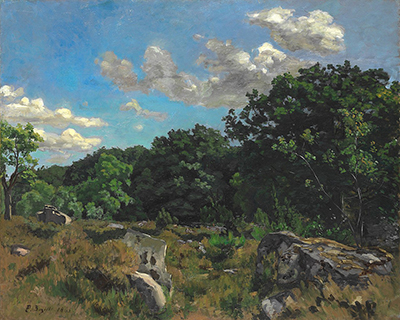
In Landscape at Chailly, the forest opens towards the sky. Rough stones interrupt the foreground, low vegetation spreads between them, and a bank of trees rises steeply towards the right. Above this uneven ground, clouds carry patches of brilliant white and cool grey across blue. The eye moves between things that seem enduring—the weight of a boulder, the thickness of a tree mass—and things that continually change: illumination, shadow and the shape of a cloud.
Frédéric Bazille painted this oil on canvas in 1865. Now in the Art Institute of Chicago, it measures 81 × 100.3 cm and belongs to the museum’s Charles H. and Mary F. S. Worcester Collection. It is an early statement of his ability to give an apparently unexceptional piece of countryside a strong pictorial structure. Its subject also places him within the friendship and working exchanges through which he and Claude Monet were developing their art. [1]
At a Glance
- Date1865 [1]
- MediumOil on canvas [1]
- Dimensions81 × 100.3 cm [1]
- CollectionArt Institute of Chicago, 1973.64 [1]
This work across Frédéric Bazille’s career
Family Reunion
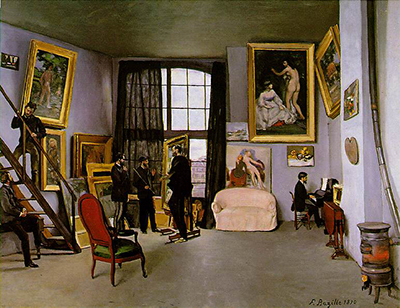
1867–1868 (museum)Bazille’s Studio, Rue La Condamine
1869–1870Summer Scene (Bathers)
1869–1870Contents
- A clearing at Chailly
- How the rocks make the picture work
- Trees, shadow and the scale of the sky
- Monet and the work behind an outdoor painting
- Two Fontainebleau landscapes, two different experiences
- An inherited landscape tradition, actively reconsidered
- From family ownership to Chicago
A clearing at Chailly
The title names Chailly, but the painting presents neither a village street nor a distant prospect of houses. Its essential elements are stone, scrub, foliage and weather. The nearest rocks feel close enough to obstruct a walker. Farther away, the vegetation thickens until the view becomes almost impenetrable. Between these extremes, small clear spaces let the eye enter the landscape without supplying a straight, continuous route.
The work is signed and dated at the lower left. Michel Schulman’s catalogue identifies its setting as the Mont-Aigu clearing in the Fontainebleau forest. The view contains few landmarks from which to recover a precise viewpoint. [2]
That distinction between a named place and an ordinary-looking fragment of it is productive. Bazille asks the viewer to attend to relationships that can easily be overlooked outdoors: the abrupt transition from a pale rock face to dark vegetation, a thin trunk appearing against foliage, the difference between a cloud’s lit top and its grey underside. There is no building, traveller or anecdote to take precedence over these encounters.
Nor is the landscape arranged as a level band of trees below an evenly distributed sky. The right-hand canopy rises into the upper field; the left stays lower and more open. This asymmetry gives the view a direction. The forest seems to gather weight towards the right, while the sky offers room for the eye to travel in the opposite direction. A relatively small tree on the left supplies a delicate vertical accent against the much heavier woodland beyond.
How the rocks make the picture work
The prominent stones at the bottom are more than foreground decoration. Their light faces give the viewer an immediate foothold in the picture. An upright, pale-edged rock near the lower centre breaks the vegetation into separate passages, while the broad formation at the right extends almost to the edge. These forms establish a scale: beyond them, individual shrubs become smaller, and the trees gather into a continuous mass.
Look at the contrast between the two principal foreground formations. The narrower stone rises in a succession of light and dark facets. The larger one at the right spreads sideways, with a broken upper edge and shadowed creases. Neither depends on a single enclosing contour. Changes of value and colour make each surface turn. Where one plane catches light, an adjacent plane falls away; dark marks interrupt the pale paint without dissolving the rock’s solidity.
The ground around them is equally varied. Ochre and brown passages mingle with subdued green; small upright marks suggest the irregular growth of low plants. Their varied directions make the surface resistant and uneven, preventing the foreground from becoming a smooth carpet beneath the more imposing trees.
The stones also connect the lower half of the painting to the sky. Bright accents occur in both, but with different effects. On rock, a pale patch defines a hard plane. In a cloud, white paint gives volume to something apparently suspended and mobile. The painting gains energy from this repeated passage between dense matter and atmosphere. Bazille makes both convincing while allowing the marks that construct them to remain visible.
This is why looking only for picturesque scenery misses much of the work’s interest. The view is full of small interruptions. There is no clear central object around which everything settles. Instead, the eye makes successive adjustments, finding one light surface, losing it in shadow, then picking up another. The foreground prepares us to read the woods in the same way.
Trees, shadow and the scale of the sky
The trees are most powerful where they are least individually described. Across the right side, their canopy becomes a large dark shape, broken by scattered green highlights and glimpses of branches. At its base, narrow trunks introduce a different rhythm from the broken horizontal and diagonal forms of the rocks. The contrast gives the forest both depth and density.
Yet the trees do not form a uniform screen. A brighter green cluster nearer the centre-left draws attention inward, while neighbouring foliage absorbs light. The same general material—leaves—can appear opaque, luminous, distant or near according to the surrounding tones. Rather than describing every leaf, Bazille differentiates the conditions in which foliage is seen.
Above, the clouds make another kind of structure. Their shapes are separate enough to register as distinct masses, but they belong to the same field of blue. White upper edges and greyer lower passages suggest volume and illumination. Their uneven distribution prevents the sky from becoming an empty background: it has its own activity, comparable in visual force to the rocks below.
Blue sky and bright highlights coexist with substantial shadow. That conjunction gives the painting a lively alternation of warmth and coolness. It does not establish the precise hour, the direction from which Bazille approached the site or how many sessions he spent there. The picture offers an organised experience of outdoor light, rather than an itinerary that can be recovered from its details.
Watch: Bazille and early Impressionism
Explore a Paris studio with Smarthistory, then discover the beginnings of Impressionism with the National Gallery of Art.
Jean-Frédéric Bazille, The Artist’s Studio, Rue Visconti, Paris
A close look at Bazille’s 1867 painting of the studio he shared in Paris.
Watch on YouTubeMonet and the work behind an outdoor painting
Bazille’s connection with Monet began within the circle formed around Charles Gleyre’s Paris studio. The Musée Fabre’s account of his early career places their outdoor work at Fontainebleau within a broader education that also included drawing and painting from the model. Its 2016 exhibition dossier reproduces a letter dated 22 April 1863 in which Bazille tells his mother that he had spent eight days at Chailly with Monet and had benefited from his advice. This earlier visit supplies a background to the landscape of 1865; it does not date the Chicago canvas to 1863. [3]
A second letter helps explain why a painting without figures nevertheless belongs to an artistic life deeply concerned with the human body. Writing to his father on 6 January 1865, Bazille described sustained work from the living model in Monet’s studio. “I must paint a great many figures this winter,” he wrote, in a new English translation from the French. He explained that the purpose was to make better use of spring and summer in the countryside. In the same letter he asked for his parasol and folding stool to be sent with his paintings. [4]
These details make outdoor painting tangible. It required equipment, preparation and the organisation of time. Winter practice and summer observation were connected activities. The countryside was a place in which previously acquired skills could be tested against a less controllable combination of light, space and living forms.
The letter dated 17 July 1865 records another exchange. Bazille planned to finish work already under way and then spend five or six days at Chailly, where Monet needed him to pose in a large painting. The phrasing describes a future intention. It provides strong evidence for the practical demands of their friendship, but it cannot by itself determine the day on which Landscape at Chailly was begun or completed. [5]
The Musée Fabre connects this posing with Monet’s ambitious Déjeuner sur l’herbe. Seen in that context, the rocky clearing belongs to a shared investigation of what painting outdoors could accomplish. Monet’s large project required the integration of people and a landscape; Bazille’s canvas gives the landscape itself the entire field. Their exchange did not require identical subjects or identical solutions. [3]
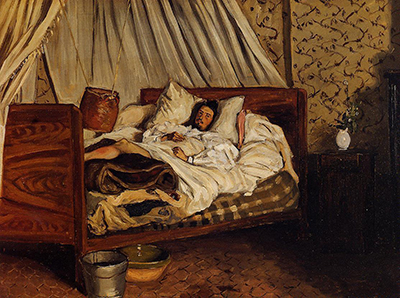
The same Chailly episode also produced The Improvised Field Hospital, showing Monet resting after an injury. The 2017 National Gallery of Art checklist dates that painting to August 1865. The contrast is instructive: friendship could lead Bazille towards both a sunlit clearing and an intimate interior. Neither subject exhausts the artistic possibilities of the visit. [6]
The Improvised Field Hospital
Two Fontainebleau landscapes, two different experiences
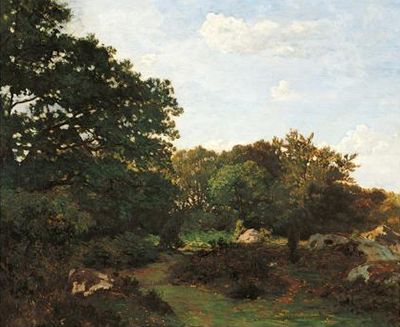
The most revealing comparison is Bazille’s Forest of Fontainebleau, also dated 1865 and now in the Musée d’Orsay. It is a separate, smaller painting, rather than another title for the Chicago canvas. Both appear as distinct works in the National Gallery’s 2017 exhibition checklist. [6]
In the Orsay picture, a large tree on the left spreads its dark canopy across the view. Lower trees and bushes gather around a patch of open ground, and the pale sky appears comparatively subdued. In the Chicago painting, the stronger blue and the prominent clouds make the upper field more assertive. The greatest concentration of tree mass has shifted to the right, and the foreground stones interrupt the view more forcefully.
The difference changes the viewer’s position. Forest of Fontainebleau offers a more sheltered encounter, with the eye drawn towards an opening among plants and stones. Landscape at Chailly exposes the viewer more directly to the sky and to the changing illumination of the rough ground. In one, an overhanging tree gives the scene a sense of enclosure; in the other, the slope of the canopy competes with the freedom of the clouds.
This comparison is more useful than treating the two pictures as successive steps towards a single perfected style. Their common year does not establish a securely dated sequence. What they show is Bazille’s willingness to vary the balance of open and closed space, bright and dark passages, descriptive marks and larger shapes. One landscape problem could be approached through different distributions of pictorial weight.
A further comparison is The Beach at Sainte-Adresse, listed in the same exhibition as a painting of 1865. Its long horizontal format opens the view across shore and sea, in marked contrast to the Chicago canvas’s close obstacles and rising tree bank. Read together, the works show how strongly the shape and arrangement of a landscape could alter Bazille’s organisation of the canvas. [6]
Forest of Fontainebleau
An inherited landscape tradition, actively reconsidered
Schulman discusses affinities with Rousseau and Corot, and comparisons with Monet and Sisley. These relationships place the work among several approaches to landscape without establishing one model that Bazille copied. [2]
Bazille’s own later words support this coexistence of loyalties. In a letter of 27 April 1869, advising his cousin Louis about paintings, he expressed admiration for Corot, Rousseau and Millet as well as Delacroix and Ingres, and qualified his praise of Courbet. The letter shows an artist capable of valuing different kinds of achievement. It does not prove that any one earlier picture determined this particular arrangement of rocks and trees. [7]
The clearing makes that breadth of interest visible without requiring an opposition between tradition and experiment. Its large masses remain easy to grasp: stone in front, woodland beyond, sky above. Within that stable organisation, the surface is restless. Light repeatedly changes the apparent relationship of one form to another. A dark tree can act as a solid boundary in one passage and break into a flicker of leaves in another.
The absence of people strengthens this attention to the landscape’s own relationships. We are not directed towards a sitter’s face or asked to follow a gesture. Instead, the painting distributes interest across the whole view. It rewards both the first impression of a bright clearing and the slower discovery of how that impression has been assembled.
From family ownership to Chicago
Schulman traces the painting through Bazille’s family, including his brother Marc and the Meynier de Salinelles descendants. It appeared at the Palais Galliéra sale in Paris on 17 March 1971, passed through the New York dealer Sam Salz and entered the Art Institute in 1973. The museum identifies it by accession number 1973.64. [2] [1]
The painting appeared in Chicago’s Bazille exhibition in 1978 and the 2016–17 retrospective; the National Gallery’s checklist records it as catalogue number 24. [2] [6]
The painting deserves that attention for what it actually accomplishes. It makes weight and light mutually dependent: rocks become solid because of the way they catch illumination, and the brightness of the day becomes perceptible because it meets resisting surfaces. The view’s unassuming elements produce an unusually active experience of space. Bazille’s early landscape is compelling because each part contributes to that experience, from the nearest fractured stone to the cloud floating above the highest trees.
Bazille catalogue directory
The 284 records comprise 85 painting records,40 separate works-on-paper records and 159 album or study records. They describe the catalogue’s organisation rather than 284 independent objects or unanimously accepted attributions. Recto, verso, albums and multiple studies remain distinct. Dates are qualified where needed; the Drawing filter includes the etching, gouache and mixed works on paper. Manuscript mentions and unproved projects are listed separately below.
Works known through documents
These mentions remain separate from the 284 catalogue records. Some may concern surviving studies or underlying compositions; they cannot simply be added together as missing physical paintings.
- A copy after Rubens mentioned in March 1863 is unlocated.
- A portrait of an unidentified woman was reported completed before July 1866.
- A portrait of Monet and a composition of two life-size women arranging flowers were reported in progress in April 1867. Their mention does not establish two otherwise unknown surviving canvases.
- Gertrude et le père Lapin was at least begun in the summer of 1870.
Further reported works and uncertain attributions
- A Bouquet of Lilacs was reportedly stolen and returned in 1864; a portrait of the friend Theulier and Yellow Narcissi reported by Maître in 1868 are also documentary mentions.
- Unidentified pictures associated with Guillemet and Mme Rolina are reported through later correspondence cited by the catalogue.
- Children Dressed as Bride and Groom was associated with Vallotton’s collection and also attributed to Renoir. Its identification and authorship should remain open.
Projects whose completion is unproved
- A portrait of Pauline was planned in July 1865.
- A portrait of Marc was proposed in April 1866; a related drawing survives.
- A Jardinière project appears in album inscriptions and related figure material. Written plans are not evidence of a completed painting.
| Name | Date | Medium |
|---|---|---|
| Mystic Marriage of St. Catherine | 1863 | Oil on canvas |
| Trees, Study | 1863 | Oil on canvas |
| Farm of Saint-Sauveur | 1863 | Oil on canvas |
| In the Garden of the Parc Monceau, Paris | 1864 | Oil on canvas |
| Naked Woman from Behind | 1864 | Oil on canvas |
| Reclining Nude | 1864 | Oil on canvas |
| Courtyard of the Auberge du Cheval blanc at Chailly near Barbizon | 1864 | Oil on canvas |
| Covered Soup Bowls | 1864 | Oil on canvas |
| Two Herrings | 1864 | Oil on canvas |
| The Pink Dress | 1864 | Oil on canvas |
| The Dog Rita Asleep | 1864 (catalogue); c. 1864 (2017 checklist) | Oil on canvas |
| The Scoter | 1864 | Oil on canvas |
| Naked Reclining Woman | 1864 | Oil on canvas |
| Landscape at Chailly | 1865 | Oil on canvas |
| Rocks at Chailly, Forest of Fontainebleau | 1865 | Oil on canvas |
| Undergrowth at Chailly, Forest of Fontainebleau | 1865 | Oil on canvas |
| Still Life with Grapes and Nuts | 1865 | Oil on canvas |
| Self-Portrait with a Palette — Chicago | 1865 | Oil on canvas |
| Landscape of Saint-Sauveur | 1865 | Oil on canvas |
| Beach at Sainte-Adresse | 1865 | Oil on canvas |
| The Improvised Field Hospital | 1865 | Oil on canvas |
| Village Street, Chailly | 1865 | Oil on canvas |
| Small Valley in the Forest of Fontainebleau | 1865 | Oil on canvas |
| Forest of Fontainebleau | 1865 | Oil on canvas |
| Woman Ironing | 1866 | Oil on canvas |
| The Artist's Studio on the rue de Furstenberg | 1865–66 (museum) | Oil on canvas |
| Still Life with Fish | 1866 | Oil on canvas |
| Little Italian Street Singer | 1866 | Oil on canvas |
| Potted Flowers | 1866 | Oil on canvas |
| The Little Gardener | 1866–1867 | Oil on canvas |
| Young Woman Playing the Piano | 1866–1867 | Oil on canvas |
| End of a Summer Day | 1866–1867 | Oil on canvas |
| A Studio on the rue Visconti | 1867 | Oil on canvas |
| Thérèse Reading in the Park at Méric | 1867 | Oil on canvas |
| Portrait of Verlaine | 1867 | Oil on canvas |
| The Terrace at Méric | 1867 | Oil on canvas |
| Still Life with Heron | 1867 | Oil on canvas |
| The Family Gathering | 1867–68 (museum) | Oil on canvas |
| Oleanders | 1867 | Oil on canvas |
| Woman on the Terrace at Méric | 1867 | Oil on canvas |
| The Ramparts at Aigues-Mortes from South | 1867 | Oil on canvas |
| The Western Ramparts at Aigues-Mortes | 1867 | Oil on canvas |
| Portrait of Edmond Maître — head study | 1867 | Oil on canvas |
| Porte de la Reine at Aigues-Mortes | 1867 | Oil on canvas |
| Portrait of Sisley | 1867 | Oil on wood |
| Portrait of Renoir — Cleveland | 1867 | Oil on canvas |
| Portrait of Renoir — Musée d’Orsay | 1867 | Oil on canvas |
| Self-Portrait with a Detachable Collar — Minneapolis | 1865–67 (museum); 1867–68 (catalogue) | Oil on canvas |
| Vase of Flowers on a Console | 1868 (museum); 1867–68 (catalogue) | Oil on canvas |
| Portrait of a Woman | 1868 | Oil on canvas |
| Young Woman in the Vineyards | 1868 | Oil on card |
| Harvester with a Basket | 1868 | Oil on card |
| Harvester with a Yellow Hat | 1868 | Oil on card |
| Harvester with a Headdress | 1868 | Oil on panel |
| On the Banks of the Lez | 1868 | Oil on canvas |
| After the Bath (attribution questioned) | 1868? | Oil on canvas |
| Young Woman with Lowered Eyes | 1868 | Oil on canvas |
| Fisherman with a Net | 1868 | Oil on canvas |
| View of the Village | 1868 | Oil on canvas |
| Portrait of Bazille (attributed to Monet by Musée Fabre; disputed catalogue attribution) | 1864 (museum); 1868 (catalogue) | Oil on panel |
| Studies for a Grape Harvest (two panels) | 1868 | Oil on canvas (two panels) |
| The Fortune Teller | 1868–69 (catalogue); c. 1869–70 (2017 checklist) | Oil on canvas |
| Harvester with a Cap | 1869 | Oil on card |
| Portrait of Edmond Maître — 1869 | 1869 | Oil on canvas |
| Woman in a Moorish Costume | 1869 | Oil on canvas |
| Young Woman in the Garden | 1869 | Oil on canvas |
| Portrait of Alphonse Tissié in a Cavalryman's Uniform | 1869 | Oil on canvas |
| Portrait of a dragoon | 1869 | Oil on canvas |
| Portrait of Zacharie Astruc | 1869 | Oil on canvas |
| Bunch of Grapes in a Bucket | 1869 | Oil on card |
| Portrait of Edouard Blau | Probably 1869; inscribed 1866 | Oil on canvas |
| Young Male Nude Lying on the Grass | 1870 | Oil on canvas |
| Summer Scene | 1869–1870 | Oil on canvas |
| The Studio on the rue La Condamine | 1869–1870 | Oil on canvas |
| La Toilette | 1870 | Oil on canvas |
| Young Woman with Peonies — Montpellier | 1870 | Oil on canvas |
| Young Woman with Peonies — Washington | 1870 | Oil on canvas |
| Monotonous Chant | 1870 | Oil on canvas |
| Flowers — private collection | 1870 | Oil on canvas |
| Flowers — Musée Fabre | 1870 | Oil on canvas |
| Young Fisherman | 1870 | Oil on canvas |
| Study for Ruth and Boaz | 1870 | Oil on wood |
| Ruth and Boaz | 1870 | Oil on canvas |
| Self-Portrait in Shirt Sleeves | 1870 | Oil on canvas |
| Landscape on the Banks of the Lez | 1870 | Oil on canvas |
| Study after an Alpine Landscape | 1860 | Graphite on watercolour-tinted paper |
| Profile Head | 1862 | Charcoal on laid paper |
| Studies after Delacroix | 1863 | Ink and graphite, with gouache and watercolour, on paper |
| Academic Head | 1863 | Charcoal on paper |
| Study of a Woman's Head in Profile on a Chair | 1863 | Charcoal on paper |
| Academic Head of a Woman | 1863 | Charcoal on paper |
| Academy of Woman | 1863 | Black pencil and charcoal, stumped, on watermarked laid paper |
| Academy of Man | 1863 | Black pencil and charcoal, stumped, on watermarked laid paper |
| Naked Man | 1863 | Charcoal on paper |
| The Pont au Change in Paris | 1864 | Watercolour on paper |
| Study for the Pink Dress or Portrait of Thérèse des Hours | 1864 | Black pencil on paper |
| Naked Woman Standing | 1864 | Pencil on paper |
| Study of a Reclining Nude | 1864 | Charcoal on paper |
| Bathers | 1864 | Charcoal on paper |
| Portrait of a Man | 1864 | Charcoal on paper |
| Study for The Pink Dress | 1864 | Black pencil, squared, on paper |
| Study for Landscape of Saint-Sauveur | 1864 | Graphite on paper |
| Study for Landscape of Saint-Sauveur | 1865 | Pencil on paper |
| Man Taming a Bull | 1866 | Pen and black pencil on paper |
| Man Half Lying on a Sofa | 1866 | Charcoal on paper |
| Study for The Family Gathering | 1867 | Pencil on paper |
| Study for The Family Gathering | 1867 | Graphite, charcoal and black pencil on paper |
| The Embroiderer | 1867 | Pencil on pink paper |
| Study of Children | 1867 | Pencil on paper |
| Women in a Garden | 1867 | Pencil drawing |
| View of the Village | 1868 | Etching on paper |
| Portrait of a Bearded Man (catalogued as Self-Portrait) | Undated (museum); 1869 (catalogue) | Charcoal and brown ink |
| Man Smoking Pipe | 1869 | Watercolour on paper |
| Manet Drawing | 1868–70(?) (museum) | Charcoal and white chalk on paper |
| Study for the Summer Scene | 1869 | Charcoal, pen and ink on paper |
| Family Portrait | 1869 | Pastel and charcoal on paper |
| Study for Ruth | 1870 | Pencil and charcoal on paper |
| Woman Arranging a Hat | 1870 | Pencil drawing |
| Study for Boaz Asleep | 1870 | Pastel and red chalk |
| Boaz Asleep | 1870 | Charcoal and pencil on paper |
| Study for Boaz Asleep | 1870 | Black and beige pastel with red chalk on laid paper |
| Ruth Lying down | 1870 | Charcoal and pastel on paper |
| Head, Arm and Chest of Ruth | 1870 | Charcoal on paper |
| Chest of Ruth | 1870 | Black chalk and charcoal on paper |
| Black Woman with Peonies — gouache | c. 1870 | Gouache, watercolour, pencil and black chalk on card |
| Various Unidentified Subjects | Undated | Pencil drawing |
| Rocky Sea Side | Undated | Charcoal on paper |
| Studies of a Dancing Woman | Undated | Drawing with white chalk |
| Study of a Leg | Undated | Pencil drawing |
| Dancers in Camargue | Undated | Pencil drawing |
| Academy of Woman | Undated | Charcoal |
| Caricature of Venus of Milo and Various Other Caricatures | Undated | Charcoal |
| Caricature | Undated | Pencil drawing |
| Study of Landscape | Undated | Charcoal |
| Caricatures and Seated Monk | Undated | Charcoal |
| Caricatures and Various Subjects | Undated | Pencil drawing |
| Women Carrying a Pitcher | Undated | Pencil drawing |
| The Hanged Man | Undated | Charcoal |
| Castle in the Plain | Undated | Charcoal |
| Naked Woman from Behind | Undated | Charcoal |
| Caricatures | Undated | Charcoal and pencil |
| Unidentified Subjects | Undated | Pencil drawing |
| Landscape with a Castle | Undated | Charcoal |
| Study of Landscape | Undated | Charcoal |
| Horse Rider seen from Behind | Undated | Charcoal |
| Mazeppa | Undated | Pencil and charcoal |
| Study of Rider and Others Subjects | Undated | Pencil, pen and brown ink |
| Study of an Unidentified Man | Undated | Pencil drawing |
| Study for an Unknown Historic Scene | Undated | Pencil drawing |
| Study a Man Reading | Undated | Pencil drawing |
| Study of Men Reading | Undated | Pencil drawing |
| Study of Landscape ? | Undated | Charcoal |
| Study of a Head of a Man | Undated | Pencil drawing |
| Erotic Scene | Undated | Pencil drawing |
| Study of Dog | Undated | Charcoal |
| Studies of Unidentified Subjects and Erotic Scene | Undated | Pencil and charcoal drawing |
| Study for a Theater Scene | Undated | Charcoal |
| Study of a Reclining Naked Woman | Undated | Charcoal |
| Two Studies of Landscape | Undated | Pencil drawing |
| Caricature | Undated | Pencil and charcoal drawing |
| Portrait of an Unidentified Young Man | Undated | Charcoal |
| Study of an Unidentified Subject | Undated | Brown ink drawing |
| Unidentified Man with a Hat | Undated | Pencil and charcoal |
| Study of an Unidentified Women | Undated | Pencil drawing |
| Study for a Theater Character ? | Undated | Pencil drawing |
| Study for a Theater Character ? | Undated | Pen drawing |
| The Pavillon de la Reine in Paris | Undated | Pencil drawing |
| Study of a Horse Rider | Undated | Pencil and charcoal drawing |
| Entwined Couple. Caricature ? | Undated | Pencil drawing |
| Woman Sitting on a Sofa | Undated | Pencil drawing |
| Studies of Unidentified Subjects | Undated | Pencil and charcoal drawing |
| Studies of Animals | Undated | Pencil drawing |
| Study of a Horse Rider in Camargue | Undated | Charcoal |
| Study of Hunting Dogs | Undated | Pencil drawing |
| Study of Soldiers. Caricatures | Undated | Pencil drawing |
| Studies of Hunting Dogs ? | Undated | Pencil drawing |
| Hunting Scene. Hunter Playing the Horn | Undated | Pencil drawing |
| Caricature | Undated | Pencil drawing |
| Study of an Ibex | Undated | Pencil drawing |
| Theater Scene. Caricatures | Undated | Pencil drawing |
| Studies of Animals. Horses ? | Undated | Pencil drawing |
| Caricatures | Undated | Pencil drawing |
| Studies of Various Subjects and Animals | Undated | Pencil drawing |
| Unidentified Subject | Undated | Pencil drawing |
| Rider Taming a Horse [in Camargue ?] | Undated | Pencil drawing |
| Caricature of a Soldier | Undated | Pencil drawing |
| Study of a Woman and Mouse | Undated | Pencil drawing |
| Historic Scene | Undated | Charcoal |
| Architecture Studies | Undated | Pencil drawing |
| Mythologic Scene | Undated | Charcoal |
| Ophelia | Undated | Pencil drawing |
| Mythologic Scene | Undated | Charcoal |
| Studies of Various Subjects | Undated | Pencil and pen drawing |
| Studies of Peasants | Undated | Pencil drawing |
| Historic Scene | Undated | Pencil drawing |
| Historic or Literary Scene | Undated | Pencil drawing |
| Unidentified Historic Scene | Undated | Pencil drawing |
| Studies of Unidentified Subjects | Undated | Pencil drawing |
| Unidentified Study | Undated | Pencil drawing |
| Man in an Armchair | Undated | Pencil drawing |
| Studies of Various Subjects | Undated | Pencil drawing |
| Portraits of Unidentified Men | Undated | Pencil drawing |
| Studies of Various Subjects | Undated | Pencil drawing |
| Horse Rider and Artist | Undated | Charcoal and pencil |
| Study of Unidentified Characters | Undated | Charcoal |
| Dead Horse in a Plain | Undated | Charcoal |
| Study of Various Subjects and Furniture | Undated | Pencil drawing |
| Caricatures and Various Notes about Opéra | Undated | Pencil drawing |
| Galloping Horse | Undated | Charcoal |
| Study for La Toilette | Undated | Pencil drawing |
| Study of a Naked Woman | Undated | Pencil drawing |
| Domestic Scene | Undated | Pencil drawing |
| Physiognomies | Undated | Pencil drawing |
| Study for a Grape Harvest | Undated | Pencil drawing |
| Study for the Summer Scene | Undated | Pencil drawing |
| Female Profiles | Undated | Pencil drawing |
| Various Subjects | Undated | Pencil drawing |
| Study for The Terrace at Méric | Undated | Pencil drawing |
| Study for The Ramparts at Aigues-Mortes | Undated | Pencil drawing |
| Study for The Ramparts at Aigues-Mortes | Undated | Pencil drawing |
| Study for a Grape Harvest | Undated | Charcoal |
| Children Portraits | Undated | Pencil drawing |
| Study for Children's Heads | Undated | Pencil drawing |
| Study of Minerva | Undated | Pencil drawing |
| Study for a Grape Harvest | Undated | Pencil drawing |
| Study for The Family Gathering | Undated | Pencil drawing |
| Study for a Young Fisherman | Undated | Charcoal |
| Self-Portraits | Undated | Black pencil drawing |
| Study of Horses for the Porte de la Reine at Aigues-Mortes | Undated | Ink drawing |
| Study of Horses for the Porte de la Reine at Aigues-Mortes | Undated | Ink drawing |
| Study of Horses for the Porte de la Reine at Aigues-Mortes | Undated | Ink drawing |
| Study for an Outdoor Concert | Undated | Pencil drawing |
| Studies of Legs | Undated | Pencil drawing |
| Study for The Ramparts at Aigues Mortes | Undated | Pencil drawing |
| Studies of Hats | Undated | Pencil drawing |
| Studies of Men | Undated | Pencil drawing |
| Study for The Little Gardener | Undated | Pencil drawing |
| Study for The Ramparts at Aigues Mortes | Undated | Charcoal |
| Studies of Sail Boats | Undated | Pencil drawing |
| Portrait of Marc Bazille | Undated | Charcoal, black pencil and graphite |
| Studies of Children's Heads | Undated | Pencil drawing |
| Study for Aigues-Mortes | Undated | Pencil drawing |
| Studies of Women's Heads | Undated | Pencil drawing |
| Portrait of Camille des Hours and an Unidentified Man | Undated | Charcoal |
| Study of Flying Birds | Undated | Charcoal or graphite |
| Study for the Summer Scene | Undated | Pencil drawing |
| Study of Hands | Undated | Pen drawing |
| Self-Portrait | Undated | Black pencil drawing |
| Study for the Summer Scene | Undated | Pencil drawing |
| Study for the Summer Scene | Undated | Pencil drawing |
| Study for a Grape Harvest | Undated | Pencil drawing |
| Study of Branches | Undated | Pencil drawing |
| Study of a Seated Child | Undated | Pencil drawing |
| Study for a Couple and Unidentified Women | Undated | Pencil drawing |
| Studies of Unidentified Women | Undated | Pencil drawing |
| Study of Buildings | Undated | Pencil drawing |
| Study for a Grape Harvest | Undated | Pencil and charcoal |
| Studies of Boaters | Undated | Pencil drawing |
| Study of a Man Writing at his Table | Undated | Pencil drawing |
| Study of a Woman Cutting Flowers | Undated | Pencil drawing |
| Study of Hand | Undated | Pencil drawing |
| Women in a Garden | Undated | Pencil drawing |
| Studies of Women in Profile | Undated | Pencil drawing |
| Study for Ruth and Boaz | Undated | Charcoal |
| Study for The Family Gathering | Undated | Pencil drawing |
| Study for the View of the Village | Undated | Pencil drawing |
| Study of the View of the Village | Undated | Pencil drawing |
| Study for the Fisherman with a Net | Undated | Pencil drawing |
| Study for the View of the Village | Undated | Charcoal |
| Study for The Little Gardener | Undated | Charcoal |
| Portrait of a Man with a Top Hat | Undated | Pencil drawing |
| Portrait of a Man with a Top Hat | Undated | Pencil drawing |
| Inscriptions | Undated | Pencil inscriptions |
| Study of Tree | Undated | Pencil drawing |
| Caricature of Nina la Belle | Undated | Pencil drawing |
| Study for Saint Sebastian | Undated | Pencil drawing |
| Young Woman Sewing | Undated | Pencil drawing |
| Studies of Hands | Undated | Pencil drawing |
| Woman in a Garden | Undated | Pencil drawing |
| Elegant Woman | Undated | Pencil drawing |
| Various Inscriptions | Undated | Inscriptions (medium unspecified in index) |
| Study of a Man with a Hat | Undated | Pencil drawing |
| Study of a Child | Undated | Pencil drawing |
| Study of a Man with a Hat | Undated | Pencil drawing |
Frequently Asked Questions
The Art Institute of Chicago dates the canvas 1865. It measures 81 × 100.3 cm. [1]
No. The Chicago landscape and the smaller Orsay forest painting are distinct works, both dated 1865. [6]
Discussion
The low ground and distant trees divide the landscape into unequal areas. Which passage gives it depth?
Reader Insights
How do the foreground stones connect the near ground with the bright clouds?
What does the concentration of trees at the right do to the balance of the sky?
Compare this canvas with Forest of Fontainebleau. Which arrangement gives you a stronger sense of shelter or exposure?
Join the Conversation
Share a detail, comparison or question about Landscape at Chailly by Frédéric Bazille below.
References
- Art Institute of Chicago, Landscape at Chailly, 1865, accession 1973.64. Collection record; museum collection data. View source 1. View source 2.
- Michel Schulman, Landscape at Chailly, MSb-14, digital catalogue raisonné: object information, history, exhibitions and critical commentary. Catalogue entry (English translation of French scholarship; provenance and exhibition fields in French). View source.
- Musée Fabre, Frédéric Bazille: la jeunesse de l’impressionnisme, 2016 exhibition press dossier, pp. 11–13, including the letter to his mother dated 22 April 1863. Exhibition dossier (in French). View source.
- Frédéric Bazille, letter to his father, 6 January 1865, Musée Fabre, inventory 92.2.1, transcription p. 4 and manuscript p. 2; English translation from French. Letter and transcription (in French). View source.
- Frédéric Bazille, letter to his father, editorially dated 17 July 1865, Musée Fabre, inventory 92.2.2, transcription p. 4. Letter and transcription (in French). View source.
- National Gallery of Art, Frédéric Bazille and the Birth of Impressionism, 2017 exhibition checklist, p. 3, catalogue nos. 22–26. Exhibition checklist. View source.
- Frédéric Bazille, letter to his cousin Louis, 27 April 1869, Musée Fabre, inventory 94.2.1, transcription pp. 6–7. Letter and transcription (in French). View source.
- Joconde/POP, La Robe rose, RF2450. View source. (in French).
- Musée d’Orsay, L’Ambulance improvisée, RF 1967 5. View source. (in French).
- Art Institute of Chicago, Landscape at Chailly,1973.64. View source.
- Musée d’Orsay, Réunion de famille,RF2749. View source. (in French).
- Musée d’Orsay, Pierre Auguste Renoir,DL1970 3. View source.
- Musée Fabre, Vue de village, 898.5.1. View source. (in French).
- National Gallery of Art, Young Woman with Peonies,1983.1.6. View source.
- Michel Schulman, painting index and documentary introduction (English titles; French metadata). View source.
- Michel Schulman, works-on-paper index (English titles; French metadata). View source.
- Michel Schulman, albums and studies index (English titles; French metadata). View source.
 Frederic Bazille.jpg)