 by Tom Gurney
Tom Gurney BSc (Hons) is an art history expert with over 20 years experience
Published on June 19, 2020 / Updated on November 2, 2026
Email: tomgurney1@gmail.com / Phone: +44 7429 011000
Forest of Fontainebleau by Frédéric Bazille: Introduction
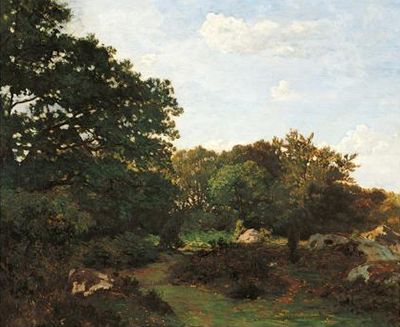
A dark tree spreads across the left side of Frédéric Bazille’s Forest of Fontainebleau, sheltering a clearing scattered with rocks and low vegetation. Above it, pale clouds float through a much brighter sky. The painting’s interest lies in the distance between those two experiences: the openness overhead and the interrupted, shaded space at ground level. Painted in 1865 and now in the Musée d’Orsay, this is a landscape in which light has to find its way around solid things. [1]
It also offers a useful way into Bazille’s relationship with earlier landscape painting. Michel Schulman connects the work with Théodore Rousseau, Narcisse Diaz and Gustave Courbet, while distinguishing it from the more brilliantly illuminated Landscape at Chailly. Its restrained contrasts invite attention to how a small wooded place becomes legible through colour, overlap and scattered touches of brightness. [2]
At a Glance
- Date1865 [1]
- MediumOil on canvas [1]
- Dimensions60 × 73.2 cm [1]
- CollectionMusée d’Orsay, Paris, RF 2721 [1]
This work across Frédéric Bazille’s career
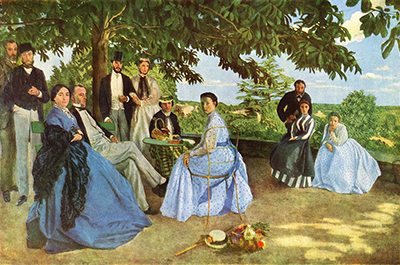
Family Reunion
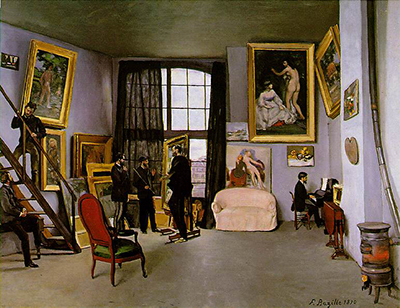
1867–1868 (museum)Bazille’s Studio, Rue La Condamine
1869–1870Summer Scene (Bathers)
1869–1870Contents
- A clearing seen from close quarters
- Open sky and sheltered earth
- Monet, Chailly and the limits of a precise chronology
- Barbizon as a living resource
- Three different problems of landscape
- From a painter’s gift to the museum
A clearing seen from close quarters
The Orsay canvas is an oil painting measuring 60 × 73.2 centimetres, inventory RF 2721. It should be distinguished from the larger Landscape at Chailly in Chicago, although both are dated 1865 and belong to Bazille’s engagement with the Fontainebleau area. Their similar subjects can obscure how differently they organise the encounter between trees, stones and sky. [1] [3]
In Forest of Fontainebleau, the near ground does not resolve into a single broad, unobstructed plane. Patches of green lead between dark shrubs and pale rocks. A light area at lower left catches the eye, but another brighter stone farther back pulls it inward. On the right, uneven rock forms rise against vegetation, creating a different obstruction. The result is a clearing that seems accessible in fragments. We can imagine moving into it, yet there is no continuous pale road carrying us smoothly towards a distant horizon.
The large tree at left makes that experience especially strong. Its foliage overlaps the sky in an irregular edge, with small openings between branches and leaves. Lower down, its darker mass merges with surrounding growth. It is both a particular tree occupying space and a broad area of shade holding one side of the composition together. The smaller trees beyond it are easier to separate against the light. Their varied heights keep the middle distance from becoming a level screen.
An instructive way to look is to follow the painting’s lightest accents from left to right. They do not join into a single band. They appear, disappear behind foliage, then return on another stone or patch of ground. Depth is built through these interruptions. The eye has to compare one exposed surface with the next, rather than simply follow the diminishing scale of objects along an obvious route.
That broken movement also keeps the foreground active without introducing a human figure. There is no walker to give the clearing a story or to indicate its scale. Stones, shrubs and the spaces between them become the principal events. Looking takes the place of an anecdote: the question is where the eye can travel and what prevents it from going farther.
Open sky and sheltered earth
Although the lower landscape feels enclosed, a substantial area of sky remains visible across the upper right. Calling the whole picture a dark thicket misses this contrast. The clouds are pale and softly bounded; the vegetation below is more compact and irregular. The sky offers release, but the ground retains its weight.
The uneven meeting of these two zones matters. The left canopy rises high, while the trees across the middle remain lower. The skyline therefore descends and opens rather than forming a level roof. Our viewpoint seems close to the vegetation, with the sky seen above and around it. Bazille has not placed us at a commanding distance from which the whole scene can be surveyed at once.
The colour follows the same division. Greens and browns dominate below, but they are not uniform. Warmer notes appear among the lower growth and along parts of the distant foliage; cooler or paler passages distinguish exposed stone. These differences are small enough to preserve the overall sheltering effect, yet sufficient to prevent shadow from becoming a single featureless darkness.
The visible handling changes with the forms. Small broken marks enliven the edges of foliage, while the stones are stated in broader light and dark areas. The varied handling helps the viewer recognise distinct materials: leaves interrupt the air; rocks catch light on their faces; the ground connects them through less sharply bounded patches.
There is a quiet tension between surface and space. At first, neighbouring greens can seem to sit together on the canvas. Then a pale rock or opening establishes that one passage lies behind another. Looking again restores depth. Its structure emerges through comparisons between adjacent passages, with softer boundaries alternating with more firmly stated forms.
Monet, Chailly and the limits of a precise chronology
Bazille’s experience of this region began before the date of the painting. The Musée Fabre’s retrospective account places him at Chailly with Monet in spring 1863 and reproduces a letter to his mother in which he describes benefiting from his friend’s landscape advice. Fontainebleau was thus part of an ongoing artistic education, alongside the studio training and friendships that shaped his early work. [4]
The surviving evidence for 1865 is more specific about a proposed visit than about the making of this particular canvas. In his letter to his father dated 17 July, Bazille explains that he still has paintings to finish before spending five or six days at Chailly. Monet needs him to pose for a large picture. This is practical evidence of their exchange: Bazille was a fellow painter, but also a model whose presence mattered to his friend’s project. It does not identify the day on which Forest of Fontainebleau was begun. [5]
Schulman relates the summer stay to Monet’s Déjeuner sur l’herbe and notes gaps in the correspondence about other possible visits that year. The exact number of outings remains uncertain, as does the place of this canvas within their sequence. [2]
This distinction helps preserve what is valuable about the friendship. The Fabre exhibition presents outdoor work beside Monet as a formative part of Bazille’s practice; the July letter shows how that companionship involved obligations as well as advice. [4] [5] The decisions we can see here concern this canvas: the dominant left-hand mass, the broken foreground and the balance between a bright sky and sheltered earth.
Watch: Bazille and early Impressionism
Explore a Paris studio with Smarthistory, then discover the beginnings of Impressionism with the National Gallery of Art.
Jean-Frédéric Bazille, The Artist’s Studio, Rue Visconti, Paris
A close look at Bazille’s 1867 painting of the studio he shared in Paris.
Watch on YouTubeBarbizon as a living resource
Schulman’s reading places Rousseau at the centre of the painting’s landscape inheritance, with Diaz and Courbet as further points of comparison. That interpretation is especially useful for the relationship between dense vegetation and selective illumination. It concerns ways of building a landscape through dark masses and material contrasts, rather than the identification of a single composition as its model. [2]
Bazille’s own later words give the connection a firmer documentary basis while leaving its scope open. Advising his cousin Louis about paintings in April 1869, he wrote: “I greatly like Ingres, Corot, Rousseau, Millet, and often Courbet” — translated here from the French. Rousseau belonged to a group of artists he actively valued, alongside painters with very different subjects and methods. The qualification “often” also matters: his admiration for Courbet was discriminating. [6]
The letter was written four years after this landscape. It establishes a preference, rather than recording what Bazille had in mind as he painted each tree. Even so, it makes a simple opposition between an old landscape tradition and a young modern painter unhelpful. For Bazille, these predecessors remained resources from which to choose, rather than a body of practice that friendship with Monet required him to reject. [6]
The picture itself rewards that less rigid approach. Its darker passages do not cancel its attentiveness to changing light. Nor does its coherent arrangement prevent the small marks from remaining visible. A viewer can appreciate the shelter and solidity of the wooded place while also noticing how provisional its boundaries become where foliage meets the sky.
Three different problems of landscape
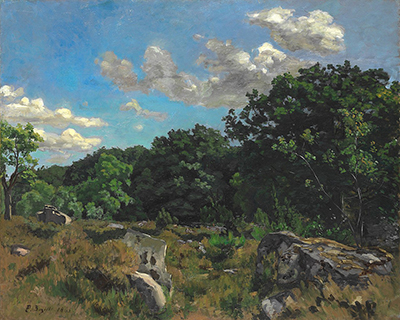
The most revealing comparison is Landscape at Chailly, the distinct Chicago canvas listed beside Forest of Fontainebleau in the National Gallery of Art’s 2017 exhibition checklist. Both are dated 1865. [3] In the Chicago painting, larger exposed rocks assert themselves in the foreground, while blue sky and sharply varied cloud masses occupy the upper field. Dark trees remain essential, especially at right, but they form one side of a more expansive encounter with the outdoors.
In Forest of Fontainebleau, bright accents are more dispersed and the path through the vegetation is less emphatic. The sky is lighter in tone and less forceful in colour. Placing the two side by side makes it possible to distinguish kinds of light rather than simply count how many trees they contain. One gives stronger prominence to exposed surfaces and open air; the other makes us work through the relationships within a sheltered clearing.
That difference should not automatically become a verdict that the darker painting is an unsuccessful step towards the brighter one. The uneven distribution of light is precisely what makes the Orsay landscape interesting. Its small discoveries of stone and ground would lose their force if everything were equally exposed. It sustains attention by withholding a complete view.
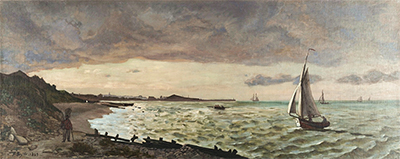
The Beach at Sainte-Adresse, also dated 1865, offers another contrast. The High Museum identifies it as one of two overdoor panels commissioned by Bazille’s uncle. Its long proportions therefore belong to a decorative purpose quite different from this compact woodland canvas. [7] A comparison makes format part of the discussion: the eye can travel laterally along the shore, whereas the forest repeatedly turns it back towards local interruptions and openings.
The later Landscape on the Banks of the Lez, dated 1870 and held in Minneapolis, extends the comparison to Bazille’s southern landscape practice. [8] Its broad opening, tree groups and pale ground invite comparison with the earlier forest’s distribution of masses. These works show why landscape deserves attention in its own right within Bazille’s painting: trees and spaces are not merely settings awaiting the arrival of a portrait sitter.
Landscape at Chailly
The Beach at Sainte-Adresse
From a painter’s gift to the museum
The Orsay records an artist’s gift to the Fantin-Latour collection, followed by Mme Fantin-Latour’s donation to the French state in 1905. The painting then passed through the Musée du Luxembourg, the Louvre and the Jeu de Paume before its assignment to the Musée d’Orsay in 1986. Its survival in public collections therefore began with an exchange within the artistic world. The record does not establish the occasion or motive for the original gift. [1]
Its exhibition history has allowed more than one setting for interpretation: the 1910 Salon d’Automne, Fontainebleau exhibitions in Paris in 2007 and Washington in 2008, and the Bazille retrospective of 2016–17. [1] The Washington retrospective checklist places it near Landscape at Chailly, making their difference available within an account of the same early period. [3]
These contexts suggest complementary ways of approaching the picture: as part of Fontainebleau landscape painting, and as a particular decision within Bazille’s work. Neither requires treating it as a prediction of everything he might later have painted. Its achievement is present in the encounter it offers now: a bright sky above a shaded, uneven clearing, where a few exposed surfaces are enough to give the landscape depth and hold the eye.
Bazille catalogue directory
The 284 records comprise 85 painting records,40 separate works-on-paper records and 159 album or study records. They describe the catalogue’s organisation rather than 284 independent objects or unanimously accepted attributions. Recto, verso, albums and multiple studies remain distinct. Dates are qualified where needed; the Drawing filter includes the etching, gouache and mixed works on paper. Manuscript mentions and unproved projects are listed separately below.
Works known through documents
These mentions remain separate from the 284 catalogue records. Some may concern surviving studies or underlying compositions; they cannot simply be added together as missing physical paintings.
- A copy after Rubens mentioned in March 1863 is unlocated.
- A portrait of an unidentified woman was reported completed before July 1866.
- A portrait of Monet and a composition of two life-size women arranging flowers were reported in progress in April 1867. Their mention does not establish two otherwise unknown surviving canvases.
- Gertrude et le père Lapin was at least begun in the summer of 1870.
Further reported works and uncertain attributions
- A Bouquet of Lilacs was reportedly stolen and returned in 1864; a portrait of the friend Theulier and Yellow Narcissi reported by Maître in 1868 are also documentary mentions.
- Unidentified pictures associated with Guillemet and Mme Rolina are reported through later correspondence cited by the catalogue.
- Children Dressed as Bride and Groom was associated with Vallotton’s collection and also attributed to Renoir. Its identification and authorship should remain open.
Projects whose completion is unproved
- A portrait of Pauline was planned in July 1865.
- A portrait of Marc was proposed in April 1866; a related drawing survives.
- A Jardinière project appears in album inscriptions and related figure material. Written plans are not evidence of a completed painting.
| Name | Date | Medium |
|---|---|---|
| Mystic Marriage of St. Catherine | 1863 | Oil on canvas |
| Trees, Study | 1863 | Oil on canvas |
| Farm of Saint-Sauveur | 1863 | Oil on canvas |
| In the Garden of the Parc Monceau, Paris | 1864 | Oil on canvas |
| Naked Woman from Behind | 1864 | Oil on canvas |
| Reclining Nude | 1864 | Oil on canvas |
| Courtyard of the Auberge du Cheval blanc at Chailly near Barbizon | 1864 | Oil on canvas |
| Covered Soup Bowls | 1864 | Oil on canvas |
| Two Herrings | 1864 | Oil on canvas |
| The Pink Dress | 1864 | Oil on canvas |
| The Dog Rita Asleep | 1864 (catalogue); c. 1864 (2017 checklist) | Oil on canvas |
| The Scoter | 1864 | Oil on canvas |
| Naked Reclining Woman | 1864 | Oil on canvas |
| Landscape at Chailly | 1865 | Oil on canvas |
| Rocks at Chailly, Forest of Fontainebleau | 1865 | Oil on canvas |
| Undergrowth at Chailly, Forest of Fontainebleau | 1865 | Oil on canvas |
| Still Life with Grapes and Nuts | 1865 | Oil on canvas |
| Self-Portrait with a Palette — Chicago | 1865 | Oil on canvas |
| Landscape of Saint-Sauveur | 1865 | Oil on canvas |
| Beach at Sainte-Adresse | 1865 | Oil on canvas |
| The Improvised Field Hospital | 1865 | Oil on canvas |
| Village Street, Chailly | 1865 | Oil on canvas |
| Small Valley in the Forest of Fontainebleau | 1865 | Oil on canvas |
| Forest of Fontainebleau | 1865 | Oil on canvas |
| Woman Ironing | 1866 | Oil on canvas |
| The Artist's Studio on the rue de Furstenberg | 1865–66 (museum) | Oil on canvas |
| Still Life with Fish | 1866 | Oil on canvas |
| Little Italian Street Singer | 1866 | Oil on canvas |
| Potted Flowers | 1866 | Oil on canvas |
| The Little Gardener | 1866–1867 | Oil on canvas |
| Young Woman Playing the Piano | 1866–1867 | Oil on canvas |
| End of a Summer Day | 1866–1867 | Oil on canvas |
| A Studio on the rue Visconti | 1867 | Oil on canvas |
| Thérèse Reading in the Park at Méric | 1867 | Oil on canvas |
| Portrait of Verlaine | 1867 | Oil on canvas |
| The Terrace at Méric | 1867 | Oil on canvas |
| Still Life with Heron | 1867 | Oil on canvas |
| The Family Gathering | 1867–68 (museum) | Oil on canvas |
| Oleanders | 1867 | Oil on canvas |
| Woman on the Terrace at Méric | 1867 | Oil on canvas |
| The Ramparts at Aigues-Mortes from South | 1867 | Oil on canvas |
| The Western Ramparts at Aigues-Mortes | 1867 | Oil on canvas |
| Portrait of Edmond Maître — head study | 1867 | Oil on canvas |
| Porte de la Reine at Aigues-Mortes | 1867 | Oil on canvas |
| Portrait of Sisley | 1867 | Oil on wood |
| Portrait of Renoir — Cleveland | 1867 | Oil on canvas |
| Portrait of Renoir — Musée d’Orsay | 1867 | Oil on canvas |
| Self-Portrait with a Detachable Collar — Minneapolis | 1865–67 (museum); 1867–68 (catalogue) | Oil on canvas |
| Vase of Flowers on a Console | 1868 (museum); 1867–68 (catalogue) | Oil on canvas |
| Portrait of a Woman | 1868 | Oil on canvas |
| Young Woman in the Vineyards | 1868 | Oil on card |
| Harvester with a Basket | 1868 | Oil on card |
| Harvester with a Yellow Hat | 1868 | Oil on card |
| Harvester with a Headdress | 1868 | Oil on panel |
| On the Banks of the Lez | 1868 | Oil on canvas |
| After the Bath (attribution questioned) | 1868? | Oil on canvas |
| Young Woman with Lowered Eyes | 1868 | Oil on canvas |
| Fisherman with a Net | 1868 | Oil on canvas |
| View of the Village | 1868 | Oil on canvas |
| Portrait of Bazille (attributed to Monet by Musée Fabre; disputed catalogue attribution) | 1864 (museum); 1868 (catalogue) | Oil on panel |
| Studies for a Grape Harvest (two panels) | 1868 | Oil on canvas (two panels) |
| The Fortune Teller | 1868–69 (catalogue); c. 1869–70 (2017 checklist) | Oil on canvas |
| Harvester with a Cap | 1869 | Oil on card |
| Portrait of Edmond Maître — 1869 | 1869 | Oil on canvas |
| Woman in a Moorish Costume | 1869 | Oil on canvas |
| Young Woman in the Garden | 1869 | Oil on canvas |
| Portrait of Alphonse Tissié in a Cavalryman's Uniform | 1869 | Oil on canvas |
| Portrait of a dragoon | 1869 | Oil on canvas |
| Portrait of Zacharie Astruc | 1869 | Oil on canvas |
| Bunch of Grapes in a Bucket | 1869 | Oil on card |
| Portrait of Edouard Blau | Probably 1869; inscribed 1866 | Oil on canvas |
| Young Male Nude Lying on the Grass | 1870 | Oil on canvas |
| Summer Scene | 1869–1870 | Oil on canvas |
| The Studio on the rue La Condamine | 1869–1870 | Oil on canvas |
| La Toilette | 1870 | Oil on canvas |
| Young Woman with Peonies — Montpellier | 1870 | Oil on canvas |
| Young Woman with Peonies — Washington | 1870 | Oil on canvas |
| Monotonous Chant | 1870 | Oil on canvas |
| Flowers — private collection | 1870 | Oil on canvas |
| Flowers — Musée Fabre | 1870 | Oil on canvas |
| Young Fisherman | 1870 | Oil on canvas |
| Study for Ruth and Boaz | 1870 | Oil on wood |
| Ruth and Boaz | 1870 | Oil on canvas |
| Self-Portrait in Shirt Sleeves | 1870 | Oil on canvas |
| Landscape on the Banks of the Lez | 1870 | Oil on canvas |
| Study after an Alpine Landscape | 1860 | Graphite on watercolour-tinted paper |
| Profile Head | 1862 | Charcoal on laid paper |
| Studies after Delacroix | 1863 | Ink and graphite, with gouache and watercolour, on paper |
| Academic Head | 1863 | Charcoal on paper |
| Study of a Woman's Head in Profile on a Chair | 1863 | Charcoal on paper |
| Academic Head of a Woman | 1863 | Charcoal on paper |
| Academy of Woman | 1863 | Black pencil and charcoal, stumped, on watermarked laid paper |
| Academy of Man | 1863 | Black pencil and charcoal, stumped, on watermarked laid paper |
| Naked Man | 1863 | Charcoal on paper |
| The Pont au Change in Paris | 1864 | Watercolour on paper |
| Study for the Pink Dress or Portrait of Thérèse des Hours | 1864 | Black pencil on paper |
| Naked Woman Standing | 1864 | Pencil on paper |
| Study of a Reclining Nude | 1864 | Charcoal on paper |
| Bathers | 1864 | Charcoal on paper |
| Portrait of a Man | 1864 | Charcoal on paper |
| Study for The Pink Dress | 1864 | Black pencil, squared, on paper |
| Study for Landscape of Saint-Sauveur | 1864 | Graphite on paper |
| Study for Landscape of Saint-Sauveur | 1865 | Pencil on paper |
| Man Taming a Bull | 1866 | Pen and black pencil on paper |
| Man Half Lying on a Sofa | 1866 | Charcoal on paper |
| Study for The Family Gathering | 1867 | Pencil on paper |
| Study for The Family Gathering | 1867 | Graphite, charcoal and black pencil on paper |
| The Embroiderer | 1867 | Pencil on pink paper |
| Study of Children | 1867 | Pencil on paper |
| Women in a Garden | 1867 | Pencil drawing |
| View of the Village | 1868 | Etching on paper |
| Portrait of a Bearded Man (catalogued as Self-Portrait) | Undated (museum); 1869 (catalogue) | Charcoal and brown ink |
| Man Smoking Pipe | 1869 | Watercolour on paper |
| Manet Drawing | 1868–70(?) (museum) | Charcoal and white chalk on paper |
| Study for the Summer Scene | 1869 | Charcoal, pen and ink on paper |
| Family Portrait | 1869 | Pastel and charcoal on paper |
| Study for Ruth | 1870 | Pencil and charcoal on paper |
| Woman Arranging a Hat | 1870 | Pencil drawing |
| Study for Boaz Asleep | 1870 | Pastel and red chalk |
| Boaz Asleep | 1870 | Charcoal and pencil on paper |
| Study for Boaz Asleep | 1870 | Black and beige pastel with red chalk on laid paper |
| Ruth Lying down | 1870 | Charcoal and pastel on paper |
| Head, Arm and Chest of Ruth | 1870 | Charcoal on paper |
| Chest of Ruth | 1870 | Black chalk and charcoal on paper |
| Black Woman with Peonies — gouache | c. 1870 | Gouache, watercolour, pencil and black chalk on card |
| Various Unidentified Subjects | Undated | Pencil drawing |
| Rocky Sea Side | Undated | Charcoal on paper |
| Studies of a Dancing Woman | Undated | Drawing with white chalk |
| Study of a Leg | Undated | Pencil drawing |
| Dancers in Camargue | Undated | Pencil drawing |
| Academy of Woman | Undated | Charcoal |
| Caricature of Venus of Milo and Various Other Caricatures | Undated | Charcoal |
| Caricature | Undated | Pencil drawing |
| Study of Landscape | Undated | Charcoal |
| Caricatures and Seated Monk | Undated | Charcoal |
| Caricatures and Various Subjects | Undated | Pencil drawing |
| Women Carrying a Pitcher | Undated | Pencil drawing |
| The Hanged Man | Undated | Charcoal |
| Castle in the Plain | Undated | Charcoal |
| Naked Woman from Behind | Undated | Charcoal |
| Caricatures | Undated | Charcoal and pencil |
| Unidentified Subjects | Undated | Pencil drawing |
| Landscape with a Castle | Undated | Charcoal |
| Study of Landscape | Undated | Charcoal |
| Horse Rider seen from Behind | Undated | Charcoal |
| Mazeppa | Undated | Pencil and charcoal |
| Study of Rider and Others Subjects | Undated | Pencil, pen and brown ink |
| Study of an Unidentified Man | Undated | Pencil drawing |
| Study for an Unknown Historic Scene | Undated | Pencil drawing |
| Study a Man Reading | Undated | Pencil drawing |
| Study of Men Reading | Undated | Pencil drawing |
| Study of Landscape ? | Undated | Charcoal |
| Study of a Head of a Man | Undated | Pencil drawing |
| Erotic Scene | Undated | Pencil drawing |
| Study of Dog | Undated | Charcoal |
| Studies of Unidentified Subjects and Erotic Scene | Undated | Pencil and charcoal drawing |
| Study for a Theater Scene | Undated | Charcoal |
| Study of a Reclining Naked Woman | Undated | Charcoal |
| Two Studies of Landscape | Undated | Pencil drawing |
| Caricature | Undated | Pencil and charcoal drawing |
| Portrait of an Unidentified Young Man | Undated | Charcoal |
| Study of an Unidentified Subject | Undated | Brown ink drawing |
| Unidentified Man with a Hat | Undated | Pencil and charcoal |
| Study of an Unidentified Women | Undated | Pencil drawing |
| Study for a Theater Character ? | Undated | Pencil drawing |
| Study for a Theater Character ? | Undated | Pen drawing |
| The Pavillon de la Reine in Paris | Undated | Pencil drawing |
| Study of a Horse Rider | Undated | Pencil and charcoal drawing |
| Entwined Couple. Caricature ? | Undated | Pencil drawing |
| Woman Sitting on a Sofa | Undated | Pencil drawing |
| Studies of Unidentified Subjects | Undated | Pencil and charcoal drawing |
| Studies of Animals | Undated | Pencil drawing |
| Study of a Horse Rider in Camargue | Undated | Charcoal |
| Study of Hunting Dogs | Undated | Pencil drawing |
| Study of Soldiers. Caricatures | Undated | Pencil drawing |
| Studies of Hunting Dogs ? | Undated | Pencil drawing |
| Hunting Scene. Hunter Playing the Horn | Undated | Pencil drawing |
| Caricature | Undated | Pencil drawing |
| Study of an Ibex | Undated | Pencil drawing |
| Theater Scene. Caricatures | Undated | Pencil drawing |
| Studies of Animals. Horses ? | Undated | Pencil drawing |
| Caricatures | Undated | Pencil drawing |
| Studies of Various Subjects and Animals | Undated | Pencil drawing |
| Unidentified Subject | Undated | Pencil drawing |
| Rider Taming a Horse [in Camargue ?] | Undated | Pencil drawing |
| Caricature of a Soldier | Undated | Pencil drawing |
| Study of a Woman and Mouse | Undated | Pencil drawing |
| Historic Scene | Undated | Charcoal |
| Architecture Studies | Undated | Pencil drawing |
| Mythologic Scene | Undated | Charcoal |
| Ophelia | Undated | Pencil drawing |
| Mythologic Scene | Undated | Charcoal |
| Studies of Various Subjects | Undated | Pencil and pen drawing |
| Studies of Peasants | Undated | Pencil drawing |
| Historic Scene | Undated | Pencil drawing |
| Historic or Literary Scene | Undated | Pencil drawing |
| Unidentified Historic Scene | Undated | Pencil drawing |
| Studies of Unidentified Subjects | Undated | Pencil drawing |
| Unidentified Study | Undated | Pencil drawing |
| Man in an Armchair | Undated | Pencil drawing |
| Studies of Various Subjects | Undated | Pencil drawing |
| Portraits of Unidentified Men | Undated | Pencil drawing |
| Studies of Various Subjects | Undated | Pencil drawing |
| Horse Rider and Artist | Undated | Charcoal and pencil |
| Study of Unidentified Characters | Undated | Charcoal |
| Dead Horse in a Plain | Undated | Charcoal |
| Study of Various Subjects and Furniture | Undated | Pencil drawing |
| Caricatures and Various Notes about Opéra | Undated | Pencil drawing |
| Galloping Horse | Undated | Charcoal |
| Study for La Toilette | Undated | Pencil drawing |
| Study of a Naked Woman | Undated | Pencil drawing |
| Domestic Scene | Undated | Pencil drawing |
| Physiognomies | Undated | Pencil drawing |
| Study for a Grape Harvest | Undated | Pencil drawing |
| Study for the Summer Scene | Undated | Pencil drawing |
| Female Profiles | Undated | Pencil drawing |
| Various Subjects | Undated | Pencil drawing |
| Study for The Terrace at Méric | Undated | Pencil drawing |
| Study for The Ramparts at Aigues-Mortes | Undated | Pencil drawing |
| Study for The Ramparts at Aigues-Mortes | Undated | Pencil drawing |
| Study for a Grape Harvest | Undated | Charcoal |
| Children Portraits | Undated | Pencil drawing |
| Study for Children's Heads | Undated | Pencil drawing |
| Study of Minerva | Undated | Pencil drawing |
| Study for a Grape Harvest | Undated | Pencil drawing |
| Study for The Family Gathering | Undated | Pencil drawing |
| Study for a Young Fisherman | Undated | Charcoal |
| Self-Portraits | Undated | Black pencil drawing |
| Study of Horses for the Porte de la Reine at Aigues-Mortes | Undated | Ink drawing |
| Study of Horses for the Porte de la Reine at Aigues-Mortes | Undated | Ink drawing |
| Study of Horses for the Porte de la Reine at Aigues-Mortes | Undated | Ink drawing |
| Study for an Outdoor Concert | Undated | Pencil drawing |
| Studies of Legs | Undated | Pencil drawing |
| Study for The Ramparts at Aigues Mortes | Undated | Pencil drawing |
| Studies of Hats | Undated | Pencil drawing |
| Studies of Men | Undated | Pencil drawing |
| Study for The Little Gardener | Undated | Pencil drawing |
| Study for The Ramparts at Aigues Mortes | Undated | Charcoal |
| Studies of Sail Boats | Undated | Pencil drawing |
| Portrait of Marc Bazille | Undated | Charcoal, black pencil and graphite |
| Studies of Children's Heads | Undated | Pencil drawing |
| Study for Aigues-Mortes | Undated | Pencil drawing |
| Studies of Women's Heads | Undated | Pencil drawing |
| Portrait of Camille des Hours and an Unidentified Man | Undated | Charcoal |
| Study of Flying Birds | Undated | Charcoal or graphite |
| Study for the Summer Scene | Undated | Pencil drawing |
| Study of Hands | Undated | Pen drawing |
| Self-Portrait | Undated | Black pencil drawing |
| Study for the Summer Scene | Undated | Pencil drawing |
| Study for the Summer Scene | Undated | Pencil drawing |
| Study for a Grape Harvest | Undated | Pencil drawing |
| Study of Branches | Undated | Pencil drawing |
| Study of a Seated Child | Undated | Pencil drawing |
| Study for a Couple and Unidentified Women | Undated | Pencil drawing |
| Studies of Unidentified Women | Undated | Pencil drawing |
| Study of Buildings | Undated | Pencil drawing |
| Study for a Grape Harvest | Undated | Pencil and charcoal |
| Studies of Boaters | Undated | Pencil drawing |
| Study of a Man Writing at his Table | Undated | Pencil drawing |
| Study of a Woman Cutting Flowers | Undated | Pencil drawing |
| Study of Hand | Undated | Pencil drawing |
| Women in a Garden | Undated | Pencil drawing |
| Studies of Women in Profile | Undated | Pencil drawing |
| Study for Ruth and Boaz | Undated | Charcoal |
| Study for The Family Gathering | Undated | Pencil drawing |
| Study for the View of the Village | Undated | Pencil drawing |
| Study of the View of the Village | Undated | Pencil drawing |
| Study for the Fisherman with a Net | Undated | Pencil drawing |
| Study for the View of the Village | Undated | Charcoal |
| Study for The Little Gardener | Undated | Charcoal |
| Portrait of a Man with a Top Hat | Undated | Pencil drawing |
| Portrait of a Man with a Top Hat | Undated | Pencil drawing |
| Inscriptions | Undated | Pencil inscriptions |
| Study of Tree | Undated | Pencil drawing |
| Caricature of Nina la Belle | Undated | Pencil drawing |
| Study for Saint Sebastian | Undated | Pencil drawing |
| Young Woman Sewing | Undated | Pencil drawing |
| Studies of Hands | Undated | Pencil drawing |
| Woman in a Garden | Undated | Pencil drawing |
| Elegant Woman | Undated | Pencil drawing |
| Various Inscriptions | Undated | Inscriptions (medium unspecified in index) |
| Study of a Man with a Hat | Undated | Pencil drawing |
| Study of a Child | Undated | Pencil drawing |
| Study of a Man with a Hat | Undated | Pencil drawing |
Frequently Asked Questions
It belongs to the Musée d’Orsay, inventory RF 2721. Painted in 1865, it measures 60 × 73.2 cm. [1]
No. A sheltered, broken clearing occupies the lower part, while a substantial pale sky opens above the trees.
After an artist’s gift to the Fantin-Latour collection, Mme Fantin-Latour donated it to the French state in 1905. [1]
Discussion
Rocks, tree trunks and open intervals shape the forest. What route does your eye take through them?
Reader Insights
Follow the pale stones through the clearing. Where does each interruption make you change direction?
How does the pale sky change your experience of the darker left canopy?
Compare the forest with Chailly’s stronger blue sky. Which material or light relationship differs most?
Join the Conversation
Share a detail, comparison or question about Forest of Fontainebleau by Frédéric Bazille below.
References
- Musée d’Orsay, Forêt de Fontainebleau, RF 2721, object details, provenance and exhibition history. Collection record (record fields in French). View source.
- Michel Schulman, Forest of Fontainebleau, MSb-13, Frédéric Bazille: The Digital Catalogue Raisonné, critical essay and object history. Catalogue entry (English translation of French scholarship). View source.
- National Gallery of Art, Frédéric Bazille and the Birth of Impressionism, 2017 exhibition checklist, catalogue nos. 23–24. Exhibition checklist. View source.
- Musée Fabre, Frédéric Bazille: la jeunesse de l’impressionnisme, 2016 press dossier, pp. 6 and 12–13, especially the outdoor-painting account and the excerpt from the letter of 22 April 1863. Museum dossier (in French). View source.
- Frédéric Bazille, letter to his father, [17 July 1865], Musée Fabre, inventory 92.2.2, transcription p. 4. Letter and transcription (in French; date editorially assigned). View source.
- Frédéric Bazille, letter to his cousin Louis, 27 April [1869], Musée Fabre, inventory 94.2.1, manuscript p. 3 and transcription pp. 6–7. Letter and transcription (in French; English quotation newly translated). View source.
- High Museum of Art, The Beach at Sainte-Adresse, 1865, accession 1980.62, collection record and commission account. Collection record. View source.
- Minneapolis Institute of Art, Landscape by the Lez River, 1870, accession 69.23. Collection record. View source.
- Joconde/POP, La Robe rose, RF2450. View source. (in French).
- Musée d’Orsay, L’Ambulance improvisée, RF 1967 5. View source. (in French).
- Musée d’Orsay, Réunion de famille,RF2749. View source. (in French).
- Musée d’Orsay, Pierre Auguste Renoir,DL1970 3. View source.
- Musée Fabre, Vue de village, 898.5.1. View source. (in French).
- National Gallery of Art, Young Woman with Peonies,1983.1.6. View source.
- Michel Schulman, painting index and documentary introduction (English titles; French metadata). View source.
- Michel Schulman, works-on-paper index (English titles; French metadata). View source.
- Michel Schulman, albums and studies index (English titles; French metadata). View source.
 Frederic Bazille.jpg)