 by Tom Gurney
Tom Gurney BSc (Hons) is an art history expert with over 20 years experience
Published on June 19, 2020 / Updated on November 2, 2026
Email: tomgurney1@gmail.com / Phone: +44 7429 011000
The Improvised Field Hospital by Frédéric Bazille: Introduction
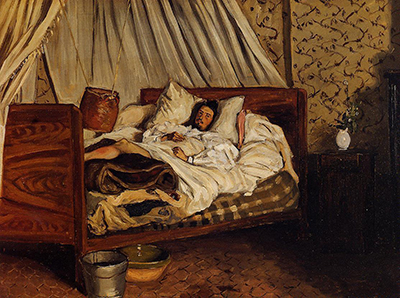
Claude Monet lies in a wooden bed, surrounded by rumpled linen, heavy blankets and the patterned walls of an inn bedroom. One leg is exposed; a suspended vessel hangs nearby. Frédéric Bazille painted this intimate scene at Chailly-en-Bière in 1865, when an injury interrupted his friend's work. Known in French as L’Ambulance improvisée, the picture belongs to the Musée d’Orsay in Paris. Its subject is a domestic sickroom, years before the Franco-Prussian War. [1]
The title promises an emergency; the painting asks us to look at what follows it. A man waits, the bed has been adapted around his discomfort, and ordinary objects have become unusually important. Bazille makes this temporary interruption into a portrait of a particular person occupying a particular room. Friendship emerges through proximity and attention: the painter has stayed close enough to record both the injured body and its makeshift surroundings.
At a Glance
- Date1865 [1]
- MediumOil on canvas [1]
- Dimensions48 × 65 cm [1]
- CollectionMusée d’Orsay, Paris, RF 1967 5 [1]
This work across Frédéric Bazille’s career
Family Reunion
1867–1868 (museum)Bazille’s Studio, Rue La Condamine
1869–1870Summer Scene (Bathers)
1869–1870Contents
- An interrupted painting expedition
- Looking across the bed
- What the objects can tell us
- A room in Chailly, but which inn?
- Friendship before the sickroom
- Brown tones and an active surface
- From a family painting to a museum collection
An interrupted painting expedition
The National Gallery of Art's retrospective checklist dates the canvas to August 1865. Monet was working at Chailly on his ambitious Déjeuner sur l’herbe, a large outdoor figure composition for which he wanted Bazille to model. The arrangement placed the two friends on both sides of the easel: each could be an artist, a subject and a practical resource for the other. [2] [1]
Bazille's own correspondence gives a useful view of the plans before the accident. In a letter to his father assigned the date 17 July 1865 by the Musée Fabre, he describes several pictures in progress and says that, after finishing them, he intends to spend another five or six days at Chailly to help Monet. His friend is making a large picture in which Bazille is to appear and needs time to paint him. Bazille then expects to travel to Montpellier. These are intentions expressed in July, rather than a diary of the visit's eventual timetable. [3]
The passage matters because it puts the famous episode inside an ordinary working life. Bazille has his own unfinished pictures, family plans and ambitions. His offer to pose requires him to allocate time among them. Monet's large canvas depends on another artist's bodily presence, just as Bazille's small sickroom picture will depend on Monet remaining before him. The exchange is unusually tangible: the person who had been needed as a model becomes the painter of the person who requested him.
Medical study belonged to Bazille's recent past. He had pursued it alongside his artistic training before abandoning it in 1864. Michel Hilaire's account of his early career describes the competing expectations of family, medicine and painting, and the importance of his friendships in the studio of Charles Gleyre. Bazille brought experience as a medical student to Chailly; he had not qualified as a doctor. [4]
The familiar explanation of Monet's injury is more uncertain than the existence of the injury itself. Michel Schulman records a family tradition in which Monet was struck by a heavy metal disc while protecting children from its path. He also points out that this detailed account is not preserved in the surviving correspondence of either painter. The anecdote should therefore retain its status as a later family story. The picture gives us the injured man; it cannot confirm how the accident happened. [5]
Looking across the bed
Bazille places us beside the bed at an angle. The tall wooden footboard occupies the left foreground, while Monet's head rests farther back towards the centre. The bed's side carries the eye diagonally across the picture, making the reclining body feel embedded in a substantial piece of furniture. We have a close view, but the wooden frame partly interrupts it. That obstruction makes the encounter feel less like a ceremonial portrait and more like approaching someone in a crowded room.
Monet wears a pale, long-sleeved shirt. His hands rest near the centre of his body, and his dark hair and facial hair give the head a compact, strongly defined shape amid the pillows. The face is small compared with the great spread of bedding. Bazille does not enlarge it or isolate it against a blank field. We have to find the individual within the things gathered around him.
The linen contributes much of the picture's movement. Sheets slip, turn, bunch and fall over one another. Their creases redirect the light in short passages, so that the bed seems active even while the man is still. The heavier covering beneath them has a different visual weight: darker, more continuous and patterned with pale squares. Looking between these fabrics, one can follow the distinction between a soft surface folded around a body and a thicker mass supporting it.
The exposed leg breaks the continuity of the pale shirt and sheets. Its warm flesh colour brings the injury into the same visual field as Monet's face and hands. The body is neither completely hidden nor displayed for an anatomical study. Bazille gives just enough exposure to explain why this person is in bed, while keeping the larger experience of the room around him.
Above, the curtains form an uneven canopy. Their descending folds gather towards the sides and create a sheltered space around the pillow. Yet the cloth is not a seamless background. Individual folds remain visible, with alternating light and shadow. Below, the angular wooden furniture makes another kind of enclosure. Between the flowing canopy and the rigid frame, the body has a protected but decidedly confined place.
An expanse of patterned wall remains visible at the right. Its repeated dark marks compete gently with the rhythms of the curtains and bedding, making the room feel furnished all the way to its edges. A small table stands beside the head of the bed, carrying a light-coloured vase and flowers. Against the large fields of cloth and wood, this small still life is easy to overlook. It gives the eye somewhere to pause outside the immediate business of the injury.
What the objects can tell us
The hanging vessel is the room's strangest feature. Its curved body sits close to the left side of the bed, suspended by cords that pass upward into the canopy. The Musée d’Orsay interprets it as a counterweight within the arrangement Bazille devised for Monet's comfort, alongside blankets that raise the injured leg. [1]
Schulman's catalogue offers a different account, suggesting a cooling drip. That explanation is conjectural. Neither the painted apparatus nor Bazille's medical studies supplies a complete record of treatment. The vessel belongs to the improvised arrangement surrounding the patient; its precise function remains open to interpretation. [5] [1]
At floor level, a metal bucket and a rounded earthenware container introduce another pair of materials. One catches narrow, cool highlights; the other has a warmer, fuller body. Their position below the foot of the bed connects the elevated sick man to the room's practical equipment. They are objects within reach of the care surrounding him, without their exact uses having to be assigned.
The floor tiles perform a quieter structural task. Small repeated shapes give the foreground a scale that differs from the broad surfaces of the bed. Their angled pattern carries space beneath the furniture. The room does not open into a distant view, but these low, close intervals make its limited depth readable. Bazille can establish a convincing place without showing a window, a doorway or the village outside.
At the left, the footboard's conspicuous wood grain offers a further change of rhythm. Long curling bands move across a hard surface, answering the curves of cloth without imitating them. The patient is surrounded by competing kinds of pattern: grain, tiles, wallpaper and textiles. Their differences make the interior specific. A generalized brown room would convey enclosure; these distinctions convey the things enclosure is made of.
Such detail also affects how we understand care. The picture does not show a caregiver performing an action. Instead, it presents the consequences of attention: supports have been placed, coverings arranged, and vessels kept nearby. Care becomes visible through an altered environment. This reading needs no invented account of what Bazille prescribed or how long Monet remained in bed.
Watch: Bazille and early Impressionism
Explore a Paris studio with Smarthistory, then discover the beginnings of Impressionism with the National Gallery of Art.
Jean-Frédéric Bazille, The Artist’s Studio, Rue Visconti, Paris
A close look at Bazille’s 1867 painting of the studio he shared in Paris.
Watch on YouTubeA room in Chailly, but which inn?
The traditional identification is the Auberge du Lion d’Or at Chailly, retained in the Musée d’Orsay's record. Schulman raises an alternative: the Auberge du Cheval Blanc, across the village street, where he notes comparable floor tiles. He presents this as a hypothesis. A resemblance between tiled floors cannot by itself identify the room, and the two names should not be collapsed into a single certain location. [1] [5]
The uncertainty is revealing because the floor looks so persuasive. Bazille's capacity to make an interior believable does not make the picture a precise architectural survey. The bed fills much of the field, while the upper curtains and right-hand furniture conceal other parts of the room. We can recognize a lived setting without being able to recover its address from its furnishings.
This distinction preserves the force of the painting. Its intimacy depends on how close the artist and viewer are allowed to come to Monet, rather than on identifying every feature of the building. The dark, restricted space is sufficient to make his temporary withdrawal from outdoor work palpable. Beyond the edges of the canvas lies the countryside for which both painters had prepared; inside, looking has narrowed to one person and the means of making him comfortable.
Friendship before the sickroom
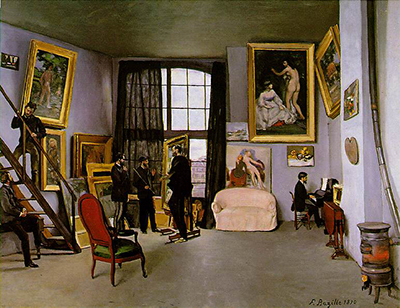
Bazille's Studio in the Rue de Furstenberg offers a useful companion to this interior. The connection between the artists was already woven into their daily routines. Writing from his new address on 6 January 1865, Bazille assured his father that he was working diligently. “Monet takes the trouble to come and wake me every morning,” he reported, in a new translation from the French. He then described painting from the living model in Monet's studio and preparing through winter figure studies for work in the countryside during spring and summer. [6]
The letter's opening is equally concrete. Sheets sent by his mother have arrived; his iron bed has a mattress and base; he has enough blankets despite the cold and is waiting for window curtains. Later, he asks that his parasol and folding stool be packed with his paintings when they are sent. Domestic needs and artistic equipment occupy the same correspondence. A bed, curtains and a means of working outdoors all belong to the practical conditions of becoming a painter. [6]
Read beside the sickroom, these details make the friendship broader than a single generous act. Monet could encourage Bazille's discipline; Bazille could contribute time, company and a model's pose. Illness or injury could rearrange those roles again. The picture allows the usually energetic maker of images to become their reclining subject, while Bazille's presence is implied by the attentive view.
Monet's face turns towards the space occupied by the painter and, consequently, by the viewer. His expression can be read as weary, but a painting cannot tell us every thought passing through its sitter. The important visible relation is that the head remains available to an encounter. The room confines his movement without removing his individuality.
Brown tones and an active surface
The painting's warmth comes from the relation between broad areas: the reddish wood, earthy floor, golden-brown wall and deeper bedding. Pale cloth gathers light at the centre without making the surrounding furnishings disappear. The colours hold the room together while allowing its contents to remain distinct.
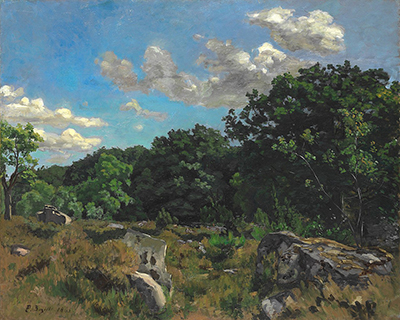
This is useful to consider beside Landscape at Chailly, another painting dated 1865. There, rocks, ground and trees occupy an outdoor space opened by sky. Here, a wooden bed and overlapping fabrics concentrate attention within a shallow interior. The comparison brings out Bazille's interest in the weight and placement of ordinary things across different subjects. [7]
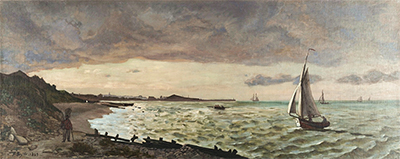
The same year's Beach at Sainte-Adresse extends a view across an unusually broad horizontal panel. Its association with Monet and its decorative purpose belong to a different aspect of their artistic relationship. Set beside the sickroom, it reminds us how varied Bazille's work already was: a coastal panorama and an enclosed portrait could both emerge from this period of exchange. [8]
Schulman reports Kimberly A. Jones's conclusion from the 2016–17 exhibition catalogue that X-rays reveal no significant compositional changes in The Improvised Field Hospital. That is a report of a technical finding, rather than proof that the painting was completed in one sitting. The canvas's apparently direct organisation remains compatible with careful observation of its many surfaces. [5]
The Beach at Sainte-Adresse
Landscape at Chailly
From a family painting to a museum collection
The work remained in the artist's family, passing through Marc Bazille and his descendants before its sale in Paris in 1967. The French national museums acquired it by pre-emption at the public sale. It was assigned to the Louvre and kept at the Jeu de Paume before its transfer to the Musée d’Orsay in 1986. The current owning museum gives its unframed dimensions as 48 by 65 centimetres. [1] [9]
Its public history includes the 1910 Bazille retrospective at the Salon d’Automne and the 2017 National Gallery of Art retrospective in Washington. These appearances place the small bedroom scene within the recovery and reassessment of Bazille's career. [9] [2]
That recovery has also produced interpretations that need care. Schulman discusses older critics who related the painting's stillness to Bazille's Protestant background, and questions whether religious solitude adequately explains it. Such a reading belongs to the picture's reception; the room itself gives no simple statement of belief. A single figure can be physically alone within an image while remaining engaged with the person painting him. [5]
The painting's importance within early Impressionism rests partly on who is represented and partly on the quality of this encounter. It shows the human conditions around artistic work: a plan interrupted, another person available, and a room adapted to an immediate need. Bazille gives the objects their weight and the patient his place among them. The patient and the room sustain close attention long after the anecdote has been told.
Bazille catalogue directory
The 284 records comprise 85 painting records,40 separate works-on-paper records and 159 album or study records. They describe the catalogue’s organisation rather than 284 independent objects or unanimously accepted attributions. Recto, verso, albums and multiple studies remain distinct. Dates are qualified where needed; the Drawing filter includes the etching, gouache and mixed works on paper. Manuscript mentions and unproved projects are listed separately below.
Works known through documents
These mentions remain separate from the 284 catalogue records. Some may concern surviving studies or underlying compositions; they cannot simply be added together as missing physical paintings.
- A copy after Rubens mentioned in March 1863 is unlocated.
- A portrait of an unidentified woman was reported completed before July 1866.
- A portrait of Monet and a composition of two life-size women arranging flowers were reported in progress in April 1867. Their mention does not establish two otherwise unknown surviving canvases.
- Gertrude et le père Lapin was at least begun in the summer of 1870.
Further reported works and uncertain attributions
- A Bouquet of Lilacs was reportedly stolen and returned in 1864; a portrait of the friend Theulier and Yellow Narcissi reported by Maître in 1868 are also documentary mentions.
- Unidentified pictures associated with Guillemet and Mme Rolina are reported through later correspondence cited by the catalogue.
- Children Dressed as Bride and Groom was associated with Vallotton’s collection and also attributed to Renoir. Its identification and authorship should remain open.
Projects whose completion is unproved
- A portrait of Pauline was planned in July 1865.
- A portrait of Marc was proposed in April 1866; a related drawing survives.
- A Jardinière project appears in album inscriptions and related figure material. Written plans are not evidence of a completed painting.
| Name | Date | Medium |
|---|---|---|
| Mystic Marriage of St. Catherine | 1863 | Oil on canvas |
| Trees, Study | 1863 | Oil on canvas |
| Farm of Saint-Sauveur | 1863 | Oil on canvas |
| In the Garden of the Parc Monceau, Paris | 1864 | Oil on canvas |
| Naked Woman from Behind | 1864 | Oil on canvas |
| Reclining Nude | 1864 | Oil on canvas |
| Courtyard of the Auberge du Cheval blanc at Chailly near Barbizon | 1864 | Oil on canvas |
| Covered Soup Bowls | 1864 | Oil on canvas |
| Two Herrings | 1864 | Oil on canvas |
| The Pink Dress | 1864 | Oil on canvas |
| The Dog Rita Asleep | 1864 (catalogue); c. 1864 (2017 checklist) | Oil on canvas |
| The Scoter | 1864 | Oil on canvas |
| Naked Reclining Woman | 1864 | Oil on canvas |
| Landscape at Chailly | 1865 | Oil on canvas |
| Rocks at Chailly, Forest of Fontainebleau | 1865 | Oil on canvas |
| Undergrowth at Chailly, Forest of Fontainebleau | 1865 | Oil on canvas |
| Still Life with Grapes and Nuts | 1865 | Oil on canvas |
| Self-Portrait with a Palette — Chicago | 1865 | Oil on canvas |
| Landscape of Saint-Sauveur | 1865 | Oil on canvas |
| Beach at Sainte-Adresse | 1865 | Oil on canvas |
| The Improvised Field Hospital | 1865 | Oil on canvas |
| Village Street, Chailly | 1865 | Oil on canvas |
| Small Valley in the Forest of Fontainebleau | 1865 | Oil on canvas |
| Forest of Fontainebleau | 1865 | Oil on canvas |
| Woman Ironing | 1866 | Oil on canvas |
| The Artist's Studio on the rue de Furstenberg | 1865–66 (museum) | Oil on canvas |
| Still Life with Fish | 1866 | Oil on canvas |
| Little Italian Street Singer | 1866 | Oil on canvas |
| Potted Flowers | 1866 | Oil on canvas |
| The Little Gardener | 1866–1867 | Oil on canvas |
| Young Woman Playing the Piano | 1866–1867 | Oil on canvas |
| End of a Summer Day | 1866–1867 | Oil on canvas |
| A Studio on the rue Visconti | 1867 | Oil on canvas |
| Thérèse Reading in the Park at Méric | 1867 | Oil on canvas |
| Portrait of Verlaine | 1867 | Oil on canvas |
| The Terrace at Méric | 1867 | Oil on canvas |
| Still Life with Heron | 1867 | Oil on canvas |
| The Family Gathering | 1867–68 (museum) | Oil on canvas |
| Oleanders | 1867 | Oil on canvas |
| Woman on the Terrace at Méric | 1867 | Oil on canvas |
| The Ramparts at Aigues-Mortes from South | 1867 | Oil on canvas |
| The Western Ramparts at Aigues-Mortes | 1867 | Oil on canvas |
| Portrait of Edmond Maître — head study | 1867 | Oil on canvas |
| Porte de la Reine at Aigues-Mortes | 1867 | Oil on canvas |
| Portrait of Sisley | 1867 | Oil on wood |
| Portrait of Renoir — Cleveland | 1867 | Oil on canvas |
| Portrait of Renoir — Musée d’Orsay | 1867 | Oil on canvas |
| Self-Portrait with a Detachable Collar — Minneapolis | 1865–67 (museum); 1867–68 (catalogue) | Oil on canvas |
| Vase of Flowers on a Console | 1868 (museum); 1867–68 (catalogue) | Oil on canvas |
| Portrait of a Woman | 1868 | Oil on canvas |
| Young Woman in the Vineyards | 1868 | Oil on card |
| Harvester with a Basket | 1868 | Oil on card |
| Harvester with a Yellow Hat | 1868 | Oil on card |
| Harvester with a Headdress | 1868 | Oil on panel |
| On the Banks of the Lez | 1868 | Oil on canvas |
| After the Bath (attribution questioned) | 1868? | Oil on canvas |
| Young Woman with Lowered Eyes | 1868 | Oil on canvas |
| Fisherman with a Net | 1868 | Oil on canvas |
| View of the Village | 1868 | Oil on canvas |
| Portrait of Bazille (attributed to Monet by Musée Fabre; disputed catalogue attribution) | 1864 (museum); 1868 (catalogue) | Oil on panel |
| Studies for a Grape Harvest (two panels) | 1868 | Oil on canvas (two panels) |
| The Fortune Teller | 1868–69 (catalogue); c. 1869–70 (2017 checklist) | Oil on canvas |
| Harvester with a Cap | 1869 | Oil on card |
| Portrait of Edmond Maître — 1869 | 1869 | Oil on canvas |
| Woman in a Moorish Costume | 1869 | Oil on canvas |
| Young Woman in the Garden | 1869 | Oil on canvas |
| Portrait of Alphonse Tissié in a Cavalryman's Uniform | 1869 | Oil on canvas |
| Portrait of a dragoon | 1869 | Oil on canvas |
| Portrait of Zacharie Astruc | 1869 | Oil on canvas |
| Bunch of Grapes in a Bucket | 1869 | Oil on card |
| Portrait of Edouard Blau | Probably 1869; inscribed 1866 | Oil on canvas |
| Young Male Nude Lying on the Grass | 1870 | Oil on canvas |
| Summer Scene | 1869–1870 | Oil on canvas |
| The Studio on the rue La Condamine | 1869–1870 | Oil on canvas |
| La Toilette | 1870 | Oil on canvas |
| Young Woman with Peonies — Montpellier | 1870 | Oil on canvas |
| Young Woman with Peonies — Washington | 1870 | Oil on canvas |
| Monotonous Chant | 1870 | Oil on canvas |
| Flowers — private collection | 1870 | Oil on canvas |
| Flowers — Musée Fabre | 1870 | Oil on canvas |
| Young Fisherman | 1870 | Oil on canvas |
| Study for Ruth and Boaz | 1870 | Oil on wood |
| Ruth and Boaz | 1870 | Oil on canvas |
| Self-Portrait in Shirt Sleeves | 1870 | Oil on canvas |
| Landscape on the Banks of the Lez | 1870 | Oil on canvas |
| Study after an Alpine Landscape | 1860 | Graphite on watercolour-tinted paper |
| Profile Head | 1862 | Charcoal on laid paper |
| Studies after Delacroix | 1863 | Ink and graphite, with gouache and watercolour, on paper |
| Academic Head | 1863 | Charcoal on paper |
| Study of a Woman's Head in Profile on a Chair | 1863 | Charcoal on paper |
| Academic Head of a Woman | 1863 | Charcoal on paper |
| Academy of Woman | 1863 | Black pencil and charcoal, stumped, on watermarked laid paper |
| Academy of Man | 1863 | Black pencil and charcoal, stumped, on watermarked laid paper |
| Naked Man | 1863 | Charcoal on paper |
| The Pont au Change in Paris | 1864 | Watercolour on paper |
| Study for the Pink Dress or Portrait of Thérèse des Hours | 1864 | Black pencil on paper |
| Naked Woman Standing | 1864 | Pencil on paper |
| Study of a Reclining Nude | 1864 | Charcoal on paper |
| Bathers | 1864 | Charcoal on paper |
| Portrait of a Man | 1864 | Charcoal on paper |
| Study for The Pink Dress | 1864 | Black pencil, squared, on paper |
| Study for Landscape of Saint-Sauveur | 1864 | Graphite on paper |
| Study for Landscape of Saint-Sauveur | 1865 | Pencil on paper |
| Man Taming a Bull | 1866 | Pen and black pencil on paper |
| Man Half Lying on a Sofa | 1866 | Charcoal on paper |
| Study for The Family Gathering | 1867 | Pencil on paper |
| Study for The Family Gathering | 1867 | Graphite, charcoal and black pencil on paper |
| The Embroiderer | 1867 | Pencil on pink paper |
| Study of Children | 1867 | Pencil on paper |
| Women in a Garden | 1867 | Pencil drawing |
| View of the Village | 1868 | Etching on paper |
| Portrait of a Bearded Man (catalogued as Self-Portrait) | Undated (museum); 1869 (catalogue) | Charcoal and brown ink |
| Man Smoking Pipe | 1869 | Watercolour on paper |
| Manet Drawing | 1868–70(?) (museum) | Charcoal and white chalk on paper |
| Study for the Summer Scene | 1869 | Charcoal, pen and ink on paper |
| Family Portrait | 1869 | Pastel and charcoal on paper |
| Study for Ruth | 1870 | Pencil and charcoal on paper |
| Woman Arranging a Hat | 1870 | Pencil drawing |
| Study for Boaz Asleep | 1870 | Pastel and red chalk |
| Boaz Asleep | 1870 | Charcoal and pencil on paper |
| Study for Boaz Asleep | 1870 | Black and beige pastel with red chalk on laid paper |
| Ruth Lying down | 1870 | Charcoal and pastel on paper |
| Head, Arm and Chest of Ruth | 1870 | Charcoal on paper |
| Chest of Ruth | 1870 | Black chalk and charcoal on paper |
| Black Woman with Peonies — gouache | c. 1870 | Gouache, watercolour, pencil and black chalk on card |
| Various Unidentified Subjects | Undated | Pencil drawing |
| Rocky Sea Side | Undated | Charcoal on paper |
| Studies of a Dancing Woman | Undated | Drawing with white chalk |
| Study of a Leg | Undated | Pencil drawing |
| Dancers in Camargue | Undated | Pencil drawing |
| Academy of Woman | Undated | Charcoal |
| Caricature of Venus of Milo and Various Other Caricatures | Undated | Charcoal |
| Caricature | Undated | Pencil drawing |
| Study of Landscape | Undated | Charcoal |
| Caricatures and Seated Monk | Undated | Charcoal |
| Caricatures and Various Subjects | Undated | Pencil drawing |
| Women Carrying a Pitcher | Undated | Pencil drawing |
| The Hanged Man | Undated | Charcoal |
| Castle in the Plain | Undated | Charcoal |
| Naked Woman from Behind | Undated | Charcoal |
| Caricatures | Undated | Charcoal and pencil |
| Unidentified Subjects | Undated | Pencil drawing |
| Landscape with a Castle | Undated | Charcoal |
| Study of Landscape | Undated | Charcoal |
| Horse Rider seen from Behind | Undated | Charcoal |
| Mazeppa | Undated | Pencil and charcoal |
| Study of Rider and Others Subjects | Undated | Pencil, pen and brown ink |
| Study of an Unidentified Man | Undated | Pencil drawing |
| Study for an Unknown Historic Scene | Undated | Pencil drawing |
| Study a Man Reading | Undated | Pencil drawing |
| Study of Men Reading | Undated | Pencil drawing |
| Study of Landscape ? | Undated | Charcoal |
| Study of a Head of a Man | Undated | Pencil drawing |
| Erotic Scene | Undated | Pencil drawing |
| Study of Dog | Undated | Charcoal |
| Studies of Unidentified Subjects and Erotic Scene | Undated | Pencil and charcoal drawing |
| Study for a Theater Scene | Undated | Charcoal |
| Study of a Reclining Naked Woman | Undated | Charcoal |
| Two Studies of Landscape | Undated | Pencil drawing |
| Caricature | Undated | Pencil and charcoal drawing |
| Portrait of an Unidentified Young Man | Undated | Charcoal |
| Study of an Unidentified Subject | Undated | Brown ink drawing |
| Unidentified Man with a Hat | Undated | Pencil and charcoal |
| Study of an Unidentified Women | Undated | Pencil drawing |
| Study for a Theater Character ? | Undated | Pencil drawing |
| Study for a Theater Character ? | Undated | Pen drawing |
| The Pavillon de la Reine in Paris | Undated | Pencil drawing |
| Study of a Horse Rider | Undated | Pencil and charcoal drawing |
| Entwined Couple. Caricature ? | Undated | Pencil drawing |
| Woman Sitting on a Sofa | Undated | Pencil drawing |
| Studies of Unidentified Subjects | Undated | Pencil and charcoal drawing |
| Studies of Animals | Undated | Pencil drawing |
| Study of a Horse Rider in Camargue | Undated | Charcoal |
| Study of Hunting Dogs | Undated | Pencil drawing |
| Study of Soldiers. Caricatures | Undated | Pencil drawing |
| Studies of Hunting Dogs ? | Undated | Pencil drawing |
| Hunting Scene. Hunter Playing the Horn | Undated | Pencil drawing |
| Caricature | Undated | Pencil drawing |
| Study of an Ibex | Undated | Pencil drawing |
| Theater Scene. Caricatures | Undated | Pencil drawing |
| Studies of Animals. Horses ? | Undated | Pencil drawing |
| Caricatures | Undated | Pencil drawing |
| Studies of Various Subjects and Animals | Undated | Pencil drawing |
| Unidentified Subject | Undated | Pencil drawing |
| Rider Taming a Horse [in Camargue ?] | Undated | Pencil drawing |
| Caricature of a Soldier | Undated | Pencil drawing |
| Study of a Woman and Mouse | Undated | Pencil drawing |
| Historic Scene | Undated | Charcoal |
| Architecture Studies | Undated | Pencil drawing |
| Mythologic Scene | Undated | Charcoal |
| Ophelia | Undated | Pencil drawing |
| Mythologic Scene | Undated | Charcoal |
| Studies of Various Subjects | Undated | Pencil and pen drawing |
| Studies of Peasants | Undated | Pencil drawing |
| Historic Scene | Undated | Pencil drawing |
| Historic or Literary Scene | Undated | Pencil drawing |
| Unidentified Historic Scene | Undated | Pencil drawing |
| Studies of Unidentified Subjects | Undated | Pencil drawing |
| Unidentified Study | Undated | Pencil drawing |
| Man in an Armchair | Undated | Pencil drawing |
| Studies of Various Subjects | Undated | Pencil drawing |
| Portraits of Unidentified Men | Undated | Pencil drawing |
| Studies of Various Subjects | Undated | Pencil drawing |
| Horse Rider and Artist | Undated | Charcoal and pencil |
| Study of Unidentified Characters | Undated | Charcoal |
| Dead Horse in a Plain | Undated | Charcoal |
| Study of Various Subjects and Furniture | Undated | Pencil drawing |
| Caricatures and Various Notes about Opéra | Undated | Pencil drawing |
| Galloping Horse | Undated | Charcoal |
| Study for La Toilette | Undated | Pencil drawing |
| Study of a Naked Woman | Undated | Pencil drawing |
| Domestic Scene | Undated | Pencil drawing |
| Physiognomies | Undated | Pencil drawing |
| Study for a Grape Harvest | Undated | Pencil drawing |
| Study for the Summer Scene | Undated | Pencil drawing |
| Female Profiles | Undated | Pencil drawing |
| Various Subjects | Undated | Pencil drawing |
| Study for The Terrace at Méric | Undated | Pencil drawing |
| Study for The Ramparts at Aigues-Mortes | Undated | Pencil drawing |
| Study for The Ramparts at Aigues-Mortes | Undated | Pencil drawing |
| Study for a Grape Harvest | Undated | Charcoal |
| Children Portraits | Undated | Pencil drawing |
| Study for Children's Heads | Undated | Pencil drawing |
| Study of Minerva | Undated | Pencil drawing |
| Study for a Grape Harvest | Undated | Pencil drawing |
| Study for The Family Gathering | Undated | Pencil drawing |
| Study for a Young Fisherman | Undated | Charcoal |
| Self-Portraits | Undated | Black pencil drawing |
| Study of Horses for the Porte de la Reine at Aigues-Mortes | Undated | Ink drawing |
| Study of Horses for the Porte de la Reine at Aigues-Mortes | Undated | Ink drawing |
| Study of Horses for the Porte de la Reine at Aigues-Mortes | Undated | Ink drawing |
| Study for an Outdoor Concert | Undated | Pencil drawing |
| Studies of Legs | Undated | Pencil drawing |
| Study for The Ramparts at Aigues Mortes | Undated | Pencil drawing |
| Studies of Hats | Undated | Pencil drawing |
| Studies of Men | Undated | Pencil drawing |
| Study for The Little Gardener | Undated | Pencil drawing |
| Study for The Ramparts at Aigues Mortes | Undated | Charcoal |
| Studies of Sail Boats | Undated | Pencil drawing |
| Portrait of Marc Bazille | Undated | Charcoal, black pencil and graphite |
| Studies of Children's Heads | Undated | Pencil drawing |
| Study for Aigues-Mortes | Undated | Pencil drawing |
| Studies of Women's Heads | Undated | Pencil drawing |
| Portrait of Camille des Hours and an Unidentified Man | Undated | Charcoal |
| Study of Flying Birds | Undated | Charcoal or graphite |
| Study for the Summer Scene | Undated | Pencil drawing |
| Study of Hands | Undated | Pen drawing |
| Self-Portrait | Undated | Black pencil drawing |
| Study for the Summer Scene | Undated | Pencil drawing |
| Study for the Summer Scene | Undated | Pencil drawing |
| Study for a Grape Harvest | Undated | Pencil drawing |
| Study of Branches | Undated | Pencil drawing |
| Study of a Seated Child | Undated | Pencil drawing |
| Study for a Couple and Unidentified Women | Undated | Pencil drawing |
| Studies of Unidentified Women | Undated | Pencil drawing |
| Study of Buildings | Undated | Pencil drawing |
| Study for a Grape Harvest | Undated | Pencil and charcoal |
| Studies of Boaters | Undated | Pencil drawing |
| Study of a Man Writing at his Table | Undated | Pencil drawing |
| Study of a Woman Cutting Flowers | Undated | Pencil drawing |
| Study of Hand | Undated | Pencil drawing |
| Women in a Garden | Undated | Pencil drawing |
| Studies of Women in Profile | Undated | Pencil drawing |
| Study for Ruth and Boaz | Undated | Charcoal |
| Study for The Family Gathering | Undated | Pencil drawing |
| Study for the View of the Village | Undated | Pencil drawing |
| Study of the View of the Village | Undated | Pencil drawing |
| Study for the Fisherman with a Net | Undated | Pencil drawing |
| Study for the View of the Village | Undated | Charcoal |
| Study for The Little Gardener | Undated | Charcoal |
| Portrait of a Man with a Top Hat | Undated | Pencil drawing |
| Portrait of a Man with a Top Hat | Undated | Pencil drawing |
| Inscriptions | Undated | Pencil inscriptions |
| Study of Tree | Undated | Pencil drawing |
| Caricature of Nina la Belle | Undated | Pencil drawing |
| Study for Saint Sebastian | Undated | Pencil drawing |
| Young Woman Sewing | Undated | Pencil drawing |
| Studies of Hands | Undated | Pencil drawing |
| Woman in a Garden | Undated | Pencil drawing |
| Elegant Woman | Undated | Pencil drawing |
| Various Inscriptions | Undated | Inscriptions (medium unspecified in index) |
| Study of a Man with a Hat | Undated | Pencil drawing |
| Study of a Child | Undated | Pencil drawing |
| Study of a Man with a Hat | Undated | Pencil drawing |
Frequently Asked Questions
No. It dates from 1865 and shows Monet recovering from a leg injury during a stay at Chailly. [1]
It belongs to the Musée d’Orsay, inventory RF 1967 5. The museum records its purchase by pre-emption in 1967. [1]
He had studied medicine but did not qualify. That background should not be turned into a documented reconstruction of the treatment shown. [4]
Discussion
The ordinary objects around Monet’s injured leg make the temporary sickroom specific. Which changes the scene most?
Reader Insights
How do the bedclothes, chair and injured leg lead your eye across the room?
Which ordinary object contributes most to the painting’s sense of improvised care?
Compare the quiet interior with a nearby Chailly landscape. How does each make a temporary place feel inhabited?
Join the Conversation
Share a detail, comparison or question about The Improvised Field Hospital by Frédéric Bazille below.
References
- Musée d’Orsay, L’Ambulance improvisée, Frédéric Bazille, 1865, RF 1967 5; collection commentary, object metadata and provenance. Collection record (in French). View source.
- National Gallery of Art, Frédéric Bazille and the Birth of Impressionism, exhibition checklist, 2017, p. 3, catalogue no. 26. Exhibition checklist. View source.
- Frédéric Bazille, letter to his father, [17 July 1865], Musée Fabre, inventory 92.2.2, transcription p. 4. Letter and museum transcription (in French). View source.
- Michel Hilaire, Bazille ou la vie brève, Académie des Sciences et Lettres de Montpellier, 2016, pp. 166–172, especially pp. 168–169. Lecture (in French). View source.
- Michel Schulman, The Improvised Field Hospital, digital catalogue raisonné, MSb-17; including family tradition, location hypothesis, reception and its report of Jones's technical findings. Catalogue entry (English translation, with French object history and bibliography). View source.
- Frédéric Bazille, letter to his father, [6 January 1865], Musée Fabre, inventory 92.2.1, facsimile p. 2 and transcription p. 4. Letter and museum transcription (in French; quoted English translation prepared for this article). View source.
- Michel Schulman, Landscape at Chailly, digital catalogue raisonné, MSb-14. Catalogue entry (English translation, with French object metadata). View source.
- Michel Schulman, The Beach at Sainte-Adresse, digital catalogue raisonné, MSb-18. Catalogue entry (English translation, with French object metadata). View source.
- French Ministry of Culture, POP/Joconde, L’Ambulance improvisée, notice 000PE003696, inventory RF 1967 5; acquisition, transfer and historical exhibitions. National collection record (in French). View source.
- Joconde/POP, La Robe rose, RF2450. View source. (in French).
- Musée d’Orsay, Réunion de famille,RF2749. View source. (in French).
- Musée d’Orsay, Pierre Auguste Renoir,DL1970 3. View source.
- Musée Fabre, Vue de village, 898.5.1. View source. (in French).
- National Gallery of Art, Young Woman with Peonies,1983.1.6. View source.
- Michel Schulman, painting index and documentary introduction (English titles; French metadata). View source.
- Michel Schulman, works-on-paper index (English titles; French metadata). View source.
- Michel Schulman, albums and studies index (English titles; French metadata). View source.
 Frederic Bazille.jpg)