 by Tom Gurney
Tom Gurney BSc (Hons) is an art history expert with over 20 years experience
Published on June 19, 2020 / Updated on November 2, 2026
Email: tomgurney1@gmail.com / Phone: +44 7429 011000
The Little Gardener by Frédéric Bazille: Introduction
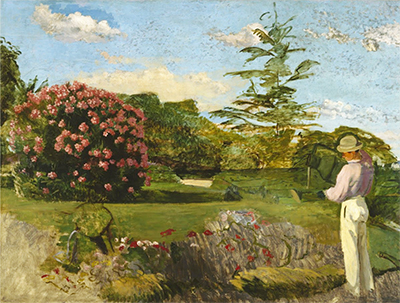
The gardener in Frédéric Bazille’s The Little Gardener occupies only a narrow strip of a spacious canvas. A pink flowering bush, a tall evergreen and a sweep of lawn command as much attention as the man watering the foreground bed. His work gives the garden a human measure, while the garden gives his ordinary action an unexpectedly expansive setting. The painting belongs to the Museum of Fine Arts, Houston, which dates it 1865–67 and records its dimensions as 128 × 168.9 cm. Its modest title conceals a substantial painting. [1]
This is a cultivated landscape, shaped by planting and maintained through labour. It is also an experiment in placing people within outdoor light. The partly stated forms preserve something of that experiment: the large setting is established, but the relationship between its figures, flowers and open spaces remains unusually exposed. Michel Schulman’s catalogue identifies the place as Méric, the Bazille family estate near Montpellier, and connects the picture with a garden project that Bazille began, set aside and intended to resume. [2]
At a Glance
- Date1865–67 (Houston); 1866–67 (catalogue) [1] [2]
- MediumOil on canvas [1]
- Dimensions128 × 168.9 cm [1]
- CollectionMuseum of Fine Arts, Houston, 76.236 [1]
This work across Frédéric Bazille’s career
Family Reunion
1867–1868 (museum)Bazille’s Studio, Rue La Condamine
1869–1870Summer Scene (Bathers)
1869–1870Contents
- A garden that outweighs its gardener
- Méric: pleasure and maintenance
- Drawing the figure, changing the picture
- A painting made across several summers
- Other ways of painting an outdoor figure
- From the Bazille family to Houston
A garden that outweighs its gardener
The first strong contrast lies between the two sides of the composition. On the left, pink flowers cover a broad, rounded bush. Its dark interior gives the lighter blossoms something solid to rest against. On the right, the gardener stands almost vertically, his pale trousers catching the light beneath a pink shirt and brimmed hat. Between them stretches an area of grass. This interval matters: Bazille has allowed the eye to travel through the garden before it returns to the person named in the title.
The foreground bed curves across the lower part of the painting. Its irregular marks of red, white and green carry the eye sideways, then turn it back towards the gardener’s watering can. A bed which might have been a decorative border becomes a means of connecting the figure to the wider scene. The gardener’s bent arms and extended can direct attention downwards, whereas his upright body leads it back towards the sky. His pose helps join the picture’s horizontal and vertical movements.
Behind him rises a slender evergreen, its branches spreading in separate tiers. Its uppermost growth reaches into the blue, making a second upright beside the human one. The tree is taller and more central than the gardener, yet its relatively open structure allows the sky to remain visible around and between its branches. The flowering bush has the opposite effect: it gathers flowers and leaves into a dense mass. One plant spreads, the other rises, and their differing shapes make the middle of the garden feel open.
The pale clouds add another kind of movement. Their broken horizontal forms stretch across a sky that occupies a generous part of the canvas. Below, dark foliage marks the garden’s farther boundary without closing it into a rigid wall. Light grass, shaded greens and blue sky establish distinct distances even where individual objects remain broadly handled. The scene is spacious because these larger areas hold together, rather than because every leaf has been separately described.
At the lower left, an easily missed second figure is suggested among the loose marks. Schulman describes a kneeling woman who appears to gather flowers. Her activity is less fully readable than the gardener’s, and she should not be turned into a confidently identified portrait. Nevertheless, her presence changes the scene: the garden contains more than one kind of movement, with a low, bending action balancing the standing figure across the foreground. [2]
Méric: pleasure and maintenance
Méric repeatedly supplied Bazille with subjects during his returns from Paris. Michel Hilaire describes the estate’s planted paths, flowering shrubs, access to the river and gatherings of relatives and friends as a setting for modern pictures. The familiar surroundings offered both landscapes and the people who could inhabit them. [3]
In The Little Gardener, familiarity does not result in a conventional view of the house. The painting brings the garden itself forward: beds, grass, foliage and sky are enough to establish its world. The cultivated setting is legible through its organisation. A curved bed has been separated from the lawn; an ornamental flowering bush has room to expand; different heights of planting give the view variety. Such distinctions imply decisions about where things grow and how the place is kept.
Watering makes that maintenance visible. The flowers are not simply waiting to be admired; someone must tend them. At the same time, the gardener’s small scale prevents his action from becoming an isolated demonstration of agricultural work. He belongs to a setting that accommodates both occupation and enjoyment. The picture holds those aspects together without telling us his employment, social position or relationship to the family.
His pale trousers and pink shirt are particularly useful pictorially. Against the darker garden, they make his body readable at a glance. The pink also answers the blossoms across the lawn, connecting two widely separated parts of the canvas. This is a visible colour relationship, rather than evidence that the flowers or clothes carry a hidden message. The figure can be small because colour helps locate him so efficiently.
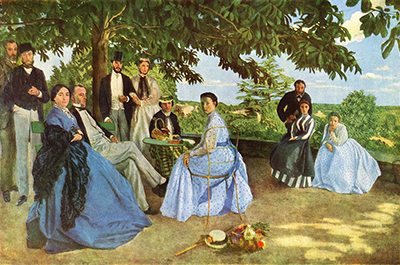
The difference from Family Reunion is revealing. There, a group of people beneath a dense canopy makes the terrace a place of gathering and encounter. Here, the wide interval between the figures gives planting and open ground greater independence. Both pictures make a family environment available to painting, but the garden scene directs attention towards the space around people as much as towards people themselves. Hilaire places the later group portrait within Bazille’s sustained work at Méric. [3]
Drawing the figure, changing the picture
Two surviving studies make the painting’s apparent informality more interesting. Schulman catalogues a compositional study as MSb-233, on folio 29 recto of album RF 5259, and a study of the gardener as MSb-266, on folio 55 verso. He records both as Orsay works kept in the Louvre’s Department of Prints and Drawings. The sheets preserve alternatives rather than exact instructions for the canvas. [4] [5]
In her Houston catalogue essay, Helga Kessler Aurisch explains that the compositional study contains three figures, including a standing woman subsequently omitted. The retained figures move towards the sides in the painting. She also points to the kneeling woman’s brown outline over the green lawn as evidence that the landscape was painted before that figure was added. [6]
These changes affect the whole experience of the scene. Removing a standing person makes a larger opening; moving figures apart allows the garden to become the connection between them. Instead of reading an exchange within a compact group, the viewer follows separate activities across a shared space. The final arrangement leaves more room for flowers and grass to establish their own rhythms.
The gardener also changes between paper and canvas. Schulman draws attention to the study’s broad hat and sash and to the different clothes and movement in the painting. The painted figure wears long pale trousers and a tucked-in pink shirt. The differences are real; the suggestion that a different person posed remains an interpretation. Changes in costume, apparent age or gesture cannot establish a sitter’s name. [2] [5]
Drawing and outdoor painting were complementary parts of Bazille’s practice. Writing to his father on 6 January 1865, he explained his winter concentration on the living model: “I must paint a great many figures this winter” — a new translation from the French — so that he could make good use of spring and summer in the countryside. The gardener studies fit that broader concern with preparing the human figure for an outdoor setting. [7]
Watch: Bazille and early Impressionism
Explore a Paris studio with Smarthistory, then discover the beginnings of Impressionism with the National Gallery of Art.
Jean-Frédéric Bazille, The Artist’s Studio, Rue Visconti, Paris
A close look at Bazille’s 1867 painting of the studio he shared in Paris.
Watch on YouTubeA painting made across several summers
The dating requires a little explanation. Schulman gives 1866–67, while Houston uses 1865–67. Both connect the painting to an August 1866 letter in which Bazille proposed returning to a view of Méric with a gardener that he had left aside the previous year. The earlier starting date therefore rests on documentary interpretation, rather than on a date visibly inscribed on the canvas. Aurisch argues for including the project’s beginnings in 1865. [2] [6]
This extended history helps explain why a sunny outdoor scene need not record one uninterrupted session. The garden could be returned to; the relationship between its parts could be reconsidered. The surviving studies and the changes they reveal already demonstrate that the design evolved. The letter supplies a different kind of evidence: the project was something Bazille could resume after a substantial interval.
Its surface also contains differing degrees of development. The flower bush has greater density than the airy tree, and the foreground bed is more loosely indicated than the gardener’s pale silhouette. Aurisch identifies scraping in the foreground as evidence of revision and describes the tree as lightly painted over the sky. Her account treats the picture as incomplete. [6]
It is useful to distinguish that judgement from the mere presence of visible brushwork. Broad or economical painting can be a deliberate way of giving a scene light and movement. Here, the argument for incompletion includes the barely articulated woman and the unequal development of substantial passages. Even so, the painting’s appearance cannot tell us precisely when Bazille stopped, how much more he meant to do or why the work remained in this state.
The interrupted tree trunk attracted Schulman’s attention, but the catalogue offers a proposed explanation rather than a demonstrated technical history. It is safer to recognise the painting’s revisions without assigning every visible discontinuity to a particular campaign. The picture gives access to a changing composition; it does not supply a complete timetable of its making. [2]
Other ways of painting an outdoor figure
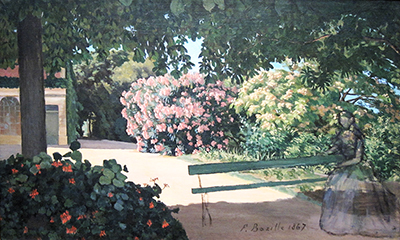
The closest comparison is Oleanders, another Méric garden scene. There, a long green bench and a bright path make a clear invitation into the planted space, while pink and pale flowers stand against darker foliage. The lightly described woman at the right has less visual weight than the bench or the flowering masses. The painting is signed and dated 1867, a reminder that a schematic figure does not by itself prove that a picture was abandoned. [8]
Placed beside The Little Gardener, it makes the variety within Bazille’s garden painting apparent. The bench supplies a long horizontal accent where the watering man supplies an upright one. The path is a conspicuous plane of light, whereas the gardener’s lawn has a more continuous green breadth. Both compositions give ornamental plants a scale and presence that can compete with a person. Neither requires a large cast of figures to make the garden inhabited.
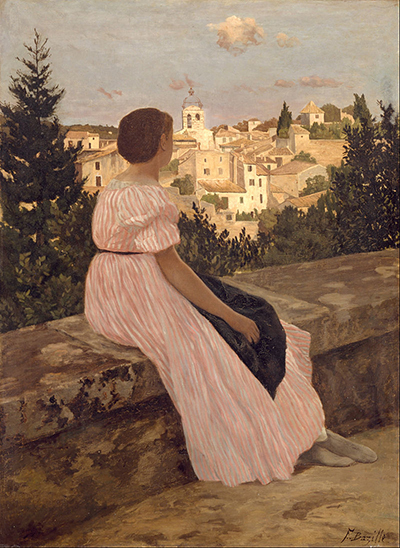
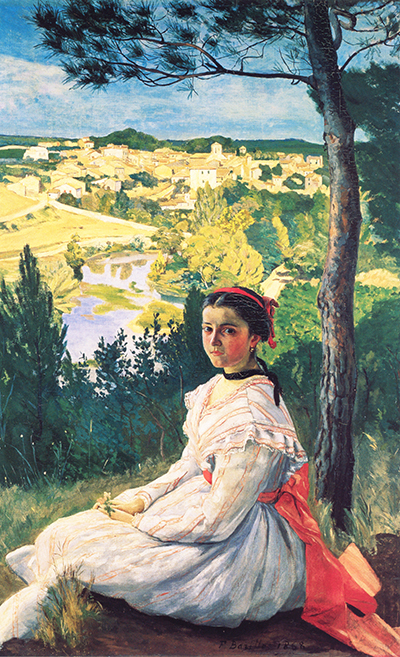
View of the Village offers another solution. Its seated girl occupies the near foreground and looks towards the viewer; behind her, a bright settlement spreads across the distance. The gardener’s attention is directed towards his task. His face has little role in establishing contact with us, and his body occupies a much smaller share of the scene. The comparison shows how differently a person can function within an outdoor picture: as a prominent presence at its threshold, or as an action within its larger space.
Monet belongs to the history of these experiments too. Aurisch relates The Little Gardener to his ambitious Luncheon on the Grass, for which Bazille posed, and to Women in the Garden, which Bazille acquired and sent to Méric in 1867. The connection places the painting within a shared investigation of figures and outdoor light. [6]
The Houston canvas has its own balance. It distributes attention among planting, working bodies and intervals of open ground. The eye may settle first on the pink bush, then notice the man, then follow the bed towards the barely indicated woman. Human activity emerges gradually from looking around the garden.
View of the Village
Les Lauriers Roses
From the Bazille family to Houston
The picture remained in the artist’s family after his death. Houston’s provenance identifies his nephew, also named Frédéric Bazille, as an owner by 1923, followed by Catherine Bazille Hérisson by 1959. By May 1976 it belonged to Sophie Marie Jordan in Paris; the circumstances of her acquisition remain unclear. Audrey Jones Beck bought it for the museum in 1976 and gave it that year. It is now part of the John A. and Audrey Jones Beck Collection, accession 76.236. [1]
Its exhibition history includes the Montpellier retrospective of 1927, where it appeared under a title referring to the park at Méric, and the Art Institute of Chicago’s Frédéric Bazille and Early Impressionism in 1978. These different framings suit the painting’s two enduring interests: a particular southern garden and an experiment within the developing art of outdoor painting. [1]
The surviving canvas rewards attention to both. Its setting has the material character of a tended place, while its surface preserves choices still visibly open: how far to define a tree, how firmly to establish a flowerbed, and how much space to leave around a figure. The gardener’s small action holds these large questions together. He is watering plants, but the painting asks us to look across the whole garden.
Bazille catalogue directory
The 284 records comprise 85 painting records,40 separate works-on-paper records and 159 album or study records. They describe the catalogue’s organisation rather than 284 independent objects or unanimously accepted attributions. Recto, verso, albums and multiple studies remain distinct. Dates are qualified where needed; the Drawing filter includes the etching, gouache and mixed works on paper. Manuscript mentions and unproved projects are listed separately below.
Works known through documents
These mentions remain separate from the 284 catalogue records. Some may concern surviving studies or underlying compositions; they cannot simply be added together as missing physical paintings.
- A copy after Rubens mentioned in March 1863 is unlocated.
- A portrait of an unidentified woman was reported completed before July 1866.
- A portrait of Monet and a composition of two life-size women arranging flowers were reported in progress in April 1867. Their mention does not establish two otherwise unknown surviving canvases.
- Gertrude et le père Lapin was at least begun in the summer of 1870.
Further reported works and uncertain attributions
- A Bouquet of Lilacs was reportedly stolen and returned in 1864; a portrait of the friend Theulier and Yellow Narcissi reported by Maître in 1868 are also documentary mentions.
- Unidentified pictures associated with Guillemet and Mme Rolina are reported through later correspondence cited by the catalogue.
- Children Dressed as Bride and Groom was associated with Vallotton’s collection and also attributed to Renoir. Its identification and authorship should remain open.
Projects whose completion is unproved
- A portrait of Pauline was planned in July 1865.
- A portrait of Marc was proposed in April 1866; a related drawing survives.
- A Jardinière project appears in album inscriptions and related figure material. Written plans are not evidence of a completed painting.
| Name | Date | Medium |
|---|---|---|
| Mystic Marriage of St. Catherine | 1863 | Oil on canvas |
| Trees, Study | 1863 | Oil on canvas |
| Farm of Saint-Sauveur | 1863 | Oil on canvas |
| In the Garden of the Parc Monceau, Paris | 1864 | Oil on canvas |
| Naked Woman from Behind | 1864 | Oil on canvas |
| Reclining Nude | 1864 | Oil on canvas |
| Courtyard of the Auberge du Cheval blanc at Chailly near Barbizon | 1864 | Oil on canvas |
| Covered Soup Bowls | 1864 | Oil on canvas |
| Two Herrings | 1864 | Oil on canvas |
| The Pink Dress | 1864 | Oil on canvas |
| The Dog Rita Asleep | 1864 (catalogue); c. 1864 (2017 checklist) | Oil on canvas |
| The Scoter | 1864 | Oil on canvas |
| Naked Reclining Woman | 1864 | Oil on canvas |
| Landscape at Chailly | 1865 | Oil on canvas |
| Rocks at Chailly, Forest of Fontainebleau | 1865 | Oil on canvas |
| Undergrowth at Chailly, Forest of Fontainebleau | 1865 | Oil on canvas |
| Still Life with Grapes and Nuts | 1865 | Oil on canvas |
| Self-Portrait with a Palette — Chicago | 1865 | Oil on canvas |
| Landscape of Saint-Sauveur | 1865 | Oil on canvas |
| Beach at Sainte-Adresse | 1865 | Oil on canvas |
| The Improvised Field Hospital | 1865 | Oil on canvas |
| Village Street, Chailly | 1865 | Oil on canvas |
| Small Valley in the Forest of Fontainebleau | 1865 | Oil on canvas |
| Forest of Fontainebleau | 1865 | Oil on canvas |
| Woman Ironing | 1866 | Oil on canvas |
| The Artist's Studio on the rue de Furstenberg | 1865–66 (museum) | Oil on canvas |
| Still Life with Fish | 1866 | Oil on canvas |
| Little Italian Street Singer | 1866 | Oil on canvas |
| Potted Flowers | 1866 | Oil on canvas |
| The Little Gardener | 1866–1867 | Oil on canvas |
| Young Woman Playing the Piano | 1866–1867 | Oil on canvas |
| End of a Summer Day | 1866–1867 | Oil on canvas |
| A Studio on the rue Visconti | 1867 | Oil on canvas |
| Thérèse Reading in the Park at Méric | 1867 | Oil on canvas |
| Portrait of Verlaine | 1867 | Oil on canvas |
| The Terrace at Méric | 1867 | Oil on canvas |
| Still Life with Heron | 1867 | Oil on canvas |
| The Family Gathering | 1867–68 (museum) | Oil on canvas |
| Oleanders | 1867 | Oil on canvas |
| Woman on the Terrace at Méric | 1867 | Oil on canvas |
| The Ramparts at Aigues-Mortes from South | 1867 | Oil on canvas |
| The Western Ramparts at Aigues-Mortes | 1867 | Oil on canvas |
| Portrait of Edmond Maître — head study | 1867 | Oil on canvas |
| Porte de la Reine at Aigues-Mortes | 1867 | Oil on canvas |
| Portrait of Sisley | 1867 | Oil on wood |
| Portrait of Renoir — Cleveland | 1867 | Oil on canvas |
| Portrait of Renoir — Musée d’Orsay | 1867 | Oil on canvas |
| Self-Portrait with a Detachable Collar — Minneapolis | 1865–67 (museum); 1867–68 (catalogue) | Oil on canvas |
| Vase of Flowers on a Console | 1868 (museum); 1867–68 (catalogue) | Oil on canvas |
| Portrait of a Woman | 1868 | Oil on canvas |
| Young Woman in the Vineyards | 1868 | Oil on card |
| Harvester with a Basket | 1868 | Oil on card |
| Harvester with a Yellow Hat | 1868 | Oil on card |
| Harvester with a Headdress | 1868 | Oil on panel |
| On the Banks of the Lez | 1868 | Oil on canvas |
| After the Bath (attribution questioned) | 1868? | Oil on canvas |
| Young Woman with Lowered Eyes | 1868 | Oil on canvas |
| Fisherman with a Net | 1868 | Oil on canvas |
| View of the Village | 1868 | Oil on canvas |
| Portrait of Bazille (attributed to Monet by Musée Fabre; disputed catalogue attribution) | 1864 (museum); 1868 (catalogue) | Oil on panel |
| Studies for a Grape Harvest (two panels) | 1868 | Oil on canvas (two panels) |
| The Fortune Teller | 1868–69 (catalogue); c. 1869–70 (2017 checklist) | Oil on canvas |
| Harvester with a Cap | 1869 | Oil on card |
| Portrait of Edmond Maître — 1869 | 1869 | Oil on canvas |
| Woman in a Moorish Costume | 1869 | Oil on canvas |
| Young Woman in the Garden | 1869 | Oil on canvas |
| Portrait of Alphonse Tissié in a Cavalryman's Uniform | 1869 | Oil on canvas |
| Portrait of a dragoon | 1869 | Oil on canvas |
| Portrait of Zacharie Astruc | 1869 | Oil on canvas |
| Bunch of Grapes in a Bucket | 1869 | Oil on card |
| Portrait of Edouard Blau | Probably 1869; inscribed 1866 | Oil on canvas |
| Young Male Nude Lying on the Grass | 1870 | Oil on canvas |
| Summer Scene | 1869–1870 | Oil on canvas |
| The Studio on the rue La Condamine | 1869–1870 | Oil on canvas |
| La Toilette | 1870 | Oil on canvas |
| Young Woman with Peonies — Montpellier | 1870 | Oil on canvas |
| Young Woman with Peonies — Washington | 1870 | Oil on canvas |
| Monotonous Chant | 1870 | Oil on canvas |
| Flowers — private collection | 1870 | Oil on canvas |
| Flowers — Musée Fabre | 1870 | Oil on canvas |
| Young Fisherman | 1870 | Oil on canvas |
| Study for Ruth and Boaz | 1870 | Oil on wood |
| Ruth and Boaz | 1870 | Oil on canvas |
| Self-Portrait in Shirt Sleeves | 1870 | Oil on canvas |
| Landscape on the Banks of the Lez | 1870 | Oil on canvas |
| Study after an Alpine Landscape | 1860 | Graphite on watercolour-tinted paper |
| Profile Head | 1862 | Charcoal on laid paper |
| Studies after Delacroix | 1863 | Ink and graphite, with gouache and watercolour, on paper |
| Academic Head | 1863 | Charcoal on paper |
| Study of a Woman's Head in Profile on a Chair | 1863 | Charcoal on paper |
| Academic Head of a Woman | 1863 | Charcoal on paper |
| Academy of Woman | 1863 | Black pencil and charcoal, stumped, on watermarked laid paper |
| Academy of Man | 1863 | Black pencil and charcoal, stumped, on watermarked laid paper |
| Naked Man | 1863 | Charcoal on paper |
| The Pont au Change in Paris | 1864 | Watercolour on paper |
| Study for the Pink Dress or Portrait of Thérèse des Hours | 1864 | Black pencil on paper |
| Naked Woman Standing | 1864 | Pencil on paper |
| Study of a Reclining Nude | 1864 | Charcoal on paper |
| Bathers | 1864 | Charcoal on paper |
| Portrait of a Man | 1864 | Charcoal on paper |
| Study for The Pink Dress | 1864 | Black pencil, squared, on paper |
| Study for Landscape of Saint-Sauveur | 1864 | Graphite on paper |
| Study for Landscape of Saint-Sauveur | 1865 | Pencil on paper |
| Man Taming a Bull | 1866 | Pen and black pencil on paper |
| Man Half Lying on a Sofa | 1866 | Charcoal on paper |
| Study for The Family Gathering | 1867 | Pencil on paper |
| Study for The Family Gathering | 1867 | Graphite, charcoal and black pencil on paper |
| The Embroiderer | 1867 | Pencil on pink paper |
| Study of Children | 1867 | Pencil on paper |
| Women in a Garden | 1867 | Pencil drawing |
| View of the Village | 1868 | Etching on paper |
| Portrait of a Bearded Man (catalogued as Self-Portrait) | Undated (museum); 1869 (catalogue) | Charcoal and brown ink |
| Man Smoking Pipe | 1869 | Watercolour on paper |
| Manet Drawing | 1868–70(?) (museum) | Charcoal and white chalk on paper |
| Study for the Summer Scene | 1869 | Charcoal, pen and ink on paper |
| Family Portrait | 1869 | Pastel and charcoal on paper |
| Study for Ruth | 1870 | Pencil and charcoal on paper |
| Woman Arranging a Hat | 1870 | Pencil drawing |
| Study for Boaz Asleep | 1870 | Pastel and red chalk |
| Boaz Asleep | 1870 | Charcoal and pencil on paper |
| Study for Boaz Asleep | 1870 | Black and beige pastel with red chalk on laid paper |
| Ruth Lying down | 1870 | Charcoal and pastel on paper |
| Head, Arm and Chest of Ruth | 1870 | Charcoal on paper |
| Chest of Ruth | 1870 | Black chalk and charcoal on paper |
| Black Woman with Peonies — gouache | c. 1870 | Gouache, watercolour, pencil and black chalk on card |
| Various Unidentified Subjects | Undated | Pencil drawing |
| Rocky Sea Side | Undated | Charcoal on paper |
| Studies of a Dancing Woman | Undated | Drawing with white chalk |
| Study of a Leg | Undated | Pencil drawing |
| Dancers in Camargue | Undated | Pencil drawing |
| Academy of Woman | Undated | Charcoal |
| Caricature of Venus of Milo and Various Other Caricatures | Undated | Charcoal |
| Caricature | Undated | Pencil drawing |
| Study of Landscape | Undated | Charcoal |
| Caricatures and Seated Monk | Undated | Charcoal |
| Caricatures and Various Subjects | Undated | Pencil drawing |
| Women Carrying a Pitcher | Undated | Pencil drawing |
| The Hanged Man | Undated | Charcoal |
| Castle in the Plain | Undated | Charcoal |
| Naked Woman from Behind | Undated | Charcoal |
| Caricatures | Undated | Charcoal and pencil |
| Unidentified Subjects | Undated | Pencil drawing |
| Landscape with a Castle | Undated | Charcoal |
| Study of Landscape | Undated | Charcoal |
| Horse Rider seen from Behind | Undated | Charcoal |
| Mazeppa | Undated | Pencil and charcoal |
| Study of Rider and Others Subjects | Undated | Pencil, pen and brown ink |
| Study of an Unidentified Man | Undated | Pencil drawing |
| Study for an Unknown Historic Scene | Undated | Pencil drawing |
| Study a Man Reading | Undated | Pencil drawing |
| Study of Men Reading | Undated | Pencil drawing |
| Study of Landscape ? | Undated | Charcoal |
| Study of a Head of a Man | Undated | Pencil drawing |
| Erotic Scene | Undated | Pencil drawing |
| Study of Dog | Undated | Charcoal |
| Studies of Unidentified Subjects and Erotic Scene | Undated | Pencil and charcoal drawing |
| Study for a Theater Scene | Undated | Charcoal |
| Study of a Reclining Naked Woman | Undated | Charcoal |
| Two Studies of Landscape | Undated | Pencil drawing |
| Caricature | Undated | Pencil and charcoal drawing |
| Portrait of an Unidentified Young Man | Undated | Charcoal |
| Study of an Unidentified Subject | Undated | Brown ink drawing |
| Unidentified Man with a Hat | Undated | Pencil and charcoal |
| Study of an Unidentified Women | Undated | Pencil drawing |
| Study for a Theater Character ? | Undated | Pencil drawing |
| Study for a Theater Character ? | Undated | Pen drawing |
| The Pavillon de la Reine in Paris | Undated | Pencil drawing |
| Study of a Horse Rider | Undated | Pencil and charcoal drawing |
| Entwined Couple. Caricature ? | Undated | Pencil drawing |
| Woman Sitting on a Sofa | Undated | Pencil drawing |
| Studies of Unidentified Subjects | Undated | Pencil and charcoal drawing |
| Studies of Animals | Undated | Pencil drawing |
| Study of a Horse Rider in Camargue | Undated | Charcoal |
| Study of Hunting Dogs | Undated | Pencil drawing |
| Study of Soldiers. Caricatures | Undated | Pencil drawing |
| Studies of Hunting Dogs ? | Undated | Pencil drawing |
| Hunting Scene. Hunter Playing the Horn | Undated | Pencil drawing |
| Caricature | Undated | Pencil drawing |
| Study of an Ibex | Undated | Pencil drawing |
| Theater Scene. Caricatures | Undated | Pencil drawing |
| Studies of Animals. Horses ? | Undated | Pencil drawing |
| Caricatures | Undated | Pencil drawing |
| Studies of Various Subjects and Animals | Undated | Pencil drawing |
| Unidentified Subject | Undated | Pencil drawing |
| Rider Taming a Horse [in Camargue ?] | Undated | Pencil drawing |
| Caricature of a Soldier | Undated | Pencil drawing |
| Study of a Woman and Mouse | Undated | Pencil drawing |
| Historic Scene | Undated | Charcoal |
| Architecture Studies | Undated | Pencil drawing |
| Mythologic Scene | Undated | Charcoal |
| Ophelia | Undated | Pencil drawing |
| Mythologic Scene | Undated | Charcoal |
| Studies of Various Subjects | Undated | Pencil and pen drawing |
| Studies of Peasants | Undated | Pencil drawing |
| Historic Scene | Undated | Pencil drawing |
| Historic or Literary Scene | Undated | Pencil drawing |
| Unidentified Historic Scene | Undated | Pencil drawing |
| Studies of Unidentified Subjects | Undated | Pencil drawing |
| Unidentified Study | Undated | Pencil drawing |
| Man in an Armchair | Undated | Pencil drawing |
| Studies of Various Subjects | Undated | Pencil drawing |
| Portraits of Unidentified Men | Undated | Pencil drawing |
| Studies of Various Subjects | Undated | Pencil drawing |
| Horse Rider and Artist | Undated | Charcoal and pencil |
| Study of Unidentified Characters | Undated | Charcoal |
| Dead Horse in a Plain | Undated | Charcoal |
| Study of Various Subjects and Furniture | Undated | Pencil drawing |
| Caricatures and Various Notes about Opéra | Undated | Pencil drawing |
| Galloping Horse | Undated | Charcoal |
| Study for La Toilette | Undated | Pencil drawing |
| Study of a Naked Woman | Undated | Pencil drawing |
| Domestic Scene | Undated | Pencil drawing |
| Physiognomies | Undated | Pencil drawing |
| Study for a Grape Harvest | Undated | Pencil drawing |
| Study for the Summer Scene | Undated | Pencil drawing |
| Female Profiles | Undated | Pencil drawing |
| Various Subjects | Undated | Pencil drawing |
| Study for The Terrace at Méric | Undated | Pencil drawing |
| Study for The Ramparts at Aigues-Mortes | Undated | Pencil drawing |
| Study for The Ramparts at Aigues-Mortes | Undated | Pencil drawing |
| Study for a Grape Harvest | Undated | Charcoal |
| Children Portraits | Undated | Pencil drawing |
| Study for Children's Heads | Undated | Pencil drawing |
| Study of Minerva | Undated | Pencil drawing |
| Study for a Grape Harvest | Undated | Pencil drawing |
| Study for The Family Gathering | Undated | Pencil drawing |
| Study for a Young Fisherman | Undated | Charcoal |
| Self-Portraits | Undated | Black pencil drawing |
| Study of Horses for the Porte de la Reine at Aigues-Mortes | Undated | Ink drawing |
| Study of Horses for the Porte de la Reine at Aigues-Mortes | Undated | Ink drawing |
| Study of Horses for the Porte de la Reine at Aigues-Mortes | Undated | Ink drawing |
| Study for an Outdoor Concert | Undated | Pencil drawing |
| Studies of Legs | Undated | Pencil drawing |
| Study for The Ramparts at Aigues Mortes | Undated | Pencil drawing |
| Studies of Hats | Undated | Pencil drawing |
| Studies of Men | Undated | Pencil drawing |
| Study for The Little Gardener | Undated | Pencil drawing |
| Study for The Ramparts at Aigues Mortes | Undated | Charcoal |
| Studies of Sail Boats | Undated | Pencil drawing |
| Portrait of Marc Bazille | Undated | Charcoal, black pencil and graphite |
| Studies of Children's Heads | Undated | Pencil drawing |
| Study for Aigues-Mortes | Undated | Pencil drawing |
| Studies of Women's Heads | Undated | Pencil drawing |
| Portrait of Camille des Hours and an Unidentified Man | Undated | Charcoal |
| Study of Flying Birds | Undated | Charcoal or graphite |
| Study for the Summer Scene | Undated | Pencil drawing |
| Study of Hands | Undated | Pen drawing |
| Self-Portrait | Undated | Black pencil drawing |
| Study for the Summer Scene | Undated | Pencil drawing |
| Study for the Summer Scene | Undated | Pencil drawing |
| Study for a Grape Harvest | Undated | Pencil drawing |
| Study of Branches | Undated | Pencil drawing |
| Study of a Seated Child | Undated | Pencil drawing |
| Study for a Couple and Unidentified Women | Undated | Pencil drawing |
| Studies of Unidentified Women | Undated | Pencil drawing |
| Study of Buildings | Undated | Pencil drawing |
| Study for a Grape Harvest | Undated | Pencil and charcoal |
| Studies of Boaters | Undated | Pencil drawing |
| Study of a Man Writing at his Table | Undated | Pencil drawing |
| Study of a Woman Cutting Flowers | Undated | Pencil drawing |
| Study of Hand | Undated | Pencil drawing |
| Women in a Garden | Undated | Pencil drawing |
| Studies of Women in Profile | Undated | Pencil drawing |
| Study for Ruth and Boaz | Undated | Charcoal |
| Study for The Family Gathering | Undated | Pencil drawing |
| Study for the View of the Village | Undated | Pencil drawing |
| Study of the View of the Village | Undated | Pencil drawing |
| Study for the Fisherman with a Net | Undated | Pencil drawing |
| Study for the View of the Village | Undated | Charcoal |
| Study for The Little Gardener | Undated | Charcoal |
| Portrait of a Man with a Top Hat | Undated | Pencil drawing |
| Portrait of a Man with a Top Hat | Undated | Pencil drawing |
| Inscriptions | Undated | Pencil inscriptions |
| Study of Tree | Undated | Pencil drawing |
| Caricature of Nina la Belle | Undated | Pencil drawing |
| Study for Saint Sebastian | Undated | Pencil drawing |
| Young Woman Sewing | Undated | Pencil drawing |
| Studies of Hands | Undated | Pencil drawing |
| Woman in a Garden | Undated | Pencil drawing |
| Elegant Woman | Undated | Pencil drawing |
| Various Inscriptions | Undated | Inscriptions (medium unspecified in index) |
| Study of a Man with a Hat | Undated | Pencil drawing |
| Study of a Child | Undated | Pencil drawing |
| Study of a Man with a Hat | Undated | Pencil drawing |
Frequently Asked Questions
It belongs to the Museum of Fine Arts, Houston, inventory 76.236. [1]
Discussion
The garden opens around two figures whose actions remain distinct. How does the planting direct your eye?
Reader Insights
How much of the painting’s space belongs to the garden rather than its people?
Compare the drawn gardener with the painted figure. Which change most affects the sense of work?
Where does loose handling suggest something still unresolved, and where does it make foliage convincing?
Join the Conversation
Share a detail, comparison or question about The Little Gardener by Frédéric Bazille below.
References
- Museum of Fine Arts, Houston, The Little Gardener, object 76.236, collection record, provenance and exhibition history. Museum collection. View source.
- Michel Schulman, The Little Gardener, MSb-26, Frédéric Bazille: The Digital Catalogue Raisonné. Catalogue entry (English translation of French catalogue; French metadata). View source.
- Michel Hilaire, “Bazille ou la vie brève,” Académie des Sciences et Lettres de Montpellier, 2016, pp. 166–172. Lecture (in French). View source.
- Michel Schulman, Study for The Little Gardener, MSb-233, album RF 5259, folio 29 recto. Catalogue entry (English translation of French catalogue; French metadata). View source.
- Michel Schulman, Study for The Little Gardener, MSb-266, album RF 5259, folio 55 verso. Catalogue entry (English translation of French catalogue; French metadata). View source.
- Helga Kessler Aurisch, “The Little Gardener,” The Beck Collection, Museum of Fine Arts, Houston, main essay and notes. Museum catalogue. View source.
- Frédéric Bazille, letter to his father, 6 January 1865, Musée Fabre, inventory 92.2.1, manuscript facsimile and transcription. Letter (in French; English quotation translated here). View source.
- Michel Schulman, Oleanders, MSb-36, Frédéric Bazille: The Digital Catalogue Raisonné. Catalogue entry (English translation of French catalogue; French metadata). View source.
- Joconde/POP, La Robe rose, RF2450. View source. (in French).
- Musée d’Orsay, L’Ambulance improvisée, RF 1967 5. View source. (in French).
- Musée d’Orsay, Réunion de famille,RF2749. View source. (in French).
- Musée d’Orsay, Pierre Auguste Renoir,DL1970 3. View source.
- Musée Fabre, Vue de village, 898.5.1. View source. (in French).
- National Gallery of Art, Frédéric Bazille and the Birth of Impressionism: exhibition checklist,2017. View source.
- National Gallery of Art, Young Woman with Peonies,1983.1.6. View source.
- Michel Schulman, painting index and documentary introduction (English titles; French metadata). View source.
- Michel Schulman, works-on-paper index (English titles; French metadata). View source.
- Michel Schulman, albums and studies index (English titles; French metadata). View source.
 Frederic Bazille.jpg)