



 by Tom Gurney
Tom Gurney BSc (Hons) is an art history expert with over 20 years experience
Published on June 19, 2020 / Updated on November 2, 2026
Email: tomgurney1@gmail.com / Phone: +44 7429 011000
Louis Auriol Fishing (Young Fisherman): Introduction
A white shirt catches the light at the centre of Frédéric Bazille’s Young Fisherman. Around it, trees, water and bankside growth remain restless patches of green and yellow; above it, a boy lowers his head towards his fishing rod. Painted in 1870, this narrow canvas is traditionally known as Louis Auriol Fishing. The personal name comes from Bazille family tradition, rather than a proven identification. Michel Schulman’s catalogue raisonné lists the oil painting in a private collection and associates its making with Bazille’s last summer at Méric, near Montpellier. [1]
The picture offers an unusually direct encounter with Bazille’s handling of a figure outdoors. Some passages establish firm, substantial forms; others look barely settled. Its interest lies in that uneven concentration: the shirt seems almost tangible, while the ground dissolves into separated strokes. A related charcoal drawing shows that the apparently casual scene also involved preparation. Together, drawing and painting reveal a composition developed through changes of gesture and through the very different resources of line and colour. [2]
At a Glance
- Date1870 [1]
- MediumOil on canvas [1]
- Dimensions103 × 55 cm [1]
- CollectionPrivate collection, as recorded by Schulman [1]
This work across Frédéric Bazille’s career
Family Reunion
1867–1868 (museum)Bazille’s Studio, Rue La Condamine
1869–1870Summer Scene (Bathers)
1869–1870Contents
- The traditional name and the unnamed boy
- How the white shirt holds the picture together
- A charcoal study and a changed hand
- Water, vegetation and two earlier outdoor figures
- A late painting without a certain final position
- Family preservation and later exhibitions
The traditional name and the unnamed boy
According to the tradition recorded by Schulman, the sitter was Louis Auriol, son of the farmer at the Saint-Sauveur estate in Lattès. This gives the image a possible connection with people around the Bazille family’s southern properties, but the name should retain its qualification. Young Fisherman, the catalogue title, accurately describes what the painting establishes without requiring an identification. Neither the apparent age of the boy nor his clothing can independently confirm the family account. [1]
He stands turned towards the left, his head inclined and his face presented in profile. A dark band circles a low cap. The lifted right hand holds the rod, while the left arm drops beside the body. His attention seems directed towards the fishing apparatus rather than towards us. This small withdrawal shapes the encounter: we can look closely at his posture without receiving the answering gaze familiar from a formal portrait.
The clothes make the body readable through broad divisions. The full shirt gathers at the neck and wrists, spreads across the torso and swells into a loose sleeve. Brown trousers extend downwards in long bands of light and dark. A narrow dark area at the waist separates the two garments. The boy’s occupation supplies the pose, but the painting shows no catch and no decisive action. Its moment is one of holding and waiting.
That distinction matters when thinking about the possible sitter’s social position. A farmer’s son, if the identification is correct, need not be made into a symbol of rural poverty or picturesque innocence. The image gives us an individual figure engaged with a rod beside water. It leaves his circumstances, feelings and relationship to the painter largely unstated.
How the white shirt holds the picture together
The canvas measures 103 × 55 centimetres: nearly twice as high as it is wide. Its vertical shape leaves relatively little space around the standing figure. [1] The boy occupies much of the height, but Bazille avoids the effect of an isolated cut-out. Branches and foliage press close to his silhouette, while pale ground continues around his feet. His shirt is both the clearest object in the image and a surface on which the surrounding light becomes visible.
Look at the difference between the two sides of the garment. The front breaks into pale planes interrupted by darker folds; the sleeve forms a broad light curve against the deep green behind it. Blue-grey shadows stop the white from becoming a single flat patch. The shoulder and upper arm feel rounded because these cooler passages turn away from the brightest light. Farther down, the sleeve narrows into the cuff and the small warm shape of the lowered hand.
The trousers answer that rounded volume with a longer, more angular rhythm. Near-black marks descend beside warmer brown strips. Their alternation carries the eye towards the feet, where the figure becomes less distinctly separated from the ground. The body is therefore neither uniformly finished nor uniformly sketchy. Its different parts ask for different kinds of attention.
Schulman criticises the unresolved hands and the proportions of the head, while finding the painting’s principal strength in its light and energetic landscape handling. [1] Those observations point to a useful tension. The hands do not have the precision of a fully resolved portrait, yet the right hand is immediately legible as a grip and the left as a release of the arm. Gesture can remain clear even where anatomy receives only abbreviated description.
The strongest contrast is between the boy’s relatively continuous contours and the surrounding vegetation. At the left, little light and dark marks accumulate into a tree mass. Behind the head and sleeve, the darker tree takes a broader, more sweeping form. The blue opening between these masses keeps the upper figure visible. Such differences prevent the painting from settling into one repeated texture. Cloth, foliage, sky and ground each contribute a different pace.
A charcoal study and a changed hand
The related Study for a Young Fisherman, catalogue number MSb-223, is a charcoal album leaf identified as RF 5259, folio 19 recto. Schulman records it as a Musée d’Orsay work kept in the Louvre’s Department of Graphic Arts, tracing its passage from the family to Marc Bazille’s gift to the Louvre in 1921. It is the study for this clothed boy with a rod, distinct from the drawing associated with Bazille’s earlier nude Fisherman with a Net. [2]
In the charcoal drawing, the boy already stands inside a tall, narrow rectangle. The cap, inclined head, loose shirt and long trousered legs establish the basic silhouette. Repeated lines along the framing rectangle and around parts of the body make the act of arranging the scene visible. Darker marks behind and below the figure suggest a setting without turning every plant or patch of bank into a separately described object.
The conspicuous change concerns the left hand. In the study it is drawn up near the waist; in the painting it hangs beside the trousers. Schulman identifies this alteration in both catalogue entries. He also observes that the fishing line is more fully indicated in the drawing. [1] Lowering the hand opens the gesture. The raised right arm and hanging left arm now make different shapes, and the light sleeve carries the eye downward rather than returning it immediately to the belt.
The comparison also shows why a drawing should not be treated as an imperfect painting. Charcoal allows the rod, body and enclosing rectangle to be tested together through lines and dark accents. In the oil, the shirt becomes a luminous mass, and green, blue, brown and yellow distribute the figure’s weight across the whole surface. The basic arrangement persists, but the means of making it convincing change.
Schulman proposes that Bazille established the figure before developing the surrounding landscape, pointing to the interruption of the fishing line by foliage at the left. He also suggests an initial pencil indication on a fresh canvas. These are his readings of the work’s construction; they should not be confused with results from an X-ray or pigment examination. [1] What can be seen directly is the picture’s willingness to let vegetation interrupt the fishing apparatus. The boy belongs within the place, and the apparatus does not have to remain completely exposed for his activity to be understood.
Watch: Bazille and early Impressionism
Explore a Paris studio with Smarthistory, then discover the beginnings of Impressionism with the National Gallery of Art.
Jean-Frédéric Bazille, The Artist’s Studio, Rue Visconti, Paris
A close look at Bazille’s 1867 painting of the studio he shared in Paris.
Watch on YouTubeWater, vegetation and two earlier outdoor figures
Water enters the composition through a relatively low, dark green passage at the left. It does not open into a distant panorama. The near bank, the boy’s body and the trees keep the space close. Pale strokes at the lower right make the ground look much less settled than the shirt, while the greens around the feet draw the standing figure back into the bankside growth.
This compact arrangement is especially revealing beside Fisherman with a Net, painted in the summer of 1868. The earlier work presents a full-length nude largely from behind, with another seated figure farther into the scene. The National Gallery of Art’s exhibition checklist identifies that canvas with the Arp Museum Bahnhof Rolandseck’s Rau collection in Remagen. It is a separate painting, with a different figure, fishing implement and bodily action. [3]
In the earlier picture, the broad back and spread stance make the relationship between bodily effort and landscape central. Here, a rod held in one hand produces a quieter pose, and clothing becomes the chief carrier of light. The comparison does not require an assumption that Bazille was improving one fixed design. He was finding different ways for a standing person to occupy an outdoor space: through exposed flesh and movement in one case, through a brilliant garment and relative stillness in the other.
The Little Gardener provides another useful comparison. Schulman dates that larger garden composition to 1866–67 and connects it with Méric. [4] There, the standing worker is comparatively small within the cultivated grounds; flowerbeds and trees have room to spread. In Young Fisherman, the narrower format brings the person forward and restricts the surroundings. An everyday occupation again gives the figure a reason to be in the landscape, but the scale of that relationship has changed.
These comparisons show how varied Bazille’s outdoor figures could be. The clothes, the amount of surrounding space and the direction of attention each change the experience of looking at a person within a place.

The Fisherman with a Net
A late painting without a certain final position
The year 1870 brought markedly different subjects into Bazille’s work. The institutional exhibition checklist places the peony paintings, the reclining male nude, Landscape on the Banks of the Lez and Ruth and Boaz within that year. [3] The bright, closely framed fisherman belongs to this late activity, but it cannot securely be placed at the very end of it. Schulman explicitly rejects certainty about Gaston Poulain’s earlier presentation of Young Fisherman as Bazille’s last painting. [1]
The distinction affects how the picture is read. If every loose mark is treated as a final farewell or as evidence of an inevitable future Impressionism, its actual choices become harder to see. The standing figure has a strong design; the landscape remains broadly stated; the related drawing demonstrates preparation. Those qualities can be discussed without turning the canvas into a prediction of paintings Bazille never had the chance to make.
The comparison with Landscape on the Banks of the Lez is particularly telling. That large horizontal landscape, also dated 1870, gives trees, open ground and sky an extensive field of their own. [3] No human figure is visible there, although a small resting dog appears at the bottom right. Here, the standing boy fills the centre and sets the surrounding forms in relation to his body. The two works demonstrate different ambitions operating within the same year, rather than a simple progression from one pictorial formula to another.
Bazille enlisted on 16 August 1870 and was killed at Beaune-la-Rolande on 28 November, before his twenty-ninth birthday. The Musée Fabre’s account places the interruption of his painting within that military chronology. [5] His death gives the late works their historical poignancy, but it does not tell us which received his final brushstroke or how he would have developed them.
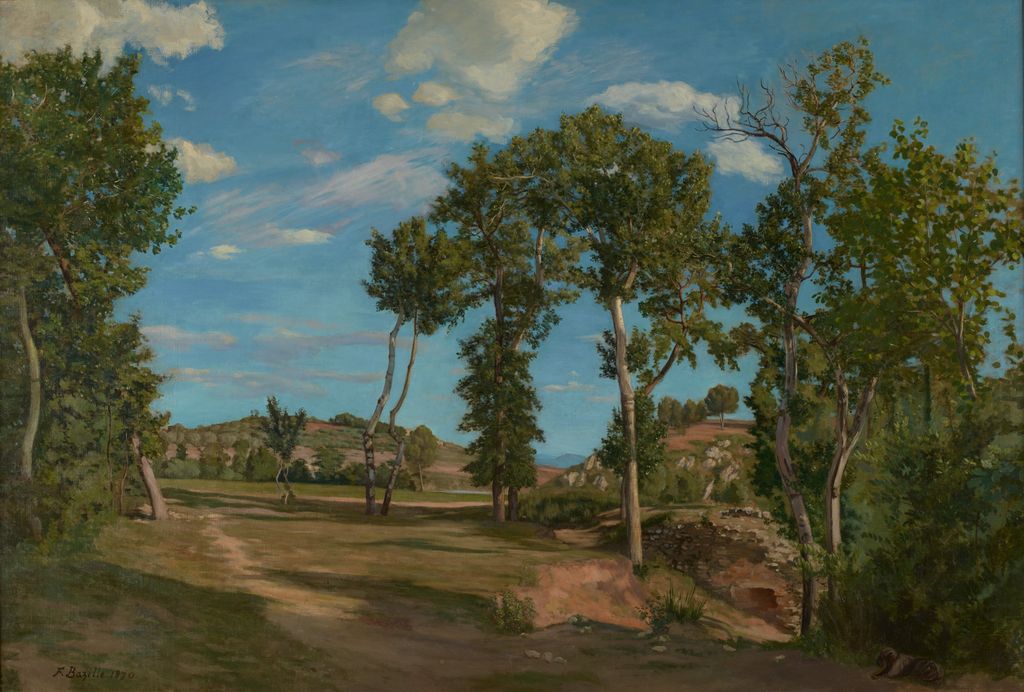
Landscape on the Banks of the Lez Image source. Public domain. Resized proportionally; full painting retained.
Family preservation and later exhibitions
Schulman traces Young Fisherman from the artist’s family in Montpellier through his nephew André Bazille to a private collection. He records its appearance in the Montpellier retrospective of 1927, at the Musée Fabre in 1941 and at the Galerie Wildenstein in Paris in 1950. Its documented exhibition history thus belongs to the twentieth-century reassessment of the artist. [1]
Its survival within the family and later retrospective display belong to the broader recovery of Bazille’s reputation. Michel Hilaire describes the combined importance of family generosity, museum exposure and twentieth-century historians in bringing the work back into view. [6] The traditional sitter name and the preservation of the canvas both come to us through that family connection, although preservation does not itself prove an identification.
The painting’s attraction ultimately rests on something more immediate. The boy’s lowered head invites attention to a small activity; the white shirt gives that activity unexpected visual force. Around him, a landscape forms through marks that remain conspicuously marks. Looking between the clear body and the open edges lets us see Bazille holding an outdoor figure together while leaving much of its surrounding world fluid.
Bazille catalogue directory
The 284 records comprise 85 painting records,40 separate works-on-paper records and 159 album or study records. They describe the catalogue’s organisation rather than 284 independent objects or unanimously accepted attributions. Recto, verso, albums and multiple studies remain distinct. Dates are qualified where needed; the Drawing filter includes the etching, gouache and mixed works on paper. Manuscript mentions and unproved projects are listed separately below.
Works known through documents
These mentions remain separate from the 284 catalogue records. Some may concern surviving studies or underlying compositions; they cannot simply be added together as missing physical paintings.
- A copy after Rubens mentioned in March 1863 is unlocated.
- A portrait of an unidentified woman was reported completed before July 1866.
- A portrait of Monet and a composition of two life-size women arranging flowers were reported in progress in April 1867. Their mention does not establish two otherwise unknown surviving canvases.
- Gertrude et le père Lapin was at least begun in the summer of 1870.
Further reported works and uncertain attributions
- A Bouquet of Lilacs was reportedly stolen and returned in 1864; a portrait of the friend Theulier and Yellow Narcissi reported by Maître in 1868 are also documentary mentions.
- Unidentified pictures associated with Guillemet and Mme Rolina are reported through later correspondence cited by the catalogue.
- Children Dressed as Bride and Groom was associated with Vallotton’s collection and also attributed to Renoir. Its identification and authorship should remain open.
Projects whose completion is unproved
- A portrait of Pauline was planned in July 1865.
- A portrait of Marc was proposed in April 1866; a related drawing survives.
- A Jardinière project appears in album inscriptions and related figure material. Written plans are not evidence of a completed painting.
| Name | Date | Medium |
|---|---|---|
| Mystic Marriage of St. Catherine | 1863 | Oil on canvas |
| Trees, Study | 1863 | Oil on canvas |
| Farm of Saint-Sauveur | 1863 | Oil on canvas |
| In the Garden of the Parc Monceau, Paris | 1864 | Oil on canvas |
| Naked Woman from Behind | 1864 | Oil on canvas |
| Reclining Nude | 1864 | Oil on canvas |
| Courtyard of the Auberge du Cheval blanc at Chailly near Barbizon | 1864 | Oil on canvas |
| Covered Soup Bowls | 1864 | Oil on canvas |
| Two Herrings | 1864 | Oil on canvas |
| The Pink Dress | 1864 | Oil on canvas |
| The Dog Rita Asleep | 1864 (catalogue); c. 1864 (2017 checklist) | Oil on canvas |
| The Scoter | 1864 | Oil on canvas |
| Naked Reclining Woman | 1864 | Oil on canvas |
| Landscape at Chailly | 1865 | Oil on canvas |
| Rocks at Chailly, Forest of Fontainebleau | 1865 | Oil on canvas |
| Undergrowth at Chailly, Forest of Fontainebleau | 1865 | Oil on canvas |
| Still Life with Grapes and Nuts | 1865 | Oil on canvas |
| Self-Portrait with a Palette — Chicago | 1865 | Oil on canvas |
| Landscape of Saint-Sauveur | 1865 | Oil on canvas |
| Beach at Sainte-Adresse | 1865 | Oil on canvas |
| The Improvised Field Hospital | 1865 | Oil on canvas |
| Village Street, Chailly | 1865 | Oil on canvas |
| Small Valley in the Forest of Fontainebleau | 1865 | Oil on canvas |
| Forest of Fontainebleau | 1865 | Oil on canvas |
| Woman Ironing | 1866 | Oil on canvas |
| The Artist's Studio on the rue de Furstenberg | 1865–66 (museum) | Oil on canvas |
| Still Life with Fish | 1866 | Oil on canvas |
| Little Italian Street Singer | 1866 | Oil on canvas |
| Potted Flowers | 1866 | Oil on canvas |
| The Little Gardener | 1866–1867 | Oil on canvas |
| Young Woman Playing the Piano | 1866–1867 | Oil on canvas |
| End of a Summer Day | 1866–1867 | Oil on canvas |
| A Studio on the rue Visconti | 1867 | Oil on canvas |
| Thérèse Reading in the Park at Méric | 1867 | Oil on canvas |
| Portrait of Verlaine | 1867 | Oil on canvas |
| The Terrace at Méric | 1867 | Oil on canvas |
| Still Life with Heron | 1867 | Oil on canvas |
| The Family Gathering | 1867–68 (museum) | Oil on canvas |
| Oleanders | 1867 | Oil on canvas |
| Woman on the Terrace at Méric | 1867 | Oil on canvas |
| The Ramparts at Aigues-Mortes from South | 1867 | Oil on canvas |
| The Western Ramparts at Aigues-Mortes | 1867 | Oil on canvas |
| Portrait of Edmond Maître — head study | 1867 | Oil on canvas |
| Porte de la Reine at Aigues-Mortes | 1867 | Oil on canvas |
| Portrait of Sisley | 1867 | Oil on wood |
| Portrait of Renoir — Cleveland | 1867 | Oil on canvas |
| Portrait of Renoir — Musée d’Orsay | 1867 | Oil on canvas |
| Self-Portrait with a Detachable Collar — Minneapolis | 1865–67 (museum); 1867–68 (catalogue) | Oil on canvas |
| Vase of Flowers on a Console | 1868 (museum); 1867–68 (catalogue) | Oil on canvas |
| Portrait of a Woman | 1868 | Oil on canvas |
| Young Woman in the Vineyards | 1868 | Oil on card |
| Harvester with a Basket | 1868 | Oil on card |
| Harvester with a Yellow Hat | 1868 | Oil on card |
| Harvester with a Headdress | 1868 | Oil on panel |
| On the Banks of the Lez | 1868 | Oil on canvas |
| After the Bath (attribution questioned) | 1868? | Oil on canvas |
| Young Woman with Lowered Eyes | 1868 | Oil on canvas |
| Fisherman with a Net | 1868 | Oil on canvas |
| View of the Village | 1868 | Oil on canvas |
| Portrait of Bazille (attributed to Monet by Musée Fabre; disputed catalogue attribution) | 1864 (museum); 1868 (catalogue) | Oil on panel |
| Studies for a Grape Harvest (two panels) | 1868 | Oil on canvas (two panels) |
| The Fortune Teller | 1868–69 (catalogue); c. 1869–70 (2017 checklist) | Oil on canvas |
| Harvester with a Cap | 1869 | Oil on card |
| Portrait of Edmond Maître — 1869 | 1869 | Oil on canvas |
| Woman in a Moorish Costume | 1869 | Oil on canvas |
| Young Woman in the Garden | 1869 | Oil on canvas |
| Portrait of Alphonse Tissié in a Cavalryman's Uniform | 1869 | Oil on canvas |
| Portrait of a dragoon | 1869 | Oil on canvas |
| Portrait of Zacharie Astruc | 1869 | Oil on canvas |
| Bunch of Grapes in a Bucket | 1869 | Oil on card |
| Portrait of Edouard Blau | Probably 1869; inscribed 1866 | Oil on canvas |
| Young Male Nude Lying on the Grass | 1870 | Oil on canvas |
| Summer Scene | 1869–1870 | Oil on canvas |
| The Studio on the rue La Condamine | 1869–1870 | Oil on canvas |
| La Toilette | 1870 | Oil on canvas |
| Young Woman with Peonies — Montpellier | 1870 | Oil on canvas |
| Young Woman with Peonies — Washington | 1870 | Oil on canvas |
| Monotonous Chant | 1870 | Oil on canvas |
| Flowers — private collection | 1870 | Oil on canvas |
| Flowers — Musée Fabre | 1870 | Oil on canvas |
| Young Fisherman | 1870 | Oil on canvas |
| Study for Ruth and Boaz | 1870 | Oil on wood |
| Ruth and Boaz | 1870 | Oil on canvas |
| Self-Portrait in Shirt Sleeves | 1870 | Oil on canvas |
| Landscape on the Banks of the Lez | 1870 | Oil on canvas |
| Study after an Alpine Landscape | 1860 | Graphite on watercolour-tinted paper |
| Profile Head | 1862 | Charcoal on laid paper |
| Studies after Delacroix | 1863 | Ink and graphite, with gouache and watercolour, on paper |
| Academic Head | 1863 | Charcoal on paper |
| Study of a Woman's Head in Profile on a Chair | 1863 | Charcoal on paper |
| Academic Head of a Woman | 1863 | Charcoal on paper |
| Academy of Woman | 1863 | Black pencil and charcoal, stumped, on watermarked laid paper |
| Academy of Man | 1863 | Black pencil and charcoal, stumped, on watermarked laid paper |
| Naked Man | 1863 | Charcoal on paper |
| The Pont au Change in Paris | 1864 | Watercolour on paper |
| Study for the Pink Dress or Portrait of Thérèse des Hours | 1864 | Black pencil on paper |
| Naked Woman Standing | 1864 | Pencil on paper |
| Study of a Reclining Nude | 1864 | Charcoal on paper |
| Bathers | 1864 | Charcoal on paper |
| Portrait of a Man | 1864 | Charcoal on paper |
| Study for The Pink Dress | 1864 | Black pencil, squared, on paper |
| Study for Landscape of Saint-Sauveur | 1864 | Graphite on paper |
| Study for Landscape of Saint-Sauveur | 1865 | Pencil on paper |
| Man Taming a Bull | 1866 | Pen and black pencil on paper |
| Man Half Lying on a Sofa | 1866 | Charcoal on paper |
| Study for The Family Gathering | 1867 | Pencil on paper |
| Study for The Family Gathering | 1867 | Graphite, charcoal and black pencil on paper |
| The Embroiderer | 1867 | Pencil on pink paper |
| Study of Children | 1867 | Pencil on paper |
| Women in a Garden | 1867 | Pencil drawing |
| View of the Village | 1868 | Etching on paper |
| Portrait of a Bearded Man (catalogued as Self-Portrait) | Undated (museum); 1869 (catalogue) | Charcoal and brown ink |
| Man Smoking Pipe | 1869 | Watercolour on paper |
| Manet Drawing | 1868–70(?) (museum) | Charcoal and white chalk on paper |
| Study for the Summer Scene | 1869 | Charcoal, pen and ink on paper |
| Family Portrait | 1869 | Pastel and charcoal on paper |
| Study for Ruth | 1870 | Pencil and charcoal on paper |
| Woman Arranging a Hat | 1870 | Pencil drawing |
| Study for Boaz Asleep | 1870 | Pastel and red chalk |
| Boaz Asleep | 1870 | Charcoal and pencil on paper |
| Study for Boaz Asleep | 1870 | Black and beige pastel with red chalk on laid paper |
| Ruth Lying down | 1870 | Charcoal and pastel on paper |
| Head, Arm and Chest of Ruth | 1870 | Charcoal on paper |
| Chest of Ruth | 1870 | Black chalk and charcoal on paper |
| Black Woman with Peonies — gouache | c. 1870 | Gouache, watercolour, pencil and black chalk on card |
| Various Unidentified Subjects | Undated | Pencil drawing |
| Rocky Sea Side | Undated | Charcoal on paper |
| Studies of a Dancing Woman | Undated | Drawing with white chalk |
| Study of a Leg | Undated | Pencil drawing |
| Dancers in Camargue | Undated | Pencil drawing |
| Academy of Woman | Undated | Charcoal |
| Caricature of Venus of Milo and Various Other Caricatures | Undated | Charcoal |
| Caricature | Undated | Pencil drawing |
| Study of Landscape | Undated | Charcoal |
| Caricatures and Seated Monk | Undated | Charcoal |
| Caricatures and Various Subjects | Undated | Pencil drawing |
| Women Carrying a Pitcher | Undated | Pencil drawing |
| The Hanged Man | Undated | Charcoal |
| Castle in the Plain | Undated | Charcoal |
| Naked Woman from Behind | Undated | Charcoal |
| Caricatures | Undated | Charcoal and pencil |
| Unidentified Subjects | Undated | Pencil drawing |
| Landscape with a Castle | Undated | Charcoal |
| Study of Landscape | Undated | Charcoal |
| Horse Rider seen from Behind | Undated | Charcoal |
| Mazeppa | Undated | Pencil and charcoal |
| Study of Rider and Others Subjects | Undated | Pencil, pen and brown ink |
| Study of an Unidentified Man | Undated | Pencil drawing |
| Study for an Unknown Historic Scene | Undated | Pencil drawing |
| Study a Man Reading | Undated | Pencil drawing |
| Study of Men Reading | Undated | Pencil drawing |
| Study of Landscape ? | Undated | Charcoal |
| Study of a Head of a Man | Undated | Pencil drawing |
| Erotic Scene | Undated | Pencil drawing |
| Study of Dog | Undated | Charcoal |
| Studies of Unidentified Subjects and Erotic Scene | Undated | Pencil and charcoal drawing |
| Study for a Theater Scene | Undated | Charcoal |
| Study of a Reclining Naked Woman | Undated | Charcoal |
| Two Studies of Landscape | Undated | Pencil drawing |
| Caricature | Undated | Pencil and charcoal drawing |
| Portrait of an Unidentified Young Man | Undated | Charcoal |
| Study of an Unidentified Subject | Undated | Brown ink drawing |
| Unidentified Man with a Hat | Undated | Pencil and charcoal |
| Study of an Unidentified Women | Undated | Pencil drawing |
| Study for a Theater Character ? | Undated | Pencil drawing |
| Study for a Theater Character ? | Undated | Pen drawing |
| The Pavillon de la Reine in Paris | Undated | Pencil drawing |
| Study of a Horse Rider | Undated | Pencil and charcoal drawing |
| Entwined Couple. Caricature ? | Undated | Pencil drawing |
| Woman Sitting on a Sofa | Undated | Pencil drawing |
| Studies of Unidentified Subjects | Undated | Pencil and charcoal drawing |
| Studies of Animals | Undated | Pencil drawing |
| Study of a Horse Rider in Camargue | Undated | Charcoal |
| Study of Hunting Dogs | Undated | Pencil drawing |
| Study of Soldiers. Caricatures | Undated | Pencil drawing |
| Studies of Hunting Dogs ? | Undated | Pencil drawing |
| Hunting Scene. Hunter Playing the Horn | Undated | Pencil drawing |
| Caricature | Undated | Pencil drawing |
| Study of an Ibex | Undated | Pencil drawing |
| Theater Scene. Caricatures | Undated | Pencil drawing |
| Studies of Animals. Horses ? | Undated | Pencil drawing |
| Caricatures | Undated | Pencil drawing |
| Studies of Various Subjects and Animals | Undated | Pencil drawing |
| Unidentified Subject | Undated | Pencil drawing |
| Rider Taming a Horse [in Camargue ?] | Undated | Pencil drawing |
| Caricature of a Soldier | Undated | Pencil drawing |
| Study of a Woman and Mouse | Undated | Pencil drawing |
| Historic Scene | Undated | Charcoal |
| Architecture Studies | Undated | Pencil drawing |
| Mythologic Scene | Undated | Charcoal |
| Ophelia | Undated | Pencil drawing |
| Mythologic Scene | Undated | Charcoal |
| Studies of Various Subjects | Undated | Pencil and pen drawing |
| Studies of Peasants | Undated | Pencil drawing |
| Historic Scene | Undated | Pencil drawing |
| Historic or Literary Scene | Undated | Pencil drawing |
| Unidentified Historic Scene | Undated | Pencil drawing |
| Studies of Unidentified Subjects | Undated | Pencil drawing |
| Unidentified Study | Undated | Pencil drawing |
| Man in an Armchair | Undated | Pencil drawing |
| Studies of Various Subjects | Undated | Pencil drawing |
| Portraits of Unidentified Men | Undated | Pencil drawing |
| Studies of Various Subjects | Undated | Pencil drawing |
| Horse Rider and Artist | Undated | Charcoal and pencil |
| Study of Unidentified Characters | Undated | Charcoal |
| Dead Horse in a Plain | Undated | Charcoal |
| Study of Various Subjects and Furniture | Undated | Pencil drawing |
| Caricatures and Various Notes about Opéra | Undated | Pencil drawing |
| Galloping Horse | Undated | Charcoal |
| Study for La Toilette | Undated | Pencil drawing |
| Study of a Naked Woman | Undated | Pencil drawing |
| Domestic Scene | Undated | Pencil drawing |
| Physiognomies | Undated | Pencil drawing |
| Study for a Grape Harvest | Undated | Pencil drawing |
| Study for the Summer Scene | Undated | Pencil drawing |
| Female Profiles | Undated | Pencil drawing |
| Various Subjects | Undated | Pencil drawing |
| Study for The Terrace at Méric | Undated | Pencil drawing |
| Study for The Ramparts at Aigues-Mortes | Undated | Pencil drawing |
| Study for The Ramparts at Aigues-Mortes | Undated | Pencil drawing |
| Study for a Grape Harvest | Undated | Charcoal |
| Children Portraits | Undated | Pencil drawing |
| Study for Children's Heads | Undated | Pencil drawing |
| Study of Minerva | Undated | Pencil drawing |
| Study for a Grape Harvest | Undated | Pencil drawing |
| Study for The Family Gathering | Undated | Pencil drawing |
| Study for a Young Fisherman | Undated | Charcoal |
| Self-Portraits | Undated | Black pencil drawing |
| Study of Horses for the Porte de la Reine at Aigues-Mortes | Undated | Ink drawing |
| Study of Horses for the Porte de la Reine at Aigues-Mortes | Undated | Ink drawing |
| Study of Horses for the Porte de la Reine at Aigues-Mortes | Undated | Ink drawing |
| Study for an Outdoor Concert | Undated | Pencil drawing |
| Studies of Legs | Undated | Pencil drawing |
| Study for The Ramparts at Aigues Mortes | Undated | Pencil drawing |
| Studies of Hats | Undated | Pencil drawing |
| Studies of Men | Undated | Pencil drawing |
| Study for The Little Gardener | Undated | Pencil drawing |
| Study for The Ramparts at Aigues Mortes | Undated | Charcoal |
| Studies of Sail Boats | Undated | Pencil drawing |
| Portrait of Marc Bazille | Undated | Charcoal, black pencil and graphite |
| Studies of Children's Heads | Undated | Pencil drawing |
| Study for Aigues-Mortes | Undated | Pencil drawing |
| Studies of Women's Heads | Undated | Pencil drawing |
| Portrait of Camille des Hours and an Unidentified Man | Undated | Charcoal |
| Study of Flying Birds | Undated | Charcoal or graphite |
| Study for the Summer Scene | Undated | Pencil drawing |
| Study of Hands | Undated | Pen drawing |
| Self-Portrait | Undated | Black pencil drawing |
| Study for the Summer Scene | Undated | Pencil drawing |
| Study for the Summer Scene | Undated | Pencil drawing |
| Study for a Grape Harvest | Undated | Pencil drawing |
| Study of Branches | Undated | Pencil drawing |
| Study of a Seated Child | Undated | Pencil drawing |
| Study for a Couple and Unidentified Women | Undated | Pencil drawing |
| Studies of Unidentified Women | Undated | Pencil drawing |
| Study of Buildings | Undated | Pencil drawing |
| Study for a Grape Harvest | Undated | Pencil and charcoal |
| Studies of Boaters | Undated | Pencil drawing |
| Study of a Man Writing at his Table | Undated | Pencil drawing |
| Study of a Woman Cutting Flowers | Undated | Pencil drawing |
| Study of Hand | Undated | Pencil drawing |
| Women in a Garden | Undated | Pencil drawing |
| Studies of Women in Profile | Undated | Pencil drawing |
| Study for Ruth and Boaz | Undated | Charcoal |
| Study for The Family Gathering | Undated | Pencil drawing |
| Study for the View of the Village | Undated | Pencil drawing |
| Study of the View of the Village | Undated | Pencil drawing |
| Study for the Fisherman with a Net | Undated | Pencil drawing |
| Study for the View of the Village | Undated | Charcoal |
| Study for The Little Gardener | Undated | Charcoal |
| Portrait of a Man with a Top Hat | Undated | Pencil drawing |
| Portrait of a Man with a Top Hat | Undated | Pencil drawing |
| Inscriptions | Undated | Pencil inscriptions |
| Study of Tree | Undated | Pencil drawing |
| Caricature of Nina la Belle | Undated | Pencil drawing |
| Study for Saint Sebastian | Undated | Pencil drawing |
| Young Woman Sewing | Undated | Pencil drawing |
| Studies of Hands | Undated | Pencil drawing |
| Woman in a Garden | Undated | Pencil drawing |
| Elegant Woman | Undated | Pencil drawing |
| Various Inscriptions | Undated | Inscriptions (medium unspecified in index) |
| Study of a Man with a Hat | Undated | Pencil drawing |
| Study of a Child | Undated | Pencil drawing |
| Study of a Man with a Hat | Undated | Pencil drawing |
Frequently Asked Questions
Family tradition identifies him as the son of the farmer at Saint-Sauveur in Lattès. The identification has not been proven. [1]
That cannot be established. Schulman rejects certainty about the earlier claim that it was his final painting. [1]
Yes. MSb 223, RF 5259 folio 19 recto, is a charcoal study of this clothed boy, with a changed position of the left hand. [2]
Discussion
The white shirt remains substantial while the surrounding landscape opens into broad marks. How do the two kinds of description work together?
Reader Insights
How do cool shadows give the white shirt its rounded form?
Compare the position of the left hand in the drawing and painting. What changes in the gesture?
Where does the figure remain firm while the surrounding bank becomes more openly painted?
Join the Conversation
Share a detail, comparison or question about Louis Auriol Fishing (Young Fisherman) below.
References
- Michel Schulman, Frédéric Bazille: The Digital Catalogue Raisonné, “Young Fisherman,” MSb-64, metadata, history, exhibitions and critical essay. Catalogue entry (English essay; some record fields in French). View source.
- Michel Schulman, Frédéric Bazille: The Digital Catalogue Raisonné, “Study for a Young Fisherman,” MSb-223, RF 5259 folio 19 recto. Catalogue entry (English essay; some record fields in French). View source.
- National Gallery of Art, Frédéric Bazille and the Birth of Impressionism, exhibition checklist, 2017, especially catalogue nos. 47, 61–62, 64–65 and 72. Exhibition checklist. View source.
- Michel Schulman, Frédéric Bazille: The Digital Catalogue Raisonné, “The Little Gardener,” MSb-26. Catalogue entry (English essay; some record fields in French). View source.
- Musée Fabre, Frédéric Bazille, la jeunesse de l’impressionnisme, press dossier, 2016, pp. 22–23. Museum dossier (in French). View source.
- Michel Hilaire, “Bazille ou la vie brève,” Académie des Sciences et Lettres de Montpellier, 2016, pp. 166–172, especially p. 166. Lecture text (in French). View source.
- Joconde/POP, La Robe rose, RF2450. View source. (in French).
- Musée d’Orsay, L’Ambulance improvisée, RF 1967 5. View source. (in French).
- Musée d’Orsay, Réunion de famille,RF2749. View source. (in French).
- Musée d’Orsay, Pierre Auguste Renoir,DL1970 3. View source.
- Musée Fabre, Vue de village, 898.5.1. View source. (in French).
- National Gallery of Art, Young Woman with Peonies,1983.1.6. View source.
- Michel Schulman, painting index and documentary introduction (English titles; French metadata). View source.
- Michel Schulman, works-on-paper index (English titles; French metadata). View source.
- Michel Schulman, albums and studies index (English titles; French metadata). View source.


 Frederic Bazille.jpg)


