



 by Tom Gurney
Tom Gurney BSc (Hons) is an art history expert with over 20 years experience
Published on June 19, 2020 / Updated on November 2, 2026
Email: tomgurney1@gmail.com / Phone: +44 7429 011000
Portrait of Édouard Blau by Frédéric Bazille: Introduction
Édouard Blau sits close to the picture’s surface, his head turned slightly aside and his black clothes spreading towards the lower corners. Behind him, green upholstery and a bright reddish wooden curve make the chair almost as forceful a presence as the sitter. Frédéric Bazille’s oil on canvas belongs to the National Gallery of Art in Washington, which dates it probably 1869, despite the inscription reading 1866. It measures 59.5 × 43.2 cm. [1]
Blau was a writer whose career would become closely associated with French opera. Yet Bazille gives him no manuscript, score or theatrical accessory. The portrait asks us to look at the arrangement of a head, a clothed body and a chair before learning the sitter’s profession. Its historical interest emerges when that concentrated image is brought together with letters describing a friendship sustained by writing, performance and the ordinary pleasures of Parisian artistic life.
At a Glance
- DateProbably 1869; inscribed 1866 [1]
- MediumOil on canvas [1]
- CollectionNational Gallery of Art, Washington, 1963.10.81 [1]
This work across Frédéric Bazille’s career
Portrait of Édouard Blau by Frédéric Bazille (current article)
Probably 1869; inscribed 1866Family Reunion
1867–1868 (museum)Bazille’s Studio, Rue La Condamine
1869–1870Summer Scene (Bathers)
1869–1870Contents
- A writer within Bazille’s circle
- The head within the chair
- Dark clothes, strong colour
- Why the date remains uncertain
- Theatre and music around the portrait
- Other portraits, another use of the chair
- From a private collection to Washington
- Annotated details
A writer within Bazille’s circle
Born in 1836, Blau worked in the offices of the Assistance publique, where he befriended Louis Gallet, while pursuing journalism, fiction, poetry and theatre. In 1868 the two writers won a competition for the libretto of La Coupe du roi de Thulé, subsequently set by Eugène Diaz. Blau later collaborated on the texts of Massenet’s Le Cid and Werther, and wrote the libretto of Lalo’s Le Roi d’Ys. These achievements situate him within an overlapping world of literary and musical collaboration. [2]
Bazille knew him well before that later operatic reputation. In the letter to his father dated 17 July 1865 by the Musée Fabre, he reports that he and Blau had begun a play during the winter. They had spent a month’s evenings finishing it, and a reading to friends, including two dramatists, had encouraged them. Bazille was seeking further advice and hoped to submit the piece to the actress Déjazet. His imagined performance and earnings remained hopes; the letter establishes the collaboration, without proving that the play reached the stage. [3]
Blau was someone with whom Bazille had already undertaken sustained creative work. The painter’s evenings could involve the drafting and testing of dramatic dialogue alongside his daytime painting. Their friendship consequently belongs to a broader artistic life than a list of painters exchanging studio visits would suggest.
That same letter is lively about competing activities. Bazille discusses paintings in progress, a planned portrait at Méric, the shared play and a rowing victory at Bougival. He anticipates his father’s concern that he is doing too many things, and reassures him that painting remains his central occupation. Writing with Blau appears as one of the pursuits he enjoys around that commitment. [3]
The head within the chair
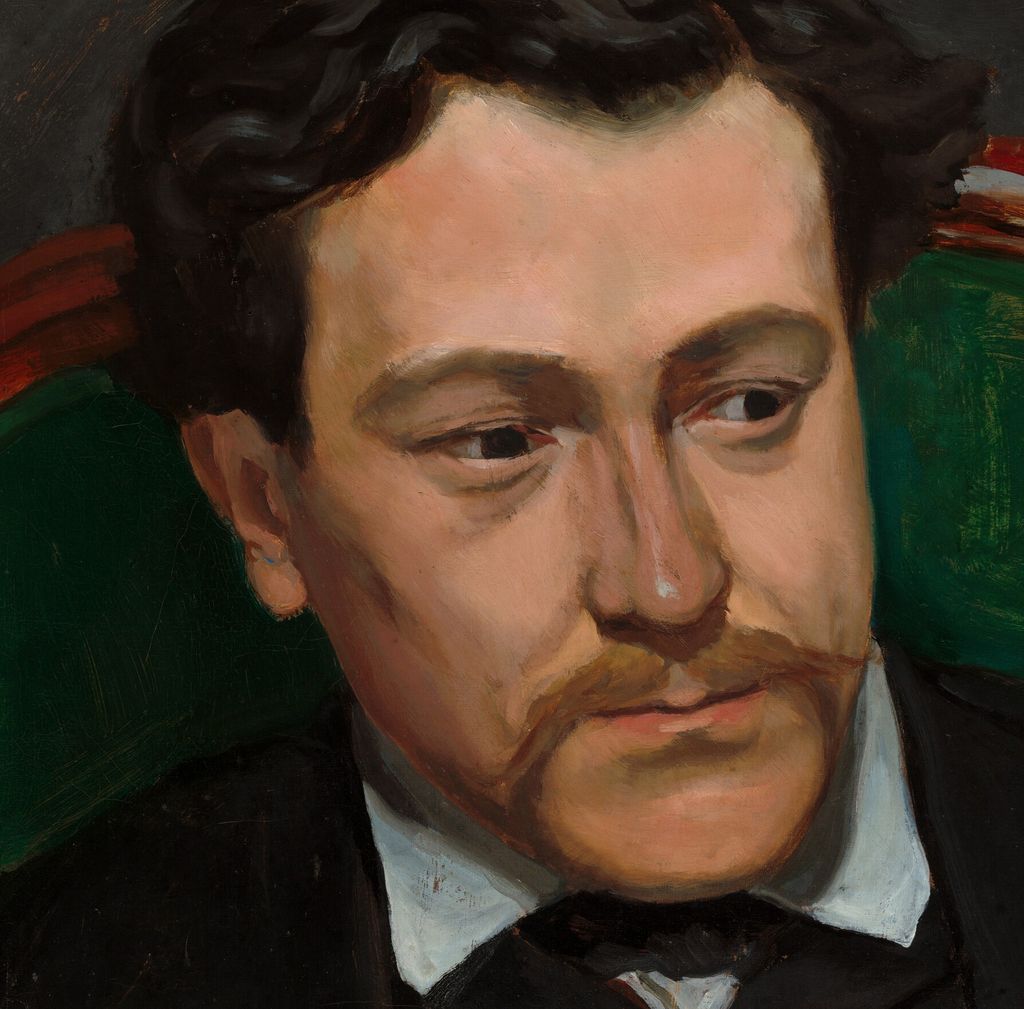
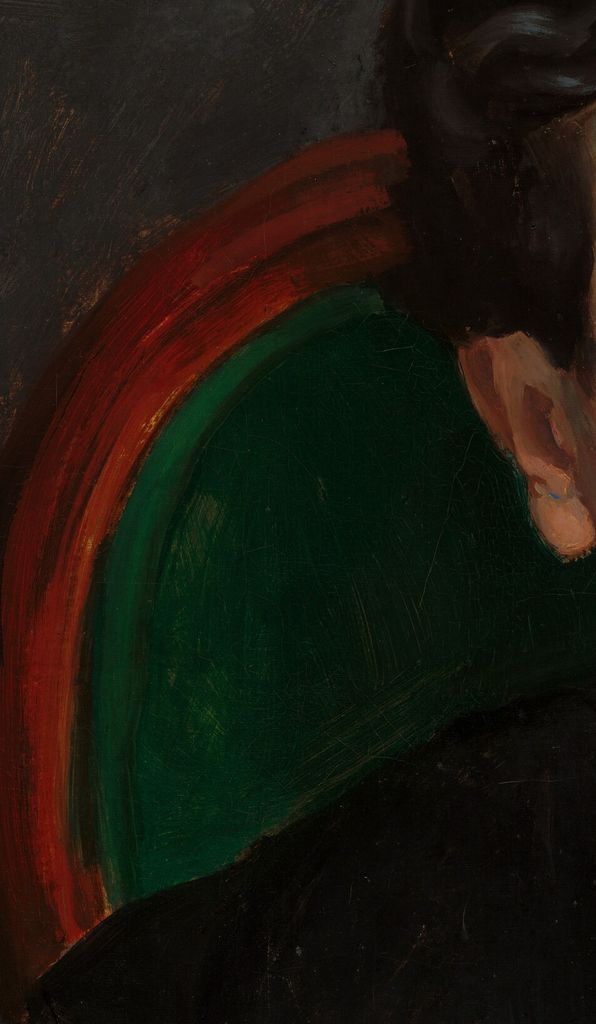
The portrait’s format gives Blau little surrounding room. His shoulders extend across most of the width, and the dark clothing continues beyond the bottom edge. No hands appear to explain what he is doing. The chair supports the head visually as well as physically: the green back forms a coloured field immediately around the face, with the reddish frame describing a larger curve behind the hair.
His body is presented broadly towards us, but the head and eyes turn towards our right. The adjustment is small enough that both eyes remain clearly visible. It creates an encounter in which the sitter is available to close scrutiny while his attention points beyond the canvas. The picture leaves the object of that attention unstated.
Look at the unequal shapes on either side of his face. On our left, the exposed ear and dark side of the head interrupt a substantial area of green. On our right, the face approaches the chair’s outer curve more closely, and the frame runs out of the picture. The sitter’s position is therefore less symmetrical than the broad frontal body initially suggests. This slight displacement keeps the enclosing chair from becoming a decorative halo.
The features are firmly set out. Dark marks beneath the brows sharpen the eyes; the nose is built from warm and cool changes of tone, with a small bright accent near its tip. The lighter skin across the forehead broadens into a continuous plane beneath the irregular hairline. Around the mouth, the moustache supplies a different kind of line, curling away from the lips and extending the face sideways. These varied edges make the face legible without requiring a sharply drawn outline everywhere.
There is an apparent reserve to the pose, but the painting cannot tell us that Blau was habitually reserved, distressed or absorbed in a particular thought. The visible evidence is more precise: closed lips, eyes directed away, an upright head and no gesturing hands. Those choices organise the viewer’s experience of the portrait. They do not establish the sitter’s private emotional state.
Annotated Details from Portrait of Édouard Blau
The numbered points identify visible features discussed in this article. Return from each detail to the whole composition. Portrait of Édouard Blau
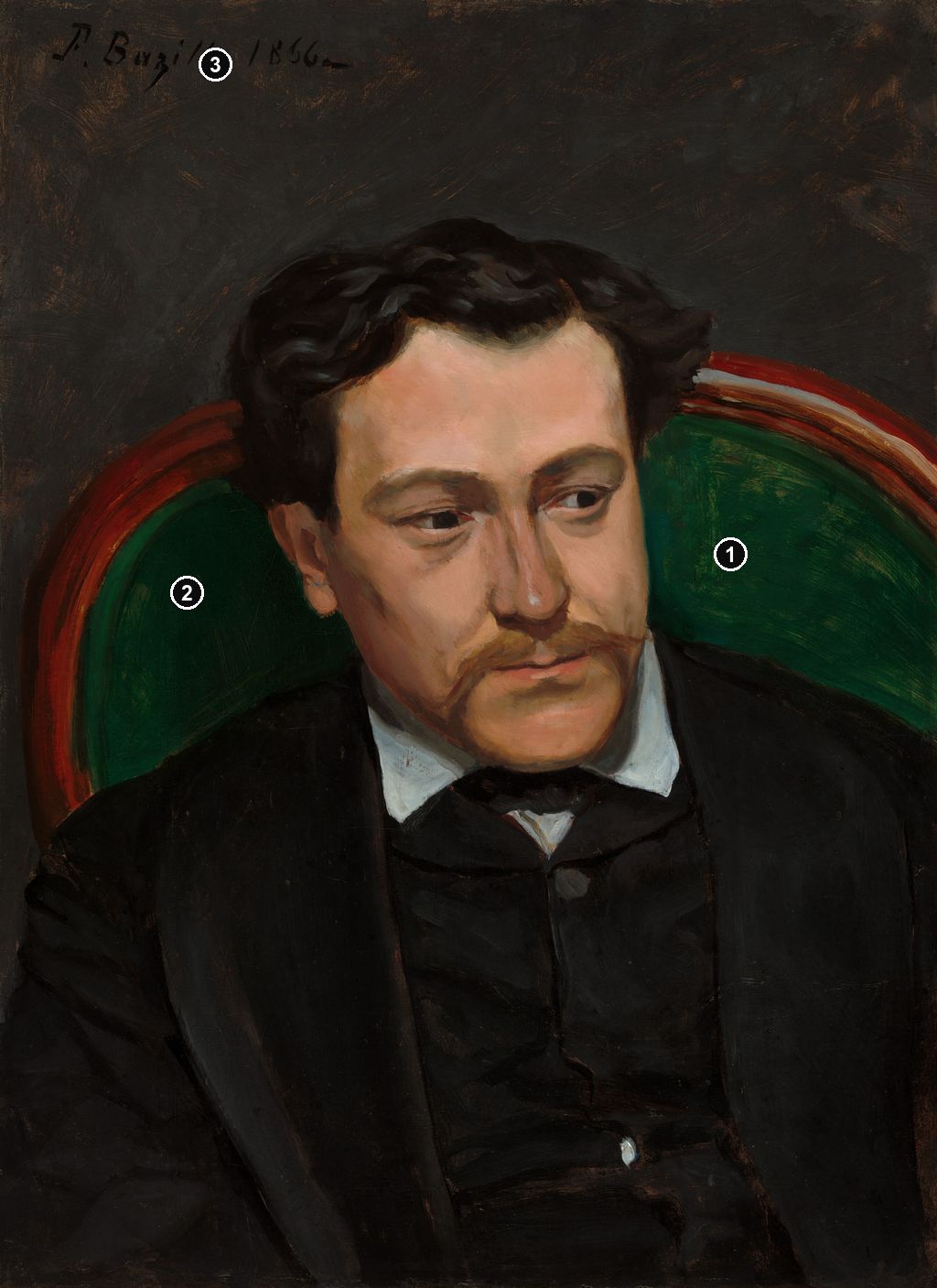
Details from PORTRAIT OF ÉDOUARD BLAU
Compare the cropped details with the complete images above. Notice how their colours, shapes and positions contribute to the larger compositions.
The turned face
The open eyes look sideways, while cheek nose and moustache keep the head strongly modelled.
The curved chair
Red wood and green upholstery make a rounded frame around the dark-clothed sitter.
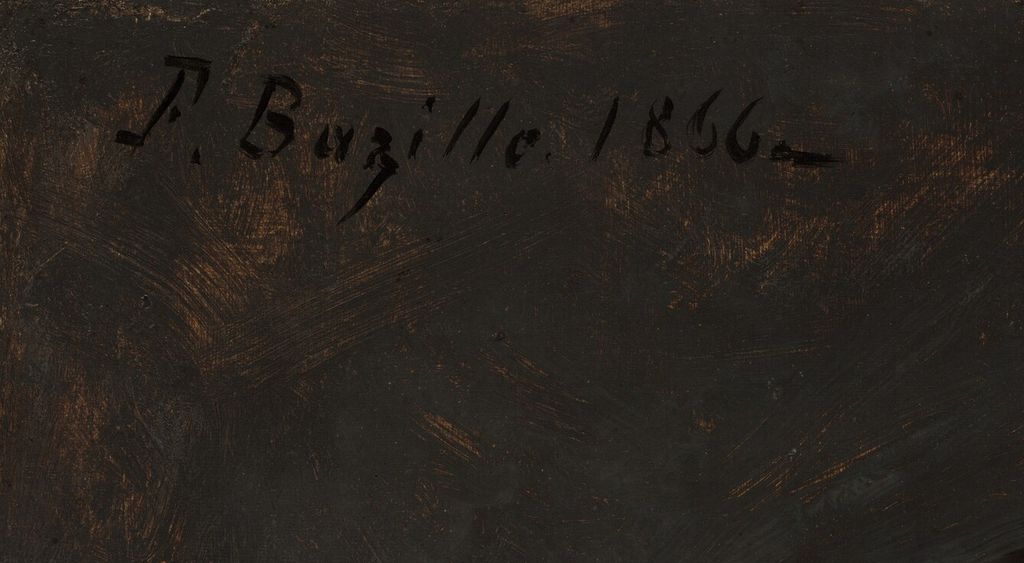
The inscription above
The dark inscription sits apart from the head in the upper field. The article distinguishes its written date from the proposed painting chronology.
Dark clothes, strong colour
The black suit occupies a large part of the canvas, but its surface contains several distinct shapes. Long lapels run downwards around the waistcoat; flatter areas give way to diagonal folds and the rounded movement of a sleeve. A small light button near the lower centre provides a sharp interruption. Above it, a narrow glimpse of pale shirt prevents the waistcoat from becoming an entirely closed black mass.
The collar is especially effective. Its two pale points sit beneath the chin, with the dark neckwear between them. They make a compact arrangement of light and dark that carries the eye from the face into the clothing. Their cool white also sets off the warmer pinks and ochres of the skin. Bazille makes formal dress useful to the painting: it supplies contrasting shapes and surfaces as well as identifying an aspect of Blau’s appearance.
The chair brings stronger colour into this subdued setting. Deep green brushwork varies across the upholstery, while the red frame catches pale, almost silvery highlights along its upper curve. The face occupies the meeting point of these surrounding colours. The red does not spread evenly across the canvas, and the green remains concentrated behind the head and shoulders; that restriction gives both more force.
Above the sitter, the background opens into a dark field crossed by loose, slanting strokes. The space is not described as a furnished room. Its visible movement contrasts with the more carefully articulated face. The hair supplies another transition: broad dark waves take up the freedom of the background while remaining firmly attached to the head’s structure. These differences in handling are visible features of the surface; they do not by themselves establish how many sittings the portrait required.
Schulman places Blau alongside The Fortune Teller and Young Woman with Lowered Eyes, drawing attention to their controlled contours, illuminated faces and restrained surrounding tones. That comparison usefully reminds us that Bazille’s late figure painting includes concentrated indoor images as well as ambitious outdoor compositions. [4]
Watch: Bazille and early Impressionism
Explore a Paris studio with Smarthistory, then discover the beginnings of Impressionism with the National Gallery of Art.
Jean-Frédéric Bazille, The Artist’s Studio, Rue Visconti, Paris
A close look at Bazille’s 1867 painting of the studio he shared in Paris.
Watch on YouTubeWhy the date remains uncertain
The inscription in the upper-left corner reads 1866. The National Gallery nevertheless assigns the painting to probably 1869, and its retrospective checklist proposed the still more specific date of probably December 1869. The distinction is between what is written on the canvas and the date proposed for its execution; both deserve to remain visible. [1] [5]
There is substantial documentary support for work on a Blau portrait at the later date. In a letter assigned by the Musée Fabre to late 1869, Bazille lists three current projects: his studio interior, the portrait of Blau and a female nude intended for the Salon. He expects these to occupy the winter. The letter establishes a portrait project in progress, not necessarily its completion before the year ended. It also does not explain why the surviving painting carries the earlier inscription. [6]
Schulman also cites a February 1869 letter in which Blau apologises for a failed arrangement and offers his availability for another meeting; he connects it with the portrait project. Read as an indication of plans between painter and sitter, it adds context, but the later work list is more explicit about the painting itself. Schulman’s catalogue adopts 1869, although its inscription field conflicts with both its own discussion and the National Gallery’s reading of 1866. [4]
The earlier date on the canvas cannot be dismissed on the assumption that the men met only in 1869. Their joint play is documented four years before then. What remains uncertain is the painting’s chronology, not whether an earlier friendship was possible. The most useful designation is therefore the museum’s qualified one: probably 1869, with an inscription dated 1866. [3] [1]
Theatre and music around the portrait
Theatrical interests continued after the joint play. Schulman places Blau and Bazille together in the preparations for a performance of Victor Hugo’s Ruy Blas at the Lejosnes’ home in March 1869. This was a social setting in which literary performance and friendship overlapped, rather than an occasion that establishes their first acquaintance. [4]
Music also runs through the letter listing the portrait. Bazille writes from Maître’s home and describes an outing with Maître, Renoir and others to hear Fidelio, followed by a meal. He also remembers a woodcock cooked at Maître’s. The small details matter because they place the painting among actual activities and relationships. They bring the winter work list into the same letter as an evening at the opera and shared food, without turning either episode into a scene supposedly witnessed during Blau’s sitting. [6]
The Musée Fabre’s retrospective account describes Bazille as an experienced pianist and an enthusiastic listener to Mozart and the Romantic composers. Music was part of the culture in which he worked and socialised. [7] Blau’s developing career gives that culture a further dimension: one of Bazille’s friends would make words for musical performance his principal occupation. [2] The portrait preserves the person within that network while leaving his profession visually unannounced.
Other portraits, another use of the chair
The Portrait of Edmond Maître makes a particularly useful companion. Maître turns much farther into profile, with an open book below and a cigar held away from his body. His hands extend the portrait into a small field of activity. Blau’s tighter framing removes that field: head, collar, torso and chair carry the whole encounter. The paintings offer different ways of making a friend present, even though both use dark contemporary clothing against a subdued ground.
The Portrait of Renoir introduces a more visibly folded pose, with raised knees and arms gathered across them. In comparison, Blau’s shoulders and enclosing chair produce a compact, upright arrangement. These differences reward looking across Bazille’s portraits without making each pose an explanation of an entire personality.
Schulman identifies Blau’s chair with the armchair displayed prominently in Bazille’s Studio, Rue La Condamine. Their curving reddish frames and green upholstery invite comparison, although the studio chair has a red back and green seat, whereas green fills the visible back behind Blau. The visual relationship is clear; the exact furniture identification deserves caution. [4]
The comparison also reveals two different pictorial functions. In the portrait, furniture encloses a sitter. In the studio picture, the empty chair stands out on the open floor, bringing saturated colour forward while people gather farther back. Mottin’s technical account reports that the figures and the chair were added after the room had first been painted. That finding concerns the construction of the studio picture; it gives no equivalent sequence for Blau’s portrait. [8]

Portrait of Edmond Maitre

Portrait of Renoir
From a private collection to Washington
The National Gallery records a sale from Leicester Galleries in London to Chester Dale on 20 April 1927, followed by Dale’s bequest to the museum in 1963. This is the documented acquisition date, rather than the 1920 given in Schulman’s provenance. [1] [4]
The painting appeared in the National Gallery’s 1965 presentation of the Chester Dale Bequest. It later joined the Washington stage of the 2016–17 Bazille retrospective, where it was catalogue number 55; it was not shown at the Montpellier and Paris stages. [1] The retrospective’s placement of Blau among the portraits and late figure pictures helps restore the breadth of Bazille’s subjects. [5]
Blau’s profession and the letters deepen the portrait, but its strongest effects remain available before we know that history. The curved chair directs attention towards the face; the white collar gives the dark body a precise upper boundary; the eyes carry attention away from the viewer. Bazille makes a recognisable social presence from those few elements. The documentary record then reveals how much shared activity stands behind the apparently quiet act of sitting.
Bazille catalogue directory
The 284 records comprise 85 painting records,40 separate works-on-paper records and 159 album or study records. They describe the catalogue’s organisation rather than 284 independent objects or unanimously accepted attributions. Recto, verso, albums and multiple studies remain distinct. Dates are qualified where needed; the Drawing filter includes the etching, gouache and mixed works on paper. Manuscript mentions and unproved projects are listed separately below.
Works known through documents
These mentions remain separate from the 284 catalogue records. Some may concern surviving studies or underlying compositions; they cannot simply be added together as missing physical paintings.
- A copy after Rubens mentioned in March 1863 is unlocated.
- A portrait of an unidentified woman was reported completed before July 1866.
- A portrait of Monet and a composition of two life-size women arranging flowers were reported in progress in April 1867. Their mention does not establish two otherwise unknown surviving canvases.
- Gertrude et le père Lapin was at least begun in the summer of 1870.
Further reported works and uncertain attributions
- A Bouquet of Lilacs was reportedly stolen and returned in 1864; a portrait of the friend Theulier and Yellow Narcissi reported by Maître in 1868 are also documentary mentions.
- Unidentified pictures associated with Guillemet and Mme Rolina are reported through later correspondence cited by the catalogue.
- Children Dressed as Bride and Groom was associated with Vallotton’s collection and also attributed to Renoir. Its identification and authorship should remain open.
Projects whose completion is unproved
- A portrait of Pauline was planned in July 1865.
- A portrait of Marc was proposed in April 1866; a related drawing survives.
- A Jardinière project appears in album inscriptions and related figure material. Written plans are not evidence of a completed painting.
| Name | Date | Medium |
|---|---|---|
| Mystic Marriage of St. Catherine | 1863 | Oil on canvas |
| Trees, Study | 1863 | Oil on canvas |
| Farm of Saint-Sauveur | 1863 | Oil on canvas |
| In the Garden of the Parc Monceau, Paris | 1864 | Oil on canvas |
| Naked Woman from Behind | 1864 | Oil on canvas |
| Reclining Nude | 1864 | Oil on canvas |
| Courtyard of the Auberge du Cheval blanc at Chailly near Barbizon | 1864 | Oil on canvas |
| Covered Soup Bowls | 1864 | Oil on canvas |
| Two Herrings | 1864 | Oil on canvas |
| The Pink Dress | 1864 | Oil on canvas |
| The Dog Rita Asleep | 1864 (catalogue); c. 1864 (2017 checklist) | Oil on canvas |
| The Scoter | 1864 | Oil on canvas |
| Naked Reclining Woman | 1864 | Oil on canvas |
| Landscape at Chailly | 1865 | Oil on canvas |
| Rocks at Chailly, Forest of Fontainebleau | 1865 | Oil on canvas |
| Undergrowth at Chailly, Forest of Fontainebleau | 1865 | Oil on canvas |
| Still Life with Grapes and Nuts | 1865 | Oil on canvas |
| Self-Portrait with a Palette — Chicago | 1865 | Oil on canvas |
| Landscape of Saint-Sauveur | 1865 | Oil on canvas |
| Beach at Sainte-Adresse | 1865 | Oil on canvas |
| The Improvised Field Hospital | 1865 | Oil on canvas |
| Village Street, Chailly | 1865 | Oil on canvas |
| Small Valley in the Forest of Fontainebleau | 1865 | Oil on canvas |
| Forest of Fontainebleau | 1865 | Oil on canvas |
| Woman Ironing | 1866 | Oil on canvas |
| The Artist's Studio on the rue de Furstenberg | 1865–66 (museum) | Oil on canvas |
| Still Life with Fish | 1866 | Oil on canvas |
| Little Italian Street Singer | 1866 | Oil on canvas |
| Potted Flowers | 1866 | Oil on canvas |
| The Little Gardener | 1866–1867 | Oil on canvas |
| Young Woman Playing the Piano | 1866–1867 | Oil on canvas |
| End of a Summer Day | 1866–1867 | Oil on canvas |
| A Studio on the rue Visconti | 1867 | Oil on canvas |
| Thérèse Reading in the Park at Méric | 1867 | Oil on canvas |
| Portrait of Verlaine | 1867 | Oil on canvas |
| The Terrace at Méric | 1867 | Oil on canvas |
| Still Life with Heron | 1867 | Oil on canvas |
| The Family Gathering | 1867–68 (museum) | Oil on canvas |
| Oleanders | 1867 | Oil on canvas |
| Woman on the Terrace at Méric | 1867 | Oil on canvas |
| The Ramparts at Aigues-Mortes from South | 1867 | Oil on canvas |
| The Western Ramparts at Aigues-Mortes | 1867 | Oil on canvas |
| Portrait of Edmond Maître — head study | 1867 | Oil on canvas |
| Porte de la Reine at Aigues-Mortes | 1867 | Oil on canvas |
| Portrait of Sisley | 1867 | Oil on wood |
| Portrait of Renoir — Cleveland | 1867 | Oil on canvas |
| Portrait of Renoir — Musée d’Orsay | 1867 | Oil on canvas |
| Self-Portrait with a Detachable Collar — Minneapolis | 1865–67 (museum); 1867–68 (catalogue) | Oil on canvas |
| Vase of Flowers on a Console | 1868 (museum); 1867–68 (catalogue) | Oil on canvas |
| Portrait of a Woman | 1868 | Oil on canvas |
| Young Woman in the Vineyards | 1868 | Oil on card |
| Harvester with a Basket | 1868 | Oil on card |
| Harvester with a Yellow Hat | 1868 | Oil on card |
| Harvester with a Headdress | 1868 | Oil on panel |
| On the Banks of the Lez | 1868 | Oil on canvas |
| After the Bath (attribution questioned) | 1868? | Oil on canvas |
| Young Woman with Lowered Eyes | 1868 | Oil on canvas |
| Fisherman with a Net | 1868 | Oil on canvas |
| View of the Village | 1868 | Oil on canvas |
| Portrait of Bazille (attributed to Monet by Musée Fabre; disputed catalogue attribution) | 1864 (museum); 1868 (catalogue) | Oil on panel |
| Studies for a Grape Harvest (two panels) | 1868 | Oil on canvas (two panels) |
| The Fortune Teller | 1868–69 (catalogue); c. 1869–70 (2017 checklist) | Oil on canvas |
| Harvester with a Cap | 1869 | Oil on card |
| Portrait of Edmond Maître — 1869 | 1869 | Oil on canvas |
| Woman in a Moorish Costume | 1869 | Oil on canvas |
| Young Woman in the Garden | 1869 | Oil on canvas |
| Portrait of Alphonse Tissié in a Cavalryman's Uniform | 1869 | Oil on canvas |
| Portrait of a dragoon | 1869 | Oil on canvas |
| Portrait of Zacharie Astruc | 1869 | Oil on canvas |
| Bunch of Grapes in a Bucket | 1869 | Oil on card |
| Portrait of Edouard Blau | Probably 1869; inscribed 1866 | Oil on canvas |
| Young Male Nude Lying on the Grass | 1870 | Oil on canvas |
| Summer Scene | 1869–1870 | Oil on canvas |
| The Studio on the rue La Condamine | 1869–1870 | Oil on canvas |
| La Toilette | 1870 | Oil on canvas |
| Young Woman with Peonies — Montpellier | 1870 | Oil on canvas |
| Young Woman with Peonies — Washington | 1870 | Oil on canvas |
| Monotonous Chant | 1870 | Oil on canvas |
| Flowers — private collection | 1870 | Oil on canvas |
| Flowers — Musée Fabre | 1870 | Oil on canvas |
| Young Fisherman | 1870 | Oil on canvas |
| Study for Ruth and Boaz | 1870 | Oil on wood |
| Ruth and Boaz | 1870 | Oil on canvas |
| Self-Portrait in Shirt Sleeves | 1870 | Oil on canvas |
| Landscape on the Banks of the Lez | 1870 | Oil on canvas |
| Study after an Alpine Landscape | 1860 | Graphite on watercolour-tinted paper |
| Profile Head | 1862 | Charcoal on laid paper |
| Studies after Delacroix | 1863 | Ink and graphite, with gouache and watercolour, on paper |
| Academic Head | 1863 | Charcoal on paper |
| Study of a Woman's Head in Profile on a Chair | 1863 | Charcoal on paper |
| Academic Head of a Woman | 1863 | Charcoal on paper |
| Academy of Woman | 1863 | Black pencil and charcoal, stumped, on watermarked laid paper |
| Academy of Man | 1863 | Black pencil and charcoal, stumped, on watermarked laid paper |
| Naked Man | 1863 | Charcoal on paper |
| The Pont au Change in Paris | 1864 | Watercolour on paper |
| Study for the Pink Dress or Portrait of Thérèse des Hours | 1864 | Black pencil on paper |
| Naked Woman Standing | 1864 | Pencil on paper |
| Study of a Reclining Nude | 1864 | Charcoal on paper |
| Bathers | 1864 | Charcoal on paper |
| Portrait of a Man | 1864 | Charcoal on paper |
| Study for The Pink Dress | 1864 | Black pencil, squared, on paper |
| Study for Landscape of Saint-Sauveur | 1864 | Graphite on paper |
| Study for Landscape of Saint-Sauveur | 1865 | Pencil on paper |
| Man Taming a Bull | 1866 | Pen and black pencil on paper |
| Man Half Lying on a Sofa | 1866 | Charcoal on paper |
| Study for The Family Gathering | 1867 | Pencil on paper |
| Study for The Family Gathering | 1867 | Graphite, charcoal and black pencil on paper |
| The Embroiderer | 1867 | Pencil on pink paper |
| Study of Children | 1867 | Pencil on paper |
| Women in a Garden | 1867 | Pencil drawing |
| View of the Village | 1868 | Etching on paper |
| Portrait of a Bearded Man (catalogued as Self-Portrait) | Undated (museum); 1869 (catalogue) | Charcoal and brown ink |
| Man Smoking Pipe | 1869 | Watercolour on paper |
| Manet Drawing | 1868–70(?) (museum) | Charcoal and white chalk on paper |
| Study for the Summer Scene | 1869 | Charcoal, pen and ink on paper |
| Family Portrait | 1869 | Pastel and charcoal on paper |
| Study for Ruth | 1870 | Pencil and charcoal on paper |
| Woman Arranging a Hat | 1870 | Pencil drawing |
| Study for Boaz Asleep | 1870 | Pastel and red chalk |
| Boaz Asleep | 1870 | Charcoal and pencil on paper |
| Study for Boaz Asleep | 1870 | Black and beige pastel with red chalk on laid paper |
| Ruth Lying down | 1870 | Charcoal and pastel on paper |
| Head, Arm and Chest of Ruth | 1870 | Charcoal on paper |
| Chest of Ruth | 1870 | Black chalk and charcoal on paper |
| Black Woman with Peonies — gouache | c. 1870 | Gouache, watercolour, pencil and black chalk on card |
| Various Unidentified Subjects | Undated | Pencil drawing |
| Rocky Sea Side | Undated | Charcoal on paper |
| Studies of a Dancing Woman | Undated | Drawing with white chalk |
| Study of a Leg | Undated | Pencil drawing |
| Dancers in Camargue | Undated | Pencil drawing |
| Academy of Woman | Undated | Charcoal |
| Caricature of Venus of Milo and Various Other Caricatures | Undated | Charcoal |
| Caricature | Undated | Pencil drawing |
| Study of Landscape | Undated | Charcoal |
| Caricatures and Seated Monk | Undated | Charcoal |
| Caricatures and Various Subjects | Undated | Pencil drawing |
| Women Carrying a Pitcher | Undated | Pencil drawing |
| The Hanged Man | Undated | Charcoal |
| Castle in the Plain | Undated | Charcoal |
| Naked Woman from Behind | Undated | Charcoal |
| Caricatures | Undated | Charcoal and pencil |
| Unidentified Subjects | Undated | Pencil drawing |
| Landscape with a Castle | Undated | Charcoal |
| Study of Landscape | Undated | Charcoal |
| Horse Rider seen from Behind | Undated | Charcoal |
| Mazeppa | Undated | Pencil and charcoal |
| Study of Rider and Others Subjects | Undated | Pencil, pen and brown ink |
| Study of an Unidentified Man | Undated | Pencil drawing |
| Study for an Unknown Historic Scene | Undated | Pencil drawing |
| Study a Man Reading | Undated | Pencil drawing |
| Study of Men Reading | Undated | Pencil drawing |
| Study of Landscape ? | Undated | Charcoal |
| Study of a Head of a Man | Undated | Pencil drawing |
| Erotic Scene | Undated | Pencil drawing |
| Study of Dog | Undated | Charcoal |
| Studies of Unidentified Subjects and Erotic Scene | Undated | Pencil and charcoal drawing |
| Study for a Theater Scene | Undated | Charcoal |
| Study of a Reclining Naked Woman | Undated | Charcoal |
| Two Studies of Landscape | Undated | Pencil drawing |
| Caricature | Undated | Pencil and charcoal drawing |
| Portrait of an Unidentified Young Man | Undated | Charcoal |
| Study of an Unidentified Subject | Undated | Brown ink drawing |
| Unidentified Man with a Hat | Undated | Pencil and charcoal |
| Study of an Unidentified Women | Undated | Pencil drawing |
| Study for a Theater Character ? | Undated | Pencil drawing |
| Study for a Theater Character ? | Undated | Pen drawing |
| The Pavillon de la Reine in Paris | Undated | Pencil drawing |
| Study of a Horse Rider | Undated | Pencil and charcoal drawing |
| Entwined Couple. Caricature ? | Undated | Pencil drawing |
| Woman Sitting on a Sofa | Undated | Pencil drawing |
| Studies of Unidentified Subjects | Undated | Pencil and charcoal drawing |
| Studies of Animals | Undated | Pencil drawing |
| Study of a Horse Rider in Camargue | Undated | Charcoal |
| Study of Hunting Dogs | Undated | Pencil drawing |
| Study of Soldiers. Caricatures | Undated | Pencil drawing |
| Studies of Hunting Dogs ? | Undated | Pencil drawing |
| Hunting Scene. Hunter Playing the Horn | Undated | Pencil drawing |
| Caricature | Undated | Pencil drawing |
| Study of an Ibex | Undated | Pencil drawing |
| Theater Scene. Caricatures | Undated | Pencil drawing |
| Studies of Animals. Horses ? | Undated | Pencil drawing |
| Caricatures | Undated | Pencil drawing |
| Studies of Various Subjects and Animals | Undated | Pencil drawing |
| Unidentified Subject | Undated | Pencil drawing |
| Rider Taming a Horse [in Camargue ?] | Undated | Pencil drawing |
| Caricature of a Soldier | Undated | Pencil drawing |
| Study of a Woman and Mouse | Undated | Pencil drawing |
| Historic Scene | Undated | Charcoal |
| Architecture Studies | Undated | Pencil drawing |
| Mythologic Scene | Undated | Charcoal |
| Ophelia | Undated | Pencil drawing |
| Mythologic Scene | Undated | Charcoal |
| Studies of Various Subjects | Undated | Pencil and pen drawing |
| Studies of Peasants | Undated | Pencil drawing |
| Historic Scene | Undated | Pencil drawing |
| Historic or Literary Scene | Undated | Pencil drawing |
| Unidentified Historic Scene | Undated | Pencil drawing |
| Studies of Unidentified Subjects | Undated | Pencil drawing |
| Unidentified Study | Undated | Pencil drawing |
| Man in an Armchair | Undated | Pencil drawing |
| Studies of Various Subjects | Undated | Pencil drawing |
| Portraits of Unidentified Men | Undated | Pencil drawing |
| Studies of Various Subjects | Undated | Pencil drawing |
| Horse Rider and Artist | Undated | Charcoal and pencil |
| Study of Unidentified Characters | Undated | Charcoal |
| Dead Horse in a Plain | Undated | Charcoal |
| Study of Various Subjects and Furniture | Undated | Pencil drawing |
| Caricatures and Various Notes about Opéra | Undated | Pencil drawing |
| Galloping Horse | Undated | Charcoal |
| Study for La Toilette | Undated | Pencil drawing |
| Study of a Naked Woman | Undated | Pencil drawing |
| Domestic Scene | Undated | Pencil drawing |
| Physiognomies | Undated | Pencil drawing |
| Study for a Grape Harvest | Undated | Pencil drawing |
| Study for the Summer Scene | Undated | Pencil drawing |
| Female Profiles | Undated | Pencil drawing |
| Various Subjects | Undated | Pencil drawing |
| Study for The Terrace at Méric | Undated | Pencil drawing |
| Study for The Ramparts at Aigues-Mortes | Undated | Pencil drawing |
| Study for The Ramparts at Aigues-Mortes | Undated | Pencil drawing |
| Study for a Grape Harvest | Undated | Charcoal |
| Children Portraits | Undated | Pencil drawing |
| Study for Children's Heads | Undated | Pencil drawing |
| Study of Minerva | Undated | Pencil drawing |
| Study for a Grape Harvest | Undated | Pencil drawing |
| Study for The Family Gathering | Undated | Pencil drawing |
| Study for a Young Fisherman | Undated | Charcoal |
| Self-Portraits | Undated | Black pencil drawing |
| Study of Horses for the Porte de la Reine at Aigues-Mortes | Undated | Ink drawing |
| Study of Horses for the Porte de la Reine at Aigues-Mortes | Undated | Ink drawing |
| Study of Horses for the Porte de la Reine at Aigues-Mortes | Undated | Ink drawing |
| Study for an Outdoor Concert | Undated | Pencil drawing |
| Studies of Legs | Undated | Pencil drawing |
| Study for The Ramparts at Aigues Mortes | Undated | Pencil drawing |
| Studies of Hats | Undated | Pencil drawing |
| Studies of Men | Undated | Pencil drawing |
| Study for The Little Gardener | Undated | Pencil drawing |
| Study for The Ramparts at Aigues Mortes | Undated | Charcoal |
| Studies of Sail Boats | Undated | Pencil drawing |
| Portrait of Marc Bazille | Undated | Charcoal, black pencil and graphite |
| Studies of Children's Heads | Undated | Pencil drawing |
| Study for Aigues-Mortes | Undated | Pencil drawing |
| Studies of Women's Heads | Undated | Pencil drawing |
| Portrait of Camille des Hours and an Unidentified Man | Undated | Charcoal |
| Study of Flying Birds | Undated | Charcoal or graphite |
| Study for the Summer Scene | Undated | Pencil drawing |
| Study of Hands | Undated | Pen drawing |
| Self-Portrait | Undated | Black pencil drawing |
| Study for the Summer Scene | Undated | Pencil drawing |
| Study for the Summer Scene | Undated | Pencil drawing |
| Study for a Grape Harvest | Undated | Pencil drawing |
| Study of Branches | Undated | Pencil drawing |
| Study of a Seated Child | Undated | Pencil drawing |
| Study for a Couple and Unidentified Women | Undated | Pencil drawing |
| Studies of Unidentified Women | Undated | Pencil drawing |
| Study of Buildings | Undated | Pencil drawing |
| Study for a Grape Harvest | Undated | Pencil and charcoal |
| Studies of Boaters | Undated | Pencil drawing |
| Study of a Man Writing at his Table | Undated | Pencil drawing |
| Study of a Woman Cutting Flowers | Undated | Pencil drawing |
| Study of Hand | Undated | Pencil drawing |
| Women in a Garden | Undated | Pencil drawing |
| Studies of Women in Profile | Undated | Pencil drawing |
| Study for Ruth and Boaz | Undated | Charcoal |
| Study for The Family Gathering | Undated | Pencil drawing |
| Study for the View of the Village | Undated | Pencil drawing |
| Study of the View of the Village | Undated | Pencil drawing |
| Study for the Fisherman with a Net | Undated | Pencil drawing |
| Study for the View of the Village | Undated | Charcoal |
| Study for The Little Gardener | Undated | Charcoal |
| Portrait of a Man with a Top Hat | Undated | Pencil drawing |
| Portrait of a Man with a Top Hat | Undated | Pencil drawing |
| Inscriptions | Undated | Pencil inscriptions |
| Study of Tree | Undated | Pencil drawing |
| Caricature of Nina la Belle | Undated | Pencil drawing |
| Study for Saint Sebastian | Undated | Pencil drawing |
| Young Woman Sewing | Undated | Pencil drawing |
| Studies of Hands | Undated | Pencil drawing |
| Woman in a Garden | Undated | Pencil drawing |
| Elegant Woman | Undated | Pencil drawing |
| Various Inscriptions | Undated | Inscriptions (medium unspecified in index) |
| Study of a Man with a Hat | Undated | Pencil drawing |
| Study of a Child | Undated | Pencil drawing |
| Study of a Man with a Hat | Undated | Pencil drawing |
Frequently Asked Questions
The National Gallery of Art dates the portrait probably 1869, despite its 1866 inscription. [1]
Discussion
Blau’s quiet pose is supported by strong curves and small light accents. Which gives him the clearest presence?
Reader Insights
How does the green chair direct attention towards Blau’s face?
Compare the white collar with the darker boundaries of the jacket. Which makes the pose clearest?
What changes when you compare Blau’s outward gaze with Maître’s attention to his book?
Join the Conversation
Share a detail, comparison or question about Portrait of Édouard Blau by Frédéric Bazille below.
References
- National Gallery of Art, Edouard Blau, probably 1869, accession 1963.10.81: collection record, inscription, provenance and exhibition history. Source. View source.
- Palazzetto Bru Zane, Édouard Blau, Bru Zane Mediabase: biography and works. Source (in French). View source.
- Frédéric Bazille, letter to his father, [17 July 1865], Musée Fabre, inventory 92.2.2, transcription p. 4; date supplied by the museum. Source (in French). View source.
- Michel Schulman, Portrait of Edouard Blau, MSb-57, Frédéric Bazille: The Digital Catalogue Raisonné: critical essay and object history. Source (English translation, with metadata in French). View source.
- National Gallery of Art, Frédéric Bazille and the Birth of Impressionism, exhibition checklist, 2017, especially p. 7, catalogue no. 55. Source. View source.
- Frédéric Bazille, letter to his father, [late 1869], Musée Fabre, inventory 92.2.6, transcription p. 4; date supplied by the museum. Source (in French). View source.
- Musée Fabre, Frédéric Bazille: la jeunesse de l’impressionnisme, exhibition press dossier, 2016, especially p. 10, “Dessins, lettres, musique.” Source (in French). View source.
- Bruno Mottin, “L’œuvre de Frédéric Bazille (1841-1870) examiné au laboratoire,” Technè 46 (2018), pp. 30–38, especially paragraphs 21–23. Source (in French). View source.
- Joconde/POP, La Robe rose, RF2450. View source. (in French).
- Musée d’Orsay, L’Ambulance improvisée, RF 1967 5. View source. (in French).
- Musée d’Orsay, Réunion de famille,RF2749. View source. (in French).
- Musée d’Orsay, Pierre Auguste Renoir,DL1970 3. View source.
- Musée Fabre, Vue de village, 898.5.1. View source. (in French).
- National Gallery of Art, Young Woman with Peonies,1983.1.6. View source.
- Michel Schulman, painting index and documentary introduction (English titles; French metadata). View source.
- Michel Schulman, works-on-paper index (English titles; French metadata). View source.
- Michel Schulman, albums and studies index (English titles; French metadata). View source.


 Frederic Bazille.jpg)


