 by Tom Gurney
Tom Gurney BSc (Hons) is an art history expert with over 20 years experience
Published on June 19, 2020 / Updated on November 2, 2026
Email: tomgurney1@gmail.com / Phone: +44 7429 011000
Frédéric Bazille’s Self-Portrait with Detachable Collar: Introduction
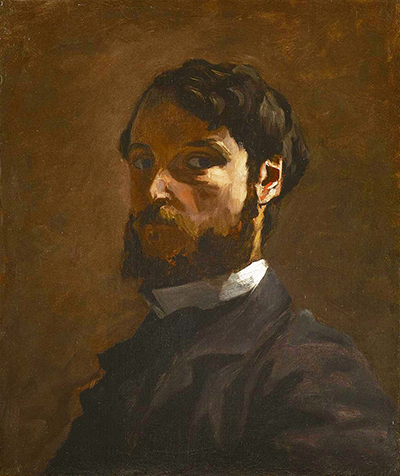
A bright white collar holds the centre of Frédéric Bazille’s Self-Portrait with Detachable Collar. Above it, a bearded face turns out of a dark coat and a brown background, its uneven lighting giving the head an almost sculptural presence. The picture belongs to the Minneapolis Institute of Art, which dates it to 1865–67. Its close framing leaves face and clothing to establish the sitter’s presence. [1]
Its apparent directness conceals two questions. When exactly was it painted, and is the man unquestionably Bazille? Michel Schulman dates the canvas later than the museum, to 1867–68, and defends its identification as a self-portrait against an earlier scholarly doubt. Those differences matter because they prevent the image from becoming a simple illustration of a supposedly known moment in the artist’s life. Its power comes first from the painted encounter: the head’s turn, the dark eyes, and the sudden clarity of the collar beneath the beard. [2]
At a Glance
- Date1865–67 (Minneapolis); 1867–68 (catalogue) [1] [2]
- MediumOil on canvas [1]
- CollectionMinneapolis Institute of Art, 62.39 [1]
This work across Frédéric Bazille’s career
Frédéric Bazille’s Self-Portrait with Detachable Collar (current article)
1865–1867 (museum); 1867–1868 (catalogue)Family Reunion
1867–1868 (museum)Bazille’s Studio, Rue La Condamine
1869–1870Summer Scene (Bathers)
1869–1870Contents
- Which self-portrait is this?
- The face emerges through light
- A painter without his tools
- Faces among friends
- How certain is the sitter’s identity?
- From the Bazille family to Minneapolis
Which self-portrait is this?
The Minneapolis painting is an oil on canvas measuring approximately 54 × 46 centimetres, accession number 62.39. The museum’s title refers to the detachable collar: the separate white band around the neck that makes such a strong visual division between face and clothing. The composition stops at the upper body. No hand, palette, easel or canvas appears within it. Its limited field brings the viewer close to the sitter, while the plain background leaves his surroundings undescribed. [1]
The dates should remain a range. Minneapolis gives 1865–67; Schulman’s catalogue gives 1867–68 and proposes the winter spanning those years. These datings overlap in 1867, but the catalogue’s more specific seasonal suggestion is a scholarly proposal rather than a date written on the canvas. The museum records no visible signature. Neither the sitter’s beard nor the picture’s vigorous appearance can establish a particular month by themselves. [1] [2]
The distinction from Chicago is equally important. The Art Institute of Chicago’s Self-Portrait, dated 1865–66, measures 108.9 × 71.1 centimetres and includes the tools of painting. Its greater height makes room for a fuller presentation of the artist’s body and activity. Minneapolis offers a different problem: how much can a portrait communicate when the visible evidence is reduced to head, clothing, light and gaze? Treating the two works as interchangeable would erase that difference. [3]
The face emerges through light
Begin with the shoulder at the lower right and follow its diagonal towards the neck. The coat occupies much of the lower picture, but its subdued colour gives it less immediate emphasis than its size might suggest. The collar interrupts that dark mass. Its pale upper edge turns beneath the beard, then rises towards the illuminated side of the neck. This small band helps us understand both the head’s position and the body’s direction.
The face does not receive an even wash of light. The forehead, bridge of the nose, cheek and visible ear form separate illuminated areas, with deeper passages around the eyes and beneath the brow. The beard enlarges the lower silhouette of the head while partly concealing the jaw. Hair and facial hair therefore do more than furnish a likeness: they organise the dark shapes against which the brighter features become legible.
There is a useful tension between the head and eyes. The nose gives the face a definite turn, while the eyes carry the encounter back towards the viewer. We are neither looking at a strict profile nor receiving the symmetrical address of a fully frontal head. The face seems engaged with someone just outside its bodily alignment. That makes the gaze feel alert, although alertness in a portrait should not be mistaken for proof of a particular thought or mood.
The background provides little narrative information, yet it is essential to the composition. Its warm brown field separates the dark hair from the upper edge and gives the head space to turn. At the lower left, clothing and background approach one another in tone; around the brighter ear and collar, separation becomes much more definite. The sitter is consequently established by an alternation of firm and softer boundaries, rather than by an equally emphatic outline all the way around.
Schulman draws attention to the contrast between more heavily worked light passages and thinner shadows, especially the collar and ear against coat and background. That account helps explain why such a restrained arrangement can feel forceful: the accents of brightness seem concentrated rather than dispersed. The contrast belongs to the construction of the portrait; it cannot establish the sitter’s private feelings. [2]
Schulman places the picture within the realist portrait tradition of the 1850s and 1860s, naming painters including Courbet and Fantin-Latour. The connection is useful because the format itself is conventional: a single dressed sitter, a plain ground and a turned head. The force of the result lies in what happens within that familiar arrangement. Strong divisions of light and dark make the face hold together at a glance, while the collar gives the otherwise subdued painting a clear accent. Its modern presence does not require a wholly new subject or an elaborate setting. [2]
A painter without his tools
Chicago’s museum interprets its palette self-portrait as both an exercise in observing a reversed mirror image and a declaration of professional purpose, following Bazille’s decision to leave medicine for painting. The visible palette and brushes make that interpretation concrete. We see a man presenting himself through his work, even though his easel and canvas remain outside the picture. That museum reading belongs specifically to the Chicago composition. [3]
In Minneapolis, costume carries more of the burden. The dark coat and light collar offer the recognisable appearance of a dressed contemporary man without identifying a particular occupation. The omission of tools does not make the picture less ambitious. It moves the emphasis from the public signs of being a painter to the painter’s ability to construct a convincing presence. The face itself becomes the main subject of the demonstration.
This need not be read as a rejection of the earlier self-image. The competing dates do not support a confidently narrated progression from one psychological state to another. What the two pictures establish is a range of pictorial choices: a larger image that names the profession through objects, and a smaller image that concentrates on the head. Neither needs to be made into an unguarded confession to explain its interest.
Bazille’s letters supply a more secure account of his working ambitions than an imagined inner monologue. Writing to his father on 6 January 1865, he explained that he was painting from the living model in Monet’s studio. “I must paint a great many figures this winter,” he wrote, in a translation from his French, before explaining that the work would prepare him to make good use of spring and summer in the countryside. The remark places figure painting within a sustained programme of learning, rather than treating portraiture as an occasional diversion from landscape. [4]
That letter does not identify the Minneapolis canvas. It does clarify the kinds of problems a head study could address: modelling a face, making a turn convincing and relating a figure to surrounding space. Nor does the availability of the painter’s own face prove that money forced this particular choice of subject. Self-portraiture offered an opportunity to practise and to present oneself, but the circumstances of this sitting remain less certain than the painted result.
Watch: Bazille and early Impressionism
Explore a Paris studio with Smarthistory, then discover the beginnings of Impressionism with the National Gallery of Art.
Jean-Frédéric Bazille, The Artist’s Studio, Rue Visconti, Paris
A close look at Bazille’s 1867 painting of the studio he shared in Paris.
Watch on YouTubeFaces among friends
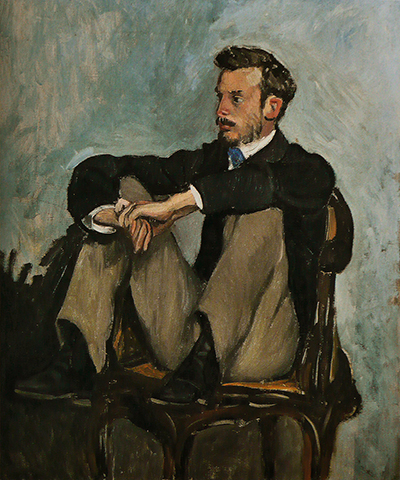
The Minneapolis portrait becomes more distinctive beside Bazille’s Portrait of Renoir, dated 1867 in the Musée d’Orsay record. Renoir sits with his knees drawn up, his forearms resting across them. His pose fills the canvas through the interlocking shapes of legs, arms and hands. The head remains important, but it is one part of a conspicuous bodily arrangement against a pale wall. [5]
In the self-portrait, by contrast, the hands are absent and the shoulders provide a broad, relatively quiet support for the face. The comparison shows how much an impression of intimacy depends on framing. Renoir’s unusual seat and folded limbs give us an encounter with a person occupying a room. The Minneapolis sitter is detached from almost every indication of place. One portrait makes bodily arrangement memorable; the other makes the turn of a head sufficient.
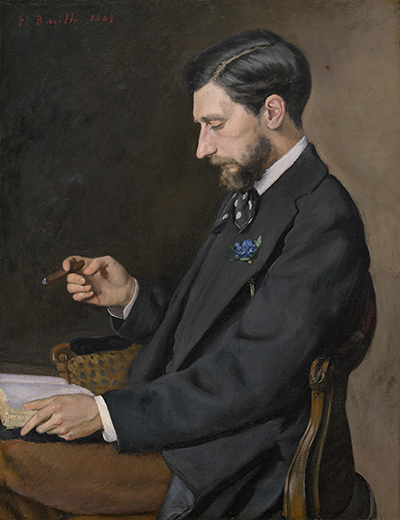
The Portrait of Edmond Maître, painted in 1869 and now in the National Gallery of Art, offers another variation. Maître’s lowered head, book and cigar direct attention into the sitter’s immediate activity. His dark clothing and white collar provide a useful formal comparison, but his profile leads the gaze away from the viewer rather than returning it. The objects give that withdrawal a visible setting. [6]
Minneapolis has no comparable action to explain the eyes. There is no page being read and no hand interrupting a task. The encounter therefore remains open. We can describe the direction of the gaze and the arrangement of light without inventing the subject of the sitter’s attention. These portraits demonstrate Bazille’s interest in different ways of making a person present, through a compact head, a conspicuous pose or a carefully furnished moment.
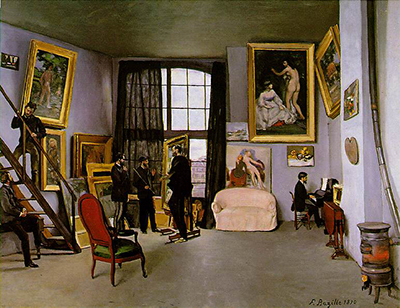
His later Studio, Rue La Condamine places the artist within a larger social and working environment. The 1870 painting includes Bazille standing among visitors, pictures and studio furniture. Here professional identity is distributed across a whole room: displayed work, conversation, an easel and the relationships between people. [7]
The figure of Bazille in that studio picture also complicates the idea that every painted likeness of him must be a self-portrait. The contribution traditionally assigned to Manet is treated cautiously in Bruno Mottin’s technical discussion, which also explains that the room was painted before the figures were introduced. The studio is a constructed account of artistic company, not a single instantaneous record. Set beside it, the Minneapolis canvas feels unusually concentrated: its encounter excludes the surrounding community that the studio painting makes visible. [8]
Portrait of Renoir
Portrait of Edmond Maitre
How certain is the sitter’s identity?
Minneapolis currently calls the painting a self-portrait, and Schulman accepts that identification. There has nevertheless been dissent. Schulman reports that the 1992 Montpellier exhibition catalogue used the title Portrait d’homme, or Portrait of a Man, and records Dianne W. Pitman’s uncertainty about recognising Bazille in it. His own discussion argues for retaining the self-portrait identification. This is a disagreement about the sitter, not a reason to treat the painting’s attribution to Bazille as equally disputed. [2]
A likeness can change substantially with pose, lighting, beard and the way the painter builds the face. Those variables explain why comparing portraits requires care; they do not, on their own, settle the identity. The current museum title retains the self-portrait identification. The earlier question remains part of the picture’s interpretation, rather than the museum’s present conclusion.
The same care applies to the wider group of possible self-images. A work on paper associated with this discussion is now titled Portrait of a Bearded Man by the Musée d’Orsay. That title describes what is securely identifiable without deciding that the man is Bazille. It is a useful reminder that a bearded face is not sufficient evidence for adding another self-portrait to the group. [9]
The Minneapolis painting remains rewarding even as its title is considered critically. If it represents Bazille, it gives us one of his concentrated acts of self-presentation. The portrait’s visual achievement is the particular presence it creates through a few relationships: dark coat against brown field, pale collar beneath beard, and an oblique head whose eyes keep the viewer engaged.
From the Bazille family to Minneapolis
Schulman traces the canvas through the artist’s family, including his nephew Marc Bazille and subsequent descendants, before it passed through Knoedler & Co. in New York. Minneapolis acquired it in 1962 using the John R. Van Derlip Fund, the fund named in the museum’s current credit line. This history distinguishes the picture from the Chicago self-portrait, despite both entering their present American collections in the same year. [2] [1] [3]
Its exhibition history also predates its American acquisition. Schulman lists appearances in Paris in 1950 and Montpellier in 1959, followed by later exhibitions in the United States and Europe. The portrait was included in the 1992–93 retrospective context in which the sitter’s identity was questioned. The exhibition record therefore includes a period when the customary identification was being reconsidered. [2]
The National Gallery of Art’s 2017 retrospective checklist listed the Minneapolis and Chicago paintings separately as Self-Portrait with Detachable Collar and Self Portrait with Palette. It dated the Minneapolis picture to about 1865–67, close to the holding museum’s present range. Bringing both together made possible precisely the comparison their different formats invite: professional equipment in the larger painting, a tightly framed face in the smaller one. [10]
Schulman also records that the Minneapolis canvas was lined in 1947. That is a fact about its physical history, not evidence of a compositional revision by Bazille. The surviving portrait asks to be understood through the visible arrangement of head and clothing, while its dating, sitter identification and later treatment remain distinct questions. Within its modest dimensions, a few illuminated forms sustain a compelling encounter. [2]
Bazille catalogue directory
The 284 records comprise 85 painting records,40 separate works-on-paper records and 159 album or study records. They describe the catalogue’s organisation rather than 284 independent objects or unanimously accepted attributions. Recto, verso, albums and multiple studies remain distinct. Dates are qualified where needed; the Drawing filter includes the etching, gouache and mixed works on paper. Manuscript mentions and unproved projects are listed separately below.
Works known through documents
These mentions remain separate from the 284 catalogue records. Some may concern surviving studies or underlying compositions; they cannot simply be added together as missing physical paintings.
- A copy after Rubens mentioned in March 1863 is unlocated.
- A portrait of an unidentified woman was reported completed before July 1866.
- A portrait of Monet and a composition of two life-size women arranging flowers were reported in progress in April 1867. Their mention does not establish two otherwise unknown surviving canvases.
- Gertrude et le père Lapin was at least begun in the summer of 1870.
Further reported works and uncertain attributions
- A Bouquet of Lilacs was reportedly stolen and returned in 1864; a portrait of the friend Theulier and Yellow Narcissi reported by Maître in 1868 are also documentary mentions.
- Unidentified pictures associated with Guillemet and Mme Rolina are reported through later correspondence cited by the catalogue.
- Children Dressed as Bride and Groom was associated with Vallotton’s collection and also attributed to Renoir. Its identification and authorship should remain open.
Projects whose completion is unproved
- A portrait of Pauline was planned in July 1865.
- A portrait of Marc was proposed in April 1866; a related drawing survives.
- A Jardinière project appears in album inscriptions and related figure material. Written plans are not evidence of a completed painting.
| Name | Date | Medium |
|---|---|---|
| Mystic Marriage of St. Catherine | 1863 | Oil on canvas |
| Trees, Study | 1863 | Oil on canvas |
| Farm of Saint-Sauveur | 1863 | Oil on canvas |
| In the Garden of the Parc Monceau, Paris | 1864 | Oil on canvas |
| Naked Woman from Behind | 1864 | Oil on canvas |
| Reclining Nude | 1864 | Oil on canvas |
| Courtyard of the Auberge du Cheval blanc at Chailly near Barbizon | 1864 | Oil on canvas |
| Covered Soup Bowls | 1864 | Oil on canvas |
| Two Herrings | 1864 | Oil on canvas |
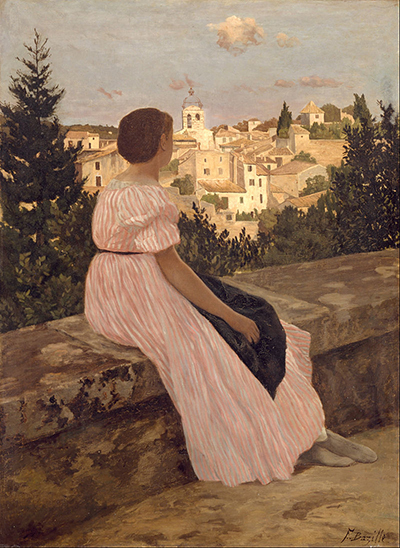
| The Pink Dress | 1864 | Oil on canvas |
| The Dog Rita Asleep | 1864 (catalogue); c. 1864 (2017 checklist) | Oil on canvas |
| The Scoter | 1864 | Oil on canvas |
| Naked Reclining Woman | 1864 | Oil on canvas |
| Landscape at Chailly | 1865 | Oil on canvas |
| Rocks at Chailly, Forest of Fontainebleau | 1865 | Oil on canvas |
| Undergrowth at Chailly, Forest of Fontainebleau | 1865 | Oil on canvas |
| Still Life with Grapes and Nuts | 1865 | Oil on canvas |
| Self-Portrait with a Palette — Chicago | 1865 | Oil on canvas |
| Landscape of Saint-Sauveur | 1865 | Oil on canvas |
| Beach at Sainte-Adresse | 1865 | Oil on canvas |
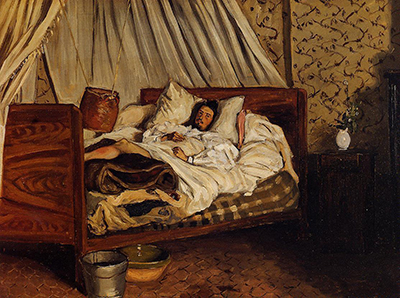
| The Improvised Field Hospital | 1865 | Oil on canvas |
| Village Street, Chailly | 1865 | Oil on canvas |
| Small Valley in the Forest of Fontainebleau | 1865 | Oil on canvas |
| Forest of Fontainebleau | 1865 | Oil on canvas |
| Woman Ironing | 1866 | Oil on canvas |
| The Artist's Studio on the rue de Furstenberg | 1865–66 (museum) | Oil on canvas |
| Still Life with Fish | 1866 | Oil on canvas |
| Little Italian Street Singer | 1866 | Oil on canvas |
| Potted Flowers | 1866 | Oil on canvas |
| The Little Gardener | 1866–1867 | Oil on canvas |
| Young Woman Playing the Piano | 1866–1867 | Oil on canvas |
| End of a Summer Day | 1866–1867 | Oil on canvas |
| A Studio on the rue Visconti | 1867 | Oil on canvas |
| Thérèse Reading in the Park at Méric | 1867 | Oil on canvas |
| Portrait of Verlaine | 1867 | Oil on canvas |
| The Terrace at Méric | 1867 | Oil on canvas |
| Still Life with Heron | 1867 | Oil on canvas |
| The Family Gathering | 1867–68 (museum) | Oil on canvas |
| Oleanders | 1867 | Oil on canvas |
| Woman on the Terrace at Méric | 1867 | Oil on canvas |
| The Ramparts at Aigues-Mortes from South | 1867 | Oil on canvas |
| The Western Ramparts at Aigues-Mortes | 1867 | Oil on canvas |
| Portrait of Edmond Maître — head study | 1867 | Oil on canvas |
| Porte de la Reine at Aigues-Mortes | 1867 | Oil on canvas |
| Portrait of Sisley | 1867 | Oil on wood |
| Portrait of Renoir — Cleveland | 1867 | Oil on canvas |
| Portrait of Renoir — Musée d’Orsay | 1867 | Oil on canvas |
| Self-Portrait with a Detachable Collar — Minneapolis | 1865–67 (museum); 1867–68 (catalogue) | Oil on canvas |
| Vase of Flowers on a Console | 1868 (museum); 1867–68 (catalogue) | Oil on canvas |
| Portrait of a Woman | 1868 | Oil on canvas |
| Young Woman in the Vineyards | 1868 | Oil on card |
| Harvester with a Basket | 1868 | Oil on card |
| Harvester with a Yellow Hat | 1868 | Oil on card |
| Harvester with a Headdress | 1868 | Oil on panel |
| On the Banks of the Lez | 1868 | Oil on canvas |
| After the Bath (attribution questioned) | 1868? | Oil on canvas |
| Young Woman with Lowered Eyes | 1868 | Oil on canvas |
| Fisherman with a Net | 1868 | Oil on canvas |
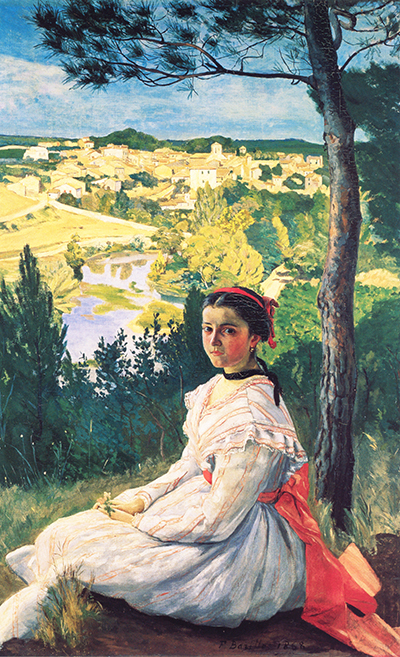
| View of the Village | 1868 | Oil on canvas |
| Portrait of Bazille (attributed to Monet by Musée Fabre; disputed catalogue attribution) | 1864 (museum); 1868 (catalogue) | Oil on panel |
| Studies for a Grape Harvest (two panels) | 1868 | Oil on canvas (two panels) |
| The Fortune Teller | 1868–69 (catalogue); c. 1869–70 (2017 checklist) | Oil on canvas |
| Harvester with a Cap | 1869 | Oil on card |
| Portrait of Edmond Maître — 1869 | 1869 | Oil on canvas |
| Woman in a Moorish Costume | 1869 | Oil on canvas |
| Young Woman in the Garden | 1869 | Oil on canvas |
| Portrait of Alphonse Tissié in a Cavalryman's Uniform | 1869 | Oil on canvas |
| Portrait of a dragoon | 1869 | Oil on canvas |
| Portrait of Zacharie Astruc | 1869 | Oil on canvas |
| Bunch of Grapes in a Bucket | 1869 | Oil on card |
| Portrait of Edouard Blau | Probably 1869; inscribed 1866 | Oil on canvas |
| Young Male Nude Lying on the Grass | 1870 | Oil on canvas |
| Summer Scene | 1869–1870 | Oil on canvas |
| The Studio on the rue La Condamine | 1869–1870 | Oil on canvas |
| La Toilette | 1870 | Oil on canvas |
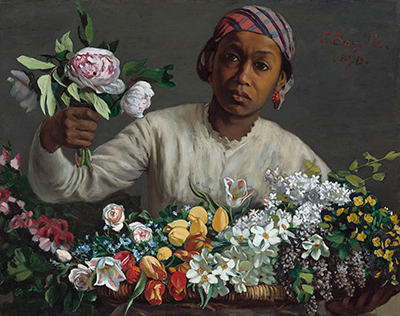
| Young Woman with Peonies — Montpellier | 1870 | Oil on canvas |
| Young Woman with Peonies — Washington | 1870 | Oil on canvas |
| Monotonous Chant | 1870 | Oil on canvas |
| Flowers — private collection | 1870 | Oil on canvas |
| Flowers — Musée Fabre | 1870 | Oil on canvas |
| Young Fisherman | 1870 | Oil on canvas |
| Study for Ruth and Boaz | 1870 | Oil on wood |
| Ruth and Boaz | 1870 | Oil on canvas |
| Self-Portrait in Shirt Sleeves | 1870 | Oil on canvas |
| Landscape on the Banks of the Lez | 1870 | Oil on canvas |
| Study after an Alpine Landscape | 1860 | Graphite on watercolour-tinted paper |
| Profile Head | 1862 | Charcoal on laid paper |
| Studies after Delacroix | 1863 | Ink and graphite, with gouache and watercolour, on paper |
| Academic Head | 1863 | Charcoal on paper |
| Study of a Woman's Head in Profile on a Chair | 1863 | Charcoal on paper |
| Academic Head of a Woman | 1863 | Charcoal on paper |
| Academy of Woman | 1863 | Black pencil and charcoal, stumped, on watermarked laid paper |
| Academy of Man | 1863 | Black pencil and charcoal, stumped, on watermarked laid paper |
| Naked Man | 1863 | Charcoal on paper |
| The Pont au Change in Paris | 1864 | Watercolour on paper |
| Study for the Pink Dress or Portrait of Thérèse des Hours | 1864 | Black pencil on paper |
| Naked Woman Standing | 1864 | Pencil on paper |
| Study of a Reclining Nude | 1864 | Charcoal on paper |
| Bathers | 1864 | Charcoal on paper |
| Portrait of a Man | 1864 | Charcoal on paper |
| Study for The Pink Dress | 1864 | Black pencil, squared, on paper |
| Study for Landscape of Saint-Sauveur | 1864 | Graphite on paper |
| Study for Landscape of Saint-Sauveur | 1865 | Pencil on paper |
| Man Taming a Bull | 1866 | Pen and black pencil on paper |
| Man Half Lying on a Sofa | 1866 | Charcoal on paper |
| Study for The Family Gathering | 1867 | Pencil on paper |
| Study for The Family Gathering | 1867 | Graphite, charcoal and black pencil on paper |
| The Embroiderer | 1867 | Pencil on pink paper |
| Study of Children | 1867 | Pencil on paper |
| Women in a Garden | 1867 | Pencil drawing |
| View of the Village | 1868 | Etching on paper |
| Portrait of a Bearded Man (catalogued as Self-Portrait) | Undated (museum); 1869 (catalogue) | Charcoal and brown ink |
| Man Smoking Pipe | 1869 | Watercolour on paper |
| Manet Drawing | 1868–70(?) (museum) | Charcoal and white chalk on paper |
| Study for the Summer Scene | 1869 | Charcoal, pen and ink on paper |
| Family Portrait | 1869 | Pastel and charcoal on paper |
| Study for Ruth | 1870 | Pencil and charcoal on paper |
| Woman Arranging a Hat | 1870 | Pencil drawing |
| Study for Boaz Asleep | 1870 | Pastel and red chalk |
| Boaz Asleep | 1870 | Charcoal and pencil on paper |
| Study for Boaz Asleep | 1870 | Black and beige pastel with red chalk on laid paper |
| Ruth Lying down | 1870 | Charcoal and pastel on paper |
| Head, Arm and Chest of Ruth | 1870 | Charcoal on paper |
| Chest of Ruth | 1870 | Black chalk and charcoal on paper |
| Black Woman with Peonies — gouache | c. 1870 | Gouache, watercolour, pencil and black chalk on card |
| Various Unidentified Subjects | Undated | Pencil drawing |
| Rocky Sea Side | Undated | Charcoal on paper |
| Studies of a Dancing Woman | Undated | Drawing with white chalk |
| Study of a Leg | Undated | Pencil drawing |
| Dancers in Camargue | Undated | Pencil drawing |
| Academy of Woman | Undated | Charcoal |
| Caricature of Venus of Milo and Various Other Caricatures | Undated | Charcoal |
| Caricature | Undated | Pencil drawing |
| Study of Landscape | Undated | Charcoal |
| Caricatures and Seated Monk | Undated | Charcoal |
| Caricatures and Various Subjects | Undated | Pencil drawing |
| Women Carrying a Pitcher | Undated | Pencil drawing |
| The Hanged Man | Undated | Charcoal |
| Castle in the Plain | Undated | Charcoal |
| Naked Woman from Behind | Undated | Charcoal |
| Caricatures | Undated | Charcoal and pencil |
| Unidentified Subjects | Undated | Pencil drawing |
| Landscape with a Castle | Undated | Charcoal |
| Study of Landscape | Undated | Charcoal |
| Horse Rider seen from Behind | Undated | Charcoal |
| Mazeppa | Undated | Pencil and charcoal |
| Study of Rider and Others Subjects | Undated | Pencil, pen and brown ink |
| Study of an Unidentified Man | Undated | Pencil drawing |
| Study for an Unknown Historic Scene | Undated | Pencil drawing |
| Study a Man Reading | Undated | Pencil drawing |
| Study of Men Reading | Undated | Pencil drawing |
| Study of Landscape ? | Undated | Charcoal |
| Study of a Head of a Man | Undated | Pencil drawing |
| Erotic Scene | Undated | Pencil drawing |
| Study of Dog | Undated | Charcoal |
| Studies of Unidentified Subjects and Erotic Scene | Undated | Pencil and charcoal drawing |
| Study for a Theater Scene | Undated | Charcoal |
| Study of a Reclining Naked Woman | Undated | Charcoal |
| Two Studies of Landscape | Undated | Pencil drawing |
| Caricature | Undated | Pencil and charcoal drawing |
| Portrait of an Unidentified Young Man | Undated | Charcoal |
| Study of an Unidentified Subject | Undated | Brown ink drawing |
| Unidentified Man with a Hat | Undated | Pencil and charcoal |
| Study of an Unidentified Women | Undated | Pencil drawing |
| Study for a Theater Character ? | Undated | Pencil drawing |
| Study for a Theater Character ? | Undated | Pen drawing |
| The Pavillon de la Reine in Paris | Undated | Pencil drawing |
| Study of a Horse Rider | Undated | Pencil and charcoal drawing |
| Entwined Couple. Caricature ? | Undated | Pencil drawing |
| Woman Sitting on a Sofa | Undated | Pencil drawing |
| Studies of Unidentified Subjects | Undated | Pencil and charcoal drawing |
| Studies of Animals | Undated | Pencil drawing |
| Study of a Horse Rider in Camargue | Undated | Charcoal |
| Study of Hunting Dogs | Undated | Pencil drawing |
| Study of Soldiers. Caricatures | Undated | Pencil drawing |
| Studies of Hunting Dogs ? | Undated | Pencil drawing |
| Hunting Scene. Hunter Playing the Horn | Undated | Pencil drawing |
| Caricature | Undated | Pencil drawing |
| Study of an Ibex | Undated | Pencil drawing |
| Theater Scene. Caricatures | Undated | Pencil drawing |
| Studies of Animals. Horses ? | Undated | Pencil drawing |
| Caricatures | Undated | Pencil drawing |
| Studies of Various Subjects and Animals | Undated | Pencil drawing |
| Unidentified Subject | Undated | Pencil drawing |
| Rider Taming a Horse [in Camargue ?] | Undated | Pencil drawing |
| Caricature of a Soldier | Undated | Pencil drawing |
| Study of a Woman and Mouse | Undated | Pencil drawing |
| Historic Scene | Undated | Charcoal |
| Architecture Studies | Undated | Pencil drawing |
| Mythologic Scene | Undated | Charcoal |
| Ophelia | Undated | Pencil drawing |
| Mythologic Scene | Undated | Charcoal |
| Studies of Various Subjects | Undated | Pencil and pen drawing |
| Studies of Peasants | Undated | Pencil drawing |
| Historic Scene | Undated | Pencil drawing |
| Historic or Literary Scene | Undated | Pencil drawing |
| Unidentified Historic Scene | Undated | Pencil drawing |
| Studies of Unidentified Subjects | Undated | Pencil drawing |
| Unidentified Study | Undated | Pencil drawing |
| Man in an Armchair | Undated | Pencil drawing |
| Studies of Various Subjects | Undated | Pencil drawing |
| Portraits of Unidentified Men | Undated | Pencil drawing |
| Studies of Various Subjects | Undated | Pencil drawing |
| Horse Rider and Artist | Undated | Charcoal and pencil |
| Study of Unidentified Characters | Undated | Charcoal |
| Dead Horse in a Plain | Undated | Charcoal |
| Study of Various Subjects and Furniture | Undated | Pencil drawing |
| Caricatures and Various Notes about Opéra | Undated | Pencil drawing |
| Galloping Horse | Undated | Charcoal |
| Study for La Toilette | Undated | Pencil drawing |
| Study of a Naked Woman | Undated | Pencil drawing |
| Domestic Scene | Undated | Pencil drawing |
| Physiognomies | Undated | Pencil drawing |
| Study for a Grape Harvest | Undated | Pencil drawing |
| Study for the Summer Scene | Undated | Pencil drawing |
| Female Profiles | Undated | Pencil drawing |
| Various Subjects | Undated | Pencil drawing |
| Study for The Terrace at Méric | Undated | Pencil drawing |
| Study for The Ramparts at Aigues-Mortes | Undated | Pencil drawing |
| Study for The Ramparts at Aigues-Mortes | Undated | Pencil drawing |
| Study for a Grape Harvest | Undated | Charcoal |
| Children Portraits | Undated | Pencil drawing |
| Study for Children's Heads | Undated | Pencil drawing |
| Study of Minerva | Undated | Pencil drawing |
| Study for a Grape Harvest | Undated | Pencil drawing |
| Study for The Family Gathering | Undated | Pencil drawing |
| Study for a Young Fisherman | Undated | Charcoal |
| Self-Portraits | Undated | Black pencil drawing |
| Study of Horses for the Porte de la Reine at Aigues-Mortes | Undated | Ink drawing |
| Study of Horses for the Porte de la Reine at Aigues-Mortes | Undated | Ink drawing |
| Study of Horses for the Porte de la Reine at Aigues-Mortes | Undated | Ink drawing |
| Study for an Outdoor Concert | Undated | Pencil drawing |
| Studies of Legs | Undated | Pencil drawing |
| Study for The Ramparts at Aigues Mortes | Undated | Pencil drawing |
| Studies of Hats | Undated | Pencil drawing |
| Studies of Men | Undated | Pencil drawing |
| Study for The Little Gardener | Undated | Pencil drawing |
| Study for The Ramparts at Aigues Mortes | Undated | Charcoal |
| Studies of Sail Boats | Undated | Pencil drawing |
| Portrait of Marc Bazille | Undated | Charcoal, black pencil and graphite |
| Studies of Children's Heads | Undated | Pencil drawing |
| Study for Aigues-Mortes | Undated | Pencil drawing |
| Studies of Women's Heads | Undated | Pencil drawing |
| Portrait of Camille des Hours and an Unidentified Man | Undated | Charcoal |
| Study of Flying Birds | Undated | Charcoal or graphite |
| Study for the Summer Scene | Undated | Pencil drawing |
| Study of Hands | Undated | Pen drawing |
| Self-Portrait | Undated | Black pencil drawing |
| Study for the Summer Scene | Undated | Pencil drawing |
| Study for the Summer Scene | Undated | Pencil drawing |
| Study for a Grape Harvest | Undated | Pencil drawing |
| Study of Branches | Undated | Pencil drawing |
| Study of a Seated Child | Undated | Pencil drawing |
| Study for a Couple and Unidentified Women | Undated | Pencil drawing |
| Studies of Unidentified Women | Undated | Pencil drawing |
| Study of Buildings | Undated | Pencil drawing |
| Study for a Grape Harvest | Undated | Pencil and charcoal |
| Studies of Boaters | Undated | Pencil drawing |
| Study of a Man Writing at his Table | Undated | Pencil drawing |
| Study of a Woman Cutting Flowers | Undated | Pencil drawing |
| Study of Hand | Undated | Pencil drawing |
| Women in a Garden | Undated | Pencil drawing |
| Studies of Women in Profile | Undated | Pencil drawing |
| Study for Ruth and Boaz | Undated | Charcoal |
| Study for The Family Gathering | Undated | Pencil drawing |
| Study for the View of the Village | Undated | Pencil drawing |
| Study of the View of the Village | Undated | Pencil drawing |
| Study for the Fisherman with a Net | Undated | Pencil drawing |
| Study for the View of the Village | Undated | Charcoal |
| Study for The Little Gardener | Undated | Charcoal |
| Portrait of a Man with a Top Hat | Undated | Pencil drawing |
| Portrait of a Man with a Top Hat | Undated | Pencil drawing |
| Inscriptions | Undated | Pencil inscriptions |
| Study of Tree | Undated | Pencil drawing |
| Caricature of Nina la Belle | Undated | Pencil drawing |
| Study for Saint Sebastian | Undated | Pencil drawing |
| Young Woman Sewing | Undated | Pencil drawing |
| Studies of Hands | Undated | Pencil drawing |
| Woman in a Garden | Undated | Pencil drawing |
| Elegant Woman | Undated | Pencil drawing |
| Various Inscriptions | Undated | Inscriptions (medium unspecified in index) |
| Study of a Man with a Hat | Undated | Pencil drawing |
| Study of a Child | Undated | Pencil drawing |
| Study of a Man with a Hat | Undated | Pencil drawing |
Frequently Asked Questions
Discussion
The pale collar gives this compact portrait a sharp boundary. How does it change your encounter with the face?
Reader Insights
How does the pale collar separate the face from the dark clothing?
Compare this cropped encounter with the Chicago portrait’s more explicit presentation of the painter at work.
Which area of the face seems most clearly illuminated, and how does that affect the gaze?
Join the Conversation
Share a detail, comparison or question about Frédéric Bazille’s Self-Portrait with Detachable Collar below.
References
- Minneapolis Institute of Art, Self-Portrait with Detachable Collar, accession 62.39, current collection record and expanded object data. Museum record. View source.
- Michel Schulman, Self-Portrait with a Detachable Collar, MSb-39, digital catalogue raisonné, metadata, history, exhibitions and critical essay. Pitman’s 1992 position is reported through this source. Catalogue entry (English translation of a French scholarly catalogue). View source.
- Art Institute of Chicago, Self-Portrait, accession 1962.336, collection record, museum commentary and provenance. Museum record. View source.
- Frédéric Bazille, letter to his father, 6 January 1865, Musée Fabre, inventory 92.2.1, transcription p. 4 and facsimile p. 2. English quotation translated from the French. Museum facsimile and transcription (in French). View source.
- Musée d’Orsay, Pierre Auguste Renoir, collection record, DL 1970 3. Museum record (English interface with French collection fields). View source.
- National Gallery of Art, Edmond Maître, accession 1985.64.2, collection record. Museum record. View source.
- Musée d’Orsay, L’Atelier de Bazille, accession RF 2449, collection record and commentary. Museum record (English interface with French collection fields). View source.
- Bruno Mottin, “L’œuvre de Frédéric Bazille (1841–1870) examiné au laboratoire,” Technè 46 (2018), pp. 30–38, especially paragraphs 21–23. Article (in French). View source.
- Musée d’Orsay, Portrait d’homme barbu, Louvre inventory RF 29731 verso, current title and collection metadata. Museum record (in French). View source.
- National Gallery of Art, Frédéric Bazille and the Birth of Impressionism, 2017 exhibition checklist, p. 2, catalogue nos. 17–18. Exhibition checklist. View source.
- Joconde/POP, La Robe rose, RF2450. View source. (in French).
- Musée d’Orsay, L’Ambulance improvisée, RF 1967 5. View source. (in French).
- Musée d’Orsay, Réunion de famille,RF2749. View source. (in French).
- Musée Fabre, Vue de village, 898.5.1. View source. (in French).
- National Gallery of Art, Young Woman with Peonies,1983.1.6. View source.
- Michel Schulman, painting index and documentary introduction (English titles; French metadata). View source.
- Michel Schulman, works-on-paper index (English titles; French metadata). View source.
- Michel Schulman, albums and studies index (English titles; French metadata). View source.
 Frederic Bazille.jpg)