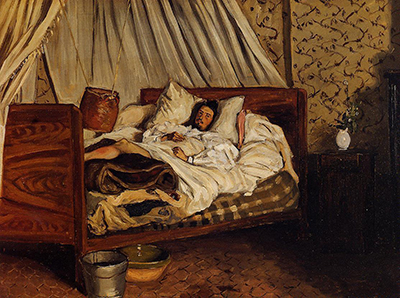
 by Tom Gurney
Tom Gurney BSc (Hons) is an art history expert with over 20 years experience
Published on June 19, 2020 / Updated on November 2, 2026
Email: tomgurney1@gmail.com / Phone: +44 7429 011000
Still Life with Fish by Frédéric Bazille: Introduction
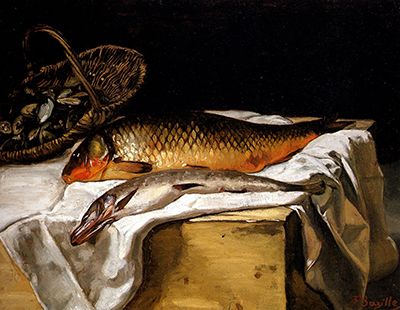
Two fish lie across a white cloth, one catching the light in a broad band of golden scales, the other extending a pale body towards the foreground. Behind them, an open basket emerges from darkness. Frédéric Bazille's Still Life with Fish makes this small gathering of objects unusually substantial. Its oil-painted surfaces ask us to distinguish the weight of a body, the yielding folds of linen and the open construction of wicker. Painted in 1866, the canvas measures 63.5 × 81.9 cm and belongs to the Detroit Institute of Arts. [1]
The painting also marks a public beginning. It was accepted for the Paris Salon of 1866, while Bazille's more ambitious composition of a young woman playing the piano and a young man listening was rejected. Michel Hilaire describes this outcome as the jury preferring the more readily acceptable still life. That preference gave Bazille an opportunity to show how much could be achieved through an apparently modest subject. [2]
At a Glance
- Date1866 [1]
- MediumOil on canvas [1]
- Dimensions63.5 × 81.9 cm [1]
- CollectionDetroit Institute of Arts, 1988.9 [1]
This work across Frédéric Bazille’s career
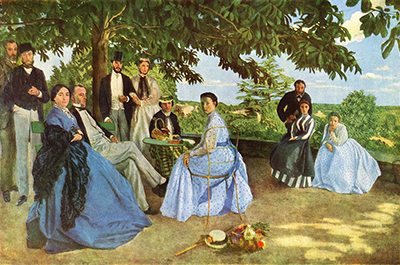
Family Reunion
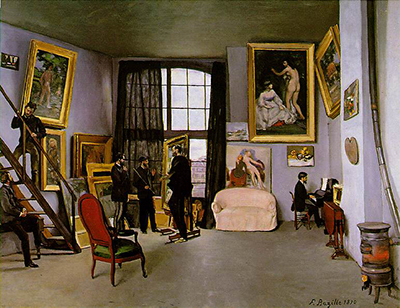
1867–1868 (museum)Bazille’s Studio, Rue La Condamine
1869–1870Summer Scene (Bathers)
1869–1870Contents
- A shallow stage for heavy objects
- The white cloth holds the picture together
- Gold, grey and the surrounding dark
- Still life and the ambition to exhibit
- Beneath the fish, and beside other still lifes
- From the Bazille family to Detroit
A shallow stage for heavy objects
The arrangement is close to the viewer. There is little surrounding room to establish a setting, and the dark background offers no distant view. The front and right sides of a box or chest provide the essential indication of depth. Its top supports the cloth and fish, while its warm ochre front rises towards us from the lower edge. The composition combines a firm rectangular support with bodies and textiles that break across its straight lines.
Both fish have their heads towards the left and their tails towards the right, but they occupy different positions. The larger, warmer body stretches across the back of the arrangement. The slender pale fish lies nearer us, its long head descending diagonally towards the lower left. These separate directions matter: the fish are aligned without becoming two mechanically parallel stripes. One establishes a horizontal weight; the other leads the eye forward and down.
The basket raises the left side. Its rounded opening, curved handle and projecting woven rim rise above the fish, making an uneven cluster where the rest of the picture is comparatively low. From there, the eye can follow the golden body towards the right, descend with the hanging cloth and return along the lower fish. The objects create a circuit around the illuminated centre.
Schulman's catalogue identifies the fish as a carp and a pike, and the contents of the basket as mussels. These names help distinguish the two bodies and the smaller shellfish; the picture's effect does not depend on identifying every item individually. [3] What first registers is the contrast between a broad, patterned flank and a smooth, narrow form, with a crowded group of small dark shapes behind them.
The white cloth holds the picture together
The cloth is the largest continuous light area, but it is far from uniformly white. Near the fish, narrow bright passages make their lower contours legible. At the front, the textile descends in broad folds; on the right it gathers into a deeper, darker fall. Changes of tone give each part a different orientation. The linen turns a simple horizontal platform into a succession of ledges, hollows and hanging planes.
Look especially at the relationship between the pale fish and its support. A light body rests against light fabric, so Bazille cannot rely everywhere on a strong difference of colour to separate them. Darker edges, small intervals of shadow and changes in direction do much of the work. The body reads as something rounded and solid because it interrupts the cloth's folds rather than merely sharing their brightness.
At the lower left, the cloth approaches the edge of the picture. Its descending folds draw the arrangement towards the viewer, almost as if the objects were set just beyond our reach. On the opposite side, the longer hanging portion partly conceals the support. We understand the chest through what remains uncovered and through the changing course of the linen over its corner. Concealment becomes a means of describing structure.
The basket offers a different kind of construction. Its strands describe an open vessel through repeated narrow marks, whereas the cloth establishes mass through broader light and shade. The bright fish scales introduce a third pattern between them. Wicker, scales and folds each repeat, but at different intervals and in different directions. This makes the compact arrangement more varied than its restricted palette initially suggests.
Nothing in the visible folds establishes that the cloth is wet or that the fish have just been caught. Nor does the basket reveal a particular fisherman or fishing place. The painting supplies a concentrated encounter with materials rather than an illustrated account of how the food arrived there.
Gold, grey and the surrounding dark
The golden fish receives the most conspicuous colour. Its scales form a lattice across a body that shifts from brighter yellow towards orange and brown. The pattern is not equally distinct everywhere. It becomes most insistent where the light strikes, then recedes into the darker upper contour. The eye reads both an overall swollen form and the repeated small units covering it.
The nearer fish creates a cooler counterweight. Its body is subdued beside the carp's warm flank, but its long head and sharply narrowing shape give it a strong presence. The dark mouth area, pale underside and thin silhouette ask for a different kind of attention from the glittering scale pattern behind. Bazille varies the means of description according to the object, rather than giving every surface the same finish.
Small reddish passages near the larger fish's head interrupt the gold and white. They sharpen our awareness of the body as dead flesh, but they do not establish a particular religious or moral programme. The stillness already belongs to the arrangement: both bodies are laid down, dependent on the cloth and chest beneath them. Their physical condition can be recognised without turning each colour into a symbol.
The dark upper field is equally active. It clears away competing detail and makes the objects' lit edges more forceful. The basket almost merges with it in places, while individual shell interiors and woven strands remain visible. This uneven emergence prevents the left side from becoming a single solid silhouette. Darkness gives the painting cohesion while permitting different degrees of definition within it.
That combination of a restricted setting and emphatic material differences helps explain the work's place in nineteenth-century realism. The Musée Fabre's 2016 exhibition presentation connects Bazille's fish still lifes with Dutch painting and with contemporary realists including François Bonvin, Antoine Vollon and Édouard Manet. It treats still life as a recurring field of observation in his work, alongside the practical question of paying models. [4]
Watch: Bazille and early Impressionism
Explore a Paris studio with Smarthistory, then discover the beginnings of Impressionism with the National Gallery of Art.
Jean-Frédéric Bazille, The Artist’s Studio, Rue Visconti, Paris
A close look at Bazille’s 1867 painting of the studio he shared in Paris.
Watch on YouTubeStill life and the ambition to exhibit
The choice of fish should be understood within a career that already included figure painting and landscape. For the 1866 Salon, Bazille prepared the piano picture as well as this still life; the different decisions reached by the jury placed only the latter before the public. [2] Acceptance therefore tells us which work passed a particular institutional test. It does not make the fish painting an accidental exercise or prove that Bazille had renounced larger subjects.
The economic distinction between genres was real. In its discussion of still life, the Musée Fabre cites an 1866 letter in which Bazille asks his mother for money for models and resists being confined to still-life painting. Yet the same curatorial account stresses that money was not his only reason for returning to the genre. [4] Objects could remain available for sustained scrutiny, and an arrangement could concentrate the problems of colour, volume and surface without the continuing demands of a posed figure. That practical freedom helped make still life a serious area of work.
Manet provides a particularly relevant comparison. Schulman relates the painting to Manet's Still Life with Carp of 1864, while qualifying where Bazille may have seen it. A precise encounter need not be assumed in order to recognise the shared interest in fish as subjects for concentrated painting. [3] The larger connection, supported by the Fabre exhibition's realist framing, is the conviction that familiar provisions can carry an ambitious exploration of paint. [4]
The historical responses were mixed. In the reviews discussed by Schulman, Charles de Sarlat admired the convincing fish but warned about dark tones; J. Ixe was more dismissive, questioning their appearance, the cloth and the material of the support. These are individual critical responses, rather than evidence of either general acclaim or universal rejection. [3]
Their disagreements still direct attention to useful questions. Does darkness give the objects weight, or obscure them? How much colour can linen contain while remaining recognisably white? How clearly must a support be described when it is partly covered? The painting's achievement lies in making such questions arise from ordinary things. Its apparent simplicity gives the relationships between them unusual importance.
Beneath the fish, and beside other still lifes
Schulman reports that X-rays made in Detroit revealed an earlier still life with apples and pears beneath the visible painting. He also preserves uncertainty over whether Bazille painted that earlier composition or reused another artist's canvas. This account describes a reused support without identifying the underlying painter securely. [3] The finished surface must still be read on its own terms, without treating its visible dark background as a view into the earlier arrangement.
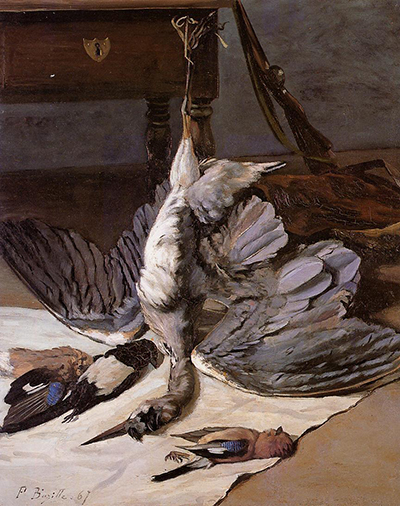
Bazille's Still Life with Heron, dated 1867 in the National Gallery of Art's retrospective checklist, offers a strong comparison. [5] There, a suspended bird brings vertical tension to an arrangement spread across pale fabric. Wings extend into broad fans; smaller birds create separate accents below. In Still Life with Fish, the bodies remain low and horizontally supported. Both paintings use cloth to reveal the weight and contours of dead animals, but they build very different movements through the picture.
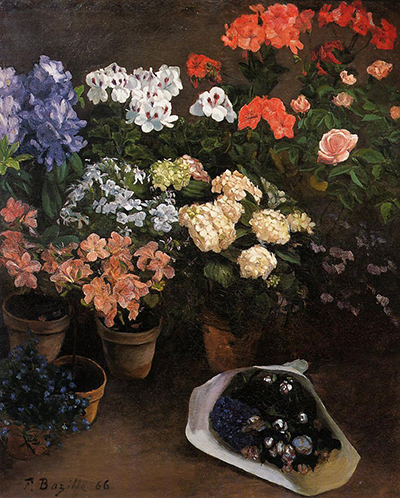
The Study of Flowers, also known as Potted Flowers, is another work of 1866 listed in the retrospective. [5] Its dense flowering plants rise through a dark field, while a paper-wrapped bouquet opens towards the foreground. Comparing the two paintings brings their enclosing materials into focus: wrapping separates the flowers from the surrounding ground, just as the fish painting's linen distinguishes bodies from their support. The flower picture multiplies upright stems and rounded blooms; the fish painting concentrates on two extended forms.
The ornate vase and spilling foliage of Flowers (Vase of Flowers on a Console) take this contrast further. Decoration extends through the vessel, flowers, furniture and textile. Beside that abundance, the fish arrangement seems deliberately spare. Still life gave Bazille room to explore both density and restraint, with each arrangement demanding its own balance between the object and its surroundings.
The Heron
Study of Flowers
From the Bazille family to Detroit
The Detroit Institute of Arts records the painting in A. M. André Bazille's collection in Montpellier in 1952, followed by a possible descent to Mme Rachou-Bazille. Paul Kantor appears next in the recorded ownership chain, before the museum's purchase in 1988 through the Robert H. Tannahill Foundation Fund. The accession number is 1988.9. The possible family descent remains qualified in the museum's account. [1]
Detroit also records the signature at the lower right as F. Bazille. Its bibliography explicitly corrects an older exhibition catalogue's description of a signature and painted date, so the accepted date of 1866 should not be confused with an inscription reading “1866” on the canvas. [1] The work was subsequently included in the 2017 Washington retrospective, which placed it within the wider range of Bazille's painting. [5]
Its value within that range is easy to see. With almost no surrounding narrative, Bazille brings hard and soft surfaces, warm and cool bodies, open weave and opaque cloth into a close relationship. The composition holds together because those differences remain distinct. A small arrangement of fish and shellfish becomes a sustained demonstration of how painting can make ordinary matter compelling.
Bazille catalogue directory
The 284 records comprise 85 painting records,40 separate works-on-paper records and 159 album or study records. They describe the catalogue’s organisation rather than 284 independent objects or unanimously accepted attributions. Recto, verso, albums and multiple studies remain distinct. Dates are qualified where needed; the Drawing filter includes the etching, gouache and mixed works on paper. Manuscript mentions and unproved projects are listed separately below.
Works known through documents
These mentions remain separate from the 284 catalogue records. Some may concern surviving studies or underlying compositions; they cannot simply be added together as missing physical paintings.
- A copy after Rubens mentioned in March 1863 is unlocated.
- A portrait of an unidentified woman was reported completed before July 1866.
- A portrait of Monet and a composition of two life-size women arranging flowers were reported in progress in April 1867. Their mention does not establish two otherwise unknown surviving canvases.
- Gertrude et le père Lapin was at least begun in the summer of 1870.
Further reported works and uncertain attributions
- A Bouquet of Lilacs was reportedly stolen and returned in 1864; a portrait of the friend Theulier and Yellow Narcissi reported by Maître in 1868 are also documentary mentions.
- Unidentified pictures associated with Guillemet and Mme Rolina are reported through later correspondence cited by the catalogue.
- Children Dressed as Bride and Groom was associated with Vallotton’s collection and also attributed to Renoir. Its identification and authorship should remain open.
Projects whose completion is unproved
- A portrait of Pauline was planned in July 1865.
- A portrait of Marc was proposed in April 1866; a related drawing survives.
- A Jardinière project appears in album inscriptions and related figure material. Written plans are not evidence of a completed painting.
| Name | Date | Medium |
|---|---|---|
| Mystic Marriage of St. Catherine | 1863 | Oil on canvas |
| Trees, Study | 1863 | Oil on canvas |
| Farm of Saint-Sauveur | 1863 | Oil on canvas |
| In the Garden of the Parc Monceau, Paris | 1864 | Oil on canvas |
| Naked Woman from Behind | 1864 | Oil on canvas |
| Reclining Nude | 1864 | Oil on canvas |
| Courtyard of the Auberge du Cheval blanc at Chailly near Barbizon | 1864 | Oil on canvas |
| Covered Soup Bowls | 1864 | Oil on canvas |
| Two Herrings | 1864 | Oil on canvas |
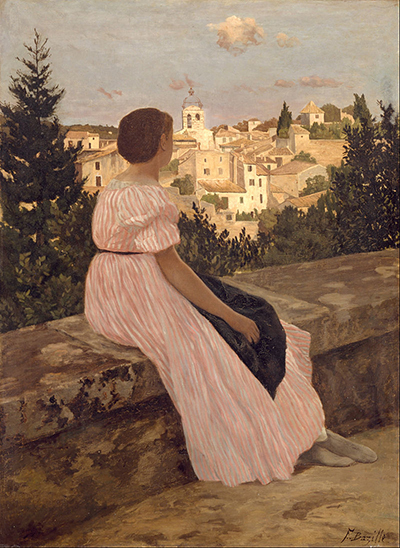
| The Pink Dress | 1864 | Oil on canvas |
| The Dog Rita Asleep | 1864 (catalogue); c. 1864 (2017 checklist) | Oil on canvas |
| The Scoter | 1864 | Oil on canvas |
| Naked Reclining Woman | 1864 | Oil on canvas |
| Landscape at Chailly | 1865 | Oil on canvas |
| Rocks at Chailly, Forest of Fontainebleau | 1865 | Oil on canvas |
| Undergrowth at Chailly, Forest of Fontainebleau | 1865 | Oil on canvas |
| Still Life with Grapes and Nuts | 1865 | Oil on canvas |
| Self-Portrait with a Palette — Chicago | 1865 | Oil on canvas |
| Landscape of Saint-Sauveur | 1865 | Oil on canvas |
| Beach at Sainte-Adresse | 1865 | Oil on canvas |
| The Improvised Field Hospital | 1865 | Oil on canvas |
| Village Street, Chailly | 1865 | Oil on canvas |
| Small Valley in the Forest of Fontainebleau | 1865 | Oil on canvas |
| Forest of Fontainebleau | 1865 | Oil on canvas |
| Woman Ironing | 1866 | Oil on canvas |
| The Artist's Studio on the rue de Furstenberg | 1865–66 (museum) | Oil on canvas |
| Still Life with Fish | 1866 | Oil on canvas |
| Little Italian Street Singer | 1866 | Oil on canvas |
| Potted Flowers | 1866 | Oil on canvas |
| The Little Gardener | 1866–1867 | Oil on canvas |
| Young Woman Playing the Piano | 1866–1867 | Oil on canvas |
| End of a Summer Day | 1866–1867 | Oil on canvas |
| A Studio on the rue Visconti | 1867 | Oil on canvas |
| Thérèse Reading in the Park at Méric | 1867 | Oil on canvas |
| Portrait of Verlaine | 1867 | Oil on canvas |
| The Terrace at Méric | 1867 | Oil on canvas |
| Still Life with Heron | 1867 | Oil on canvas |
| The Family Gathering | 1867–68 (museum) | Oil on canvas |
| Oleanders | 1867 | Oil on canvas |
| Woman on the Terrace at Méric | 1867 | Oil on canvas |
| The Ramparts at Aigues-Mortes from South | 1867 | Oil on canvas |
| The Western Ramparts at Aigues-Mortes | 1867 | Oil on canvas |
| Portrait of Edmond Maître — head study | 1867 | Oil on canvas |
| Porte de la Reine at Aigues-Mortes | 1867 | Oil on canvas |
| Portrait of Sisley | 1867 | Oil on wood |
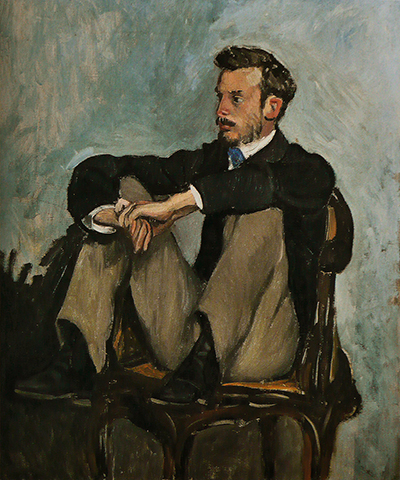
| Portrait of Renoir — Cleveland | 1867 | Oil on canvas |
| Portrait of Renoir — Musée d’Orsay | 1867 | Oil on canvas |
| Self-Portrait with a Detachable Collar — Minneapolis | 1865–67 (museum); 1867–68 (catalogue) | Oil on canvas |
| Vase of Flowers on a Console | 1868 (museum); 1867–68 (catalogue) | Oil on canvas |
| Portrait of a Woman | 1868 | Oil on canvas |
| Young Woman in the Vineyards | 1868 | Oil on card |
| Harvester with a Basket | 1868 | Oil on card |
| Harvester with a Yellow Hat | 1868 | Oil on card |
| Harvester with a Headdress | 1868 | Oil on panel |
| On the Banks of the Lez | 1868 | Oil on canvas |
| After the Bath (attribution questioned) | 1868? | Oil on canvas |
| Young Woman with Lowered Eyes | 1868 | Oil on canvas |
| Fisherman with a Net | 1868 | Oil on canvas |
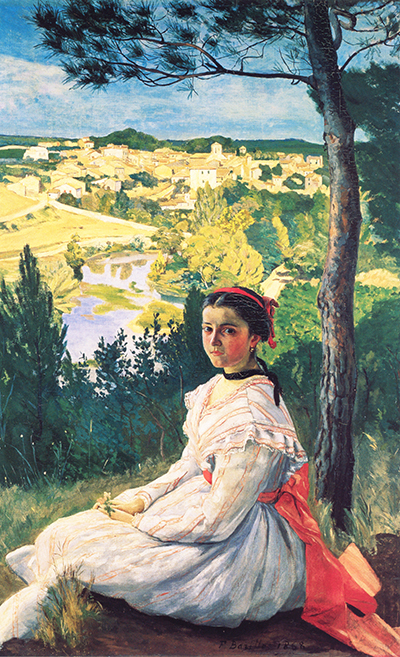
| View of the Village | 1868 | Oil on canvas |
| Portrait of Bazille (attributed to Monet by Musée Fabre; disputed catalogue attribution) | 1864 (museum); 1868 (catalogue) | Oil on panel |
| Studies for a Grape Harvest (two panels) | 1868 | Oil on canvas (two panels) |
| The Fortune Teller | 1868–69 (catalogue); c. 1869–70 (2017 checklist) | Oil on canvas |
| Harvester with a Cap | 1869 | Oil on card |
| Portrait of Edmond Maître — 1869 | 1869 | Oil on canvas |
| Woman in a Moorish Costume | 1869 | Oil on canvas |
| Young Woman in the Garden | 1869 | Oil on canvas |
| Portrait of Alphonse Tissié in a Cavalryman's Uniform | 1869 | Oil on canvas |
| Portrait of a dragoon | 1869 | Oil on canvas |
| Portrait of Zacharie Astruc | 1869 | Oil on canvas |
| Bunch of Grapes in a Bucket | 1869 | Oil on card |
| Portrait of Edouard Blau | Probably 1869; inscribed 1866 | Oil on canvas |
| Young Male Nude Lying on the Grass | 1870 | Oil on canvas |
| Summer Scene | 1869–1870 | Oil on canvas |
| The Studio on the rue La Condamine | 1869–1870 | Oil on canvas |
| La Toilette | 1870 | Oil on canvas |
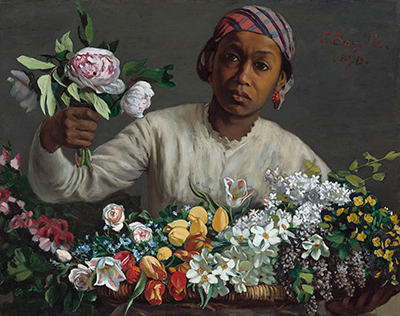
| Young Woman with Peonies — Montpellier | 1870 | Oil on canvas |
| Young Woman with Peonies — Washington | 1870 | Oil on canvas |
| Monotonous Chant | 1870 | Oil on canvas |
| Flowers — private collection | 1870 | Oil on canvas |
| Flowers — Musée Fabre | 1870 | Oil on canvas |
| Young Fisherman | 1870 | Oil on canvas |
| Study for Ruth and Boaz | 1870 | Oil on wood |
| Ruth and Boaz | 1870 | Oil on canvas |
| Self-Portrait in Shirt Sleeves | 1870 | Oil on canvas |
| Landscape on the Banks of the Lez | 1870 | Oil on canvas |
| Study after an Alpine Landscape | 1860 | Graphite on watercolour-tinted paper |
| Profile Head | 1862 | Charcoal on laid paper |
| Studies after Delacroix | 1863 | Ink and graphite, with gouache and watercolour, on paper |
| Academic Head | 1863 | Charcoal on paper |
| Study of a Woman's Head in Profile on a Chair | 1863 | Charcoal on paper |
| Academic Head of a Woman | 1863 | Charcoal on paper |
| Academy of Woman | 1863 | Black pencil and charcoal, stumped, on watermarked laid paper |
| Academy of Man | 1863 | Black pencil and charcoal, stumped, on watermarked laid paper |
| Naked Man | 1863 | Charcoal on paper |
| The Pont au Change in Paris | 1864 | Watercolour on paper |
| Study for the Pink Dress or Portrait of Thérèse des Hours | 1864 | Black pencil on paper |
| Naked Woman Standing | 1864 | Pencil on paper |
| Study of a Reclining Nude | 1864 | Charcoal on paper |
| Bathers | 1864 | Charcoal on paper |
| Portrait of a Man | 1864 | Charcoal on paper |
| Study for The Pink Dress | 1864 | Black pencil, squared, on paper |
| Study for Landscape of Saint-Sauveur | 1864 | Graphite on paper |
| Study for Landscape of Saint-Sauveur | 1865 | Pencil on paper |
| Man Taming a Bull | 1866 | Pen and black pencil on paper |
| Man Half Lying on a Sofa | 1866 | Charcoal on paper |
| Study for The Family Gathering | 1867 | Pencil on paper |
| Study for The Family Gathering | 1867 | Graphite, charcoal and black pencil on paper |
| The Embroiderer | 1867 | Pencil on pink paper |
| Study of Children | 1867 | Pencil on paper |
| Women in a Garden | 1867 | Pencil drawing |
| View of the Village | 1868 | Etching on paper |
| Portrait of a Bearded Man (catalogued as Self-Portrait) | Undated (museum); 1869 (catalogue) | Charcoal and brown ink |
| Man Smoking Pipe | 1869 | Watercolour on paper |
| Manet Drawing | 1868–70(?) (museum) | Charcoal and white chalk on paper |
| Study for the Summer Scene | 1869 | Charcoal, pen and ink on paper |
| Family Portrait | 1869 | Pastel and charcoal on paper |
| Study for Ruth | 1870 | Pencil and charcoal on paper |
| Woman Arranging a Hat | 1870 | Pencil drawing |
| Study for Boaz Asleep | 1870 | Pastel and red chalk |
| Boaz Asleep | 1870 | Charcoal and pencil on paper |
| Study for Boaz Asleep | 1870 | Black and beige pastel with red chalk on laid paper |
| Ruth Lying down | 1870 | Charcoal and pastel on paper |
| Head, Arm and Chest of Ruth | 1870 | Charcoal on paper |
| Chest of Ruth | 1870 | Black chalk and charcoal on paper |
| Black Woman with Peonies — gouache | c. 1870 | Gouache, watercolour, pencil and black chalk on card |
| Various Unidentified Subjects | Undated | Pencil drawing |
| Rocky Sea Side | Undated | Charcoal on paper |
| Studies of a Dancing Woman | Undated | Drawing with white chalk |
| Study of a Leg | Undated | Pencil drawing |
| Dancers in Camargue | Undated | Pencil drawing |
| Academy of Woman | Undated | Charcoal |
| Caricature of Venus of Milo and Various Other Caricatures | Undated | Charcoal |
| Caricature | Undated | Pencil drawing |
| Study of Landscape | Undated | Charcoal |
| Caricatures and Seated Monk | Undated | Charcoal |
| Caricatures and Various Subjects | Undated | Pencil drawing |
| Women Carrying a Pitcher | Undated | Pencil drawing |
| The Hanged Man | Undated | Charcoal |
| Castle in the Plain | Undated | Charcoal |
| Naked Woman from Behind | Undated | Charcoal |
| Caricatures | Undated | Charcoal and pencil |
| Unidentified Subjects | Undated | Pencil drawing |
| Landscape with a Castle | Undated | Charcoal |
| Study of Landscape | Undated | Charcoal |
| Horse Rider seen from Behind | Undated | Charcoal |
| Mazeppa | Undated | Pencil and charcoal |
| Study of Rider and Others Subjects | Undated | Pencil, pen and brown ink |
| Study of an Unidentified Man | Undated | Pencil drawing |
| Study for an Unknown Historic Scene | Undated | Pencil drawing |
| Study a Man Reading | Undated | Pencil drawing |
| Study of Men Reading | Undated | Pencil drawing |
| Study of Landscape ? | Undated | Charcoal |
| Study of a Head of a Man | Undated | Pencil drawing |
| Erotic Scene | Undated | Pencil drawing |
| Study of Dog | Undated | Charcoal |
| Studies of Unidentified Subjects and Erotic Scene | Undated | Pencil and charcoal drawing |
| Study for a Theater Scene | Undated | Charcoal |
| Study of a Reclining Naked Woman | Undated | Charcoal |
| Two Studies of Landscape | Undated | Pencil drawing |
| Caricature | Undated | Pencil and charcoal drawing |
| Portrait of an Unidentified Young Man | Undated | Charcoal |
| Study of an Unidentified Subject | Undated | Brown ink drawing |
| Unidentified Man with a Hat | Undated | Pencil and charcoal |
| Study of an Unidentified Women | Undated | Pencil drawing |
| Study for a Theater Character ? | Undated | Pencil drawing |
| Study for a Theater Character ? | Undated | Pen drawing |
| The Pavillon de la Reine in Paris | Undated | Pencil drawing |
| Study of a Horse Rider | Undated | Pencil and charcoal drawing |
| Entwined Couple. Caricature ? | Undated | Pencil drawing |
| Woman Sitting on a Sofa | Undated | Pencil drawing |
| Studies of Unidentified Subjects | Undated | Pencil and charcoal drawing |
| Studies of Animals | Undated | Pencil drawing |
| Study of a Horse Rider in Camargue | Undated | Charcoal |
| Study of Hunting Dogs | Undated | Pencil drawing |
| Study of Soldiers. Caricatures | Undated | Pencil drawing |
| Studies of Hunting Dogs ? | Undated | Pencil drawing |
| Hunting Scene. Hunter Playing the Horn | Undated | Pencil drawing |
| Caricature | Undated | Pencil drawing |
| Study of an Ibex | Undated | Pencil drawing |
| Theater Scene. Caricatures | Undated | Pencil drawing |
| Studies of Animals. Horses ? | Undated | Pencil drawing |
| Caricatures | Undated | Pencil drawing |
| Studies of Various Subjects and Animals | Undated | Pencil drawing |
| Unidentified Subject | Undated | Pencil drawing |
| Rider Taming a Horse [in Camargue ?] | Undated | Pencil drawing |
| Caricature of a Soldier | Undated | Pencil drawing |
| Study of a Woman and Mouse | Undated | Pencil drawing |
| Historic Scene | Undated | Charcoal |
| Architecture Studies | Undated | Pencil drawing |
| Mythologic Scene | Undated | Charcoal |
| Ophelia | Undated | Pencil drawing |
| Mythologic Scene | Undated | Charcoal |
| Studies of Various Subjects | Undated | Pencil and pen drawing |
| Studies of Peasants | Undated | Pencil drawing |
| Historic Scene | Undated | Pencil drawing |
| Historic or Literary Scene | Undated | Pencil drawing |
| Unidentified Historic Scene | Undated | Pencil drawing |
| Studies of Unidentified Subjects | Undated | Pencil drawing |
| Unidentified Study | Undated | Pencil drawing |
| Man in an Armchair | Undated | Pencil drawing |
| Studies of Various Subjects | Undated | Pencil drawing |
| Portraits of Unidentified Men | Undated | Pencil drawing |
| Studies of Various Subjects | Undated | Pencil drawing |
| Horse Rider and Artist | Undated | Charcoal and pencil |
| Study of Unidentified Characters | Undated | Charcoal |
| Dead Horse in a Plain | Undated | Charcoal |
| Study of Various Subjects and Furniture | Undated | Pencil drawing |
| Caricatures and Various Notes about Opéra | Undated | Pencil drawing |
| Galloping Horse | Undated | Charcoal |
| Study for La Toilette | Undated | Pencil drawing |
| Study of a Naked Woman | Undated | Pencil drawing |
| Domestic Scene | Undated | Pencil drawing |
| Physiognomies | Undated | Pencil drawing |
| Study for a Grape Harvest | Undated | Pencil drawing |
| Study for the Summer Scene | Undated | Pencil drawing |
| Female Profiles | Undated | Pencil drawing |
| Various Subjects | Undated | Pencil drawing |
| Study for The Terrace at Méric | Undated | Pencil drawing |
| Study for The Ramparts at Aigues-Mortes | Undated | Pencil drawing |
| Study for The Ramparts at Aigues-Mortes | Undated | Pencil drawing |
| Study for a Grape Harvest | Undated | Charcoal |
| Children Portraits | Undated | Pencil drawing |
| Study for Children's Heads | Undated | Pencil drawing |
| Study of Minerva | Undated | Pencil drawing |
| Study for a Grape Harvest | Undated | Pencil drawing |
| Study for The Family Gathering | Undated | Pencil drawing |
| Study for a Young Fisherman | Undated | Charcoal |
| Self-Portraits | Undated | Black pencil drawing |
| Study of Horses for the Porte de la Reine at Aigues-Mortes | Undated | Ink drawing |
| Study of Horses for the Porte de la Reine at Aigues-Mortes | Undated | Ink drawing |
| Study of Horses for the Porte de la Reine at Aigues-Mortes | Undated | Ink drawing |
| Study for an Outdoor Concert | Undated | Pencil drawing |
| Studies of Legs | Undated | Pencil drawing |
| Study for The Ramparts at Aigues Mortes | Undated | Pencil drawing |
| Studies of Hats | Undated | Pencil drawing |
| Studies of Men | Undated | Pencil drawing |
| Study for The Little Gardener | Undated | Pencil drawing |
| Study for The Ramparts at Aigues Mortes | Undated | Charcoal |
| Studies of Sail Boats | Undated | Pencil drawing |
| Portrait of Marc Bazille | Undated | Charcoal, black pencil and graphite |
| Studies of Children's Heads | Undated | Pencil drawing |
| Study for Aigues-Mortes | Undated | Pencil drawing |
| Studies of Women's Heads | Undated | Pencil drawing |
| Portrait of Camille des Hours and an Unidentified Man | Undated | Charcoal |
| Study of Flying Birds | Undated | Charcoal or graphite |
| Study for the Summer Scene | Undated | Pencil drawing |
| Study of Hands | Undated | Pen drawing |
| Self-Portrait | Undated | Black pencil drawing |
| Study for the Summer Scene | Undated | Pencil drawing |
| Study for the Summer Scene | Undated | Pencil drawing |
| Study for a Grape Harvest | Undated | Pencil drawing |
| Study of Branches | Undated | Pencil drawing |
| Study of a Seated Child | Undated | Pencil drawing |
| Study for a Couple and Unidentified Women | Undated | Pencil drawing |
| Studies of Unidentified Women | Undated | Pencil drawing |
| Study of Buildings | Undated | Pencil drawing |
| Study for a Grape Harvest | Undated | Pencil and charcoal |
| Studies of Boaters | Undated | Pencil drawing |
| Study of a Man Writing at his Table | Undated | Pencil drawing |
| Study of a Woman Cutting Flowers | Undated | Pencil drawing |
| Study of Hand | Undated | Pencil drawing |
| Women in a Garden | Undated | Pencil drawing |
| Studies of Women in Profile | Undated | Pencil drawing |
| Study for Ruth and Boaz | Undated | Charcoal |
| Study for The Family Gathering | Undated | Pencil drawing |
| Study for the View of the Village | Undated | Pencil drawing |
| Study of the View of the Village | Undated | Pencil drawing |
| Study for the Fisherman with a Net | Undated | Pencil drawing |
| Study for the View of the Village | Undated | Charcoal |
| Study for The Little Gardener | Undated | Charcoal |
| Portrait of a Man with a Top Hat | Undated | Pencil drawing |
| Portrait of a Man with a Top Hat | Undated | Pencil drawing |
| Inscriptions | Undated | Pencil inscriptions |
| Study of Tree | Undated | Pencil drawing |
| Caricature of Nina la Belle | Undated | Pencil drawing |
| Study for Saint Sebastian | Undated | Pencil drawing |
| Young Woman Sewing | Undated | Pencil drawing |
| Studies of Hands | Undated | Pencil drawing |
| Woman in a Garden | Undated | Pencil drawing |
| Elegant Woman | Undated | Pencil drawing |
| Various Inscriptions | Undated | Inscriptions (medium unspecified in index) |
| Study of a Man with a Hat | Undated | Pencil drawing |
| Study of a Child | Undated | Pencil drawing |
| Study of a Man with a Hat | Undated | Pencil drawing |
Frequently Asked Questions
The Detroit Institute of Arts dates it 1866. [1]
No. Detroit records F. Bazille at the lower right and corrects an older catalogue’s report of a painted date. [1]
Discussion
Fish, cloth and woven support remain visibly different materials. How does Bazille make them belong to one arrangement?
Reader Insights
How does the pale cloth join the fish to the front edge of their support?
Which contrast is strongest: the two fish, the cloth and basket, or the light bodies and dark ground?
Compare this horizontal arrangement with the upward growth of Potted Flowers. How does each hold its objects together?
Join the Conversation
Share a detail, comparison or question about Still Life with Fish by Frédéric Bazille below.
References
- Detroit Institute of Arts, Still Life with Fish, 1866, accession 1988.9: object data, markings, provenance and published references. Collection record. View source.
- Michel Hilaire, “Bazille ou la vie brève,” Académie des Sciences et Lettres de Montpellier, 2016, pp. 166–172, especially p. 169. Lecture text (in French). View source.
- Michel Schulman, Frédéric Bazille: catalogue raisonné, “Still Life with Fish,” MSb-22: object essay, Manet comparison, mediated contemporary reception and account of Detroit radiography. Digital catalogue (English translation of French scholarship). View source.
- Musée Fabre, Frédéric Bazille: la jeunesse de l’impressionnisme, 2016 press dossier, p. 13, “Vies silencieuses.” Exhibition dossier (in French). View source.
- National Gallery of Art, Frédéric Bazille and the Birth of Impressionism, 2017 exhibition checklist, cat. 29, Still Life with Fish; cat. 31, Potted Flowers or Flower Study; cat. 43, Still Life with Heron. Exhibition checklist. View source.
- Joconde/POP, La Robe rose, RF2450. View source. (in French).
- Musée d’Orsay, L’Ambulance improvisée, RF 1967 5. View source. (in French).
- Musée d’Orsay, Réunion de famille,RF2749. View source. (in French).
- Musée d’Orsay, Pierre Auguste Renoir,DL1970 3. View source.
- Musée Fabre, Vue de village, 898.5.1. View source. (in French).
- National Gallery of Art, Young Woman with Peonies,1983.1.6. View source.
- Michel Schulman, painting index and documentary introduction (English titles; French metadata). View source.
- Michel Schulman, works-on-paper index (English titles; French metadata). View source.
- Michel Schulman, albums and studies index (English titles; French metadata). View source.
 Frederic Bazille.jpg)