 by Tom Gurney
Tom Gurney BSc (Hons) is an art history expert with over 20 years experience
Published on June 19, 2020 / Updated on November 2, 2026
Email: tomgurney1@gmail.com / Phone: +44 7429 011000
Study of Flowers (Potted Flowers) by Frédéric Bazille: Introduction
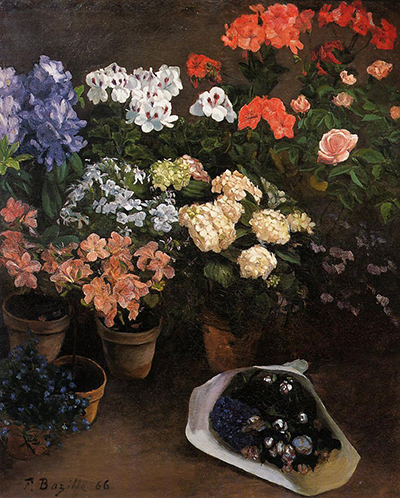
A bouquet lies on its side at the foot of a crowded assembly of flowering plants. Pale wrapping paper opens around its dark centre, while above it red, white, blue and cream blossoms press towards the edges of the canvas. Frédéric Bazille's Study of Flowers, also known as Potted Flowers, combines the abundance of a cultivated garden with the plain equipment of growing and giving flowers. Signed and dated 1866 at the lower left, it was exhibited at the Paris Salon in 1868. [1]
The distinction between those two dates matters. This was an existing painting, already given to the Lejosne family, when Bazille sent it before the Salon jury. Its public success belonged to a different moment from its making. The modest word study in its exhibition title should not obscure its ambition: at about a metre high, the canvas makes an assortment of pots and a wrapped bouquet into a substantial encounter with colour and material. [1] [2]
At a Glance
- Date1866; exhibited at the Salon in 1868 [1]
- MediumOil on canvas [2]
- CollectionPrivate collection (2017 checklist) [2]
This work across Frédéric Bazille’s career
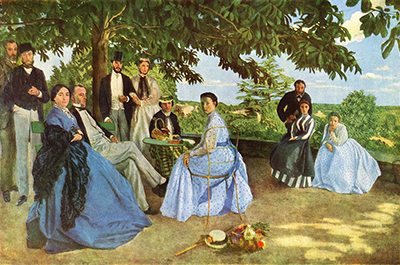
Family Reunion
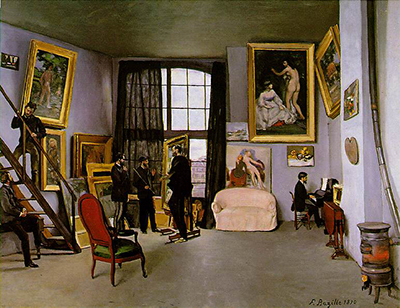
1867–1868 (museum)Bazille’s Studio, Rue La Condamine
1869–1870Summer Scene (Bathers)
1869–1870Contents
- An arrangement built from the ground upwards
- Colour, flowers and the possibility of Méric
- A gift intended for the Salon
- What the Salon title conceals
- Flowers among Bazille's friends
- A still life within a varied practice
- From the Lejosnes to later exhibitions
An arrangement built from the ground upwards
The pots give the arrangement its footing. Their curved rims and tapering sides emerge from the lower darkness, anchoring plants whose upper branches overlap almost continuously. Brown earthenware has a different visual weight from the blossoms it supports. The pots stand separately, but the leaves and flowers cross their boundaries; Bazille allows the arrangement to become a dense field without completely losing the identity of its components.
At the upper left a blue-violet mass pushes against the edge. White blossoms occupy the space beside it, and brilliant red flowers spread across the upper right. Lower down, pink and orange clusters balance pale rounded flower heads towards the centre. The eye can follow these colours in more than one direction. A strict central axis would make the display seem ceremonial; here the differing heights and uneven intervals suggest plants gathered together for inspection.
Their setting remains deliberately spare. A dark wall or backdrop closes the upper space, while an earthy brown surface opens below. There is no broad garden prospect to explain where the plants have grown. Instead, the contrast between the background and each coloured cluster makes the flowers themselves carry the spatial information. Leaves disappear into shadow and reappear at their edges; lighter petals advance across that dark scaffolding.
The foreground bouquet interrupts this upward growth. It lies diagonally, with the pale paper separating its dark flowers from the brown surface beneath. The paper's folded edge creates a broad shape that can be grasped at once, unlike the multitude of petals above. Its opening turns towards the viewer, bringing a compact, portable arrangement into the same space as the rooted plants. The painting thus contains two different ways of presenting flowers: standing in their growing containers and gathered for carrying away.
This difference gives the lower part of the canvas unusual importance. Cover the bouquet mentally, and the picture becomes a tall wall of flowering plants. Restore it, and an open interval appears between viewer and pots. The bouquet brings the display forward while the brown ground gives the crowded forms somewhere to stand. The signature occupies that clearer lower strip, where it does not have to compete with the mass of vegetation.
Flowers
Colour, flowers and the possibility of Méric
Michel Schulman proposes that Bazille painted the arrangement in the greenhouse at Méric, his family's property near Montpellier. It is a plausible setting rather than a documented location for the sitting. The cultivated abundance of Méric also appears in Oleanders and the garden pictures, but this canvas provides no recognisable architectural landmark that would settle the question by itself. [1]
The Musée Fabre places Bazille's flower painting within a wider familiarity with cultivated plants, connecting the gardens of Méric with Montpellier's botanical garden near the medical faculty where he had studied. That context helps explain the availability and variety of his subjects. It does not turn the picture into a scientific botanical plate. His principal task here is to make very different plants coexist as painted forms under a common light. [3]
The distinction is useful when identifying the flowers. Schulman recounts a contemporary Salon review that named hydrangeas, azaleas and varieties of geranium among the potted plants. Those historical identifications help distinguish the painting from other flower pictures by Bazille. They need not be treated as a complete modern inventory. The wrapped flowers, which Schulman tentatively suggests may be peonies, remain less certain. [1]
For looking, the differences of colour and growth are more consequential than an exhaustive list. Small white blossoms make a broken, almost lacy patch; rounded cream and pink heads gather light into larger volumes. Red flowers rise on darker stems, while broad leaves provide pauses between clusters. Bazille moves between a single large petal and a mass of small marks. The resulting surface has variety without requiring every flower to be equally distinct.
The blue-violet flowers at the left are particularly important to the balance. Their cool colour checks the warmth of the red and coral passages. White is equally active: sometimes it forms a bright flower against deep green, elsewhere it belongs to the wrapping paper, spreading into a larger, quieter plane. The painting's richness depends on these differences in the size and placement of colour, as much as on the number of hues.
A gift intended for the Salon
The Lejosnes were the painting's first audience. Schulman's provenance records that it was made for the family, and Bazille's own letter confirms that he had given them the flower painting before sending it to the Salon. In the letter addressed to his father and dated April 1868 by the Musée Fabre's transcription, he explains that he submitted it to please its recipients. He expected the flowers to be accepted, while anticipating rejection for the picture of Méric, the work now known as Family Reunion. [1] [4]
That private account adds something more precise than a general claim that Bazille painted still lifes to sell. The flower canvas was already a gift. Its submission could gratify its owners and extend its audience beyond their home. The evidence establishes a relationship between giving and exhibiting; it does not establish a price or a formal commercial commission. [4]
The letter also preserves the uncertainty of waiting for a jury. Bazille's confidence in the flowers and anxiety about the family portrait were predictions, not reports of a result. Both paintings were accepted in 1868. Their presence together complicates an account of his career in which still life was merely an occasional retreat from more ambitious work: he chose to represent himself publicly through both flowers and a large figure composition. [1]
It would be too simple to infer that he considered flowers easy. The very painting that appeared a safer submission demands sustained control of crowded forms, dark foliage and sharply differing colours. His expectations concern the jury's likely response, not a measured comparison of the labour involved. The gift also meant that another household had a stake in the painting's reception.
Watch: Bazille and early Impressionism
Explore a Paris studio with Smarthistory, then discover the beginnings of Impressionism with the National Gallery of Art.
Jean-Frédéric Bazille, The Artist’s Studio, Rue Visconti, Paris
A close look at Bazille’s 1867 painting of the studio he shared in Paris.
Watch on YouTubeWhat the Salon title conceals
At the Salon the picture appeared as Étude de fleurs, or Study of Flowers, catalogue number 147. That general title later encouraged confusion with Vase of Flowers on a Console, the very different composition now in Grenoble. Schulman distinguishes them through a copied list of Bazille's works and a review signed J. Ixe in the Journal de Montpellier on 23 May 1868. The review's potted plants fit this canvas, rather than the large vase and console. [1] [5]
The copied list, as presented by Schulman, also separates two successive Salon episodes. The rejected submissions of 1867 were the earlier portrait of Edmond Maître and The Terrace at Méric. The accepted submissions of 1868 were the family portrait and the flowers given to Madame Lejosne. The story that Potted Flowers had been substituted for the Maître portrait and rejected in 1867 confuses those events. [1]
The correction changes the painting's place in Bazille's career. Its appearance at the Salon was a success after the preceding year's refusals. It also explains why the visible date of 1866 need not agree with the exhibition year. A signature records the painting's dated identity; the exhibition catalogue records a later public appearance. Neither requires moving the canvas's execution to 1868.
The contemporary description fixes what viewers encountered more securely than it establishes a consensus about the painting. Its variety of potted plants supplies a recognisable identity. Acceptance gave Bazille an opportunity to be seen, while leaving open the question of how his painting would be valued.
Flowers among Bazille's friends
Flower painting connected Bazille with the painters around him. The Musée Fabre's exhibition account reproduces Monet's letter from Honfleur of 26 August 1864, in which Monet encouraged him to paint flowers while describing his own competing desire to paint them and the demands of his outdoor studies. The advice makes still life part of their exchange about worthwhile subjects. It was compatible with landscape work, rather than an admission that outdoor painting had failed. [3]
Schulman also places Potted Flowers beside Renoir's 1864 greenhouse-plant painting and Monet's still life of that year. These comparisons establish a shared interest, without proving that Bazille copied one particular arrangement. The humble container was itself usable material: plants could be brought together, their heights varied and their colours tested against a restrained setting. [1]
The wrapped bouquet introduces another comparison. In its 2016 exhibition account, the Musée Fabre reads it as an allusion to the bouquet in Manet's Olympia. This is a curatorial interpretation of a visible motif. The paper makes the flowers appear transferable, something that can be brought, offered or received. Bazille leaves the human exchange outside the canvas, allowing the bouquet to imply handling without depicting a giver. [3]
The paper's painted function is clear even without identifying its source. The pale opening concentrates attention around a dark interior and separates this small arrangement from the surrounding pots. The suggestion of Manet enriches that contrast while leaving the particular circumstances of this bouquet unresolved.
A still life within a varied practice
Set beside Bazille's Still Life with Fish, also dated 1866, Potted Flowers reveals how differently he could organise a still life in the same year. In the fish painting, a white cloth spreads beneath elongated bodies, and a nearly black background enlarges their material presence. Here upright plants occupy much more of the surface, and colour is dispersed among many separate centres. The exhibition checklist places the two works together in the sequence of his early career. [2]
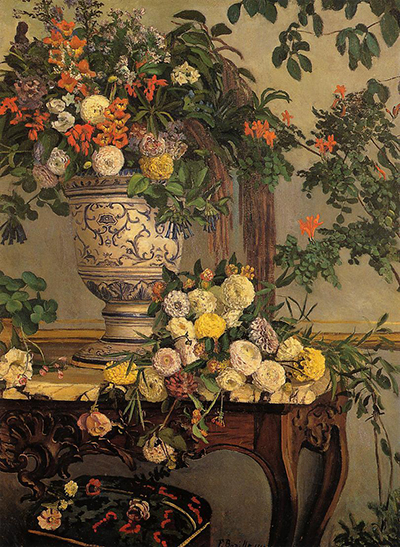
The Grenoble Vase of Flowers on a Console offers another contrast. Its ornate vessel, carved furniture and decorative setting make the surrounding objects conspicuous participants. In Potted Flowers, ordinary earthenware largely retreats beneath the foliage. One arrangement presents flowers through an elaborate domestic furnishing; the other builds a display from several plain containers. Their different intended recipients also matter: the console painting belonged to Bazille's relationship with the Teulon family, while this canvas was given to the Lejosnes. [1] [5]
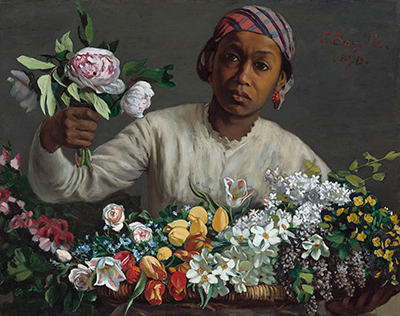
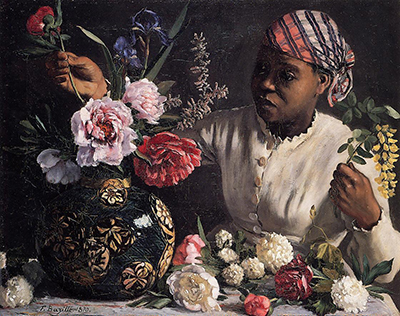
By 1870, the Montpellier Young Woman with Peonies made the act of arranging flowers visible. A woman raises a stem beside an ornate vase; her attention and hands become part of the subject. The date and identity of that separate canvas are recorded by the Musée Fabre. [6] Looking back from it, the absent handler of the 1866 bouquet becomes more noticeable. This is a comparison of pictorial relationships, rather than evidence that Bazille had already planned the later painting.
Technical research provides a further, carefully bounded connection. Bruno Mottin reports that Still Life with Heron was painted over an inverted composition of a woman behind flowers. Discussing Paul Perrin's interpretation, he relates that earlier image to a private study of a young woman and to the floral study. This places flower and figure experiments close together in Bazille's working practice. It does not establish a hidden figure beneath Potted Flowers, or identify one unchanged model across different paintings. The evidence belongs to the canvas examined. [7]
Young Woman with Peonies — Montpellier
From the Lejosnes to later exhibitions
The painting's history extends well beyond its Salon appearance. Schulman's provenance traces it from the Lejosne family, recorded in Pau around 1932, through F. Shöni in Zurich around 1952, to John Hay Whitney's collection in 1960. It subsequently passed through Betsey Cushing Whitney and the Greentree Foundation; the catalogue records a Sotheby's sale in 2004 and a Christie's sale in 2022. These entries establish a succession of collections and sales, rather than an unbroken history of public display. [1]
Exhibitions nevertheless brought the privately held picture to wider audiences. It appeared in the Whitney collection exhibition at the Tate in 1960–61 and at the National Gallery of Art in Washington in 1983. It was also included in the Montpellier–Paris–Washington Bazille retrospective of 2016–17. Washington's checklist calls it Potted Flowers or Flower Study, dates it 1866 and lists it as a private-collection loan. An exhibition at the National Gallery therefore should not be mistaken for ownership by that museum. [1] [2]
Later museum presentations have also widened the way these subjects are understood. The Thyssen-Bornemisza's account of its Impressionist Gardens exhibition placed Bazille and Renoir's flower pictures within the history of bringing the garden indoors. That framework is useful here without requiring this canvas to represent a particular room: its pots preserve the experience of cultivation, while its bouquet turns flowers into a portable arrangement. [8]
Schulman records contrasting earlier responses to the painting: John Rewald stressed firmness and contrast despite reservations about the invention of the arrangement, while Gaston Poulain emphasised its departure into brighter colour. In Schulman's account, those judgements draw attention to a productive tension. [1] The display is materially ordinary, but its colour is expansive. Bazille makes the pots hold their ground beneath the flowers, and gives the fallen bouquet enough space to change how the whole assembly meets the viewer.
Bazille catalogue directory
The 284 records comprise 85 painting records,40 separate works-on-paper records and 159 album or study records. They describe the catalogue’s organisation rather than 284 independent objects or unanimously accepted attributions. Recto, verso, albums and multiple studies remain distinct. Dates are qualified where needed; the Drawing filter includes the etching, gouache and mixed works on paper. Manuscript mentions and unproved projects are listed separately below.
Works known through documents
These mentions remain separate from the 284 catalogue records. Some may concern surviving studies or underlying compositions; they cannot simply be added together as missing physical paintings.
- A copy after Rubens mentioned in March 1863 is unlocated.
- A portrait of an unidentified woman was reported completed before July 1866.
- A portrait of Monet and a composition of two life-size women arranging flowers were reported in progress in April 1867. Their mention does not establish two otherwise unknown surviving canvases.
- Gertrude et le père Lapin was at least begun in the summer of 1870.
Further reported works and uncertain attributions
- A Bouquet of Lilacs was reportedly stolen and returned in 1864; a portrait of the friend Theulier and Yellow Narcissi reported by Maître in 1868 are also documentary mentions.
- Unidentified pictures associated with Guillemet and Mme Rolina are reported through later correspondence cited by the catalogue.
- Children Dressed as Bride and Groom was associated with Vallotton’s collection and also attributed to Renoir. Its identification and authorship should remain open.
Projects whose completion is unproved
- A portrait of Pauline was planned in July 1865.
- A portrait of Marc was proposed in April 1866; a related drawing survives.
- A Jardinière project appears in album inscriptions and related figure material. Written plans are not evidence of a completed painting.
| Name | Date | Medium |
|---|---|---|
| Mystic Marriage of St. Catherine | 1863 | Oil on canvas |
| Trees, Study | 1863 | Oil on canvas |
| Farm of Saint-Sauveur | 1863 | Oil on canvas |
| In the Garden of the Parc Monceau, Paris | 1864 | Oil on canvas |
| Naked Woman from Behind | 1864 | Oil on canvas |
| Reclining Nude | 1864 | Oil on canvas |
| Courtyard of the Auberge du Cheval blanc at Chailly near Barbizon | 1864 | Oil on canvas |
| Covered Soup Bowls | 1864 | Oil on canvas |
| Two Herrings | 1864 | Oil on canvas |
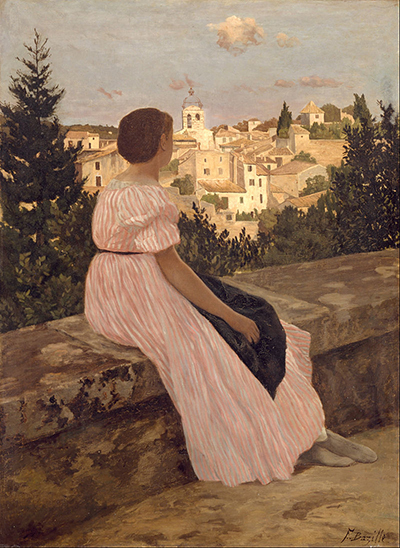
| The Pink Dress | 1864 | Oil on canvas |
| The Dog Rita Asleep | 1864 (catalogue); c. 1864 (2017 checklist) | Oil on canvas |
| The Scoter | 1864 | Oil on canvas |
| Naked Reclining Woman | 1864 | Oil on canvas |
| Landscape at Chailly | 1865 | Oil on canvas |
| Rocks at Chailly, Forest of Fontainebleau | 1865 | Oil on canvas |
| Undergrowth at Chailly, Forest of Fontainebleau | 1865 | Oil on canvas |
| Still Life with Grapes and Nuts | 1865 | Oil on canvas |
| Self-Portrait with a Palette — Chicago | 1865 | Oil on canvas |
| Landscape of Saint-Sauveur | 1865 | Oil on canvas |
| Beach at Sainte-Adresse | 1865 | Oil on canvas |
| The Improvised Field Hospital | 1865 | Oil on canvas |
| Village Street, Chailly | 1865 | Oil on canvas |
| Small Valley in the Forest of Fontainebleau | 1865 | Oil on canvas |
| Forest of Fontainebleau | 1865 | Oil on canvas |
| Woman Ironing | 1866 | Oil on canvas |
| The Artist's Studio on the rue de Furstenberg | 1865–66 (museum) | Oil on canvas |
| Still Life with Fish | 1866 | Oil on canvas |
| Little Italian Street Singer | 1866 | Oil on canvas |
| Potted Flowers | 1866 | Oil on canvas |
| The Little Gardener | 1866–1867 | Oil on canvas |
| Young Woman Playing the Piano | 1866–1867 | Oil on canvas |
| End of a Summer Day | 1866–1867 | Oil on canvas |
| A Studio on the rue Visconti | 1867 | Oil on canvas |
| Thérèse Reading in the Park at Méric | 1867 | Oil on canvas |
| Portrait of Verlaine | 1867 | Oil on canvas |
| The Terrace at Méric | 1867 | Oil on canvas |
| Still Life with Heron | 1867 | Oil on canvas |
| The Family Gathering | 1867–68 (museum) | Oil on canvas |
| Oleanders | 1867 | Oil on canvas |
| Woman on the Terrace at Méric | 1867 | Oil on canvas |
| The Ramparts at Aigues-Mortes from South | 1867 | Oil on canvas |
| The Western Ramparts at Aigues-Mortes | 1867 | Oil on canvas |
| Portrait of Edmond Maître — head study | 1867 | Oil on canvas |
| Porte de la Reine at Aigues-Mortes | 1867 | Oil on canvas |
| Portrait of Sisley | 1867 | Oil on wood |
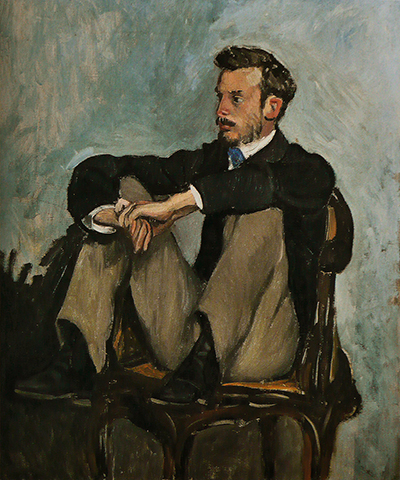
| Portrait of Renoir — Cleveland | 1867 | Oil on canvas |
| Portrait of Renoir — Musée d’Orsay | 1867 | Oil on canvas |
| Self-Portrait with a Detachable Collar — Minneapolis | 1865–67 (museum); 1867–68 (catalogue) | Oil on canvas |
| Vase of Flowers on a Console | 1868 (museum); 1867–68 (catalogue) | Oil on canvas |
| Portrait of a Woman | 1868 | Oil on canvas |
| Young Woman in the Vineyards | 1868 | Oil on card |
| Harvester with a Basket | 1868 | Oil on card |
| Harvester with a Yellow Hat | 1868 | Oil on card |
| Harvester with a Headdress | 1868 | Oil on panel |
| On the Banks of the Lez | 1868 | Oil on canvas |
| After the Bath (attribution questioned) | 1868? | Oil on canvas |
| Young Woman with Lowered Eyes | 1868 | Oil on canvas |
| Fisherman with a Net | 1868 | Oil on canvas |
| View of the Village | 1868 | Oil on canvas |
| Portrait of Bazille (attributed to Monet by Musée Fabre; disputed catalogue attribution) | 1864 (museum); 1868 (catalogue) | Oil on panel |
| Studies for a Grape Harvest (two panels) | 1868 | Oil on canvas (two panels) |
| The Fortune Teller | 1868–69 (catalogue); c. 1869–70 (2017 checklist) | Oil on canvas |
| Harvester with a Cap | 1869 | Oil on card |
| Portrait of Edmond Maître — 1869 | 1869 | Oil on canvas |
| Woman in a Moorish Costume | 1869 | Oil on canvas |
| Young Woman in the Garden | 1869 | Oil on canvas |
| Portrait of Alphonse Tissié in a Cavalryman's Uniform | 1869 | Oil on canvas |
| Portrait of a dragoon | 1869 | Oil on canvas |
| Portrait of Zacharie Astruc | 1869 | Oil on canvas |
| Bunch of Grapes in a Bucket | 1869 | Oil on card |
| Portrait of Edouard Blau | Probably 1869; inscribed 1866 | Oil on canvas |
| Young Male Nude Lying on the Grass | 1870 | Oil on canvas |
| Summer Scene | 1869–1870 | Oil on canvas |
| The Studio on the rue La Condamine | 1869–1870 | Oil on canvas |
| La Toilette | 1870 | Oil on canvas |
| Young Woman with Peonies — Montpellier | 1870 | Oil on canvas |
| Young Woman with Peonies — Washington | 1870 | Oil on canvas |
| Monotonous Chant | 1870 | Oil on canvas |
| Flowers — private collection | 1870 | Oil on canvas |
| Flowers — Musée Fabre | 1870 | Oil on canvas |
| Young Fisherman | 1870 | Oil on canvas |
| Study for Ruth and Boaz | 1870 | Oil on wood |
| Ruth and Boaz | 1870 | Oil on canvas |
| Self-Portrait in Shirt Sleeves | 1870 | Oil on canvas |
| Landscape on the Banks of the Lez | 1870 | Oil on canvas |
| Study after an Alpine Landscape | 1860 | Graphite on watercolour-tinted paper |
| Profile Head | 1862 | Charcoal on laid paper |
| Studies after Delacroix | 1863 | Ink and graphite, with gouache and watercolour, on paper |
| Academic Head | 1863 | Charcoal on paper |
| Study of a Woman's Head in Profile on a Chair | 1863 | Charcoal on paper |
| Academic Head of a Woman | 1863 | Charcoal on paper |
| Academy of Woman | 1863 | Black pencil and charcoal, stumped, on watermarked laid paper |
| Academy of Man | 1863 | Black pencil and charcoal, stumped, on watermarked laid paper |
| Naked Man | 1863 | Charcoal on paper |
| The Pont au Change in Paris | 1864 | Watercolour on paper |
| Study for the Pink Dress or Portrait of Thérèse des Hours | 1864 | Black pencil on paper |
| Naked Woman Standing | 1864 | Pencil on paper |
| Study of a Reclining Nude | 1864 | Charcoal on paper |
| Bathers | 1864 | Charcoal on paper |
| Portrait of a Man | 1864 | Charcoal on paper |
| Study for The Pink Dress | 1864 | Black pencil, squared, on paper |
| Study for Landscape of Saint-Sauveur | 1864 | Graphite on paper |
| Study for Landscape of Saint-Sauveur | 1865 | Pencil on paper |
| Man Taming a Bull | 1866 | Pen and black pencil on paper |
| Man Half Lying on a Sofa | 1866 | Charcoal on paper |
| Study for The Family Gathering | 1867 | Pencil on paper |
| Study for The Family Gathering | 1867 | Graphite, charcoal and black pencil on paper |
| The Embroiderer | 1867 | Pencil on pink paper |
| Study of Children | 1867 | Pencil on paper |
| Women in a Garden | 1867 | Pencil drawing |
| View of the Village | 1868 | Etching on paper |
| Portrait of a Bearded Man (catalogued as Self-Portrait) | Undated (museum); 1869 (catalogue) | Charcoal and brown ink |
| Man Smoking Pipe | 1869 | Watercolour on paper |
| Manet Drawing | 1868–70(?) (museum) | Charcoal and white chalk on paper |
| Study for the Summer Scene | 1869 | Charcoal, pen and ink on paper |
| Family Portrait | 1869 | Pastel and charcoal on paper |
| Study for Ruth | 1870 | Pencil and charcoal on paper |
| Woman Arranging a Hat | 1870 | Pencil drawing |
| Study for Boaz Asleep | 1870 | Pastel and red chalk |
| Boaz Asleep | 1870 | Charcoal and pencil on paper |
| Study for Boaz Asleep | 1870 | Black and beige pastel with red chalk on laid paper |
| Ruth Lying down | 1870 | Charcoal and pastel on paper |
| Head, Arm and Chest of Ruth | 1870 | Charcoal on paper |
| Chest of Ruth | 1870 | Black chalk and charcoal on paper |
| Black Woman with Peonies — gouache | c. 1870 | Gouache, watercolour, pencil and black chalk on card |
| Various Unidentified Subjects | Undated | Pencil drawing |
| Rocky Sea Side | Undated | Charcoal on paper |
| Studies of a Dancing Woman | Undated | Drawing with white chalk |
| Study of a Leg | Undated | Pencil drawing |
| Dancers in Camargue | Undated | Pencil drawing |
| Academy of Woman | Undated | Charcoal |
| Caricature of Venus of Milo and Various Other Caricatures | Undated | Charcoal |
| Caricature | Undated | Pencil drawing |
| Study of Landscape | Undated | Charcoal |
| Caricatures and Seated Monk | Undated | Charcoal |
| Caricatures and Various Subjects | Undated | Pencil drawing |
| Women Carrying a Pitcher | Undated | Pencil drawing |
| The Hanged Man | Undated | Charcoal |
| Castle in the Plain | Undated | Charcoal |
| Naked Woman from Behind | Undated | Charcoal |
| Caricatures | Undated | Charcoal and pencil |
| Unidentified Subjects | Undated | Pencil drawing |
| Landscape with a Castle | Undated | Charcoal |
| Study of Landscape | Undated | Charcoal |
| Horse Rider seen from Behind | Undated | Charcoal |
| Mazeppa | Undated | Pencil and charcoal |
| Study of Rider and Others Subjects | Undated | Pencil, pen and brown ink |
| Study of an Unidentified Man | Undated | Pencil drawing |
| Study for an Unknown Historic Scene | Undated | Pencil drawing |
| Study a Man Reading | Undated | Pencil drawing |
| Study of Men Reading | Undated | Pencil drawing |
| Study of Landscape ? | Undated | Charcoal |
| Study of a Head of a Man | Undated | Pencil drawing |
| Erotic Scene | Undated | Pencil drawing |
| Study of Dog | Undated | Charcoal |
| Studies of Unidentified Subjects and Erotic Scene | Undated | Pencil and charcoal drawing |
| Study for a Theater Scene | Undated | Charcoal |
| Study of a Reclining Naked Woman | Undated | Charcoal |
| Two Studies of Landscape | Undated | Pencil drawing |
| Caricature | Undated | Pencil and charcoal drawing |
| Portrait of an Unidentified Young Man | Undated | Charcoal |
| Study of an Unidentified Subject | Undated | Brown ink drawing |
| Unidentified Man with a Hat | Undated | Pencil and charcoal |
| Study of an Unidentified Women | Undated | Pencil drawing |
| Study for a Theater Character ? | Undated | Pencil drawing |
| Study for a Theater Character ? | Undated | Pen drawing |
| The Pavillon de la Reine in Paris | Undated | Pencil drawing |
| Study of a Horse Rider | Undated | Pencil and charcoal drawing |
| Entwined Couple. Caricature ? | Undated | Pencil drawing |
| Woman Sitting on a Sofa | Undated | Pencil drawing |
| Studies of Unidentified Subjects | Undated | Pencil and charcoal drawing |
| Studies of Animals | Undated | Pencil drawing |
| Study of a Horse Rider in Camargue | Undated | Charcoal |
| Study of Hunting Dogs | Undated | Pencil drawing |
| Study of Soldiers. Caricatures | Undated | Pencil drawing |
| Studies of Hunting Dogs ? | Undated | Pencil drawing |
| Hunting Scene. Hunter Playing the Horn | Undated | Pencil drawing |
| Caricature | Undated | Pencil drawing |
| Study of an Ibex | Undated | Pencil drawing |
| Theater Scene. Caricatures | Undated | Pencil drawing |
| Studies of Animals. Horses ? | Undated | Pencil drawing |
| Caricatures | Undated | Pencil drawing |
| Studies of Various Subjects and Animals | Undated | Pencil drawing |
| Unidentified Subject | Undated | Pencil drawing |
| Rider Taming a Horse [in Camargue ?] | Undated | Pencil drawing |
| Caricature of a Soldier | Undated | Pencil drawing |
| Study of a Woman and Mouse | Undated | Pencil drawing |
| Historic Scene | Undated | Charcoal |
| Architecture Studies | Undated | Pencil drawing |
| Mythologic Scene | Undated | Charcoal |
| Ophelia | Undated | Pencil drawing |
| Mythologic Scene | Undated | Charcoal |
| Studies of Various Subjects | Undated | Pencil and pen drawing |
| Studies of Peasants | Undated | Pencil drawing |
| Historic Scene | Undated | Pencil drawing |
| Historic or Literary Scene | Undated | Pencil drawing |
| Unidentified Historic Scene | Undated | Pencil drawing |
| Studies of Unidentified Subjects | Undated | Pencil drawing |
| Unidentified Study | Undated | Pencil drawing |
| Man in an Armchair | Undated | Pencil drawing |
| Studies of Various Subjects | Undated | Pencil drawing |
| Portraits of Unidentified Men | Undated | Pencil drawing |
| Studies of Various Subjects | Undated | Pencil drawing |
| Horse Rider and Artist | Undated | Charcoal and pencil |
| Study of Unidentified Characters | Undated | Charcoal |
| Dead Horse in a Plain | Undated | Charcoal |
| Study of Various Subjects and Furniture | Undated | Pencil drawing |
| Caricatures and Various Notes about Opéra | Undated | Pencil drawing |
| Galloping Horse | Undated | Charcoal |
| Study for La Toilette | Undated | Pencil drawing |
| Study of a Naked Woman | Undated | Pencil drawing |
| Domestic Scene | Undated | Pencil drawing |
| Physiognomies | Undated | Pencil drawing |
| Study for a Grape Harvest | Undated | Pencil drawing |
| Study for the Summer Scene | Undated | Pencil drawing |
| Female Profiles | Undated | Pencil drawing |
| Various Subjects | Undated | Pencil drawing |
| Study for The Terrace at Méric | Undated | Pencil drawing |
| Study for The Ramparts at Aigues-Mortes | Undated | Pencil drawing |
| Study for The Ramparts at Aigues-Mortes | Undated | Pencil drawing |
| Study for a Grape Harvest | Undated | Charcoal |
| Children Portraits | Undated | Pencil drawing |
| Study for Children's Heads | Undated | Pencil drawing |
| Study of Minerva | Undated | Pencil drawing |
| Study for a Grape Harvest | Undated | Pencil drawing |
| Study for The Family Gathering | Undated | Pencil drawing |
| Study for a Young Fisherman | Undated | Charcoal |
| Self-Portraits | Undated | Black pencil drawing |
| Study of Horses for the Porte de la Reine at Aigues-Mortes | Undated | Ink drawing |
| Study of Horses for the Porte de la Reine at Aigues-Mortes | Undated | Ink drawing |
| Study of Horses for the Porte de la Reine at Aigues-Mortes | Undated | Ink drawing |
| Study for an Outdoor Concert | Undated | Pencil drawing |
| Studies of Legs | Undated | Pencil drawing |
| Study for The Ramparts at Aigues Mortes | Undated | Pencil drawing |
| Studies of Hats | Undated | Pencil drawing |
| Studies of Men | Undated | Pencil drawing |
| Study for The Little Gardener | Undated | Pencil drawing |
| Study for The Ramparts at Aigues Mortes | Undated | Charcoal |
| Studies of Sail Boats | Undated | Pencil drawing |
| Portrait of Marc Bazille | Undated | Charcoal, black pencil and graphite |
| Studies of Children's Heads | Undated | Pencil drawing |
| Study for Aigues-Mortes | Undated | Pencil drawing |
| Studies of Women's Heads | Undated | Pencil drawing |
| Portrait of Camille des Hours and an Unidentified Man | Undated | Charcoal |
| Study of Flying Birds | Undated | Charcoal or graphite |
| Study for the Summer Scene | Undated | Pencil drawing |
| Study of Hands | Undated | Pen drawing |
| Self-Portrait | Undated | Black pencil drawing |
| Study for the Summer Scene | Undated | Pencil drawing |
| Study for the Summer Scene | Undated | Pencil drawing |
| Study for a Grape Harvest | Undated | Pencil drawing |
| Study of Branches | Undated | Pencil drawing |
| Study of a Seated Child | Undated | Pencil drawing |
| Study for a Couple and Unidentified Women | Undated | Pencil drawing |
| Studies of Unidentified Women | Undated | Pencil drawing |
| Study of Buildings | Undated | Pencil drawing |
| Study for a Grape Harvest | Undated | Pencil and charcoal |
| Studies of Boaters | Undated | Pencil drawing |
| Study of a Man Writing at his Table | Undated | Pencil drawing |
| Study of a Woman Cutting Flowers | Undated | Pencil drawing |
| Study of Hand | Undated | Pencil drawing |
| Women in a Garden | Undated | Pencil drawing |
| Studies of Women in Profile | Undated | Pencil drawing |
| Study for Ruth and Boaz | Undated | Charcoal |
| Study for The Family Gathering | Undated | Pencil drawing |
| Study for the View of the Village | Undated | Pencil drawing |
| Study of the View of the Village | Undated | Pencil drawing |
| Study for the Fisherman with a Net | Undated | Pencil drawing |
| Study for the View of the Village | Undated | Charcoal |
| Study for The Little Gardener | Undated | Charcoal |
| Portrait of a Man with a Top Hat | Undated | Pencil drawing |
| Portrait of a Man with a Top Hat | Undated | Pencil drawing |
| Inscriptions | Undated | Pencil inscriptions |
| Study of Tree | Undated | Pencil drawing |
| Caricature of Nina la Belle | Undated | Pencil drawing |
| Study for Saint Sebastian | Undated | Pencil drawing |
| Young Woman Sewing | Undated | Pencil drawing |
| Studies of Hands | Undated | Pencil drawing |
| Woman in a Garden | Undated | Pencil drawing |
| Elegant Woman | Undated | Pencil drawing |
| Various Inscriptions | Undated | Inscriptions (medium unspecified in index) |
| Study of a Man with a Hat | Undated | Pencil drawing |
| Study of a Child | Undated | Pencil drawing |
| Study of a Man with a Hat | Undated | Pencil drawing |
Frequently Asked Questions
No. The 2017 Washington exhibition checklist identifies it as a private-collection loan. [2]
Discussion
Rooted plants stand above a portable bouquet. How does the paper wrapping change the display’s relationship with you?
Reader Insights
How does the paper-wrapped bouquet change the crowded plants into an arrangement facing the viewer?
Which coloured group most strongly balances the red flowers at the upper right?
Compare the living plants in pots with the portable cut bouquet. How does each occupy the ground?
Join the Conversation
Share a detail, comparison or question about Study of Flowers (Potted Flowers) by Frédéric Bazille below.
References
- Michel Schulman, Frédéric Bazille: The Digital Catalogue Raisonné, “Potted Flowers,” MSb-24: object record, provenance, exhibitions and critical essay. Catalogue entry (English translation of French scholarship; older criticism and the contemporary review are cited here through Schulman). View source.
- National Gallery of Art, Frédéric Bazille and the Birth of Impressionism, exhibition checklist, 2017, especially catalogue numbers 29 and 31. Exhibition checklist. View source.
- Musée Fabre, Frédéric Bazille: la jeunesse de l’impressionnisme, exhibition press dossier, 2016, p. 15, “Fleurs.” Museum exhibition account (in French). View source.
- Frédéric Bazille, letter to his father, Thursday [April 1868], Musée Fabre inventory 92.2.4, typed transcription, PDF p. 4. Letter and transcription (in French; bracketed date supplied by the museum). View source.
- Michel Schulman, Frédéric Bazille: The Digital Catalogue Raisonné, “Vase of Flowers on a Console,” MSb-44. Catalogue entry (English translation of French scholarship). View source.
- Musée Fabre, Jeune femme aux pivoines, 1870, inventory 18.1.3. Collection record (in French). View source.
- Bruno Mottin, “L’œuvre de Frédéric Bazille (1841–1870) examiné au laboratoire,” Technè 46, 2018, pp. 30–38, especially paragraph 17. Technical study (in French). View source.
- Museo Thyssen-Bornemisza, Jardines impresionistas, exhibition press dossier, 2010, PDF p. 2. Museum exhibition account (in Spanish). View source.
- Joconde/POP, La Robe rose, RF2450. View source. (in French).
- Musée d’Orsay, L’Ambulance improvisée, RF 1967 5. View source. (in French).
- Musée d’Orsay, Réunion de famille,RF2749. View source. (in French).
- Musée d’Orsay, Pierre Auguste Renoir,DL1970 3. View source.
- Musée Fabre, Vue de village, 898.5.1. View source. (in French).
- National Gallery of Art, Young Woman with Peonies,1983.1.6. View source.
- Michel Schulman, painting index and documentary introduction (English titles; French metadata). View source.
- Michel Schulman, works-on-paper index (English titles; French metadata). View source.
- Michel Schulman, albums and studies index (English titles; French metadata). View source.
 Frederic Bazille.jpg)