 by Tom Gurney
Tom Gurney BSc (Hons) is an art history expert with over 20 years experience
Email: tomgurney1@gmail.com / Phone: +44 7429 011000
A meeting organised around a cheetah
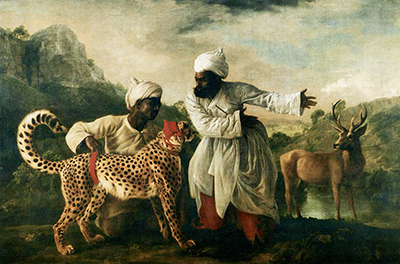
A spotted cat, two men and an antlered stag occupy an open stretch of ground. One man holds the animal's red body band; the other opens his arms towards the stag while looking back at his companion and the cheetah. The cat's eye is visible beside its raised red hood. Everything depends upon the relationship between these figures, yet Stubbs gives us neither a running chase nor a completed attack. Stubbs makes the preparation for action the principal event.
Manchester Art Gallery calls the work A Cheetah and a Stag with Two Indian Attendants and dates it about 1764. Painted in oil on canvas, it carries the accession number 1970.34. Its present interpretation names the cheetah Miss Jenny and identifies one attendant as John Morgan, an animal handler from Bengal, through research by Mark Sorrell. [1] These recoveries change the picture's human history without identifying which of its two men is Morgan.
The canvas measures 182.7 × 275.3 centimetres. Older records, including Art UK's Cheetah and Stag with Two Indians, retain variants of the title and a date around 1765. [2] Those labels concern the same Manchester painting. Its nearly three-metre breadth makes the attendants substantial figures, rather than incidental additions to an animal portrait. This is one of George Stubbs's paintings in which the work of handling an animal becomes inseparable from the animal's appearance.
At a Glance
This work across George Stubbs’s career
Whistlejacket
about 1762 [7]Contents
- A meeting organised around a cheetah
- Hands, hood and the visible eye
- The stag and the opening landscape
- From Bengal into British custody
- Pigot's office, honours and patronage
- John Morgan's testimony and its limits
- Hunting knowledge travelled too
- Windsor, reconstruction and the stag
- A figure concealed and recovered
- Exhibition and changing interpretations
- Videos on George Stubbs
Hands, hood and the visible eye
The cheetah stretches across the lower left of the picture. Its spotted flank provides a broad, almost continuous surface between the upward curl of its tail and the lifted head. The legs interrupt that horizontal shape: one foreleg reaches farther forward, while the hindquarters stand closer to the left edge. The animal is supported on the ground, not suspended in a leap. Its long tail turns back into the picture, making a curved boundary around the lower attendant rather than pointing out towards the stag. [16]
The red band crossing the abdomen draws attention to the place where a human hand controls the cat. The attendant's arm descends from a wide sleeve to the band near the animal's back. His body is largely behind the cheetah, and his lower posture keeps his head close to its level. Stubbs lets us see the point of contact clearly while allowing the spotted body to conceal much of the man. Restraint is therefore visible as an action performed by someone, rather than as equipment that happens to be attached to a specimen.
The head covering needs equally careful attention. Red material rises above and behind the cheetah's face; the nearer eye can be seen. Calling the animal blindfolded would erase this distinction. The image holds a particular arrangement of head, hood and collar, while the man at the back controls the body band. It does not let us reconstruct every fastening or decide precisely how far the equipment has been loosened. The important visual fact is that apparatus and human hands remain present at the supposed threshold of a hunt.
The central attendant is taller in the composition, with his pale turban set against the sky. His body faces across the foreground, but his head turns towards the cat and the other man. His arms carry our attention in the opposite direction. One extends towards the stag at shoulder height; the other crosses lower in front of his body. Open hands make the gesture particularly legible. They indicate a relation between the figures without supplying the words of a command or the result he expects.
The differences between the two men are specific. One stays low and close to the band; the other spreads out into a larger standing figure. Their turbans differ in outline and surface pattern, and the standing man's robe opens over red lower clothing. His folds form long descending curves beside the cheetah's straighter forelegs. These visible distinctions make them individuals within the design. Clothing alone cannot tell us their precise origins, employment terms or relative authority. Nor does the man nearest the restraint automatically become the documented Morgan.
Stubbs places the human faces between the animal's head and the upper landscape. The lower man looks across towards his companion; the taller man looks back. That exchange makes the left group internally connected even while the extended arms direct us elsewhere. The cheetah belongs to a close arrangement of hands, cloth, heads and equipment. The stag is outside it. Before any historical story is attached, the picture distinguishes an animal managed at close quarters from another animal standing across an interval.
The stag and the opening landscape
The stag occupies the right side beside water, its head turned towards the group. Its antlers rise into the lighter distance, while its legs meet a dark strip of foreground earth. There is no contact between the two animals. The standing man's robe partly interrupts the passage from the cheetah's body to the stag, so that the hunting relation is expressed through a human figure and a stretch of unoccupied ground. [16]
The two animals also register at different apparent scales. The cheetah fills much of the foreground; the stag sits farther back, close to the pool. Its smaller appearance need not imply a small species or an inferior animal. It helps establish depth and permits the antlers to stand clear of the main figure group. The water continues the opening beyond the stag, carrying the eye into a valley where trees and hills diminish towards the horizon.
At left, rock rises steeply behind the cat and its attendant. A deep cleft divides the cliff, and the upper edge is uneven. Below it, darker vegetation encloses the lower figure and tail. The right side offers a more gradual recession, interrupted by trees and rolling slopes. Thus the setting is asymmetrical: the left group receives a close, substantial backdrop, while the stag stands against a more expansive distance. The cliff does compositional work even without being identified as a particular place.
The sky occupies a considerable part of the canvas. Darker cloud crosses the top; lighter areas open nearer the horizon. Against this changing field, the upright turban and outstretched sleeve remain easy to follow. The drama does not require a visible storm to break. It comes from the contrast between the broad atmospheric space above and the concentrated handling of an animal below.
These relationships are clearer than any proposed psychological narrative. The cheetah's raised head and exposed eye do not establish eagerness or fear; the stag's planted feet do not demonstrate courage. What can be seen is a carefully arranged interval between bodies. Stubbs lets the landscape open behind an encounter whose immediate outcome he withholds. The picture rewards the structural attention central to his animal painting, while refusing to function as a sequence of instructions for reading animal emotions.
From Bengal into British custody
Historic Royal Palaces identifies Miss Jenny as a cheetah that arrived from Bengal in 1764, accompanied by John Morgan, and places her within the history of the Tower Menagerie. Its account connects the arrival of unfamiliar animals with Britain's expanding military and commercial empire, and stresses the knowledge brought by experienced keepers. [17] The cat's journey therefore included human expertise as well as the movement of a rare possession. Arrival in Britain did not supply British keepers with the experience needed to manage her.
The shipping evidence has a narrower documentary form. In a 2015 interview, Tate's curators reported Sorrell's discovery of a Pigot consignment containing a female “tyger”, aboard the Spanish prize ship Santissima Trinidada, at Plymouth on 6 June 1764. Animals described as “Tyger-Cats”, intended for the Duke of Cumberland, reached Portsmouth on 8 June. The curators suggested that these might be the same creatures continuing around the coast. They also reported payments to animal keepers in Cumberland's accounts, while treating the loan of Pigot's handlers to him as a possibility. [18] These notices establish a network more securely than a continuous biography: the entries do not individually name Miss Jenny or prove every stage of one animal's passage.
The historical word “tyger” belongs to these records, not to modern identification of the painted cat. Manchester's present title specifies a cheetah. A shipping clerk's or exhibition catalogue's vocabulary should not turn that animal into a tiger, nor should the broad label be taken to mean that every spotted cat mentioned in an eighteenth-century document was the same creature.
The royal sequence is that Pigot presented the cheetah to George III, who placed it in the care of his uncle, William Augustus, Duke of Cumberland. The latter maintained a menagerie at Windsor. [17] The gift's recipient, the person caring for the animal and the patron associated with its picture are consequently different roles. Conflating them makes the journey sound simpler than it was.
Historic Royal Palaces' earlier resource guide describes the Tower connection more cautiously: the painted cheetah is thought to be the animal later kept there as Miss Jenny. It explicitly states that Morgan's own presence at the Tower is unknown. [19] The distinction separates an institutional reconstruction of the animal's life from a documented workplace in the handler's biography. The painting supplies no Tower setting, and its Windsor association cannot itself prove that every person and animal followed the same subsequent journey.
Pigot's office, honours and patronage
George Pigot's first governorship of Madras ran from 1755 to 1763. Chennai District's official history describes that period as part of the East India Company's transformation from a trading corporation holding scattered settlements into a power controlling substantial territories. [20] The cheetah's British appearance followed this term. “Governor-General of Madras”, sometimes repeated in accounts of the painting, is misleading; “former governor of Madras” is appropriate to the British episode.
The original London Gazette also supplies a useful contemporary distinction. A notice dated 23 November 1764 calls Pigot the late governor of Fort St George and announces the grant of a baronetcy, extending its succession to his brothers if necessary. It records his attendance to kiss the King's hand. [21] This places his rise in British rank within the year of the animal's arrival, without demonstrating that the cheetah purchased the honour or that the gift had a single private motive.
A further notice, dated 27 December 1765, announces the King's order for Irish letters patent granting him a barony. [22] An announcement of intended patent proceedings is not the same thing as the completed creation. For the summer of 1764, calling him Lord Pigot would project his later dignity backwards. Titles help date the evidence only when their own chronology is respected.
The patron's later relationship with Stubbs is independently visible in another kind of object. John Ingamells's National Portrait Gallery catalogue records an equestrian portrait of Pigot in 1769 and its engraving by Benjamin Green. The Gallery also holds a later mezzotint impression, published by Robert Sayer and John Bennett on 10 January 1777. [23] In that print the mounted Pigot, a pale horse and a park landscape supply the public image of the patron. The Manchester encounter distributes comparable pictorial prominence among working attendants and their charge instead.
John Morgan's testimony and its limits
On 27 February 1765, the Old Bailey heard a theft prosecution brought by John Morgan. He told the court that he was born in Bengal, had previously travelled twice on East Indiamen and had been in England for about seven months on this visit. Living in Pigot's Soho Square house, he had accompanied an animal to Britain and continued attending it. Before this evidence, the judges approved his being sworn on the Qur'an after he explained his Muslim oath. His account of the October 1764 theft included threats and racist abuse. Another witness, James Murry, called him a “Lascar”. The proceedings establish a mobile, experienced animal attendant speaking as the injured party. They do not name the cheetah, mention Stubbs or identify a portrait sitting. [24]
Manchester's connection between this man and the painting is a later historical identification, credited to Sorrell. [1] It restores a name to the group, while leaving the precise figure unassigned. The second painted man remains unidentified. The existence of another Muslim companion in Morgan's account does not establish that he is the companion on the canvas.
This court record has also acquired a history of its own. Writing for the Old Bailey project's blog in 2015, Ian Petrie described using Morgan's case in a University of Pennsylvania course on the Indian Ocean. He returned to it alongside Stubbs's painting and historians' accounts of South Asian maritime labour. [25] That use changes the questions asked of the encounter: a witness once useful chiefly for identifying an animal's keeper becomes evidence for a traveller's working life and presence in London. It remains essential to distinguish the testimony from later attempts to complete his biography.
Hunting knowledge travelled too
A painting at the Metropolitan Museum of Art provides an earlier South Asian comparison. Made at Udaipur in 1710–15, Shah Jahan Hunting Blackbuck with Trained Cheetahs commemorates a hunt associated with the seventeenth-century Mughal emperor. The museum describes huntsmen accompanying the mounted ruler, deer scattering near water and a cheetah already on its prey. Its medium is ink, gold and opaque watercolour on paper. [26] This is neither a replica nor an identified source for Stubbs. It places the equipment and coordinated human activity in his canvas within a practice with a history outside Britain.
Wildlife historian Raza Kazmi explains that coursing with trained cheetahs commonly targeted blackbuck. Captive breeding was exceptionally difficult, and demand for hunting animals encouraged removal from the wild. His account also traces complex trapping and training practices through Indian manuals and later descriptions, including the use of hoods and sustained contact with keepers. [27] These histories reveal how much work lay behind a trained cat's appearance at a hunt. They do not establish Miss Jenny's birthplace, capture method or training regime, and none can be assigned to Morgan simply because he was an attendant.
Another royal animal journey makes the transfer of expertise especially clear. Historic Royal Palaces historian Mishka Sinha recounts the arrival in 1759 of Abdullah and a caracal, known in Britain as the Shah Goest, from Bengal. The cat entered George II's menagerie; Abdullah instructed its keepers, and provision was made for his return passage. [28] This concerns a different keeper, species and king. Its value beside the Manchester painting is comparative: transporting an animal required people able to care for it, and the history of those people could be documented separately from the royal gift. Abdullah's arrangements cannot fill gaps in Morgan's life.
Windsor, reconstruction and the stag
The Manchester picture is associated with a demonstration at Windsor Great Park in 1764. A cheetah was placed with a stag so that its hunting could be observed; the encounter did not produce the intended display. The stag repulsed the cat. [29] This is the background to the painting, rather than an explanation of every visible pose. Stubbs shows the group together before a depicted collision, not a diagram of successive attacks.
Judy Egerton considered it unlikely that Stubbs witnessed the actual event and understood the work as a reconstruction. [30] The picture itself omits a visible netted arena. Distant hills replace the enclosed demonstration ground; royal organisers and spectators are absent from the group.
The stag's anatomy further complicates literal interpretation. Specialist accounts describe a combination of a British red-deer body and antlers associated with an Indian deer, usually identified as sambar. [31] That description does not supply an individual name or settle the identity of the actual Windsor opponent. Stubbs's Red Deer, Stag and Hind poses a different question about deer representation; the Manchester animal belongs to a constructed encounter with its own requirements.
Andrew Wilton emphasised the invented setting and the unusual stillness of the stag in a 2023 discussion. His suggestion that the rocks may derive from Creswell Crags remains a suggestion. [31] The landscape works as a stage even when no precise location is assigned. To treat its cliff as a geographical certificate would narrow a picture that deliberately gives the animals and men room to form an exceptionally clear group.
A figure concealed and recovered
Egerton records that a later Pigot had the stag concealed beneath overpaint in 1882; it was uncovered in 1960. Her proposed explanation, that the animal distracted attention from the royal gift, remains hypothetical. [30] This documents an alteration and reversal, without establishing the owner's instructions, the treatment method or present condition.
Its compositional consequences are substantial. Remove the stag and the standing man's hands lose their explicit counterpart. The pool and hillside remain, but the action concentrates on cat and attendants. Restoring it restores an opponent and a direction for the gesture. The intervention changed the relationship between the foreground group and the right side, rather than merely suppressing a detail of scenery. [16]
An older reproduction without the stag therefore need not represent a different Stubbs canvas: its date and the documented alteration must be considered.
Exhibition and changing interpretations
The picture appeared at the Society of Artists in 1765 as Portrait of a Hunting Tyger. Martin Postle, discussing the work for the Arts Society in 2019, connected its scale and narrative with the ambitions of history painting. [32] The original exhibition title foregrounded the hunting cat. The present title makes the stag and the two attendants explicit, inviting attention to an encounter rather than just an unusual animal.
The public history of the picture also includes absence. Reviewing the Holburne Museum's Stubbs and the Wild in August 2016, Caroline Cannon-Brookes regretted that the Manchester painting was said to be too large to lend. [33] This is a report about one exhibition, not a permanent restriction on travel. It illustrates how a major work may shape an account of an artist even when the canvas itself is missing from the room.
The painting had appeared in Tate Britain's Artist and Empire in 2015–16. The subsequent King's College London collection Parallel Perspectives used it to discuss the instability of imperial categories: a transported cat, Indian attendants in Britain and a stag read as a composite creature. It also interpreted the cheetah's failure to perform as expected as an example of an imperial possession exceeding the role assigned to it. [34] That is a later scholarly argument about the picture's history, not evidence that Stubbs painted an intentional political protest or that the animal understood the spectacle politically.
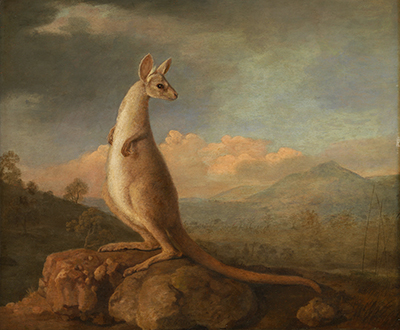
This is why the work belongs in discussion of exotic animals and empire without becoming a universal emblem. Its particular people, institutions and places matter. The royal zebra and The Kongouro from New Holland have other histories. The value of comparison lies in asking how their different journeys became pictures, rather than treating every foreign animal as the product of an identical transaction.
Manchester's public purchase
The painting remained with the Pigot family until its sale in 1970. Manchester records contributions of £110,000 from the Department of Education and Science, £10,000 from the Art Fund, £40,000 in individual donations and £60,000 from the rates fund. Together these made the £220,000 purchase possible. [1]
Sotheby's dates the sale to 18 March 1970 and describes the price as a record then for a painting by a British artist. [35]
Art Fund's acquisition record independently confirms its £10,000 grant and the total cost. [29]
The purchase also left an unusually immediate parliamentary record. On 19 March 1970, Alfred Morris asked whether public money was being made available for Manchester's acquisition. Jennie Lee replied that £110,000 was forthcoming and that an advance would initially be made through the Civil Contingencies Fund. Parliamentary approval would be sought subsequently. [36] Her answer records the mechanism and the sequence of the support, rather than simply attaching a government name to the finished acquisition. An auction record became a public purchase through specific financial commitments.
The purchase brought a painting held by the patron's family into Manchester's municipal collection.
Reproductions and renewed looking
Modern images circulate much more widely than the canvas. Art UK offers prints made to order from the Manchester picture. [37] Such reproductions allow the composition to be studied elsewhere, but they do not establish a second Stubbs oil or an eighteenth-century engraving. The engraved Pigot portrait in the National Portrait Gallery is another subject, with its own original painting and publication history. [23] The distinction matters when following Stubbs's prints: a shared patron does not make two compositions versions of one another.
The Manchester painting finally returns us to the evidence of contact. A hand rests at the cat's band; an eye is exposed beside a hood; two faces turn within the left group; two arms address an animal standing beyond it. The landscape enlarges that interval, and the work's subsequent history has repeatedly changed how it is understood. Naming Morgan adds a documented person to the encounter. Recovering the stag restores part of its visible design. Neither requires the silence of the image to be filled with invented speech or feeling.
Videos on George Stubbs
Explore Stubbs’s equestrian painting in its wider context, including two readings of Whistlejacket.
A Horse Lover’s Guide to the YCBA
A museum tour that places Stubbs alongside other artists who painted horses. It includes a look at Pumpkin with a Stable-lad.
Watch on YouTubeGeorge Stubbs artworks directory
Search works and related prints documented in this guide. Separate versions and printing matrices have separate entries; printmakers are named where known. Unidentified historical titles and untraced studio-sale material are discussed in the essays. A dash means that a date is not established here.
| Name | Date | Medium |
|---|---|---|
| A Bay Horse with a Groom | 1791 | Painting |
| A Bay Hunter with Two Playful Spaniels | 1777 | Painting |
| A Bay Hunter, a Springer Spaniel and a Sussex Spaniel in a wooded river Landscape | 1782 | Painting |
| A Cheetah and a Stag with Two Indian Attendants | about 1764 | Painting |
| A Couple of Fox Hounds (coloured print after Stubbs) | — | Print after Stubbs |
| A Couple of Foxhounds | 1792 | Painting |
| A Foxhound on the Scent | 1788 | Drawing |
| A Gentleman driving a Lady in a Phaeton | 1787 | Painting |
| A Grey Horse | 1793 | Painting |
| A Grey Horse (cantering companion) | 1793 | Painting |
| A Grey Stallion in a Landscape | — | Painting |
| A Horse Affrighted at a Lion | 1 May 1788 | |
| A Horse Belonging to the Rt. Honourable Lord Grosvenor called Bandy from his Crooked Leg | about 1763 | Painting |
| A Horse Frightened by a Lion | 1777 | |
| A Lion (A Lion Resting on a Rock) | 1 May 1788 | |
| A Lion Attacking a Horse | 1770 | Painting |
| A Lion Attacking a Horse (monumental Yale canvas) | 1762 | Painting |
| A lion attacking a horse (NGV) | about 1765 | Painting |
| A Lion Devouring a Horse (1788 print) | 1788 | |
| A lion devouring a horse (attribution disputed) | Proposed mid-1770s | Painting |
| A mare and foal with a bay horse | 1771 | Painting |
| A Monkey | 1799 | Painting |
| A Prancing Horse, Facing Right | c. 1790 | Drawing |
| A Rough Dog | 1790 | Painting |
| A Saddled Bay Hunter | 1786 | Painting |
| A Sleeping Leopard | 1 January 1791 | |
| A Tiger and a Sleeping Leopard | 1 May 1788 | |
| A Tigress (John Dixon after Stubbs) | 1772 | Print after Stubbs |
| A Tyger (A Recumbent Leopard by a Tree) | 1 May 1788 | |
| A Tyger (Sleeping Leopard) | 1 May 1788 | |
| An animal found on the coast of New Holland called kanguroo (after Stubbs) | 1773 | Print after Stubbs |
| An animal of a new species found on the coast of New South Wales (after Stubbs) | July 1773 | Print after Stubbs |
| Antinous and Jockey | — | Painting |
| Antinoüs, a chestnut racehorse, in a landscape | Undated | Painting |
| Bandy belonging to Lord Grosvenor (print after Stubbs) | — | Print after Stubbs |
| Baronet (George Townley Stubbs after Stubbs) | 20 February 1794 | Print after Stubbs |
| Baronet with Sam Chifney Up | 1791 | Painting |
| Baronet with Samuel Chifney up (Royal Collection) | 1791 | Painting |
| Bay Hunter by a Lake | 1787 | Painting |
| Brood Mares (Benjamin Green after Stubbs) | Issue 14 November 1776 | Print after Stubbs |
| Brood Mares and Foals | usually dated 1767 | Painting |
| Brown and White Norfolk or Water Spaniel | 1778 | Painting |
| Bulls Fighting | 1786 | Painting |
| Captain Samuel Sharpe Pocklington with His Wife, Pleasance, and possibly His Sister, Frances | 1769 | Painting |
| Death of the Doe (attribution disputed) | 1804 | |
| Der Englische Hühnerhund (Johann Wölfle after Stubbs) | about 1860 | Print after Stubbs |
| Dog (A Foxhound Viewed from Behind) | 1 May 1788 | |
| Dog [A Foxhound on the Scent] | 1788 | |
| Drill and albino baboon | before 1789 | Painting |
| Eclipse (Charles Hunt after Stubbs) | 12 November 1839 | Print after Stubbs |
| Eclipse (George Townley Stubbs after Stubbs) | 1796 | Print after Stubbs |
| Eclipse (oil study) | — | Painting |
| Eclipse (Thomas Burke after Stubbs) | First published 1772 | Print after Stubbs |
| Eclipse and John Wildman (Benjamin Green after Stubbs) | 1772 | Print after Stubbs |
| Eclipse at Newmarket (Jockey Club version) | Proposed early 1790s; often dated 1770 | Painting |
| Eclipse at Newmarket with a groom and jockey | 1770 | Painting |
| Eclipse with Mr Wildman and His Sons | 1769–71 | Painting |
| Eclipse, the Property of Capt.n O Kelly (anonymous print after Stubbs) | Imprint 4 June 1804; impression undated | Print after Stubbs |
| Euston | 1774 | Painting |
| Finished Study for the Seventh Anatomical Table of the Muscles of the Horse | 1756–58 | Drawing |
| Five Brood Mares at the Duke of Cumberland's Stud Farm in Windsor Great Park | 1765 | Painting |
| Fowl Body, Lateral View (Highly Finished Study for an Unpublished Table; Shows the Last Stage in Dissection) | — | Drawing |
| Fowl Body, Lateral View (Probably Prepared for Transfer to the Plate for Engraving of Table XV) | — | Drawing |
| Fowl Skeleton, Lateral View (Finished Study for Table V) | — | Drawing |
| Freeman, the Earl of Clarendon's Gamekeeper, with a Dying Doe and Hound (Yale) | 1800 | Painting |
| George Stubbs (enamel self-portrait) | 1781 | Enamel |
| Gimcrack (George Townley Stubbs after Stubbs) | 1775 | Print after Stubbs |
| Gimcrack on Newmarket Heath, with a trainer, a jockey and a stable lad | about 1765 | Painting |
| Gimcrack, with John Pratt up, on Newmarket Heath | about 1765 | Painting |
| Hambletonian, Rubbing Down | 1800 | Painting |
| Hay-Makers | 1791 | |
| Haycarting | 1795 | Enamel |
| Haymakers | 1785 | Painting |
| Haymakers (Lady Lever Art Gallery) | 1794 | Enamel |
| Hollyhock (with later additions by Vernet and Boucher) | about 1765–70 | Painting |
| Horse Attacked by a Lion (Episode C) | 1768–69 | Painting |
| Horse Attacked by a Lion (Tate enamel) | 1769 | Enamel |
| Horse Devoured by a Lion | Possibly exhibited 1763 | Painting |
| Horse Frightened by a Lion | 1770 | Painting |
| Horse Frightened by a Lion (Episode A; Wedgwood and Bentley after Stubbs) | — | Sculpture |
| Horse Frightened by a Lion (Tate) | Possibly exhibited 1763 | Painting |
| Horse Frightened by a Lion (Yale) | 1762–68 | Painting |
| Horse in the Shade of a Wood | 1780 | Painting |
| Hound Coursing a Stag | about 1762 | Painting |
| Human Figure, Anterior View (Intended for a Plate That was Never Published) | — | Drawing |
| Human Skeleton, Lateral View | 1795–1806 | Drawing |
| Hunt servants setting out (Southill commission) | 1767 | Painting |
| Hühnerhund (The Spanish Pointer) | about 1766 | Painting |
| John and Sophia Musters Riding at Colwick Hall | 1777 | Painting |
| John Musters on his hunter Pilgrim | 1777–78 | Painting |
| Labourers | 1789 | |
| Labourers (Richard Earlom after Stubbs and Amos Greene) | 25 March 1790 | Print after Stubbs |
| Laetitia, Lady Lade (d.1825) | 1793 | Painting |
| Lemon and White Water Spaniel | — | Painting |
| Lion Attacking a Stag | — | Painting |
| Lord Grosvenor's Arabian Stallion with a Groom | about 1765 | Painting |
| Lord Grosvenor's Arabian Stallion with a Groom (Peter Mazell after Stubbs) | 1771 | Print after Stubbs |
| Mambrino (Eaton Hall painting) | — | Painting |
| Mambrino (George Townley Stubbs after Stubbs) | 1794 | Print after Stubbs |
| Mares and Foals belonging to the 2nd Viscount Bolingbroke | about 1761–62 | Painting |
| Mares and foals beneath large oak trees | — | Painting |
| Mares and Foals by a stream | Exhibited 1764 | Painting |
| Mares and Foals in a River Landscape | about 1763–68 | Painting |
| Mares and Foals in an Extensive Landscape | about 1769 | Painting |
| Mares and Foals without a Background | 1762 | Painting |
| Moose Deer (after Stubbs) (Arctic Zoology plate VIII) | 1784–85 publication | Print after Stubbs |
| Newmarket Heath with a Rubbing-Down House | — | Painting |
| Otho (1796 print after Stubbs) | 1 December 1796 | Print after Stubbs |
| Otho, with John Larkin up | 1768 | Painting |
| Pangloss | about 1762 | Painting |
| Patch (Grafton commission) | 1759 | Painting |
| Phaeton and the Chariot of the Sun (enamel) | 1775 | Enamel |
| Phaeton with a Pair of Cream Ponies and a Stable-Lad | 1780–84 | Painting |
| Phillis | 1772 | Painting |
| Portrait of a Large Dog (Dingo) | 1772 | Painting |
| Pumpkin with a Stable-lad | 1774 | Painting |
| Racehorses Exercising at Goodwood | 1759–60 | Painting |
| Reapers (1791 print) | 1791 | |
| Reapers (Tate) | 1785 | Painting |
| Reapers (Yale) | 1795 | Enamel |
| Red Deer: A Stag and a Hind | 1792 | Painting |
| Richard Wedgwood | — | Enamel |
| Ringwood, a Brocklesby Foxhound | 1792 | Painting |
| Scrub, a bay horse belonging to the Marquess of Rockingham | about 1762 | Painting |
| Self Portrait on a White Hunter | 1782 | Enamel |
| Self-Portrait | about 1759 | Painting |
| Shooting (1770 Woollett plate after Stubbs) | 1770 | Print after Stubbs |
| Shooting (1771 Woollett plate after Stubbs) | 1771 | Print after Stubbs |
| Shooting at Goodwood | 1759–60 | Painting |
| Sir John Nelthorpe as a boy | 1756 | Painting |
| Sir John Nelthorpe partridge shooting with one pointer | — | Painting |
| Sir John Nelthorpe, 6th Baronet, out Shooting with His Dogs in Barton Field, Lincolnshire | 1776 | Painting |
| Sleeping Leopard | 1777 | Enamel |
| Soldiers of the 10th Light Dragoons | 1793 | Painting |
| Stallion and Mare (George Townley Stubbs after Stubbs) | 1776; reissued 1789 | Print after Stubbs |
| Steward and gamekeeper with dogs (Southill commission) | 1767 | Painting |
| Studies of a Lemur (Lemur murinus) in six different attitudes | 1773 | Drawing |
| Study for the Self-portrait in Enamel | c. 1781 | Drawing |
| Study of a Lemur | 1773 | Drawing |
| Study of a Racehorse in Action: Galloping to Left, a Semi-Anatomical Study, with Skin Flayed to Show Action of Muscles | — | Drawing |
| Study of the Legs of a Draught-Horse Pulling a Harrow (attributed to Stubbs) | Proposed about 1786 | Drawing |
| Sweet William (Grosvenor panel) | — | Painting |
| Sweet William (Turf Gallery canvas) | — | Painting |
| The Black Stallion Sampson, Portrayed from Three Angles (with landscape additions) | about 1764 | Painting |
| The Charlton Hunt | 1759–60 | Painting |
| The Fall of Phaeton | — | Sculpture |
| The Frightened Horse | 1780 | Sculpture |
| The Grosvenor Hunt | — | Painting |
| The Haymakers (Upton House) | 1783 | Painting |
| The Horse and Lion (George Townley Stubbs after George Stubbs) | 1770 | Print after Stubbs |
| The Kongouro from New Holland | 1772 | Painting |
| The Labourers | 1779 | Painting |
| The Labourers (Southill original) | 1767 | Painting |
| The lion and horse (Benjamin Green after Stubbs) | 1769; reissued 1777 | Print after Stubbs |
| The Milbanke and Melbourne Families | about 1769 | Painting |
| The Moose | 1770 | Painting |
| The Prince of Wales's Phaeton | 1793 | Painting |
| The Reapers (Upton House) | 1783 | Painting |
| The Sebra, or Wild Ass (George Townley Stubbs after Stubbs) | 1771 | Print after Stubbs |
| The Spanish Pointer (Bradford version) | about 1766–68 | Painting |
| The Spanish Pointer (William Woollett after Stubbs) | January 1768 | Print after Stubbs |
| The Third Duke of Dorset's Hunter with a Groom and a Dog | 1768 | Painting |
| Thomas Freeman, Lord Clarendon's gamekeeper, with a dog and a shot doe (with George Townly Stubbs) | 1803 | Painting |
| Turf, with Jockey up, at Newmarket | — | Painting |
| Turk and Crab | — | Painting |
| Two Bay Hunters Communing On The Bank Of A Lake | — | Painting |
| Tygers at Play | 1780 | |
| Viscount Gormanston's White Dog | 1781 | Painting |
| Viscount Gormanston's White Dog (canvas version) | — | Painting |
| Water Spaniel | 1769 | Painting |
| Wedgwood Family Portrait | 1780 | Painting |
| Whistlejacket | about 1762 | Painting |
| Whistlejacket with two other stallions and a groom | Recorded 1762 | Painting |
| White Poodle in a Punt | about 1780 | Painting |
| William Anderson with two Saddle-Horses | 1793 | Painting |
| Working Drawing for the Seventh Anatomical Table of the Muscles of the Horse | 1756–58 | Drawing |
| Zebra | 1763 | Painting |
Discussion
Look again at the images and ideas explored in A Cheetah and a Stag with Two Indian Attendants. These editorial prompts invite your observations.
Reader Insights
How do the attendants’ gestures direct your attention to the cheetah?
What does the documented animal history add to a close reading of the painting?
How does attending separately to the two attendants change the way you follow the action?
Join the Conversation
Share a detail, comparison or question about A Cheetah and a Stag with Two Indian Attendants below.
References
- Manchester Art Gallery, Gallery 3 booklet, entry for A Cheetah and a Stag with Two Indian Attendants. (accessed 31 October 2026). View source.
- Art UK, Cheetah and Stag with Two Indians, Manchester Art Gallery, 1970.34. (metadata cross-checked 31 October 2026). View source.
- Goodwood, The Collection, Painting Collection modal, Racehorses Exercising at Goodwood; An exciting acquisition: a study by George Stubbs, 30 June 2023; History of the Estate Hounds, 4 October 2023; About Goodwood Racecourse. Accessed 4 November 2026. View source.
- Goodwood, The Collection, Painting Collection modal, Racehorses Exercising at Goodwood; An exciting acquisition: a study by George Stubbs, 30 June 2023; History of the Estate Hounds, 4 October 2023; About Goodwood Racecourse. Accessed 4 November 2026. View source.
- Goodwood, The Collection, Painting Collection modal, Racehorses Exercising at Goodwood; An exciting acquisition: a study by George Stubbs, 30 June 2023; History of the Estate Hounds, 4 October 2023; About Goodwood Racecourse. Accessed 4 November 2026. View source.
- Goodwood, The Collection, Painting Collection modal, Racehorses Exercising at Goodwood; An exciting acquisition: a study by George Stubbs, 30 June 2023; History of the Estate Hounds, 4 October 2023; About Goodwood Racecourse. Accessed 4 November 2026. View source.
- National Gallery, Whistlejacket, NG6569, current collection record, provenance, in-depth discussion and frame entry. View source.
- Yale Center for British Art, Zebra, B1981.25.617, current object metadata, gallery labels, Malcolm Warner’s 1998 catalogue entry and provenance supplied through the museum’s public collection record. View source.
- Manchester Art Gallery, Gallery 3 booklet, entry for A Cheetah and a Stag with Two Indian Attendants. View source.
- Christie’s, Gimcrack on Newmarket Heath, with a trainer, a jockey and a stable lad, London, 5 July 2011, lot 12; object details, essay, provenance, exhibitions and whole image. View source.
- Christie’s, Gimcrack on Newmarket Heath, with a trainer, a jockey and a stable lad, London, 5 July 2011, lot 12; object details, essay, provenance, exhibitions and whole image. View source.
- Yale University Art Gallery, A Lion Attacking a Horse, 1770, 1955.27.1, collection record. Accessed 4 November 2026. View source.
- Royal Museums Greenwich, ‘The Kongouro from New Holland’ (Kangaroo), ZBA5754. Accessed 4 November 2026. View source.
- Tate, George Stubbs, Haymakers, 1785, T02256; details, Terry Riggs’s collection text (January 1998), and online caption. Collection record. View source.
- Frances Bailey, ‘Hambletonian, Rubbing Down: A masterpiece by George Stubbs’, National Trust Cultural Heritage Magazine, Autumn/Winter 2024, pp. 22–33. Article. View source.
- Image sources, whole reproductions of Manchester Art Gallery 1970.34, Yorck Project file and Art UK-origin photograph. ; (accessed 31 October 2026). View source 1. View source 2.
- Historic Royal Palaces, “The Tower of London Menagerie”. (accessed 31 October 2026). View source.
- Kounteya Sinha, “British painting Cheetah actually ‘Miss Jenny’”, Times of India, 21 July 2015, interview reporting Tate curators and Mark Sorrell's research. (accessed 31 October 2026). View source.
- Historic Royal Palaces, Tower of London Resource Guide, p. 55. (accessed 31 October 2026). View source.
- Chennai District, Government of Tamil Nadu, “History”. (accessed 31 October 2026). View source.
- The London Gazette, no. 10472, p. 1, notice dated 23 November 1764. (accessed 31 October 2026). View source.
- The London Gazette, no. 10586, p. 2, notice dated 27 December 1765. (accessed 31 October 2026). View source.
- John Ingamells / National Portrait Gallery, Pigot iconography, Mid-Georgian Portraits 1760–1790 (2004), and Benjamin Green after Stubbs, George Pigot, Baron Pigot, NPG D15221. ; (accessed 31 October 2026). View source 1. View source 2.
- Old Bailey Proceedings Online, trial of John Ryan, Mary Ryan and Jeremiah Ryan, 27 February 1765, t17650227-5. (accessed 31 October 2026). View source.
- Ian Petrie, “Locating Lascars: The Old Bailey Online and the Maritime World of the Indian Ocean”, Crime in the Community, 6 February 2015. (accessed 31 October 2026). View source.
- Metropolitan Museum of Art, Shah Jahan Hunting Blackbuck with Trained Cheetahs, 1710–15, 2019.445.2. (accessed 31 October 2026). View source.
- Raza Kazmi, “How to Trap a Cheetah (And Why You Shouldn't Have)”, The India Forum, 10 February 2023. (accessed 31 October 2026). View source.
- Mishka Sinha, “An Asian wild cat and his Indian trainer in 18th-century London”, Historic Royal Palaces, 12 July 2024. (accessed 31 October 2026). View source.
- Art Fund, Cheetah and Stag with Two Indians, archived 1970 acquisition record. (accessed 31 October 2026). View source.
- Judy Egerton, “Cheetah with Two Indian Attendants and a Stag”, in Martin Bailey (ed.), The Folio Society Book of the 100 Greatest Paintings, London, 2001, p. 120, online scan. (accessed 31 October 2026). View source.
- Andrew Wilton, “Stop and Look – Cheetah and Stag with two Indians by George Stubbs”, 22 April 2023. (accessed 31 October 2026). View source.
- Martin Postle, comments in “Discover the animal art of George Stubbs”, The Arts Society, 15 November 2019. (accessed 31 October 2026). View source.
- Caroline Cannon-Brookes, “Stubbs and the Wild”, British Society for Eighteenth-Century Studies, 12 August 2016. (accessed 31 October 2026). View source.
- King's College London Cultural Institute, Parallel Perspectives: Transnational curation in London 2015–16, 2017, pp. 46–50. (accessed 31 October 2026). View source.
- Sotheby's, Tygers at Play, 9 July 2014, lot 22, contextual discussion of the Manchester painting's 1970 sale. (accessed 31 October 2026). View source.
- Hansard, “Stubbs Painting (Purchase)”, House of Commons, 19 March 1970, vol. 798, c. 204W. (accessed 31 October 2026). View source.
- Art UK Shop, Cheetah and Stag with Two Indians, modern reproduction description. (accessed 31 October 2026). View source.
- Basic title, date and material metadata for Tate’s Reapers (T02257) and Otho (T02375) is adapted from the Tate collection dataset, October 2014, released under CC0. TheHistoryOfArt.org has reconciled labels and versions. This credit does not apply to Tate’s authored catalogue commentary or images.
- Data Source: Yale Center for British Art. Basic object fields are adapted and reconciled for this directory. Reuse is subject to the Center’s Open Data and Data Services Terms of Use. No museum endorsement is implied. This metadata credit does not relabel scholarly essays or images as open data.
- Basic object metadata for A Horse Frightened by a Lion, 1985.38, The Cleveland Museum of Art, John L. Severance Fund, is available under CC0. Titles and design-level grouping have been reconciled for this directory.