 by Tom Gurney
Tom Gurney BSc (Hons) is an art history expert with over 20 years experience
Email: tomgurney1@gmail.com / Phone: +44 7429 011000
A named horse beneath a tree
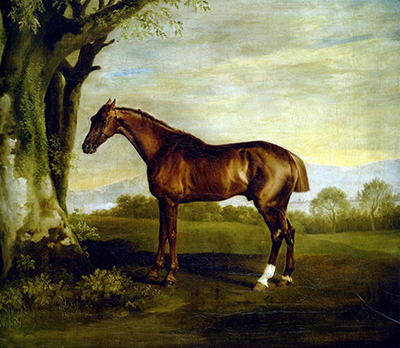
George Stubbs's Antinoüs, a chestnut racehorse, in a landscape is a signed, undated oil on canvas, 61 by 70.2 centimetres. Christie's records the inscriptions ‘Geo: Stubbs pinxit’ and ‘Antinous’ at lower right, the name below the horse. It belongs among Stubbs's named horse portraits. [1]
Antinoüs stands facing left, his body extending across the lower half of a nearly square landscape. A substantial tree occupies the left edge; its branches spread overhead while the horse's back meets a broad opening of pale sky. Four feet touch the ground. No rider, groom, saddle or bridle interrupts the outline. The scene gives the animal an unusually uninterrupted presence: we can follow him from the tips of the ears to the blunt end of the tail, then return along the legs and belly. [2]
The horse is neither small in the landscape nor pressed against the frame. There is room above his ears and behind his hindquarters, and a broad strip of ground below his hooves. His head stops just short of the tree. That narrow interval is important: the trunk and muzzle remain separate, keeping the horse readable as a complete body rather than allowing the foreground forms to merge. The dark chestnut is set against lighter ground around the head and shoulders, then against a lower band of green beneath the belly. [2]
At a Glance
This work across George Stubbs’s career
Whistlejacket
about 1762 [8]Contents
- A named horse beneath a tree
- Looking at the standing body
- The tree, ground and distance
- Antinoüs in the pedigree
- Racing, defeat and the stud
- Stonehewer and the ownership of the picture
- Another Antinoüs, with Pilkington mounted
- The surviving public record
- Videos on George Stubbs
Looking at the standing body
The most decisive contour runs from the ears down the neck, across the back and over the rounded hindquarter. It is not a straight horizontal. A shallow dip behind the shoulder and a rise towards the rump give it an individual rhythm. Below, the line of the belly bends upwards towards the hind legs. These two differently shaped boundaries enclose the long middle of the animal. Stubbs makes that length clear without requiring a racing stride or an exaggerated turn towards the viewer. [2]
Light separates several forms within this silhouette. The shoulder has a warm illuminated edge beside a darker central passage; another bright area falls across the ribcage, and the curve of the hindquarter receives a broader glow. Along the upper body, the darker back and mane make a continuous counterweight. The effect depends on changes within the brown rather than on a uniformly bright coat. In reproduction, these changes remain readable at a distance even when individual surface marks become harder to distinguish. [2]
His head inclines downwards from upright ears. The near eye appears as a small dark point, and a thin line describes the mouth above the rounded muzzle. The neck narrows markedly towards the head. Unlike the broad body, this part of the figure is almost entirely surrounded by pale background, so its smaller changes of direction are especially distinct. The ears rise into empty space; the nose projects towards the trunk; the lower jaw and throat turn back towards the chest. These visible angles carry the description without requiring a claim about the horse's feelings. [2]
The forelegs descend close together, with the farther leg showing beside the nearer one. Their hooves are slightly separated rather than becoming a single dark base. The hind legs have a wider offset: one runs further forward under the body, while the other stands behind it. Bright white markings at the hind feet draw attention to this difference. They also break the surrounding dark ground into smaller intervals. There is no need to turn this ordinary distribution of weight into a verdict on soundness, training or fatigue. [2]
The short tail has a clearly defined lower edge and hangs free of the legs. Its compact form leaves the outline of the hindquarter exposed. It contributes to the picture's particular silhouette, but the painting supplies no explanation for its length. Likewise, the absence of tack is a fact of the image, not proof that the horse had never worn it. Nothing visible establishes that a mark around the muzzle was an injury caused by equipment. A portrait can be precise about appearances without preserving the causes of every appearance. [2]
The tree, ground and distance
The tree is the horse's largest neighbour. Its broad trunk rises close to the left border, interrupted by irregular pale patches and darker hollows. A second, slimmer vertical appears further back, while strong branches spread to the right above the animal. Smaller leaves soften their edges. At ground level, separate clusters of low plants extend out from the roots. The difference between the heavy trunk and these much smaller forms makes the foreground feel close, but neither the tree nor the plants need a botanical name to fulfil that role. [2]
The horse's long axis crosses the tree's upward growth. One directs the eye sideways, the other carries it towards the top of the canvas. Their meeting is deliberately incomplete: the horse does not cover the trunk, and the branches remain above his back. Between them lies an open, lighter wedge of distance. That space prevents the left side from becoming a solid dark enclosure and lets the head remain distinct even though it points towards the picture's heaviest mass. [2]
Around the feet, the ground is dark and unevenly lit. Beyond it, a greener band rises gently behind the animal. Groups of trees appear across the middle distance, with a more open interval under the belly and smaller, paler forms towards the right. Low hills close the view. They stay below the back for much of its length, allowing sky rather than vegetation to define the upper contour. Foreground plants, middle-distance trees and distant slopes consequently offer three different scales against which to read the horse. [2]
The sky occupies a large portion of the painting, but it does not become a separate spectacle. Thin blue-grey passages cross a warmer pale field. Their long, soft shapes repeat the general sideways movement of the composition without competing with the sharper animal outline. Above the head, scattered leaves and a projecting branch give way to uninterrupted light. Behind the rump, the sky remains open. The painting balances a densely occupied left edge with a much less obstructed right side. [2]
This landscape contains no sign that securely names a particular estate or racecourse. Its contribution is spatial and pictorial: it places the horse on ground, sets different distances around him and allows his profile to remain legible. That is enough to distinguish this image within Stubbs's animal painting. A faithful description can acknowledge the body and setting without converting them into an imagined episode of waiting, unhappiness or recovery after a race. [2]
Antinoüs in the pedigree
The 1803 General Stud Book identifies Antinous as a chestnut colt foaled in 1758, by Blank. He appears beneath the Partner mare described as sister to the Widdrington Mare, with the Duke of Grafton's name bracketed beside the entry. His dam was bred by Mr Crofts and foaled in 1739. The pedigree continues through her mother, by Bloody Buttocks: that phrase describes the preceding generation, not the sire of the Partner mare herself. [16]
The layout matters. Several mares by Partner share this printed page, so the individual heading, date, relationship and ownership bracket prevent one family's details from slipping into another. The abbreviated chestnut-colt entry supplies something appearance alone cannot: a place in a recorded genealogy. A later entry for Wildman's Euston gives 1769, Antinous as sire and a dam by Brilliant, extending the record into the next generation. [16]
Racing, defeat and the stud
Pick's Turf Register records Antinous winning the King's Plate at Ipswich in July 1762 over three heats, each two and a quarter miles; Newmarket's 1,200-guinea stakes in April 1763; and £241 10s at York in August 1765, ridden by William Pilkington. The October 1767 match against Bodkin was his last race. [17]
Pick names King Herod, Exotic and Otho among his conquerors; their own entries confirm the encounters. King Herod's matches were in October 1764 and May 1765. This corrects the later sale essay's ‘Exeter’ and ‘Otto’. [1] [17] The proper Otho also has his own Stubbs portrait, Otho with John Larkin Up. [18] The connection is between documented horses, not evidence that either painting depicts their meeting. [17]
At stud, Pick places Antinous with Pilkington at Fakenham near Thetford, initially at five guineas plus five shillings, raised to ten guineas plus five shillings in 1774. Christie's gives 1775 instead. [1] [17] His listed offspring include Euston and Leapfrog. Thus the stationary animal belonged to both racing and breeding history; he was a stallion, not a gelding. [17]
The sale catalogue summarises eight wins from twelve races, two forfeits and nearly £5,000 earned for Grafton. Those totals describe the horse's career, not an event shown here. [1]
Stonehewer and the ownership of the picture
Richard Stonehewer belonged to Grafton's personal as well as professional circle. William Prideaux Courtney's Dictionary of National Biography article describes him as the Duke's Cambridge tutor, later his private secretary and lifelong confidential friend. The relationship therefore preceded official service and survived changes of office. Courtney also records Reynolds painting Stonehewer for Grafton in 1775: the secretary was himself a subject of portraiture within the Duke's collection. [19]
Stonehewer's interests extended into literature. He knew Thomas Gray, and manuscripts passed to him through Gray's friend and literary executor William Mason. Stonehewer subsequently bequeathed Gray's commonplace books and autograph poems to Pembroke College, Cambridge. This helps place the presumed recipient of the horse picture within a world of scholarship, friendship and collecting. It does not establish that Antinoüs was painted as a literary allusion, or that Stonehewer chose the horse's name. His documented closeness to Grafton makes a personal exchange intelligible while leaving its precise occasion open. [19]
Christie's begins the provenance with a presumed commission by, or gift to, Stonehewer. It then traces inheritance to his sister Penelope, who died in 1821, wife of the Reverend Sir Richard Nelson Rycroft, and family descent to the consignor. Its essay corrects a reverse label suggesting Stonehewer owned Antinoüs: the horse belonged to Grafton. [1]
Another Antinoüs, with Pilkington mounted
Grafton's patronage produced more than one image of this horse and his family. A later specialist account identifies two pictures exhibited in 1764: a mounted Antinoüs, with landscape by George Barret, and Mares and Foals by a stream, whose central bay mare carries the inscription ‘Antinoüs Dam’. It associates them with numbers 43 and 42 respectively in Judy Egerton's catalogue. The background collaboration belongs to the mounted work; it gives no reason to assign Barret the tree or landscape in the smaller standing portrait. [20]
That account also places a separate Grafton commission, the chestnut horse Patch, at Goodwood in 1759. Antinoüs therefore sits within a continuing relationship between Stubbs and the Duke rather than marking their first recorded contact. The dam group adds a further distinction: an image concerned with a mare and her offspring could preserve family identity through an inscription as well as through individual appearance. The much larger Mares and Foals in an Extensive Landscape has a separate history again. [20]
Gilbey's 1898 exhibition appendix transcribes an Antinous belonging to Grafton as no. 115 under the 1764 Society of Artists exhibition. The entry alone gives no dimensions or rider description. More revealing is his reproduction of the 1885 Vokins loan catalogue: no. 32 is Antinous and Jockey, with Pilkington identified as trainer, a river in the distance and a landscape attributed to G. Barrett. The Duke of Grafton lent it. Those details distinguish a mounted composition from the unaccompanied horse beneath the tree. [21] The larger mounted canvas measures 40 by 50 inches. [1]
The same 1885 list identifies a bay mare in another group as Antinous's dam. These historical exhibition notices show that horse, rider and parentage remained useful ways of distinguishing Stubbs pictures. They should not be collapsed into one travelling canvas. In particular, the small standing portrait cannot acquire the mounted picture's 1764 exhibition or 1885 lender simply because both are portraits of Antinoüs. Nor does a historical collection designation establish where either work is today. [21]
Antinoüs's offspring also entered Stubbs's work. Sotheby's catalogued Euston, a dappled grey with jockey, as a signed 1774 oil on panel measuring 86.5 by 99 centimetres. Its essay identifies the horse as Grafton-bred, foaled in 1769 by Antinous, and owned by William Wildman. It further records the painting's exhibition at the Royal Academy in 1775. This is a distinct animal, support, size and exhibition history. [22]
The relationship is nevertheless useful: a named sire in one portrait leads to a named son in another. Euston's grey coat should not be mistaken for a different version of the chestnut Antinoüs. Nor should Wildman's ownership of the son migrate to the father. Such connections make Stubbs's horse portraits a particularly precise form of historical record, provided each painting retains its own subject. They also explain why identifying a horse by colour alone is inadequate when inscriptions and pedigrees allow a closer distinction. [22]
The surviving public record
Christie's London lot 19, 8 December 2009, realised £361,250 against a £200,000–£300,000 estimate. Buyer, execution year and present whereabouts remain unreported. [1]
What the image does preserve is a complete, deliberate presentation of a single horse: the near profile, the separate placement of the feet, the short tail, the tree beside the muzzle and the light surrounding the upper outline. Beside Whistlejacket, its setting and grounded pose offer a markedly different viewing experience. Antinoüs's quiet placement gives the eye time to travel around the body and through the surrounding land. The wider George Stubbs guide follows the artist's other subjects; here the attention remains with this horse and this landscape. [2]
Videos on George Stubbs
Explore Stubbs’s equestrian painting in its wider context, including two readings of Whistlejacket.
A Horse Lover’s Guide to the YCBA
A museum tour that places Stubbs alongside other artists who painted horses. It includes a look at Pumpkin with a Stable-lad.
Watch on YouTubeGeorge Stubbs artworks directory
Search works and related prints documented in this guide. Separate versions and printing matrices have separate entries; printmakers are named where known. Unidentified historical titles and untraced studio-sale material are discussed in the essays. A dash means that a date is not established here.
| Name | Date | Medium |
|---|---|---|
| A Bay Horse with a Groom | 1791 | Painting |
| A Bay Hunter with Two Playful Spaniels | 1777 | Painting |
| A Bay Hunter, a Springer Spaniel and a Sussex Spaniel in a wooded river Landscape | 1782 | Painting |
| A Cheetah and a Stag with Two Indian Attendants | about 1764 | Painting |
| A Couple of Fox Hounds (coloured print after Stubbs) | — | Print after Stubbs |
| A Couple of Foxhounds | 1792 | Painting |
| A Foxhound on the Scent | 1788 | Drawing |
| A Gentleman driving a Lady in a Phaeton | 1787 | Painting |
| A Grey Horse | 1793 | Painting |
| A Grey Horse (cantering companion) | 1793 | Painting |
| A Grey Stallion in a Landscape | — | Painting |
| A Horse Affrighted at a Lion | 1 May 1788 | |
| A Horse Belonging to the Rt. Honourable Lord Grosvenor called Bandy from his Crooked Leg | about 1763 | Painting |
| A Horse Frightened by a Lion | 1777 | |
| A Lion (A Lion Resting on a Rock) | 1 May 1788 | |
| A Lion Attacking a Horse | 1770 | Painting |
| A Lion Attacking a Horse (monumental Yale canvas) | 1762 | Painting |
| A lion attacking a horse (NGV) | about 1765 | Painting |
| A Lion Devouring a Horse (1788 print) | 1788 | |
| A lion devouring a horse (attribution disputed) | Proposed mid-1770s | Painting |
| A mare and foal with a bay horse | 1771 | Painting |
| A Monkey | 1799 | Painting |
| A Prancing Horse, Facing Right | c. 1790 | Drawing |
| A Rough Dog | 1790 | Painting |
| A Saddled Bay Hunter | 1786 | Painting |
| A Sleeping Leopard | 1 January 1791 | |
| A Tiger and a Sleeping Leopard | 1 May 1788 | |
| A Tigress (John Dixon after Stubbs) | 1772 | Print after Stubbs |
| A Tyger (A Recumbent Leopard by a Tree) | 1 May 1788 | |
| A Tyger (Sleeping Leopard) | 1 May 1788 | |
| An animal found on the coast of New Holland called kanguroo (after Stubbs) | 1773 | Print after Stubbs |
| An animal of a new species found on the coast of New South Wales (after Stubbs) | July 1773 | Print after Stubbs |
| Antinous and Jockey | — | Painting |
| Antinoüs, a chestnut racehorse, in a landscape | Undated | Painting |
| Bandy belonging to Lord Grosvenor (print after Stubbs) | — | Print after Stubbs |
| Baronet (George Townley Stubbs after Stubbs) | 20 February 1794 | Print after Stubbs |
| Baronet with Sam Chifney Up | 1791 | Painting |
| Baronet with Samuel Chifney up (Royal Collection) | 1791 | Painting |
| Bay Hunter by a Lake | 1787 | Painting |
| Brood Mares (Benjamin Green after Stubbs) | Issue 14 November 1776 | Print after Stubbs |
| Brood Mares and Foals | usually dated 1767 | Painting |
| Brown and White Norfolk or Water Spaniel | 1778 | Painting |
| Bulls Fighting | 1786 | Painting |
| Captain Samuel Sharpe Pocklington with His Wife, Pleasance, and possibly His Sister, Frances | 1769 | Painting |
| Death of the Doe (attribution disputed) | 1804 | |
| Der Englische Hühnerhund (Johann Wölfle after Stubbs) | about 1860 | Print after Stubbs |
| Dog (A Foxhound Viewed from Behind) | 1 May 1788 | |
| Dog [A Foxhound on the Scent] | 1788 | |
| Drill and albino baboon | before 1789 | Painting |
| Eclipse (Charles Hunt after Stubbs) | 12 November 1839 | Print after Stubbs |
| Eclipse (George Townley Stubbs after Stubbs) | 1796 | Print after Stubbs |
| Eclipse (oil study) | — | Painting |
| Eclipse (Thomas Burke after Stubbs) | First published 1772 | Print after Stubbs |
| Eclipse and John Wildman (Benjamin Green after Stubbs) | 1772 | Print after Stubbs |
| Eclipse at Newmarket (Jockey Club version) | Proposed early 1790s; often dated 1770 | Painting |
| Eclipse at Newmarket with a groom and jockey | 1770 | Painting |
| Eclipse with Mr Wildman and His Sons | 1769–71 | Painting |
| Eclipse, the Property of Capt.n O Kelly (anonymous print after Stubbs) | Imprint 4 June 1804; impression undated | Print after Stubbs |
| Euston | 1774 | Painting |
| Finished Study for the Seventh Anatomical Table of the Muscles of the Horse | 1756–58 | Drawing |
| Five Brood Mares at the Duke of Cumberland's Stud Farm in Windsor Great Park | 1765 | Painting |
| Fowl Body, Lateral View (Highly Finished Study for an Unpublished Table; Shows the Last Stage in Dissection) | — | Drawing |
| Fowl Body, Lateral View (Probably Prepared for Transfer to the Plate for Engraving of Table XV) | — | Drawing |
| Fowl Skeleton, Lateral View (Finished Study for Table V) | — | Drawing |
| Freeman, the Earl of Clarendon's Gamekeeper, with a Dying Doe and Hound (Yale) | 1800 | Painting |
| George Stubbs (enamel self-portrait) | 1781 | Enamel |
| Gimcrack (George Townley Stubbs after Stubbs) | 1775 | Print after Stubbs |
| Gimcrack on Newmarket Heath, with a trainer, a jockey and a stable lad | about 1765 | Painting |
| Gimcrack, with John Pratt up, on Newmarket Heath | about 1765 | Painting |
| Hambletonian, Rubbing Down | 1800 | Painting |
| Hay-Makers | 1791 | |
| Haycarting | 1795 | Enamel |
| Haymakers | 1785 | Painting |
| Haymakers (Lady Lever Art Gallery) | 1794 | Enamel |
| Hollyhock (with later additions by Vernet and Boucher) | about 1765–70 | Painting |
| Horse Attacked by a Lion (Episode C) | 1768–69 | Painting |
| Horse Attacked by a Lion (Tate enamel) | 1769 | Enamel |
| Horse Devoured by a Lion | Possibly exhibited 1763 | Painting |
| Horse Frightened by a Lion | 1770 | Painting |
| Horse Frightened by a Lion (Episode A; Wedgwood and Bentley after Stubbs) | — | Sculpture |
| Horse Frightened by a Lion (Tate) | Possibly exhibited 1763 | Painting |
| Horse Frightened by a Lion (Yale) | 1762–68 | Painting |
| Horse in the Shade of a Wood | 1780 | Painting |
| Hound Coursing a Stag | about 1762 | Painting |
| Human Figure, Anterior View (Intended for a Plate That was Never Published) | — | Drawing |
| Human Skeleton, Lateral View | 1795–1806 | Drawing |
| Hunt servants setting out (Southill commission) | 1767 | Painting |
| Hühnerhund (The Spanish Pointer) | about 1766 | Painting |
| John and Sophia Musters Riding at Colwick Hall | 1777 | Painting |
| John Musters on his hunter Pilgrim | 1777–78 | Painting |
| Labourers | 1789 | |
| Labourers (Richard Earlom after Stubbs and Amos Greene) | 25 March 1790 | Print after Stubbs |
| Laetitia, Lady Lade (d.1825) | 1793 | Painting |
| Lemon and White Water Spaniel | — | Painting |
| Lion Attacking a Stag | — | Painting |
| Lord Grosvenor's Arabian Stallion with a Groom | about 1765 | Painting |
| Lord Grosvenor's Arabian Stallion with a Groom (Peter Mazell after Stubbs) | 1771 | Print after Stubbs |
| Mambrino (Eaton Hall painting) | — | Painting |
| Mambrino (George Townley Stubbs after Stubbs) | 1794 | Print after Stubbs |
| Mares and Foals belonging to the 2nd Viscount Bolingbroke | about 1761–62 | Painting |
| Mares and foals beneath large oak trees | — | Painting |
| Mares and Foals by a stream | Exhibited 1764 | Painting |
| Mares and Foals in a River Landscape | about 1763–68 | Painting |
| Mares and Foals in an Extensive Landscape | about 1769 | Painting |
| Mares and Foals without a Background | 1762 | Painting |
| Moose Deer (after Stubbs) (Arctic Zoology plate VIII) | 1784–85 publication | Print after Stubbs |
| Newmarket Heath with a Rubbing-Down House | — | Painting |
| Otho (1796 print after Stubbs) | 1 December 1796 | Print after Stubbs |
| Otho, with John Larkin up | 1768 | Painting |
| Pangloss | about 1762 | Painting |
| Patch (Grafton commission) | 1759 | Painting |
| Phaeton and the Chariot of the Sun (enamel) | 1775 | Enamel |
| Phaeton with a Pair of Cream Ponies and a Stable-Lad | 1780–84 | Painting |
| Phillis | 1772 | Painting |
| Portrait of a Large Dog (Dingo) | 1772 | Painting |
| Pumpkin with a Stable-lad | 1774 | Painting |
| Racehorses Exercising at Goodwood | 1759–60 | Painting |
| Reapers (1791 print) | 1791 | |
| Reapers (Tate) | 1785 | Painting |
| Reapers (Yale) | 1795 | Enamel |
| Red Deer: A Stag and a Hind | 1792 | Painting |
| Richard Wedgwood | — | Enamel |
| Ringwood, a Brocklesby Foxhound | 1792 | Painting |
| Scrub, a bay horse belonging to the Marquess of Rockingham | about 1762 | Painting |
| Self Portrait on a White Hunter | 1782 | Enamel |
| Self-Portrait | about 1759 | Painting |
| Shooting (1770 Woollett plate after Stubbs) | 1770 | Print after Stubbs |
| Shooting (1771 Woollett plate after Stubbs) | 1771 | Print after Stubbs |
| Shooting at Goodwood | 1759–60 | Painting |
| Sir John Nelthorpe as a boy | 1756 | Painting |
| Sir John Nelthorpe partridge shooting with one pointer | — | Painting |
| Sir John Nelthorpe, 6th Baronet, out Shooting with His Dogs in Barton Field, Lincolnshire | 1776 | Painting |
| Sleeping Leopard | 1777 | Enamel |
| Soldiers of the 10th Light Dragoons | 1793 | Painting |
| Stallion and Mare (George Townley Stubbs after Stubbs) | 1776; reissued 1789 | Print after Stubbs |
| Steward and gamekeeper with dogs (Southill commission) | 1767 | Painting |
| Studies of a Lemur (Lemur murinus) in six different attitudes | 1773 | Drawing |
| Study for the Self-portrait in Enamel | c. 1781 | Drawing |
| Study of a Lemur | 1773 | Drawing |
| Study of a Racehorse in Action: Galloping to Left, a Semi-Anatomical Study, with Skin Flayed to Show Action of Muscles | — | Drawing |
| Study of the Legs of a Draught-Horse Pulling a Harrow (attributed to Stubbs) | Proposed about 1786 | Drawing |
| Sweet William (Grosvenor panel) | — | Painting |
| Sweet William (Turf Gallery canvas) | — | Painting |
| The Black Stallion Sampson, Portrayed from Three Angles (with landscape additions) | about 1764 | Painting |
| The Charlton Hunt | 1759–60 | Painting |
| The Fall of Phaeton | — | Sculpture |
| The Frightened Horse | 1780 | Sculpture |
| The Grosvenor Hunt | — | Painting |
| The Haymakers (Upton House) | 1783 | Painting |
| The Horse and Lion (George Townley Stubbs after George Stubbs) | 1770 | Print after Stubbs |
| The Kongouro from New Holland | 1772 | Painting |
| The Labourers | 1779 | Painting |
| The Labourers (Southill original) | 1767 | Painting |
| The lion and horse (Benjamin Green after Stubbs) | 1769; reissued 1777 | Print after Stubbs |
| The Milbanke and Melbourne Families | about 1769 | Painting |
| The Moose | 1770 | Painting |
| The Prince of Wales's Phaeton | 1793 | Painting |
| The Reapers (Upton House) | 1783 | Painting |
| The Sebra, or Wild Ass (George Townley Stubbs after Stubbs) | 1771 | Print after Stubbs |
| The Spanish Pointer (Bradford version) | about 1766–68 | Painting |
| The Spanish Pointer (William Woollett after Stubbs) | January 1768 | Print after Stubbs |
| The Third Duke of Dorset's Hunter with a Groom and a Dog | 1768 | Painting |
| Thomas Freeman, Lord Clarendon's gamekeeper, with a dog and a shot doe (with George Townly Stubbs) | 1803 | Painting |
| Turf, with Jockey up, at Newmarket | — | Painting |
| Turk and Crab | — | Painting |
| Two Bay Hunters Communing On The Bank Of A Lake | — | Painting |
| Tygers at Play | 1780 | |
| Viscount Gormanston's White Dog | 1781 | Painting |
| Viscount Gormanston's White Dog (canvas version) | — | Painting |
| Water Spaniel | 1769 | Painting |
| Wedgwood Family Portrait | 1780 | Painting |
| Whistlejacket | about 1762 | Painting |
| Whistlejacket with two other stallions and a groom | Recorded 1762 | Painting |
| White Poodle in a Punt | about 1780 | Painting |
| William Anderson with two Saddle-Horses | 1793 | Painting |
| Working Drawing for the Seventh Anatomical Table of the Muscles of the Horse | 1756–58 | Drawing |
| Zebra | 1763 | Painting |
Discussion
Look again at the images and ideas explored in Antinoüs, a chestnut racehorse, in a landscape. These editorial prompts invite your observations.
Reader Insights
Which detail makes the horse feel like an individual portrait?
What changes when you compare the unmounted horse with the separate picture of Antinoüs and a jockey?
Which part of the portrait can you discuss confidently even when the date remains unresolved?
Join the Conversation
Share a detail, comparison or question about Antinoüs, a chestnut racehorse, in a landscape below.
References
- Christie's, “George Stubbs, Antinoüs, a chestnut racehorse, in a landscape”, object 5277772, lot 19, London, 8 December 2009, catalogue and exact-object sale data, accessed 31 October 2026. View source.
- Christie's, exact whole reproduction of Antinoüs, a chestnut racehorse, in a landscape, 2,700 × 2,308 pixels, independently inspected 31 October 2026. View source.
- Christie's, “George Stubbs, Antinoüs, a chestnut racehorse, in a landscape”, object 5277772, lot 19, London, 8 December 2009, catalogue and exact-object sale data, accessed 31 October 2026. View source.
- Goodwood, The Collection, Painting Collection modal, Racehorses Exercising at Goodwood; An exciting acquisition: a study by George Stubbs, 30 June 2023; History of the Estate Hounds, 4 October 2023; About Goodwood Racecourse. Accessed 4 November 2026. View source.
- Goodwood, The Collection, Painting Collection modal, Racehorses Exercising at Goodwood; An exciting acquisition: a study by George Stubbs, 30 June 2023; History of the Estate Hounds, 4 October 2023; About Goodwood Racecourse. Accessed 4 November 2026. View source.
- Goodwood, The Collection, Painting Collection modal, Racehorses Exercising at Goodwood; An exciting acquisition: a study by George Stubbs, 30 June 2023; History of the Estate Hounds, 4 October 2023; About Goodwood Racecourse. Accessed 4 November 2026. View source.
- Goodwood, The Collection, Painting Collection modal, Racehorses Exercising at Goodwood; An exciting acquisition: a study by George Stubbs, 30 June 2023; History of the Estate Hounds, 4 October 2023; About Goodwood Racecourse. Accessed 4 November 2026. View source.
- National Gallery, Whistlejacket, NG6569, current collection record, provenance, in-depth discussion and frame entry. View source.
- Yale Center for British Art, Zebra, B1981.25.617, current object metadata, gallery labels, Malcolm Warner’s 1998 catalogue entry and provenance supplied through the museum’s public collection record. View source.
- Christie’s, Gimcrack on Newmarket Heath, with a trainer, a jockey and a stable lad, London, 5 July 2011, lot 12; object details, essay, provenance, exhibitions and whole image. View source.
- Christie’s, Gimcrack on Newmarket Heath, with a trainer, a jockey and a stable lad, London, 5 July 2011, lot 12; object details, essay, provenance, exhibitions and whole image. View source.
- Yale University Art Gallery, A Lion Attacking a Horse, 1770, 1955.27.1, collection record. Accessed 4 November 2026. View source.
- Royal Museums Greenwich, ‘The Kongouro from New Holland’ (Kangaroo), ZBA5754. Accessed 4 November 2026. View source.
- Tate, George Stubbs, Haymakers, 1785, T02256; details, Terry Riggs’s collection text (January 1998), and online caption. Collection record. View source.
- Frances Bailey, ‘Hambletonian, Rubbing Down: A masterpiece by George Stubbs’, National Trust Cultural Heritage Magazine, Autumn/Winter 2024, pp. 22–33. Article. View source.
- James Weatherby, The General Stud Book, London, 1803, printed pp. 239 and 367, digital facsimile, accessed 31 October 2026. View source.
- William Pick, The Turf Register, and Sportsman & Breeder's Stud-Book, volume I, York, 1803, printed pp. 252–253, 283–284, 296 and 356, digital facsimile and OCR, accessed 31 October 2026. View source.
- Tate, “George Stubbs: Otho, with John Larkin up”, institutional artwork account, accessed 5 November 2026. View source.
- William Prideaux Courtney, “Stonehewer, Richard”, Dictionary of National Biography, volume 54, edited by Sidney Lee, 1898, Wikisource transcription, accessed 31 October 2026. View source.
- Christie's, “George Stubbs, Mares and Foals in an extensive landscape”, object 6490846, specialist essay, accessed 31 October 2026. View source.
- Walter Gilbey, The Life of George Stubbs, R.A., London, 1898, printed pp. 177–178, 207 and 212, including the 1885 Vokins loan catalogue, digital facsimile, accessed 31 October 2026. View source.
- Sotheby's, “George Stubbs, Euston”, lot 9, The British Sale, London, 5 July 2000, catalogue entry, accessed 31 October 2026. View source.
- Basic title, date and material metadata for Tate’s Reapers (T02257) and Otho (T02375) is adapted from the Tate collection dataset, October 2014, released under CC0. TheHistoryOfArt.org has reconciled labels and versions. This credit does not apply to Tate’s authored catalogue commentary or images.
- Data Source: Yale Center for British Art. Basic object fields are adapted and reconciled for this directory. Reuse is subject to the Center’s Open Data and Data Services Terms of Use. No museum endorsement is implied. This metadata credit does not relabel scholarly essays or images as open data.
- Basic object metadata for A Horse Frightened by a Lion, 1985.38, The Cleveland Museum of Art, John L. Severance Fund, is available under CC0. Titles and design-level grouping have been reconciled for this directory.