 by Tom Gurney
Tom Gurney BSc (Hons) is an art history expert with over 20 years experience
Email: tomgurney1@gmail.com / Phone: +44 7429 011000
Earl Grosvenor's Bandy: Introduction
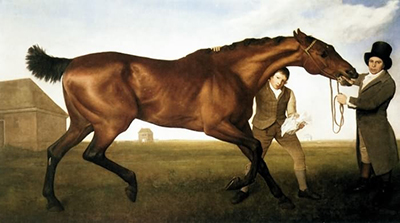
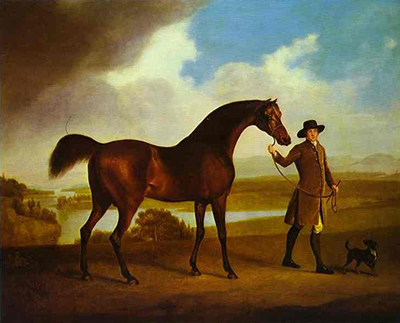
Bandy stands in profile beside a groom, his dark head lifted above the man's raised hand. A small dog occupies the ground beyond them. George Stubbs gives the horse the largest share of the foreground, but the connection between mouth, rein and hand makes the attendant essential to the encounter. The painting reproduced by Bridgeman Images dates from about 1763: an oil on canvas measuring 86 × 129 cm, recorded in a private collection. [1]
The horse's name preserves an unusual identifying feature. The longer title calls him Bandy because of his crooked leg. That individuality matters: this is a portrait of a named animal, whose pedigree and performances can be checked, rather than an illustration of an ideal horse. His recorded birth in 1747 also places the picture well after his racing years. [1] [2] [3]
At a Glance
- DateAbout 1763, in the catalogue record [1]
- MediumOil on canvas [1]
- CollectionPrivate collection, in the catalogue record [1]
This work across George Stubbs’s career
Whistlejacket
about 1762 [8]Contents
- A racehorse with a recorded history
- Looking at the horse
- The groom's place in the portrait
- A third participant
- Water, distance and the foreground
- Grosvenor, the stud and a different Arabian
- Bandy in print
- Exhibition and later portrait records
- Videos on George Stubbs
A racehorse with a recorded history
The 1803 General Stud Book lists Bandy as a bay colt by Cade, born in 1747. He appears under Vane's Little Partner, a mare foaled in 1731, by Partner. Her maternal line continues through Greyhound, Makeless, Brimmer, Place's White Turk, Dodsworth and the Layton Barb Mare. The bracket beside Bandy's entry assigns him to Mr Meredith; Mr Fetherston belongs to the later Sog entry below. [2]
William Pick identifies the breeder more fully as Thomas Meredith of Easby, near Richmond. At Newmarket in October 1752, Bandy won a subscription purse of 260 guineas for five-year-olds. Pick records further successes during 1753, including a Newmarket subscription plate and King's Plates. His York subscription purse that year was a walkover, a distinction worth retaining when counting competitive victories. [3]
In April 1754 Lord Strange's Sportsman defeated Bandy for the King's Plate at Newmarket. The following month Bandy reversed the result in a match worth 500 guineas. Pick's account moves from that concluding contest to Bandy's service as a stallion at the Oak Tree, near Richmond, and subsequently in Grosvenor's stud. [3]
Thoroughbred Heritage likewise describes a racing career concentrated in 1752–54, with the Sportsman contest as his only defeat. Its account emphasises his subsequent importance as a sire. The chronology changes the way we approach the portrait: the horse's reputation already included both competition and breeding when Stubbs represented him. The picture does not need a race in progress to commemorate that history. [17]
For the broader organisation of eighteenth-century competition, see Stubbs's racehorses and Georgian racing. Here, Bandy's particular sequence is the useful point: an established runner became a valuable breeding animal. No jockey, racing saddle, finishing post or defeated opponent appears in the portrait. His achievements belong to the history accompanying the image, while the painted encounter concerns his standing presence beside a handler. [1] [3]
Looking at the horse
The body stretches across the left and centre of the canvas. The arched neck rises towards the head at the right, while the tail spreads to the left. These opposing directions give the animal breadth. The tail's dark sweep also keeps its outline distinct from the comparatively pale distance, so that the contour remains readable beyond the heavier mass of the hindquarters. [1]
Stubbs avoids turning the horse into a uniformly dark silhouette. Warm light catches the rounded flank and parts of the shoulder; deeper colour gathers beneath the belly and within the folds of the neck. The mane and lower legs remain darker. Looking between these areas, the eye follows changes of surface and volume rather than simply tracing an enclosing line. The animal feels substantial because light describes the body within its outline. [1]
The legs repay slower attention. They do not fall into an evenly spaced row. One hind leg angles away, and the feet occupy different positions on the ground. Dark passages separate limb from limb, while small changes of illumination prevent the slender forms from disappearing. The pattern carries weight down from the large torso into several distinct points of contact. [1]
The title invites a search for the crooked leg, but the painted stance should not be treated as a veterinary diagram. A two-dimensional view cannot establish the cause or severity of an irregularity. What can be seen is the care with which each limb is distinguished. Readers interested in Stubbs's systematic study of equine structure can follow The Anatomy of the Horse; this portrait presents a particular living appearance rather than a labelled anatomical demonstration. [1]
Bandy's head is neither squarely addressed to the viewer nor hidden in the sweep of the neck. It turns towards the raised hand, with the muzzle projecting into the pale space above the rein. The ears interrupt the upper contour with small, sharp accents. Much of the picture's animation is concentrated here: the long horizontal body ends in a head that appears capable of changing direction. [1]
The groom's place in the portrait
The attendant stands to the right in a green coat, light breeches, dark boots and a black hat. His face is directed outward, making a different kind of contact from the horse's profile. The pale neckwear and face draw attention within the darker costume. Although Bandy is much larger, the groom's upright figure gives the right half of the group a clear human centre. [1]
His two arms perform different tasks. One hand rises close to the horse's mouth; the other holds the lower length of the rein and a slender stick. The rein describes a loose curve rather than a straight, taut connection. Its passage between the hands explains how the pair belong together, providing a visible relationship without requiring a dramatic struggle or a display of force. [1]
The silhouette of the green coat is especially useful to the composition. It opens away from the legs and gives the figure a broader lower outline, while the boots carry the body down into the dark foreground. Buttons and the light clothing beneath the coat introduce small vertical accents. These details make the man legible at a scale smaller than the horse, without needing to enlarge his role into a separate ceremonial portrait. [1]
No secure name for this attendant accompanies the object record. Calling him a groom identifies the represented relationship, while leaving his personal identity open. His presence nevertheless deserves attention: the hand nearest Bandy, the spare rein and the balanced stance all contribute to the organisation of the encounter. He is not simply a measure placed beside the animal to demonstrate its height. [1]
A third participant
The little black dog stands near the right edge, below the attendant's lowered hand. A white patch at the chest breaks its dark body, and the raised tail supplies a short curve against the surrounding ground. Its head points towards the right, carrying attention beyond the principal pair. The horse, the outward-facing man and the dog therefore offer three different orientations within a compact group. [1]
The difference in size is striking. Bandy's shoulder rises far above the dog, but both animals occupy the same foreground strip. This shared ground allows their proportions to be read together. The dog also prevents the area beside the groom's boots from becoming empty, extending the group laterally without competing with the horse's great mass. Its alert outline can be described without assigning it a symbolic meaning or inventing its thoughts. [1]
Water, distance and the foreground
The landscape opens behind the horse rather than closing around him. Water appears to the left, bordered by irregular banks and clusters of vegetation. Low fields and hills continue beyond the groom. Much of the skyline remains beneath Bandy's head and neck, allowing those important contours to stand against the sky instead of becoming entangled with trees. [1]
Nearer the viewer, darker earth, rocks and plants make a firmer platform. Their varied shapes contrast with the horse's smooth flank and the groom's measured outline. The shadows around the feet bind the figures to this ground. The scene consequently combines a broad view with a close encounter: the distant country is extensive, while the horse, man and dog seem gathered within a comparatively shallow space. [1]
Colour reinforces that separation. The body has a warmer, richer appearance than the pale country behind it. The green coat belongs within the landscape's range of tones but remains sufficiently dark to define the man. The light sky gives the upper part of the painting room to breathe. None of this requires the distant river to be securely identified; the arrangement is visible even when its possible topography remains uncertain. [1]
These relationships make Bandy a useful example within Stubbs's paintings. The animal commands attention through size and illumination, while the surrounding figures and terrain establish how that presence is encountered. The picture's quietness comes from the absence of an overt incident, not from a lack of relationships or movement within the design. [1]
Grosvenor, the stud and a different Arabian
The patron was Richard Grosvenor, later first Earl Grosvenor, who lived from 1731 to 1802. He became Baron Grosvenor in 1761 and an earl in 1784. The distinction explains why the early title uses Lord Grosvenor, whereas later references can properly call him Earl Grosvenor. The changing rank does not identify a different owner. [18]
Breeding records give a concrete example of Bandy's place in that stud. Grosvenor bred Bonduca in 1760, by Bandy out of the Crab mare described as Cygnet's dam. Bonduca's own offspring included Laurel, by Dux, in 1771; Sweetheart, by Eclipse, in 1772; and Haphazard, by Squirrel, in 1773. Bandy's significance thus continued through a daughter and another generation of named horses. [2]
He must be distinguished from Lord Grosvenor's Arabian Stallion with a Groom in the Kimbell Art Museum. That institution records its painting as about 1765, oil on canvas, 99.3 × 83.5 cm, accession AP 1981.03. A shared patron and an attendant do not make the two pictures portraits of the same animal. Bandy's recorded English pedigree supplies an independent reason to keep the identities separate. [19] [2]
Bandy in print
The British Sporting Art Trust holds a work titled Bandy belonging to Lord Grosvenor, reference BSAT:2017.003, classified as a print. Its composition is markedly different. The horse faces left beside a large tree, with a tether connecting the head to the trunk. Neither the green-coated groom nor the small dog appears. Water and a building occupy the distance. [20]
In this image, the tree provides the close vertical form that the attendant supplies in the early painting. The horse's long body is again exposed across the landscape, but the relationship at its head has changed: a fixed support replaces the human hand. This is a formal comparison between two visible arrangements, not evidence that one is a mechanically reversed reproduction of the other. [1] [20]
A Grosvenor Prints catalogue of June 2009 describes a sheet titled Bandy, belonging to Lord Grosvenor as a mezzotint, 250 × 345 mm, published by Laurie & Whittle on 12 May 1794. The dealer dates the first publication to 1771. Those details document the impression catalogued there; they should not automatically be attached to the Trust's sheet, whose institutional entry does not specify its state or date. [21] [20]
This distinction is central to understanding prints after Stubbs. The subject's name can persist while composition, medium, publisher and date change. A publication date on a sheet belongs to that printed object and its history, rather than supplying a new date for every painting of the horse. [20] [21]
Exhibition and later portrait records
Gilbey's 1898 biography transcribes the Society of Artists exhibition of 1763, where no. 122 identified Bandy by his crooked leg. It also reprints the 1794 Turf Gallery catalogue: Bandy appears as no. XIV, celebrated both as a runner and subsequently as a stallion. [22]
The Turf project placed important horses within a retrospective history of racing. The British Sporting Art Trust describes the venture as involving sixteen exhibited portraits and engravings made by Stubbs's son, George Townly. Its eventual incompletion is a reason to distinguish an exhibited subject from a securely identified published plate. [20]
Further records require equal care. The posthumous sale catalogue of 1807, as transcribed by Gilbey, lists Bandy with a groom and terrier as lot 90. Gilbey also records a Bandy canvas measuring 39 × 49 inches in his own Elsenham Hall collection. These entries preserve valuable evidence of different historical appearances, but they do not establish a continuous provenance connecting every Bandy image to the 86 × 129 cm canvas. [22]
The associated Baronet portrait offers another route into the Turf project. Bandy's own case remains distinctive: a horse with a brief documented racing career, an important stud history and several forms of representation. The privately held early painting has no public accession number or named current owner in the agency record. Its visible arrangement can be studied closely, while the gaps in its later object history remain acknowledged. [1] [3] [22]
Videos on George Stubbs
Explore Stubbs’s equestrian painting in its wider context, including two readings of Whistlejacket.
A Horse Lover’s Guide to the YCBA
A museum tour that places Stubbs alongside other artists who painted horses. It includes a look at Pumpkin with a Stable-lad.
Watch on YouTubeGeorge Stubbs artworks directory
Search works and related prints documented in this guide. Separate versions and printing matrices have separate entries; printmakers are named where known. Unidentified historical titles and untraced studio-sale material are discussed in the essays. A dash means that a date is not established here.
| Name | Date | Medium |
|---|---|---|
| A Bay Horse with a Groom | 1791 | Painting |
| A Bay Hunter with Two Playful Spaniels | 1777 | Painting |
| A Bay Hunter, a Springer Spaniel and a Sussex Spaniel in a wooded river Landscape | 1782 | Painting |
| A Cheetah and a Stag with Two Indian Attendants | about 1764 | Painting |
| A Couple of Fox Hounds (coloured print after Stubbs) | — | Print after Stubbs |
| A Couple of Foxhounds | 1792 | Painting |
| A Foxhound on the Scent | 1788 | Drawing |
| A Gentleman driving a Lady in a Phaeton | 1787 | Painting |
| A Grey Horse | 1793 | Painting |
| A Grey Horse (cantering companion) | 1793 | Painting |
| A Grey Stallion in a Landscape | — | Painting |
| A Horse Affrighted at a Lion | 1 May 1788 | |
| A Horse Belonging to the Rt. Honourable Lord Grosvenor called Bandy from his Crooked Leg | about 1763 | Painting |
| A Horse Frightened by a Lion | 1777 | |
| A Lion (A Lion Resting on a Rock) | 1 May 1788 | |
| A Lion Attacking a Horse | 1770 | Painting |
| A Lion Attacking a Horse (monumental Yale canvas) | 1762 | Painting |
| A lion attacking a horse (NGV) | about 1765 | Painting |
| A Lion Devouring a Horse (1788 print) | 1788 | |
| A lion devouring a horse (attribution disputed) | Proposed mid-1770s | Painting |
| A mare and foal with a bay horse | 1771 | Painting |
| A Monkey | 1799 | Painting |
| A Prancing Horse, Facing Right | c. 1790 | Drawing |
| A Rough Dog | 1790 | Painting |
| A Saddled Bay Hunter | 1786 | Painting |
| A Sleeping Leopard | 1 January 1791 | |
| A Tiger and a Sleeping Leopard | 1 May 1788 | |
| A Tigress (John Dixon after Stubbs) | 1772 | Print after Stubbs |
| A Tyger (A Recumbent Leopard by a Tree) | 1 May 1788 | |
| A Tyger (Sleeping Leopard) | 1 May 1788 | |
| An animal found on the coast of New Holland called kanguroo (after Stubbs) | 1773 | Print after Stubbs |
| An animal of a new species found on the coast of New South Wales (after Stubbs) | July 1773 | Print after Stubbs |
| Antinous and Jockey | — | Painting |
| Antinoüs, a chestnut racehorse, in a landscape | Undated | Painting |
| Bandy belonging to Lord Grosvenor (print after Stubbs) | — | Print after Stubbs |
| Baronet (George Townley Stubbs after Stubbs) | 20 February 1794 | Print after Stubbs |
| Baronet with Sam Chifney Up | 1791 | Painting |
| Baronet with Samuel Chifney up (Royal Collection) | 1791 | Painting |
| Bay Hunter by a Lake | 1787 | Painting |
| Brood Mares (Benjamin Green after Stubbs) | Issue 14 November 1776 | Print after Stubbs |
| Brood Mares and Foals | usually dated 1767 | Painting |
| Brown and White Norfolk or Water Spaniel | 1778 | Painting |
| Bulls Fighting | 1786 | Painting |
| Captain Samuel Sharpe Pocklington with His Wife, Pleasance, and possibly His Sister, Frances | 1769 | Painting |
| Death of the Doe (attribution disputed) | 1804 | |
| Der Englische Hühnerhund (Johann Wölfle after Stubbs) | about 1860 | Print after Stubbs |
| Dog (A Foxhound Viewed from Behind) | 1 May 1788 | |
| Dog [A Foxhound on the Scent] | 1788 | |
| Drill and albino baboon | before 1789 | Painting |
| Eclipse (Charles Hunt after Stubbs) | 12 November 1839 | Print after Stubbs |
| Eclipse (George Townley Stubbs after Stubbs) | 1796 | Print after Stubbs |
| Eclipse (oil study) | — | Painting |
| Eclipse (Thomas Burke after Stubbs) | First published 1772 | Print after Stubbs |
| Eclipse and John Wildman (Benjamin Green after Stubbs) | 1772 | Print after Stubbs |
| Eclipse at Newmarket (Jockey Club version) | Proposed early 1790s; often dated 1770 | Painting |
| Eclipse at Newmarket with a groom and jockey | 1770 | Painting |
| Eclipse with Mr Wildman and His Sons | 1769–71 | Painting |
| Eclipse, the Property of Capt.n O Kelly (anonymous print after Stubbs) | Imprint 4 June 1804; impression undated | Print after Stubbs |
| Euston | 1774 | Painting |
| Finished Study for the Seventh Anatomical Table of the Muscles of the Horse | 1756–58 | Drawing |
| Five Brood Mares at the Duke of Cumberland's Stud Farm in Windsor Great Park | 1765 | Painting |
| Fowl Body, Lateral View (Highly Finished Study for an Unpublished Table; Shows the Last Stage in Dissection) | — | Drawing |
| Fowl Body, Lateral View (Probably Prepared for Transfer to the Plate for Engraving of Table XV) | — | Drawing |
| Fowl Skeleton, Lateral View (Finished Study for Table V) | — | Drawing |
| Freeman, the Earl of Clarendon's Gamekeeper, with a Dying Doe and Hound (Yale) | 1800 | Painting |
| George Stubbs (enamel self-portrait) | 1781 | Enamel |
| Gimcrack (George Townley Stubbs after Stubbs) | 1775 | Print after Stubbs |
| Gimcrack on Newmarket Heath, with a trainer, a jockey and a stable lad | about 1765 | Painting |
| Gimcrack, with John Pratt up, on Newmarket Heath | about 1765 | Painting |
| Hambletonian, Rubbing Down | 1800 | Painting |
| Hay-Makers | 1791 | |
| Haycarting | 1795 | Enamel |
| Haymakers | 1785 | Painting |
| Haymakers (Lady Lever Art Gallery) | 1794 | Enamel |
| Hollyhock (with later additions by Vernet and Boucher) | about 1765–70 | Painting |
| Horse Attacked by a Lion (Episode C) | 1768–69 | Painting |
| Horse Attacked by a Lion (Tate enamel) | 1769 | Enamel |
| Horse Devoured by a Lion | Possibly exhibited 1763 | Painting |
| Horse Frightened by a Lion | 1770 | Painting |
| Horse Frightened by a Lion (Episode A; Wedgwood and Bentley after Stubbs) | — | Sculpture |
| Horse Frightened by a Lion (Tate) | Possibly exhibited 1763 | Painting |
| Horse Frightened by a Lion (Yale) | 1762–68 | Painting |
| Horse in the Shade of a Wood | 1780 | Painting |
| Hound Coursing a Stag | about 1762 | Painting |
| Human Figure, Anterior View (Intended for a Plate That was Never Published) | — | Drawing |
| Human Skeleton, Lateral View | 1795–1806 | Drawing |
| Hunt servants setting out (Southill commission) | 1767 | Painting |
| Hühnerhund (The Spanish Pointer) | about 1766 | Painting |
| John and Sophia Musters Riding at Colwick Hall | 1777 | Painting |
| John Musters on his hunter Pilgrim | 1777–78 | Painting |
| Labourers | 1789 | |
| Labourers (Richard Earlom after Stubbs and Amos Greene) | 25 March 1790 | Print after Stubbs |
| Laetitia, Lady Lade (d.1825) | 1793 | Painting |
| Lemon and White Water Spaniel | — | Painting |
| Lion Attacking a Stag | — | Painting |
| Lord Grosvenor's Arabian Stallion with a Groom | about 1765 | Painting |
| Lord Grosvenor's Arabian Stallion with a Groom (Peter Mazell after Stubbs) | 1771 | Print after Stubbs |
| Mambrino (Eaton Hall painting) | — | Painting |
| Mambrino (George Townley Stubbs after Stubbs) | 1794 | Print after Stubbs |
| Mares and Foals belonging to the 2nd Viscount Bolingbroke | about 1761–62 | Painting |
| Mares and foals beneath large oak trees | — | Painting |
| Mares and Foals by a stream | Exhibited 1764 | Painting |
| Mares and Foals in a River Landscape | about 1763–68 | Painting |
| Mares and Foals in an Extensive Landscape | about 1769 | Painting |
| Mares and Foals without a Background | 1762 | Painting |
| Moose Deer (after Stubbs) (Arctic Zoology plate VIII) | 1784–85 publication | Print after Stubbs |
| Newmarket Heath with a Rubbing-Down House | — | Painting |
| Otho (1796 print after Stubbs) | 1 December 1796 | Print after Stubbs |
| Otho, with John Larkin up | 1768 | Painting |
| Pangloss | about 1762 | Painting |
| Patch (Grafton commission) | 1759 | Painting |
| Phaeton and the Chariot of the Sun (enamel) | 1775 | Enamel |
| Phaeton with a Pair of Cream Ponies and a Stable-Lad | 1780–84 | Painting |
| Phillis | 1772 | Painting |
| Portrait of a Large Dog (Dingo) | 1772 | Painting |
| Pumpkin with a Stable-lad | 1774 | Painting |
| Racehorses Exercising at Goodwood | 1759–60 | Painting |
| Reapers (1791 print) | 1791 | |
| Reapers (Tate) | 1785 | Painting |
| Reapers (Yale) | 1795 | Enamel |
| Red Deer: A Stag and a Hind | 1792 | Painting |
| Richard Wedgwood | — | Enamel |
| Ringwood, a Brocklesby Foxhound | 1792 | Painting |
| Scrub, a bay horse belonging to the Marquess of Rockingham | about 1762 | Painting |
| Self Portrait on a White Hunter | 1782 | Enamel |
| Self-Portrait | about 1759 | Painting |
| Shooting (1770 Woollett plate after Stubbs) | 1770 | Print after Stubbs |
| Shooting (1771 Woollett plate after Stubbs) | 1771 | Print after Stubbs |
| Shooting at Goodwood | 1759–60 | Painting |
| Sir John Nelthorpe as a boy | 1756 | Painting |
| Sir John Nelthorpe partridge shooting with one pointer | — | Painting |
| Sir John Nelthorpe, 6th Baronet, out Shooting with His Dogs in Barton Field, Lincolnshire | 1776 | Painting |
| Sleeping Leopard | 1777 | Enamel |
| Soldiers of the 10th Light Dragoons | 1793 | Painting |
| Stallion and Mare (George Townley Stubbs after Stubbs) | 1776; reissued 1789 | Print after Stubbs |
| Steward and gamekeeper with dogs (Southill commission) | 1767 | Painting |
| Studies of a Lemur (Lemur murinus) in six different attitudes | 1773 | Drawing |
| Study for the Self-portrait in Enamel | c. 1781 | Drawing |
| Study of a Lemur | 1773 | Drawing |
| Study of a Racehorse in Action: Galloping to Left, a Semi-Anatomical Study, with Skin Flayed to Show Action of Muscles | — | Drawing |
| Study of the Legs of a Draught-Horse Pulling a Harrow (attributed to Stubbs) | Proposed about 1786 | Drawing |
| Sweet William (Grosvenor panel) | — | Painting |
| Sweet William (Turf Gallery canvas) | — | Painting |
| The Black Stallion Sampson, Portrayed from Three Angles (with landscape additions) | about 1764 | Painting |
| The Charlton Hunt | 1759–60 | Painting |
| The Fall of Phaeton | — | Sculpture |
| The Frightened Horse | 1780 | Sculpture |
| The Grosvenor Hunt | — | Painting |
| The Haymakers (Upton House) | 1783 | Painting |
| The Horse and Lion (George Townley Stubbs after George Stubbs) | 1770 | Print after Stubbs |
| The Kongouro from New Holland | 1772 | Painting |
| The Labourers | 1779 | Painting |
| The Labourers (Southill original) | 1767 | Painting |
| The lion and horse (Benjamin Green after Stubbs) | 1769; reissued 1777 | Print after Stubbs |
| The Milbanke and Melbourne Families | about 1769 | Painting |
| The Moose | 1770 | Painting |
| The Prince of Wales's Phaeton | 1793 | Painting |
| The Reapers (Upton House) | 1783 | Painting |
| The Sebra, or Wild Ass (George Townley Stubbs after Stubbs) | 1771 | Print after Stubbs |
| The Spanish Pointer (Bradford version) | about 1766–68 | Painting |
| The Spanish Pointer (William Woollett after Stubbs) | January 1768 | Print after Stubbs |
| The Third Duke of Dorset's Hunter with a Groom and a Dog | 1768 | Painting |
| Thomas Freeman, Lord Clarendon's gamekeeper, with a dog and a shot doe (with George Townly Stubbs) | 1803 | Painting |
| Turf, with Jockey up, at Newmarket | — | Painting |
| Turk and Crab | — | Painting |
| Two Bay Hunters Communing On The Bank Of A Lake | — | Painting |
| Tygers at Play | 1780 | |
| Viscount Gormanston's White Dog | 1781 | Painting |
| Viscount Gormanston's White Dog (canvas version) | — | Painting |
| Water Spaniel | 1769 | Painting |
| Wedgwood Family Portrait | 1780 | Painting |
| Whistlejacket | about 1762 | Painting |
| Whistlejacket with two other stallions and a groom | Recorded 1762 | Painting |
| White Poodle in a Punt | about 1780 | Painting |
| William Anderson with two Saddle-Horses | 1793 | Painting |
| Working Drawing for the Seventh Anatomical Table of the Muscles of the Horse | 1756–58 | Drawing |
| Zebra | 1763 | Painting |
Discussion
Look again at the images and ideas explored in Earl Grosvenor's Bandy. These editorial prompts invite your observations.
Reader Insights
How does the relation between Bandy and his groom organise the portrait?
Which evidence is most useful for distinguishing this named horse from a generic sporting subject?
Which visual or documentary evidence would be needed before treating two reproductions as the same object?
Join the Conversation
Share a detail, comparison or question about Earl Grosvenor's Bandy below.
References
- Bridgeman Images, George Stubbs, A Horse Belonging to the Rt. Honourable Lord Grosvenor called Bandy from his Crooked Leg, c.1763, WST17801, metadata and whole image, accessed 31 October 2026. View source.
- James Weatherby, The General Stud Book, London, 1803, printed pp. 30 and 176, digital facsimile, accessed 31 October 2026. View source.
- William Pick, The Turf Register, volume I, York, 1803, printed p. 118, digital facsimile and text, accessed 31 October 2026. View source.
- Goodwood, The Collection, Painting Collection modal, Racehorses Exercising at Goodwood; An exciting acquisition: a study by George Stubbs, 30 June 2023; History of the Estate Hounds, 4 October 2023; About Goodwood Racecourse. Accessed 4 November 2026. View source.
- Goodwood, The Collection, Painting Collection modal, Racehorses Exercising at Goodwood; An exciting acquisition: a study by George Stubbs, 30 June 2023; History of the Estate Hounds, 4 October 2023; About Goodwood Racecourse. Accessed 4 November 2026. View source.
- Goodwood, The Collection, Painting Collection modal, Racehorses Exercising at Goodwood; An exciting acquisition: a study by George Stubbs, 30 June 2023; History of the Estate Hounds, 4 October 2023; About Goodwood Racecourse. Accessed 4 November 2026. View source.
- Goodwood, The Collection, Painting Collection modal, Racehorses Exercising at Goodwood; An exciting acquisition: a study by George Stubbs, 30 June 2023; History of the Estate Hounds, 4 October 2023; About Goodwood Racecourse. Accessed 4 November 2026. View source.
- National Gallery, Whistlejacket, NG6569, current collection record, provenance, in-depth discussion and frame entry. View source.
- Yale Center for British Art, Zebra, B1981.25.617, current object metadata, gallery labels, Malcolm Warner’s 1998 catalogue entry and provenance supplied through the museum’s public collection record. View source.
- Bridgeman Images, George Stubbs, A Horse Belonging to the Rt. Honourable Lord Grosvenor called Bandy from his Crooked Leg, c.1763, WST17801, metadata and whole image, accessed 31 October 2026. View source.
- Christie’s, Gimcrack on Newmarket Heath, with a trainer, a jockey and a stable lad, London, 5 July 2011, lot 12; object details, essay, provenance, exhibitions and whole image. View source.
- Christie’s, Gimcrack on Newmarket Heath, with a trainer, a jockey and a stable lad, London, 5 July 2011, lot 12; object details, essay, provenance, exhibitions and whole image. View source.
- Yale University Art Gallery, A Lion Attacking a Horse, 1770, 1955.27.1, collection record. Accessed 4 November 2026. View source.
- Royal Museums Greenwich, ‘The Kongouro from New Holland’ (Kangaroo), ZBA5754. Accessed 4 November 2026. View source.
- Tate, George Stubbs, Haymakers, 1785, T02256; details, Terry Riggs’s collection text (January 1998), and online caption. Collection record. View source.
- Frances Bailey, ‘Hambletonian, Rubbing Down: A masterpiece by George Stubbs’, National Trust Cultural Heritage Magazine, Autumn/Winter 2024, pp. 22–33. Article. View source.
- Thoroughbred Heritage, Foundation Sires of the Thoroughbred: B, Bandy entry, accessed 31 October 2026. View source.
- H. R. T., Grosvenor, Richard (1731–1802), Dictionary of National Biography, 1885–1900, Wikisource transcription, accessed 31 October 2026. View source.
- Kimbell Art Museum, Lord Grosvenor's Arabian Stallion with a Groom, AP 1981.03, collection record, accessed 31 October 2026. View source.
- British Sporting Art Trust, Bandy belonging to Lord Grosvenor, BSAT:2017.003, object record, artist account and whole image, accessed 31 October 2026. View source.
- Grosvenor Prints, June 2009 catalogue, printed p. 49, item 5782, Bandy, belonging to Lord Grosvenor, accessed 31 October 2026. View source.
- Walter Gilbey, Life of George Stubbs, R.A., London, 1898, printed pp. 166–167, 177, 188 and 200, digital facsimile, accessed 31 October 2026. View source.
- Basic title, date and material metadata for Tate’s Reapers (T02257) and Otho (T02375) is adapted from the Tate collection dataset, October 2014, released under CC0. TheHistoryOfArt.org has reconciled labels and versions. This credit does not apply to Tate’s authored catalogue commentary or images.
- Data Source: Yale Center for British Art. Basic object fields are adapted and reconciled for this directory. Reuse is subject to the Center’s Open Data and Data Services Terms of Use. No museum endorsement is implied. This metadata credit does not relabel scholarly essays or images as open data.
- Basic object metadata for A Horse Frightened by a Lion, 1985.38, The Cleveland Museum of Art, John L. Severance Fund, is available under CC0. Titles and design-level grouping have been reconciled for this directory.