 by Tom Gurney
Tom Gurney BSc (Hons) is an art history expert with over 20 years experience
Email: tomgurney1@gmail.com / Phone: +44 7429 011000
A Grey Horse: Introduction
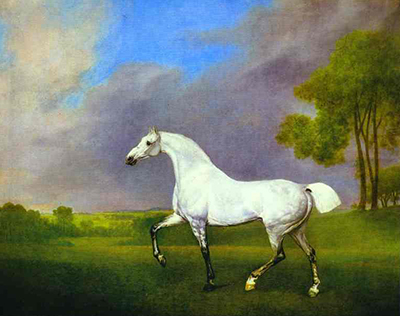
George Stubbs painted A Grey Horse in 1793. Signed and dated, this oil on canvas measures 102 × 127.8 cm and belongs to the Royal Collection, where it is numbered RCIN 400562. [1]
The pale horse advances towards the left across a dark foreground. Its lifted foreleg gives the movement a measured, almost ceremonial rhythm, while the broad sky leaves an extraordinary amount of space above its head. There is no rider to draw the eye upwards or companion animal to divide attention. The principal encounter is between the spectator and the horse's long, clearly exposed body. A small change of step becomes the picture's event. [2]
At a Glance
This work across George Stubbs’s career
Whistlejacket
about 1762 [7]Contents
- A body described through movement
- Landscape, light and open sky
- The companion and the changed composition
- Can the horse be named?
- A horse within the Prince's collection
- What the materials reveal
- From Carlton House to Windsor
- A different kind of riderless portrait
- Videos on George Stubbs
A body described through movement
The horse's silhouette combines several different kinds of line. A gently dipping back runs towards the rounded quarters, while the neck rises much more sharply towards the small head. Underneath, the belly forms another long curve, interrupted by the angular pattern of the legs. These changes prevent the profile from becoming a single smooth outline. The body looks substantial because its upper and lower boundaries enclose a broad illuminated area; the legs look mobile because they repeatedly break away from that area into the dark ground. [2]
The raised foreleg is particularly effective. Its upper part projects forward, then the lower leg turns down, allowing a small dark hoof to hang clear of the grass. Beside it, the more upright supporting foreleg makes a comparatively firm vertical. The two create a visible distinction between taking a step and carrying weight. The hind legs supply a second, less regular arrangement of angles. Looking from hoof to hoof encourages the eye to reconstruct an action that the painted body, necessarily, holds still. [2]
The coat is far from an uninterrupted field of white. Grey shading passes across the shoulder, under the belly and around the quarters; darker patches become conspicuous where the limbs emerge. The lower legs are much darker than the torso, while pale areas near the hind feet make small interruptions in those dark lengths. Such contrasts establish both the horse's overall lightness and differences within it. The viewer can read its shape at a distance, then return to the mottled transitions that make the body less uniform. [2]
The head introduces smaller, concentrated accents. A dark eye and muzzle stand out against the light face, while the ears interrupt the outline above. Behind the quarters, the pale tail spreads out as a short, broad shape. Its brightness echoes the head at the other end of the animal, but its blunt termination differs from the tapered muzzle. The contrast helps give the profile a definite direction: the eye moves towards the head and the open space into which the horse is stepping. [2]
Landscape, light and open sky
Stubbs places the animal in the lower portion of the canvas, leaving cloud and sky to occupy much of the surface. The horse remains the most immediately legible form, but its prominence depends partly on this spacious surrounding field. Its back lies against a darkened passage of sky and distant ground, while the head projects into a more open area. The painting offers two scales of looking at once: the compact articulation of one animal and the much larger sweep of the atmosphere around it. [2]
The strongest upright landscape feature is the group of trees on the right. Several narrow trunks rise from a sloping bank into a joined mass of foliage. Their height balances the long horizontal body without enclosing it on both sides. To the left, lower trees and bands of field allow the view to recede. This uneven distribution is crucial. The horse has a substantial backdrop behind its hindquarters, while the country ahead of its face opens out towards the horizon. [2]
Colour connects these different distances. The foreground is a dark mixture of green and brown; farther away, brighter yellow-green strips pick out the fields. Above them, grey cloud masses mingle with pinkish light and an irregular opening of blue. The landscape is consequently more than a flat green stage. Changes in brightness carry the eye backwards, while the pale horse comes forward. The pink and grey sky also softens the transition between the luminous body and the much darker land beneath it. [2]
The effect is expansive without being panoramic. We can look past the horse, but its body repeatedly brings us back to the near ground. The head does not point towards a building, a spectator or a clearly marked destination. Instead, the forward step leads into a continuation of grass and distant fields. That absence of a plotted destination gives the movement its particular character: enough action to animate the portrait, with enough visual stability to let the viewer examine the animal's form. [2]
The companion and the changed composition
The Royal Collection associates this canvas with another A Grey Horse, RCIN 400510, also dated 1793. It describes the present horse as walking and the companion as cantering. The proposed pair apparently represents the same animal. [1]
In the companion, the grey faces right and wears a bridle. The forelegs reach forward while the hind legs extend behind; the body appears suspended above the grass. A large wooded area occupies the left, and the view opens on the right. Seen beside the walking portrait, the arrangement reverses both the horse's direction and the balance between trees and open country. The two pictures could therefore sustain a conversation across a wall without being mirror images. One concentrates on a lifted step; the other spreads movement across a longer, airborne-looking pose. [2]
The resemblance is strongest in the combination of a pale torso, mottled legs, dark extremities and a broad light tail. Yet the cantering animal's equipment changes the face considerably. Straps cut across its pale surface and converge around the muzzle, producing a network of dark lines where the walking horse has a much simpler contour. The comparison makes the absence of equipment in the walking portrait newly noticeable. The head can be read through its own shape and shading, without the additional graphic structure of a bridle. [2]
Both compositions underwent revision: the Royal Collection records a saddle painted over in the walking portrait and a rider painted out in the cantering picture. [1]
The bare backs allow the bodies to be followed without interruption. In the walking painting, the long passage from the withers across the back to the quarters has no seated figure above it. Nor does a saddle divide that surface into animal and equipment. The eye can follow the transition from the steep rise of the neck to the comparatively level back, then down around the hindquarters. That continuity is one reason why the animal seems so completely available to view, despite the complexity of the moving legs below. [2]
Can the horse be named?
The Royal Collection preserves the proposed identification Grey Trentham with a question mark. [1]
Judy Egerton examined the problem in her 2007 catalogue, discussing the cantering portrait and its walking companion together. She traced the tentative Grey Trentham suggestion to Oliver Millar's earlier catalogue. Grey Trentham belonged to the Earl of Egremont, which leaves an awkward question about why the Prince of Wales would have commissioned two portraits of him. Egerton considered possible ownership arrangements, but did not resolve the difficulty. She also stated that the horse was unidentified in the royal archives and that its landscape supplied no identifying clues. [17]
Egerton offered a still more tentative possibility: a connection with two horses sent from Morocco and accepted by the Prince in 1791. Their colour was unknown, so the diplomatic gift cannot securely identify the painted animal. Her discussion establishes the limits of the name rather than replacing one certainty with another. The neutral title A Grey Horse remains appropriate, allowing the picture's particular appearance to be distinguished from a documented pedigree or racing career. [17]
A horse within the Prince's collection
The painting was presumably made for the future George IV. It belongs to thirteen similarly framed Stubbs canvases dated 1790–93. Thomas Allwood billed the Prince £110 16s for eight frames in 1793, but the exact eight and their original grouping are unknown. [1]
The wider character of the Prince's sporting patronage becomes clearer in The Prince of Wales's Phaeton, also dated 1793. Royal Collection commentary treats that painting's carriage and horses as an expression of their owner's fashionable identity. The human attendants and the dog Fino help turn the preparations for driving into an animated social scene. Livery, harness and carriage together describe an equipage, while the dog's intervention introduces a disturbance within its orderly preparation. The comparison shows how much social information could surround a painted horse. In A Grey Horse, the solitary animal occupies the centre of attention without those visible attendants and accessories. Royal ownership supplies a historical context, while the composition presents the body with remarkably few surrounding claims on the eye. [18]
This royal work coincided with another ambitious undertaking in Stubbs's late career. According to the National Gallery's account, an anonymous patron approached him around 1790 to paint celebrated racehorses, constructing a survey of roughly half a century of the sport. The scheme combined new pictures with repetitions of earlier subjects. Sixteen paintings were exhibited at the Turf Gallery in London in 1794, although the larger project lost its funding. His son produced related engravings in two sizes. This helps place the grey portraits within a period of sustained work on equine representation, when painted horses could belong to royal decoration, sporting commemoration and a prospective printed history. The Turf Gallery scheme had a distinct historical purpose: assembling celebrated racers into a series for exhibition and reproduction. The broader relationship between portrait, owner and racing record is explored in Stubbs's racing pictures. [19]
What the materials reveal
The Royal Collection describes the support as lined canvas. [1]
The painting also belongs chronologically to a period in which Stubbs's materials have attracted scientific investigation. John Mills and Raymond White's 1985 study examined samples from ten paintings dated between 1772 and 1800, including the royal Phaeton and Soldiers of the 10th Light Dragoons. Their results revealed combinations involving drying oil, resin and wax-related components, with difficulties in distinguishing beeswax from non-drying oil or fat in some samples. They also considered the possibility of contamination from conservation materials. Neither of the two grey portraits appears in their table of sampled paintings. The study therefore illuminates the material questions surrounding Stubbs's later practice, while leaving the precise paint mixture of this canvas unestablished. A visible impression of sheen or softness cannot supply that missing chemical evidence. His wider experiments are discussed in Stubbs's materials and techniques. [20]
What can be followed directly is the distribution of light across the painted animal. The upper neck and back receive broad pale passages, whereas shadow gathers beneath the torso and at the junctions of the limbs. On the shoulder and quarters, intermediate greys prevent the bright areas from appearing cut out and pasted onto the setting. The contrast is especially marked against the dark foreground: the legs become narrow alternating bands of light and shade, joining the spacious modelling of the body to much smaller, sharply defined feet. [2]
From Carlton House to Windsor
Recorded in store at Carlton House in 1816 and 1819, the picture moved to the King's Lodge, later Royal Lodge, in Windsor Great Park in 1822. It was at Cumberland Lodge by 1844. [1]
Carlton House and Royal Lodge were different residences. Carlton House was the Prince of Wales's London home, substantially rebuilt by Henry Holland between 1783 and 1796 and demolished in 1826. The Royal Society's account of a print showing its Crimson Drawing Room describes elaborate decoration, chandeliers, paintings and furniture. That interior records the richness of the setting in which the Prince collected, but it does not establish a place for this grey horse on the drawing-room walls. The distinction between a picture recorded in storage and one documented in a particular room matters: ownership alone cannot reconstruct its original appearance within a decorative scheme. [21]
By the time Walter Gilbey published his Life of George Stubbs in 1898, the two grey portraits had become part of a described domestic arrangement at Cumberland Lodge. His account places the sporting pictures around a dining room lit by a large window overlooking the royal park. He distinguished the grey moving left from the more animated grey facing the other way, and noticed their resemblance. His description of the left-facing animal emphasised its pale coat, darker legs and elevated step. His term for its gait was trotting, and his prose dwelt on the vigour of the animal's movement. His account also shows that the pictures were encountered together among mounted portraits and other sporting subjects, rather than simply as isolated reproductions. It preserves a nineteenth-century setting for looking, long after their first acquisition by the Prince. [22]
A different kind of riderless portrait
An earlier and much larger comparison is Whistlejacket, painted about 1762 for the Marquess of Rockingham. The National Gallery records dimensions of 296.1 × 248 cm: a scale approaching three metres in height, compared with just over a metre here. Whistlejacket rears against an almost empty, pale background. The grey advances through a fully developed landscape. Both portraits give an individual horse exceptional prominence, but they organise the encounter differently. The larger painting makes the animal's body dominate an otherwise largely unoccupied field. Here, the horse's outline is continually brought into relation with trees, changes of ground and the shifting brightness of cloud. Riderless equine portraiture could accommodate both monumental isolation and a more intimate relationship between animal and country. [23]
Videos on George Stubbs
Explore Stubbs’s equestrian painting in its wider context, including two readings of Whistlejacket.
A Horse Lover’s Guide to the YCBA
A museum tour that places Stubbs alongside other artists who painted horses. It includes a look at Pumpkin with a Stable-lad.
Watch on YouTubeGeorge Stubbs artworks directory
Search works and related prints documented in this guide. Separate versions and printing matrices have separate entries; printmakers are named where known. Unidentified historical titles and untraced studio-sale material are discussed in the essays. A dash means that a date is not established here.
| Name | Date | Medium |
|---|---|---|
| A Bay Horse with a Groom | 1791 | Painting |
| A Bay Hunter with Two Playful Spaniels | 1777 | Painting |
| A Bay Hunter, a Springer Spaniel and a Sussex Spaniel in a wooded river Landscape | 1782 | Painting |
| A Cheetah and a Stag with Two Indian Attendants | about 1764 | Painting |
| A Couple of Fox Hounds (coloured print after Stubbs) | — | Print after Stubbs |
| A Couple of Foxhounds | 1792 | Painting |
| A Foxhound on the Scent | 1788 | Drawing |
| A Gentleman driving a Lady in a Phaeton | 1787 | Painting |
| A Grey Horse | 1793 | Painting |
| A Grey Horse (cantering companion) | 1793 | Painting |
| A Grey Stallion in a Landscape | — | Painting |
| A Horse Affrighted at a Lion | 1 May 1788 | |
| A Horse Belonging to the Rt. Honourable Lord Grosvenor called Bandy from his Crooked Leg | about 1763 | Painting |
| A Horse Frightened by a Lion | 1777 | |
| A Lion (A Lion Resting on a Rock) | 1 May 1788 | |
| A Lion Attacking a Horse | 1770 | Painting |
| A Lion Attacking a Horse (monumental Yale canvas) | 1762 | Painting |
| A lion attacking a horse (NGV) | about 1765 | Painting |
| A Lion Devouring a Horse (1788 print) | 1788 | |
| A lion devouring a horse (attribution disputed) | Proposed mid-1770s | Painting |
| A mare and foal with a bay horse | 1771 | Painting |
| A Monkey | 1799 | Painting |
| A Prancing Horse, Facing Right | c. 1790 | Drawing |
| A Rough Dog | 1790 | Painting |
| A Saddled Bay Hunter | 1786 | Painting |
| A Sleeping Leopard | 1 January 1791 | |
| A Tiger and a Sleeping Leopard | 1 May 1788 | |
| A Tigress (John Dixon after Stubbs) | 1772 | Print after Stubbs |
| A Tyger (A Recumbent Leopard by a Tree) | 1 May 1788 | |
| A Tyger (Sleeping Leopard) | 1 May 1788 | |
| An animal found on the coast of New Holland called kanguroo (after Stubbs) | 1773 | Print after Stubbs |
| An animal of a new species found on the coast of New South Wales (after Stubbs) | July 1773 | Print after Stubbs |
| Antinous and Jockey | — | Painting |
| Antinoüs, a chestnut racehorse, in a landscape | Undated | Painting |
| Bandy belonging to Lord Grosvenor (print after Stubbs) | — | Print after Stubbs |
| Baronet (George Townley Stubbs after Stubbs) | 20 February 1794 | Print after Stubbs |
| Baronet with Sam Chifney Up | 1791 | Painting |
| Baronet with Samuel Chifney up (Royal Collection) | 1791 | Painting |
| Bay Hunter by a Lake | 1787 | Painting |
| Brood Mares (Benjamin Green after Stubbs) | Issue 14 November 1776 | Print after Stubbs |
| Brood Mares and Foals | usually dated 1767 | Painting |
| Brown and White Norfolk or Water Spaniel | 1778 | Painting |
| Bulls Fighting | 1786 | Painting |
| Captain Samuel Sharpe Pocklington with His Wife, Pleasance, and possibly His Sister, Frances | 1769 | Painting |
| Death of the Doe (attribution disputed) | 1804 | |
| Der Englische Hühnerhund (Johann Wölfle after Stubbs) | about 1860 | Print after Stubbs |
| Dog (A Foxhound Viewed from Behind) | 1 May 1788 | |
| Dog [A Foxhound on the Scent] | 1788 | |
| Drill and albino baboon | before 1789 | Painting |
| Eclipse (Charles Hunt after Stubbs) | 12 November 1839 | Print after Stubbs |
| Eclipse (George Townley Stubbs after Stubbs) | 1796 | Print after Stubbs |
| Eclipse (oil study) | — | Painting |
| Eclipse (Thomas Burke after Stubbs) | First published 1772 | Print after Stubbs |
| Eclipse and John Wildman (Benjamin Green after Stubbs) | 1772 | Print after Stubbs |
| Eclipse at Newmarket (Jockey Club version) | Proposed early 1790s; often dated 1770 | Painting |
| Eclipse at Newmarket with a groom and jockey | 1770 | Painting |
| Eclipse with Mr Wildman and His Sons | 1769–71 | Painting |
| Eclipse, the Property of Capt.n O Kelly (anonymous print after Stubbs) | Imprint 4 June 1804; impression undated | Print after Stubbs |
| Euston | 1774 | Painting |
| Finished Study for the Seventh Anatomical Table of the Muscles of the Horse | 1756–58 | Drawing |
| Five Brood Mares at the Duke of Cumberland's Stud Farm in Windsor Great Park | 1765 | Painting |
| Fowl Body, Lateral View (Highly Finished Study for an Unpublished Table; Shows the Last Stage in Dissection) | — | Drawing |
| Fowl Body, Lateral View (Probably Prepared for Transfer to the Plate for Engraving of Table XV) | — | Drawing |
| Fowl Skeleton, Lateral View (Finished Study for Table V) | — | Drawing |
| Freeman, the Earl of Clarendon's Gamekeeper, with a Dying Doe and Hound (Yale) | 1800 | Painting |
| George Stubbs (enamel self-portrait) | 1781 | Enamel |
| Gimcrack (George Townley Stubbs after Stubbs) | 1775 | Print after Stubbs |
| Gimcrack on Newmarket Heath, with a trainer, a jockey and a stable lad | about 1765 | Painting |
| Gimcrack, with John Pratt up, on Newmarket Heath | about 1765 | Painting |
| Hambletonian, Rubbing Down | 1800 | Painting |
| Hay-Makers | 1791 | |
| Haycarting | 1795 | Enamel |
| Haymakers | 1785 | Painting |
| Haymakers (Lady Lever Art Gallery) | 1794 | Enamel |
| Hollyhock (with later additions by Vernet and Boucher) | about 1765–70 | Painting |
| Horse Attacked by a Lion (Episode C) | 1768–69 | Painting |
| Horse Attacked by a Lion (Tate enamel) | 1769 | Enamel |
| Horse Devoured by a Lion | Possibly exhibited 1763 | Painting |
| Horse Frightened by a Lion | 1770 | Painting |
| Horse Frightened by a Lion (Episode A; Wedgwood and Bentley after Stubbs) | — | Sculpture |
| Horse Frightened by a Lion (Tate) | Possibly exhibited 1763 | Painting |
| Horse Frightened by a Lion (Yale) | 1762–68 | Painting |
| Horse in the Shade of a Wood | 1780 | Painting |
| Hound Coursing a Stag | about 1762 | Painting |
| Human Figure, Anterior View (Intended for a Plate That was Never Published) | — | Drawing |
| Human Skeleton, Lateral View | 1795–1806 | Drawing |
| Hunt servants setting out (Southill commission) | 1767 | Painting |
| Hühnerhund (The Spanish Pointer) | about 1766 | Painting |
| John and Sophia Musters Riding at Colwick Hall | 1777 | Painting |
| John Musters on his hunter Pilgrim | 1777–78 | Painting |
| Labourers | 1789 | |
| Labourers (Richard Earlom after Stubbs and Amos Greene) | 25 March 1790 | Print after Stubbs |
| Laetitia, Lady Lade (d.1825) | 1793 | Painting |
| Lemon and White Water Spaniel | — | Painting |
| Lion Attacking a Stag | — | Painting |
| Lord Grosvenor's Arabian Stallion with a Groom | about 1765 | Painting |
| Lord Grosvenor's Arabian Stallion with a Groom (Peter Mazell after Stubbs) | 1771 | Print after Stubbs |
| Mambrino (Eaton Hall painting) | — | Painting |
| Mambrino (George Townley Stubbs after Stubbs) | 1794 | Print after Stubbs |
| Mares and Foals belonging to the 2nd Viscount Bolingbroke | about 1761–62 | Painting |
| Mares and foals beneath large oak trees | — | Painting |
| Mares and Foals by a stream | Exhibited 1764 | Painting |
| Mares and Foals in a River Landscape | about 1763–68 | Painting |
| Mares and Foals in an Extensive Landscape | about 1769 | Painting |
| Mares and Foals without a Background | 1762 | Painting |
| Moose Deer (after Stubbs) (Arctic Zoology plate VIII) | 1784–85 publication | Print after Stubbs |
| Newmarket Heath with a Rubbing-Down House | — | Painting |
| Otho (1796 print after Stubbs) | 1 December 1796 | Print after Stubbs |
| Otho, with John Larkin up | 1768 | Painting |
| Pangloss | about 1762 | Painting |
| Patch (Grafton commission) | 1759 | Painting |
| Phaeton and the Chariot of the Sun (enamel) | 1775 | Enamel |
| Phaeton with a Pair of Cream Ponies and a Stable-Lad | 1780–84 | Painting |
| Phillis | 1772 | Painting |
| Portrait of a Large Dog (Dingo) | 1772 | Painting |
| Pumpkin with a Stable-lad | 1774 | Painting |
| Racehorses Exercising at Goodwood | 1759–60 | Painting |
| Reapers (1791 print) | 1791 | |
| Reapers (Tate) | 1785 | Painting |
| Reapers (Yale) | 1795 | Enamel |
| Red Deer: A Stag and a Hind | 1792 | Painting |
| Richard Wedgwood | — | Enamel |
| Ringwood, a Brocklesby Foxhound | 1792 | Painting |
| Scrub, a bay horse belonging to the Marquess of Rockingham | about 1762 | Painting |
| Self Portrait on a White Hunter | 1782 | Enamel |
| Self-Portrait | about 1759 | Painting |
| Shooting (1770 Woollett plate after Stubbs) | 1770 | Print after Stubbs |
| Shooting (1771 Woollett plate after Stubbs) | 1771 | Print after Stubbs |
| Shooting at Goodwood | 1759–60 | Painting |
| Sir John Nelthorpe as a boy | 1756 | Painting |
| Sir John Nelthorpe partridge shooting with one pointer | — | Painting |
| Sir John Nelthorpe, 6th Baronet, out Shooting with His Dogs in Barton Field, Lincolnshire | 1776 | Painting |
| Sleeping Leopard | 1777 | Enamel |
| Soldiers of the 10th Light Dragoons | 1793 | Painting |
| Stallion and Mare (George Townley Stubbs after Stubbs) | 1776; reissued 1789 | Print after Stubbs |
| Steward and gamekeeper with dogs (Southill commission) | 1767 | Painting |
| Studies of a Lemur (Lemur murinus) in six different attitudes | 1773 | Drawing |
| Study for the Self-portrait in Enamel | c. 1781 | Drawing |
| Study of a Lemur | 1773 | Drawing |
| Study of a Racehorse in Action: Galloping to Left, a Semi-Anatomical Study, with Skin Flayed to Show Action of Muscles | — | Drawing |
| Study of the Legs of a Draught-Horse Pulling a Harrow (attributed to Stubbs) | Proposed about 1786 | Drawing |
| Sweet William (Grosvenor panel) | — | Painting |
| Sweet William (Turf Gallery canvas) | — | Painting |
| The Black Stallion Sampson, Portrayed from Three Angles (with landscape additions) | about 1764 | Painting |
| The Charlton Hunt | 1759–60 | Painting |
| The Fall of Phaeton | — | Sculpture |
| The Frightened Horse | 1780 | Sculpture |
| The Grosvenor Hunt | — | Painting |
| The Haymakers (Upton House) | 1783 | Painting |
| The Horse and Lion (George Townley Stubbs after George Stubbs) | 1770 | Print after Stubbs |
| The Kongouro from New Holland | 1772 | Painting |
| The Labourers | 1779 | Painting |
| The Labourers (Southill original) | 1767 | Painting |
| The lion and horse (Benjamin Green after Stubbs) | 1769; reissued 1777 | Print after Stubbs |
| The Milbanke and Melbourne Families | about 1769 | Painting |
| The Moose | 1770 | Painting |
| The Prince of Wales's Phaeton | 1793 | Painting |
| The Reapers (Upton House) | 1783 | Painting |
| The Sebra, or Wild Ass (George Townley Stubbs after Stubbs) | 1771 | Print after Stubbs |
| The Spanish Pointer (Bradford version) | about 1766–68 | Painting |
| The Spanish Pointer (William Woollett after Stubbs) | January 1768 | Print after Stubbs |
| The Third Duke of Dorset's Hunter with a Groom and a Dog | 1768 | Painting |
| Thomas Freeman, Lord Clarendon's gamekeeper, with a dog and a shot doe (with George Townly Stubbs) | 1803 | Painting |
| Turf, with Jockey up, at Newmarket | — | Painting |
| Turk and Crab | — | Painting |
| Two Bay Hunters Communing On The Bank Of A Lake | — | Painting |
| Tygers at Play | 1780 | |
| Viscount Gormanston's White Dog | 1781 | Painting |
| Viscount Gormanston's White Dog (canvas version) | — | Painting |
| Water Spaniel | 1769 | Painting |
| Wedgwood Family Portrait | 1780 | Painting |
| Whistlejacket | about 1762 | Painting |
| Whistlejacket with two other stallions and a groom | Recorded 1762 | Painting |
| White Poodle in a Punt | about 1780 | Painting |
| William Anderson with two Saddle-Horses | 1793 | Painting |
| Working Drawing for the Seventh Anatomical Table of the Muscles of the Horse | 1756–58 | Drawing |
| Zebra | 1763 | Painting |
Discussion
Look again at the images and ideas explored in A Grey Horse. These editorial prompts invite your observations.
Reader Insights
How do light and the dark surrounding landscape distinguish the grey horse?
What changes when you compare this painting with the other royal grey horse?
How does comparing the companion painting change the apparent independence of this portrait?
Join the Conversation
Share a detail, comparison or question about A Grey Horse below.
References
- Royal Collection Trust, A Grey Horse, RCIN 400562, and companion A Grey Horse, RCIN 400510, object descriptions, provenance and physical properties. Walking portrait; cantering companion. Accessed 31 October 2026. View source 1. View source 2.
- Royal Collection Trust, whole-object research reproductions of RCIN 400562 and RCIN 400510, inspected for composition and visible form. Accessed 31 October 2026. View source 1. View source 2.
- Goodwood, The Collection, Painting Collection modal, Racehorses Exercising at Goodwood; An exciting acquisition: a study by George Stubbs, 30 June 2023; History of the Estate Hounds, 4 October 2023; About Goodwood Racecourse. Accessed 4 November 2026. View source.
- Goodwood, The Collection, Painting Collection modal, Racehorses Exercising at Goodwood; An exciting acquisition: a study by George Stubbs, 30 June 2023; History of the Estate Hounds, 4 October 2023; About Goodwood Racecourse. Accessed 4 November 2026. View source.
- Goodwood, The Collection, Painting Collection modal, Racehorses Exercising at Goodwood; An exciting acquisition: a study by George Stubbs, 30 June 2023; History of the Estate Hounds, 4 October 2023; About Goodwood Racecourse. Accessed 4 November 2026. View source.
- Goodwood, The Collection, Painting Collection modal, Racehorses Exercising at Goodwood; An exciting acquisition: a study by George Stubbs, 30 June 2023; History of the Estate Hounds, 4 October 2023; About Goodwood Racecourse. Accessed 4 November 2026. View source.
- National Gallery, Whistlejacket, NG6569, current collection record, provenance, in-depth discussion and frame entry. View source.
- Yale Center for British Art, Zebra, B1981.25.617, current object metadata, gallery labels, Malcolm Warner’s 1998 catalogue entry and provenance supplied through the museum’s public collection record. View source.
- Christie’s, Gimcrack on Newmarket Heath, with a trainer, a jockey and a stable lad, London, 5 July 2011, lot 12; object details, essay, provenance, exhibitions and whole image. View source.
- Christie’s, Gimcrack on Newmarket Heath, with a trainer, a jockey and a stable lad, London, 5 July 2011, lot 12; object details, essay, provenance, exhibitions and whole image. View source.
- Yale University Art Gallery, A Lion Attacking a Horse, 1770, 1955.27.1, collection record. Accessed 4 November 2026. View source.
- Royal Museums Greenwich, ‘The Kongouro from New Holland’ (Kangaroo), ZBA5754. Accessed 4 November 2026. View source.
- Tate, George Stubbs, Haymakers, 1785, T02256; details, Terry Riggs’s collection text (January 1998), and online caption. Collection record. View source.
- Royal Collection Trust, A Grey Horse, RCIN 400562, and companion A Grey Horse, RCIN 400510, object descriptions, provenance and physical properties. Walking portrait; cantering companion. Accessed 31 October 2026. View source.
- Royal Collection Trust, A Grey Horse, RCIN 400562, and companion A Grey Horse, RCIN 400510, object descriptions, provenance and physical properties. Walking portrait; cantering companion. Accessed 31 October 2026. View source.
- Frances Bailey, ‘Hambletonian, Rubbing Down: A masterpiece by George Stubbs’, National Trust Cultural Heritage Magazine, Autumn/Winter 2024, pp. 22–33. Article. View source.
- Judy Egerton, George Stubbs, Painter: Catalogue Raisonné (Yale University Press / Paul Mellon Centre, 2007), p. 540, no. 303 and its discussion of walking companion no. 302. Google Books preview. Accessed 31 October 2026. View source.
- Royal Collection Trust, The Prince of Wales's Phaeton, RCIN 400994, institution-supplied Google Arts & Culture record. Accessed 31 October 2026. View source.
- National Gallery, Stubbs: Portrait of a Horse, 2026 exhibition account, particularly the Turf Project. Accessed 31 October 2026. View source.
- John Mills and Raymond White, ‘The Mediums used by George Stubbs: Some Further Studies’, National Gallery Technical Bulletin, 9 (1985), pp. 60–64, particularly Table 1. Accessed 31 October 2026. View source.
- Royal Society Picture Library, Crimson drawing room, Carlton House, RS.13517, Thomas Sutherland after Charles Wild, 1816. Accessed 31 October 2026. View source.
- Walter Gilbey, Life of George Stubbs (1898), Appendix B, Cumberland Lodge collection, pp. 117–126, especially the introductory display account and the two grey-horse entries. Accessed 31 October 2026. View source.
- National Gallery, Whistlejacket, NG6569, object entry and dimensions. Accessed 31 October 2026. View source.
- Basic title, date and material metadata for Tate’s Reapers (T02257) and Otho (T02375) is adapted from the Tate collection dataset, October 2014, released under CC0. TheHistoryOfArt.org has reconciled labels and versions. This credit does not apply to Tate’s authored catalogue commentary or images.
- Data Source: Yale Center for British Art. Basic object fields are adapted and reconciled for this directory. Reuse is subject to the Center’s Open Data and Data Services Terms of Use. No museum endorsement is implied. This metadata credit does not relabel scholarly essays or images as open data.
- Basic object metadata for A Horse Frightened by a Lion, 1985.38, The Cleveland Museum of Art, John L. Severance Fund, is available under CC0. Titles and design-level grouping have been reconciled for this directory.