 by Tom Gurney
Tom Gurney BSc (Hons) is an art history expert with over 20 years experience
Email: tomgurney1@gmail.com / Phone: +44 7429 011000
Racehorses Belonging to the Duke of Richmond Exercising at Goodwood: Introduction
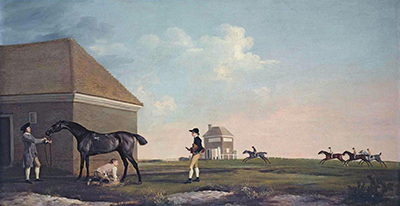
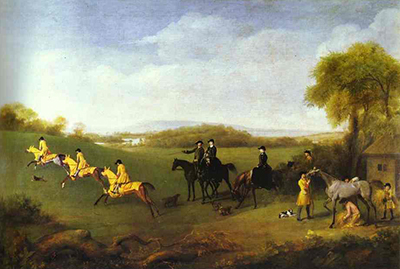
George Stubbs painted Racehorses Exercising at Goodwood in 1759–60 for the 3rd Duke of Richmond. The oil painting, measuring 127.5 × 204 cm, remains in the Goodwood Collection at Goodwood House, West Sussex. [1]
Three horses in bright yellow coverings carry yellow-coated riders towards the left, while a mounted party watches from the centre and a grey horse receives attention beside a building at the right. Across this broad field, movement, observation and manual work have their own spaces. Stubbs brings them together without making every figure perform the same action or look in the same direction. [2]
At a Glance
This work across George Stubbs’s career
Whistlejacket
about 1762 [7]Contents
- Three activities in one landscape
- The Duchess, Lady George and the steward
- Why the racehorses wear blankets
- A park opening towards the sea
- An early commission for a changing house
- The painting beyond Goodwood
- Videos on George Stubbs
Three activities in one landscape
The exercising horses occupy an unusually open part of the picture. Their bodies are separated against green ground, with enough space between them to follow each outline. They diminish towards the upper left, creating a diagonal that carries the eye away from the foreground. The nearest horse is the largest and lowest of the three; its extended body gives the procession an immediate forward thrust. [2]
Yellow cloth covers the horses’ heads, necks and backs, so their appearance differs markedly from that of the dark, uncovered mounts at the centre. The projecting ears and muzzles remain distinct, and bare legs emerge below the coverings. Red edging follows the cloths’ contours. The repetition makes the three animals recognisable as a group before the viewer has examined their different coats or positions. [2]
Each rider sits above this yellow mass in a coat of much the same colour, topped by a dark hat. The riders’ hands and reins connect them to the horses’ covered heads. Although the group progresses in one direction, the intervals between the bodies prevent it from becoming a single indistinct band. Small dark dogs below and behind the horses introduce a much lower, less regular pattern of movement. [2]
The central riders interrupt that diagonal. Here, upright figures and overlapping dark horses form a compact group. One man extends his arm towards the exercising animals, giving the spectators a visible connection with the action at the left. Beside him a woman sits prominently against the distant landscape; another mounted woman occupies a position farther to the right. Their arrangement leaves the running horses clearly visible. [2]
At the right, the grey turns the picture towards a different kind of activity. Its light body stands out against the darker trees and building. A yellow-coated attendant holds it near the head, while a crouching worker attends to its underside. Another figure carries a great bundle of straw. The exercise ground and this little workplace share the same foreground, with no fence dividing their functions. Behind the grey, another man and a dark horse emerge from the hedge, linking the spectators’ group with the working corner. [2]
The groups spread across the breadth of the canvas, each with its own centre of attention. The eye can follow the exercising line, pause among the mounted spectators, then investigate the hands, legs and straw surrounding the grey. Even where bodies overlap, their heads and contrasting positions help keep their roles legible. [1] [2]
The Duchess, Lady George and the steward
Goodwood identifies Mary, Duchess of Richmond, riding side-saddle, with her sister-in-law Lady George Lennox nearby. The pointing man is probably the estate steward Richard Buckner; some grooms may be members of Charlton’s Budd family. [1]
Lady George was Louisa Ker, also spelt Kerr. She appears under that name in a Ramsay study in the National Galleries of Scotland, while a portrait print at the Rijksmuseum calls her Lady George Lennox. Both names belong to the same woman. [15]
The Met’s 1984 book Man and the Horse instead calls the observing man the Duke. [16]
The visual distinctions between these people are precise without requiring a complete list of names. The women’s long dark skirts hang against their horses’ flanks, whereas the exercising riders’ yellow coats extend behind their saddles. The pointing man’s green coat carries conspicuous lines of pale ornament down its front. Black hats recur across the groups, but the larger areas of yellow, green and black make different figures easy to follow. [2]
There is also a difference in how bodies occupy the scene. The mounted observers sit above the dogs and attendants, their dark horses forming a relatively still centre. At the right, work brings a man close to the ground beneath the grey’s belly. His bent posture contrasts with the vertical position of the attendant holding its head. These relationships give the picture a social structure through visible tasks and positions. [2]
Goodwood calls the yellow and scarlet ducal livery, identifying household service, and the dogs Sussex spaniels. It suggests these may include the two spaniels taken on Richmond’s 1755 Grand Tour, an intriguing but tentative identification. [1]
Why the racehorses wear blankets
The coverings have a practical purpose as well as a striking appearance. Man and the Horse explains that the heavy blankets and hoods encouraged sweating, understood as a means of reducing surplus weight. The horses are being prepared through exercise, rather than competing for a finishing post. Their yellow equipment belongs to the training process represented here. [16]
A later primary account makes the relationship between clothing and labour especially clear. In his Sporting Dictionary of 1803, William Taplin describes trainers loading horses with sheets and other coverings before a sweating gallop. He says they believed the practice maintained breathing capacity and prevented excessive flesh. The quantity of clothing and the distance varied with the horse’s condition and the race for which it was being trained. [17]
Taplin follows the horse beyond the gallop. After walking it briefly, attendants removed its coverings, scraped away perspiration and then used straw or hay to rub it down. Dry sheets and a hood followed, before the return to the stable for further dressing, water, food and rest. His sequence helps explain why exercise and rubbing down belong together in a sporting picture. The worker’s job continued after the conspicuous movement across open ground had ended. [17]
Stubbs makes the materials of that work conspicuous. The bundle beside the building is almost as broad as the small figure carrying it. Loose straw lies beneath the grey, picking up the warm colour of the attendants’ coats. Its rough, spreading form contrasts with the horse’s smooth outline and the taut curves of the reins. The grey lifts one foreleg while the figures work around it, introducing a small movement within the otherwise closely gathered group. [2]
The crouching man is particularly important to the scene’s clarity. His striped upper garment differs from the yellow coats around him, and his head and shoulders fit into the space below the horse. He could easily disappear in such a crowded passage, but the change of colour and the angle of his back make his action readable. The picture gives time and space to an activity that would vanish from a portrait concerned only with a winning horse. [2]
Movement itself involves a historical convention. The Met catalogue points to the extended, airborne gallop used in sporting art before Eadweard Muybridge’s nineteenth-century photographic investigations. The painted pose communicates speed through a familiar visual formula, alongside the bodily understanding that came from Stubbs’s anatomical work. [16]
A park opening towards the sea
The ground behind the horses is remarkably spacious. A low wooded rise stretches across the distance, with a pale band beyond it. Small white buildings and areas of water appear between scattered trees. These details are much smaller and lighter than the foreground figures, so the view recedes gradually without needing a wall or road to mark the distance. The horses remain clear against this landscape, rather than being swallowed by it. [2]
Goodwood identifies Chichester Cathedral’s spire in the distance and the Isle of Wight beyond. [1]
This outward prospect fits the estate’s position between the South Downs and the coastal plain. Historic England describes a landscape rising northwards from the plain into ridges and dry valleys. Its history also records the 2nd Duke’s planting of exotic trees and construction of garden buildings. The park in which Stubbs worked was an established, managed environment, developed before the 3rd Duke’s commission. The view combines sporting space with the landscape of a country estate. [18]
The tree at the right helps organise the visible prospect. Its tall trunk and spreading canopy rise over the workers and the small building, making this edge of the picture comparatively enclosed. Across the centre and left, the skyline stays low. The contrast gives the exercising horses open ground ahead of them, while the grey and its attendants occupy a sheltered-looking corner beneath foliage. [2]
Foreground roots and fallen timber provide a different kind of boundary. They run along the lower edge, below the horses’ feet, with leaves and small plants caught among them. These irregular forms bring the nearest ground into focus. Beyond them, the smoother green turf offers a clear surface for the figures. The rough foreground, occupied middle distance and pale horizon each give the eye a different amount of detail. [2]
The sky occupies a great deal of the canvas. Grey cloud masses drift across a pale blue expanse, leaving brighter openings towards the left. Against that large upper field, the figures remain comparatively small. Yet their dark silhouettes and the riders’ yellow clothing retain attention below. The broad sky makes the landscape expansive without reducing the sharpness of the little transactions taking place on the ground. [2]
An early commission for a changing house
Richmond’s patronage came at an important point in Stubbs’s career. Judy Egerton’s National Gallery catalogue describes his arrival in London around 1758 with anatomical drawings, followed by commissions from an aristocratic circle in which Richmond took the lead. His knowledge of the structures beneath a horse’s skin helped attract patrons interested in racing and breeding. The drawings preceded the publication of The Anatomy of the Horse in 1766. [19] [16]
Goodwood places this canvas, The Charlton Hunt and Shooting at Goodwood within a nine-month stay in 1759–60. They first hung in the Jacobean Banqueting Hall, where hunt members dined. [1]
The commission was therefore connected to the house in which its viewers gathered. The Frame Blog’s specialist study suggests that the three paintings received their restrained early neoclassical frames during William Chambers’s work at Goodwood from 1760. It notes architectural mouldings, fluting and hanging festoons. The dating is proposed rather than established by a quoted framing bill, but it connects their presentation with the decoration of the interior. [20]
Chambers was also responsible for Goodwood’s grand stable courtyard, built during the late 1750s and early 1760s. Historic England’s separate entries give slightly different completion dates, 1761 and 1763. Its flint walls, stone dressings and monumental entrance show the scale of investment in housing the Duke’s horses. That quadrangle belongs to the estate context; the modest building beside Stubbs’s grey cannot simply be identified with it. [18]
Within the painted setting, the building has a much quieter presence. Its low roof and small dark window lie close to the right edge, partly hidden by the tree and figures. It helps locate the attendants’ work without competing with the mounted party or turning the scene into an architectural portrait. The landscape offers a view outwards, while this corner gives the eye a place to stop. [2]
The contrasting kinds of equine subject can be followed in Stubbs’s paintings of racehorses and racing. Here, the individual exercising animals form part of a larger arrangement: spectators, riders, dogs, staff and landscape all remain visible. The yellow coverings even conceal much of the horses’ bodies. The effect depends on their place within the whole scene, as much as on the outline of any one animal. [2]
The painting beyond Goodwood
The picture featured in the National Gallery’s 2005 Stubbs and the Horse exhibition. [21]
Its imagery has also travelled through reproduction. In the restoration of Fox Hall, completed in 1993, the Landmark Trust placed canvas reproductions of two Goodwood Stubbs paintings over doorways: the Charlton hunting scene and the scene of three horses training. A Wootton horse portrait went above the fireplace. The Trust explains that these works suited the existing frames and the building’s hunting associations, although the paintings postdated Fox Hall. These are later reproductions placed in a restored interior, giving the composition a further setting within the local history of sport. [22]
The trophy maker Inkerman identifies this painting as the inspiration for its commissioned Goodwood race trophies. It also records the connection between the three exercising horses and the racecourse logo. The repeated yellow procession has proved particularly adaptable as an emblem of the place. [23]
The racing association spans a substantial interval: Goodwood’s first private meeting was in 1801, its first public meeting in 1802, decades after Stubbs’s picture. [1]
Looking back at the whole painting, the procession is only one part of its appeal. The grey’s lifted foot, the pointing arm, the crouching attendant and the dogs’ scattered positions offer different scales of action. Some movements carry across the field; others stay within a few inches of a horse’s body. Stubbs gives those activities a common setting while preserving their distinct rhythms, making work with horses a subject with many things to notice. [2]
Videos on George Stubbs
Explore Stubbs’s equestrian painting in its wider context, including two readings of Whistlejacket.
A Horse Lover’s Guide to the YCBA
A museum tour that places Stubbs alongside other artists who painted horses. It includes a look at Pumpkin with a Stable-lad.
Watch on YouTubeGeorge Stubbs artworks directory
Search works and related prints documented in this guide. Separate versions and printing matrices have separate entries; printmakers are named where known. Unidentified historical titles and untraced studio-sale material are discussed in the essays. A dash means that a date is not established here.
| Name | Date | Medium |
|---|---|---|
| A Bay Horse with a Groom | 1791 | Painting |
| A Bay Hunter with Two Playful Spaniels | 1777 | Painting |
| A Bay Hunter, a Springer Spaniel and a Sussex Spaniel in a wooded river Landscape | 1782 | Painting |
| A Cheetah and a Stag with Two Indian Attendants | about 1764 | Painting |
| A Couple of Fox Hounds (coloured print after Stubbs) | — | Print after Stubbs |
| A Couple of Foxhounds | 1792 | Painting |
| A Foxhound on the Scent | 1788 | Drawing |
| A Gentleman driving a Lady in a Phaeton | 1787 | Painting |
| A Grey Horse | 1793 | Painting |
| A Grey Horse (cantering companion) | 1793 | Painting |
| A Grey Stallion in a Landscape | — | Painting |
| A Horse Affrighted at a Lion | 1 May 1788 | |
| A Horse Belonging to the Rt. Honourable Lord Grosvenor called Bandy from his Crooked Leg | about 1763 | Painting |
| A Horse Frightened by a Lion | 1777 | |
| A Lion (A Lion Resting on a Rock) | 1 May 1788 | |
| A Lion Attacking a Horse | 1770 | Painting |
| A Lion Attacking a Horse (monumental Yale canvas) | 1762 | Painting |
| A lion attacking a horse (NGV) | about 1765 | Painting |
| A Lion Devouring a Horse (1788 print) | 1788 | |
| A lion devouring a horse (attribution disputed) | Proposed mid-1770s | Painting |
| A mare and foal with a bay horse | 1771 | Painting |
| A Monkey | 1799 | Painting |
| A Prancing Horse, Facing Right | c. 1790 | Drawing |
| A Rough Dog | 1790 | Painting |
| A Saddled Bay Hunter | 1786 | Painting |
| A Sleeping Leopard | 1 January 1791 | |
| A Tiger and a Sleeping Leopard | 1 May 1788 | |
| A Tigress (John Dixon after Stubbs) | 1772 | Print after Stubbs |
| A Tyger (A Recumbent Leopard by a Tree) | 1 May 1788 | |
| A Tyger (Sleeping Leopard) | 1 May 1788 | |
| An animal found on the coast of New Holland called kanguroo (after Stubbs) | 1773 | Print after Stubbs |
| An animal of a new species found on the coast of New South Wales (after Stubbs) | July 1773 | Print after Stubbs |
| Antinous and Jockey | — | Painting |
| Antinoüs, a chestnut racehorse, in a landscape | Undated | Painting |
| Bandy belonging to Lord Grosvenor (print after Stubbs) | — | Print after Stubbs |
| Baronet (George Townley Stubbs after Stubbs) | 20 February 1794 | Print after Stubbs |
| Baronet with Sam Chifney Up | 1791 | Painting |
| Baronet with Samuel Chifney up (Royal Collection) | 1791 | Painting |
| Bay Hunter by a Lake | 1787 | Painting |
| Brood Mares (Benjamin Green after Stubbs) | Issue 14 November 1776 | Print after Stubbs |
| Brood Mares and Foals | usually dated 1767 | Painting |
| Brown and White Norfolk or Water Spaniel | 1778 | Painting |
| Bulls Fighting | 1786 | Painting |
| Captain Samuel Sharpe Pocklington with His Wife, Pleasance, and possibly His Sister, Frances | 1769 | Painting |
| Death of the Doe (attribution disputed) | 1804 | |
| Der Englische Hühnerhund (Johann Wölfle after Stubbs) | about 1860 | Print after Stubbs |
| Dog (A Foxhound Viewed from Behind) | 1 May 1788 | |
| Dog [A Foxhound on the Scent] | 1788 | |
| Drill and albino baboon | before 1789 | Painting |
| Eclipse (Charles Hunt after Stubbs) | 12 November 1839 | Print after Stubbs |
| Eclipse (George Townley Stubbs after Stubbs) | 1796 | Print after Stubbs |
| Eclipse (oil study) | — | Painting |
| Eclipse (Thomas Burke after Stubbs) | First published 1772 | Print after Stubbs |
| Eclipse and John Wildman (Benjamin Green after Stubbs) | 1772 | Print after Stubbs |
| Eclipse at Newmarket (Jockey Club version) | Proposed early 1790s; often dated 1770 | Painting |
| Eclipse at Newmarket with a groom and jockey | 1770 | Painting |
| Eclipse with Mr Wildman and His Sons | 1769–71 | Painting |
| Eclipse, the Property of Capt.n O Kelly (anonymous print after Stubbs) | Imprint 4 June 1804; impression undated | Print after Stubbs |
| Euston | 1774 | Painting |
| Finished Study for the Seventh Anatomical Table of the Muscles of the Horse | 1756–58 | Drawing |
| Five Brood Mares at the Duke of Cumberland's Stud Farm in Windsor Great Park | 1765 | Painting |
| Fowl Body, Lateral View (Highly Finished Study for an Unpublished Table; Shows the Last Stage in Dissection) | — | Drawing |
| Fowl Body, Lateral View (Probably Prepared for Transfer to the Plate for Engraving of Table XV) | — | Drawing |
| Fowl Skeleton, Lateral View (Finished Study for Table V) | — | Drawing |
| Freeman, the Earl of Clarendon's Gamekeeper, with a Dying Doe and Hound (Yale) | 1800 | Painting |
| George Stubbs (enamel self-portrait) | 1781 | Enamel |
| Gimcrack (George Townley Stubbs after Stubbs) | 1775 | Print after Stubbs |
| Gimcrack on Newmarket Heath, with a trainer, a jockey and a stable lad | about 1765 | Painting |
| Gimcrack, with John Pratt up, on Newmarket Heath | about 1765 | Painting |
| Hambletonian, Rubbing Down | 1800 | Painting |
| Hay-Makers | 1791 | |
| Haycarting | 1795 | Enamel |
| Haymakers | 1785 | Painting |
| Haymakers (Lady Lever Art Gallery) | 1794 | Enamel |
| Hollyhock (with later additions by Vernet and Boucher) | about 1765–70 | Painting |
| Horse Attacked by a Lion (Episode C) | 1768–69 | Painting |
| Horse Attacked by a Lion (Tate enamel) | 1769 | Enamel |
| Horse Devoured by a Lion | Possibly exhibited 1763 | Painting |
| Horse Frightened by a Lion | 1770 | Painting |
| Horse Frightened by a Lion (Episode A; Wedgwood and Bentley after Stubbs) | — | Sculpture |
| Horse Frightened by a Lion (Tate) | Possibly exhibited 1763 | Painting |
| Horse Frightened by a Lion (Yale) | 1762–68 | Painting |
| Horse in the Shade of a Wood | 1780 | Painting |
| Hound Coursing a Stag | about 1762 | Painting |
| Human Figure, Anterior View (Intended for a Plate That was Never Published) | — | Drawing |
| Human Skeleton, Lateral View | 1795–1806 | Drawing |
| Hunt servants setting out (Southill commission) | 1767 | Painting |
| Hühnerhund (The Spanish Pointer) | about 1766 | Painting |
| John and Sophia Musters Riding at Colwick Hall | 1777 | Painting |
| John Musters on his hunter Pilgrim | 1777–78 | Painting |
| Labourers | 1789 | |
| Labourers (Richard Earlom after Stubbs and Amos Greene) | 25 March 1790 | Print after Stubbs |
| Laetitia, Lady Lade (d.1825) | 1793 | Painting |
| Lemon and White Water Spaniel | — | Painting |
| Lion Attacking a Stag | — | Painting |
| Lord Grosvenor's Arabian Stallion with a Groom | about 1765 | Painting |
| Lord Grosvenor's Arabian Stallion with a Groom (Peter Mazell after Stubbs) | 1771 | Print after Stubbs |
| Mambrino (Eaton Hall painting) | — | Painting |
| Mambrino (George Townley Stubbs after Stubbs) | 1794 | Print after Stubbs |
| Mares and Foals belonging to the 2nd Viscount Bolingbroke | about 1761–62 | Painting |
| Mares and foals beneath large oak trees | — | Painting |
| Mares and Foals by a stream | Exhibited 1764 | Painting |
| Mares and Foals in a River Landscape | about 1763–68 | Painting |
| Mares and Foals in an Extensive Landscape | about 1769 | Painting |
| Mares and Foals without a Background | 1762 | Painting |
| Moose Deer (after Stubbs) (Arctic Zoology plate VIII) | 1784–85 publication | Print after Stubbs |
| Newmarket Heath with a Rubbing-Down House | — | Painting |
| Otho (1796 print after Stubbs) | 1 December 1796 | Print after Stubbs |
| Otho, with John Larkin up | 1768 | Painting |
| Pangloss | about 1762 | Painting |
| Patch (Grafton commission) | 1759 | Painting |
| Phaeton and the Chariot of the Sun (enamel) | 1775 | Enamel |
| Phaeton with a Pair of Cream Ponies and a Stable-Lad | 1780–84 | Painting |
| Phillis | 1772 | Painting |
| Portrait of a Large Dog (Dingo) | 1772 | Painting |
| Pumpkin with a Stable-lad | 1774 | Painting |
| Racehorses Exercising at Goodwood | 1759–60 | Painting |
| Reapers (1791 print) | 1791 | |
| Reapers (Tate) | 1785 | Painting |
| Reapers (Yale) | 1795 | Enamel |
| Red Deer: A Stag and a Hind | 1792 | Painting |
| Richard Wedgwood | — | Enamel |
| Ringwood, a Brocklesby Foxhound | 1792 | Painting |
| Scrub, a bay horse belonging to the Marquess of Rockingham | about 1762 | Painting |
| Self Portrait on a White Hunter | 1782 | Enamel |
| Self-Portrait | about 1759 | Painting |
| Shooting (1770 Woollett plate after Stubbs) | 1770 | Print after Stubbs |
| Shooting (1771 Woollett plate after Stubbs) | 1771 | Print after Stubbs |
| Shooting at Goodwood | 1759–60 | Painting |
| Sir John Nelthorpe as a boy | 1756 | Painting |
| Sir John Nelthorpe partridge shooting with one pointer | — | Painting |
| Sir John Nelthorpe, 6th Baronet, out Shooting with His Dogs in Barton Field, Lincolnshire | 1776 | Painting |
| Sleeping Leopard | 1777 | Enamel |
| Soldiers of the 10th Light Dragoons | 1793 | Painting |
| Stallion and Mare (George Townley Stubbs after Stubbs) | 1776; reissued 1789 | Print after Stubbs |
| Steward and gamekeeper with dogs (Southill commission) | 1767 | Painting |
| Studies of a Lemur (Lemur murinus) in six different attitudes | 1773 | Drawing |
| Study for the Self-portrait in Enamel | c. 1781 | Drawing |
| Study of a Lemur | 1773 | Drawing |
| Study of a Racehorse in Action: Galloping to Left, a Semi-Anatomical Study, with Skin Flayed to Show Action of Muscles | — | Drawing |
| Study of the Legs of a Draught-Horse Pulling a Harrow (attributed to Stubbs) | Proposed about 1786 | Drawing |
| Sweet William (Grosvenor panel) | — | Painting |
| Sweet William (Turf Gallery canvas) | — | Painting |
| The Black Stallion Sampson, Portrayed from Three Angles (with landscape additions) | about 1764 | Painting |
| The Charlton Hunt | 1759–60 | Painting |
| The Fall of Phaeton | — | Sculpture |
| The Frightened Horse | 1780 | Sculpture |
| The Grosvenor Hunt | — | Painting |
| The Haymakers (Upton House) | 1783 | Painting |
| The Horse and Lion (George Townley Stubbs after George Stubbs) | 1770 | Print after Stubbs |
| The Kongouro from New Holland | 1772 | Painting |
| The Labourers | 1779 | Painting |
| The Labourers (Southill original) | 1767 | Painting |
| The lion and horse (Benjamin Green after Stubbs) | 1769; reissued 1777 | Print after Stubbs |
| The Milbanke and Melbourne Families | about 1769 | Painting |
| The Moose | 1770 | Painting |
| The Prince of Wales's Phaeton | 1793 | Painting |
| The Reapers (Upton House) | 1783 | Painting |
| The Sebra, or Wild Ass (George Townley Stubbs after Stubbs) | 1771 | Print after Stubbs |
| The Spanish Pointer (Bradford version) | about 1766–68 | Painting |
| The Spanish Pointer (William Woollett after Stubbs) | January 1768 | Print after Stubbs |
| The Third Duke of Dorset's Hunter with a Groom and a Dog | 1768 | Painting |
| Thomas Freeman, Lord Clarendon's gamekeeper, with a dog and a shot doe (with George Townly Stubbs) | 1803 | Painting |
| Turf, with Jockey up, at Newmarket | — | Painting |
| Turk and Crab | — | Painting |
| Two Bay Hunters Communing On The Bank Of A Lake | — | Painting |
| Tygers at Play | 1780 | |
| Viscount Gormanston's White Dog | 1781 | Painting |
| Viscount Gormanston's White Dog (canvas version) | — | Painting |
| Water Spaniel | 1769 | Painting |
| Wedgwood Family Portrait | 1780 | Painting |
| Whistlejacket | about 1762 | Painting |
| Whistlejacket with two other stallions and a groom | Recorded 1762 | Painting |
| White Poodle in a Punt | about 1780 | Painting |
| William Anderson with two Saddle-Horses | 1793 | Painting |
| Working Drawing for the Seventh Anatomical Table of the Muscles of the Horse | 1756–58 | Drawing |
| Zebra | 1763 | Painting |
Discussion
Look again at the images and ideas explored in Racehorses Belonging to the Duke of Richmond Exercising at Goodwood. These editorial prompts invite your observations.
Reader Insights
How do the riders and horses establish a rhythm across the park?
What does the Goodwood setting add to the painting’s account of exercise and patronage?
Which relationship between a horse and its rider most clearly conveys coordinated work?
Join the Conversation
Share a detail, comparison or question about Racehorses Belonging to the Duke of Richmond Exercising at Goodwood below.
References
- Goodwood, The Collection, Painting Collection modal, Racehorses Exercising at Goodwood; An exciting acquisition: a study by George Stubbs, 30 June 2023; History of the Estate Hounds, 4 October 2023; About Goodwood Racecourse. Accessed 4 November 2026. View source 1. View source 2. View source 3. View source 4.
- Goodwood Collection, whole painting photograph: Racehorses Exercising at Goodwood. Image inspected 4 November 2026. View source.
- Goodwood, The Collection, Painting Collection modal, Racehorses Exercising at Goodwood; An exciting acquisition: a study by George Stubbs, 30 June 2023; History of the Estate Hounds, 4 October 2023; About Goodwood Racecourse. Accessed 4 November 2026. View source.
- Goodwood, The Collection, Painting Collection modal, Racehorses Exercising at Goodwood; An exciting acquisition: a study by George Stubbs, 30 June 2023; History of the Estate Hounds, 4 October 2023; About Goodwood Racecourse. Accessed 4 November 2026. View source.
- Goodwood, The Collection, Painting Collection modal, Racehorses Exercising at Goodwood; An exciting acquisition: a study by George Stubbs, 30 June 2023; History of the Estate Hounds, 4 October 2023; About Goodwood Racecourse. Accessed 4 November 2026. View source.
- Goodwood, The Collection, Painting Collection modal, Racehorses Exercising at Goodwood; An exciting acquisition: a study by George Stubbs, 30 June 2023; History of the Estate Hounds, 4 October 2023; About Goodwood Racecourse. Accessed 4 November 2026. View source.
- National Gallery, Whistlejacket, NG6569, current collection record, provenance, in-depth discussion and frame entry. View source.
- Yale Center for British Art, Zebra, B1981.25.617, current object metadata, gallery labels, Malcolm Warner’s 1998 catalogue entry and provenance supplied through the museum’s public collection record. View source.
- Christie’s, Gimcrack on Newmarket Heath, with a trainer, a jockey and a stable lad, London, 5 July 2011, lot 12; object details, essay, provenance, exhibitions and whole image. View source.
- Christie’s, Gimcrack on Newmarket Heath, with a trainer, a jockey and a stable lad, London, 5 July 2011, lot 12; object details, essay, provenance, exhibitions and whole image. View source.
- Yale University Art Gallery, A Lion Attacking a Horse, 1770, 1955.27.1, collection record. Accessed 4 November 2026. View source.
- Royal Museums Greenwich, ‘The Kongouro from New Holland’ (Kangaroo), ZBA5754. Accessed 4 November 2026. View source.
- Tate, George Stubbs, Haymakers, 1785, T02256; details, Terry Riggs’s collection text (January 1998), and online caption. Collection record. View source.
- Frances Bailey, ‘Hambletonian, Rubbing Down: A masterpiece by George Stubbs’, National Trust Cultural Heritage Magazine, Autumn/Winter 2024, pp. 22–33. Article. View source.
- National Galleries of Scotland, Allan Ramsay, Study for the Painting of Louisa Ker, Lady George Lennox, 1739–1830, Seated with a Lapdog, D 236; Rijksmuseum, James McArdell after Allan Ramsay, Portret van Louisa Lennox, RP-P-OB-32.462, title on object Lady George Lennox (catalogue in Dutch); National Portrait Gallery, Lady Louisa Lennox (née Kerr), sitter record. Accessed 4 November 2026. View source 1. View source 2. View source 3.
- Alexander Mackay-Smith, Jean R. Druesedow and Thomas Ryder, Man and the Horse: An Illustrated History of Equestrian Apparel, Metropolitan Museum of Art, 1984, p. 43 and illustration pp. 44–45. Relevant indexed text consulted 4 November 2026. View source.
- William Taplin, The Sporting Dictionary and Rural Repository, volume II, 1803, ‘Sweat’ and ‘Sweating for the Turf’, pp. 386–390. Accessed 4 November 2026. View source.
- Historic England, Goodwood House, registered park and garden, 1000157 and The Stables, Goodwood House, 1026129. Accessed 4 November 2026. View source 1. View source 2.
- Judy Egerton, ‘Whistlejacket’, The British Paintings, National Gallery, 2000, Discussion and note 2. Accessed 4 November 2026. View source.
- The Frame Blog, ‘George Stubbs and his frames’, 23 May 2026, ‘Frames as part of the interior decoration’. Accessed 4 November 2026. View source.
- Chris Corrigan, ‘Racing: Stubbs in the frame at Goodwood’, The Independent, 28 May 2005. Accessed 4 November 2026. View source.
- Landmark Trust, Fox Hall History Album, pp. 8, 12 and 51. Accessed 4 November 2026. View source.
- Inkerman, ‘Goodwood Race Trophies’. Accessed 4 November 2026. View source.
- Basic title, date and material metadata for Tate’s Reapers (T02257) and Otho (T02375) is adapted from the Tate collection dataset, October 2014, released under CC0. TheHistoryOfArt.org has reconciled labels and versions. This credit does not apply to Tate’s authored catalogue commentary or images.
- Data Source: Yale Center for British Art. Basic object fields are adapted and reconciled for this directory. Reuse is subject to the Center’s Open Data and Data Services Terms of Use. No museum endorsement is implied. This metadata credit does not relabel scholarly essays or images as open data.
- Basic object metadata for A Horse Frightened by a Lion, 1985.38, The Cleveland Museum of Art, John L. Severance Fund, is available under CC0. Titles and design-level grouping have been reconciled for this directory.