 by Tom Gurney
Tom Gurney BSc (Hons) is an art history expert with over 20 years experience
Email: tomgurney1@gmail.com / Phone: +44 7429 011000
The Spanish Pointer: Introduction
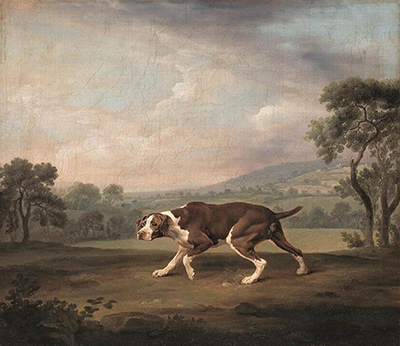
George Stubbs’s The Spanish Pointer brings a working dog close enough to study while opening an immense landscape around it. The version illustrated here belongs to the Bayerische Staatsgemäldesammlungen, Neue Pinakothek, Munich, where it is called Hühnerhund and dated about 1766. Its subject is a pointer halted after detecting a scent. [1]
At a Glance
This work across George Stubbs’s career
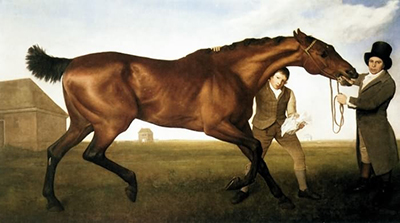
Whistlejacket
about 1762 [6]Contents
- The Munich painting
- What a pointing dog does
- Two closely related paintings
- Woollett turns the painting into a print
- States, proofs and individual impressions
- The plate’s later life
- Buckler and other later interpretations
- Videos on George Stubbs
The Munich painting
Painted in oils on canvas, the Munich picture measures 60.5 by 69.5 centimetres and bears inventory number 1602. It came from the Zweibrücken gallery. The museum places its acquisition around 1800, when Maximilian Joseph, then Elector and subsequently King of Bavaria, obtained it from an English source. [1]
The dog occupies the lower part of the canvas, its body extending from a broad head at the left to a short, slightly rising tail at the right. The nose projects beyond the chest; the back forms a long, gently uneven line. One foreleg reaches down and forward, while another bends underneath the chest, leaving its pale paw clear of the ground. The hind legs spread the body’s weight across a much longer base than the lifted forepaw might initially suggest. [15]
Brown covers most of the back, sides and upper legs. White breaks through across the face, neck, chest and lower limbs, creating a sequence of bright accents along the dog’s underside. The pattern is particularly effective at the shoulder: an irregular pale boundary separates the head and neck from the larger dark mass behind them. Light along the muzzle and the front of the chest keeps the face legible even against the landscape’s muted greens and browns. [15]
The head is broad and low, with hanging ears and a rounded muzzle. Small differences in light distinguish the eye, the brow above it and the folded ear beside it. The face turns slightly outwards from the body’s main direction, so that both the forward reach of the nose and something of the front of the face remain visible. Stubbs gives this compact area more sharply differentiated features than the distant countryside, which softens into bands of colour. [15]
Around the dog, space unfolds in stages. Dark ground and scattered plants form the nearest edge; a clearer stretch of earth accommodates the paws; fields and groups of trees open beyond. The large tree at the right rises from near the animal’s hindquarters, while smaller trees at the left leave a gap towards the distant hills. The landscape therefore gives the dog a broad setting without burying its outline in a continuous wall of foliage. [15]
Sky fills more than half the picture. Pale clouds rise above the animal, with warmer light near the left horizon and cooler greys higher up. Against that spacious upper field, the dog looks unusually close to the ground. The composition makes the small gap beneath the raised paw conspicuous: an enormous amount of open air surrounds a body whose action is concentrated within a few inches of earth. The contrast between breadth and compression gives the scene its particular balance. [15]
What a pointing dog does
The museum identifies the pose as a pause on catching a scent. That explains why a hunting picture can show neither a hunter nor a visible bird: the subject is the dog’s indication that game is nearby. Its working action supplies the event. The painting thus makes animal observation central to a sporting scene whose human participants remain outside the frame. [1]
The language of dog types was already historical in Stubbs’s lifetime. In The British Zoology of 1766, Thomas Pennant distinguished dogs by their work as well as their names. He described the pointer as foreign in origin and unfamiliar to earlier generations. In the surrounding discussion, setting dogs belonged to netting, while the water spaniel recovered shot game. These distinctions help keep pointing, setting and retrieving from becoming one undifferentiated activity. [16]
A later eighteenth-century account gives the working purpose more fully. A General History of Quadrupeds, with figures engraved by Thomas Bewick, described the Spanish pointer in 1790 as naturalised in Britain and used to find partridges and pheasants for either gun or net. Its text praised ease of instruction but judged it less hardy over a large range than the English pointer, and noted crosses between the two. Those are contemporary judgements about types of dogs, rather than a biography of the particular animal Stubbs painted. [17]
A named dog offers a useful comparison. Stubbs painted Phillis in 1772 for her owner, William Henry Fortescue, Lord Clermont. Leeds Museums and Galleries identifies her as a favoured pointer and describes the extended neck and lifted forepaw of her pointing pose. Her name and commission make that portrait a different kind of historical document: an identifiable relationship between owner and animal accompanies the working posture. [18] The broader variety of such relationships appears in Stubbs’s animal paintings.
Two closely related paintings
A second signed canvas, 62.2 by 71.8 centimetres, appeared at Sotheby’s in December 2024, dated about 1766–68. Bradford bought or possibly commissioned it. The auction argues that it supplied Woollett’s print, disputing Egerton’s Munich identification through landscape details and an annotated 1802 sale; its priority remains a scholarly conclusion. [19]
Both painted dogs face left. In the Bradford version, a broad-leaved plant stands beneath the belly; the Munich ground is clearer. Foreground rocks and grasses differ, as do the large tree’s branches and crown. These variations support Sotheby’s argument for the Bradford picture as Woollett’s model. [15] [20] [19]
Bradford’s canvas passed to Robert Sayer around 1773 with a half-share in the plate, then James Sayer. The 1802 sale links it to Coote and West Park. Later owners included Hutchinson and Knowlton; it was exhibited in 1948, sold in 1951 and 1972, and descended in Philadelphia. [19]
Woollett turns the painting into a print
William Woollett made the reproductive print; Thomas Bradford published it on 1 January 1768. The Rijksmuseum identifies etching and engraving on paper in its impression, RP-P-OB-73.173, with a plate mark measuring 444 by 558 millimetres. The separate credits preserve the roles of the painter who supplied the design, the engraver who translated it and the publisher who issued the result. [21]
The Yale Center for British Art impression illustrated in its distributed collection photograph reverses the paintings’ direction. Here the dog faces right, the large tree stands at the left, and the distant hill rises behind the left half of the scene. The lifted paw remains beneath the chest, but it now interrupts a movement across the sheet towards the opposite edge. Reversal affects the entire arrangement of landscape and animal, rather than simply turning the head. [22]
Woollett’s dark passages are made from accumulated lines and small marks. Parallel strokes describe the sky; closer patterns thicken the trees; loops, curves and short dashes differentiate plants and rough ground. Across the dog’s flank, fine linear shading preserves a sense of the rounded body within its dark coat. The white parts emerge as comparatively open areas, with enough delicate shading to distinguish a pale leg from the paper surrounding it. Colour contrasts have become contrasts of density and direction. [22]
The engraved lettering beneath the scene names Stubbs as painter and Woollett as engraver. It also identifies Bradford as the owner of the source picture and gives his Fleet Street publication address and the January 1768 date. The ownership statement belongs to the print’s public presentation of its model; it is especially valuable when separating the two very similar canvases. [22]
States, proofs and individual impressions
Louis Alexander Fagan’s 1885 catalogue describes a sequence beginning with an etched stage, followed by etched names and Bradford’s date. A further stage adds the title, ownership statement and fuller publication line. Later lettering substitutes Boydell and Laurie and Whittle as publishers. In this sequence, alterations to the plate’s words are as significant for identification as changes within the dog and landscape. [23]
Fagan counted four states; the later Stubbs print catalogue recognises six. The Rijksmuseum cites Fagan’s third alongside Lennox-Boyd, Dixon and Clayton’s fourth. Christie’s catalogued a third-state sheet and a first-state progress proof under the six-state system. Numbering follows a particular classification, rather than identifying a stage universally. [21] [24]
An impression is an individual sheet printed from the plate; a state describes the plate at a particular stage of alteration. Paper, margins and the surviving publication line help connect the two. Fagan’s succession of names shows why the image can remain recognisable while its commercial circumstances change. The dog’s appearance alone cannot explain who issued a particular sheet or when that sheet was pulled. [23]
Christie’s third-state sheet is laid paper, 45.4 by 57.5 centimetres. The Rijksmuseum gives its own impression’s plate dimensions and acquisition in 1828. Sheet size, plate mark and purchase date concern different aspects of an individual print’s life. [21] [24]
The plate’s later life
Sotheby’s traces Reinagle and Cosway copies, Pixton and Spode ceramics, sporting-gun decoration, the plate’s rediscovery at Thomas Ross & Sons and subsequent Tate acquisition. [19] It also places this print first among five Woollett engravings after Stubbs’s shooting subjects. [19]
A much later printing makes the distinction between design date and impression date particularly tangible. Larkhall Fine Art describes a sheet from the 225 impressions printed from the original copperplate in 1974, in black ink on thick, handmade wove paper, published by Iain Bain and Tate Gallery for Observer Art. It gives a plate size of 445 by 562 millimetres within a larger sheet of 587 by 720 millimetres. This is a twentieth-century printing of Woollett’s eighteenth-century plate. [25]
That later sheet extends the object’s history across two centuries. The survival of the copperplate enabled another act of printing, with a newly specified paper and edition. It is different from a photographic reproduction of an old impression: its description connects it to the printing surface itself. The distinction also makes room for Woollett’s craftsmanship within the reception of Stubbs’s painted dog, a relationship explored more broadly in Stubbs’s prints. [25]
Buckler and other later interpretations
John Buckler’s The Spanish Pointer, dated about 1799, belongs to the Yale Center for British Art’s Paul Mellon Collection. Yale’s published description credits Buckler working after Stubbs and identifies watercolour with graphite and grey, black and brown inks on smooth cream wove paper, measuring 39.5 by 53.3 centimetres. Its later date establishes the direction of the relationship: Buckler followed Stubbs, rather than supplying a model for the painting of about 1766. [26]
Buckler’s dog faces right, as in Woollett’s print, and occupies a similarly low position beneath a broad sky. The large tree rises at the left. Yet the overall effect is lighter: blue-grey touches separate the foliage into small patches, and pale warm washes run through the sky and ground. The dark body is surrounded by much thinner indications of vegetation. Seen beside the dense engraved sheet, the watercolour gives the familiar composition a more open, gently coloured surface. [27] [22]
The design also survives as a larger oil painting in the Government Art Collection. Number 576, The Spanish Pointer, is explicitly catalogued as after Stubbs, measures 82.5 by 120.5 centimetres and was purchased in 1948. Its maker and date are not supplied. This object shows how the same title can identify a painted copy as well as an autograph painting or a reproductive print. Its collection attribution keeps the copy’s status clear. [28]
Another translation used lithography. British Museum metadata reproduced with its collection photograph attributes Der Englische Hühnerhund, about 1860, to Johann Wölfle after Stubbs, published by Piloty and Loehle. It describes a lithograph on chine collé. The changed German title and different printing process belong to a later object, rather than another state of Woollett’s copperplate. [29]
Bewick’s 1790 book offers a smaller, earlier transformation. Its wood-engraved pointer faces left and stands within a compact landscape above the descriptive text. The tree and plants close around the body much more tightly than in Stubbs’s broad canvas. The page makes the animal part of an illustrated account of quadrupeds: a reader moves immediately from a recognisable pose to a discussion of the dog’s uses. [17]
The University of North Texas’s copy of the fourth edition, published in 1800, also includes the pointer. Its account of wood engraving explains the contrasting method: cut marks make white lines within an inked surface. The passage from canvas to copperplate and then to a small book illustration therefore involves different materials, scales and ways of making light visible. A reproduced dog can remain familiar while the reader’s encounter with it changes. [30]
Videos on George Stubbs
Explore Stubbs’s equestrian painting in its wider context, including two readings of Whistlejacket.
A Horse Lover’s Guide to the YCBA
A museum tour that places Stubbs alongside other artists who painted horses. It includes a look at Pumpkin with a Stable-lad.
Watch on YouTubeGeorge Stubbs artworks directory
Search works and related prints documented in this guide. Separate versions and printing matrices have separate entries; printmakers are named where known. Unidentified historical titles and untraced studio-sale material are discussed in the essays. A dash means that a date is not established here.
| Name | Date | Medium |
|---|---|---|
| A Bay Horse with a Groom | 1791 | Painting |
| A Bay Hunter with Two Playful Spaniels | 1777 | Painting |
| A Bay Hunter, a Springer Spaniel and a Sussex Spaniel in a wooded river Landscape | 1782 | Painting |
| A Cheetah and a Stag with Two Indian Attendants | about 1764 | Painting |
| A Couple of Fox Hounds (coloured print after Stubbs) | — | Print after Stubbs |
| A Couple of Foxhounds | 1792 | Painting |
| A Foxhound on the Scent | 1788 | Drawing |
| A Gentleman driving a Lady in a Phaeton | 1787 | Painting |
| A Grey Horse | 1793 | Painting |
| A Grey Horse (cantering companion) | 1793 | Painting |
| A Grey Stallion in a Landscape | — | Painting |
| A Horse Affrighted at a Lion | 1 May 1788 | |
| A Horse Belonging to the Rt. Honourable Lord Grosvenor called Bandy from his Crooked Leg | about 1763 | Painting |
| A Horse Frightened by a Lion | 1777 | |
| A Lion (A Lion Resting on a Rock) | 1 May 1788 | |
| A Lion Attacking a Horse | 1770 | Painting |
| A Lion Attacking a Horse (monumental Yale canvas) | 1762 | Painting |
| A lion attacking a horse (NGV) | about 1765 | Painting |
| A Lion Devouring a Horse (1788 print) | 1788 | |
| A lion devouring a horse (attribution disputed) | Proposed mid-1770s | Painting |
| A mare and foal with a bay horse | 1771 | Painting |
| A Monkey | 1799 | Painting |
| A Prancing Horse, Facing Right | c. 1790 | Drawing |
| A Rough Dog | 1790 | Painting |
| A Saddled Bay Hunter | 1786 | Painting |
| A Sleeping Leopard | 1 January 1791 | |
| A Tiger and a Sleeping Leopard | 1 May 1788 | |
| A Tigress (John Dixon after Stubbs) | 1772 | Print after Stubbs |
| A Tyger (A Recumbent Leopard by a Tree) | 1 May 1788 | |
| A Tyger (Sleeping Leopard) | 1 May 1788 | |
| An animal found on the coast of New Holland called kanguroo (after Stubbs) | 1773 | Print after Stubbs |
| An animal of a new species found on the coast of New South Wales (after Stubbs) | July 1773 | Print after Stubbs |
| Antinous and Jockey | — | Painting |
| Antinoüs, a chestnut racehorse, in a landscape | Undated | Painting |
| Bandy belonging to Lord Grosvenor (print after Stubbs) | — | Print after Stubbs |
| Baronet (George Townley Stubbs after Stubbs) | 20 February 1794 | Print after Stubbs |
| Baronet with Sam Chifney Up | 1791 | Painting |
| Baronet with Samuel Chifney up (Royal Collection) | 1791 | Painting |
| Bay Hunter by a Lake | 1787 | Painting |
| Brood Mares (Benjamin Green after Stubbs) | Issue 14 November 1776 | Print after Stubbs |
| Brood Mares and Foals | usually dated 1767 | Painting |
| Brown and White Norfolk or Water Spaniel | 1778 | Painting |
| Bulls Fighting | 1786 | Painting |
| Captain Samuel Sharpe Pocklington with His Wife, Pleasance, and possibly His Sister, Frances | 1769 | Painting |
| Death of the Doe (attribution disputed) | 1804 | |
| Der Englische Hühnerhund (Johann Wölfle after Stubbs) | about 1860 | Print after Stubbs |
| Dog (A Foxhound Viewed from Behind) | 1 May 1788 | |
| Dog [A Foxhound on the Scent] | 1788 | |
| Drill and albino baboon | before 1789 | Painting |
| Eclipse (Charles Hunt after Stubbs) | 12 November 1839 | Print after Stubbs |
| Eclipse (George Townley Stubbs after Stubbs) | 1796 | Print after Stubbs |
| Eclipse (oil study) | — | Painting |
| Eclipse (Thomas Burke after Stubbs) | First published 1772 | Print after Stubbs |
| Eclipse and John Wildman (Benjamin Green after Stubbs) | 1772 | Print after Stubbs |
| Eclipse at Newmarket (Jockey Club version) | Proposed early 1790s; often dated 1770 | Painting |
| Eclipse at Newmarket with a groom and jockey | 1770 | Painting |
| Eclipse with Mr Wildman and His Sons | 1769–71 | Painting |
| Eclipse, the Property of Capt.n O Kelly (anonymous print after Stubbs) | Imprint 4 June 1804; impression undated | Print after Stubbs |
| Euston | 1774 | Painting |
| Finished Study for the Seventh Anatomical Table of the Muscles of the Horse | 1756–58 | Drawing |
| Five Brood Mares at the Duke of Cumberland's Stud Farm in Windsor Great Park | 1765 | Painting |
| Fowl Body, Lateral View (Highly Finished Study for an Unpublished Table; Shows the Last Stage in Dissection) | — | Drawing |
| Fowl Body, Lateral View (Probably Prepared for Transfer to the Plate for Engraving of Table XV) | — | Drawing |
| Fowl Skeleton, Lateral View (Finished Study for Table V) | — | Drawing |
| Freeman, the Earl of Clarendon's Gamekeeper, with a Dying Doe and Hound (Yale) | 1800 | Painting |
| George Stubbs (enamel self-portrait) | 1781 | Enamel |
| Gimcrack (George Townley Stubbs after Stubbs) | 1775 | Print after Stubbs |
| Gimcrack on Newmarket Heath, with a trainer, a jockey and a stable lad | about 1765 | Painting |
| Gimcrack, with John Pratt up, on Newmarket Heath | about 1765 | Painting |
| Hambletonian, Rubbing Down | 1800 | Painting |
| Hay-Makers | 1791 | |
| Haycarting | 1795 | Enamel |
| Haymakers | 1785 | Painting |
| Haymakers (Lady Lever Art Gallery) | 1794 | Enamel |
| Hollyhock (with later additions by Vernet and Boucher) | about 1765–70 | Painting |
| Horse Attacked by a Lion (Episode C) | 1768–69 | Painting |
| Horse Attacked by a Lion (Tate enamel) | 1769 | Enamel |
| Horse Devoured by a Lion | Possibly exhibited 1763 | Painting |
| Horse Frightened by a Lion | 1770 | Painting |
| Horse Frightened by a Lion (Episode A; Wedgwood and Bentley after Stubbs) | — | Sculpture |
| Horse Frightened by a Lion (Tate) | Possibly exhibited 1763 | Painting |
| Horse Frightened by a Lion (Yale) | 1762–68 | Painting |
| Horse in the Shade of a Wood | 1780 | Painting |
| Hound Coursing a Stag | about 1762 | Painting |
| Human Figure, Anterior View (Intended for a Plate That was Never Published) | — | Drawing |
| Human Skeleton, Lateral View | 1795–1806 | Drawing |
| Hunt servants setting out (Southill commission) | 1767 | Painting |
| Hühnerhund (The Spanish Pointer) | about 1766 | Painting |
| John and Sophia Musters Riding at Colwick Hall | 1777 | Painting |
| John Musters on his hunter Pilgrim | 1777–78 | Painting |
| Labourers | 1789 | |
| Labourers (Richard Earlom after Stubbs and Amos Greene) | 25 March 1790 | Print after Stubbs |
| Laetitia, Lady Lade (d.1825) | 1793 | Painting |
| Lemon and White Water Spaniel | — | Painting |
| Lion Attacking a Stag | — | Painting |
| Lord Grosvenor's Arabian Stallion with a Groom | about 1765 | Painting |
| Lord Grosvenor's Arabian Stallion with a Groom (Peter Mazell after Stubbs) | 1771 | Print after Stubbs |
| Mambrino (Eaton Hall painting) | — | Painting |
| Mambrino (George Townley Stubbs after Stubbs) | 1794 | Print after Stubbs |
| Mares and Foals belonging to the 2nd Viscount Bolingbroke | about 1761–62 | Painting |
| Mares and foals beneath large oak trees | — | Painting |
| Mares and Foals by a stream | Exhibited 1764 | Painting |
| Mares and Foals in a River Landscape | about 1763–68 | Painting |
| Mares and Foals in an Extensive Landscape | about 1769 | Painting |
| Mares and Foals without a Background | 1762 | Painting |
| Moose Deer (after Stubbs) (Arctic Zoology plate VIII) | 1784–85 publication | Print after Stubbs |
| Newmarket Heath with a Rubbing-Down House | — | Painting |
| Otho (1796 print after Stubbs) | 1 December 1796 | Print after Stubbs |
| Otho, with John Larkin up | 1768 | Painting |
| Pangloss | about 1762 | Painting |
| Patch (Grafton commission) | 1759 | Painting |
| Phaeton and the Chariot of the Sun (enamel) | 1775 | Enamel |
| Phaeton with a Pair of Cream Ponies and a Stable-Lad | 1780–84 | Painting |
| Phillis | 1772 | Painting |
| Portrait of a Large Dog (Dingo) | 1772 | Painting |
| Pumpkin with a Stable-lad | 1774 | Painting |
| Racehorses Exercising at Goodwood | 1759–60 | Painting |
| Reapers (1791 print) | 1791 | |
| Reapers (Tate) | 1785 | Painting |
| Reapers (Yale) | 1795 | Enamel |
| Red Deer: A Stag and a Hind | 1792 | Painting |
| Richard Wedgwood | — | Enamel |
| Ringwood, a Brocklesby Foxhound | 1792 | Painting |
| Scrub, a bay horse belonging to the Marquess of Rockingham | about 1762 | Painting |
| Self Portrait on a White Hunter | 1782 | Enamel |
| Self-Portrait | about 1759 | Painting |
| Shooting (1770 Woollett plate after Stubbs) | 1770 | Print after Stubbs |
| Shooting (1771 Woollett plate after Stubbs) | 1771 | Print after Stubbs |
| Shooting at Goodwood | 1759–60 | Painting |
| Sir John Nelthorpe as a boy | 1756 | Painting |
| Sir John Nelthorpe partridge shooting with one pointer | — | Painting |
| Sir John Nelthorpe, 6th Baronet, out Shooting with His Dogs in Barton Field, Lincolnshire | 1776 | Painting |
| Sleeping Leopard | 1777 | Enamel |
| Soldiers of the 10th Light Dragoons | 1793 | Painting |
| Stallion and Mare (George Townley Stubbs after Stubbs) | 1776; reissued 1789 | Print after Stubbs |
| Steward and gamekeeper with dogs (Southill commission) | 1767 | Painting |
| Studies of a Lemur (Lemur murinus) in six different attitudes | 1773 | Drawing |
| Study for the Self-portrait in Enamel | c. 1781 | Drawing |
| Study of a Lemur | 1773 | Drawing |
| Study of a Racehorse in Action: Galloping to Left, a Semi-Anatomical Study, with Skin Flayed to Show Action of Muscles | — | Drawing |
| Study of the Legs of a Draught-Horse Pulling a Harrow (attributed to Stubbs) | Proposed about 1786 | Drawing |
| Sweet William (Grosvenor panel) | — | Painting |
| Sweet William (Turf Gallery canvas) | — | Painting |
| The Black Stallion Sampson, Portrayed from Three Angles (with landscape additions) | about 1764 | Painting |
| The Charlton Hunt | 1759–60 | Painting |
| The Fall of Phaeton | — | Sculpture |
| The Frightened Horse | 1780 | Sculpture |
| The Grosvenor Hunt | — | Painting |
| The Haymakers (Upton House) | 1783 | Painting |
| The Horse and Lion (George Townley Stubbs after George Stubbs) | 1770 | Print after Stubbs |
| The Kongouro from New Holland | 1772 | Painting |
| The Labourers | 1779 | Painting |
| The Labourers (Southill original) | 1767 | Painting |
| The lion and horse (Benjamin Green after Stubbs) | 1769; reissued 1777 | Print after Stubbs |
| The Milbanke and Melbourne Families | about 1769 | Painting |
| The Moose | 1770 | Painting |
| The Prince of Wales's Phaeton | 1793 | Painting |
| The Reapers (Upton House) | 1783 | Painting |
| The Sebra, or Wild Ass (George Townley Stubbs after Stubbs) | 1771 | Print after Stubbs |
| The Spanish Pointer (Bradford version) | about 1766–68 | Painting |
| The Spanish Pointer (William Woollett after Stubbs) | January 1768 | Print after Stubbs |
| The Third Duke of Dorset's Hunter with a Groom and a Dog | 1768 | Painting |
| Thomas Freeman, Lord Clarendon's gamekeeper, with a dog and a shot doe (with George Townly Stubbs) | 1803 | Painting |
| Turf, with Jockey up, at Newmarket | — | Painting |
| Turk and Crab | — | Painting |
| Two Bay Hunters Communing On The Bank Of A Lake | — | Painting |
| Tygers at Play | 1780 | |
| Viscount Gormanston's White Dog | 1781 | Painting |
| Viscount Gormanston's White Dog (canvas version) | — | Painting |
| Water Spaniel | 1769 | Painting |
| Wedgwood Family Portrait | 1780 | Painting |
| Whistlejacket | about 1762 | Painting |
| Whistlejacket with two other stallions and a groom | Recorded 1762 | Painting |
| White Poodle in a Punt | about 1780 | Painting |
| William Anderson with two Saddle-Horses | 1793 | Painting |
| Working Drawing for the Seventh Anatomical Table of the Muscles of the Horse | 1756–58 | Drawing |
| Zebra | 1763 | Painting |
Discussion
Look again at the images and ideas explored in The Spanish Pointer. These editorial prompts invite your observations.
Reader Insights
How does the very large area of sky affect the importance of the dog’s small raised paw?
Compare the paintings with the reversed engraving: which landscape details help you recognise their relationship most quickly?
What changes when the animal becomes a small illustration above a natural-history text?
Join the Conversation
Share a detail, comparison or question about The Spanish Pointer below.
References
- Bayerische Staatsgemäldesammlungen, George Stubbs, Hühnerhund, inventory1602. Accessed 4 November 2026. View source.
- Goodwood, The Collection, Painting Collection modal, Racehorses Exercising at Goodwood; An exciting acquisition: a study by George Stubbs, 30 June 2023; History of the Estate Hounds, 4 October 2023; About Goodwood Racecourse. Accessed 4 November 2026. View source.
- Goodwood, The Collection, Painting Collection modal, Racehorses Exercising at Goodwood; An exciting acquisition: a study by George Stubbs, 30 June 2023; History of the Estate Hounds, 4 October 2023; About Goodwood Racecourse. Accessed 4 November 2026. View source.
- Goodwood, The Collection, Painting Collection modal, Racehorses Exercising at Goodwood; An exciting acquisition: a study by George Stubbs, 30 June 2023; History of the Estate Hounds, 4 October 2023; About Goodwood Racecourse. Accessed 4 November 2026. View source.
- Goodwood, The Collection, Painting Collection modal, Racehorses Exercising at Goodwood; An exciting acquisition: a study by George Stubbs, 30 June 2023; History of the Estate Hounds, 4 October 2023; About Goodwood Racecourse. Accessed 4 November 2026. View source.
- National Gallery, Whistlejacket, NG6569, current collection record, provenance, in-depth discussion and frame entry. View source.
- Yale Center for British Art, Zebra, B1981.25.617, current object metadata, gallery labels, Malcolm Warner’s 1998 catalogue entry and provenance supplied through the museum’s public collection record. View source.
- Christie’s, Gimcrack on Newmarket Heath, with a trainer, a jockey and a stable lad, London, 5 July 2011, lot 12; object details, essay, provenance, exhibitions and whole image. View source.
- Christie’s, Gimcrack on Newmarket Heath, with a trainer, a jockey and a stable lad, London, 5 July 2011, lot 12; object details, essay, provenance, exhibitions and whole image. View source.
- Bayerische Staatsgemäldesammlungen, George Stubbs, Hühnerhund, inventory1602. Accessed 4 November 2026. View source.
- Yale University Art Gallery, A Lion Attacking a Horse, 1770, 1955.27.1, collection record. Accessed 4 November 2026. View source.
- Royal Museums Greenwich, ‘The Kongouro from New Holland’ (Kangaroo), ZBA5754. Accessed 4 November 2026. View source.
- Tate, George Stubbs, Haymakers, 1785, T02256; details, Terry Riggs’s collection text (January 1998), and online caption. Collection record. View source.
- Frances Bailey, ‘Hambletonian, Rubbing Down: A masterpiece by George Stubbs’, National Trust Cultural Heritage Magazine, Autumn/Winter 2024, pp. 22–33. Article. View source.
- Bayerische Staatsgemäldesammlungen, Whole image of Hühnerhund. Accessed 4 November 2026. View source.
- Thomas Pennant, The British Zoology (1766), p.26; digitised text. Accessed 4 November 2026. View source.
- Ralph Beilby and Thomas Bewick, A General History of Quadrupeds (1790), p.314. Accessed 4 November 2026. View source.
- Leeds City Council, A winter’s tail sees peer’s painted pooch return home, 25 November 2024. Accessed 4 November 2026. View source.
- Sotheby’s, The Spanish Pointer, 4 December 2024, lot20, provenance and catalogue essay. Accessed 4 November 2026. View source.
- Sotheby’s, Whole image of the Bradford painting. Accessed 4 November 2026. View source.
- Rijksmuseum, Spaanse Pointer in landschap, RP-P-OB-73.173. Accessed 4 November 2026. View source.
- Yale Center for British Art, William Woollett, The Spanish Pointer, B1985.36.1093; collection image supplied through Smartify and reproduced by Wikimedia Commons. Accessed 4 November 2026. View source.
- Louis Alexander Fagan, A catalogue raisonné of the engraved works of William Woollett (1885), p.27. Accessed 4 November 2026. View source.
- Christie’s, The Spanish Pointer, third-state impression, lot6013167; and first-state progress proof, lot469371. Accessed 4 November 2026. Additional impression: first-state progress proof. View source 1. View source 2.
- Larkhall Fine Art, The Spanish Pointer, 1974 impression. Accessed 4 November 2026. View source.
- Yale Center for British Art via Google Arts & Culture, John Buckler after George Stubbs, The Spanish Pointer, about1799. Accessed 4 November 2026. View source.
- Yale Center for British Art via Google Art Project and Wikimedia Commons, Whole image of John Buckler’s The Spanish Pointer. Accessed 4 November 2026. View source.
- Government Art Collection, The Spanish Pointer, after George Stubbs, GAC576. Accessed 4 November 2026. View source.
- British Museum metadata reproduced by Wikimedia Commons, Johann Wölfle, Der Englische Hühnerhund, 1868,0328.400.+. Accessed 4 November 2026. View source.
- University of North Texas Libraries, History of Wood Engraving: Early Period, 1790–1860. Accessed 4 November 2026. View source.
- Basic title, date and material metadata for Tate’s Reapers (T02257) and Otho (T02375) is adapted from the Tate collection dataset, October 2014, released under CC0. TheHistoryOfArt.org has reconciled labels and versions. This credit does not apply to Tate’s authored catalogue commentary or images.
- Data Source: Yale Center for British Art. Basic object fields are adapted and reconciled for this directory. Reuse is subject to the Center’s Open Data and Data Services Terms of Use. No museum endorsement is implied. This metadata credit does not relabel scholarly essays or images as open data.
- Basic object metadata for A Horse Frightened by a Lion, 1985.38, The Cleveland Museum of Art, John L. Severance Fund, is available under CC0. Titles and design-level grouping have been reconciled for this directory.