 by Tom Gurney
Tom Gurney BSc (Hons) is an art history expert with over 20 years experience
Published on June 19, 2020 / Updated on November 5, 2026
Email: tomgurney1@gmail.com / Phone: +44 7429 011000
Warrior with Groom
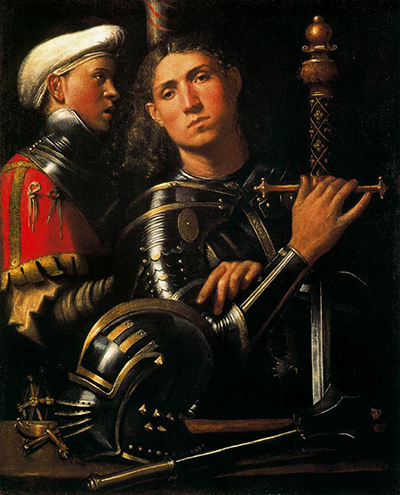
A young man in dark armour turns towards us, his head tilted above a gleaming shoulder. Behind him, a second figure looks across the picture in profile. A richly decorated sword rises beside the principal figure’s face, while a helmet and other military equipment crowd the foreground. The painting commonly called Warrior with Groom belongs to the Uffizi in Florence, where its fuller title is The “Gattamelata”. Man in armour with a squire. The museum currently attributes this oil on canvas, measuring 90 × 73 centimetres, to Giorgione and dates it to 1501–1502. Its inventory number is 1890 no. 911. [1]
That label provides a starting point, but both the painter’s identity and the sitter’s name have been disputed. Looking closely helps explain why the canvas has remained compelling through these changes of opinion: its military objects are exceptionally prominent, yet its human encounter feels suspended and unresolved.
At a Glance
Two proposed dates for the same painting
Contents
Two figures, two directions
The principal figure occupies most of the composition, his broad armoured body filling the lower centre and right. His face inclines towards the upper left, breaking the upright established by the sword. The attendant stands further back on the left, partly concealed behind the warrior. Their heads are close together, but they do not exchange a look. The warrior turns outward; the attendant’s profile carries attention sideways towards his companion and the space beyond him.
This arrangement makes the figures unequal in prominence without allowing the smaller figure to disappear. The attendant’s pale wrapped head covering catches a broad area of light against the dark background. Below it, his red clothing provides the largest warm colour accent outside the flesh. These areas balance the warrior’s illuminated face and hands. Cover the attendant mentally, and the remaining figure becomes much more isolated; restore him, and the picture begins to suggest an event involving two people.
The attendant’s lips are parted, whereas the warrior’s mouth is closed. It is tempting to imagine a message passing between them, but the painting supplies no words and no securely documented conversation. What we can observe is a difference in their presentation. The profile is sharply legible at the nose and mouth; the warrior’s face offers a broader, more gradual passage between illumination and shadow. Their proximity creates intimacy of space while the different directions of their faces preserve a sense of separation.
The attendant holds a standard pole and wears a bevor protecting his lower face and neck. [1] Neither detail makes him an ordinary bystander. He belongs to the same armed setting as the principal figure, even though their clothing and placement distinguish their roles. “Squire” is consequently more informative here than the alternative English title’s “groom”: no horse appears in the composition.
Armour, hands and reflected light
The armour initially reads as a dark mass. Looking longer reveals that its construction depends on interruptions in that darkness. Thin bright bands describe overlapping plates at the shoulder; small points of light pick out rivets; broader reflections give the arm protection its rounded volume. Gold-coloured borders and details connect the worn armour with the helmet on the foreground ledge. The eye can travel between them by following these scattered lights.
The helmet is especially substantial. Its curved upper surface catches illumination in broad strips, while its open interior remains dark. Placed low and close to the viewer, it gives the military equipment a physical presence independent of the face above. The foreground is crowded with projecting and crossing forms, so that the ledge feels occupied by objects with different weights, edges and directions. We are made conscious of how much equipment surrounds this apparently still figure.
Against those hard surfaces, the exposed hands introduce a different kind of detail. The raised hand rests across the sword’s horizontal guard, close to its ornamented grip. The lower hand reaches downwards over the armour towards the foreground. Long fingers and smooth skin interrupt the segmented metal. These are hands shown in contact with equipment, but they are not gripping a weapon in combat. The composition holds the possibility of action within an unusually composed pose.
The sword is a major organising line. It stands almost vertically at the right, with the guard crossing it beneath the warrior’s face. Its ornament invites close inspection, but its straightness also steadies the tilted head and diagonals of the arms.
There is a productive contrast between the face and the equipment. The face is comparatively quiet, with its expression concentrated around the eyes and closed mouth. The metal announces itself through repeated flashes and sharply defined boundaries. This contrast lets a viewer move from an individual presence to the elaborate apparatus of a military role. It does not tell us whether the sitter welcomed that role, feared battle or felt melancholy; those are possible responses to the image, not facts about his life.
Why “Gattamelata” needs quotation marks
The traditional name identifies the warrior as Erasmo da Narni, the military commander known as Gattamelata, and the attendant as his son Antonio. The Uffizi records that identification in the painting’s eighteenth-century Vienna history. Erasmo died in 1443, well before the museum’s proposed date for the canvas, so the name cannot establish a portrait painted from life in 1501–1502. [1]
The Italian national catalogue explicitly describes the Gattamelata identification as lacking scientific support. [2] The familiar title should therefore be understood as part of the picture’s reception, rather than a reliable identification of the two faces. A painting can acquire a famous name because later owners or viewers think its subject appropriate to that person. The name can then persist even while the evidence behind it is questioned.
The Uffizi also presents an alternative reading involving Cleitus, a companion of Alexander the Great, and an ancient painting by Apelles described by Pliny. [1] Pliny’s Natural History, book 35, section 93, mentions Cleitus with a horse hastening towards battle and an armour-bearer offering a requested helmet. [3] That passage gives the theory a specific literary foundation: a warrior, an attendant and a helmet can be connected to a celebrated ancient painter.
Yet the connection remains interpretive. The Uffizi picture contains no visible horse, and its helmet rests in the foreground. Those differences prevent the ancient text from functioning as a straightforward caption. The proposal is more useful as a way of considering a possible learned reference: a Renaissance painting might evoke a lost ancient work without reproducing every circumstance in its description. It does not securely identify the sitter as Cleitus.
Giorgione, Cavazzola and the attribution debate
The owning museum’s present attribution is only one position in a long discussion. The Fondazione Federico Zeri’s scholarly catalogue lists the canvas under Giorgione, records Paolo Morando, known as Cavazzola, as an alternative attribution, and supplies a date range of 1502–1508. The dimensions and inventory number identify exactly the same Uffizi object. [4]
The Italian national catalogue instead heads its entry with Cavazzola and a proposed date of about 1518–1522. Its historical discussion records support for Giorgione, acceptance with reservations, and the suggestion that the canvas could reproduce a lost Giorgione original. [2] These are materially different explanations: Giorgione’s own painting, a work by another artist shaped by his example, and a replica of a missing composition each give the surviving object a different place in art history.
Sylvia Ferino-Pagden offered a particularly revealing objection in her 2008 essay “Giorgione ins 21. Jahrhundert”. Discussing the comparison of paintings in the 2004 Vienna exhibition, she found the Uffizi canvas’s smooth, even description of objects at odds with Giorgione’s more experimental handling of colour through light. She nevertheless praised its quality, composition and poetic force, treating it as evidence of the power of his example. [5]
Her argument draws attention to the distinction between a painting’s overall effect and the way its surfaces are made. A solemn pose, atmospheric darkness and an arresting face may suggest Giorgione to a viewer; attribution also asks how the paint describes particular forms. The dispute should not be reduced to a judgement that the picture is too good, or insufficiently good, for a famous name. Its authorship remains contested even while its visual achievement is acknowledged.
A portrait within the Venetian tradition
A useful comparison is Giovanni Bellini’s Doge Leonardo Loredan, dated about 1501–1502 by the National Gallery in London. Bellini places an imposing figure behind a parapet and makes the sitter’s ceremonial clothing central to his public identity. The Gallery explains how oil paint enables the subtle transitions in flesh and the convincing rendering of different materials. [6]
The comparison clarifies what is distinctive about the Uffizi canvas. Here the parapet supports a collection of equipment, the hands are conspicuous, and another person enters the portrait’s space. Rank and occupation are communicated through an interaction between body, objects and attendant. The picture has more of the potential movement of a scene, although its densely arranged forms keep that movement contained.
This broader artistic relationship survives uncertainty over the painter. The National Gallery’s account of Giorgione emphasises both his influence on Venetian painting and the difficulty of defining his surviving work. [7] The Uffizi painting can be studied within that world of expressive portraiture while the question of its individual maker stays open.
From imperial collections to Florence
The Uffizi traces the canvas through the imperial collections in Prague and its eighteenth-century display at the Belvedere in Vienna. [1] The national catalogue gives April 1821 as its arrival in Florence through an exchange with the Imperial Gallery, and records the Giorgione attribution in the Uffizi inventory of 1825. [2] That history helps explain why the artist’s name and the Gattamelata title have become so closely attached to it.
Knowing this history also changes the experience of looking. We encounter a painting that successive collectors and scholars have tried to name, date and place, while the image offers its own durable certainties: two neighbouring faces turned in different directions, hands resting among weapons, and light moving across metal. Those concrete relationships reward attention even where the identities remain unsettled.
Artworks directory
The Uffizi painting studied here, with the conflicting catalogue dates retained. The Uffizi attributes it to Giorgione; the Italian national catalogue attributes it to Cavazzola. This is a single object record and not a complete catalogue of Giorgione’s work.
| Name | Date | Medium |
|---|---|---|
| Man in armour with a squire (Uffizi; attribution disputed) | 1501–02 (Uffizi); about 1518–22 (national catalogue) | Painting |
Frequently Asked Questions
The Uffizi currently attributes it to Giorgione. The Italian national catalogue instead records Cavazzola, so authorship remains disputed. [1][2]
The traditional identification is not secure. The national catalogue describes it as unsupported, and Gattamelata died long before the Uffizi’s proposed painting date. [1][2]
It belongs to the Uffizi in Florence, inventory 1890 no. 911. [1]
Discussion
Look at the opposing directions of the two faces and the reflections across the armour, while keeping the painter’s and sitter’s identities open.
Reader Insights
Which reflection first leads you through the armour?
How does the attendant change the warrior’s presence?
What can you describe securely before deciding who painted the picture?
Join the Conversation
Share a detail, comparison or question about Warrior with Groom below.
References
- Gallerie degli Uffizi, The “Gattamelata”. Man in armour with a squire, English collection record, and Ritratto di guerriero con scudiero detto “Gattamelata”, Italian collection record. Inventory 1890 no. 911; object details, current attribution and dating, historical title, provenance and Cleitus interpretation. Italian wording consulted for the sword hilt. Official colour reproduction used for the visual observations in this article. Accessed 28 October 2026. View source 1. View source 2.
- Ministero della Cultura, Catalogo Generale dei Beni Culturali, Il Gattamelata. Ritratto di guerriero con scudiero, national catalogue no. 0900286703; complete seven-page catalogue record, especially pp. 2–4, chronology, authorship, historical discussion and acquisition; pp. 5–7, bibliography and compilation history. Italian; compiled by E. Pilati, 1989, with subsequent updates including 2024. The entry records Cavazzola and c.1518–1522, in disagreement with the Uffizi’s current public collection page. Accessed 28 October 2026. View source 1. View source 2.
- Pliny the Elder, Natural History, book 35, sections 92–97, particularly section 93; English translation by H. Rackham (1952), with minor alterations as identified by Attalus. Latin text, book 35, section 93, consulted through LacusCurtius, University of Chicago. Ancient description of works by Apelles; cited for the textual basis of the Cleitus proposal, not as evidence identifying the Uffizi sitter. Accessed 28 October 2026. View source 1. View source 2.
- Fondazione Federico Zeri, Università di Bologna, Giorgione, Ritratto di giovane in armatura, online scholarly catalogue, work record 40270, entry number 35766. English interface; authorship, alternative attribution, dating, measurements and Uffizi inventory identification. Accessed 28 October 2026. View source.
- Sylvia Ferino-Pagden, “Giorgione ins 21. Jahrhundert”, in Sylvia Ferino-Pagden (ed.), Giorgione entmythisiert (Turnhout: Brepols, 2008), pp. 1–14, especially pp. 9–10 and figure 8. German scholarly essay; accessible text reproduction. The discussion concerns the Uffizi Gattamelata, separately illustrated from the Vienna Warrior. Accessed 28 October 2026. View source.
- National Gallery, London, Giovanni Bellini, Doge Leonardo Loredan, NG189, collection entry, “About the work” and “In-depth”. Date, parapet, ceremonial dress and the rendering of flesh and materials in oil. Accessed 28 October 2026. View source.
- National Gallery, London, Giorgione, artist record. Influence on Venetian painting and uncertainty surrounding attribution. Accessed 28 October 2026. View source.