



 by Tom Gurney
Tom Gurney BSc (Hons) is an art history expert with over 20 years experience
Published on June 19, 2020 / Updated on November 2, 2026
Email: tomgurney1@gmail.com / Phone: +44 7429 011000
Laundry Drying at Petit Gennevilliers: Introduction
A row of washing rises into the sky, its pale fabric swollen into strange, muscular shapes. Beneath it, a low cottage and two slender trees look unexpectedly small. Gustave Caillebotte’s Laundry Drying at Petit Gennevilliers, dated 1888, is an oil painting measuring 54 × 65 cm; the Musée des impressionnismes Giverny identified it as privately owned in its 2016 exhibition documentation. [1]
The picture makes a familiar outdoor task feel momentarily unfamiliar. Wind stretches the cloth almost horizontally, opening bright ridges and deep violet folds. The hanging fabric interrupts our view of the sky, while the landscape appears through the space underneath. Its unusual force comes from this encounter between an everyday object and an exceptionally close viewpoint.
At a Glance
- ArtistGustave Caillebotte.
- Date1888. [1]
- Medium and dimensionsOil on canvas, 54 × 65 cm. [1]
- Catalogue identityBerhaut 370. [2]
- CollectionRecorded as a private collection in 2016. [1]
This work across Gustave Caillebotte’s career
Contents
- A landscape seen beneath the washing
- What wind does to a rectangle
- Whites made from colour
- Work at the edge of the garden world
- Similar titles, different paintings
- Photography and the strangeness of everyday things
- From private ownership to public exhibitions
A landscape seen beneath the washing
The first surprise is a reversal of scale. A sheet should be a modest accessory to a landscape, yet here the washing becomes its largest, most elaborate feature. The roof below is a compact pinkish shape; the trees behind it are only thin upright strokes. The billowing cloth crosses almost the entire width of the picture. Looking past it, we have to readjust to the much smaller units of the ground beyond.
That difference makes the viewer’s position unusually tangible. We seem to stand close to the line, within the reach of fabric that might swing back towards us. There is no comfortably open prospect leading from a spacious foreground into the distance. Instead, the nearest object occupies the air directly before our eyes. It establishes an immediate relationship with our bodies before we begin to explore the view.
The left edge cuts through the washing. We cannot follow the whole line or see its complete arrangement, and no prominently displayed support explains the mechanism. The cloth enters the picture already suspended. Its attachments matter less visually than the varying lengths and twists extending away from them. This cropping lets a portion of an ordinary drying place become a self-contained arrangement of suspended forms.
Below, the pale path provides a second horizontal sweep. It lies much closer to the lower edge and feels broad and level, while the washing undulates overhead. The narrow strip of yellow-green ground along the bottom helps distinguish this lower band from the sky. Together, path and laundry compress the planted ground and cottage into a shallow interval. The scene has depth, yet its strongest shapes repeatedly draw attention back across the canvas.
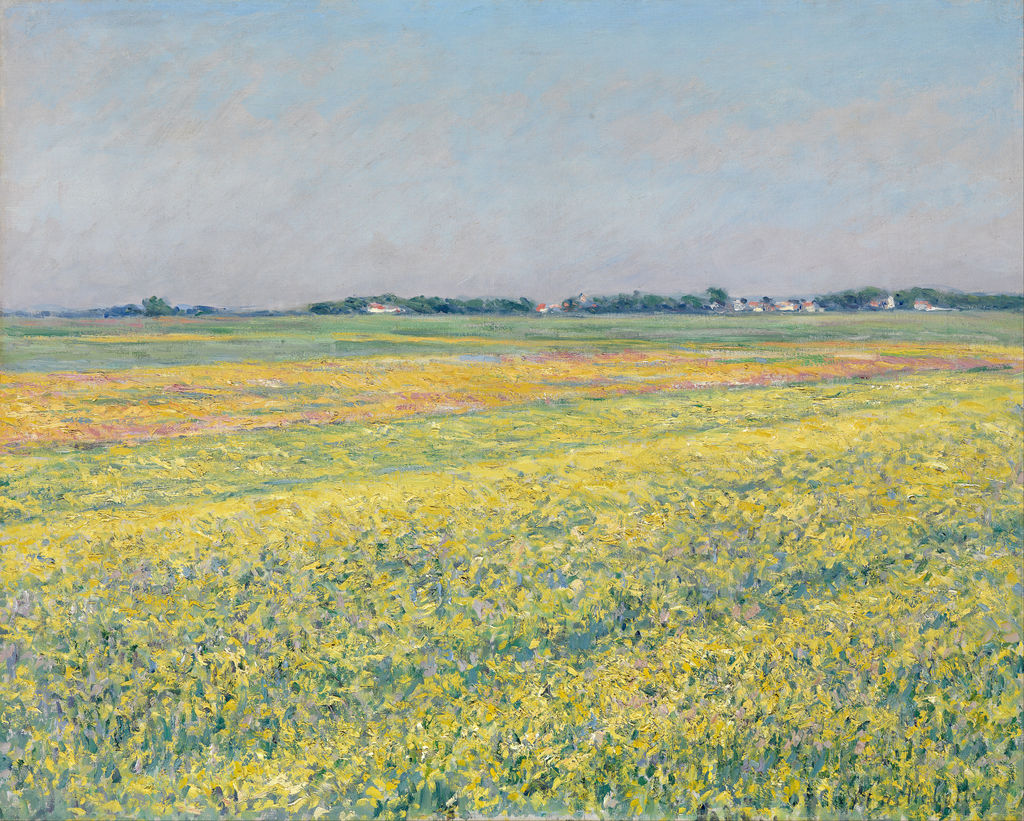
Plain of Gennevilliers, Yellow Fields, 1884; a separate view of the district around the riverside home. National Gallery of Victoria, Melbourne. Felton Bequest,2011. Source reproduction via Google Art Project and exact Commons file. Image source. Public domain. Resized only; source appearance preserved.
What wind does to a rectangle
The washing is recognisable, but its contours seldom behave like those of a simple flat sheet. At the upper right, a broad length swells into a rounded ridge and narrows towards a crumpled end. Near the centre, another form bends down into a dark, pointed projection. To the left, successive folds make smaller triangular openings. We understand these shapes as fabric because of their creases and repeated pale surfaces, even as their outline becomes difficult to predict.
Wind is invisible here except through its consequences. A hanging sheet would normally pull towards the ground; these sheets are thrust sideways, their weight temporarily overcome. The deepest lower fold still sags, keeping the sensation of gravity within the larger sensation of lift. This combination makes the movement convincing. The cloth looks neither rigid nor weightless: different parts appear to yield by different amounts.
The painting also makes time perceptible without illustrating a sequence. Each fold belongs to one arrested configuration, but its instability suggests that another must follow. The pointed end might drop; the inflated upper surface might collapse; a narrow strip might twist back on itself. These are possibilities generated by the visible forms. They give a still picture an unsettled duration, inviting us to imagine the next movement while continuing to examine the one before us.
The cottage helps make that instability legible. Its low roof and compact walls supply the kind of fixed, familiar object against which the washing’s distortions register. Likewise, the pair of thin trees gives the eye a vertical measure beneath the long horizontal lift of the sheets. Without those quieter features, the upper shapes might detach from the place altogether. Their presence keeps the extraordinary silhouette rooted in a recognisable outdoor setting.
Whites made from colour
The fabric contains some of the lightest passages in the picture, but it is far from uniformly white. Cream and pale yellow gather along raised edges; cooler lavender spreads through the turns; dark blue-violet collects in the hanging folds. Looking from the upper surface to the underside of the central sheet, we pass through a considerable range of colour. The brightness depends as much on that surrounding darkness as on the light paint itself.
The strongest darks sit inside the moving cloth rather than at the far horizon. This shifts the visual weight upwards. The distant ground is comparatively quiet: muted yellow, green and brown extend sideways beneath a pale grey sky. Even the cottage’s warmer roof remains a small accent. Our attention keeps returning to the emphatic alternation of light and shade in the washing.
Brush marks help distinguish its surfaces. Long strokes run with the drawn-out folds, while shorter, broken touches describe the creased end on the right. At the left, sharply changing directions make the cloth look pinched and twisted. The marks become a way of following stresses within the fabric. We can see how one bright edge continues for a stretch before disappearing into a darker turn.
Elsewhere the handling is less insistent. The distant vegetation resolves into clustered touches; the slender trees require only a few dark marks. Across the path, diagonal strokes disturb the broad pale band. These differences allow each part to retain its character without equal detail everywhere. The washing receives the most sustained changes of direction and value because its uneven surface is the picture’s main event.
The sky is active enough to belong to the same windy world, although its strokes do not compete with the folds. Broad grey-lilac passages surround the cloth, and occasional lighter marks loosen the upper field. At several edges, pale fabric lies against pale atmosphere, so the boundary briefly becomes soft. Then a violet underside cuts sharply across the sky. That variation prevents the entire row from reading as a single outlined silhouette.
Watch: Gustave Caillebotte
Explore a museum overview and two discussions of Paris Street; Rainy Day. This shared selection offers wider context for the artist’s work.
"Who Is Gustave Caillebotte?" - HD version
An introduction to Caillebotte from the Kimbell Art Museum.
Watch on YouTubeWork at the edge of the garden world
Caillebotte’s catalogue places this painting within a group depicting linen near public washhouses by his riverside home. The setting brings a working landscape into view close to the artist’s property. [2]
That distinction changes the scene’s emphasis. The title’s laundry carries evidence of handling and use even though nobody is shown washing, carrying or hanging it. The task has reached a stage in which weather does part of the work. The absence of a worker opens the picture to the cloth’s movement, but the objects retain their practical purpose. They are things being dried, exposed to a changing current of air.
Petit Gennevilliers was also becoming the centre of Caillebotte’s life. Giverny’s teaching dossier records the brothers’ purchase there in 1881, Gustave’s acquisition of Martial’s share in 1887 and his permanent move in 1888. It describes flower beds, a kitchen garden and buildings developing around the property. [4]
The surroundings could therefore generate very different pictures. In the museum’s account of Roses, Garden at Petit Gennevilliers (1886), planted rows and an orderly path structure the luxuriant flowers. [4] Here, the nearby landscape offers a similarly clear ground line, but above it the washing expands into shapes with little of a bed’s regularity. The contrast helps us see how a cultivated setting and its working margins could support different kinds of visual invention.
The cloth also brings a human scale into a picture without a human figure. Its familiar size is something we know through use, whereas the cottage’s smallness must be understood through distance. That tension makes the washing feel close and the building remote. The painting finds a forceful spatial relationship in objects that a passer-by might usually overlook.
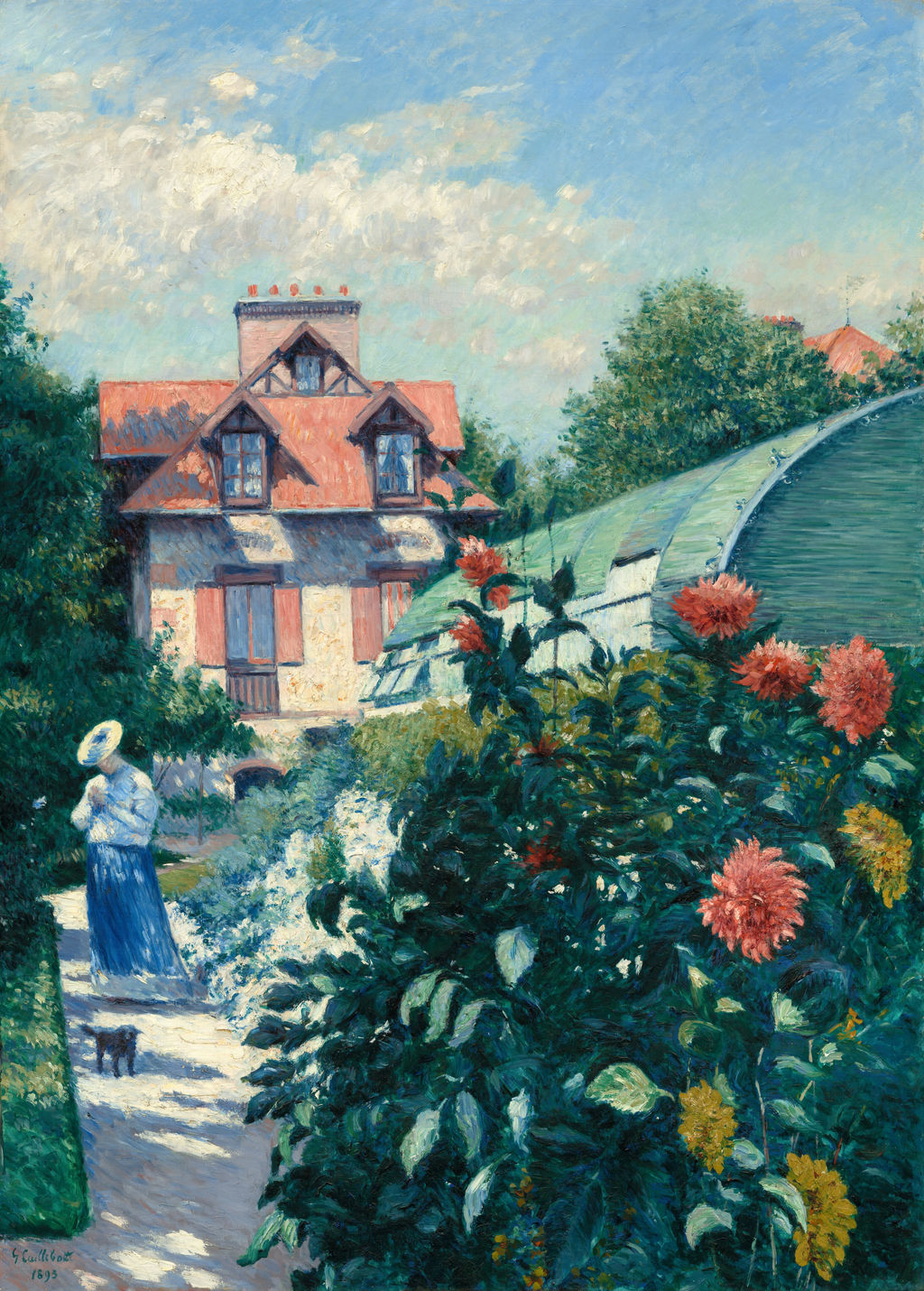
Dahlias at Petit Gennevilliers, 1893; a separate later subject from the artist’s cultivated garden. Gift of the Scharffenberger Family. Image source. Public domain. Resized only; source appearance preserved.
Similar titles, different paintings
Berhaut identifies number 369 as a study for this composition, number 370; both measure 54 × 65 cm in her catalogue. [2] The comparison is particularly useful because a study need not be smaller than the picture it prepares. In the illustrated catalogue, the study’s broad, less differentiated forms give way here to a more articulated sweep of fabric above the low building.
A much larger painting, Laundry Drying on the Banks of the Seine, is in Cologne: Berhaut 368, museum number WRM Dep. 447. Caroline von Saint-George and Katja Lewerentz’s technical report measures it at 105.5 × 150.5 cm and dates it about 1892. The report concerns that canvas, including a poplar bud embedded in its paint and evidence of outdoor execution. Those findings do not establish the materials, working location or painting sessions of the smaller 1888 picture discussed here. [5]
The distinction protects something that close looking can otherwise blur. The visible energetic brushwork creates an effect of speed, without revealing how many sittings the painting required. Likewise, a convincing gust of wind does not by itself prove that a canvas was completed in front of the motif. The smaller picture rewards an examination of its own painted arrangement: its broken strokes, coloured folds and carefully opposed scales. These are among the distinctions explored more broadly in Caillebotte’s style and technique.
Berhaut also connects the motif with Berthe Morisot’s earlier treatment of drying laundry at Petit Gennevilliers in 1875. [2] The connection makes Caillebotte’s unusually close encounter with the billowing cloth more distinctive: a familiar local subject could be renewed through the position from which it was seen.
Photography and the strangeness of everyday things
The SCHIRN Kunsthalle’s 2012 exhibition texts singled out Caillebotte’s windblown laundry series for comparison with later photographs by Man Ray and Herbert List. Its curators associated the cloth’s unfamiliar forms with a visual strangeness later explored in Surrealist photography. This is a comparison across media and periods, rather than evidence that a photograph supplied this composition or that those photographers borrowed from it. [6]
The comparison is illuminating when brought back to the picture. Cropping removes the reassuring completeness of a washing line, while enlargement gives the folds an unexpected prominence. For a moment, the cloth resembles an independent object with a complex anatomy. Recognition then returns: these shapes are produced by a routine task and a gust of wind. The picture sustains both responses without requiring a hidden symbolic explanation.
The photograph comparison also brings the ordinary details back into focus. The small roof, distant trees and level ground make no dramatic claim on our attention. Their modest scale allows the transformed fabric to dominate while still belonging to the world below. The scene becomes strange through a change of emphasis, with an everyday object occupying an unexpectedly large share of our field of vision.
From private ownership to public exhibitions
Berhaut records the work with the artist’s family before a private collection in France, and lists its appearance in the 1894 Paris retrospective and the Paris–Chicago exhibition of 1994–95. [2] These entries establish a public exhibition history alongside private ownership, without providing a continuous modern chain of possession.
Later records make the identity particularly clear. The National Gallery of Art’s 2015 The Painter’s Eye checklist includes Linen Out to Dry, Petit Gennevilliers, dated 1888, at 54 × 65 cm, from a private collection. [7] Spain’s 2016 state-guarantee annex for the Madrid Caillebotte, Painter and Gardener exhibition identifies the same dimensions and date under the explicit number MB370. [8]
Giverny’s 2016 exhibition, curated by Marina Ferretti, brought the garden subjects together within an account of Caillebotte’s successive places of residence. [1] That setting encourages a return to the apparent simplicity of the laundry picture. Close to home, a changing movement of cloth offered enough incident for a composition: a broad sweep against the sky, a dark fold descending, a little roof underneath. The more carefully we attend to those relationships, the less incidental the subject becomes.
Catalogue and documented works
This directory brings together 578 entries in the revised 1994 catalogue, 11 further documented records and three groups of study descriptions. It is a directory of records, not a total of authenticated individual works. Albums, print states and surviving decorative panels are grouped. English labels retain the French titles as searchable aliases; dates are supplied only where checked. Numbered entries link to the relevant article or the historical catalogue. Pastels appear under the Drawing filter; original prints remain searchable under All media.
Frequently Asked Questions
SCHIRN’s curators compared the laundry series’ unfamiliar, moving forms with later Surrealist photographs. The comparison concerns visual effects; it does not document a photographic source for this painting. [6]
Discussion
Look again at the images and ideas explored in Laundry Drying at Petit Gennevilliers. These editorial prompts invite your observations.
Reader Insights
The washing makes a second set of shapes across the landscape.
The white cloth changes colour as it catches light and turns away from it.
Do you first read the hanging laundry as work, weather or abstract shape?
Join the Conversation
Share a detail, comparison or question about Laundry Drying at Petit Gennevilliers below.
References
- Musée des impressionnismes Giverny, Caillebotte, peintre et jardinier: dossier de presse (2016), PDF pp. 3–4 and 20, exhibition framing and laundry caption. View source. (in French).
- Marie Berhaut with Sophie Pietri, Gustave Caillebotte: catalogue raisonné des peintures et pastels (1994), pp. 209–210, entries 366–370. View source. (in French).
- Marie Berhaut with Sophie Pietri; Wildenstein Plattner Institute, Gustave Caillebotte Catalogue raisonné des peintures et pastels, 1994. View source. (in French).
- Musée des impressionnismes Giverny, Caillebotte, peintre et jardinier: dossier pédagogique (2016), PDF pp. 5 and 11. View source. (in French).
- Caroline von Saint-George and Katja Lewerentz, Laundry Drying on the Banks of the Seine: Brief Report on Technology and Condition (2008), pp. 1–2, WRM Dep. 447. View source. (in en/de).
- SCHIRN Kunsthalle Frankfurt, Gustave Caillebotte: Ein Impressionist und die Fotografie, exhibition wall texts (2012), p. 4. View source. (in German).
- National Gallery of Art, Gustave Caillebotte: The Painter’s Eye, illustrated checklist (2015), p. 10, catalogue 57. View source.
- Spanish Ministry of Education, Culture and Sport, Order ECD/800/2016, Boletín Oficial del Estado, BOE-A-2016-5077 (2016), annex, row 5. View source. (in es).
- Art Institute of Chicago, Caillebotte Paintings and Drawings at the Art Institute of Chicago, 2015. View source.
- Petit Palais / Paris Musées, Portrait de Paul Hugot, original print, PPG2319, current. View source. (in French).
- Paul Perrin, Musée d’Orsay, Transcription de l’entretien commissaire Caillebotte, 2024. View source. (in French).
- Cleveland Museum of Art, Caillebotte collection records: 2020.260, 2009.157 and 2020.105, current. View source.
- Splash image, Laundry Drying at Petit Gennevilliers, 1888.


