



 by Tom Gurney
Tom Gurney BSc (Hons) is an art history expert with over 20 years experience
Published on June 19, 2020 / Updated on November 3, 2026
Email: tomgurney1@gmail.com / Phone: +44 7429 011000
Caudieux by Henri de Toulouse-Lautrec: Introduction
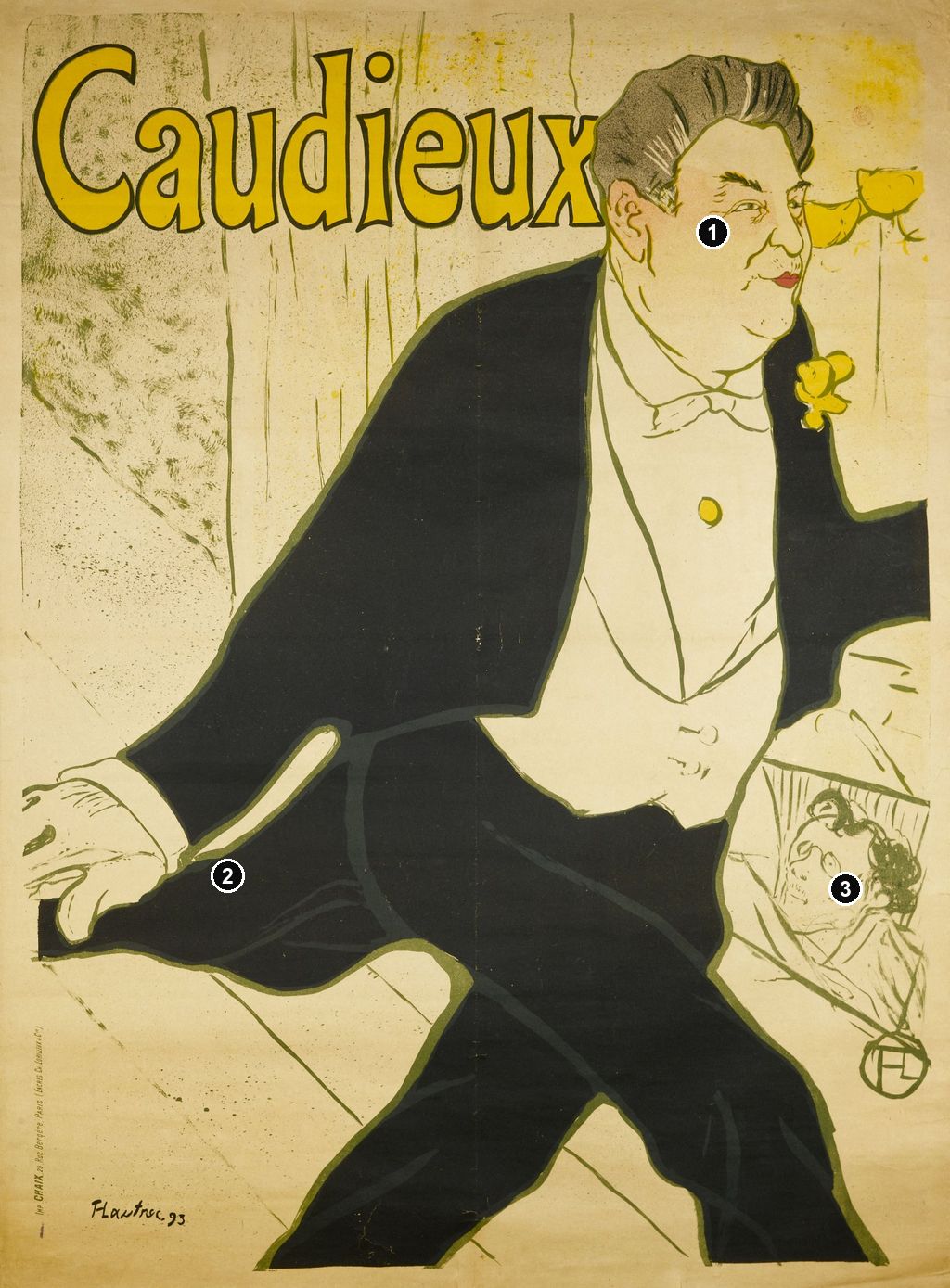
Caudieux seems about to stride out of his own advertisement. His head presses towards the right, one arm disappears beyond the edge, and his black coat swings behind him towards an open hand. Above this expansive figure, yellow letters announce a single name. Toulouse-Lautrec's Caudieux, dated 1893, turns a performer's movement into the structure of a poster. The Musée Carnavalet preserves an impression as AFF1980. [1]
The attraction lies in the contrast between weight and momentum. The large body occupies most of the sheet, yet the surrounding lines encourage it to move. A tiny upturned face at the lower right offers a second way into the scene: someone below is following the man who dominates our view.
At a Glance
- ArtistHenri de Toulouse-Lautrec.
- Title and dateCaudieux, 1893. [1]
- SubjectAlbert Caudieux, a singer and comic performer associated with the Petit Casino, Eldorado and Ambassadeurs. [1] [2]
- MediumColour lithographic poster; the Metropolitan Museum of Art describes its impression as printed in four colours on machine wove paper. [3]
- Carnavalet impressionAFF1980, 129.5 × 92.4 cm; printer Imprimerie Chaix. These measurements describe that museum's object. [1]
- Catalogue identityWittrock P7; Delteil 346. The separate Caudieux at the Petit Casino is Wittrock 25. [2] [4]
This work across Henri de Toulouse-Lautrec’s career
Contents
- A body moving through the frame
- Evening clothes become a moving silhouette
- The name above the head
- A stage and the face beneath it
- What the surviving sheets record
- Another Caudieux, another kind of print
- Annotated details
A body moving through the frame
The performer fills the poster without fitting comfortably inside it. His hair nearly reaches the top, his legs continue through the bottom, and his forward arm leaves the picture at the right. At the opposite edge, the fingers of his trailing hand are also cut short. The crop makes the sheet feel narrower than his action. We receive a strongly recognisable body while being denied a complete view of its reach.
The sloping shoulder establishes the main direction. From the low hand at the left, the dark sleeve climbs towards the neck and forward-leaning head. Below, the tails sweep away from the waist in the opposite direction, opening a pale wedge between the coat and the extended arm. The legs produce another crossing of dark diagonals. These changes of angle give the figure an internal rhythm: the upper body advances while the coat still records the space behind it.
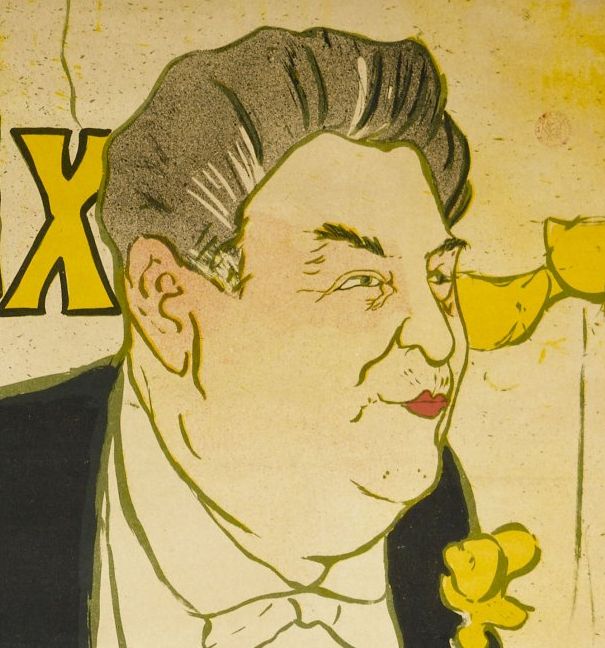
The head is more carefully articulated than the broad clothing. Streaks of light run through swept-back hair; a raised eyebrow, long nose, small moustache and red mouth distinguish the face. The chin continues the forward thrust of the chest. Caudieux looks towards the space beyond the right edge, which encourages the viewer to imagine an extension of the stage there. His destination remains outside the picture.
The action feels like an entrance or a passing movement, but the image does not supply the before and after needed to settle that impression. Wolfgang Wittrock identifies Caudieux as a popular comedian who appeared at the Petit Casino, Eldorado and Ambassadeurs. That professional context gives the emphatic gesture a setting without identifying a particular song or choreographed step. The poster makes a comic performer's physical presence its subject; the precise passage of his act remains unspecified. [2]
Evening clothes become a moving silhouette
Black tails, a pale waistcoat and a bow tie give Caudieux a formal appearance. The outfit might seem restrictive, yet Lautrec makes its divisions describe movement. The jacket opens around the bright central area of the shirtfront and waistcoat. Its pointed edges direct attention down towards the belly, while short curves register buttons and folds. A yellow ornament on the lapel and a round yellow accent on the chest interrupt the restrained black-and-pale arrangement.
These small accents matter because the jacket and trousers contain so little internal modelling. They read first as joined dark shapes. The long back of the coat, the sleeve and the bent legs can be followed around their outer contours without having to reconstruct every fold. Clothing becomes an economical account of the body: its scale, its bend at the waist, its extension towards both sides of the frame.
The pale middle prevents that silhouette from closing into one unbroken mass. It opens the figure from neck to waist, carrying the eye from the bow tie through the lapels to the lower buttons. The contrast makes Caudieux look both substantial and mobile. His broad torso is firmly established, but the surrounding coat seems to have been caught in the wake of his motion.
Colta Ives describes the fluid outlines of Lautrec's early posters as essential to their structure, capable of behaving decoratively as well as describing a person. Caudieux makes that relationship easy to see. The line around the waistcoat is at once the edge of a garment and a long, curving shape within the black suit. The sharp cuff, curling coat-tail and angled lapel have similar double roles. Recognising the clothes does not exhaust what their contours contribute to the composition. [4]
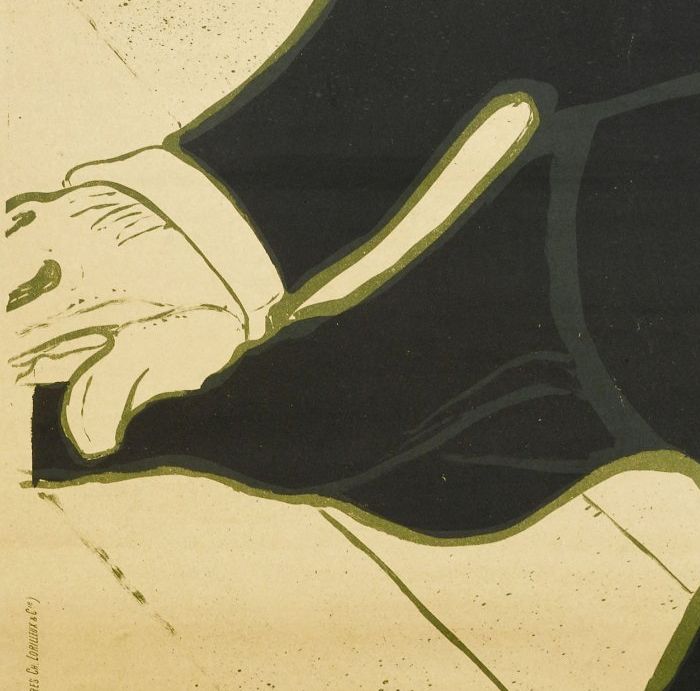
The coat-tail offers a particularly useful detail. It remains attached to the waist, but its low, outward sweep almost becomes a second gesture beside the hand. The little strip of light between arm and garment keeps the two readable. Without that opening, the left side would be a dense block. With it, the sleeve and coat-tail pull apart, and the extended arm acquires greater force.
Annotated Details from Caudieux
The numbered points identify visible features discussed in this article. Return from each detail to the whole composition. Henri de Toulouse-Lautrec, Caudieux, 1893. Colour lithographic poster. Musée Carnavalet, AFF1980; Paris Musées, CC0. Paris Musées / Musée Carnavalet – Histoire de Paris. Image source. CC0 / Public domain. Resized only; native appearance preserved.
Details from CAUDIEUX
Compare the cropped details with the complete images above. Notice how their colours, shapes and positions contribute to the larger compositions.
The moving face
Swept hair and the small red mouth intensify the head’s forward movement.
The flying coat-tail
The coat-tail extends the performer’s movement into the surrounding paper.
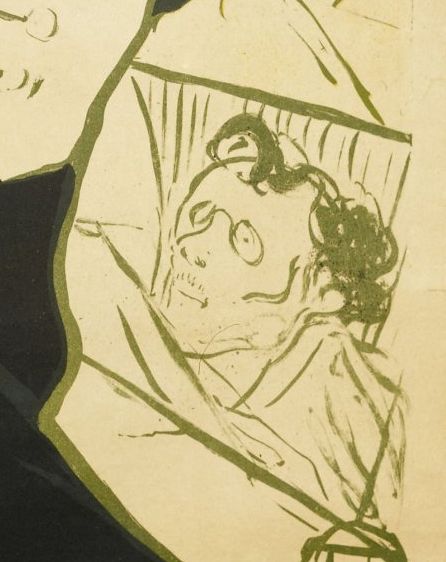
The small prompter
The much smaller prompter creates a second scale near the edge.
The name above the head
“Caudieux” occupies most of the upper width. Its oversized initial C curls towards the edge; the remaining letters rise and fall in a loose band. Yellow fills outlined forms that retain an irregular, drawn character. The name is conspicuous without needing a rectangular panel or a blank margin. It belongs to the same pictorial field as the head, backdrop and small rounded forms near the upper right.
The head crowds the end of the word. This is an effective junction between reading and looking: the letters lead towards the face, while the face gives a human identity to the name. The large C balances the dark hair across the top, preventing the composition from tipping entirely towards the performer's forward motion. The name holds the upper left as the body drives towards the right.
The restricted wording also affects the portrait. The design gives Caudieux the space that a denser advertisement might distribute among a venue, programme, address and several performers. His name and body carry the principal announcement together. The inspected examples do not name a particular engagement in their large lettering. Knowing that he performed at several café-concerts should therefore not turn this sheet into a dated programme for one of them. [1] [2]
Near the bottom, two much smaller marks establish another identity. A written signature and date sit at the left; a circular HTL monogram appears beside the little face at the right. Carnavalet records both. The difference in scale is telling: the performer's name announces itself across the top, while the artist's marks reward a closer look around the edges of the action. [1]
Watch: Toulouse-Lautrec
Choose an artist introduction, a film about graphic design or a closer look at At the Moulin Rouge.
A stage and the face beneath it
The setting is sparse but active. Long vertical strokes behind the performer suggest a hanging backdrop. Beneath him, oblique lines cross the pale ground, giving the stage a direction that competes with the upright letters. At the left, mottled texture differs from the smoother, darker clothing. The surroundings help establish motion without competing with the main figure for descriptive detail.
The floor deserves attention because it does not simply support the body. Its lines rush towards the edges, while Caudieux's legs cross them at different angles. The apparent space is shallow and steeply tilted. Rather than opening a long vista into a theatre, Lautrec compresses the stage into a few sloping surfaces. The performer feels close enough to outgrow that setting.
At the lower right, a curly-haired man looks up from a sharply bounded opening beneath the forward arm. His head is tiny beside Caudieux's, yet it is individually drawn, with round spectacles, nose, mouth and curls. He can initially look like a member of the audience peering towards the star. Carnavalet's iconographic description identifies a souffleur, a prompter, in the scene. That identification gives the small face a role within the practical work of performance. [1]
His inclusion changes the scale of the whole. The large body is no longer alone against an abstract background: another person occupies a lower level and watches it pass. The face also reverses the direction of attention. Caudieux looks outward towards the right; the smaller man looks upward into the composition. One figure propels us towards the edge, while the other brings us back to the performer.
The contrast invites a reading of the poster as a brief encounter between the conspicuous act and the work supporting it. That is an interpretation of the visible pairing, rather than evidence for a particular exchange of words. Nothing in the expression establishes a missed line, an error or a joke between the men. The scene is already lively through their unequal sizes, opposed sightlines and proximity within the cramped sheet.
What the surviving sheets record
The lettering at the left edge of Carnavalet's impression names Imprimerie Chaix at 20 rue Bergère and mentions inks from Ch. Lorilleux & Cie. The museum credits Chaix as printer. This marginal information attaches the bold image to a particular printing business and ink supplier, even though the largest letters are reserved for Caudieux himself. It records a production credit, without giving a pigment analysis or the order of printing. [1]
The Met's impression, accession 32.88.14, provides a complementary material record: four colours on machine wove paper, with a sheet measuring 127.5 × 93 cm. It entered the collection through the Harris Brisbane Dick Fund in 1932. Ives's 1996 checklist gives the same measurements and identifies it as Wittrock P7 and Adriani 15. Her possible edition range of 1,000–3,000 is explicitly tentative; it should remain an estimate rather than become an exact print run. [3] [4]
The sizes in different records need not be forced into a single measurement. Wittrock's 1985 exhibition entry describes a Schimmel-collection example measuring 124.6 × 89.5 cm. Carnavalet records its own work at 129.5 × 92.4 cm and measures the mounting separately. These are records of individual objects carrying the same design. Their differences alone do not establish why a sheet was cut, mounted or preserved in a particular form. [1] [2]
Phillip Dennis Cate's account of Lautrec's printing practice helps explain the relationship between the energetic drawing and these repeatable objects. The artist could work on lithographic stones and correct proofs before a printer produced the edition. Cate also distinguishes methods of applying colour, including separately mixed inks. For Caudieux, the documented four-colour medium is more useful than an imagined recipe reconstructing every visible hue. Its visual economy rests on the relationship between dark silhouette, pale clothing, yellow accents and spare facial colour. [13] [3]
Another Caudieux, another kind of print
The title Caudieux at the Petit Casino belongs to a separate 1893 lithograph in Le Café Concert. Ives places it within Lautrec's contribution to the portfolio, alongside eleven prints by Henri-Gabriel Ibels. Its catalogue identity is Wittrock 25, whereas the large colour poster is P7. These identifiers distinguish designs with different publication purposes, rather than two names for this advertisement. [4]
MoMA's Petit Casino sheet credits André Marty as publisher and Ancourt as printer. Those credits belong to the portfolio print; they should not replace Chaix's credit on the poster. A reader following the performer through Lautrec's prints and posters therefore encounters more than a change of colour or size. Caudieux appears within an assembled survey of café-concert life as well as in an advertisement dominated by his own name. [14]
Two other posters clarify the particular balance here. In Aristide Bruant in His Cabaret, the enormous cloak makes a comparatively still figure command the sheet. In Divan Japonais, the foreground spectator's dark dress competes with the distant singer. Ives discusses both designs beside her analysis of Lautrec's outlined forms and cropped theatre spaces. Caudieux concentrates the action in the advertised performer, yet retains a small second person below him. [4]
Look back from that little head to the much larger face above. The same sheet accommodates rapid recognition and a more intimate theatrical detail. Caudieux's silhouette and name can carry the first encounter; the hand, coat-tail, floor lines and prompter complicate it when we linger. The impression of a man moving beyond the frame grows from these precisely fitted parts.
Toulouse-Lautrec artworks directory
Browse 84 identified works and publications in this researched selection. Dates and titles follow the individual records; this is not a complete catalogue of the surviving oeuvre. Print impressions remain attached to their designs. Some listed works do not have a dedicated article. The Drawings guide also contains nine illustrated studies consolidated from former articles.
Frequently Asked Questions
Carnavalet identifies a prompter in the scene. His face looks upward from below the much larger performer. [1]
The finished advertisement is a colour lithograph. The Met describes its impression as printed in four colours on machine wove paper. [3]
Discussion
Look again at the images and ideas explored in Caudieux by Henri de Toulouse-Lautrec. These editorial prompts invite your observations.
Reader Insights
Does your eye travel first along the sleeve, the coat-tail or the sloping floor? Explain how that route changes the performer's apparent movement.
What happens to the scene if you cover the prompter's face? Consider the change in scale and the loss of his upward gaze.
Join the Conversation
Share a detail, comparison or question about Caudieux by Henri de Toulouse-Lautrec below.
References
- Paris Musées / Musée Carnavalet, Caudieux, 1893, AFF1980, current detailed object record, signatures, printer's imprint, measurements and iconography (in French). View source.
- Wolfgang Wittrock, “Catalogue of the Exhibition,” in Riva Castleman and Wolfgang Wittrock, eds., Henri de Toulouse-Lautrec: Images of the 1890s, Museum of Modern Art, 1985, p. 230, cat. 255: colour poster, Schimmel impression, catalogue numbers and performer venues. View source.
- Metropolitan Museum of Art, Caudieux, 1893, accession 32.88.14, current medium, sheet measurements and acquisition credit. View source.
- Colta Ives, Toulouse-Lautrec in The Metropolitan Museum of Art, 1996, pp. 36–40, Bruant, Divan Japonais and outlined forms; checklist p. 63, the Met's Caudieux poster and separate Petit Casino portfolio print. The checklist's possible poster edition size is an estimate. View source.
- Autoportrait, 1880 (in French). View source.
- ALBERTINA: Der Schimmel Gazelle,GE123DL. View source. (in German).
- Franka Blok, Portrait of Vincent van Gogh, 2024. View source.
- Art Institute of Chicago: Moulin Rouge, La Goulue. View source.
- Art Institute of Chicago: At the Moulin Rouge. View source.
- Jane Avril, 1893. View source.
- Au Salon de la rue des Moulins (in French). View source.
- Maurice Joyant (in French). View source.
- Phillip Dennis Cate, “The Popularization of Lautrec,” in Henri de Toulouse-Lautrec: Images of the 1890s, Museum of Modern Art, 1985, pp. 80–82: colour methods, separately mixed inks, proofing and printer collaboration. View source.
- Museum of Modern Art, Caudieux at the Petit Casino, from Le Café Concert, 1893, object 1107.1964.8, separate portfolio print, publisher André Marty and printer Ancourt. View source.
- Splash image, Henri de Toulouse-Lautrec, Caudieux, 1893. Colour lithographic poster. Musée Carnavalet, AFF1980; Paris Musées, CC0. Paris Musées / Musée Carnavalet – Histoire de Paris. Image source. CC0 / Public domain. Resized only; native appearance preserved.


 Henri de Toulouse-Lautrec.jpg)