



 by Tom Gurney
Tom Gurney BSc (Hons) is an art history expert with over 20 years experience
Published on June 19, 2020 / Updated on October 29, 2026
Email: tomgurney1@gmail.com / Phone: +44 7429 011000
Portrait of Madame M.: Introduction
A woman in an immense black dress stands among flowers, holding a pansy in one hand and a closed parasol in the other. Her eyes meet ours, while a cat plays beside her feet. Henri Rousseau’s Portrait of Madame M., dated about 1896 by the Musée d’Orsay, is an oil painting almost two metres high.[1] Its presence comes from the meeting of that commanding figure with details small enough to seem private: a pale scarf, thin bracelets, a flower stem, and a ball of yarn.
At a Glance
- ArtistHenri Rousseau
- SubjectPortrait of Madame M.
- ExploreA figure almost as tall as the canvas; Stillness with unequal arms
This work across Henri Rousseau’s career
Carnival Evening
1886 [2]The Merry Jesters
1906 [7]The Snake Charmer
1907 [8]Contents
- A figure almost as tall as the canvas
- Stillness with unequal arms
- Dress, accessories, and the suggestion of status
- Flowers, a narrow path, and a cat
- Who was Madame M.?
- A head revised during painting
- From exhibition picture to the Musée d’Orsay
A figure almost as tall as the canvas
The canvas measures 198 × 114.5 centimetres, giving the standing woman room to approach the scale of someone facing us in a garden.[1] Her skirt spreads towards the bottom edge; her sleeves stretch towards the sides; her head rises into a narrow opening of cloudy sky. There is little empty space around her. Even where the figure leaves a gap, a branch or spray of foliage comes forward to fill it.
The approximate date deserves attention. The 1985 Rousseau catalogue gives a range of about 1895–97, rather than a single year, and records a width of 115 centimetres.[12] The current museum date, about 1896, sits within that range. These descriptions place the work in the same period; neither supplies an exact day or year of execution. The current collection record supplies the measurement used here.
From a distance, the dress seems to be one continuous black shape. Closer looking reveals its divisions: a gathered upper bodice, a narrow waist, the rounded sleeves, and long, nearly vertical changes of tone in the skirt. Those subtle divisions give the body a structure without making the dress lose its great dark breadth. Rousseau concentrates much of the picture’s force in a silhouette that can be grasped at once, then asks us to return to its surfaces.
Stillness with unequal arms
The woman faces almost directly out of the painting. Her shoulders spread broadly, her neck rises upright, and her face is presented with remarkable clarity. The eyes, eyebrows, nose, and small closed mouth each remain distinct. The softly shaded cheeks surround a steady arrangement of features. Against the clouded sky, the head reads as a compact, carefully bounded shape.
Below it, the body becomes less symmetrical. On the left of the picture, one elbow projects outwards and the hand rests at the waist. A tiny flower extends from this concentrated group of fingers, wrist, and dark fabric. On the right, the other arm drops down; its pale forearm and loosely extended fingers lead towards the parasol. The two arms create different routes through the picture. One turns the eye back into the centre, while the other sends it downwards.
The sleeves amplify that difference. Their large volumes are close enough in size to establish balance, but their contours do not mirror one another. Small changes in the outline keep the upper body from becoming a rigid emblem. Lower down, the glimpses of dark shoes beneath the hem suggest an uneven placement of the feet. The skirt still feels planted, although its wearer seems capable of shifting her weight.
The hands are especially rewarding to follow. They are light patches against a field of black and green, and their gestures are easy to distinguish even when the picture is seen small. The hand at the waist gives the stance firmness; the hanging hand relaxes it. A bracelet draws a fine horizontal line across the latter wrist, briefly checking the long descent from sleeve to fingers. These are modest adjustments, but together they make the figure’s stillness feel held rather than empty.
The head’s scale makes the effect stranger. The woman’s face invites close attention, yet the body and dress take up far more space. Our eye alternates between a person who looks back and a shape that dominates its setting. The painting allows both experiences to remain active.
Dress, accessories, and the suggestion of status
The enormous sleeves belong to the style described as “Medici” sleeves. The 1985 catalogue relates the dress to fashions around 1895, while cautioning that this does not establish whether the model herself wore an up-to-date dress.[12] Costume helps place the image historically, but it cannot settle the sitter’s identity or the circumstances in which she posed.
The Musée d’Orsay’s commentary on Google Arts & Culture reads the bracelets, elegant parasol handle, and fine neck scarf as possible signs of a prosperous middle-class sitter. It also suggests that the picture may have been commissioned.[13] Those are plausible readings of the ensemble. The accessories alone do not reveal a profession, a family name, or a payment.
Within the composition, their work is more immediately visible. The pale yellow scarf separates the face from the black bodice. Its folds spread sideways beneath the chin, giving the small head a light platform. The bracelets repeat this pale colouring further down, connecting the neck with the arms. Beneath the vast sleeves, the exposed skin looks particularly delicate.
The parasol supplies another long dark form beside the skirt, but its pointed, folded shape differs from the dress’s broad descent. It sits at an angle, opening a wedge through which the surrounding foliage becomes visible. Its small curved handle introduces a lighter accent near the waist. The eye can move from that handle to the scarf, then down to the hands, finding a network of fine details within the heavy silhouette.
The 1985 catalogue compares the painting with grand society portraits shown at the Salon and with seventeenth-century Flemish portraiture.[12] The comparison helps explain the full-length format and conspicuous clothing. It does not identify a particular painting that Rousseau copied. Here, the conspicuous dress shares attention with leaves, little flowers, and a cat: the figure’s grandeur is continually brought into contact with the small life around it.
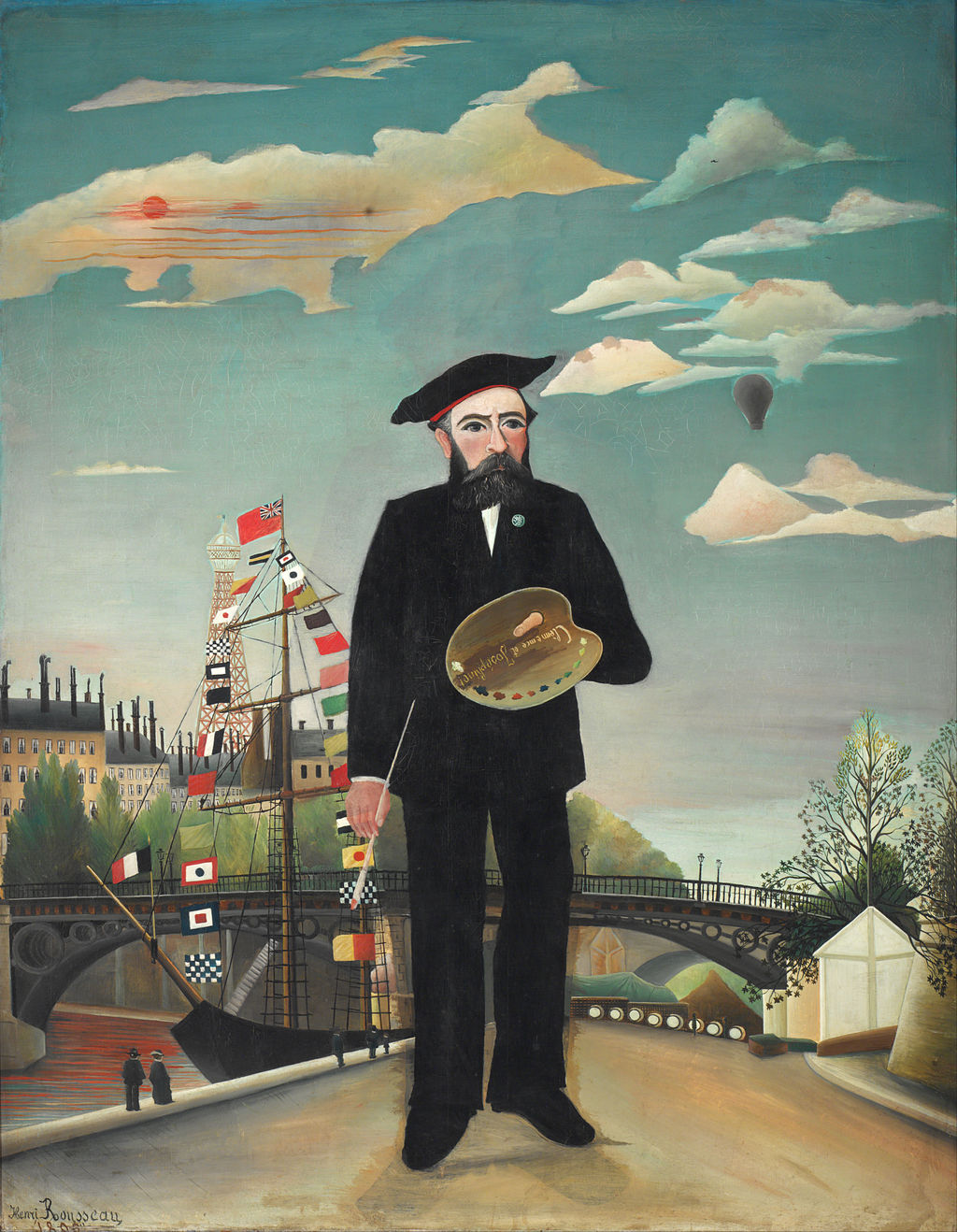
Henri Rousseau, Myself, Portrait–Landscape, 1890. National Gallery Prague, O 3221. Palette and brush make the painter’s occupation visible in this other full-length portrait. Google Art Project reproduction via Wikimedia Commons. Image source. Public domain. Resized only; the full supplied painting is retained.
Flowers, a narrow path, and a cat
The vegetation rises along both sides of the woman like an irregular frame. On the left, broad leaves cross in front of taller stems; on the right, slender branches stand out against the sky. Each branch seems to have its own rhythm. Some leaves spread in paired ranks, while others cluster into dense, rounded masses. The differing patterns make the garden busy without turning it into an indistinct green backdrop.
There are suggestions of depth, particularly where a large diagonal stem passes behind the lowered arm. Yet the plants also press towards the surface. Leaves remain crisply outlined as they overlap one another, and pale blossoms are readily visible against their darker surroundings. The woman appears enclosed by vegetation even while her head stands free above it. The result feels at once open to the sky and tightly packed.
Pansies can be identified along the lower edge, and the catalogue also identifies the flower held by the woman as a pansy. It leaves most of the other highly stylised plants unnamed.[12] That restraint suits the experience of looking. We can recognise differences of leaf, stem, and blossom without needing to turn the garden into a botanical inventory. The pale flowers at the left, the rounded heads at the right, and the dark-and-yellow foreground blooms give us distinct points of attention.
The held flower makes a particularly fine connection. A tiny piece of the garden has been lifted to the waist, linking the woman’s gesture with the ground beneath her. Its scale is easily overlooked beside the sleeve above it. Once noticed, however, it changes the hand from a simple assertion of posture into a place where the figure touches her surroundings.
At the lower right, the cat offers a different kind of contact. Its body stretches close to the flowers, and a line of yarn runs towards the ball lying on the bare ground. The ball’s compact roundness contrasts with the animal’s elongated pose. This little episode asks the eye to travel sideways, briefly interrupting the upward pull of the standing woman. The uncluttered strip of path gives the yarn room to be seen. Garden, pet, and person share the same narrow space, although each seems to occupy a different scale of activity.
Who was Madame M.?
The initial in the title promises an identity without providing one. The museum’s commentary states that the model’s identity remains uncertain.[13] Her level gaze, carefully described dress, and numerous accessories can make her seem fully knowable. They tell us much about the painted presentation and much less about the person represented.
An older identification has nevertheless become part of the picture’s history. The 1985 catalogue records its appearance in a 1912 Paris exhibition as Portrait of Rousseau’s First Wife.[12] An exhibition title is evidence that this identification circulated; it cannot by itself establish that the identification was correct.
For the Musée d’Orsay’s 2016 exhibition Le Douanier Rousseau. L’innocence archaïque, the museum proposed that Madame M. could be a posthumous portrait of Rousseau’s first wife, Clémence Boitard, who died in 1888. The same exhibition text suggested a studio photograph as the basis for the figure.[14] This remains a proposal. It would allow an image made years after her death, but the dating of the painting cannot be used to prove that she is its subject.
A photographic starting point would also leave many pictorial choices to explain. The woman’s relationship to the plants, the breadth of her silhouette, and the placement of the small animal all belong to the painting we see. A possible studio photograph offers a way to think about the frontal stance; it does not give us a surviving account of the entire composition’s construction.
The ambiguity need not be filled with a story of mourning or a supposed personality. Black occupies most of the figure, but it also organises the colours around her. We can observe its visual gravity without making it a record of an emotion. Her face, too, can seem reserved or searching according to where our attention rests. Such responses belong to the encounter with the portrait. They should remain open rather than becoming a substitute biography.
A head revised during painting
The relationship between head and body was worked on. The 1985 catalogue describes Rousseau reducing the fullness of the hair, thereby reducing the apparent volume of the head.[12] The museum commentary likewise draws attention to visible reworking around the hair.[13] This is a useful detail to carry back to the picture: the narrow dark shape at the top is part of an adjusted balance between face, dress, and sky.
More recent scientific work adds material evidence of revision. In the transcript accompanying the museums’ 2026 scientific-analysis film, Johanna Salvant, a physical chemist at the Centre de recherche et de restauration des musées de France, identifies changes of scale in Portrait of Madame M. She discusses the picture within a wider study of approximately forty works, and the transcript associates it with radiography.[15]
The two accounts illuminate different aspects of the revision. The earlier catalogue describes the hair’s altered outline; the recent technical account confirms scale changes in the composition. Together, they support looking at the portrait as an arrangement reconsidered during work. They do not provide a complete order of every alteration or a documented explanation from Rousseau for making it.
The adjustment matters because proportion governs the whole encounter. A larger head would draw greater weight towards the face. A smaller one leaves more authority with the dress and its spreading sleeves, while allowing additional sky to surround the hair. The existing figure’s mixture of imposing breadth and delicate features can therefore be understood as something Rousseau actively balanced. His style and technique are particularly tangible here: a seemingly fixed frontal figure contains evidence of decisions made on the canvas.
From exhibition picture to the Musée d’Orsay
The museum records the painting at the 1896 Salon des Indépendants, number 981, and again in Paris exhibitions in 1911 and 1912.[1] Its substantial scale thus belongs to a work with a public exhibition history as well as the intimacy of a portrait.
Its recorded owners include Wilhelm Uhde from 1910 to 1922, Suermondt Droue from 1922 to 1930, and Mendelssohn-Bartholdi from 1929 to 1930. The last two periods overlap in the museum’s account, leaving the exact sequence of those transfers unclear. It entered the Gourgaud collection in 1930. Eva Gebhard-Gourgaud donated it to the French state in 1965 for the Jeu de Paume; it was assigned to the Musée d’Orsay in 1986.[1]
Henri Rousseau artworks directory
This directory brings together works covered on this site and other works documented in the cited museum records and catalogues. Alternate titles share one entry; distinct versions remain separate. Historical dates for works without an article follow the cited catalogues. This is not a catalogue raisonné.
Frequently Asked Questions
The cat plays beside a ball of yarn at the bottom right. Its low, stretched pose adds a small episode of movement beside the standing figure.
Discussion
Look again at the images and ideas explored in Portrait of Madame M.. These editorial prompts invite your observations.
Reader Insights
Follow the two arms separately. How does each gesture change your sense of the woman’s stance?
Cover the cat and ball of yarn, then look at the whole painting again. How much does that small episode affect its mood?
How does knowing that Rousseau revised the scale of the figure change your response to the small head and enormous sleeves?
Join the Conversation
Share a detail, comparison or question about Portrait of Madame M. below.
References
- Musée d’Orsay. Portrait de Madame M., RF 1965 15, current collection record, metadata, provenance, and exhibitions; accessed 23 October 2026. View source. (in French).
- Philadelphia Museum of Art, Carnival Evening,1963-181-64,object59593. View source.
- Musée de l’Orangerie / Juliette Degennes, Henri Rousseau,L’ambition de la peinture: Un artiste dans son époque (in French). View source.
- National Gallery, Surprised!, NG6421. View source.
- Musée d’Orsay, La Guerre,RF19461 (in French). View source.
- MoMA, The Sleeping Gypsy. View source.
- Philadelphia Museum of Art, The Merry Jesters, 1950-134-176, object51097. View source.
- Musée d’Orsay, La Charmeuse de serpents, RF 1937 7 (in French). View source.
- Musée de l’Orangerie, La Carriole du Père Junier, RF 1960 26 (in French). View source.
- Solomon R. Guggenheim Museum / Cornelia Lauf, The Football Players,60.1583: current collection record. View source.
- MoMA, The Dream, 252.1954. View source.
- The Museum of Modern Art. Henri Rousseau: Essays, 1985, catalogue entry 17, “Portrait of a Woman,” printed p. 136 (PDF p. 141); English translation from the French by Richard Miller. View source.
- Musée d’Orsay, via Google Arts & Culture. Portrait of Madame M., museum-supplied commentary; accessed 23 October 2026. Its older date range and rounded width differ from the current collection record. View source.
- Musée d’Orsay. Le Douanier Rousseau. L’innocence archaïque, exhibition, 22 March–17 July 2016, section “Femmes monuments.” View source. (in French).
- Johanna Salvant, C2RMF; musées d’Orsay et de l’Orangerie. Henri Rousseau, L’ambition de la peinture: Les analyses scientifiques, French film transcript, 2026, pp. 1–3, especially p. 2 on revisions and changes of scale. View source. (in French).
- The Museum of Modern Art, Henri Rousseau: Essays (1985), selected catalogue entries, chronology and notes on early devotees. View source. Selected entries, chronology (pp.91–95) and early-devotee notes (pp.262–264) were consulted. Historical collection credits do not establish present ownership.
- Daniel Catton Rich, Henri Rousseau (The Museum of Modern Art, 1942), selected drawings and landscape studies; historical catalogue. View source. The dated 1942 publication is used for the two Quai d’Auteuil ink views; its Malakoff date differs from the 1985 catalogue.
- MANAS, Laval, Henri Rousseau, dit le Douanier, urban landscapes and preparatory study (in French). View source.
- National Gallery of Art, Self-Portrait (1895), pen-and-ink drawing, accession 1995.47.66. View source.
- The Museum of Modern Art, War (published January 1895), lithograph, accession 684.1943. View source.
- Barnes Foundation, Landscape and Four Young Girls, object 5521, BF855. View source.


 Henri Rousseau.jpg)


 Henri Rousseau.jpg)