



 by Tom Gurney
Tom Gurney BSc (Hons) is an art history expert with over 20 years experience
Published on June 19, 2020 / Updated on October 29, 2026
Email: tomgurney1@gmail.com / Phone: +44 7429 011000
Portrait of the Father of the Artist: Introduction
A dark coat rises out of white clouds, carrying a small, sharply defined head into a wide blue sky. In Henri Rousseau’s Portrait of the Father of the Artist, the man looks to the left while the clouds gather around his shoulders and disappear beneath him. The face is solid and particular; the space it inhabits offers no ground. That meeting of familiar appearance and impossible placement gives this small portrait its peculiar gravity.
At a Glance
- ArtistHenri Rousseau
- SubjectPortrait of the Father of the Artist
- ExploreA small canvas with a spacious setting; The face and its enclosing outline
This work across Henri Rousseau’s career
Carnival Evening
1886 [1]The Merry Jesters
1906 [6]The Snake Charmer
1907 [7]Contents
- A small canvas with a spacious setting
- The face and its enclosing outline
- A coat that gives the figure weight
- Where the clouds meet the body
- Dignity, affection and the open sky
- Annotated details
A small canvas with a spacious setting
The Museo Nacional de Bellas Artes identifies the sitter as Julien Rousseau, the artist’s father, a tin merchant and hardware dealer in Laval. Its record lists oil on canvas, 21.8 × 16 cm, inventory 8555; its collection record names Antonio Santamarina alongside the year 1975. No execution date is supplied.[11]
Those dimensions matter to the experience of the composition. The expanse of sky belongs to a painting small enough to invite close attention. The head occupies only a compact portion of the upright rectangle, yet its features are legible and its outline immediately catches the eye. The empty area above it makes the figure seem suspended within a much larger space. Looking at the portrait involves moving between those two scales: the intimate encounter with a face and the open distance surrounding it.
The blue strengthens towards the top of the picture and lightens around the head. There is no horizon to divide the setting into measured distances. Instead, the gradual shift towards pale blue and white gives an impression of atmosphere without locating the sitter at any particular height. The eye can travel upwards, but it cannot find a place from which this view could reasonably be taken. The painting makes room for the man while keeping his whereabouts elusive.
The face and its enclosing outline
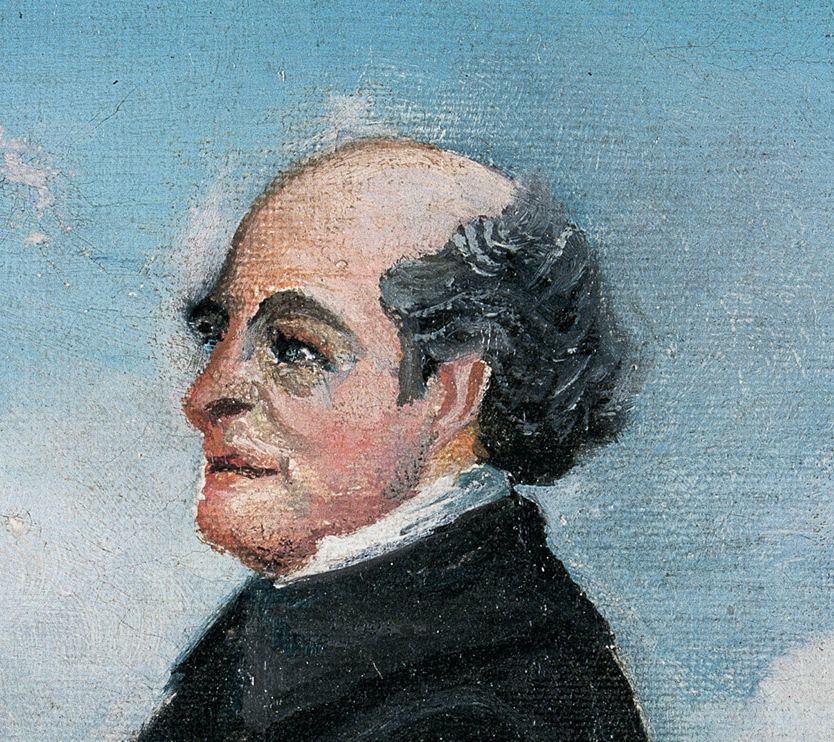
The forehead forms a pale dome above a dark eyebrow. Beneath it, the nose, mouth and chin make a sequence of projections along the left edge of the face. Each change in direction is easy to follow against the light sky. This gives the profile an almost drawn clarity, even though the cheek itself contains softer transitions between warm and darker tones. The head combines a firm outer boundary with a more varied interior.
The visible eye sits beneath the heavy brow, concentrating attention in a small dark area. The mouth is closed, its reddish colour providing a quiet accent among the flesh tones. The direction of the face carries our attention beyond the left edge, towards something the picture leaves unseen. The sitter has a direction without acquiring an action or a story.
At the back of the head, dark curls interrupt the smooth curve of the skull. They gather around the ear and form a compact, uneven edge against the blue. The pale forehead and dark hair divide the head into distinct masses. Their difference also prevents the profile from becoming a simple silhouette. We recognise its outline first, then discover the small changes of colour and shape that give it weight.
A coat that gives the figure weight
The white collar makes a narrow, bright passage between the head and the dark clothing. It picks up the lightness of the surrounding clouds while retaining a crispness of its own. That small interval is essential: without it, the chin, neck and coat would merge more readily into one heavy shape. With it, the head appears set carefully upon the body, and the turn of the neck becomes easier to read.
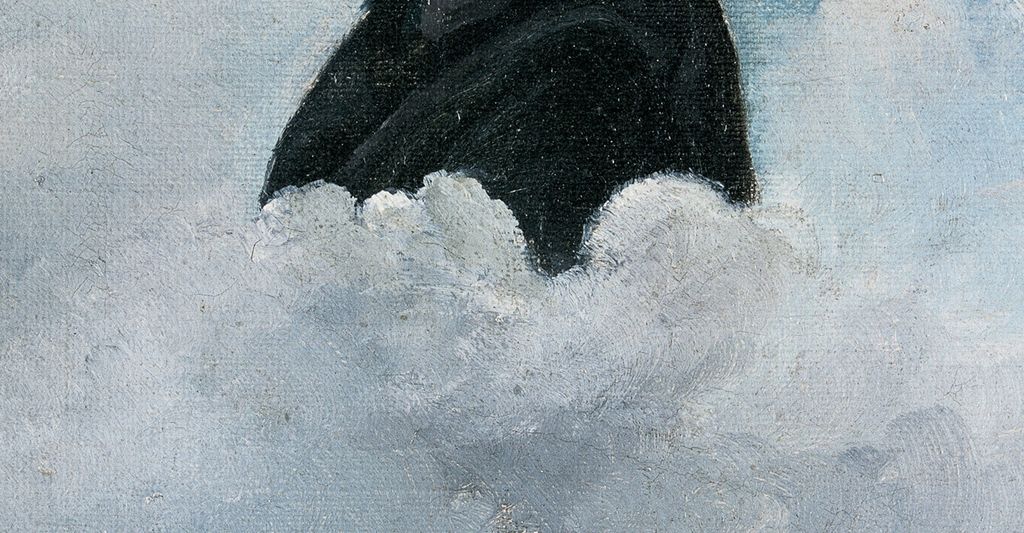
The coat spreads below the face into a broad wedge. Its shoulder slopes down towards the right, while the opposite edge runs more steeply beneath the chin. The dark area therefore has an internal direction, carrying the eye diagonally across the lower part of the bust. Its breadth steadies the much smaller head. Even in this airborne setting, the figure has the substantial presence of a clothed body.
Within the black are subdued variations that suggest the coat’s folds and surfaces. They remain quieter than the bright collar or the face. No emblem or tool interrupts the broad area of clothing. The figure’s identity is concentrated in his head and bearing. The clouds remove the rest of the body from view, leaving the coat to provide the portrait’s principal dark anchor.
Where the clouds meet the body
The lower edge of the bust is remarkably unsettled. White cloud forms press up against the coat and overlap its base, leaving a dark point visible near the centre. To either side, the cloud bank rises in rounded shapes. It conceals the bodily continuation that we expect, yet it does not supply an alternative support. The man appears to emerge from this pale mass, caught at the boundary between something solid and something that cannot hold him.
That boundary changes the rhythm of looking. Following the face, the eye encounters short, decisive turns: brow, nose, lips, chin. Following the clouds, it moves through broad curves and overlapping pale patches. The contrast gives the head a special precision. The cloud bank can spread and dissolve, while the features retain their distinctive shape. The portrait’s strangeness depends partly on how confidently those different kinds of edge coexist.
There are smaller correspondences as well. The curls behind the ear and the rounded cloud forms both break their outlines into successive curves. Their scale and colour differ, so the resemblance remains a visual echo. It helps the two parts of the composition belong together without making them interchangeable. Above the clouds, the hair stays dark and compact; below the figure, the white and grey forms expand towards the edges of the canvas.
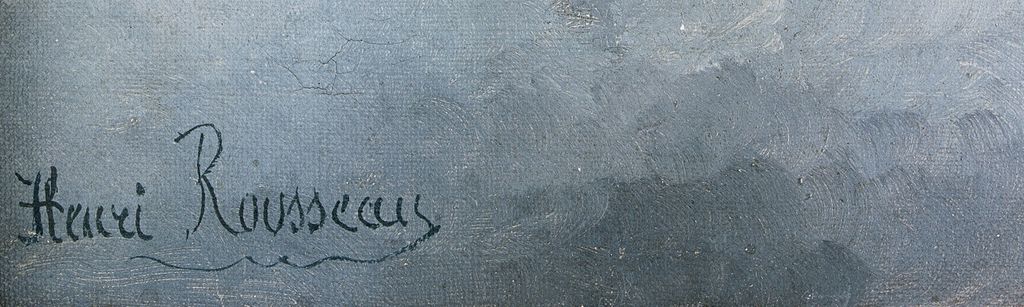
Near the bottom, greyer passages give the cloud bank more weight. The cursive signature at the lower left runs across this atmospheric foreground, bringing the eye back to the painted surface. After following the sitter’s gaze outwards or the sky upwards, we encounter the artist’s name close to the edge. Its long, looping movement supplies a final change of scale beside the much broader forms of the clouds.
Annotated Details from Portrait of the Father
The numbered points identify visible features discussed in this article. Return from each detail to the whole composition. Henri Rousseau, Portrait of the Father of the Artist, undated. Museo Nacional de Bellas Artes, Buenos Aires, inventory 8555. Image provided by Museo Nacional de Bellas Artes via Wikimedia Commons. Image source. Public domain. Numbers added to a separate resized overview. Three details cropped directly from the published original without enlargement, sharpening, recolouring, cleaning or retouching.
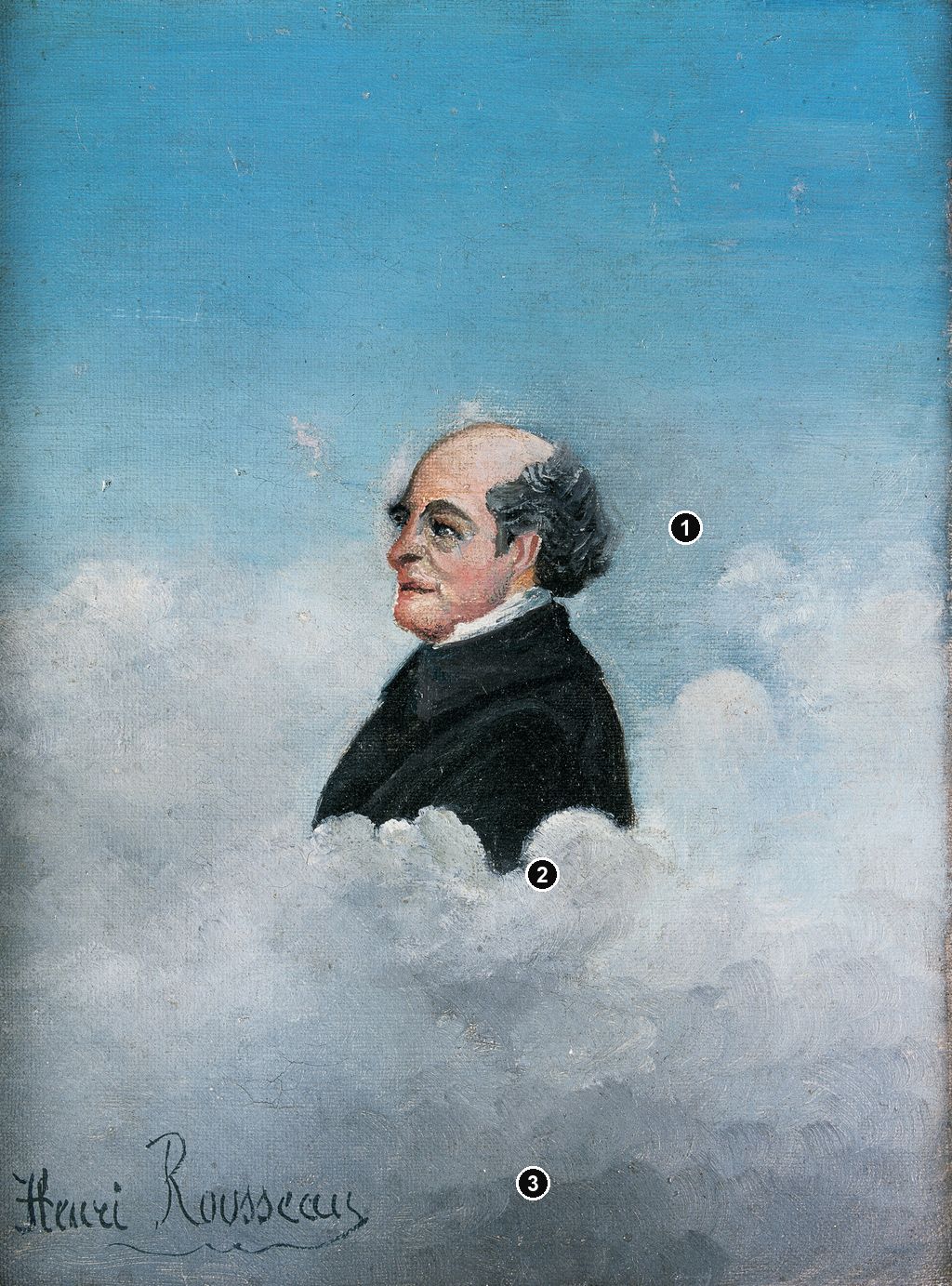
Details from PORTRAIT OF THE FATHER
Compare the crisp profile with the coat’s cloud-covered base, then follow the signature across the atmospheric foreground.
A firm profile above a white collar
The forehead, nose, mouth and chin make a sharply defined outline against the pale sky. Dark curls gather behind the ear, and the white collar separates the warm face from the black clothing.
Where the coat meets the clouds
The coat widens into a dark wedge, then meets rounded white and grey cloud forms. The clouds overlap its lower edge and conceal the body’s continuation, leaving the bust without visible ground beneath it.
A signature across the cloud bank
The long cursive name stretches across the lower-left clouds. Its looping line brings attention back to the painted surface after the eye has followed the sitter’s profile and the open sky.
Dignity, affection and the open sky
Abigail Winograd reads the profile as an expression of affection and respect, relating its dignity to portraits of rulers and influential figures. She sees the sky as a further elevation of the father, and places the painting within Rousseau’s portrait-landscape practice.[11]
Her interpretation draws attention to the force of the arrangement. The turned head has a self-contained quality: we observe the sitter without receiving a returning gaze. The open sky enlarges the space around that enclosed presence. Together, they give the portrait a combination of distance and intimacy. We can scrutinise the ear, collar and mouth, yet the figure remains absorbed in a direction and a setting we cannot share.
The clouds can suggest remembrance or a departure from ordinary life, but the painting leaves that suggestion open. Its effect also rests on very concrete relationships: pale skin against blue, white collar against black, a compact figure above a spreading bank of cloud. These relationships continue to hold the picture even when its symbolism remains uncertain. For a wider discussion of such visible decisions, see Rousseau’s style and technique.
Returning to the space above the forehead, we find nothing that identifies a place or advances an incident. Its broad blue gives the small head room to remain distinct. Beneath it, the coat presses into the clouds; above it, the sky opens.
Henri Rousseau artworks directory
This directory brings together works covered on this site and other works documented in the cited museum records and catalogues. Alternate titles share one entry; distinct versions remain separate. Historical dates for works without an article follow the cited catalogues. This is not a catalogue raisonné.
Frequently Asked Questions
Winograd identifies him as Julien Rousseau, Henri’s father.[11]
The museum’s entry supplies no execution date.[11]
The bust emerges from clouds without any visible ground beneath it. The clear outline of the head contrasts with the broad, soft-edged forms below.
They invite an interpretation of distance or remembrance, but the composition alone cannot establish a particular belief or occasion.
Discussion
Look again at the images and ideas explored in Portrait of the Father of the Artist. These editorial prompts invite your observations.
Reader Insights
How does the large area of blue above the head affect your sense of the sitter’s presence?
Follow the edges of the face, hair and clouds. Where does each become crisp or soft?
How would the portrait change if the clouds were replaced by a plain background?
Join the Conversation
Share a detail, comparison or question about Portrait of the Father of the Artist below.
References
- Philadelphia Museum of Art, Carnival Evening,1963-181-64,object59593. View source.
- Musée de l’Orangerie / Juliette Degennes, Henri Rousseau,L’ambition de la peinture: Un artiste dans son époque (in French). View source.
- National Gallery, Surprised!, NG6421. View source.
- Musée d’Orsay, La Guerre,RF19461 (in French). View source.
- MoMA, The Sleeping Gypsy. View source.
- Philadelphia Museum of Art, The Merry Jesters, 1950-134-176, object51097. View source.
- Musée d’Orsay, La Charmeuse de serpents, RF 1937 7 (in French). View source.
- Musée de l’Orangerie, La Carriole du Père Junier, RF 1960 26 (in French). View source.
- Solomon R. Guggenheim Museum / Cornelia Lauf, The Football Players,60.1583: current collection record. View source.
- MoMA, The Dream, 252.1954. View source.
- Museo Nacional de Bellas Artes; Abigail Winograd. Portrait du père de l’artiste (Retrato del padre del artista), undated online collection entry, inventory 8555; metadata, commentary and notes 1–2. Accessed 23 October 2026. View source. (in Spanish).
- The Museum of Modern Art, Henri Rousseau: Essays (1985), selected catalogue entries, chronology and notes on early devotees. View source. Selected entries, chronology (pp.91–95) and early-devotee notes (pp.262–264) were consulted. Historical collection credits do not establish present ownership.
- Daniel Catton Rich, Henri Rousseau (The Museum of Modern Art, 1942), selected drawings and landscape studies; historical catalogue. View source. The dated 1942 publication is used for the two Quai d’Auteuil ink views; its Malakoff date differs from the 1985 catalogue.
- MANAS, Laval, Henri Rousseau, dit le Douanier, urban landscapes and preparatory study (in French). View source.
- National Gallery of Art, Self-Portrait (1895), pen-and-ink drawing, accession 1995.47.66. View source.
- The Museum of Modern Art, War (published January 1895), lithograph, accession 684.1943. View source.
- Barnes Foundation, Landscape and Four Young Girls, object 5521, BF855. View source.


 Henri Rousseau.jpg)


 Henri Rousseau.jpg)